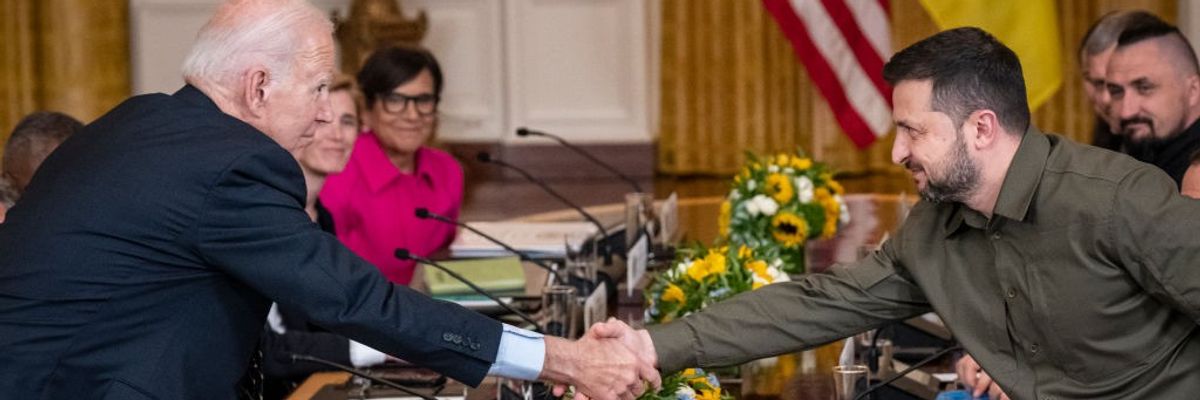
U.S. President Joe Biden shakes hands with President of Ukraine Volodymyr Zelensky after a meeting in the East Room of the White House September 21, 2023 in Washington, D.C.
(Photo by Drew Angerer/Getty Images)
Whether heralded or reviled, Biden’s supposed restraint during the Ukraine war has steadily faded, with more and more dangerous escalation in its place.
Norman Solomon, Nov 25, 2024, Common Dreams
President Biden has never wavered from approving huge arms shipments to Israel during more than 13 months of mass murder and deliberate starvation of Palestinian civilians in Gaza. Biden’s crucial role earned him the name “Genocide Joe.”
That nickname might seem shrill, but it’s valid. Although Biden will not be brought to justice for serving as a key accomplice to the horrific crimes against humanity that continue in Gaza, the label sticks—and candid historians will condemn him as a direct enabler of genocide.
Biden could also qualify for another nickname, which according to Google was never published before this article: “Omnicide Joe.”
In contrast to the Genocide Joe sobriquet, which events have already proven apt, Omnicide Joe is a bit anticipatory. That’s inevitable, because if the cascading effects of his foreign policy end up as key factors in nuclear annihilation, historians will not be around to assess his culpability for omnicide—defined as “the destruction of all life or all human life.”
That definition scarcely overstates what scientists tell us would result from an exchange of nuclear weapons. Researchers have discovered that “nuclear winter” would quickly set in across the globe, blotting out sunlight and wiping out agriculture, with a human survival rate of perhaps 1 or 2 percent.
While Russia’s invasion and horrible war in Ukraine should be condemned, Biden has compounded Putin’s crimes by giving much higher priority to Washington’s cold-war mania than to negotiation for peace—or to mitigation of escalating risks of nuclear war.
With everything—literally everything—at stake, you might think that averting thermonuclear war between the world’s two nuclear superpowers, Russia and the United States, would be high on a president’s to-do list. But that hardly has been the case with Joe Biden since he first pulled up a chair at the Oval Office desk.
In fact, Biden has done a lot during the first years of this decade to inflame the realistic fears of nuclear war. His immediate predecessor Donald Trump pulled the U.S. out of two vital treaties — Intermediate-Range Nuclear Forces and Open Skies — and Biden did nothing to reinstate them. Likewise, Trump killed the Iran nuclear deal negotiated during the Obama administration, and Biden let it stay dead.
Instead of fulfilling his 2020 campaign promise to adopt a U.S. policy of no-first-use of nuclear weapons, two years ago Biden signed off on the Nuclear Posture Review policy document that explicitly declares the opposite. Last year, under the euphemism of “modernization,” the U.S. government spent $51 billion — more than every other nuclear-armed country combined — updating and sustaining its nuclear arsenal, gaining profligate momentum in a process that’s set to continue for decades to come.
Before and after Russia’s invasion of Ukraine in late February 2022, Biden showed a distinct lack of interest in actual diplomacy to prevent the war or to end it. Three days before the invasion, writing in the Financial Times, Jeffrey Sachs pointed out: “Biden has said repeatedly that the U.S. is open to diplomacy with Russia, but on the issue that Moscow has most emphasized—NATO enlargement—there has been no American diplomacy at all. [Russian President Vladimir] Putin has repeatedly demanded that the U.S. forswear NATO’s enlargement into Ukraine, while Biden has repeatedly asserted that membership of the alliance is Ukraine’s choice.”
While Russia’s invasion and horrible war in Ukraine should be condemned, Biden has compounded Putin’s crimes by giving much higher priority to Washington’s cold-war mania than to negotiation for peace—or to mitigation of escalating risks of nuclear war.
From the outset, Biden scarcely acknowledged that the survival of humanity was put at higher risk by the Ukraine war. In his first State of the Union speech, a week after the invasion, Biden devoted much of his oratory to the Ukraine conflict without saying a word about the heightened danger that it might trigger the use of nuclear weapons.
During the next three months, the White House posted more than 60 presidential statements, documents and communiques about the war in Ukraine. They all shared with his State of the Union address a stunning characteristic — the complete absence of any mention of nuclear weapons or nuclear war dangers—even though many experts gauged those dangers as being the worst they’d been since the 1962 Cuban Missile Crisis.
With everything—literally everything—at stake, you might think that averting thermonuclear war between the world’s two nuclear superpowers, Russia and the United States, would be high on a president’s to-do list.
With occasional muted references to not wanting a U.S. military clash with nuclear-armed Russia, during the last 33 months the Biden administration has said it did not want to cross its own red lines—and then has repeatedly proceeded to do so.
A week ago superhawk John Bolton, a former national security advisor to President Trump, summarized the process on CNN while bemoaning that Biden’s reckless escalation hasn’t been even more reckless: “It’s been one long public debate after another, going back to ‘Shall we supply ATACMS [ballistic missiles] to the Ukrainians at all?’ First it’s no, then there’s a debate, then there’s yes. ‘Should we supply the Ukrainians Abrams tanks?’ First it’s no, then there’s a long debate, then it’s yes. ‘Should we supply the Ukrainians with F-16s?’ First it’s no, then there’s a long debate, and it’s yes. Now, ‘Can we allow the Ukrainians to use ATACMS inside Russia?’ After a long debate, now it’s yes.”
Whether heralded or reviled, Biden’s supposed restraint during the Ukraine war has steadily faded, with more and more dangerous escalation in its place.
Biden’s recent green light for Ukraine to launch longer-range missiles into Russia is another jump toward nuclear warfare. As a Quincy Institute analyst wrote, “the stakes, and escalatory risks, have steadily crept up.” In an ominous direction, “this needlessly escalatory step has put Russia and NATO one step closer to a direct confrontation—the window to avert catastrophic miscalculation is now that much narrower.”
Like Biden and Secretary of State Antony Blinken as well as the Democratic and Republican phalanx of Ukraine war cheerleaders on Capitol Hill, Bolton doesn’t mention that recent polling shows strong support among Ukrainian people for negotiations to put a stop to the war. “An average of 52 percent of Ukrainians would like to see their country negotiate an end to the war as soon as possible,” Gallup reported last week, compared to only 38 percent who say “their country should keep fighting until victory.”
Biden and other war boosters have continued to scorn, as capitulation and accommodation to aggression, what so much of the Ukrainian population now says it wants—a negotiated settlement. Instead, top administration officials and laptop-warrior pundits in the press corps are eager to tout their own mettle by insisting that Ukrainians and Russians must keep killing and dying.
Elites in Washington continue to posture as courageous defenders of freedom with military escalation in Ukraine, where hundreds of thousands have already died. Meanwhile, dangers of nuclear war increase.
Last week, Putin “lowered the threshold for a nuclear strike in response to a broader range of conventional attacks,” Reuters reported, “and Moscow said Ukraine had struck deep inside Russia with U.S.-made ATACMS missiles…. Russia had been warning the West for months that if Washington allowed Ukraine to fire U.S., British and French missiles deep into Russia, Moscow would consider those NATO members to be directly involved in the war in Ukraine.”
For President Biden, the verdict of Genocide Joe is already in. But if, despite pleas for sanity, he turns out to fully deserve the name Omnicide Joe, none of us will be around to read about it.
Join Us: News for people demanding a better world
Common Dreams is powered by optimists who believe in the power of informed and engaged citizens to ignite and enact change to make the world a better place. We’re hundreds of thousands strong, but every single supporter makes the difference. Your contribution supports this bold media model—free, independent, and dedicated to reporting the facts every day. Stand with us in the fight for economic equality, social justice, human rights, and a more sustainable future. As a people-powered nonprofit news outlet, we cover the issues the corporate media never will. | about:blank |
about:blank
Our work is licensed under Creative Commons (CC BY-NC-ND 3.0). Feel free to republish and share widely.
Norman Solomon is the national director of RootsAction.org and executive director of the Institute for Public Accuracy. His latest book, War Made Invisible: How America Hides the Human Toll of Its Military Machine, was published in paperback with a new afterword about the Gaza war in autumn 2024.

 Peace and Justice Post
Understanding Imperialism
December 12, 2008“I will never apologise for the United States.
I don’t care what the facts are.”
George Bush the First in 1988 when a US missile cruiser in the Persian Gulf shot down an Iranian passenger jet, killing 290 people.
“We think the price is worth it.”
Madeleine Albright, US Secretary of State, in December 1996 when it was reported that UN sanctions had killed 576,000 Iraqi children under the age of five.
Today, in the name of “freedom” and “democracy” – hope-laden words – as many as 250,000 Iraqis lie dead, Iraqis and Afghanis live with the brutality of military occupation by the US and it allies and over 20,000 US soldiers are dead or maimed.
In a world where facts are irrelevant, and language is used as if we are living in a never-ending mad hatter’s party, the protests of millions keep alive some sense of human sanity. However, if we are to not just protest, but begin to challenge the source of the barbarity, we need to understand what we are up against.
The idea that Bush is a homicidal maniac surrounded by greedy bastards is appealing. But it implies we just need well-intentioned politicians and business people. As the Indian writer and activist Arundati Roy said: “It’s true that [George Bush the Second] is a dangerous, almost suicidal pilot, but the machine he handles is far more dangerous than the man himself.”
Understanding that machine provides us with the tools we need to disable it.
Capitalism breeds war
Two Russian revolutionaries – Lenin and Nikolai Bukharin – explained why war is an inevitable result of capitalism when they analysed the causes of World War I.
Capitalism is a system of competition, but there is an inbuilt contradiction: successful companies buy up those that go broke, getting ever bigger. Lenin wrote: “Marx had proved that free competition gives rise to the concentration of production, which, in turn, at a certain stage of development, leads to monopoly.” Ever-bigger capitalist corporations combine in cartels to keep rivals out of the market. Just think of OPEC, the modern cartel of oil exporting states. Their website sums it up: “OPEC’s mission is to … ensure the stabilisation of oil prices in order to secure … a steady income to producers and a fair return on capital to those investing in the petroleum industry.”
By the twentieth century, giant corporations had developed interests extending beyond the borders of their national state. They struggle to out-compete each other in an increasingly integrated world market (called globalisation today). Microsoft, Shell, Nike, BHP-Billiton are typical.
However, contrary to many anti-globalisation theories today, we are not just confronted with marauding multinational corporations. National states have to control “spheres of influence” in order to maximise access to raw materials, markets for goods and investment, trade routes and the like for their multinational corporations. They may use economic and political means, but “the mutual relations of those states – [are] in the final analysis the relations between their military forces”.
Lenin and Bukharin concluded that imperialism – the competition between powerful nations to dominate areas of the globe – defines modern capitalism and this makes war inevitable.
Twentieth century imperialism
As Lenin and Bukharin predicted, World War I did not end the drive to war; it only laid the basis for a further re-division of the world between the major powers. World War II was an imperialist war, not a war for democracy. “War for democracy” – sounds eerily familiar doesn’t it? That’s because the machine was the same – only the drivers were different.
The war ended with a new re-partitioning of the world – by Roosevelt, Stalin and Churchill. The Cold War after 1945 was a stand-off between two new superpowers, the Stalinist USSR and the US. The massive stockpiles of weapons of mass destruction by both sides were justified by the lies that capitalism was defending freedom from the tyranny of communism, and conversely, that the “workers’ states” – which were in reality state-run capitalist states – were a bastion against vile capitalism. It finally ended when this madness brought on the collapse of the USSR’s imperialist bloc between 1989 and 1991.
However, the inbuilt contradictions of capitalism gave rise to a new balance of power. The lunacy of wasting billions of dollars on more than enough nuclear weapons to blow the earth away sustained the longest economic boom ever. Germany and Japan, forbidden to re-arm, gained an economic advantage, riding on the back of the boom to modernise their economies without the burden of military spending. By the end of the long boom in the mid-1970s, the US was no longer the supreme economic power it had been.
The dominance of the US ruling class rested more on military than economic might. Increasingly they needed to send a message to other rising powers such as China, Japan or a united Europe that the US could and would take on any states that challenged its status as the world’s superpower. But the defeat in Vietnam undermined US confidence.
When Saddam Hussein, their former bully boy in the Middle East, looked too independent, they seized the opportunity, not to rid the world of the “new Hitler” as they proclaimed in 1991, but to strike a blow for their future. “Humanitarian” interventions in places such as the Balkans and Somalia were used to put the “Vietnam syndrome” behind them. And they bamboozled even some on the left into believing US might could be humane.
The War of Terror
The supposed “war on terror” is nothing more than the US ruling class’s drive to shore up their empire. Saddam and Al Qaeda are just a convenient pretext for US military bases in the strategic Middle East and Afghanistan, a corridor for supplies of natural gas and oil from Central Asia.
But much more than control of that strategic commodity is at stake. It is about an increasingly belligerent capitalist class who rely on military might to prevent a challenge to their power. Bases in Afghanistan complete the encirclement of China, a potential rival. And the wars demonstrate the barbarity the US is willing to unleash.
Nuclear war – the logic of imperialism
Bush’s drive towards a nuclear strike against Iran is, from the point of view of the US rulers, not madness, but the most reliable way to ensure they remain top imperialist dog.
Australia, as a middle-ranking power, allies itself with the US as a central part of its own imperialist drive to dominate the area regarded as “our own backyard”. Howard and Australia’s capitalists want to go down the nuclear road because it gives them an entry into the nuclear imperialist club. Even if Australian capitalists are only minor players, they’re increasingly flexing their muscles on “their” block. And they have enough uranium to make themselves indispensable to that club.
During the Cold War even many on the left argued that nuclear weapons threatened all of humanity, so at least some capitalists could be anti-war allies. But capitalists take risks all the time. Short term gain far outweighs long term risks, and certainly wins out over humanitarianism.
How can we stop war?
Once we recognise that wars are inevitable in capitalist society, it follows that we can’t rely on parliamentary parties that want to run this system. The US Democrats, in the midst of a massive anti-war campaign, ran a pro-war candidate for President in 2004. The ALP government enthusiastically sent troops to the Persian Gulf in 1991. Even the Greens, who use anti-war rhetoric, don’t consistently campaign to mobilise demonstrations against war, and they actually support the use of imperialist Australian troops to interfere in states in “our neighbourhood”. The German Greens campaigned for years against war and the nuclear industry. Once in government, they attacked anti-nuke campaigners and sent troops to bomb the Balkans in the mid 1990s.
To end the wars we will have to build a movement that mobilises the strength of the mass of people to demonstrate, strike and organise so that governments and bosses know they will have no peace while they occupy, bomb or exploit other countries. That movement needs to be implacably opposed to imperialism, fighting every deployment of imperialist troops, whatever the “justification”.
Share this:
Tags:250000 Iraqis killed, Arundati Roy, capitalism, imperialism, Iraqis and Afghans, Lenin and Nikolai Bukharin, Madeleine Albright, nuclear war, President George W. Bush, to end wars, US military bases, war of terror, wars
Posted in Commentary, imperialism, USA | Leave a Comment »