Adm. Rob Bauer previously said NATO countries should consider shifting to a ‘war economy‘
by Dave DeCamp, Antiwar. com, November 25, 2024
The head of NATO’s Military Committee has called on European businesses to prepare for a “wartime scenario” amid soaring tensions between the Western military alliance and Russia.
Dutch Adm. Rob Bauer said Western businesses must adjust to become less vulnerable to both Russia and China. “If we can make sure that all crucial services and goods can be delivered no matter what, then that is a key part of our deterrence,” Bauer said at a European Policy Centre event in Brussels, according to Reuters.
Bauer said energy supplies could be targeted or used as weapons of war. “We’re seeing that with the growing number of sabotage acts, and Europe has seen that with energy supply,” he said. “We thought we had a deal with Gazprom, but we actually had a deal with Mr Putin. And the same goes for Chinese-owned infrastructure and goods. We actually have a deal with (Chinese President) Xi (Jinping).”
US and European officials have accused Russia of weaponizing energy, but Moscow began reducing gas shipments to Europe in 2022 in response to Western sanctions meant to destroy the Russian economy.
Bauer also said Western economies were too dependent on China. “We are naive if we think the Communist Party will never use that power. Business leaders in Europe and America need to realize that the commercial decisions they make have strategic consequences for the security of their nation,” he said. “Businesses need to be prepared for a wartime scenario and adjust their production and distribution lines accordingly. Because while it may be the military who wins battles, it’s the economies that win wars.”
Last year, Bauer called for NATO countries to consider shifting to a “war economy” where civilian factories would begin producing military goods, similar to what the US did during World War II. “Those priorities should be discussed about, partially, a war economy in peacetime,” he said in January 2023.
Bauer also said at the time that NATO was “ready” for a direct confrontation with Russia. Today, that confrontation is much more likely following the US authorization of long-range strikes on Russian territory with NATO missiles, a step Moscow has made clear risks a nuclear escalation.
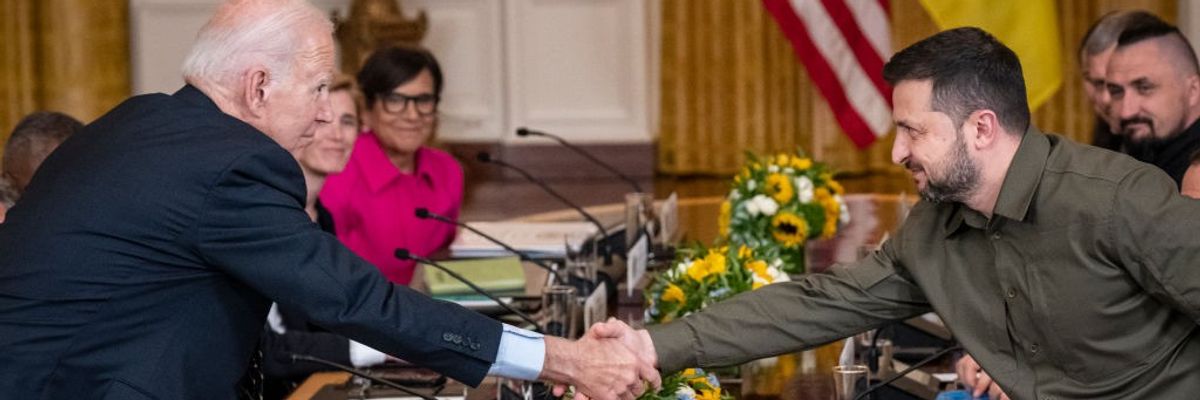
U.S. President Joe Biden shakes hands with President of Ukraine Volodymyr Zelensky after a meeting in the East Room of the White House September 21, 2023 in Washington, D.C.
(Photo by Drew Angerer/Getty Images)
Whether heralded or reviled, Biden’s supposed restraint during the Ukraine war has steadily faded, with more and more dangerous escalation in its place.
President Biden has never wavered from approving huge arms shipments to Israel during more than 13 months of mass murder and deliberate starvation of Palestinian civilians in Gaza. Biden’s crucial role earned him the name “Genocide Joe.”
That nickname might seem shrill, but it’s valid. Although Biden will not be brought to justice for serving as a key accomplice to the horrific crimes against humanity that continue in Gaza, the label sticks—and candid historians will condemn him as a direct enabler of genocide.
Biden could also qualify for another nickname, which according to Google was never published before this article: “Omnicide Joe.”
In contrast to the Genocide Joe sobriquet, which events have already proven apt, Omnicide Joe is a bit anticipatory. That’s inevitable, because if the cascading effects of his foreign policy end up as key factors in nuclear annihilation, historians will not be around to assess his culpability for omnicide—defined as “the destruction of all life or all human life.”
That definition scarcely overstates what scientists tell us would result from an exchange of nuclear weapons. Researchers have discovered that “nuclear winter” would quickly set in across the globe, blotting out sunlight and wiping out agriculture, with a human survival rate of perhaps 1 or 2 percent.
While Russia’s invasion and horrible war in Ukraine should be condemned, Biden has compounded Putin’s crimes by giving much higher priority to Washington’s cold-war mania than to negotiation for peace—or to mitigation of escalating risks of nuclear war.
With everything—literally everything—at stake, you might think that averting thermonuclear war between the world’s two nuclear superpowers, Russia and the United States, would be high on a president’s to-do list. But that hardly has been the case with Joe Biden since he first pulled up a chair at the Oval Office desk.
In fact, Biden has done a lot during the first years of this decade to inflame the realistic fears of nuclear war. His immediate predecessor Donald Trump pulled the U.S. out of two vital treaties — Intermediate-Range Nuclear Forces and Open Skies — and Biden did nothing to reinstate them. Likewise, Trump killed the Iran nuclear deal negotiated during the Obama administration, and Biden let itstay dead.
Instead of fulfilling his 2020 campaign promise to adopt a U.S. policy of no-first-use of nuclear weapons, two years ago Biden signed off on the Nuclear Posture Review policy document that explicitly declares the opposite. Last year, under the euphemism of “modernization,” the U.S. government spent $51 billion — more than every other nuclear-armed country combined — updating and sustaining its nuclear arsenal, gaining profligate momentum in a process that’s set to continue for decades to come.
Before and after Russia’s invasion of Ukraine in late February 2022, Biden showed a distinct lack of interest in actual diplomacy to prevent the war or to end it. Three days before the invasion, writing in the Financial Times, Jeffrey Sachs pointed out: “Biden has said repeatedly that the U.S. is open to diplomacy with Russia, but on the issue that Moscow has most emphasized—NATO enlargement—there has been no American diplomacy at all. [Russian President Vladimir] Putin has repeatedly demanded that the U.S. forswear NATO’s enlargement into Ukraine, while Biden has repeatedly asserted that membership of the alliance is Ukraine’s choice.”
While Russia’s invasion and horrible war in Ukraine should be condemned, Biden has compounded Putin’s crimes by giving much higher priority to Washington’s cold-war mania than to negotiation for peace—or to mitigation of escalating risks of nuclear war.
From the outset, Biden scarcely acknowledged that the survival of humanity was put at higher risk by the Ukraine war. In his first State of the Union speech, a week after the invasion, Biden devoted much of his oratory to the Ukraine conflict without saying a word about the heightened danger that it might trigger the use of nuclear weapons.
During the next three months, the White House posted more than 60 presidential statements, documents and communiques about the war in Ukraine. They all shared with his State of the Union address a stunning characteristic — the complete absence of any mention of nuclear weapons or nuclear war dangers—even though many experts gauged those dangers as being the worst they’d been since the 1962 Cuban Missile Crisis.
With everything—literally everything—at stake, you might think that averting thermonuclear war between the world’s two nuclear superpowers, Russia and the United States, would be high on a president’s to-do list.
With occasional muted references to not wanting a U.S. military clash with nuclear-armed Russia, during the last 33 months the Biden administration has said it did not want to cross its own red lines—and then has repeatedly proceeded to do so.
A week ago superhawk John Bolton, a former national security advisor to President Trump, summarized the process on CNN while bemoaning that Biden’s reckless escalation hasn’t been even more reckless: “It’s been one long public debate after another, going back to ‘Shall we supply ATACMS [ballistic missiles] to the Ukrainians at all?’ First it’s no, then there’s a debate, then there’s yes. ‘Should we supply the Ukrainians Abrams tanks?’ First it’s no, then there’s a long debate, then it’s yes. ‘Should we supply the Ukrainians with F-16s?’ First it’s no, then there’s a long debate, and it’s yes. Now, ‘Can we allow the Ukrainians to use ATACMS inside Russia?’ After a long debate, now it’s yes.”
Whether heralded or reviled, Biden’s supposed restraint during the Ukraine war has steadily faded, with more and more dangerous escalation in its place.
Biden’s recent green light for Ukraine to launch longer-range missiles into Russia is another jump toward nuclear warfare. As a Quincy Institute analyst wrote, “the stakes, and escalatory risks, have steadily crept up.” In an ominous direction, “this needlessly escalatory step has put Russia and NATO one step closer to a direct confrontation—the window to avert catastrophic miscalculation is now that much narrower.”
Like Biden and Secretary of State Antony Blinken as well as the Democratic and Republican phalanx of Ukraine war cheerleaders on Capitol Hill, Bolton doesn’t mention that recent polling shows strong support among Ukrainian people for negotiations to put a stop to the war. “An average of 52 percent of Ukrainians would like to see their country negotiate an end to the war as soon as possible,” Gallup reported last week, compared to only 38 percent who say “their country should keep fighting until victory.”
Biden and other war boosters have continued to scorn, as capitulation and accommodation to aggression, what so much of the Ukrainian population now says it wants—a negotiated settlement. Instead, top administration officials and laptop-warrior pundits in the press corps are eager to tout their own mettle by insisting that Ukrainians and Russians must keep killing and dying.
Last week, Putin “lowered the threshold for a nuclear strike in response to a broader range of conventional attacks,” Reuters reported, “and Moscow said Ukraine had struck deep inside Russia with U.S.-made ATACMS missiles…. Russia had been warning the West for months that if Washington allowed Ukraine to fire U.S., British and French missiles deep into Russia, Moscow would consider those NATO members to be directly involved in the war in Ukraine.”
For President Biden, the verdict of Genocide Joe is already in. But if, despite pleas for sanity, he turns out to fully deserve the name Omnicide Joe, none of us will be around to read about it.
Common Dreams is powered by optimists who believe in the power of informed and engaged citizens to ignite and enact change to make the world a better place.
We’re hundreds of thousands strong, but every single supporter makes the difference.
Your contribution supports this bold media model—free, independent, and dedicated to reporting the facts every day. Stand with us in the fight for economic equality, social justice, human rights, and a more sustainable future. As a people-powered nonprofit news outlet, we cover the issues the corporate media never will.
about:blank
about:blank
Our work is licensed under Creative Commons (CC BY-NC-ND 3.0). Feel free to republish and share widely.
Everything is at stake. Everything is at stake with nuclear weapons.
While working as a nuclear war planner for the Kennedy administration, Daniel Ellsberg was shown a document calculating that a U.S. nuclear attack on communist countries would result in 600 million dead. As he put it later: “A hundred Holocausts.”
That was in 1961.
Today, with nuclear arsenals vastly larger and more powerful, scientists know that a nuclear exchange would cause “nuclear winter.” And the nearly complete end of agriculture on the planet. Some estimates put the survival rate of humans on Earth at 1 or 2 percent.
No longer 100 Holocausts.
More than 1,000 Holocausts.
What might we Americans say about the actions and inaction of our leaders?
If such a nuclear war happens, of course we won’t be around for any retrospective analysis. Or regrets. So, candid introspection is in a category of now or never.
What if we did have the opportunity for hindsight? What if we could somehow hover over this planet and see what had become a global crematorium and unspeakable ordeal of human agony? Where, in words attributed to both Nikita Khrushchev and Winston Churchill, “the living would envy the dead.”
What might we Americans say about the actions and inaction of our leaders?
In 2023: The nine nuclear-armed countries spent $91 billion on their nuclear weapons. Most of that amount, $51 billion, was the United States. And our country accounted for 80 percent of the increase in nuclear weapons spending.
The United States is leading the way in the nuclear arms race. And we’re encouraged to see that as a good thing. “Escalation dominance.”
But escalation doesn’t remain unipolar. As time goes on, “Do as we say, not as we do” isn’t convincing to other nations.
China is now expanding its nuclear arsenal. That escalation does not exist in a vacuum. Official Washington pretends that Chinese policies are shifting without regard to the U.S. pursuit of “escalation dominance.” But that’s a disingenuous pretense. What the great critic of Vietnam War escalation during the 1960s, Sen. William Fulbright, called “the arrogance of power.”
Of course there’s plenty to deplore about Russia’s approach to nuclear weapons. Irresponsible threats about using “tactical” ones in Ukraine have come from Moscow. There’s now public discussion — by Russian military and political elites — of putting nuclear weapons in space.
We should face the realities of the U.S. government’s role in fueling such ominous trends, in part by dismantling key arms-control agreements. Among crucial steps, it’s long past time to restore three treaties that the United States abrogated — ABM, Intermediate-Range Nuclear Forces, and Open Skies.
On the non-proliferation front, opportunities are being spurned by Washington. For instance, as former CIA analyst Melvin Goodman wrote in September: “Iran’s Ayatollah has indicated a readiness to open discussions with the United States on nuclear matters, but the Biden administration has turned a deaf ear to such a possibility.”
That deaf ear greatly pleases Israel, the only nuclear-weapons state in the Middle East. On Sept. 22, former Defense Secretary Leon Panetta said unequivocally that Israel’s pager attack in Lebanon was “a form of terrorism.” The United States keeps arming Israel, but won’t negotiate with Iran.
The U.S. government has a responsibility to follow up on every lead, and respond to every overture. Without communication, we vastly increase the risk of devastation.
We can too easily forget what’s truly at stake.
We should face the realities of the U.S. government’s role in fueling ominous trends, in part by dismantling key arms-control agreements.
Despite diametrical differences in ideologies, in values, in ideals and systems — programs for extermination are in place at a magnitude dwarfing what occurred during the first half of the 1940s.
Today, Congress and the White House are in the grip of what Martin Luther King Jr. called “the madness of militarism.” In a toxic mix with the arrogance of power. Propelling a new and more dangerous Cold War.
And so, at the State Department, the leadership talks about a “rules-based order,” which all too often actually means: “We make the rules, we break the rules.”
Meanwhile, the Doomsday Clock set by the Bulletin of the Atomic Scientists is now just 90 seconds away from apocalyptic midnight.
Six decades ago, the Doomsday Clock was a full 12 minutes away. And President Lyndon Johnson was willing to approach Moscow with the kind of wisdom that is now absent at both ends of Pennsylvania Avenue.
Here’s what Johnson said at the end of his extensive summit meeting with Soviet Premier Alexei Kosygin in June 1967 in Glassboro, New Jersey: “We have made further progress in an effort to improve our understanding of each other’s thinking on a number of questions.”
Two decades later, President Ronald Reagan — formerly a supreme cold warrior — stood next to Soviet leader Mikhail Gorbachev and said: “We decided to talk to each other instead of about each other.”
But such attitudes would be heresy today.
As each day brings escalation toward a global nuclear inferno, standard-issue legislators on both sides of the aisle keep boosting the Pentagon budget. Huge new appropriations for nuclear weapons are voted under the euphemism of “modernization.”
And here’s a sad irony: The few members of Congress willing to urgently warn about the danger of nuclear war often stoke that danger with calls for “victory” in the Ukraine war. Instead, what’s urgently needed is a sober push for actual diplomacy to end it.
The United States should not use the Ukraine war as a rationale for pursuing a mutually destructive set of policies toward Russia. It’s an approach that maintains and worsens the daily reality on the knife-edge of nuclear war.
We don’t know how far negotiations with Russia could get on an array of pivotal issues. But refusing to negotiate is a catastrophic path.
Continuation of the war in Ukraine markedly increases the likelihood of spinning out from a regional to a Europe-wide to a nuclear war. Yet, calls for vigorously pursuing diplomacy to end the Ukraine war are dismissed out of hand as serving Vladimir Putin’s interests.
The world has gotten even closer to the precipice of a military clash between the nuclear superpowers, with a push to greenlight NATO-backed Ukrainian attacks heading deeper into Russia.
At the State Department, the leadership talks about a “rules-based order,” which all too often actually means: “We make the rules, we break the rules.”
Consider what President John Kennedy had to say, eight months after the Cuban Missile Crisis, in his historic speech at American University: “Above all, while defending our own vital interests, nuclear powers must avert those confrontations which bring an adversary to a choice of either a humiliating retreat or a nuclear war. To adopt that kind of course in the nuclear age would be evidence only of the bankruptcy of our policy, or of a collective death wish for the world.”
That crucial insight from Kennedy is currently in the dumpsters at the White House and on Capitol Hill.
And where is this all headed?
Ellsberg tried to alert members of Congress. Five years ago, in a letter that was hand-delivered to every office of Senate and House members, he wrote: “I am concerned that the public, most members of Congress, and possibly even high members of the Executive branch have remained in the dark, or in a state of denial, about the implications of rigorous studies by environmental scientists over the last dozen years.” Those studies “confirm that using even a large fraction of the existing U.S. or Russian nuclear weapons that are on high alert would bring about nuclear winter, leading to global famine and near extinction of humanity.”
In the quest for sanity and survival, isn’t it time for reconstruction of the nuclear arms-control infrastructure? Yes, the Russian war against Ukraine violates international law and “norms,” as did U.S. wars in Iraq and Afghanistan. But real diplomacy with Russia is in the interests of global security.
And some great options don’t depend on what happens at the negotiation table.
Many experts say that the most important initial step our country could take to reduce the chances of nuclear war would be a shutdown of all ICBMs.
The word “deterrence” is often heard. But the land-based part of the triad is actually the opposite of deterrence — it’s an invitation to be attacked. That’s the reality of the 400 intercontinental ballistic missiles that are on hair-trigger alert in five western states
Uniquely, ICBMs invite a counterforce attack. And they allow a president just minutes to determine whether what’s incoming is actually a set of missiles — or, as in the past, a flock of geese or a drill message that’s mistaken for the real thing.
The former Secretary of Defense William Perry wrote that ICBMs are “some of the most dangerous weapons in the world” and “they could even trigger an accidental nuclear war.”
And yet, so far, we can’t get anywhere with Congress in order to shut down ICBMs. “Oh no,” we’re told, “that would be unilateral disarmament.”
Imagine that you’re standing in a pool of gasoline, with your adversary. You’re lighting matches, and your adversary is lighting matches. If you stop lighting matches, that could be condemned as “unilateral disarmament.” It would also be a sane step to reduce the danger — whether or not the other side follows suit.
The ongoing refusal to shut down the ICBMs is akin to insisting that our side must keep lighting matches while standing in gasoline.
The chances of ICBMs starting a nuclear conflagration have increased with sky-high tensions between the world’s two nuclear superpowers. Mistaking a false alarm for a nuclear-missile attack becomes more likely amid the stresses, fatigue and paranoia that come with the protracted war in Ukraine and extending war into Russia.
Their unique vulnerability as land-based strategic weapons puts ICBMs in the unique category of “use them or lose them.” So, as Perry explained, “If our sensors indicate that enemy missiles are en route to the United States, the president would have to consider launching ICBMs before the enemy missiles could destroy them. Once they are launched, they cannot be recalled. The president would have less than 30 minutes to make that terrible decision.”
The United States should dismantle its entire ICBM force. Former ICBM launch officer Bruce Blair and Gen. James Cartwright, former vice chair of the Joint Chiefs of Staff, wrote in 2016: “By scrapping the vulnerable land-based missile force, any need for launching on warning disappears.”
The United States should dismantle its entire ICBM force.
In July, the Union of Concerned Scientists released a letter signed by more than 700 scientists. They not only called for cancelation of the Sentinel program for a new version of ICBMs — they also called for getting rid of the entire land-based arsenal.
Meanwhile, the current dispute in Congress about ICBMs has focused on whether it would be cheaper to build the cost-overrunning Sentinel system or upgrade the existing Minuteman III missiles. But either way, the matches keep being lit for a global holocaust.
During his Nobel Peace Prize speech, Martin Luther King Jr. declared: “I refuse to accept the cynical notion that nation after nation must spiral down a militaristic stairway into the hell of thermonuclear destruction.”
I want to close with some words from Ellsberg’s book “The Doomsday Machine: Confessions of a Nuclear War Planner,” summing up the preparations for nuclear war. He wrote:
“No policies in human history have more deserved to be recognized as immoral, or insane. The story of how this calamitous predicament came about, and how and why it has persisted for over half a century is a chronicle of human madness. Whether Americans, Russians and other humans can rise to the challenge of reversing these policies and eliminating the danger of near-term extinction caused by their own inventions and proclivities remains to be seen. I choose to join with others in acting as if that is still possible.”
This article is adapted from the keynote speech that the author gave at the annual conference of the Center for Arms Control and Non-Proliferation in Washington, D.C., on Sept. 24, 2024.
You have to wonder what it might take to get the man in the White House to acknowledge just how absurd the current U.S. military effort in Afghanistan has become. Would the president of Afghanistan himself telling us to start getting our troops out do it? Nah. How about the leader of the last country to send its army there telling us “Victory is impossible in Afghanistan”? Nope. Finding out that some of the guards who protect NATO bases were Taliban — but the top Taliban guy we’d been negotiating with actually wasn’t? Neither. A Hollywood agent might push this story as farce. But it’s real life and that qualifies it as tragedy.
Given that candidate Obama was so widely seen as a man of “new thinking,” one to deliver the country from tired old debates and morasses, one hoped President Obama would listen hard to what Mikhail Gorbachev had to say about the damage that a fruitless nine-years-plus war in Afghanistan can do to a country. But if so, no evidence yet.
Though it is not the first time US forces have crossed the border and launched attacks into Pakistan, such attacks have been exceedingly rare (and followed by angry reactions from Pakistan’s military and civilian government). NATO has also repeatedly tried to distance itself from previous attacks, insisting there is no basis for crossing the border.
Gen. David Petraeus, a straight shooter, admitted on Meet the Press Sunday that the Afghanistan War will take years and incur high casualties. His implicit defense of President Obama from Dick Cheney on the issues of torture and closing Guantanamo will make bigger headlines, but sooner or later the American public will notice the admission. The country is now evenly divided between those who think the US can and should restore a modicum of stability before getting out, and those who want a quick withdrawal. The Marjah Campaign, the centerpiece of the new counter-insurgency strategy, is over a week old, and some assessment of this new, visible push by the US military in violent Helmand Province is in order.
NATO countries are poised to add 7,000 soldiers to the 30,000-troop US escalation in Afghanistan, providing a cover of multilateralism for the Obama administration and the NATO commander, US General Stanley McChrystal. The NATO decision is expected to be ratified January 28 at a conference called by the United Kingdom, Germany, France, the Karzai administration and the United Nations Afghan Mission (UNAM).
Barack Obama’s December 1 nationally televised address to announce a further escalation of 30,000 troops to Afghanistan cemented his role as a war president who bears responsibility for the U.S. war on that country. It also marked Obama’s assumption of the task of providing the justifications, alibis and obfuscations needed to cloak U.S. military aims in an aura of legitimacy.
Eric Ruder goes through Obama’s speech and counters seven of Barack Obama’s worst half-truths and lies about Afghanistan.
President Barack Obama speaks on Afghanistan at West Point (Pete Souza | White House)
DECEPTION NO. 1: “We did not ask for this fight…[T]he United Nations Security Council endorsed the use of all necessary steps to respond to the 9/11 attacks…and only after the Taliban refused to turn over Osama bin Laden, we sent our troops into Afghanistan.”
HERE, BARACK Obama is repeating a lie that has been told and retold so often that it goes completely unexamined in the mainstream press. Countless Western newspapers reported on the Taliban’s offers to hand over Osama bin Laden, so long as the Bush administration provided Afghan government officials with evidence of bin Laden’s involvement in the September 11 attacks–something that any sovereign nation, like the U.S., would require before agreeing to an extradition.
US troops occupy an Afghan village as local children look on
NATO has called on allied nations to send more troops to Afghanistan in the run-up to President Barack Obama’s decision on whether to boost the US occupying forces.
NATO secretary-general Anders Fogh Rasmussen is in the midst of intense talks on getting more troops, equipment and funding for the newly established NATO training mission, spokesman James Appathurai said.
 NATO says that the tribesmen they attacked were believed to be the same ones responsible for an attack against a NATO base in the Khost Province of Afghanistan.
  Printable
 Email
Email

 Peace and Justice Post
Answering Obama’s Afghanistan deceptions
December 11, 2009Eric Ruder, Socialist Worker, December 8, 2009
Barack Obama’s December 1 nationally televised address to announce a further escalation of 30,000 troops to Afghanistan cemented his role as a war president who bears responsibility for the U.S. war on that country. It also marked Obama’s assumption of the task of providing the justifications, alibis and obfuscations needed to cloak U.S. military aims in an aura of legitimacy.
Eric Ruder goes through Obama’s speech and counters seven of Barack Obama’s worst half-truths and lies about Afghanistan.
DECEPTION NO. 1: “We did not ask for this fight…[T]he United Nations Security Council endorsed the use of all necessary steps to respond to the 9/11 attacks…and only after the Taliban refused to turn over Osama bin Laden, we sent our troops into Afghanistan.”
HERE, BARACK Obama is repeating a lie that has been told and retold so often that it goes completely unexamined in the mainstream press. Countless Western newspapers reported on the Taliban’s offers to hand over Osama bin Laden, so long as the Bush administration provided Afghan government officials with evidence of bin Laden’s involvement in the September 11 attacks–something that any sovereign nation, like the U.S., would require before agreeing to an extradition.
Continues >>
Share this:
Tags:Afghanistan, Al Qaeda, Eric Ruder, Karzai's electoral fraud, NATO, President Obama, U.S. war on Afghanistan and Security Council
Posted in Afghanistan, Commentary, imperialism, President Barack Obama, Uncategorized, US policy, USA, war, warmongers | Leave a Comment »