
A Kashmiri Muslim shows a victory sign during a march in Srinagar, India. Photograph: Dar Yasin/AP
For the past 60 days or so, since about the end of June, the people of Kashmir have been free. Free in the most profound sense. They have shrugged off the terror of living their lives in the gun-sights of half a million heavily armed soldiers, in the most densely militarised zone in the world.
After 18 years of administering a military occupation, the Indian government’s worst nightmare has come true. Having declared that the militant movement has been crushed, it is now faced with a non-violent mass protest, but not the kind it knows how to manage. This one is nourished by people’s memory of years of repression in which tens of thousands have been killed, thousands have been “disappeared”, hundreds of thousands tortured, injured, and humiliated. That kind of rage, once it finds utterance, cannot easily be tamed, rebottled and sent back to where it came from.
A sudden twist of fate, an ill-conceived move over the transfer of 100 acres of state forest land to the Amarnath Shrine Board (which manages the annual Hindu pilgrimage to a cave deep in the Kashmir Himalayas) suddenly became the equivalent of tossing a lit match into a barrel of petrol. Until 1989 the Amarnath pilgrimage used to attract about 20,000 people who travelled to the Amarnath cave over a period of about two weeks. In 1990, when the overtly Islamist militant uprising in the valley coincided with the spread of virulent Hindu nationalism (Hindutva) in the Indian plains, the number of pilgrims began to increase exponentially. By 2008 more than 500,000 pilgrims visited the Amarnath cave, in large groups, their passage often sponsored by Indian business houses. To many people in the valley this dramatic increase in numbers was seen as an aggressive political statement by an increasingly Hindu-fundamentalist Indian state. Rightly or wrongly, the land transfer was viewed as the thin edge of the wedge. It triggered an apprehension that it was the beginning of an elaborate plan to build Israeli-style settlements, and change the demography of the valley.
Days of massive protest forced the valley to shut down completely. Within hours the protests spread from the cities to villages. Young stone pelters took to the streets and faced armed police who fired straight at them, killing several. For people as well as the government, it resurrected memories of the uprising in the early 90s. Throughout the weeks of protest, hartal (strikes) and police firing, while the Hindutva publicity machine charged Kashmiris with committing every kind of communal excess, the 500,000 Amarnath pilgrims completed their pilgrimage, not just unhurt, but touched by the hospitality they had been shown by local people.
Eventually, taken completely by surprise at the ferocity of the response, the government revoked the land transfer. But by then the land-transfer had become what Syed Ali Shah Geelani, the most senior and also the most overtly Islamist separatist leader, called a “non-issue”.
Massive protests against the revocation erupted in Jammu. There, too, the issue snowballed into something much bigger. Hindus began to raise issues of neglect and discrimination by the Indian state. (For some odd reason they blamed Kashmiris for that neglect.) The protests led to the blockading of the Jammu-Srinagar highway, the only functional road-link between Kashmir and India. Truckloads of perishable fresh fruit and valley produce began to rot.
The blockade demonstrated in no uncertain terms to people in Kashmir that they lived on sufferance, and that if they didn’t behave themselves they could be put under siege, starved, deprived of essential commodities and medical supplies.
To expect matters to end there was of course absurd. Hadn’t anybody noticed that in Kashmir even minor protests about civic issues like water and electricity inevitably turned into demands for azadi, freedom? To threaten them with mass starvation amounted to committing political suicide.
Not surprisingly, the voice that the government of India has tried so hard to silence in Kashmir has massed into a deafening roar. Raised in a playground of army camps, checkpoints, and bunkers, with screams from torture chambers for a soundtrack, the young generation has suddenly discovered the power of mass protest, and above all, the dignity of being able to straighten their shoulders and speak for themselves, represent themselves. For them it is nothing short of an epiphany. Not even the fear of death seems to hold them back. And once that fear has gone, of what use is the largest or second largest army in the world?
There have been mass rallies in the past, but none in recent memory that have been so sustained and widespread. The mainstream political parties of Kashmir – National Conference and People’s Democratic party – appear dutifully for debates in New Delhi’s TV studios, but can’t muster the courage to appear on the streets of Kashmir. The armed militants who, through the worst years of repression were seen as the only ones carrying the torch of azadi forward, if they are around at all, seem content to take a back seat and let people do the fighting for a change.
The separatist leaders who do appear and speak at the rallies are not leaders so much as followers, being guided by the phenomenal spontaneous energy of a caged, enraged people that has exploded on Kashmir’s streets. Day after day, hundreds of thousands of people swarm around places that hold terrible memories for them. They demolish bunkers, break through cordons of concertina wire and stare straight down the barrels of soldiers’ machine guns, saying what very few in India want to hear. Hum Kya Chahtey? Azadi! (We want freedom.) And, it has to be said, in equal numbers and with equal intensity: Jeevey jeevey Pakistan. (Long live Pakistan.)
That sound reverberates through the valley like the drumbeat of steady rain on a tin roof, like the roll of thunder during an electric storm.
On August 15, India’s independence day, Lal Chowk, the nerve centre of Srinagar, was taken over by thousands of people who hoisted the Pakistani flag and wished each other “happy belated independence day” (Pakistan celebrates independence on August 14) and “happy slavery day”. Humour obviously, has survived India’s many torture centres and Abu Ghraibs in Kashmir.
On August 16 more than 300,000 people marched to Pampore, to the village of the Hurriyat leader, Sheikh Abdul Aziz, who was shot down in cold blood five days earlier.
On the night of August 17 the police sealed the city. Streets were barricaded, thousands of armed police manned the barriers. The roads leading into Srinagar were blocked. On the morning of August 18, people began pouring into Srinagar from villages and towns across the valley. In trucks, tempos, jeeps, buses and on foot. Once again, barriers were broken and people reclaimed their city. The police were faced with a choice of either stepping aside or executing a massacre. They stepped aside. Not a single bullet was fired.
The city floated on a sea of smiles. There was ecstasy in the air. Everyone had a banner; houseboat owners, traders, students, lawyers, doctors. One said: “We are all prisoners, set us free.” Another said: “Democracy without freedom is demon-crazy.” Demon-crazy. That was a good one. Perhaps he was referring to the insanity that permits the world’s largest democracy to administer the world’s largest military occupation and continue to call itself a democracy.
There was a green flag on every lamp post, every roof, every bus stop and on the top of chinar trees. A big one fluttered outside the All India Radio building. Road signs were painted over. Rawalpindi they said. Or simply Pakistan. It would be a mistake to assume that the public expression of affection for Pakistan automatically translates into a desire to accede to Pakistan. Some of it has to do with gratitude for the support – cynical or otherwise – for what Kashmiris see as their freedom struggle, and the Indian state sees as a terrorist campaign. It also has to do with mischief. With saying and doing what galls India most of all. (It’s easy to scoff at the idea of a “freedom struggle” that wishes to distance itself from a country that is supposed to be a democracy and align itself with another that has, for the most part been ruled by military dictators. A country whose army has committed genocide in what is now Bangladesh. A country that is even now being torn apart by its own ethnic war. These are important questions, but right now perhaps it’s more useful to wonder what this so-called democracy did in Kashmir to make people hate it so?)
Everywhere there were Pakistani flags, everywhere the cry Pakistan se rishta kya? La illaha illallah. (What is our bond with Pakistan? There is no god but Allah.) Azadi ka matlab kya? La illaha illallah. (What does freedom mean? There is no god but Allah.)
For somebody like myself, who is not Muslim, that interpretation of freedom is hard – if not impossible – to understand. I asked a young woman whether freedom for Kashmir would not mean less freedom for her, as a woman. She shrugged and said “What kind of freedom do we have now? The freedom to be raped by Indian soldiers?” Her reply silenced me.
Surrounded by a sea of green flags, it was impossible to doubt or ignore the deeply Islamic fervour of the uprising taking place around me. It was equally impossible to label it a vicious, terrorist jihad. For Kashmiris it was a catharsis. A historical moment in a long and complicated struggle for freedom with all the imperfections, cruelties and confusions that freedom struggles have. This one cannot by any means call itself pristine, and will always be stigmatised by, and will some day, I hope, have to account for, among other things, the brutal killings of Kashmiri Pandits in the early years of the uprising, culminating in the exodus of almost the entire Hindu community from the Kashmir valley.
As the crowd continued to swell I listened carefully to the slogans, because rhetoric often holds the key to all kinds of understanding. There were plenty of insults and humiliation for India: Ay jabiron ay zalimon, Kashmir hamara chhod do (Oh oppressors, Oh wicked ones, Get out of our Kashmir.) The slogan that cut through me like a knife and clean broke my heart was this one: Nanga bhookha Hindustan, jaan se pyaara Pakistan. (Naked, starving India, More precious than life itself – Pakistan.)
Why was it so galling, so painful to listen to this? I tried to work it out and settled on three reasons. First, because we all know that the first part of the slogan is the embarrassing and unadorned truth about India, the emerging superpower. Second, because all Indians who are not nanga or bhooka are and have been complicit in complex and historical ways with the elaborate cultural and economic systems that make Indian society so cruel, so vulgarly unequal. And third, because it was painful to listen to people who have suffered so much themselves mock others who suffer, in different ways, but no less intensely, under the same oppressor. In that slogan I saw the seeds of how easily victims can become perpetrators.
Syed Ali Shah Geelani began his address with a recitation from the Qur’an. He then said what he has said before, on hundreds of occasions. The only way for the struggle to succeed, he said, was to turn to the Qur’an for guidance. He said Islam would guide the struggle and that it was a complete social and moral code that would govern the people of a free Kashmir. He said Pakistan had been created as the home of Islam, and that that goal should never be subverted. He said just as Pakistan belonged to Kashmir, Kashmir belonged to Pakistan. He said minority communities would have full rights and their places of worship would be safe. Each point he made was applauded.
I imagined myself standing in the heart of a Hindu nationalist rally being addressed by the Bharatiya Janata party’s (BJP) LK Advani. Replace the word Islam with the word Hindutva, replace the word Pakistan with Hindustan, replace the green flags with saffron ones and we would have the BJP’s nightmare vision of an ideal India.
Is that what we should accept as our future? Monolithic religious states handing down a complete social and moral code, “a complete way of life”? Millions of us in India reject the Hindutva project. Our rejection springs from love, from passion, from a kind of idealism, from having enormous emotional stakes in the society in which we live. What our neighbours do, how they choose to handle their affairs does not affect our argument, it only strengthens it.
Arguments that spring from love are also fraught with danger. It is for the people of Kashmir to agree or disagree with the Islamist project (which is as contested, in equally complex ways, all over the world by Muslims, as Hindutva is contested by Hindus). Perhaps now that the threat of violence has receded and there is some space in which to debate views and air ideas, it is time for those who are part of the struggle to outline a vision for what kind of society they are fighting for. Perhaps it is time to offer people something more than martyrs, slogans and vague generalisations. Those who wish to turn to the Qur’an for guidance will no doubt find guidance there. But what of those who do not wish to do that, or for whom the Qur’an does not make place? Do the Hindus of Jammu and other minorities also have the right to self-determination? Will the hundreds of thousands of Kashmiri Pandits living in exile, many of them in terrible poverty, have the right to return? Will they be paid reparations for the terrible losses they have suffered? Or will a free Kashmir do to its minorities what India has done to Kashmiris for 61 years? What will happen to homosexuals and adulterers and blasphemers? What of thieves and lafangas and writers who do not agree with the “complete social and moral code”? Will we be put to death as we are in Saudi Arabia? Will the cycle of death, repression and bloodshed continue? History offers many models for Kashmir’s thinkers and intellectuals and politicians to study. What will the Kashmir of their dreams look like? Algeria? Iran? South Africa? Switzerland? Pakistan?
At a crucial time like this, few things are more important than dreams. A lazy utopia and a flawed sense of justice will have consequences that do not bear thinking about. This is not the time for intellectual sloth or a reluctance to assess a situation clearly and honestly.
Already the spectre of partition has reared its head. Hindutva networks are alive with rumours about Hindus in the valley being attacked and forced to flee. In response, phone calls from Jammu reported that an armed Hindu militia was threatening a massacre and that Muslims from the two Hindu majority districts were preparing to flee. Memories of the bloodbath that ensued and claimed the lives of more than a million people when India and Pakistan were partitioned have come flooding back. That nightmare will haunt all of us forever.
However, none of these fears of what the future holds can justify the continued military occupation of a nation and a people. No more than the old colonial argument about how the natives were not ready for freedom justified the colonial project.
Of course there are many ways for the Indian state to continue to hold on to Kashmir. It could do what it does best. Wait. And hope the people’s energy will dissipate in the absence of a concrete plan. It could try and fracture the fragile coalition that is emerging. It could extinguish this non-violent uprising and re-invite armed militancy. It could increase the number of troops from half a million to a whole million. A few strategic massacres, a couple of targeted assassinations, some disappearances and a massive round of arrests should do the trick for a few more years.
The unimaginable sums of public money that are needed to keep the military occupation of Kashmir going is money that ought by right to be spent on schools and hospitals and food for an impoverished, malnutritioned population in India. What kind of government can possibly believe that it has the right to spend it on more weapons, more concertina wire and more prisons in Kashmir?
The Indian military occupation of Kashmir makes monsters of us all. It allows Hindu chauvinists to target and victimise Muslims in India by holding them hostage to the freedom struggle being waged by Muslims in Kashmir.
India needs azadi from Kashmir just as much as – if not more than – Kashmir needs azadi from India.
· Arundhati Roy, 2008. A longer version of this article will be available tomorrow at outlookindia.com.
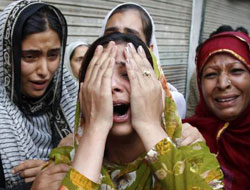 Kashmiris accused New Delhi of adding to the heavy security presence in Kashmir while not reaching out for a political dialogue.


 enlarge


Kashmiris seek independence now, not Indian poll!
October 12, 2008Not by Curfews alone, Mr. Governor!
By Dr Abdul Ruff Colachal | Kashmir Watch, Oct 11, 2008, Part 32
Muslims are being tortured and killed almost everywhere, in conservative countries, autocracies and the so-called democracies. Anti-Islamic regimes kill them to quench their blood thirst, while the Muslim nations do the same in order to appease the terrorist nations led by the USA which many developing countries vie to gain nuclear contracts. Muslims are being butchered in Kashmir, Pakistan, Afghanistan, Iraq and elsewhere and yet none is capable to raise their serious concern against those waging poisonous tails against Muslims. In anti-Muslim Hindu conservative India, even Muslims are made to be work against their own legitimate interests.
Terrorist India that occupies its neighbor Jammu Kashmir by brutal force has over decades created a terror force to kill Kashmiris and groomed a band of anti-Muslim militant-minded journalists to pursue the state agenda of anti-Muslimism who in the name of combating terrorism only keep the inter-civilization wedge intact if no t further fueling it. They promote only anti-Islamic opinions in the media under their control and influence abroad especially in developing world, more importantly in Middle East. Indian journalists, thriving on “terrorism” cash, see only terrorism in Indian and Kashmir Muslims in one form or the other. They denounce anything “not pro-India’ and term them as ” anti-India” and terrorize even the non-Muslim journalists who make living on terrorism theme.
India is country of hidden agendas at home and abroad. State terrorism has remained the hallmark of Indian policy. As soon as it clinched the nuclerism with USA, it went further to showcase its power to Jammu Kashmir. Indian leaders, including the military top brass, are yet to admit the fact that terror forces are illegally occupying Jammu Kashmir. India has repeatedly asked Pakistan to stay away from Kashmir issue and let the Kashmiris seek independence all by themselves. It is very particular that Kashmir is kept out of purview of any bilateral talks between them. Will India, then, resolve the issue now and surrender Kashmir for good?
Indian and JK governments have complicated the life of freedom leaders particularly Syed Ali Geelani who is being repeated arrested and mentally tortured. During the recent curfew clamped by Vohra regime in Srinagar has further deteriorated the health of this veteran leader. The Majlis Shoura of All Parties Hurriyat Conference (APHC-G) has appointed Ghulam Nabi Sumji as acting chairman of the amalgam because of the ill-health of Chairman Shah Geelani, who has been advised to get his pacemaker replaced and is being shifted to Delhi for treatment. The condition of Geelani had deteriorated because of his continuous detention and house arrest. He was admitted to a local hospital on October 5.
Geelani criticized the authorities for imposing curfew in the valley and arresting separatist leaders and asked the people not to heed rumors and foil any attempt by miscreants to harm unity. However, in a message to the people of Kashmir, he stressed the need for unity among all pro liberation groups.
People’s power is indeed great and purposeful. Kashmiris have shown that if people are united and fight for a just cause the rulers would be ruined sooner than later.
Discovered by UK in 19th century, the Amarnath temple structure outside India has all of sudden become a Hindutva symbol of Hindus in India and Jammu region of Kashmir. India and its Hindu representatives in Jammu Kashmir seem to have accorded to the Amarnath the status of NRI. After the destruction of Babri Mosque on the pretext that it was once Hindu structure, the Hindu India has taken up a new agenda in Hinduizing occupied Jammu Kashmir. They were under illusion that what they want to do in India and Jammu Kashmir will have to be accepted by Muslims as the final law. But Muslims Kashmir are totally different form those in India made with completely pro-Hindu mindset, and they don’t want to be a part of terrorist India that has killed over lakh [100,000] Kashmiris so far.
Unlike the slavery minded Muslims in India who even don’t have the capacity to fight for the reconstruction of the Babri Mosque demolished by Indian Hindu terrorists, Kashmiris continue to demand freedom from occupying India. Muzaffarabad March sacrificed a prominent freedom leader among others, but it evoked the inner consciousness of freedom seeking Kashmiris who are overwhelming in Jammu Kashmir. After protestors thronged the United Nations Military Observer Group’s (UNIMOGIP’S) office in Srinagar demanding the resolution of Kashmir dispute the United Nation Secretary-General Ban Ki-moon has formulated plans to pay a visit to India towards the end of this month or early November. Ban has criticized the India terrorism in Kashmir but, as usual, prompted resented by India. UN chiefs visit to India will be closely watched by the pro liberation camp in the Valley. Many pro liberation leaders are planning to seek a rendezvous with the UN chief and plead for his intervention in resolving the six decades old Kashmir sovereignty issue.
Pertinent to mention that freedom leader Syed Ali Shah Geelani had during a rally held at TRC grounds on August 18 asked Ban Ki-moon to pay a visit to the Valley and ascertain the facts, besides getting a firsthand account on the uprising in Kashmir. Hopefully, UN chief’s visit to this “democracy’ killing Kashmiris for fun will pave way for freedom of Jammu Kashmir.
Not by Curfew alone!
A high level meeting held in New Delhi discussed the Kashmir situation and unanimously decided to impose curfew in the Valley to scuttle the Lal Chowk March. The security agencies were already directed to erect long iron-made barricades at various entry points including Kokerbazar, Amira Kadal, Jehangir Chowk, Regal Chowk to prevent people from marching towards Lal Chowk. “Massive deployment of troops has already been put in place and Lal Chowk will be made out of bound for the people. Meanwhile, authorities have imposed section 144 in Ganderbal and Baramulla districts of Kashmir to prevent assembling of more than four persons at a place.
The curfew comes in the wake of Lal Chowk Chalo March call given by Coordination Committee, a freedom conglomerate, to press for its demands which include opening of Line of Control roads for trade, release of all detainees and revocation of Armed Forces Special Powers Act. A number of freedom leaders, including Jammu and Kashmir Liberation Front leader Yaseen Malik were put under preventive custody. Hardline freedom leader Syed Ali Shah Geelani was shifted to a hospital after he complained of pain in lower abdomen. Among those placed under house arrest were Chairman of moderate faction of the Hurriyat Conference, Mirwaiz Umer Farooq, Jamiat-e-Ahl-e-Hadith chief Maulana Showkat besides senior separatist leaders Abdul Gani Bhat, Bilal Lone and Sajjad Lone.
A virtual siege was laid around Lal Chowk as a large posse of gun-toting security personnel took up position in and around the area. All entry and exit points in Srinagar city have been sealed. There were some sporadic protests when the paramilitary forces refused to entertain curfew passes. However, the issue was resolved later. The new anti-riot vehicles, procured by the Jammu and Kashmir Police recently, were positioned at strategic locations, especially those which had witnessed violence earlier. Due to indefinite curfew imposed by the authorities in Srinagar and elsewhere in Kashmir and the government’s failure to provide adequate number of curfew passes to our staff, distributors and hawkers, the print editions. Some of the local newspapers failed to hit the stands as publishers decided not to print them accusing the government of not providing enough curfew passes to their staff, a charge denied by the government. A private television channel — Sen TV– was banned for allegedly inciting people to disturb public peace and tranquility.
Indian agents in Jammu Kashmir headed by Governor Vohra are trying all tricks including state terrorism techniques to quell the freedom move in Jammu Kashmir by clamping curfews intermittently adding more harm to the Kashmiris. After creating enough trouble for the Kashmir Muslims the Hindu “brethren” in Jammu region are enjoying life by being agents of New Delhi.
Continued . . .
Share this:
Tags:Amarnath temple, anti-Islamic regimes, Babri maque, curfew, demands of Coordination Committee, freedom leaders, Governor Vohra, India, Indian agenda, Jammu and Kashmir, Kashmiri Muslims, Kashmiris, military occupation of Kashmir, Muslims, Pakistan, Syed Ali Shah Geelani, USA
Posted in Commentary, imperialism, India, Islam and Muslims, Kashmir | Leave a Comment »