Posts Tagged ‘Kashmir’

India’s ‘new normal’ of perpetual war will damage its democracy

May 15, 2025

The BJP whipped up war fervour in the aftermath of the Pahalgam attack. Now it cannot ‘disappoint’ with peace.

  • Apoorvanand
  • Apoorvanand teaches Hindi at the University of Delhi. He writes literary and cultural criticism.

Al-Jazeera, Published On 13 May 2025

People wave Indian flags in support of the Indian Armed Forces, following the ceasefire announcement between India and Pakistan, in Delhi, India, May 13, 2025. REUTERS/Priyanshu Singh
People wave Indian flags in support of the Indian Armed Forces, following the ceasefire announcement between India and Pakistan, in Delhi on May 13, 2025 [Priyanshu Singh/Reuters]

On May 12, two days after the announcement of a ceasefire between India and Pakistan, Indian Prime Minister Narendra Modi finally addressed the nation. He stated that the Indian army had only “paused” military action and Operation Sindoor, launched in the aftermath of the April 22 massacre in Pahalgam to target “terrorist hideouts”, had not ended.

“Now, Operation Sindoor is India’s policy against terrorism. Operation Sindoor has carved out a new benchmark in our fight against terrorism and has set up a new parameter and new normal,” he said.

Modi’s speech was clearly not meant to reassure the Indian people that the government can guarantee their safety or security and is seeking peace and stability. Instead, it was meant to warn that the country is now in a permanent warlike situation.

This new state of affairs has been called not to secure the national interest but to satisfy Modi’s nationalist support base, which was bewildered and disappointed with the announcement of the ceasefire by United States President Donald Trump. The detrimental impact that this new militarised normal will have on Indian democracy is clearly a price worth paying, according to the ruling Bharatiya Janata Party (BJP).

The truth is, the political establishment unwittingly put itself in a difficult position when it decided to capitalise politically on the aftermath of the Pahalgam attack in India-administered Kashmir and whip up war fervour.

While victims of the attack like Himanshi Narwal, who survived but lost her husband, navy officer Vinay Narwal, called for peace and warned against the targeting of Muslims and Kashmiris, the BJP called for revenge and embraced anti-Muslim rhetoric.

Sign up for Al Jazeera

Breaking News Alert

Get real-time breaking news alerts and stay up-to-date with the most important headlines from around the globe.

Please check your email to confirm your subscription

By signing up, you agree to our Privacy Policy

protected by reCAPTCHA

As a ruling party, it did not feel the need to take responsibility for failing to prevent the attack or explain the carelessness in securing tourist destinations. It immediately converted this act of killing into an act of war against India.

Actions followed the hate rhetoric swiftly. Muslims and Kashmiris were attacked in several parts of India, and arrests were made of those criticising the Indian government. In Kashmir, nine houses were blasted immediately as punishment of those who had any link with “terrorists”, and thousands were detained or arrested. People with Pakistani passports were deported, and families were broken.

Then, Operation Sindoor was announced. The Indian army’s targeting of Pakistani sites was accompanied by frenzied calls from the mainstream media for the complete obliteration of Pakistan. Major TV platforms – entirely falsely – declared the Karachi port had been destroyed and the Indian army had breached the border.

The war cries and fake news emerging from the TV studios and the frantic messaging from the IT cells of the BJP led its supporters to believe that a decisive battle against Pakistan had been launched and its fall was imminent.

In parallel, critical voices were swiftly silenced. The Indian government requested the blocking of 8,000 accounts from the social media platform X, including those of BBC Urdu, Outlook India, Maktoob Media, veteran journalist Anuradha Bhasin and political content creator Arpit Sharma.

Just when war fever had gripped the BJP’s support base, the sudden announcement of a ceasefire by the US caught them by surprise. The truce was seen as a retreat and an admission of weakness.

Some of the BJP’s online supporters turned on the foreign secretary, Vikram Misri, who had declared the ceasefire as the representative of the government of India. He was viciously attacked, and his timeline was flooded with abusive and violent messages, calling him a traitor and coward. His daughter also faced abuse.

The trolling was so severe that Misri had to lock his social media accounts. Interestingly, but unsurprisingly, we did not hear about the blocking of any social media accounts trolling him or any action by the police against them. There was no action to protect Narwal either after she faced abuse and humiliation by the same crowd for daring to call for peace.

Meanwhile, the Association for Protection of Civil Rights, which focuses on rights violations in marginalised communities, has released a report saying 184 hate crimes against Muslims – including murder, assault, vandalism, hate speech, threats, intimidation and harassment – have been reported from different parts of India since April 22.

On Saturday, Misri claimed that India was a democracy that allowed criticism of the government. But the experience of critics raising questions about the objective and efficacy of Operation Sindoor has been bitter.

Criticism of government requires parliamentary deliberation. But the government has been ignoring calls by opposition parties to convene the parliament, which means stalling democratic dialogue.

Now that the prime minister has announced the operation has not ended, total loyalty from the Indian people will be demanded. Opposition parties would feel compelled to suspend all questions to the government. Muslims would feel a burden to prove their allegiance to the nation. The government will happily blame a dire economic situation that is of its doing on the war. There will be freedom of speech, but only for those who speak in favour of the BJP.

Democracy in India thus remains in suspended animation as the country now faces a permanent enemy and a permanent war.

The views expressed in this article are the author’s own and do not necessarily reflect Al Jazeera’s editorial stance.


  • ApoorvanandApoorvanand teaches Hindi at the University of Delhi. He writes literary and cultural criticism.Apoorvanand teaches Hindi at the University of Delhi. He writes literary and cultural criticism.
Kashmir and the Indus

April 29, 2025

The Causes of Heightened Ethnic, Political and Religious Tension in Kashmir

Craig Murray, Apr 28, 2025

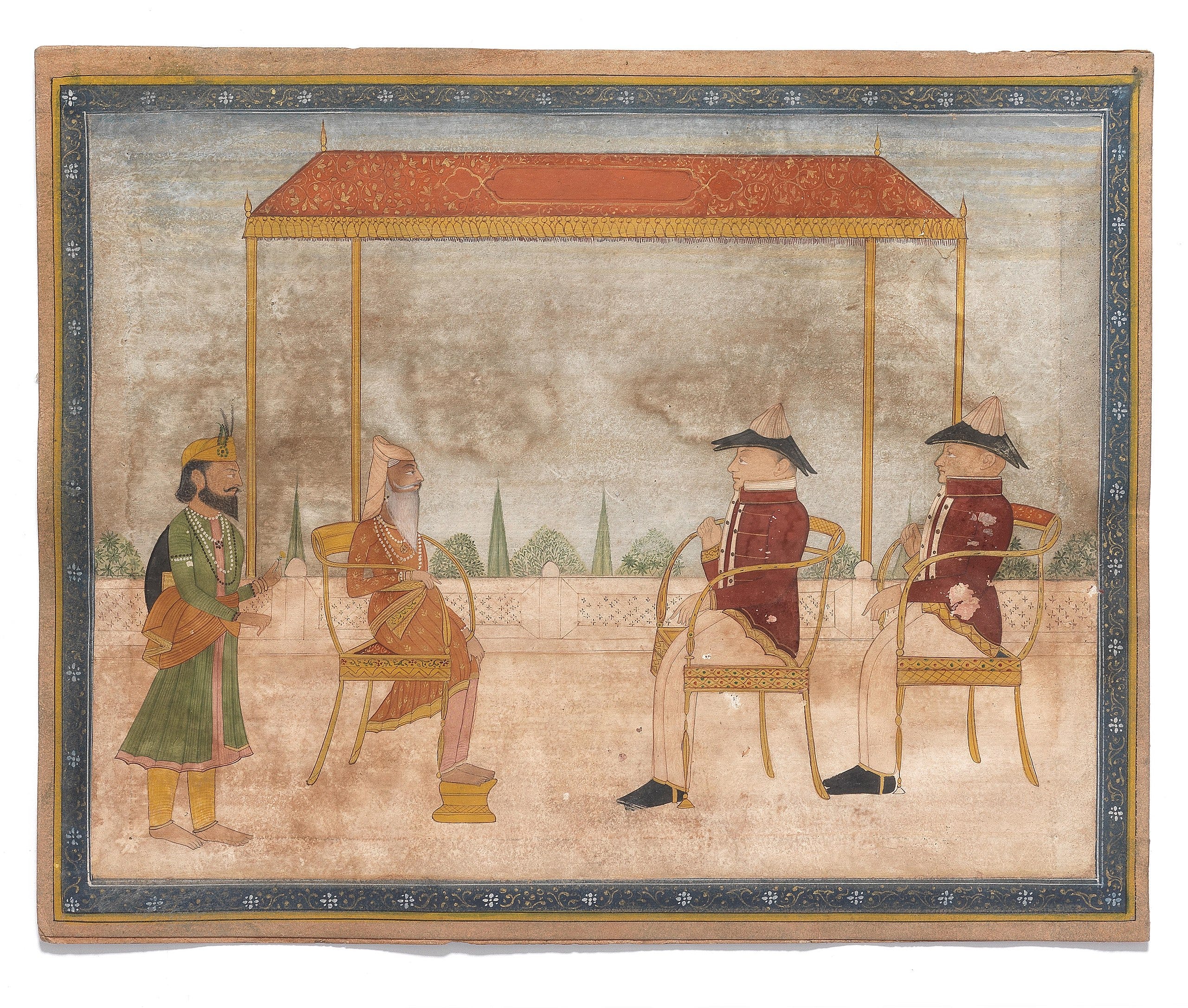
Maharaja Ranjit Singh with two British officers, artist unknown, 19th century, gouache and gold on paper.

India’s Hindutva Prime Minister, Narendra Modi, has used the Kashmir terrorism incident to abrogate the 1960s Indus Waters Treaty—a longstanding goal of Modi. The Indian version of the “terrorist attack,” most of whose victims were Muslim, has largely been accepted by Western governments without evidence.

False flags abound nowadays. You may recall that we were told that the most deadly rocket ever fired by Hamas killed only Palestinians in a hospital compound, while the most deadly rocket ever fired by Hezbollah killed only Druze children. I have at present an open mind about what occurred in Kashmir.

It is however certain that tearing up the Indus Waters Treaty is a long term Modi goal. The Indus supplies 80% of Pakistan’s agricultural water, and the supply is already insufficient, with disastrous salination of the lower reaches of the river as the sea creeps into the areas once occupied by the mighty flow. I visited the area of lower Sind five years ago and witnessed the fields encrused with white salt.

India controls the upstream flow into Pakistan of approximately 70% of the total water of the Indus, about 55% of all of Pakistan’s agricultural water.

In September 2016 in response to earlier violence in Kashmir, Modi initiated his slogan “Blood and water cannot flow together” and threatened to cut the Indus supply. He increased India’s out-take from the Ravi, Beas and Sutlej tributaries and restarted the Tulbul canal project. In both 2019 and 2022 while campaigning in Haryana, Modi made strong speeches threatening to cut off the water “wasted on Pakistan.”

In 2023 Modi issued formal notice to Pakistan of India’s desire to renegotiate the Indus Waters Treaty and repeated this in 2024 when Pakistan did not respond. On both occasions India cited “counter-terrorism” as one of three reasons for review (the others being environmental protection and hydro-electric generation). As counter-terrorism can scarcely be linked to agricultural water allocation, this illustrates Modi’s grandstanding approach.

Modi does not have the physical power to stop the Indus, but does have the ability short term to divert more of the river to Indian irrigation and storage, sufficient to cause some immediate distress in Pakistan. Indian media are already thrilled with the idea. But long term major reblancing of the river water allocation would require substantive new infrastructure in India. Such projects however would be both economically viable and likely wildly popular with Modi’s Hindutva base both for promoting Indian development and for damaging Pakistan.

In 2019, Modi revoked Article 270 of the Indian constitution which gave special autonomous status to Jammu and Kashmir, incorporating them into India proper. He did this despite the Constitution stating it could only be done with the support of the “Constituent Assembly of the State.” That body no longer existed, having been replaced by a “legislative Assembly.” Modi used another Constitutional provision to replace “Constituent Assembly” with “Legislative Assembly,” which seems fair enough. But having suspended the Legislative Assembly, he then claimed that its powers were now vested in the Governor, a Modi appointee.

Modi then agreed with himself to remove the autonomy of Indian Kashmir—a move that had no significant support among its 97% Muslim inhabitants and was accompanied by a ferocious crackdown, indeed lockdown, and the destruction of its once thriving tourism industry. He simultaneously repealed another provision preventing non Kashmiris from buying property in the region. Modi himself is therefore very much the cause of heightened ethnic, political and religious tension in Kashmir.

It is generally recognised that the situation of Kashmir, partly in India and partly in Pakistan with a small portion in China, and the Indian part occupied by deeply dissatisfied Muslims, is a result of the disastrous British partition of India of 1947. But in fact British responsibility for the disaster of modern Kashmir goes back a hundred years further than that, to 1846.

Kashmir was part of the Dourrani Afghan Empire from 1758 until 1819, when it was captured by the Sikh Empire of Maharajah Ranjit Singh. Singh was always careful to place Muslim Governors over Muslim lands, including from the Dourrani family itself. He allied with the British during the First Afghan War, and sent troops, including Kashmiri levies, to aid the British invasion in 1839. However after Ranjit Singh’s death and civil war over the succession, the British attacked the Sikh Empire to “restore stability.” Following the battle of Sobraon, the British annexed the land between the Beas and Ravi rivers, while by the Treaty of Amritsar of 1846 the British sold Jammu and Kashmir to the former Sikh wazir, Gulab Singh, for 50 lakhs of rupees.

Gulab Singh was a particularly murderous character who had played an extraordinarily Machiavellian role in the Sikh court of Ranjit Singh and his immediate successors, and had of course looted from the Sikh treaury the money he paid to the British. So he paid the British with stolen money for land the British had just stolen.

This is how the extraordinary situation arose that the Muslim territories of Kahmir and Jammu had a Hindu ruler (Gulab Singh was a Hindu Dogra). That anomaly was the direct cause of the disastrous division of the territory by the British in the Partition 100 years later.

It is extremely frequent that today’s conflicts are caused by the actions of the British Empire reverberating down and continuing their evil over generations. It is equally frequent that it is very hard to find analyses that explain the truth behind the conflicts.

Resolving the Kashmir Conflict

January 14, 2011

by Dr. Nasir Khan, Foreign Policy Journal, January 13, 2011

Almost the whole world had condemned the Mumbai attacks of November 2008. Such terrorism had also, once again, reminded us how important it is to combat the forces of communalist terror and political violence in the Indian subcontinent. But what is often ignored or suppressed is the fact that there are deep underlying causes of the malaise that erupts in the shape of such violent actions; the unresolved Kashmir issue happens to be the one prime cause that inflames the passions and anger of millions of people.

Kashmir Conflict

However, to repeat the mantra of “war on terror” as the Bush Administration had done for the last eight years while planning and starting major wars of aggression does not bring us one inch closer to solving the problem of violence and terror in our region. On the contrary, such short-sighted propaganda gimmicks were and are meant to camouflage the wars of aggression and lay the ground for further violence and bloodshed. The basic motive is to advance imperial interests and domination. The so-called “war on terror” is no war against terror; on the contrary, it has been the continuation of the American imperial policy for its definite goals in the Middle East and beyond. Obviously any serious effort to combat terror will necessarily take into account the causes of terror, and not merely be content with the visible symptoms.

Continues >>

Last 5 months of Kashmiri resistance against Indian oppressive rule – Urdu Weekly Rehbar

November 14, 2010

Editorial: An evaluation of the last 5 months  in Kashmir

Urdu Weekly Rehbar, Srinagar (Kashmir)

|| Archieve || Page1 || Page 2 || Page 3 || Page4 || Page 5 || Page 6 || Page 7 || Page 8 || قومی خبریں || کھیل || بین الاقوامی خبریں || اداریہ ||
Since 1932
Founder : Late Ghulam Mohi-ud-din Rehbar, Since 1932Contact Us:  The “REHBAR” Urdu News Paper, E.Mail:-  weeklyrehbar@gmail.com

Printer, Publisher and Editor: Shahid Rehbar, Published from Palladium Street Lal Chowk Srinagar Kmr., Pin Code:- 190001 J&K India
Visitor No :  #9419094623

Copyright © 2008 Weekly Rehbar Powered by Sterling IT Services.

India and Kashmir: From bad to worse

June 19, 2010

The killing of civilians by Indian security forces threatens to derail plans for a stable Kashmir.
Jason Overdorf
By Jason Overdorf GlobalPostJune 17, 2010

Indian soldiers in Kashmir
India’s Border Security Force soldiers patrol near the fenced border with Pakistan in Suchetgarh, southwest of Jammu, Jan. 12, 2010. (Mukesh Gupta/Reuters) Click to enlarge photo

NEW DELHI, India — In a two-story brick home in Srinagar’s old city, hundreds of relatives and neighbors waited throughout the night for the police to return the body of 17-year-old Tufail Ahmed Mattoo, who was allegedly killed by a teargas shell fired at him by police during a protest last week. When his body finally arrived on the morning of June 12, the gloom erupted into anger. Mattoo’s mother, Rubina, fainted. Scores of other women wailed and beat their chests, and the men raised slogans like “We want freedom,” and “Prosecute the killers.”

Continues >>

Kashmir democracy under the barrel of Indian guns

June 12, 2010

By Yasmin Qureshi, ZNet, June 12, 2010

Change Text Size a- | A+

Yasmin Qureshi’s ZSpace Page

I had wanted to go to Kashmir ever since I visited Palestine in 2007. There are many similarities in the nature of the occupation as well as the struggles, both being nearly 63 years old.  One difference is that while Israel is seen as an external occupying force in Palestine, the Kashmir issue is considered an ‘internal’ matter or a conflict between Pakistan and India and the voice of Kashmiris is often lost. As a result there are fewer international organizations monitoring the region and little information about the extent and impact of the occupation gets out.

Continues >>

Ghulam Nabi Gilkar and Kashmir Freedom Movement

February 21, 2010

By Zahir-ud-Din, KashmirWatch.com, Oct. 8, 2009


After Saad-ud-Din Shawl, Gilkar was the first Kashmiri to strive for the rights of his people. It started with the launch of All Kashmir Muslim Uplift Association in 1925. Two years later, Gilkar was once again out on the streets to protest issue of illegal state subject certificates. This time Gilkar founded the State Subject Protection Committee. According to Muhammad Din Fouq, Gilkar acted as the vice-president of this committee. Gilkar was only a student when he founded these associations. On May 8, 1930 when Munshi Naseer-ud-Din and Moulvi Bashir Ahmad Vakil hosted the rasam-e-qul of a lady at Kachgari Mohalla to formally launch the freedom struggle, Gilkar achieved the distinction of being the first person to join the duo. Gilkar became instrumental in persuading Sheikh Muhammad Abdullah to join the freedom movement. And in 1947 when veteran leaders refused to announce Azad Kashmir government, Gilkar once again proved his mettle. He became the first president of Azad Kashmir on October 4, 1947.

Gilkar became an active member of the reading room Party which was launched during the above mentioned meeting at Kachgari Mohalla. The activities of this party gave sleepless nights to the Maharaja. To curb the activities of the newly launched party, the government pasted a notice on the door of the Jamia Masjid, Srinagar. The notice prescribed punishment for using places of worship for political purposes. The Reading Room Party discussed the notice with Sheikh Muhammad Abdullah in chair. The meeting decided to ignore the notice. The meeting also decided to remove the notice from the door of Jamia Masjid. The participants expected Sheikh Muhammad Abdullah to volunteer for the act, but he did not raise his head. Finally, Gilkar offered himself for the job. He removed the notice and crushed it under his feet.

On April 19, 1931, the Holy Quran was desecrated at Jammu on the occasion of Eid. Gilkar and his associates registered protest and pasted thousands of posters in the city of Srinagar. Soon after, a huge rally was organized in the Jamia Masjid where Sheikh Abdullah delivered a fiery speech. Incidentally, it was his first political speech. Later, Gilkar organized a series of processions forcing the government to order an enquiry into the desecration.

After the incident of July 13, 1931, G N Gilkar, Sheikh Muhammad Abdullah, Chowdhury Abbas, Mistri Yaqoub and Gowher Rehman were detained at Kohi Maran (Hariparbat) Fort. Sheikh Abdullah was reluctant to enter the dark room. Gilkar, again, took the lead and went inside. “If death awaits us in the dark room, let me die first,” he said. After his release from Kohi Maran (Hariparbat) Fort, Gilkar addressed a mammoth gathering. He said, “If I die or get killed, bury me at a place which will serve as a thoroughfare for Mujahideen after liberation of Kashmir. My soul will get the much needed solace by their plod.” (Kashmir Ka Siyasi Inqilab, Vol 4, page 329).

When the Muslim Conference was converted into National Conference, Moulvi Abdullah Vakil, Sheikh Ahmad Din of Banihal, Ghulam Ahmad Ganaie of Bhaderwah opposed it. Gilkar, Moulvi Abdul Rahim and Muhammad Yusuf Qureshi mustered support from the masses against the conversion. Later, Gilkar played a significant role in the revival of Muslim Conference along with Muhammad Yusuf Qureshi. Gilkar contested two elections for a berth in the Praja Sabha on Muslim Conference ticket and got elected on both the occasions. Later, the year when the Government of India ousted the Nawab of Junagarh, the Government of Pakistan approached Mirza Bashir-ud-Din Ahmad of Qadiyan and authorized him to take appropriate measures with regard to Kashmir. Mirza called Gilkar to Lahore. Several rallies were held at Rattan Bagh, Lahore. Besides Gilkar the rallies were attended by Mufti Zia-ud-Din Poonchi, Chowdhury Rahim Dad advocate, Master Mir Alam Kotli, Ammanullah Khan of Khor Pattan, Professor Muhammad Ishaq Qureshi, Syed Muhammad Abdullah Qadri. Suggestions put forth by the concerned persons were discussed threadbare and a plan of action was chalked out. It was during these meetings that the issue of forming an ad hoc Azad Kashmir government was discussed. Mufti Zia-ud-Din Poonchi was told to announce the government but he refused. Syed Muhammad Abdullah Qadri also refused. Finally, Gilkar came forward and declared the government. In his first presidential address, Gilkar said, “With the end of the British rule, the Maharaja Hari Singh’s claim to rule the state (by virtue of the Sale Deed of Amritsar) has also come to an end.” Kashmir was sold to Hari Singh’s grandfather Gulab Singh for 7.5 million Rupees.

Now the people have formed an ad hoc government with its headquarters at Tradkhel. From October 4, if Hari Singh or any other person claims to govern the state, he shall be punished in accordance with the laws framed by the ad hoc government. The people should follow the laws made by the ad hoc government from now onwards.” This speech was reported by all the Pakistani newspapers on October 5, 1947.

On October 6, 1947 Gilkar came to Kashmir and discussed the issue with Sheikh Muhammad Abdullah in an exclusive meeting which lasted three hours. It was decided in the meeting that Sheikh Muhammad Abdullah would meet Quaid-e-Azam Muhammad Ali Jinnah. But, as ill luck would have it, Gilkar was arrested. After 13 months of detention he was released on January 13, 1949 and pushed back into Pakistan in exchange for Brigadier Gansara Singh.

Immediately, after reaching Pakistan, Gilkar launched a newspaper ‘Hamara Kashmir’ and highlighted the problems of the Kashmiri Muhajireen. He also became a strong advocate of the independent Kashmir.

He contested presidential elections against K H Khurshid but lost. For his straight forwardness, Gilkar was imprisoned several times for criticizing the Kashmir policy of the Government of Pakistan, but he continued his struggle. Gilkar lived from hand to mouth in his worn-out Rawalpindi house. In this house Gilkar authored a master plan for beautification of Srinagar in 1970. It was published in an issue of ‘Aayeena’ in the same year.

Gilkar was straightforward and blunt. He criticized Pakistan for its Kashmir policy. Even though he lived from hand to mouth in Pakistan, he did not compromise his political-stand and his honour. He was invited to grace a function held to celebrate the Independence Day of Pakistan on August 14, 1968 at Mirpur. In his address, Gilkar said, “August 14 and 15 are auspicious days for the people of Pakistan and India, but for Kashmiris these days are most inauspicious. Our slavery started from here.” Syed Rasool of Rainawari, also present at the function, saw many a brow rise.

According to Syed, Gilkar one day told his wife to cook Saag (a Kashmiri vegetable) on that day he desperately wanted to talk to a Kashmiri in his mother tongue. Gilkar breathed his last next morning (July 18, 1973) at Rawalpindi. Kashmiris heard about the tragic news from Radio Pakistan. Next day Ghayibana Namaz-e-Jinaza (funeral prayer in absentia) was offered at Pathar Masjid. Thousands of people participated in the Namaz-e-Jinaza (funeral prayer), which was led by Sheikh Muhammad Abdullah. On July 20, a condolence meeting was held in Gilkar’s ancestral house at Fateh Kadal, Srinagar. Representatives of all the political organizations participated in the condolence meeting and paid glowing tributes to his memory.

Feed back: din.zahir@gmail.com

Kashmir key to peace

November 22, 2009

The Nation, November 22, 2009

IT reflects poorly on New Delhi’s political sense that it has failed to realise that the more it tries to suppress the Kashmiris’ urge to get out of its cruel hold, the more entrenched in the people’s psyche becomes the freedom struggle and the more conscious the world gets of the urgency with which the dispute needs to be resolved. Amnesty International recently called upon President Obama to raise the issue of India’s brutal oppression in Occupied Kashmir when he meets Prime Minister Singh in Washington. Its words, “The Indian side of Kashmir is an area where the security forces commit mass human rights abuses with impunity…facilitated by the Armed Forces (Special Powers) Act and other similar laws.” Similarly, President Hu and President Obama, in a joint statement, have observed that the two sides, “agreed to cooperate…(in) bringing about more stable, peaceful relations in all of South Asia”. Secretary of State Clinton maintained, in an interview on Friday, that the US wanted the resumption of talks between India and Pakistan to sort out their differences, including Kashmir.

However, India has been greatly upset at these declarations and continues to defy the calls for an understanding look at the situation that the lingering dispute creates both within Occupied Kashmir and outside. It is a measure of Pakistan’s disappointment that Foreign Minister Qureshi had to say that though we were urging for the resumption of talks, we were not looking for a photo session; we wanted ‘constructive engagement and meaningful dialogue’. He stressed that any talks without the participation of Pakistan would be futile. He had in mind India’s efforts to engage the Kashmiri leaders from the occupied state to find a solution. Foreign Office spokesman Abdul Basit did some plain speaking, when he remarked that India did not want peace in the region. His conclusion is absolutely justified since New Delhi refuses to come to the negotiating table just because it would have to discuss Kashmir. It is well known that even when the composite dialogue was going on it avoided coming to grips with the issue. As the history of post-partition reveals, the fate of Indo-Pakistan relations is closely linked to the settlement of the Kashmir dispute in accordance with the aspirations of Kashmiris.

Kashmiris’ revolt against Indian occupation and military terror

October 2, 2009

The Socialist Worker, October 2, 2009

Arundhati Roy is the renowned author of the novel The God of Small Things, for which she won the prestigious Booker Prize in 1997. But Roy is equally well known as a determined social movement activist and leading voice of the global justice movement.

Roy’s new collection of essays, titled Field Notes on Democracy: Listening to Grasshoppers, examines the dark side of democracy in her native India. It looks at how religious majoritarianism, cultural nationalism and neo-fascism simmer just beneath the surface in a country that projects itself as the world’s largest democracy.

Here, we republish an essay from the book that provides a brilliant account of the summer 2008 uprising against Indian occupation by the people of Kashmir–a disputed region partitioned between India and Pakistan, and subject to Indian military rule in the section it controls.

Field Notes on Democracy: Listening to Grasshoppers | Arundhati Roy

FOR THE past sixty days or so, since about the end of June, the people of Kashmir have been free. Free in the most profound sense. They have shrugged off the terror of living their lives in the gun-sights of half a million heavily armed soldiers, in the most densely militarized zone in the world.

Continues >>

Kashmir dispute main cause of tension in South Asia

September 29, 2009

Kashmir Media Service,

New York, September 26 (KMS): The Chairman of All Parties Hurriyet Conference, Mirwaiz Umar Farooq, has said that Kashmir dispute is the main cause of tension in South Asia and needs to be resolved without any further delay. Addressing the OIC Foreign Ministers’ Conference in New York, the APHC Chairman said, because of its impact on relations between Pakistan and India, the conflict over Kashmir directly affects the peace and stability in the entire region, which is home to millions of people.

Mirwaiz maintained that the APHC was committed to bring about a peaceful and political solution to the dispute through meaningful dialogue among Pakistan, India and Kashmiris’ genuine leadership. He demanded demilitarization of Jammu and Kashmir, complete withdrawal of Indian troops from town and villages of occupied Kashmir and repeal of all draconian laws including Disturbed Areas Act, Public Safety Act and Armed Forces Special Powers Act.

The APHC Chairman said that human rights violations should be stopped and the international rights organisations should be allowed to have access to the occupied territory. He also called for the restoration of the rights of peaceful association, assembly and demonstrations, unconditional release of all political prisoners, freedom of all political leaders to travel abroad and allowing people to people contact on either side of the Line of Control.

Mirwaiz appealed to the leaders of the Islamic countries to use their moral and political influence to help resume the peace process for a just and honourable settlement of the Kashmir dispute and to grant the people of Kashmir their inalienable right of self-determination.

Complete text of the APHC Chairman’s speech is as follows

Mr. Chairman, Mr. Secretary General, Excellencies, distinguished guest, ladies and gentlemen,
Assalam-u-Alaikum Warahmatula-e-Wabarakatuhu,
I am enormously grateful for the opportunity to address this highly esteemed gathering of Foreign Ministers of the Organization of the Islamic Conference (OIC) on the subject of Kashmir.  I was also invited to participate in the OIC Council of Foreign Ministers in Damascus, Syria in May 2009. However, I could not attend that meeting because I was not given the travel document by the Government of India.

Excellencies, today, at this august body, I stand before you not just as a representative of the Kashmiri people struggling for their inalienable right of self-determination, but, more importantly as a ‘believer’. A believer who is urging the Ummah to reclaim its intellectual and spiritual glory.  A believer who is proud of the accomplishments of the Organization of Islamic Conference, yet, recognizes that there is much work still to do.

The Foreign Ministers in this annual coordination meeting aim to discuss various issues related to the United Nations’ agenda in order to enhance cooperation and coordination among the OIC Member States at the UN.  The importance of this initiative cannot be overstated. And, we need to be sure that our cooperation cannot be built on the hatred of anyone or anything, rather it should be undertaken with a love for ourselves and our traditions.

The present Charter of the Organization was adopted by the Eleventh Islamic Summit held in Dakar on 13-14 March 2008, which laid down the objectives and principles of the organization and fundamental purposes to strengthen the solidarity and cooperation among the Member States. The Organization has the singular honor to galvanize the Ummah into a unified body and have actively represented the Muslims by espousing all causes close to the hearts of over 1.5 billion Muslims of the world. The Organization has consultative and cooperative relations with the UN to protect the vital interests of the Muslims and to work for the settlement of conflicts and disputes involving Member States. One such conflict is that of the Jammu and Kashmir.

It bears no reiteration that the Kashmir conflict primarily involves the life and future of the people of the land. However, unresolved dispute is at the underlying cause of tension between two nuclear rival – India and Pakistan.  Because of its impact on relations between these two neighboring countries, it directly affects the peace and stability in an unstable region, which is home to more than 1.2 billion people, and the peace and security of many more nations beyond.

It has been a cause of two wars and numerous battles between the two neighbors, India and Pakistan.  The place has been aptly described by the former US President, Bill Clinton as the “most dangerous place” on earth. The situation has taken an ominous turn since the Mumbai attacks o November 26, 2008. With extremist threat growing in the region, the escalating turmoil in Kashmir promises to engulf the entire region extending from Afghanistan to Bangladesh.

Excellencies, the APHC is committed to a peaceful and political solution to the Kashmir dispute. We believe that for a meaningful dialogue between Pakistan, India and the Leadership of Jammu & Kashmir the following measures need to be taken.

1.  To demilitarize the arena of conflict – the State of Jammu and Kashmir – through a phased withdrawal of the troops;

2.  Complete withdrawal of India’s military presence from Kashmiri towns and villages;

3.  Immediate repeal of all draconian laws including Jammu and Kashmir Disturbed Areas Act and Public Safety Act and Armed Forces Special Powers Act;

4.   End to violations of human rights and allowing the international human rights organisations to have access to Kashmir;

5. The restoration of the rights of peaceful association, assembly and demonstrations;

6.    The unconditional release of all political prisoners;

7.     Freedom of all political leaders to travel abroad; and

8.   To allow people to people contact on either side of the Line of Control.

Excellencies, we trust you will bring your immense moral and political influence to bear on initiating a peace process which will lead to a speedy, just an honourable settlement of the dispute and to restore the inalienable right of self-determination of the people of Kashmir.

I thank you, Excellencies for your patient hearing.

See also, Resolving the Kashmir Conflict