US Ambassador to Israel Mike Huckabee said in an interview last week that the US has never asked Israel to “not apply sovereignty,” referring to the possibility of Israel annexing parts of the Israeli-occupied West Bank.
“The US has never asked Israel to not apply sovereignty,” Huckabee said, according to a September 5 post from a journalist for Israel’s Channel 14. “I have repeatedly stated that the US respects Israel as a sovereign nation and will not tell Israel what to do. This is also what Secretary Rubio has said as recently as this week.”
Israeli officials said last week that Secretary of State Marco Rubio had signaled to them that the US wouldn’t oppose Israel if it moved to annex the West Bank. He has also said publicly that annexation could be Israel’s response to Western states taking steps toward recognizing a Palestinian state.
Israeli Finance Minister Bezalel Smotrich recently outlined a proposal for annexing 82% of the West Bank and leaving six Palestinian population centers isolated as islands. He said that his plan aims for “maximum territory and minimum Arab population.”
Huckabee has also made clear that the Trump administration doesn’t oppose the recent major expansion of illegal Jewish settlements in the West Bank, which Smotrich said would “erase” the idea of a Palestinian state. Huckabee has claimed that the settlements are not illegal under international law despite their clear prohibition under the Geneva Convention of 1949, which both the US and Israel have signed and ratified.
Huckabee is a Christian Zionist, and his approach to Israel and Palestine is based on his view that God gave historic Palestine to the modern state of Israel, a theology that is rejected by the Catholic Church and most other Christian denominations. When asked in a recent interview with The Jerusalem Post about the growing skepticism of Israel among Americans, Huckabee suggested Christian pastors who didn’t teach his viewpoint were to blame.
“There are pastors in the evangelical world who have not explained to their congregations where the support for Israel comes from biblically,” he said.
Israeli Defense Minister Israel Katz on Thursday repeated a threat to unleash biblical plagues on Yemen in response to Houthi attacks on Israel, which have continued following the Israeli assassination of the prime minister of the Sanaa-based government.
“The Houthis are firing missiles at Israel again. A plague of darkness, a plague of the firstborn – we will complete all ten plagues,” Katz wrote on X, referring to plagues brought upon Egypt in the book of Exodus.
Katz has previously used the “plague of darkness” in apparent reference to Israel’s strikes on Yemeni power plants and other energy infrastructure. He also referenced the “plague of the firstborn,” which resulted in the deaths of all firstborn males in Egypt in Exodus, when announcing the Israeli strikes that targeted Yemeni civilian leadership and killed Prime Minister Ahmed al-Rahawi.
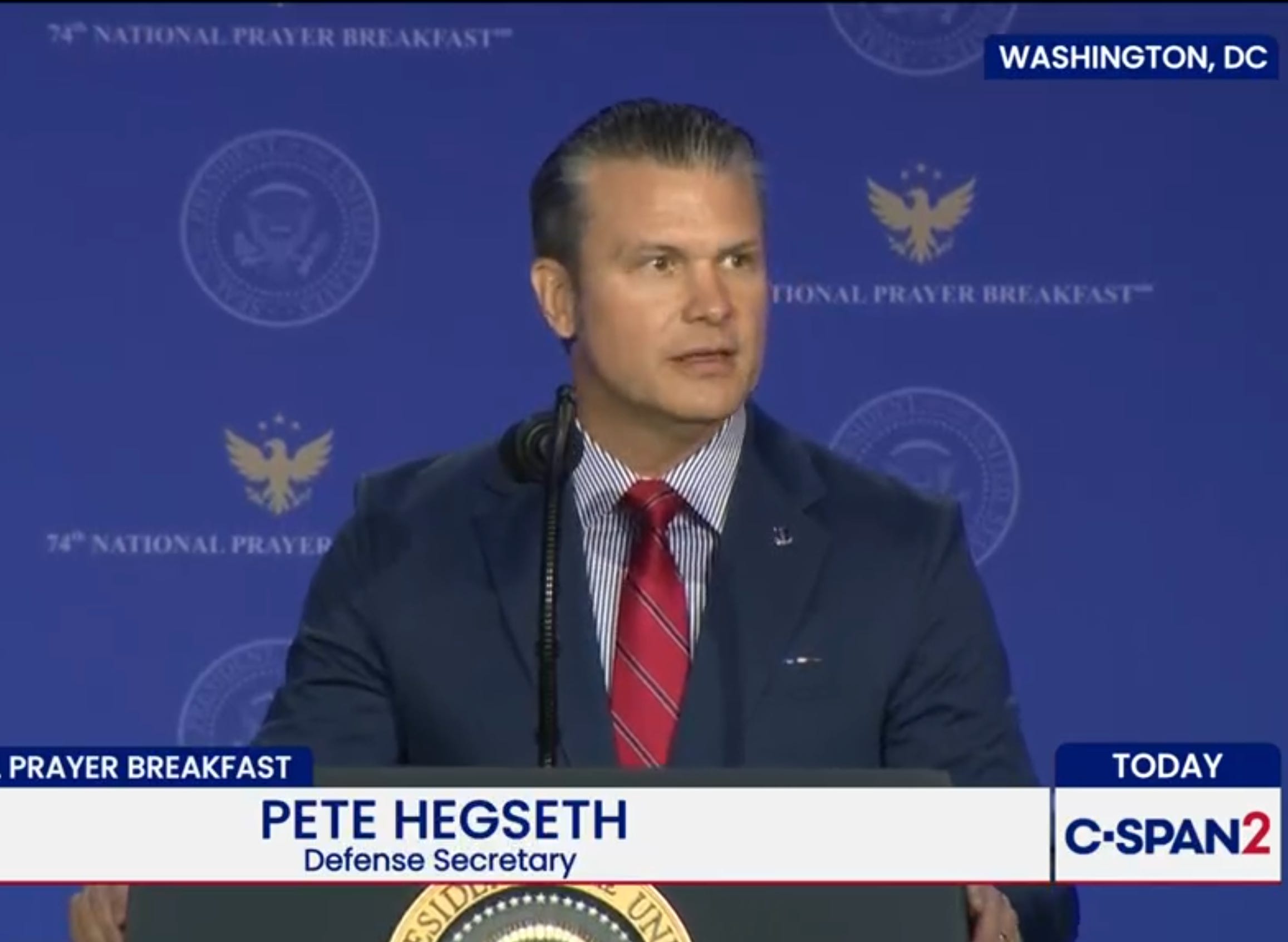
Secretary of Defense Pete Hegseth and Israel Minister of Defense Israel Katz stand for the playing of the US and Israel national anthems prior to a bilateral exchange at the Pentagon, Washington, DC, July 18, 2025. (DoD photo via DVIDS)
Yemen’s Houthis, officially known as Ansar Allah, announced another missile attack on Israel on Thursday and repeated their vow that the operations in support of the Palestinians in Gaza will continue until there’s a ceasefire and an end to the blockade on the Palestinian territory.
“The suffering of our oppressed Palestinian people in Gaza makes it imperative for all peoples to take action and break all restrictions in fulfillment of their religious, moral, and humanitarian duty to end this unprecedented crime in our contemporary history. Everyone bears responsibility, and their duty will not be done until it is fulfilled,” said Houthi military spokesman Yahya Saree. “Yemenis will continue to support Gaza until the aggression against it stops and the siege is lifted.”
The Houthis are known for their resilience and did not back down in the face of a very heavy US bombing campaign that the Trump administration conducted from March 15 to May 6, which killed more than 250 civilians. The US gave up on trying to get the Houthis to stop their attacks on Israel and their blockade of Israeli shipping and agreed to a ceasefire with the group.
The president also noted the Israel lobby’s strong influence on Congress and said it has waned in recent years
by Dave DeCamp, Antiwar. com, | September 2, 2025
President Trump said in an interview published on Tuesday that no one has done more for the state of Israel than himself and cited his recent airstrikes on Iranian nuclear facilities as an example.
“So, Israel is amazing, because, you know, I have good support from Israel,” the president told the Daily Caller. “Look, nobody has done more for Israel than I have, including the recent attacks with Iran, wiping that thing out. We, that plane, wiped them out like nobody ever saw before.”
Trump made the comments when asked if he was worried about the growing skepticism among young Republicans when it comes to the US relationship with Israel, and he noted the Israel lobby’s control over Congress, saying it has waned in recent years.
“But when, if you go back 20 years. I mean, I will tell you, Israel had the strongest lobby in Congress of anything or body, or of any company or corporation or state that I’ve ever seen. Israel was the strongest. Today, it doesn’t have that strong a lobby. It’s amazing,” Trump said. President Donald Trump and Israeli Prime Minister Benjamin Netanyahu speak privately in the Vermeil Room before a dinner, Monday, July 7, 2025, at the White House. (Official White House Photo by Daniel Torok)
“There was a time where you couldn’t speak bad, if you wanted to be a politician, you couldn’t speak badly. But today, you have, you know, AOC plus three, and you have all these lunatics, and they’ve really, they’ve changed it,” he added.
The criticism of Israel among a small number of members of Congress is no longer limited to Democrats, as Rep. Marjorie Taylor Greene (R-GA), who is considered a strong supporter of President Trump, has recently come out strongly against Israel’s campaign in Gaza and became the first Republican in Congress to label it a genocide. Rep. Thomas Massie (R-KY) is also known for his opposition to US aid to Israel and the pro-Israel lobby group AIPAC.
“Israel, you would understand this very much, Israel was the strongest lobby I’ve ever seen. They had total control over Congress, and now they don’t, you know, I’m a little surprised to see that,” Trump said.
The president, who is strongly backing Israel’s genocidal assault in Gaza, said the military campaign is not good for Israel’s public image. “They may be winning the war, but they’re not winning the world of public relations, you know, and it is hurting them. But Israel was the strongest lobby 15 years ago that there has ever been, and now it’s, it’s been hurt, especially in Congress,” he said.
Trump made similar comments while on the campaign trail last year, both about the Israel lobby and Israel’s public image being damaged by the destruction of Gaza. “Some 15 years ago, Israel had the strongest lobby. If you were a politician, you couldn’t say anything bad about Israel, that would be like the end of your political career. Today, it’s almost the opposite,” he told Israel Hayom in March 2024.
The problem of glorifying individuals from ancient times to the present has existed. The term ‘personality cult’ covers such a phenomenon. Some political and influential people in power have carefully cultivated their images in this fashion. Their followers took such notions of worshipping personalities to extreme limits. When some activists began to praise Karl Marx and Frederick Engles for their political accomplishments in the International Workingmen’s Association (IWA), Marx showed his aversion to it; he had no place for such eulogies for himself and his friend Engels. We can see how he saw the problem in his letter to Wilhelm Bloss in Hamburg (1877):
“Neither of us cares a straw for popularity. Let me cite one proof of this: such was my aversion to the personality cult that at the time of the International, when plagued by numerous moves — originating from various countries — to accord me public honour, I never allowed one of these to enter the domain of publicity, nor did I ever reply to them, save with an occasional snub. When Engels and I first joined the secret communist society, we did so only on condition that anything conducive to a superstitious belief in authority be eliminated from the Rules.”
— Marx & Engels Collected Works Vol. 45, Progress Publishers, Moscow, 1991, p. 288
By Jeffrey Sachs* and Sybil Fares* – Article sent to Other News by the authors
Israel has crossed the clear line into the darkest crimes.
Israel, with US complicity, is committing genocide in Gaza through the mass starvation of the population as well as direct mass murders and the physical destruction of Gaza’s infrastructure. Israel does the dirty work. The US Government funds it and provides diplomatic cover through its UN veto. Palantir, through “Lavendar,” provides the AI for efficient mass murder. Microsoft, through Azure cloud services, and Google and Amazon through the “Nimbus” initiative, supply core tech infrastructure for the Israeli army.
This marks 21st-century war crimes as an Israel-US public-private partnership. Israel’s mass starvation of the people of Gaza has been confirmed by the United Nations, Amnesty International, Red Cross, Save the Children and many others. The Norwegian Refugee Council, along with 100 organizations, have been calling for an end to Israel’s weaponization of food relief. This is the first time that mass starvation has been officially confirmed in the Middle East.
The scale of the starvation is staggering. Israel is systematically depriving food to more than 2 million people. Over half a million Palestinians face catastrophic hunger and at least 132,000 children aged under five are at risk of death from acute malnutrition. The scale of the horror is thoroughly documented by Haaretz in a recent article entitled “Starvation is Everywhere.” Those who are able to somehow access food distribution sites are routinely fired on by the Israeli army.
As a former US ambassador to Israel has recently explained, the intention to starve the population has been present from the start. Israel’s Heritage Minister Amichai Eliyahu recently declared, “there is no nation that feeds its enemies.” Minister Bezalel Smotrich recently stated, “whoever doesn’t evacuate, don’t let them. No water, no electricity; they can die of hunger or surrender. This is what we want.”
Yet despite these glaring declarations of genocide, US representatives at the UN repeatedly deny the facts and cover for Israel’s war crimes. The US alone vetoed Palestine’s admission to the UN in 2024. The US now denies visas to Palestinian leaders to come to the UN in September, yet another violation of international law.
The US has used its power and especially its veto in the UN Security Council to abet Israel’s genocide of the Palestinians and to block even the most basic humanitarian responses. The world is aghast but seems paralyzed before the the Israel-US murder machine. Yet the world can act, even in the face of US intransigence. The US will stand naked and alone in its criminal complicity with Israel.
Let’s be clear. The overwhelming voice of humanity is on the side of the people of Palestine. Last December, 172 countries, with more than 90 percent of the world population, voted to support Palestine’s right to self-determination. Israel and the US were essentially isolated in their opposition. Similar overwhelming majorities are repeatedly expressed on behalf of Palestine and against the actions of Israel. Israel’s thuggish government now counts solely on US support, but even that may not be there for long. Despite Trump’s intransigence and US government attempts to stifle pro-Palestinian voices, 58% of Americans want the UN to recognize the State of Palestine, compared to only 33% who do not. Moreover, 60% of Americans oppose Israel’s actions in Gaza.
Here are practical steps that the world can take.
First, Türkiye has set the correct course by ending all economic, trade, shipping, and air links with Israel. Israel is currently a rogue state, and Türkiye is right to treat it as such until Israeli-created mass starvation ends, and a State of Palestine is admitted to the UN as the 194th member, with the borders of June 4, 1967. Other states should immediately follow Türkiye’s lead.
Second, all UN member states that have not yet done so should recognize the State of Palestine. So far, 147 countries recognize Palestine. Dozens more should do so at the UN Summit on Palestine on September 22, even over the vociferous objections of the US.
Third, the Arab signatories to the Abraham Accords, Bahrain, Morocco, Sudan, and the UAE, should suspend their diplomatic relations with Israel until the Gaza siege ends and the State of Palestine is admitted to the UN.
Fourth, the UN General Assembly, by a vote of two-thirds present and voting, should suspend Israel from the UN General Assembly until it lifts its murderous siege on Gaza, based on the precedent of suspending South Africa during its Apartheid regime. The US has no veto in the UN General Assembly.
Fifth, UN member states should stop the export of all technology services that support the war, until the siege of Gaza ends and Palestine’s membership in the UN is adopted by the UN Security Council. Consumer companies such as Amazon and Microsoft that persist in aiding the Israel Defence Forces in the context of a genocide should face the wrath of consumers worldwide.
Seventh, the UN General Assembly should dispatch a UN Protection Force to Gaza and the West Bank. Typically, it would be the UN Security Council that mandates a protection force, but in this case, the US will block the Security Council with its veto. There is another way.
Under the “Uniting for Peace” mechanism, when the Security Council is deadlocked, the authority to act passes to the General Assembly. After a Security Council session and the almost inevitable US veto, the issue would be brought before the UNGA in a resumed 10th emergency special session on the Israel-Palestine conflict. There, the General Assembly can, by a two-thirds majority not subject to US veto, authorize a protection force in response to an urgent request from the State of Palestine. There is a precedent: in 1956, the General Assembly authorized the UN Emergency Force (UNEF) to enter Egypt and protect it from the ongoing invasion by Israel, France, and the United Kingdom.
At the invitation of Palestine, the protection force would enter Gaza to secure emergency humanitarian aid for the starving population. If Israel were to attack the UN protection force, the force would be authorized to defend itself and the Gazans. Whether Israel and the US would dare to fight a UNGA-mandated force protecting the starving Gazans remains to be seen.
Israel has crossed the clear line into the darkest crimes — starving civilians to death and shooting them as they line up, emaciated, for food. There is no further line to cross, nor time to lose. The family of nations is being tested and summoned to action as it has not been in decades.
*Jeffrey D. Sachs, Professor and Director of the Center for Sustainable Development at Columbia University.
*Sybil Fares, Senior Advisor on the Middle East and Africa for UN Sustainable Development Solutions Network.
This is the most lethal war for the media in recent times. A generation of journalists is being wiped out
Sun 31 Aug 2025 18.30 CEST
Day by day, the death toll rises, the war crimes mount, and the outrage grows. Last Wednesday, the pope demanded that Israel stop its “collective punishment” of Gaza’s population. A day later, António Guterres, the United Nations secretary general, warned that “the levels of death and destruction … are without parallel in recent times”. More than 500 UN staff have pressed the human rights chief, Volker Türk, to call it genocide. Half of registered voters in the US have already concluded that that is what Israel is doing in Gaza.
The agony is deepening. On Friday, the Israeli military declared famine-hit Gaza City to be a combat zone, intensifying its assault and ending “tactical pauses” that allowed limited – if utterly inadequate – food delivery. Many inhabitants are physically incapable of fleeing again, and fear that they would be no safer elsewhere. Israel has attacked parts of areas that it has labelled as “humanitarian zones”.
Israel could end the international condemnation by stopping its campaign of annihilation. Instead, it tries to stop us learning about it, by silencing those who bear witness. It is determined to control the narrative of the war – though even its own figures at times offer a bleak view of conditions – and will go to shocking lengths. This has become the most lethal war for the media in recent history. According to the Committee to Protect Journalists (CPJ), at least 189 Palestinian journalists are dead in Gaza; others put the toll still higher. Five were killed in a single strike last week.
Reporters Without Borders (RSF) and Avaaz, a non-profit organisation promoting global activism, are calling on Israel to abide by its international obligations to protect journalists as civilians, and open Gaza’s borders so that international journalists can report freely.
The Guardian is printing the names of all of those whom the CPJ has listed as killed: women and men such as Fatma Hassona, Hamza al-Dahdouh and Anas al-Sharif, admired for their work and, of course, dearly loved as daughters, fathers, sisters and friends. These are deeply personal losses. But they also represent a generation of journalists that is being wiped out and cannot be replaced.
“At the rate journalists are being killed in Gaza by the Israeli army, there will soon be no one left to keep you informed,” warned Thibaut Bruttin, RSF’s director general.
The civilian death toll in Gaza is staggering, and journalists are put at particular risk when they run to danger to report as others try to escape. But the killing of so many who have been clearly identified as members of the media, in some cases after they were threatened over their work or smeared, leaves no doubt that they have been targeted. This is “the deadliest and most deliberate effort to kill and silence journalists that CPJ has ever documented”, the organisation has said. “Palestinian journalists are being threatened, directly targeted and murdered by Israeli forces, and are arbitrarily detained and tortured in retaliation for their work.”
Journalists in Gaza work in unbearable conditions – hungry and exhausted, breaking off reporting to find food for their families, help carry bodies from rubble or assist wounded relatives in finding shelter. Many are separated from those they love; many have buried loved ones. All know that in bearing witness, they increase the danger that they face. They carry on to defend the truth against Israel’s attempts to extinguish it. They must be defended themselves.
Genoa’s dockworkers, engaged in collecting and shipping aid for Gaza, vow to block Europe if the Sumud Flotilla faces attacks or intimidation.
The Port of Genoa has turned into a symbol of resistance and international solidarity.
Italian media reported that for weeks, Genoese dockworkers have been collecting aid for the people of Gaza, and on Saturday evening they renewed their clear and determined message: if the Global Sumud Flotilla, which set sail today loaded with food supplies, were to find itself in danger, an unprecedented response will follow.
“If we lose contact with our boats even for just 20 minutes, we will block all of Europe. From the Port of Genoa nothing will leave anymore,” declared representatives of the Autonomous Collective of Dockworkers (Calp).
Their words, spoken before 40,000 people, expressed the unbreakable bond between the Ligurian city and the international mission to break Israel’s siege on Gaza.
The collective’s spokesperson explained that the most delicate stage will begin “around mid-September, when these boats will arrive near the coast of Gaza, in the critical zone.”
He then added: “If we lose contact with our boats, with our comrades, even for just 20 minutes, we will block all of Europe. Together with our Usb union, together with all dockworkers, together with the entire city of Genoa.”
During the torchlight vigil, the dockworkers reaffirmed their commitment: “Our girls and boys must return without a scratch, and all our goods, which belong to the people, down to the very last box, must reach their destination.”
They also reminded that every year 13-14,000 containers leave the Genoa port for Israel, issuing a stern warning: “We will not let a single nail leave anymore. We will launch an international strike, we will block the roads. We will block everything.”
Words were matched with actions. Over 280 tons of foodstuffs have been collected and shipped thanks to the joint efforts of the dockworkers and the association Music for Peace.
“We want to show that the Port of Genoa is a civilian port and not a port of war. We want to send the signal that not only do we block weapons, but we also physically deliver aid to the Palestinian population,” explained the dockworkers.
The historic “Sala della Compagnia Unica” has been transformed into a warehouse of resistance, where teams of volunteer dockworkers organized, packed, and loaded the aid. Not only their labor, but also their vehicles and resources, were put at the service of a cause they consider not abstract solidarity but a duty of class and humanity.
The Sumud Flotilla therefore sets out from Genoa not only as a humanitarian mission, but as a direct challenge to an inhuman siege.
And the dockworkers, long at the forefront of struggles for dignity and justice, have made it clear they will not stand by: if anyone tries to stop the boats, “we will block all of Europe.”
About 100 kilometers east of Baku, the capital of Azerbaijan, lies the Azeri–Chirag–Deepwater Gunashli (ACG) oilfield, the largest in the Caspian basin’s Azerbaijani sector. Operated by BP Exploration Limited, it feeds directly into the infamous Baku–Tiflis–Ceyhan (BTC) Pipeline.
South of Baku, at the Sangachal terminal, oil and gas are stored before being exported. According to BP, around 106 million barrels of oil and condensate passed through Sangachal in the first half of this year, primarily via the BTC Pipeline.
From there, oil crosses Azerbaijan and Georgia, enters Turkiye, and finally reaches the Turkish port of Ceyhan on the Mediterranean. As authors James Marriott and Mika Minio-Paluello explain in ‘The Oil Road: Journeys from the Caspian Sea to the City of London’ (2012), the oil takes two primary paths from Ceyhan: one to the Italian port of Miggia via the Greek Islands, the other south along the Levantine coast to the Suez Canal.
Pipeline to genocide
After that, oil and gas inexplicably find their way to fund the Israeli occupation state’s genocidal war on Gaza. The profits enrich bankers in the City of London and British Petroleum shareholders. Everyone wins – except the Palestinians.
The BTC Pipeline, stretching nearly 1,800 miles, is a main energy artery for the occupation state. It supplies an estimated 40 percent of Tel Aviv’s crude oil needs, while Israel ranks sixth among importers of Azerbaijani oil. Azerbaijan’s state-owned energy giant SOCAR, one of Israel’s key energy partners, is also Turkiye’s largest foreign investor, as confirmed by SOCAR Turkiye CEO Elchin Ibadov.
The BTC Pipeline’s legal foundation is anchored in two key agreements. The more consequential of the two comprises Host Government Agreements signed between BP’s BTC Consortium and each transit country. These contracts essentially override national sovereignty.
Article 2 of the Intergovernmental Agreement illustrates this starkly:
“Each State declares and guarantees that it is not a party to, or is not legally bound to apply or comply with, any internal law or regulation, or any international agreement or treaty, that is inconsistent with, undermines, or impedes this Agreement, or that adversely affects or restricts the State’s ability to enter into or implement this Agreement or other relevant Project Agreements.”
Even after the devastating earthquakes that shook south-eastern Turkey in 2023, it was BP who declared force majeure for the Ceyhan Terminal in Adana, where Azerbaijani oil is shipped.
This effectively prioritized oil exports over local disaster relief. A BP spokesperson in Baku confirmed the declaration, which allowed the company to bypass contractual obligations.
A map showing the Baku–Tiflis–Ceyhan (BTC)Pipeline route.
Beyond Baku: The global complicity network
Yet focusing solely on Azerbaijan and the BTC Pipeline obscures the bigger picture: The occupation state is deeply embedded in the global energy trade, both as importer and exporter.
Investor-owned and private oil companies are complicit. According to last year’s report by Oil Change International, these firms collectively supply 66 percent of Israel’s oil, with 35 percent of that share coming from six major international oil companies – BP, Chevron, Eni, ExxonMobil, Shell, and TotalEnergies – between October 2023 and July 2024.
Over the same period, Kazakhstan supplied 22 percent of Israeli crude. African nations – notably Gabon, Nigeria, and Congo – contributed 37 percent. Even Brazil, under President Luiz Inacio Lula da Silva (a vocal critic of Tel Aviv) continued shipments throughout 2024. In May 2025, Brazilian oil workers’ unions revealed in a joint letter to the president that 2.7 million barrels of crude had been exported to Israel that year.
Israel also imports refined petroleum products critical for its military occupation across Palestine, Lebanon, and Syria. Mediterranean states like Cyprus, Italy, Greece, and Albania have all shipped fuel, diesel, and naphtha.
Cyprus has additionally provided transshipment services. Meanwhile, Russian vacuum gas oil (VGO) continues to flow into Haifa’s refineries. One major source remains Kazakhstan’s CPC Blend crude, exported via Russia’s Black Sea port of Novorossiysk.
Despite its shift toward natural gas, coal still comprised 12.7 percent of Tel Aviv’s energy supply in 2023, according to the International Energy Agency (IEA), with the top suppliers being BRICS nations. Colombia provides 50–60 percent of the coal. Russia and South Africa follow closely despite their condemnations of Israel and South Africa’s International Court of Justice (ICJ) genocide case. The US and China round out the top five.
Arab and Muslim countries are no exception. Following 7 October 2023, the Saudi-led OPEC bloc rejected Iran’s calls for an oil embargo. Tel Aviv continues to receive modest but steady crude flows through the Sumed (Suez-Mediterranean) Pipeline, transporting oil from Saudi Arabia, the UAE, Iraq, and Egypt. In 2020, Israel’s Europe–Asia Pipeline Co. signed a transport agreement with UAE firm RED Land Bridge Ltd., deepening the ties between Gulf states and Tel Aviv.
Leviathan’s bounty and Arab betrayal
Perhaps the most scandalous development is that Israel itself has become an energy source.
In August 2025, Egypt signed a record-breaking $35-billion gas deal with Tel Aviv, nearly tripling its gas imports from the Leviathan offshore fields – the largest export agreement in Israeli ‘history.’ NewMed Energy, an Israeli company, anticipates transporting 130 billion cubic meters (bcm) of gas to Egypt by 2040.
Natural gas exports to Egypt and Jordan rose 13.4 percent in 2024, despite rhetorical condemnations from Arab leaders. Energy Minister Eli Cohen lauded the figures, claiming they prove Israel’s energy sector is a “strategic asset” and key to “regional stability.”
Reuters also noted that “Israel is positioning itself as a regional energy hub and has committed to supplying natural gas to Europe, which has been diversifying away from Russia since its invasion of Ukraine.”
Last year, the Leviathan field produced 11.33 bcm of gas, generating $282 million in revenue. The nearby Tamar field earned $232 million from 10.09 bcm. Total gas production rose 8.3 percent, with royalties climbing nearly 11 percent to $704.5 million. State revenues from gas are projected to hit $1.4 billion this year, doubling within a few years.
The masquerade of embargoes
On 21 August, Reutersreported that Turkiye informed its port authorities that ships linked to Israel would be barred from docking. The new requirement insists that guarantee letters confirm no Israeli ties or military cargo on board.
Ankara claims to have halted trade with Israel post-7 October. But the reality suggests otherwise. Tankers frequently disable their tracking systems in the eastern Mediterranean, feign destinations in Egypt or elsewhere, and arrange deliveries through third-country traders.
Russian Telegram channel Dva Mayora exposed Greek tankers Seavigour and Kimolos for involvement in these covert routes in 2025. As of 22 August, the Marshall Islands-flagged Nissos Antimilos was seen 190 kilometers west of Haifa, fresh from Ceyhan and awaiting an Israeli tanker for offshore transfer.
Arab and Muslim-majority states, it seems, prefer performative outrage over substantive action. Their duplicity ensures that, while Tel Aviv drops bombs on Gaza, the oil fueling its war machine flows uninterrupted.
The foreign ministers of six European nations have condemned Israel’s expanded offensive in Gaza City and its plans to “establish a permanent presence” in the enclave’s largest city. In a joint statement issued on Friday, the foreign ministers from Iceland, Ireland, Luxembourg, Norway, Slovenia and Spain reiterated that intensifying military operations in the war-torn enclave would “endanger the lives of hostages who cruelly remain at the hands of Hamas and will lead to the intolerable deaths of innocent Palestinian civilians.” The ministers also denounced “the forced displacement of Palestinians, which represents a flagrant violation of international law.” The statement said Israel’s “systematic destruction of essential civilian infrastructure, including locations that serve as refuge for extremely vulnerable displaced civilians, is unacceptable.” They urged the Israeli government and military authorities to immediately cease its operations. “This spiral of violence must end,” the statement said. The ministers also said they were “horrified” by the UN-backed monitor’s confirmation of a famine in Gaza City and its surroundings, urging Israel to “uphold its humanitarian obligations.” “The international community will not remain silent in the face of human rights violations, and we will continue working intensively for peace (…) We all need peace and stability to return to the region,” the statement concluded.
by Akram Belkaïd, Le Monde diplomatique, September 2025
The Arab states will not come to Gaza’s aid. None of them has launched any significant diplomatic initiative to prevent the reoccupation of the enclave or to end the Israeli bombardment it has endured for nearly two years. Despite the dreadful human toll — 70,000 dead, 70% of them women and children, according to some estimates — and a famine reminiscent of the worst medieval sieges, not a single capital across the Arab world is demanding sanctions against Tel Aviv or threatening its Western partners with retaliation for their unwavering support of Binyamin Netanyahu and his government (1).
Unlike in the October 1973 Arab-Israeli war, the Organisation of Arab Petroleum Exporting Countries (OAPEC) is not trying to persuade other oil producers to restrict deliveries so that Washington will put pressure on Israel. As an example of how things have changed, in May, as American weapons continued to flow into Israel and Congress approved credit after credit for Tel Aviv, the USS Forrest Sherman, a US Navy destroyer, made a routine port call at Algiers (2).
The communist activist Georges Ibrahim Abdallah, recently released after 41 years in a French prison, was just as critical of ordinary Arab people as of their leaders, if not more so: ‘Palestinian children are dying of hunger,’ he said when he arrived in Beirut. ‘It’s a source of shame for history. A source of shame for the Arab people, more than for their governments. The regimes, we know. [But] how many martyrs have died in demonstrations or attempting to cross Gaza’s borders? None. No one has fallen. Everything depends on the Egyptian people, more than on anyone else.’
Egypt’s leaders disagree. Far from breaking off diplomatic relations, they are strengthening their economic cooperation with Tel Aviv, even as dozens of Gazans die every day. True, 40,000 Egyptian soldiers are deployed in northern Sinai, but their mission is not to open a corridor for humanitarian aid, it’s to prevent an influx of refugees. Reasons aren’t hard to find…
In early August the Israeli company NewMed announced the signing of a ‘historic’ €35bn contract to supply Egypt with natural gas from the offshore Leviathan field starting in 2026. The deal — for 135 billion cubic metres over 15 years — will supply 20% of Egypt’s annual needs. Since 2019, when it concluded a first contract for 60 billion cubic metres, Cairo has accepted that it’s dependent on Israel for its energy security. This may explain why its security services prevented participants in the World March to Gaza from converging on Sinai in June, often by force.
The United Arab Emirates (UAE), for its part, normalised relations with Israel in 2020 under the Abraham accords. In January, Edge Group, a leading Emirati defence contractor, announced a $10m deal that will give it a 30% stake in the Israeli company Thirdeye Systems, which specialises in drone detection using AI. In Egypt, the UAE and Morocco — another signatory of the Abraham accords — normalisation with Israel goes hand in hand with business opportunities. It’s enough to inspire Syria and Saudi Arabia, which are stepping up their contacts with Israel too.
Akram Belkaïd is deputy director of Le Monde diplomatique.
You must be logged in to post a comment.