Archive for the ‘Zionist Israel’ Category

Israel Turns Back Gaza Aid Boat

December 2, 2008

Antiwar.com,  December 1, 2008

A Libyan cargo vessel weighed down with 3,000 tonnes of food, medicine, and other humanitarian goods, was barred from entering the Gaza Strip yesterday by the Israeli navy. Palestinian officials say they expect the vessel to attempt to reach the Gaza Strip again.

Andy David, a spokesman for the Israeli Foreign Ministry, defended to move, saying Israel’s policy on the naval blockade was “very clear,” He said Israeli naval ships approached the aid boat and ordered it via radio to turn back, adding “Anyone wishing to transfer humanitarian aid into Gaza is welcome to do it in coordination with Israel and through the regular crossings.”

Yet this has not been the case in recent days,  after an Israeli raid on the strip earlier this month sparked an exchange of strikes and a full closure on the strip. Since then, Israel has only occasionally allowed small amounts of humanitarian aid across the border, and has expressed public outrage at the suggestions of UN officials that refusing to allow food (and officially barring the importation of shoes) into a small region inhabited by 1.5 million people was a “direct contravention of international human rights and humanitarian law.”

Israeli officials condemned concern over the humanitarian situation in Gaza as “utterly shortsighted” and have insisted that their refusal to allow basic humanitarian aid into the strip is entirely the fault of the Hamas government. The crossings were expected to open briefly last Thursday (coincidentally Thanksgiving in the United States), but the government decided against it after a rocket landed in an empty field in southern Israel, doing no damage and causing no injuries. Since then no aid has been permitted to enter Gaza by land or, as witnessed today, by sea.

Related Stories

compiled by Jason Ditz [email the author]

The United Nations’ Darkest Day

November 30, 2008

By Robert Thompson | Axis of Logic, Nov 27, 2008

This Saturday, 29th November, is the sixty-first anniversary of the darkest day in the history of the then still youthful United Nations.   The Organisation then member states carelessly breached the provisions of the Charter by voting in favour of a partition of Palestine without any attempt at asking the population what it wished to have as a future, after the British Empire wished to give up its mandate due to a general desire on the part of the government headed by Clement Atlee to decolonise, cut expenses and end the terrorism of the Zionist gangs, Irgun Zwai Leumi, the Strern Gang and Haganah. The British Empire had been bled dry by the cost incurred for the supply of very expensive arms from the USA manufacturers before their country finally joined in the Second World War half-way through. Also the cost in British lives and injuries at the hands of the terrorists was a strong argument in favour of leaving what had become a hell-hole not only for the indigenous people but also for the British before, during and after the War, as a result of the attrocities committed by these de facto allies of the Nazis.


For those who do not understand the extent of the injustice of the Proposition for which the United Nations then voted, the Zionist occupied land in Palestine was approximately 7% and that occupied by indigenous Palestinians some 93%, whereas, apart from the proposal to make Jerusalem and its immediate neighbourhood into an international area, the land was attributed almost equally between the indigenous people and the incoming Zionists, with the latter being given areas largely occupied by the former, especially in the centre and in the south, including the Naqab (or in Hebrew Negev) giving access to the Gulf of Aqaba.

We should all condemn this terrible breach of justice, as well as of their Charter, by the United Nations and work towards the establishment in all of Palestine of a single democratic state, where all those driven out by force in 1947-1948 (and their descendants) can, as the United Nations did later resolve, return and recover their homes and lands, and where full citizenship rights do not depend on one’s belonging to any specific religious group.

© Copyright 2008 by AxisofLogic.com

Israel’s Settlement on Capitol Hill

November 29, 2008

Robert Weitzel | November 28, 2008


“With [traditional Israeli defense strategists] it’s all about tanks and land and controlling territories . . . and this hilltop and that hilltop. All these things are worthless.” -Incumbent Israeli Prime Minister Ehud Olmert-

Soon after the sand settled following the Six Day War in 1967, Jewish settlements began dotting the hills in the occupied territories. These settlements are typically located on the high ground to better control the surrounding landscape. Today there are 127 Jewish settlements with a population exceeding 468,000 in the West Bank, the Golan Heights and in the suburbs of East Jerusalem—the last of nearly 8,000 settlers were removed from the Gaza Strip in 2005.

According to a recent Amnesty International report, “In the first six months of 2008 Israel has expanded settlements in the West Bank/East Jerusalem at a faster rate than in the previous seven years.”

Unbeknownst to most Americans, Israel’s westernmost settlement is not located in Palestine-Israel, but is 6000 miles away on the high ground overlooking Foggy Bottom in Washington D.C.

This Capital Hill settlement of pro-Israel lobbies and think tanks strategically controls the high ground overlooking the United States’ Middle East policy landscape by having made kibbutzniks of most members of the executive and legislative branches of the government—including President-elect Obama, Vice President-elect Biden (a wannabe Zionist), and future Secretary of State Hillary Clinton and Chief of Staff Rahm Emanuel (a born Zionist).

While Israel’s hilltop settlements in the occupied territories—violating over 30 UN Security Council resolutions since 1968—are “facts on the ground” that make the two state peace solution unlikely, their hilltop settlement in the center of the world’s only superpower makes it equally unlikely that Israel’s right-wing government will feel compelled to end their “self defensive” brutalization of the Palestinian people, which has been condemned by the international community (UN, EU) as crimes against humanity.

John Holmes, UN Undersecretary General for Humanitarian Affairs, said that Israel’s blockade of vital supplies to the Gaza Strip in retaliation for rocket attacks “amounts to collective punishment and is contrary to international humanitarian law.”

Collective punishment is forbidden by Article 33 of the Fourth Geneva Convention, which states, “No protected person may be punished for an offense he or she has not personally committed.” A “protected person” is someone who is under the control of an “Occupying Power of which they are not nationals.” Only the most ideologically blinkered individual would fail to recognize the Gaza Strip as occupied territory.

Israel’s current blockade of Gaza, which began on November 4, is resulting in what the UN Relief and Works Agency is calling a humanitarian catastrophe. Before the blockade, 1000 truckloads of food, fuel and essential supplies per day were necessary to sustain the 1.5 million Palestinians imprisoned behind the concrete and barbed wire of the 25-mile long border. Eighty percent of Gazans live on two dollars a day and depend on international aid to survive. Since the border crossings were sealed, less than 100 truckloads have been permitted through.

The imprisoned Palestinians—50 percent of whom are younger than 15—are slowly starving. They lack the fuel to generate electricity for lighting, water purification, and sewage treatment. The erratic, intermittent electrical power puts the lives of patients in intensive care wards and those who are connected to live-sustaining equipment in grave peril. The lack of basic medicines such as antibiotics and insulin pose an equally fatal threat.

Twenty human rights organizations and all Israeli and international journalists have been barred from entering the Gaza Strip since the blockade began. A letter of protest signed by most major news organizations was sent to Prime Minister Olmert. Israeli Defense Ministry spokesman Shlomo Dror responded to the letter by saying that Israel was afraid journalists would inflate the Palestinians’ suffering. No one is allow to speak out on behalf of this beleaguered population.

President-elect Obama has been speaking out “swiftly and boldly” about the economic catastrophe threatening our 401Ks, but his silence regarding the unfolding humanitarian catastrophe threatening the lives of Palestinians is both deafening and telling of the price he’s willing to pay to maintain his status as kibbutznik-in-good-standing in Israel’s westernmost hilltop settlement.

Obama’s unconditional support for Israel’s policy of “self defense,” preemptive attacks, and repressive occupations is not one iota different from that of George W. Bush, an internationally recognized war criminal. This is not an encouraging beginning for a man whose battle cry was “change we can believe in.”

By any rational, humanitarian standard, Israel’s treatment of the Palestinians amounts to collective punishment and crimes against humanity. Perpetrators of such crimes, whether they are individuals or governments or willing allies, are criminals who should one day sit in the dock of the International Court of Justice in The Hague—just as defendants sat in a Nuremberg court 60 years ago—and be held accountable for their crimes.

Until Israel’s hilltop settlement in our nation’s capital is dismantled, allowing for the possibility of a just and lasting peace in Palestine-Israel, its influence on both branches of our government and its insidious affect on US Middle East policy will continue to make willing—or unwitting—kibbutzniks of all Americans. We will be held as complicit, and as culpable, as the citizens of the country whose leaders sat in the dock at Nuremberg.

The world will ask, “Why didn’t you do something to stop it?” The majority of us will reply, “We didn’t know!”

Robert Weitzel is a contributing editor to Media With a Conscience (www.mwcnews.net). His essays regularly appear in The Capital Times in Madison, WI. He can be contacted at: robertweitzel@mac.com

Amy Goodman: Media silence doesn’t mean all’s well in Gaza

November 28, 2008

Amy Goodman | The Capital Times, Nov 27, 2008

As President-elect Barack Obama focuses on the meltdown of the U.S. economy, another fire is burning: the Israeli-Palestinian conflict.

You may not have heard much lately about the disaster in the Gaza Strip. That silence is intentional: The Israeli government has barred international journalists from entering the occupied territory. Last week, executives from the Associated Press, New York Times, Reuters, CNN, BBC and other news organizations sent a letter of protest to Israeli Prime Minister Ehud Olmert criticizing his government’s decision to bar journalists from entering Gaza.

Israel has virtually sealed off the Gaza Strip and cut off aid and fuel shipments. A spokesman for Israel’s Defense Ministry said Israel was displeased with international media coverage, which he said inflated Palestinian suffering and did not make clear that Israel’s measures were in response to Palestinian violence.

A cease-fire between Israel and Hamas, the group that won Palestinian elections nearly three years ago and controls Gaza, broke down after an Israeli raid killed six Hamas militants two weeks ago. More Israeli raids have followed, killing approximately 17 Hamas members, and Palestinian militants have fired dozens of rockets into southern Israel, injuring several people.

U.N. Secretary-General Ban Ki-moon has criticized Israel over its blockade of the overcrowded Gaza, home to close to 1.5 million Palestinians. The United Nations Relief and Works Agency is warning that Gaza faces a humanitarian “catastrophe” if Israel continues to blockade aid from reaching the territory.

The sharply divided landscape of Israel and the occupied territories is familiar ground for South African Archbishop Desmond Tutu. He won the Nobel Peace Prize for his opposition to apartheid in South Africa. Tutu was in New York last week to receive the Global Citizens Circle award. I sat down with him at the residence of the South African vice consul.

Tutu reflected on the Israeli occupation: “Coming from South Africa … and looking at the checkpoints … when you humiliate a people to the extent that they are being — and, yes, one remembers the kind of experience we had when we were being humiliated — when you do that, you’re not contributing to your own security.”

Tutu said the embargo must be lifted. “The suffering is unacceptable. It doesn’t promote the security of Israel or any other part of that very volatile region,” he said. “There are very, very many in Israel who are opposed to what is happening.”

Tutu points to the outgoing Israeli prime minister. In September, Olmert made a stunning declaration to Yedioth Ahronoth, the largest Israeli newspaper. He said that Israel should withdraw from nearly all territory captured in the 1967 Middle East war in return for peace with the Palestinians and Syria: “I am saying what no previous Israeli leader has ever said: We should withdraw from almost all of the territories, including in East Jerusalem and in the Golan Heights.” Olmert said that traditional Israeli defense strategists had learned nothing from past experiences and that they seemed stuck in the considerations of the 1948 War of Independence. He said: “With them, it is all about tanks and land and controlling territories and controlled territories and this hilltop and that hilltop. All these things are worthless.”

Olmert appears to have come closer to his daughter’s point of view. In 2006, Dana Olmert was among 200 people who gathered outside the home of the Israeli army chief of staff and chanted “murderer” as they protested Israeli killings of Palestinians (Archbishop Tutu was blocked from entering Gaza in his U.N.- backed attempts to investigate those killings). Ehud Olmert recently resigned over corruption allegations, but remains prime minister until a new government is approved by parliament.

Palestinian Foreign Minister Riyad al- Maliki criticized Olmert for waiting until now to call for an end to the settlements: “We wish we heard this personal opinion when Olmert was prime minister, not after he resigned. I think it is a very important commitment, but it came too late. We hope this commitment will be fulfilled by the new Israeli government.”

Israel is a top recipient of U.S. military aid. Archbishop Tutu says of the Israeli- Palestinian conflict, “When that is resolved, what we will find (is) that the tensions between the West and … a large part of the Muslim world … evaporates.” He said of Obama, “I pray that this new president will have the capacity to see we’ve got to do something here … for the sake of our children.”

Amy Goodman is the host of “Democracy Now!,” a daily international TV/radio news hour airing on 700 stations, including WYOU cable access TV and WORT-FM/89.9 radio here. You can hear her podcast at captimes.com. Denis Moynihan contributed research to this column.

THIS IS GAZA – A REPORT BY AMIRA HASS

November 27, 2008

collective-punishment.jpg
Image by David BaldingerUruknet.info, November 27, 2008This is Gaza
Amira Hass

If it`s not the power getting cut, leaving entire neighborhoods in darkness, then it`s the water not reaching the top floors or the cooking gas running out. If you have an electric generator, some small part of it is bound to be broken and unfixable, because even before the hermetic three-week siege, Israel prohibited bringing in any spare parts for cars, machines and household electric appliances.

And if you somehow manage to find the money for a generator that was smuggled through the tunnels (its price has doubled or tripled since last month), it`s at the expense of buying a heater (not electric, of course), English lessons, clothes for the children and visits to the doctor.

This is Gaza in November 2008. Just as Gaza is the emptying of the United Nations Relief and Works Agency storehouses and the farmers who sowed and watered, but cannot market, their tomatoes, guavas and strawberries out of the Gaza Strip because Israel forbids it, it is also the calmness with which people receive the sudden darkness and the jokes that there is not much food in the refrigerator to spoil anyway.

Gaza is the ability to tell jokes in any situation, and the burning insult of having no running water for three or four days. And yet, the children go clean and neat to school.

Gaza is the long Nasser Street which has been blocked to traffic for over a year. Its asphalt is torn out and it is riddled with potholes and mounds of sand. When Israel forbade bringing any construction materials and raw materials into the strip, the renovation work stopped on this thoroughfare, the main access to three hospitals, which are always in danger of equipment failure if some part breaks down.

But Gaza is also parents leaving their children alone at home, without fear, or letting them go to a playground far from home, or go by themselves to their grandmother in the Jabaliya refugee camp (in the streets parallel to Nasser Street).

Gaza is reports of policemen attacking Fatah supporters at a university, or the police closing a restaurant for one night because its owners didn`t report in advance about a symposium that was held in the restaurant`s hall, in which Hamas speakers participated and was organized by a research center associated with Ramallah authorities.

Gaza is the teacher who forces school girls to cover their heads, although senior officials assert that this is not the education ministry`s policy. It is exaggerations and false rumors, and it is also the Fatah detainees` report that cameras were installed in the interrogation room to ensure that the interrogators act within the boundaries of the law. It is the surprise when `Hamas` police restore stolen property, even before it has been reported stolen.

Gaza is the feeling among Fatah supporters that the power has been stolen from them, and their fear of the security apparatus, as it is Hamas` self confidence. It is the comparisons made with the intimidation methods in Yasser Arafat`s era and exchanging information about the suppression of Hamas activity in the West Bank.

Gaza is the anger of the entire public, including Fatah members, for what appears to be Ramallah`s deliberate neglect and indifference toward the strip and its residents` fate.

Gaza is those dreaming to leave it, and those who left years ago for school and work and miss it. Gaza is the people who cannot return to their families here, because even if they could find a crack and enter through the border crossings blocked by Israel, they would remain imprisoned here, and would have to renounce their freedom of movement and choice completely.

Everything is so intense here.

`We measure our lives in minutes, not in days or weeks,` a Fatah man said. His life has been turned upside down since June 2007, and is turned upside down every day due to the political rupture. He was referring to Fatah men like himself, convinced that Hamas people in the West Bank also `measure their lives in minutes.`

But his description suits everyone. The changes are so sudden, violent, swift and frequent that the individual has no control over them – whether it is high politics or laundry times.

Gaza is people`s constant attempt to cling to a normal life, although Israel foists on them abnormal terms of imprisonment, isolation from the rest of the world and deterioration to a state of humiliating dependence on international charity programs.

Source

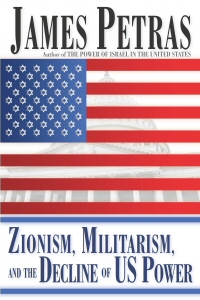
Zionism, the United States, and Hegemony in the Middle East

November 26, 2008

Zionism, Militarism, and the Decline OF US Power
By James Petras

Paperback: 192 pages
(Clarity Press, 2008)
ISBN-10: 0-932863-60-4
ISBN-13: 978-0-932863-60-7

Professor James Petras has written another book — Zionism, Militarism, and the Decline OF US Power — probing deeper into what he contends is a Zionist Power Configuration (ZPC) that has infiltrated and largely usurped US foreign policy even using the US military for its ends in the Middle East. Petras fills his book with lots of evidence backed by sound rationales.

Petras’s thesis is that Israel — and not Big Oil — was behind the push to invade and occupy Iraq. That has already happened. What concerns Petras now is the push by the ZPC to have the United States again breach international law and launch an attack against Iran.

Petras reasons that the ZPC’s purpose is to incorporate Palestine and consolidate its hegemony in the Middle East. Strategically, gaining and holding sway over the planet’s preeminent military power has been a major plank toward this goal.

The professor provides numerous examples of the sway the ZPC wields and how it wields it: through its propaganda and media arms (Petras cites how, pre-“war,” the Lobby produced about 8,800 pro-Iraq attack pieces which were circulated to major Anglo-American media versus zero pro-Iraq attack pieces published from Big Oil spokespeople); through its academic acolytes; through involving US soldiers to fight its wars (Petras charges that the Israel Firsters “ridicule the US military precisely to instigate them to prosecute wars and thereby avoid the loss of Israeli-Jewish lives”); through the relative silence of dissenting voices, including dissenting Jewish voices in mass media; through members of the US Congress beholden through acceptance of campaign contributions form the Lobby.

Campaign contributions turn out, actually, to be an investment. Through seeding the US Congress, Israel has become the prime beneficiary of US “aid,” even though Israel is a relatively well-to-do state, especially compared to many of its neighbors. Petras wavers on what the “US annual ‘tribute to Israel’” is. On page 68, he cites a figure of $6 billion a year; on page 68 he states $3 billion a year; on page 156, it is $2.4 billion a year; and on page 164 it is “well over $3 billion” a year. This irritation contributes to unevenness in Petras’s account.

Exacerbating this irritation is an uneven patchwork of endnotes. Sometimes key points are in the endnotes, and sometimes key points are not in the endnotes. For example, he writes that Big Oil is anxious and fearful about an Israeli-instigated warmongering destabilizing the Middle East citing a source for this claim (p. 32). On page 92 he claims electoral chicanery without citation. Whether the claims are true or not is beside the point, which is that the reader is hindered from checking the professor’s sources. And when there are endnotes, many convey scanty information (e.g., no author, no title, no page) that forces a reader to spend inordinate time tracking down a citation.

Petras, however, deserves kudos for taking on the Lobby which resorts to disreputable tactics to try and silence its critics. Petras does not shirk from identifying how he perceives the threat from the ZPC: “The lesson is clear: the rise of Judeo-fascism represents a clear and present danger to our democratic freedoms in the United States.”

The ZPC is ruthless says Petras, who observes that Israel reneges on obligations as an occupier in Palestine and engages in “meat-grinder genocidal policies in Gaza.” And yet, it has vulnerabilities, such as the “repeated failures and incredible stupidity of the Israeli intelligence agencies.”

The ZPC control apparatus is necessarily twined with the corporate media. “State provocations,” writes Petras, “require uniform mass media complicity in the lead-up to open warfare.”

With a massive media blitz and compliant government, Israel recruits US soldiers to fight its wars. The US, on the other hand, tries to get its victims to fight against their fellow countryfolk. This is a dubious strategy reasons Petras, as Iraqis fighters under occupation “recruited on basis of hunger and unemployment (caused by US war) are unreliable soldiers.”

This, according to Petras, is a losing tactic: “US colonization of Iraq is a blatant denial of the conditions necessary for reconciliation.”

Just how losing a strategy it is to run a militaristic economy is evidenced by the massive capitalistic expansion of non-belligerent China. In fact, the US is becoming less competitive and falling into an increasingly dire economic situation

Petras describes a schism among Jewry. He notes that “most Jewish Americans differ from the leaders of the major American Jewish organizations” … but that “they have not or do not challenge” this leadership. Antiwar sentiment among Jewish Americans, finds Petras, is quite vague.

He writes that “both the progressive majority of Jews and the reactionary minority … have a fundamental point of agreement and convergence: support for and identity with Israel and its anti-Arab prejudices, its expansion, and the dispossession of Palestine [sic].”

Given that the peace movement has gone AWOL, this bodes ill for the peoples of the Middle East. Here again, Petras holds the ZPC responsible since he charges that it has also infiltrated the antiwar movement and split it, rendering it anemic.

Petras notes that everywhere he visits around the globe people from all walks ask him why American citizens tolerate the killing done by the US government/military. This is a good question, but another question is unasked by Petras. Why do these citizens not demand the same answers from their complicit governments which, even when they do not contribute fighters to a so-called Coalition of the Willing, remain silent to the great criminal breaches of international law and the abandonment of morality?

That is why Petras’s thesis in Zionism, Militarism, and the Decline OF US Power is important: innocent people are dying for wicked reasons.

Kim Petersen is co-editor of Dissident Voice. He can be reached at: kim@dissidentvoice.org. Read other articles by Kim.

Foreign Press in Israel Fight Gaza Entry Ban

November 26, 2008

JERUSALEM – International journalists based in Israel appealed to the country’s Supreme Court on Monday to overturn a government decision barring foreign correspondents from entering the Gaza Strip.

The Foreign Press Association filed the court petition against the military’s Gaza commander, Defense Minister Ehud Barak and Interior Minister Meir Sheetrit after the government failed to heed a letter signed by heads of the world’s largest news organizations calling for the ban to be lifted.

The court petition charged the media ban constitutes “a grave and mortal blow against freedom of the press and other basic rights and gives the unpleasant feeling that the state of Israel has something to hide.” It requested an urgent hearing.

The Tel Aviv-based Foreign Press Association represents foreign correspondents working in Israel and the Palestinian territories.

Israel has long restricted movement across its border with Gaza, but it closed the area to all but essential supplies on Nov. 5 after an upsurge in Palestinian rocket fire. For the first time, that included a blanket ban on foreign reporters entering the territory.

The government routinely prevents Israeli journalists from entering Gaza because of fears for their safety, but up to now foreign reporters had been permitted in, even during times of heavy fighting.

Since the ban, coverage in Gaza has been largely left to local Palestinian staff and a handful of foreign journalists who entered before the ban took effect, including two Associated Press reporters.

Israel’s Defense Ministry says foreign journalists will be allowed in only once Gaza militants stop shooting.

The letter protesting the ban, signed by The AP, Reuters, the New York Times, the BBC, CNN and other major news organizations, was sent last week to Prime Minister Ehud Olmert.

In responding to the letter, Defense Ministry spokesman Shlomo Dror said Israel was displeased with international media coverage, which he said inflated Palestinian suffering and did not make clear that Israel’s measures were in response to Palestinian violence.

Top UN official: Israel’s policies are like apartheid of bygone era

November 25, 2008

United Nations General Assembly President Miguel D’Escoto Brockmann. (Reuters)

Last update – 15:07 25/11/2008
By Shlomo Shamir, Haaretz Correspondent and Haaretz Service
Tags: Palestinian Solidarity, UN
United Nations General Assembly President Miguel D’Escoto Brockmann on Monday likened Israel’s policies toward the Palestinians to South Africa’s treatment of blacks under apartheid.Israel’s actions in the West Bank and Gaza Strip were like “the apartheid of an earlier era,” said Brockmann, of Nicaragua, speaking at the annual debate marking the International Day of Solidarity with the Palestinian People.

He added: “We must not be afraid to call something what it is.”

Advertisement

Brockmann stressed that it was important for the United Nations to use the heavily-charged term since it was the institution itself that had passed the International Convention against the crime of apartheid.

Israeli ambassador to the UN Gabriela Shalev in September called Brockmann an “Israel hater” for having hugged Iranian President Mahmoud Ahmadinejad, a vocal enemy of Israel.

Meanwhile, other diplomatic attacks against Israel were expected Tuesday on the second day of the annual debate.

The event is usually observed on November 29, to coincide with the UN’s resolution in 1947 to establish a Jewish and an Arab state in Palestine.

The Palestinians, along with a group of Arab states, intend to use Tuesday’s debate, entitled “the Palestinian question and the situation in the Middle East,” for a public campaign directed at the international community about the the suffering of the Palestinian people under Israeli occupation. They will also denounce Israel as responsible for the lack of a solution for the Israeli-Palestinian conflict.

Speakers at the debate are expected to harshly criticize Israel for its policy in the territories, especially following UN Secretary General Ban Ki-moon’s complaint that Israel refused his request to alleviate the humanitarian crisis in the Gaza Strip.

Shalev will ask in her address Tuesday why the UN has turned November 29 into a day of mourning, but does not mention that on this day a resolution to establish two states was adopted with Israel’s consent.

“The UN must adopt new content and no longer accept the agenda foisted on it by the automatic majority, which sabotages the peace process’ progress in the region,” Shalev will say.

The two-day event includes several events and ceremonies at the UN headquarters, including movies and photography exhibitions showing alleged Palestinian hardships under Israeli occupation.

The debate is expected to end with the adoption of some 20 anti-Israel resolutions. In the past, these included denouncing Israel for annexing East Jerusalem and the Golan Heights in separate resolutions.

Deprivation and Desperation in Gaza

November 25, 2008

By JOE MOWREY | Counterpunch, Nov  24, 2008

As conditions in the Gaza strip approach a catastrophic level of deprivation, the world media, and in particular the U.S. media, remain largely silent. The United Nations, whose truckloads of food and medical supplies continue to be denied entry into Gaza by Israel, appears to be one of the few international voices of dissent concerning the collective punishment of 1.5 million human beings. This, despite the fact that more than 50% of the population in Gaza is comprised of children under the age of 15.

Israel claims to be defending itself against the crude, often homemade rockets which militant factions in Gaza fire randomly into southern Israel. Though it may be considered politically incorrect, this writer refuses to precede his remarks with the requisite, “It’s wrong for militant Palestinians to be firing rockets into Israel.” The ethics of Palestinian resistance to the Zionist colonization of Palestine and the dispossession of the Palestinian people is a subject for another article. The issue at hand is one of collective punishment. Regardless of the actions of certain factions in Gaza, the fact remains that Israel (with the approval of the U.S.and the world community) is depriving an entire civilian population of food, medicine and clean drinking water in response to the violent actions of a few among that population. By any civilized standard this behavior is wrong and should be condemned vociferously. To paraphrase the words of an alien from another planet in a not-so-great Hollywood movie of some years ago, every sentient being knows the difference between right and wrong.

Apparently not. Israel’s Foreign Minister and likely future Prime Minister, Tzipi Livni, recently dismissed the notion that Israel’s actions in Gaza amount to collective punishment and claimed those actions were a justifiable response to the rocket attacks on Israel. She stated, “The international community must be more decisive in making itself heard and in using its influence in the face of these attacks.”

To suggest that the international community should condemn “these attacks” by militant Palestinian factions, yet ignore the humanitarian disaster being imposed on Gaza by the government of Israel demonstrates a nearly incomprehensible level of hypocrisy. But more importantly, the fact that Jews are the ones perpetrating these unconscionable actions in Gaza is a tragedy of historic proportions. The Geneva Conventions, particularly those articles addressing the  of civilian populations, were largely crafted in response to the treatment of Jews by the Nazis during World War II. Has the sense of exclusivity and entitlement created by the Zionist experiment in Israel become so great that people there no longer see themselves in the mirror of their own history? The irony of Jews, among the most egregiously persecuted and maligned people in history, denying food to hundreds of thousands of children in order, allegedly, to insure their own security, is breathtaking. Who could ever have imagined such a thing?

As people of Gaza suffer, here in the U.S., the vast majority of so-called progressives continue to revel in the recent election of the first Black man to the Presidency. While Obama has garnered a great deal of political and financial support by pledging his unconditional support for the Zionist regime in Israel, he remains completely silent on the plight of the children of Gaza. Our first Black President not only refuses to speak out against the collective punishment of an oppressed people, he actively supports and encourages the regime responsible for this behavior. This too is a tragedy of historic proportions. Have we come this far in the struggle against racism in our country only to see Barack Obama put a minority face on U.S. support for violations of international law and essential human dignity by Israel? Again, one has to say, who could ever have imagined such a thing?

Each morning I peruse the alternative media online and hope to see at least some minor degree of outrage at the situation in Gaza. A small but courageous handful of progressive web sites dare to criticize Israel and speak out against the abuse of the Palestinian people. But for the most part, the glorious and powerful “NetRoots” movement is too busy congratulating itself on the so-called victory it has achieved in the recent elections, too busy celebrating the illusion of change which Barack Obama represents, to admit the absence of any indication of substantive change in U.S. foreign policy in Palestine or the Middle East under his coming administration.

Does it ever occur to those who so blindly and passionately rallied ‘round their candidate for the Presidency that they might now use their voices to encourage him to oppose the human rights abuses being orchestrated in Gaza? The sad reality is, not even a chorus of such voices is likely to alter the course Obama appears to have taken. He has surrounded himself with a familiar cast of armchair militarists, corporatists and hard core pro-Zionist zealots who will continue to give their unconditional support to Israel regardless of what barbaric tactics the government there uses to advance the colonization of Palestine. He is choosing to turn his back on the men, women and children in Gaza and the West Bank who suffer chronic malnutrition, desperate poverty, dispossession and daily humiliation at the hands of the Israeli military.

We should stand up in opposition to instances of human rights abuses whenever and wherever they occur. The situation in Gaza is only one on an unfortunately long list, locally, nationally and internationally. And U.S. government (that means you and me) support for and complicity in many such instances is no secret. If each of us were to do just one thing per week to address these issues, the result might surprise us all. Take a minute out from the long and endless chatter of day to day living and speak to a friend about the idea of social equality. Write one letter to the editor of your local paper in support of human rights. Spend just one percent of your online hours learning the truth about our complicity as U.S. citizens in the exploitation and degradation of other people and their cultures. Turn off your television. Go stand on a corner with a sign to protest war. Wear a button promoting peace and justice. One small thing at a time.

To those who became politically active, possibly for the first time, and expended their valuable enthusiasm and energy in order to see Barack Obama elected: thank you for being a part of history. Now why not try on the mantel of social activism? Write our President-elect a letter and suggest that he at least acknowledge the suffering of the people in Gaza. It is doubtful it will change him or his policies, but it may change you. And that truly is “change we can believe in.”

Every sentient being knows the difference between right and wrong. The question is, why do so few of us act on that knowledge?

Joe Mowrey is an anti-war and Palestinian rights activist. He lives in Santa Fe, New Mexico, with his spouse, Janice, and their three canine enablers. You can write to him at jmowrey@ix.netcom.com.

Israeli army brass advocate timely war on Iran

November 24, 2008

The Global Research, Nov 23, 2008

Press TV

An Israeli security assessment has recommended devising contingency plans to attack Iran even if it means courting a conflict with the US.

The leaked paper drawn up by Israeli military chiefs maintains that Tel Aviv has a ‘limited’ window of opportunity to act against Iran before the country obtains a nuclear weapon, claiming that in 2009, Israel might have to face a nuclear Iran ‘alone’.

Senior Israeli officials had earlier expressed concern that an Obama administration might lead up to the restoration of Washington-Tehran relations.

President-elect Barack Obama has vowed to begin direct and unconditional talks with top Iranian officials on the country’s long-disputed nuclear program.

Israel alleges that Iran, a signatory to the nuclear Non-Proliferation Treaty (NPT), has plans ‘to build a nuclear weapon’. Under the allegation, Israeli officials have long argued that the use of military force is a legitimate option in retarding the country’s nuclear progress.

Iran denies the Israeli claim, insisting that the country’s nuclear activities are solely directed at the civilian applications of the technology.

The Israeli army assessment claims ‘Iran’s threat to Israel’s survival’ is at the top of the list of challenges facing Tel Aviv and recommends close cooperation with the US to prevent a Washington-Tehran rapprochement.

According to the assessment, Israel must therefore draw up a plan for military action against Iran, in case other countries show reluctance to counter the Islamic Republic’s nuclear program.

The paper is to be presented to the cabinet next month as part of the National Security Council’s annual situation assessment, Haaretz reported.

This comes as outgoing Israeli Prime Minister Ehud Olmert arrived in Washington on Sunday for talks with US President George W. Bush.

During his three-day stay, Olmert is expected to attempt to make President Bush pledge to counter the Iranian nuclear program.

Earlier in November, an unnamed senior European Union diplomat said that the bloc is concerned that ‘a possible Israeli strike against Iran is not completely off the radar’.

The official suggested that the perfect time for Israel to strike Iranian nuclear installations ‘is between now and January 20’ — when US President-elect Barack Obama takes office.