| AlJazeera, Aug 21, 2009 |
|||
At least 10 people have been killed after a suspected US drone fired missiles into Pakistan’s North Waziristan region, Pakistani intelligence agency officials have said. The raid on Friday on Darpa Kheil village was the third such attack this month in Pakistan’s ethnic Pashtun tribal areas by what are believed to be CIA-operated pilotless aircraft. “The attack caused a huge explosion,” said a Reuters reporter in Miranshah, about 2km from the scene of the raid. Drones were seen flying over the area after the blast, he said. Madrassa attacked Darpa Kheil village is home to a large madrassa, or religious school, set up by Jalaluddin Haqqani, a former veteran Afghan fighter commander who is also a senior Taliban leader. US drone aircraft attacked the complex in September last year, killing 23 people, most of them members of Haqqani’s family. Pakistani and US officials believe Baitullah Mehsud, the Pakistani Taliban chief, was killed in a similar strike in neighbouring South Waziristan on August 5. Pakistan, an ally of the US, which is fighting al-Qaeda and Taliban fighters in the region, officially objects to US drone attacks on its soil, saying they violate its sovereignty. |
Archive for the ‘warmongers’ Category
Deadly ‘US drone raid’ in Pakistan
August 21, 2009
Perpetual War for Perpetual War
August 10, 2009Get ready for a “lasting military presence” in Iraq
By Jeff Huber | The American Conservative, Aug 8, 2009
U.S. Army Col. Timothy R. Reese says it’s time for the U.S. to “declare victory” in Iraq and “go home.” It was time to declare victory and go home in January 2007, when the Bush administration decided to ignore the recommendations of the Iraq Study Group and charged off on its cockamamie “surge” strategy.
The original stated objective of the surge was political reconciliation in Iraq. By September 2007, when it was clear that the political objective was not in sight, Gen. David Petraeus pulled a bait-and-switch and announced that the military objectives of the surge were being met. Petraeus hagiographer Thomas E. Ricks slipped Freudian in February 2009 when he confessed that Petraeus’s goal was never to end the Iraq conflict but to trick Congress and the American public into extending it indefinitely by achieving short-term results though bribing Iraq’s militias.
According to Colonel Reese, chief of the Baghdad Operations Command Advisory Team, the surge’s real objectives still haven’t been met and never will be. In a recent memorandum, Reese asserts that “the ineffectiveness and corruption” of Iraq’s government ministries is “the stuff of legend.” The government is “failing to take rational steps to improve its electrical infrastructure and to improve their oil exploration, production and exports.” There is “no progress towards resolving the Kirkuk situation,” transition the Sons of Iraq into the Iraqi Security Forces “is not happening” and “the Kurdish situation continues to fester.” Violent political intimidation is “rampant.” Iraq’s security forces are a disaster. The officer corps is corrupt. Enlisted men are neglected and mistreated. Cronyism and nepotism are rampant. Laziness, lack of initiative, and absence of basic military discipline are endemic. Iraq’s military leadership is incapable of leading; it can’t plan ahead, it can’t stand up to the Shiite political parties, it can’t stick to its agreements.
The U.S. military in Iraq has accomplished “all that can be expected,” Reese says.
Gen. Ray Odierno’s propaganda officer, Lt. Col. Josslyn Aberlem, told the New York Times that Reese’s memo “does not reflect the official stance of the U.S. military.” The memo “Reflects one person’s personal view at the time we were first implementing the Security Agreement post-30 June,” Abaelem said. “Since that time many of the initial issues have been resolved and our partnerships with Iraqi Security Forces and [government of Iraq] partners now are even stronger than before 30 June.”
Right. We shaved our monkey in Iraq for six years and change, but since June 30 everything’s gone hunky dory.
Oddly enough, Defense Secretary Robert Gates said on July 29 that the relatively low levels of violence in Iraq might allow commanders to “moderately accelerate” troops reductions. He added, though, that Odierno would have to recommend speeding up the withdrawal before any decision is made. That pretty much tells you how things work in the Department of Defense. Gates isn’t in charge of his four-stars; they’re in charge of him.
Odie is on record as wanting to keep 35,000 U.S. troops in Iraq through 2015, so, predictably enough, on August 4 he rejected the idea of an accelerated pullout, saying that the surge hasn’t reached its goals yet and we need to “stay the course.” (Yes, he really used that moronic Bush-era mantra.) The Desert Ox doesn’t seem particularly concerned about the Status of Forces Agreement that requires all U.S. troops to leave Iraq by the end of 2011. Iraqi President Nuri al-Maliki doesn’t appear to be overly committed to the agreement either. In a July 23 appearance at the United States Institute of Peace in Washington, Maliki opened the door for indefinite U.S. presence in his country, saying, “If Iraqi forces need more training and support, we will reexamine the agreement at that time, based on our own national needs.”
Even Reese isn’t all that committed about U.S. forces leaving Iraq. In his memo, he says that during the withdrawal period the U.S. and Iraqi governments “should develop a new strategic framework agreement that would include some lasting military presence at 1-3 large training bases, airbases, or key headquarters locations.”
Lasting military presence. That’s been the objective of the neoconservatives all along. In their September 2009 manifesto Rebuilding America’s Defenses Cheney’s pals at the infamous Project for the New American Century argued, “While the unresolved conflict with Iraq provides the immediate justification, the need for a substantial American force presence in the Gulf transcends the issue of the regime of Saddam Hussein.” The neocons’ Pax Americana vision has translated into the Pentagon’s “long war,” a strategy that does not seek to win wars but rather to create a sequel to the Cold War in which Islamofacism substitutes for communism and puny Iran, whose defense budget is less than one percent of ours, replaces the Soviet juggernaut.
That might be justified if military applications overseas were making us safer from terrorism, but they are not. In 2008 the highly respected national security analysts at Rand Corporation released a report titled How Terrorist Groups End. The study involved a comprehensive analysis of terror organizations that existed worldwide between 1968 and 2006. 83 percent of the groups ended as a result of policing and political action. Military force accounted for a mere 7 percent of success against terrorists. Rand analysts recommend that the best course of counterterrorism actions should involve “a light U.S. military footprint or none at all.” We’re almost certainly, as Donald Rumsfeld suspected in 2004, making multiple new terrorists for every one we capture or kill. We have discovered a new style of warfare: reverse attrition. The more enemy we attrite the more enemy we have.
All the talk about withdrawing from Iraq is an Orwellian card trick. Reese says our “lasting military presence” should not “include the presence of any combat forces save those for force protection needs or the occasional exercise.” Why would we need to leave noncombat forces behind? So they can cook and clean for the combat forces that provide them force protection? The exercises we might do with the Iraqis would involve practicing for the invasions of Iran and Syria, which is the real reason the warmongery wants to keep an enduring base of operations in Iraq. There’s no need to conduct defensive exercises. None of Iraq’s neighbors is capable of invading and occupying it or crazy enough to try.
President Obama’s promise to remove all U.S combat troops from Iraq by August 2010 was also a see-through canard. As Gareth Porter revealed in March, the “advisory and assistance brigades” that will remain after that date will in fact be combat brigades augmented by a handful of advisers and assistants. The Cold War justified defense spending for a half-century. Now, the Pentagon is trying to validate its existence with another long war in the Middle East.
Sun Tzu famously said, “No nation ever profited from a long war.” The 27- year Peloponnesian War ended Athens’ reign as a superpower. The Thirty Years’ War Balkanized the Holy Roman Empire, dividing German power among multiple smaller states. The 46-year Cold War forced the Soviet Union to change its name back to Russia.
Don’t expect us to withdraw from Iraq or the Bananastans any time soon. The American warmongery, a confluence of Big War, Big Energy, Big Jesus, Big Israel, Big Brainwash, and Big Brother, is trying to entangle us in a state of constant armed conflict that will carry on into the next American century. There’s no need for anyone to challenge our hegemony; all they have to do is sit back and watch us collapse under the weight of our own stupidity.
Commander Jeff Huber, U.S. Navy (Retired) writes at Pen and Sword. Jeff’s novel Bathtub Admirals
The Myths of Afghanistan, Past and Present
August 6, 2009William Blum, Counterpunch, Aug 6, 2009
On the Fourth of July, Senator Patrick Leahy declared he was optimistic that, unlike the Soviet forces that were driven from Afghanistan 20 years ago, US forces could succeed there. The Democrat from Vermont stated:
“The Russians were sent running as they should have been. We helped send them running. But they were there to conquer the country. We’ve made it very clear, and everybody I talk to within Afghanistan feels the same way: they know we’re there to help and we’re going to leave. We’ve made it very clear we are going to leave. And it’s going to be turned back to them. The ones that made the mistakes in the past are those that tried to conquer them.” (Vermont TV station WCAX, July 4, 2009, WCAX.com)
Leahy is a long-time liberal on foreign-policy issues, a champion of withholding US counter-narcotics assistance to foreign military units guilty of serious human-rights violations, and an outspoken critic of robbing terrorist suspects of their human and legal rights. Yet he is willing to send countless young Americans to a living hell, or horrible death, or maimed survival.
And for what? Every point he made in his statement is simply wrong.
The Russians were not in Afghanistan to conquer it. The Soviet Union had existed next door to the country for more than 60 years without any kind of invasion. It was only when the United States intervened in Afghanistan to replace a government friendly to Moscow with one militantly anti-communist that the Russians invaded to do battle with the US-supported Islamic jihadists; precisely what the United States would have done to prevent a communist government in Canada or Mexico.
It’s also rather difficult for the United States to claim that it’s in Afghanistan to help the people there when it’s killed tens of thousands of simply for resisting the American invasion and occupation or for being in the wrong place at the wrong time; not a single one of the victims has been identified as having had any kind of connection to the terrorist attack in the US of September 11, 2001, the event usually cited by Washington as justification for the military intervention. Moreover, Afghanistan is now permeated with depleted uranium, cluster bombs-cum-landmines, white phosphorous, a witch’s brew of other charming chemicals, and a population, after 30 years of almost non-stop warfare, of physically and mentally mutilated human beings, exceedingly susceptible to the promise of paradise, or at least relief, sold by the Taliban.
As to the US leaving … utterly meaningless propaganda until it happens. Ask the people of South Korea — 56 years of American occupation and still counting; ask the people of Japan — 64 years. And Iraq? Would you want to wager your life’s savings on which decade it will be that the last American soldier and military contractor leaves?
It’s not even precise to say that the Russians were sent running. That was essentially Russian president Mikhail Gorbachev’s decision, and it was more of a political decision than a military one. Gorbachev’s fondest ambition was to turn the Soviet Union into a West-European style social democracy, and he fervently wished for the approval of those European leaders, virtually all of whom were cold-war anti-communists and opposed the Soviet intervention into Afghanistan.
William Blum is the author of Killing Hope: U.S. Military and CIA Interventions Since World War II, Rogue State: a guide to the World’s Only Super Power. and West-Bloc Dissident: a Cold War Political Memoir.
He can be reached at: BBlum6@aol.com
Bush’s Hit Teams
July 17, 2009
By Robert Parry, Consortiumnews.com, July 15, 2009
Despite the new controversy over whether a global CIA “hit team” ever went operational, there has been public evidence for years that the Bush administration approved “rules of engagement” that permitted executions and targeted killings of suspected insurgents in Iraq and Afghanistan.
In effect, President George W. Bush transformed elite units of the U.S. military – including Special Forces and highly trained sniper teams – into “death squads” with a license to kill unarmed targets on suspicion that they might be a threat to American occupying forces.
In the recent public debate over whether Bush also authorized the CIA to assemble teams of assassins to roam the world hunting al-Qaeda suspects, the U.S. news media has cited the distinction between such face-to-face executions and the CIA’s use of remote-controlled Predator drones firing missiles to kill groups of suspected insurgents in or near the war zones.
However, the evidence is that the Bush administration also permitted U.S. military units to engage in close-quarter executions when encountering alleged insurgents, even if they were unarmed and presented no immediate threat to American or allied troops.
This reality surfaced in 2007 with the attempted prosecutions of several U.S. soldiers whose defense attorneys cited “rules of engagement” that permitted killing suspected insurgents.
One case involved Army sniper Jorge G. Sandoval Jr., who was acquitted by a U.S. military court in Baghdad on Sept. 28, 2007, in the murders of two unarmed Iraqi men – one on April 27, 2007, and the other on May 11, 2007 – because the jury accepted defense arguments that the killings were within the approved rules. (Sandoval was convicted of lesser charges relating to planting evidence on a victim to obscure the facts of the homicide.)
The Sandoval case also revealed a classified program in which the Pentagon’s Asymmetric Warfare Group encouraged U.S. military snipers in Iraq to drop “bait” – such as electrical cords and ammunition – and then shoot Iraqis who picked up the items, according to evidence in the Sandoval case. [Washington Post, Sept. 24, 2007]
Afghan Execution
Another case of authorized murder of an insurgent suspect surfaced at a military court hearing at Fort Bragg, North Carolina, in mid-September 2007. Two U.S. Special Forces soldiers took part in the execution of an Afghani who was suspected of leading an insurgent group.
Though the Afghani, identified as Nawab Buntangyar, responded to questions and offered no resistance when encountered on Oct. 13, 2006, he was shot dead by Master Sgt. Troy Anderson on orders from his superior officer, Capt. Dave Staffel.
According to evidence at the Fort Bragg proceedings, an earlier Army investigation had cleared the two soldiers because they had been operating under “rules of engagement” that empowered them to kill individuals who had been designated “enemy combatants,” even if the targets were unarmed and presented no visible threat.
The troubling picture was that the U.S. chain of command, presumably up to President Bush, authorized loose “rules of engagement” that allowed targeted killings – as well as other objectionable tactics including arbitrary arrests and indefinite detentions, “enhanced interrogations” otherwise known as torture, kidnappings in third countries with “extraordinary renditions” to countries that torture, secret CIA prisons, and “reeducation camps” for younger detainees.
Typical of Washington politics, however, the loudest arguments have been over whether the Bush administration adequately notified Congress of covert aspects of these operations, including the reported CIA-assassination plan which allegedly was ordered kept hidden from the House and Senate intelligence oversight committees by Vice President Dick Cheney.
Some Republicans have said Democrats proved that they don’t have the toughness to defend U.S. national security by raising questions about the hit team, while pro-Democratic pundits note that the Bush administration apparently demonstrated its incompetence by failing to get the assassination program off the ground. In other words, the debate is centered on peripheral issues, not on the substance of extrajudicial murders.
Similarly, Attorney General Eric Holder is said to be leaning toward appointing a special prosecutor to investigate some CIA personnel for torturing detainees, but only if they went beyond the parameters of torture that had been spelled out by Bush administration lawyers. In other words, senior government officials who sanctioned limited waterboarding and other torture techniques would not be held to account, only overzealous interrogators who went even further.
A Sordid History
Like torture, assassinations and the use of other lethal force against unarmed suspects and civilians violates a variety of laws and has a notorious history in irregular warfare, both regarding cross-border murders and violent repression of an indigenous resistance in which guerrillas and their political supporters blend in with the local population.
And, at least inside and near the war zones of Iraq and Afghanistan, Bush’s “global war on terror” appears to have recreated what was known during the Vietnam War as Operation Phoenix, a program that assassinated Vietcong cadre, including suspected communist backers.
Through a classified Pentagon training program known as “Project X,” the lessons of Operation Phoenix from the 1960s were passed on to Third World armies, especially in Latin America, giving a green light to some of the “dirty wars” that swept the region, causing tens of thousands of political murders, widespread use of torture, and secret detentions.
Bush’s alleged plan for global hit teams also has similarities to “Operation Condor” in which South American right-wing military regimes in the 1970s sent assassins on cross-border operations to eliminate “subversives.”
Despite quiet support and encouragement for Latin American “death squads” through much of the 1970s and 1980s, the U.S. government presented itself as the standard-bearer for human rights and criticized American adversaries that engaged in extrajudicial killings, torture and arbitrary detentions.
That gap between American rhetoric and reality widened after 9/11 as Bush announced his “global war on terror,” while continuing to impress the American news media with pretty words about his commitment to human rights – as occurred in his address to the United Nations on Sept. 25, 2007.
Under Bush’s double standards, he took the position that he could override both international law and the U.S. Constitution in deciding who would get basic human rights and who wouldn’t. He saw himself as the final judge of whether people he deemed “bad guys” should live or die, or possibly face indefinite imprisonment and torture.
Yet, whatever Bush and other higher-ups approved as “rules of engagement,” the practice of murdering unarmed suspects – especially after they’ve been detained – violated the law of war and could have opened up the offending country’s chain of command to war-crimes charges.
However, while such actions by leaders of, say, Serbia or Sudan would provoke demands for war-crimes tribunals, other rules apply when the offending nation is the United States. Given its “superpower” status, the United States and its senior leadership appear to be effectively beyond the reach of international law – and in the case of Bush, beyond domestic accountability.
Downplaying a Slaughter
By and large, the U.S. military also has failed to impose serious punishments on American troops implicated in extrajudicial killings and massacres, even high-profile ones like the killing of two dozen Iraqis in Haditha on Nov. 19, 2005, after one Marine died from an improvised explosive device.
According to published accounts of U.S. military investigations, the dead Marine’s comrades retaliated by pulling five men from a cab and shooting them, and clearing two homes where civilians, including women and children, were slaughtered.
The Marines then tried to cover up the killings by claiming that the civilian deaths were caused by the original explosion or a subsequent firefight, according to investigations by the U.S. military and human rights groups.
One of the accused Marines, Sgt. Frank Wuterich, gave his account of the Haditha killings in an interview with CBS’s “60 Minutes,” including an admission that his squad tossed a grenade into one of the residences without knowing who was inside.
“Frank, help me understand,” asked interviewer Scott Pelley. “You’re in a residence, how do you crack a door open and roll a grenade into a room?”
“At that point, you can’t hesitate to make a decision,” Wuterich answered. “Hesitation equals being killed, either yourself or your men.”
“But when you roll a grenade in a room through the crack in the door, that’s not positive identification, that’s taking a chance on anything that could be behind that door,” Pelley said.
“Well, that’s what we do. That’s how our training goes,” Wuterich said.
Eight Marines were initially charged in the Haditha case, but six cases were dropped, one Marine was acquitted, and Wuterich’s case has been delayed by legal skirmishing. As in earlier cases, such as the Abu Ghraib torture scandal, courts martial have mostly focused on rank-and-file soldiers.
The lack of high-level accountability appears to stem from the fact that the key instigators of both the illegal invasion of Iraq and the harsh tactics employed in the “global war on terror” were former President Bush, ex-Vice President Dick Cheney and other senior officials. President Barack Obama has made clear he doesn’t want Bush and his top aides punished.
Yet, not only did Bush order an aggressive war – what World War II’s Nuremberg Tribunal called “the supreme international crime differing only from other war crimes in that it contains within itself the accumulated evil of the whole” – but Bush pumped U.S. troops full of false propaganda by linking Iraq with the 9/11 attacks.
Bush’s subliminal connections between the Iraq War and 9/11 continued years after U.S. intelligence dismissed any linkage. For instance, on June 18, 2005, more than two years into the Iraq War, Bush justified the invasion by telling the American people that “we went to war because we were attacked” on 9/11.
Little wonder that a poll of 944 U.S. military personnel in Iraq – taken in January and February 2006 – found that 85 percent believed the U.S. mission in Iraq was mainly “to retaliate for Saddam’s role in the 9/11 attacks.” Seventy-seven percent said a chief war goal was “to stop Saddam from protecting al-Qaeda in Iraq.”
Bush’s rhetorical excesses had the predictable effect of turning loose a revenge-seeking and heavily armed U.S. military force on the Iraqi population.
‘Salvador Option’
By early 2005, with the Iraqi insurgency growing, an increasingly frustrated Bush administration also debated a “Salvador option” for Iraq, an apparent reference to the “death squad” operations that decimated the ranks of perceived leftists who were opposed to El Salvador’s right-wing military junta in the early 1980s.
According to Newsweek magazine, President Bush was contemplating the adoption of that brutal “still-secret strategy” of the Reagan administration as a way to get a handle on the spiraling violence in Iraq.
“Many U.S. conservatives consider the policy [in El Salvador] to have been a success – despite the deaths of innocent civilians,” Newsweek wrote.
The magazine also noted that many of Bush’s advisers were leading figures in the Central American operations of the 1980s, such as Elliott Abrams, who became an architect of Middle East policy on the National Security Council.
In the Iraqi-sniper case, Army sniper Sandoval admitted killing an Iraqi man near the town of Iskandariya on April 27, 2007, after a skirmish with insurgents. Sandoval testified that his team leader, Staff Sgt. Michael A. Hensley, ordered him to kill a man cutting grass with a rusty scythe because he was suspected of being an insurgent posing as a farmer.
The second killing occurred on May 11, 2007, when a man walked into a concealed location where Sandoval, Hensley and other snipers were hiding. After the Iraqi was detained, another sniper, Sgt. Evan Vela, was ordered to shoot the man in the head by Hensley and did so, according to Vela’s testimony at Sandoval’s court martial.
Sandoval and Hensley were acquitted of murder charges because a military jury concluded that their actions were within the rules of engagement. (Like Sandoval, Hensley was convicted of lesser charges relating to planting evidence.) But Vela was convicted of killing an unarmed Iraqi civilian and planting evidence on the body, leading to a 10-year prison sentence.
Regarding the Afghanistan case, Special Forces Capt. Staffel and Sgt. Anderson were leading a team of Afghan soldiers when an informant told them where a suspected insurgent leader was hiding. The U.S.-led contingent found a man believed to be Nawab Buntangyar walking outside his compound near the village of Hasan Kheyl.
While the Americans kept their distance out of fear the suspect might be wearing a suicide vest, the Afghanis questioned the man about his name and the Americans checked his description against a list from the Combined Joint Special Operations Task Force Afghanistan, known as “the kill-or-capture list.”
Concluding that the man was insurgent leader Nawab Buntangyar, Staffel gave the order to shoot, and Anderson – from a distance of about 100 yards away – fired a bullet through the man’s head, killing him instantly.
The soldiers viewed the killing as “a textbook example of a classified mission completed in accordance with the American rules of engagement,” the International Herald Tribune reported. “The men said such rules allowed them to kill Buntangyar, whom the American military had designated a terrorist cell leader, once they positively identified him.”
Staffel’s civilian lawyer Mark Waple said the Army’s Criminal Investigation Command concluded that the shooting was “justifiable homicide,” but a two-star general in Afghanistan instigated a murder charge against the two men. That case, however, floundered over accusations that the charge was improperly filed. [IHT, Sept. 17, 2007]
The U.S. news media has given the Fort Bragg case only minor coverage concentrating mostly on the legal sparring. The New York Times’ inside-the-paper, below-the-fold headline on Sept. 19, 2007, was “Green Beret Hearing Focuses on How Charges Came About.”
The Washington Post did publish a front-page story on the “bait” aspect of the Sandoval case – when family members of U.S. soldiers implicated in the killings came forward with evidence of high-level encouragement of the snipers – but the U.S. news media treated the story mostly as a minor event and drew no larger implications.
The greater significance of the cases is that they confirm the long-whispered allegations that the U.S. chain of command had approved standing orders giving the U.S. military broad discretion to kill suspected militants on sight.
Whatever the full story about President Bush’s CIA hit team, the facts are already clear that his “global war on terror” had morphed into an international “dirty war” with Bush now having passed off command to President Obama.
Robert Parry broke many of the Iran-Contra stories in the 1980s for the Associated Press and Newsweek. His latest book, Neck Deep: The Disastrous Presidency of George W. Bush, was written with two of his sons, Sam and Nat, and can be ordered at neckdeepbook.com. His two previous books, Secrecy & Privilege: The Rise of the Bush Dynasty from Watergate to Iraq and Lost History: Contras, Cocaine, the Press & ‘Project Truth’ are also available there. Or go to Amazon.com.
Clinton: US Won’t Hesitate to Use Military Against Iran
July 16, 2009Not a Threat, It’s a Promise, Secretary of State Tells CFR
In a high-profile policy address before the Council on Foreign Relations (CFR), Secretary of State Hillary Clinton declared that the US wouldn’t not hesitate to use its military to “defend our friends, our interests, and above all, our people” during the segment discussing Iran.
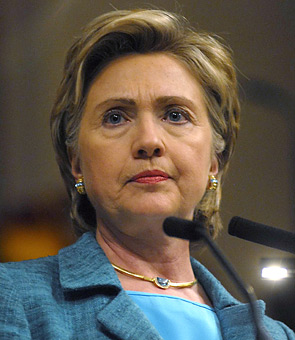 She elaborated on the declaration with “this is not an option we seek nor is it a threat; it is a promise.” Clinton also warned Iran that the US offer to hold talks, which she had previously said she didn’t expect to work to begin with, would not be open-ended and that “our willingness to talk is not a sign of weakness.”
Today’s comments are the latest in a long line of bellicose rhetoric coming from the Secretary of State. Last month during a television interview she said that Iran was risking the possibility of a US invasion, citing the disastrous 2003 invasion of Iraq as a model.
The US has been demanding that the Iranian government abandon its civilian nuclear energy generation program, and several officials have claimed, despite a stark lack of evidence, that Iran is working on nuclear weapons. The IAEA has pointed out no evidence for the accusation exists, and America’s own National Intelligence Estimate says they don’t believe Iran has an active weapons program either.
UK: How many more will die in vain before we withdraw?
July 16, 2009The attempt to exploit soldiers’ deaths to win support for the shameful war in Afghanistan thankfully isn’t working
-

-
- Seumas Milne
- guardian.co.uk, Wednesday 15 July 2009 22.00 BST
All week politicians, media and the military have strained every nerve to turn public sympathy over the deaths of British squaddies into support for the US-led occupation of Afghanistan. After a year of parades, a new Armed Forces Day and a stream of censored reports of derring-do from the frontline, the killing of 15 soldiers in 10 days has triggered a barrage of war propaganda. Having all but ignored the same number who died in Helmand province last month, every tabloid and Whitehall stop has been pulled out to capitalise on the emotions unleashed by the continuing sacrifice of British teenagers in an endless war.
From the Ministry of Defence-orchestrated processions of coffins through the Wiltshire village of Wootton Bassett to the black ties worn by Sky TV presenters as they address generals as “sir”, the message is clear: this war is a “patriotic duty”, in the prime minister’s words. The only argument in parliament yesterday was whether the government had provided enough helicopters and boots on the ground to do the job.

 Peace and Justice Post
Another 45,000 US troops needed in Afghanistan, military adviser says
August 11, 2009Nato needs to change its strategy in Afghanistan, says Anthony Cordesman, a military adviser
Anthony Cordesman, an influential American academic who is a member of a team that has been advising General Stanley McChrystal, now in charge of Nato forces in Afghanistan, also said that to deal with the threat from the Taleban the size of the Afghan National Army might have to increase to 240,000.
Continues >>
Share this:
Tags:Afghanistan, Anthony Cordesman, more troops, NATO forces, United States
Posted in Afghanistan, Commentary, imperialism, Uncategorized, US policy, USA, war, warmongers | Leave a Comment »