Archive for the ‘USA’ Category

Drawing the Future From the Past

December 7, 2008

By Channapha Khamvongsa | Foreign Policy in Focus, Dec 5, 2008

The bombing was relentless. From 1964 to 1973, the United States dropped more than 2 million tons of ordnance on Laos. That’s a planeload of bombs every eight minutes, 24 hours a day, for nine years. Laos has the unfortunate distinction of being the most heavily bombed country in the history of the world.

“In the area of Xieng Khoang, the place of my birth, there was health, good earth, and fine weather,” one survivor, a 33-year-old man, recalls of that period. “But then the airplanes came, bombing the rice fields and the forests, making us leave our land and rice fields with great sadness. One day a plane came bombing my rice field as well as the village. I had gone very early to harrow the field. I thought, ‘I am only a village rice farmer, the airplane will not shoot me.’ But that day truly it did shoot me and wounded me together with my buffalo, which was the source of a hundred thousand loves and a hundred thousand worries for me.”

For nearly three decades, the U.S. secret war in Laos and the impact of the most massive bombing campaign in the world was nearly forgotten. For those who remembered, the events seemed surreal. They witnessed the reckless destruction of a people and their land, and careful efforts by the U.S. government to conceal it. For those too young to know, gathering information and knowledge of this history was scattered and fragmented. It seemed the secret war in Laos and its aftermath would remain a secret.

But then a remarkable set of drawings and eyewitness accounts came to light. Laotian villagers put their memories on paper in the 1970s to depict the secret bombing of their country. This trove of reminiscences became the inspiration for Legacies of War. Founded by Laotian Americans in 2004, the project raises awareness about the history of the Vietnam War-era bombing in Laos. Using a unique combination of art, culture, education, community organizing, advocacy, and dialogue, Legacies of War also works for the removal of unexploded bombs in Laos, to provide space for healing the wounds of war, and to create greater hope for a future of peace.
A Secret War, a People Scattered

When the United States withdrew from Indochina, the “Secret War” in Laos was lost to history. But the legacy of the war lives on. Up to 30% of the cluster bombs dropped by the United States in Laos failed to detonate, leaving extensive contamination from unexploded ordnance (UXO) in the countryside. That translates into 78 to 130 million unexploded bomblets. Over one-third of the land in Laos is contaminated. These “bombies,” as the Lao now call them, have killed or maimed more than 34,000 people since the war’s end, and continue to claim more innocent victims every day. About 40% of accidents result in death, and 60% of the victims are children. UXO remains a major barrier to the safety, health, livelihoods, and food security of the people of Laos.

The war also displaced up to one-third of the Lao population. Nearly 750,000 would eventually become refugees in France, Australia, and Canada, among other countries. Over 350,000 refugees from Laos came to the United States after having experienced war, destruction, death, imprisonment, family separation, loss of homeland, loss of identity, and loss of control over their destinies. Many had undiagnosed post-traumatic stress disorder. But these weren’t things Laotian refugees had the luxury to contemplate, for basic economic survival trumped all other needs.
Drawing on the Past

Between December 1970 and May 1971, Fred Branfman, an American, and Boungeun, a Lao man, collected illustrations and narratives in the Vientiane refugee camps, where bombing victims fled. The drawings and narratives represent the voiceless, faceless, and nameless who endured an air war campaign committed in secrecy. Drawn in pencil, pens, crayons, and markers, they are raw and stark, reflecting the crude events that shaped their reality. The simplicity of the narration and drawings emphasize the illustrators’ identities as ordinary villagers who bore witness to a devastating event.

For instance, an 18-year-old woman remembers, “In the year 1967, my village built small shelters in the forest and we had holes in the bamboo thicket on top of the hill. It was a place to which we could flee. But there were two brothers who went out to cut wood in the forest. The airplanes shot them and both brothers died. Their mother and father had just these two sons and were both in the same hole with me. I think with much pity about this old father and mother who were like crazy people because their children had died.”

Each of the illustrations demonstrates the violence of warfare. However, the images of blood and death are contradicted by the memories of the scenic and peaceful village life these survivors once lived. Scenes show farmers tending to their rice fields, monks praying at the temple, women going to the market, and children playing in the schoolyard. The drawings capture the very moments when their lives and society were forever altered. The illustrations and narratives are at the heart of the Legacies of War National Traveling Exhibition, which is accompanied by historical photos, maps and other relevant documents to give context to the decade-long bombings.

Only a small circle of individuals knew of the existence of these illustrations. The pictures hadn’t been seen in decades, not since the end of the war. A fortuitous meeting between me and Institute for Policy Studies director John Cavanagh led to the return of the illustrations to the Lao American community. In the last several years, thousands of visitors have seen the illustrations through the Legacies of War traveling exhibit and other community forums. Although most Laotian Americans didn’t experience the same horrors depicted in the drawings, the illustrations invoke memory of their own stories of refuge, survival, and resilience.

The reaction to the drawings was instructive to Legacies’ work. Initially considered an artifact, the illustrations have become a living document. One at a time, each drawing tells the story of a survivor. Although the illustrations were from four decades ago, they inspire others to share their stories, contributing to a collective narrative that began long ago in Laos, but continues today through the voices of Laotian Americans.

Following a viewing of the illustrations at an exhibit in Lowell, Massachusetts, a Lao woman in the audience stood up to speak at a community forum, “The illustrations made me remember. I have not shared, not even with my family because I didn’t think it was important. When I was a young woman in Laos, I worked as a nurse to help people hurt by the bombing. Every day, the airplanes would come: Boom! Boom! Boom! And then one day, it came so close to us, we had to hide in the cave and we hear right outside the cave, the sound so loud. It scared me so much. I feel so lucky I did not die. The pictures made me remember. I am so sad that today, people in Lao are still being hurt and dying from these bombs.” The woman, whose husband had spoken on several occasions about his experience, had never shared hers. The illustrations and community forum gave her a chance to tell her story for the first time in 30 years. Today, she remains engaged in educating people in the Boston-area about the bombing and its aftermath.

These new voices and stories are captured in various ways through Legacies of War: interactive exhibition pieces, community programs, oral history interviews, theater performance pieces, and new commissioned works of art. Based on oral histories collected from Laotian refugees and their descendents, the Refugee Nation theater piece reveals connections between U.S. and Southeast Asian history, and the unique challenges faced by political refugees and their American children. Touching on themes of identity, globalization, and activism, it brings a Laotian voice to a growing part of the Asian-American Diaspora that is yet to be included in the American experience. <

The integration of storytelling, art, and performance are critical in breaking the silence. By creating multiple access points of engagement, Legacies of War facilitates the connection of personal stories to a collective experience in recognition that we are not alone in our experiences, that we are connected to a larger narrative and a larger context. The acknowledgement of a shared journey and struggle could lead to collective strength and power.

Since the end to the U.S. wars in Southeast Asia, many other wars have been waged, in other parts of the world, in new terrain, villages, and communities. Yet, the wars in Southeast Asia lingers. And for the people living in Laos as well as those who became refugees, the lingering impact of war remains ever present in their daily lives. Although war and conflict created the refugee community, they don’t have to define it. Through the transformative power of stories, art, and performance, Laotian Americans are evolving from victim to agency of change. “Now that I know about the secret war,” said a Lao American student in Seattle, “I have to do something about the horrible things that are still happening to people. As Americans, we must do something.”

Another victim, a 37-year old woman, reflects, “Our lives became like those of animals desperately trying to escape their hunters . . . Human beings, whose parents brought them into the world and carefully raised them with overflowing love despite so many difficulties, these human beings would die from a single blast as explosions burst, lying still without moving again at all. And who then thinks of the blood, flesh, sweat and strength of their parents, and who will have charity and pity for them?…In reality, whatever happens, it is only the innocent who suffer. And as for other men, do they know all the unimaginable things happening in this war?”
Copyright © 2008, Institute for Policy Studies

Channapha Khamvongsa, the executive director of Legacies of War, is a Foreign Policy In Focus contributor.

Fidel Castro offers to talk to Barack Obama

December 5, 2008

Putting a human mask on imperialism

December 3, 2008

Politicians and historians may argue that the U.S. is a force for good around the world, but the facts show the opposite.

MAINSTREAM AND liberal opposition to the Iraq war is based on accepting the aims of the war, but criticizing its lack of success, its “excesses” or its tactical or strategic mistakes.

Columnist: Paul D’Amato

Paul D'Amato Paul D’Amato is managing editor of the International Socialist Review and author of The Meaning of Marxism, a lively and accessible introduction to the ideas of Karl Marx and the tradition he founded.

The argument of people who hold this view is that the Iraq invasion was a mistake, not because it denied the sovereignty of the Iraqi people, or that it has led to the deaths of tens of thousands, the displacement of millions and the destruction of Iraq’s infrastructure. It was a mistake because it failed to achieve U.S. objectives.

Barack Obama, for example, criticizes the Iraq war because it has weakened U.S. power–it has emboldened its enemies, such as Iran and North Korea–and created a crisis of U.S. credibility abroad. Instead, he argues, the U.S. should shift troops to Afghanistan, organize a phased withdrawal from Iraq (but leave a “residual force”) and maintain an “over the horizon” military presence to intervene when necessary.

Obama is fully committed to the idea that the U.S. should continue to be the world’s unchallenged global military power; he merely believes that there are better ways to achieve that goal.

– – – – – – – – – – – – – – – –

AHMED RASHID, in his new book on Afghanistan, Descent into Chaos, offers a tortured variation of this argument.

He says he supported the invasion of Afghanistan as a “just war and not an imperialist intervention, because only external intervention could save the Afghan people from the Taliban and al-Qaeda and prevent the spread of al-Qaeda.”

Rashid himself admits, however, that none of these aims have been achieved:

Instead, the U.S.-led war on terrorism has left in its wake a far more unstable world than existed on that momentous day in 2001…Afghanistan is once again staring down the abyss of state collapse, despite billions of dollars in aid, 45,000 Western troops and the deaths of thousands of people. The Taliban have made a dramatic comeback, enlisting the help of al-Qaeda and Islamic extremists in Pakistan, and getting a boost from the explosion of heroin production that has helped fund their movement.

Rashid’s logic boils down to this: because I supported the stated aims of the invasion, it cannot be imperialist.

This is a bad method. Better to look at the facts of the case: The biggest military power in the world invaded a country halfway around the world that had never threatened the U.S. It proceeded to occupy the country, remove the existing government from power and install a government to its own liking, which it maintains through a military occupation. Pardon me for concluding that this is imperialism.

What galls Rashid is not that a great power violated Afghanistan’s sovereignty, but that it wasn’t done with sufficient tact. “Above all, arrogance and ignorance were on display,” he complains, when the Bush administration “invaded two countries in the Muslim world without any attempt to understand the history, culture, society or traditions of those countries.”

In other words, it’s not arrogant to invade and conquer another country; it’s arrogant to not learn more about it first.

The Bush administration wanted to “declare victory” after removing the Taliban, “get out, and move on to Iraq,” when it should have had a longer-term commitment, according to Rashid. By his own account, Afghanistan was primarily a stepping-stone to the war in Iraq, and both wars were part of a long-term plan to reshape the Middle East and the wider region under the rubric of an open-ended “war on terror.”

Part of the Bush and Rumsfeld Doctrine was the idea that regimes could be changed on the cheap by swift, decisive invasions, after which things could quickly be wrapped up, and messy, long wars of occupation could be avoided. That is why security in Afghanistan was handed over to “warlords and drug barons.”

What the U.S. should have done, he explains, is commit itself to “nation-building” in Afghanistan–a decades-long plan involving “massive aid, internal economic reforms, democratization and literacy.”

To believe in this paternalistic fantasy, one must ignore America’s long history of genocide and conquest in North America; its brutal occupations, annexations and colonizations in the Caribbean and Pacific; its destruction of Korea and Vietnam; its sanctions against Iraq that killed a million people; and finally, one must ignore what Rashid admits to be true–that the U.S. has wrecked both Iraq and Afghanistan over the past several years.

Rashid is either naïve or is trying to deliberately put a human mask over the ugly face of U.S. imperialism.

– – – – – – – – – – – – – – – –

RASHID IS a kind of utopian imperialist, who looks at what is and can only counterpose to it a kinder, gentler version. To counter this neocon fantasy, Rashid offers a fantasy of his own: the revival of British-style colonialism. I must quote him at length here to give the reader the full flavor of his argument:

The neocons seemed to have no knowledge of what history had taught us about empires. The great empire builders quickly learned that when it came to ruling newly conquered lands, they had to put back in almost as much as they took out. If the conqueror was to extract raw materials, taxes, manpower he needed from the colony, he had to establish a system of security and law and order over the conquered and help his subjects maintain their economic livelihoods.

Most significantly, empire builders from Alexander the Great to Queen Victoria had to learn about their subjects if they want to rule over them with any authority. At the very least, they had to be curious about them. In the 19th century, the British epitomized a colonialism that exploited with responsibility, used force judiciously and yet learned about its subject peoples.

History might beg to differ. At its height, the British Empire covered a quarter of the world’s land surface and ruled over 400 million people. It ruled first by conquest, then by dividing up the populations and pitting them against one other. It “learned” about its subjects in order to better dominate them.

When it could not cow its subjects into believing in their own innate inferiority, it resorted to unstinting force. The history of British colonialism begins with the brutal conquest and partition of Ireland, moves through the enslavement of Black Africans to work the great plantations of the Caribbean, on to the conquest of India and China, and ends with the carving up, with the other great powers, of Africa in order to get at its diamonds, gold and other precious resources. The bones of those who resisted the British are strewn across several continents.

Britain drained India of its wealth. Under the first 120 years of British rule, there were 31 famines in India in which at least 15 million people died, all during which Britain drained tribute from India and exported grain from its ports.

Historian Irfan Habib calculates the average annual drain at about 9 percent of India’s GNP. At the time just before the British conquest, 1750, India accounted for about one quarter of the world’s manufacturing output. By 1900, India accounted for only 1.7 percent.

Clearly, the British did not “put back in almost as much as they took out,” either in India or in Africa, which to this day remains, despite being resource-rich, the poorest continent on the planet.

“History does not record a single instance,” remarked the Indian nationalist Romesh Dutt, “of one people ruling another in the interests of the subject nation.” When politicians and apologists for U.S. intervention talk about “saving” another country by invading it, we should remember Dutt’s words.

You Cannot Pardon a Crime You Authorized

November 28, 2008

RINF.COM, Nov 28, 2008

Statement from the Steering Committee for the Prosecution for War Crimes of President Bush and His Subordinates

Never before has a president pardoned himself or his subordinates for crimes he authorized. The closest thing to this in U.S. history thus far has been Bush’s commutation of Scooter Libby’s sentence. Bush is widely expected to follow that commutation with a pardon. Not only did Libby work for the White House, but he was convicted of obstruction of justice in an investigation that was headed to the president. Evidence introduced in the trial, including a hand-written note by the vice president, implicated Bush, and former press secretary Scott McClellan has since testified that Bush authorized the exposure of an undercover agent, that being the crime that was under investigation.

There are widespread concerns that Bush might pardon other subordinates for various other crimes that he authorized, potentially including torture, warrantless spying, a variety of war crimes, taking the nation to war on fraudulent evidence, and the abuses of the politicized Justice Department. Voices in the media advising Bush to issue such pardons include: Stuart Taylor Jr. (Newsweek 7/12/08) and Alan Dershowitz (Wall St Journal 9/12/08), while many additional voices have urged Obama to commit to not prosecuting.

The idea that the pardon power constitutionally includes such pardons ignores a thousand year tradition in which no man can sit in judgment of himself, and the fact that James Madison and George Mason argued that the reason we needed the impeachment power was that a president might some day try to pardon someone for a crime that he himself was involved in. The problem is not preemptive pardons of people not yet tried and convicted. The problem is not blanket pardons of unnamed masses of people. Both of those types of pardons have been issued in the past and have their appropriate place. The problem is the complete elimination of any semblance of the rule of law if Bush pardons his subordinates for crimes he instructed or authorized them to commit.

If Bush attempts this, here are possible responses:

1. Immediate impeachment of Bush and Cheney and various pardonees, even if they are out of office. (Here are arguments for the permissibility of such impeachments: http://afterdowningstreet.org/node/37834 )

2. Overturning of the pardons by the new president or by Congress, as Bush’s lawyers told him he could do to Clinton’s pardon of Marc Rich, which was a far more minor abuse of the pardon power.

3. Legislation banning self-pardons and pardons of crimes authorized by the president.

4. A Constitutional Amendment banning self-pardons and pardons of crimes authorized by the president.

5. Refusal by the courts to honor the supposed pardons.

6. Prosecution of Bush, Cheney, and their subordinates for their crimes.

With thanks to all who have aided over the past millennia in the establishment of the rule of law.

***

Lawrence Velvel, Dean of Massachusetts Law School, chairs the Steering Committee whose members include Ben Davis, Marjorie Cohn, Chris Pyle, Elaine Scarry, Peter Weiss, David Swanson, Kristina Borjesson, Colleen Costello, Valeria Gheorghiu, and Andy Worthington.

Amy Goodman: Media silence doesn’t mean all’s well in Gaza

November 28, 2008

Amy Goodman | The Capital Times, Nov 27, 2008

As President-elect Barack Obama focuses on the meltdown of the U.S. economy, another fire is burning: the Israeli-Palestinian conflict.

You may not have heard much lately about the disaster in the Gaza Strip. That silence is intentional: The Israeli government has barred international journalists from entering the occupied territory. Last week, executives from the Associated Press, New York Times, Reuters, CNN, BBC and other news organizations sent a letter of protest to Israeli Prime Minister Ehud Olmert criticizing his government’s decision to bar journalists from entering Gaza.

Israel has virtually sealed off the Gaza Strip and cut off aid and fuel shipments. A spokesman for Israel’s Defense Ministry said Israel was displeased with international media coverage, which he said inflated Palestinian suffering and did not make clear that Israel’s measures were in response to Palestinian violence.

A cease-fire between Israel and Hamas, the group that won Palestinian elections nearly three years ago and controls Gaza, broke down after an Israeli raid killed six Hamas militants two weeks ago. More Israeli raids have followed, killing approximately 17 Hamas members, and Palestinian militants have fired dozens of rockets into southern Israel, injuring several people.

U.N. Secretary-General Ban Ki-moon has criticized Israel over its blockade of the overcrowded Gaza, home to close to 1.5 million Palestinians. The United Nations Relief and Works Agency is warning that Gaza faces a humanitarian “catastrophe” if Israel continues to blockade aid from reaching the territory.

The sharply divided landscape of Israel and the occupied territories is familiar ground for South African Archbishop Desmond Tutu. He won the Nobel Peace Prize for his opposition to apartheid in South Africa. Tutu was in New York last week to receive the Global Citizens Circle award. I sat down with him at the residence of the South African vice consul.

Tutu reflected on the Israeli occupation: “Coming from South Africa … and looking at the checkpoints … when you humiliate a people to the extent that they are being — and, yes, one remembers the kind of experience we had when we were being humiliated — when you do that, you’re not contributing to your own security.”

Tutu said the embargo must be lifted. “The suffering is unacceptable. It doesn’t promote the security of Israel or any other part of that very volatile region,” he said. “There are very, very many in Israel who are opposed to what is happening.”

Tutu points to the outgoing Israeli prime minister. In September, Olmert made a stunning declaration to Yedioth Ahronoth, the largest Israeli newspaper. He said that Israel should withdraw from nearly all territory captured in the 1967 Middle East war in return for peace with the Palestinians and Syria: “I am saying what no previous Israeli leader has ever said: We should withdraw from almost all of the territories, including in East Jerusalem and in the Golan Heights.” Olmert said that traditional Israeli defense strategists had learned nothing from past experiences and that they seemed stuck in the considerations of the 1948 War of Independence. He said: “With them, it is all about tanks and land and controlling territories and controlled territories and this hilltop and that hilltop. All these things are worthless.”

Olmert appears to have come closer to his daughter’s point of view. In 2006, Dana Olmert was among 200 people who gathered outside the home of the Israeli army chief of staff and chanted “murderer” as they protested Israeli killings of Palestinians (Archbishop Tutu was blocked from entering Gaza in his U.N.- backed attempts to investigate those killings). Ehud Olmert recently resigned over corruption allegations, but remains prime minister until a new government is approved by parliament.

Palestinian Foreign Minister Riyad al- Maliki criticized Olmert for waiting until now to call for an end to the settlements: “We wish we heard this personal opinion when Olmert was prime minister, not after he resigned. I think it is a very important commitment, but it came too late. We hope this commitment will be fulfilled by the new Israeli government.”

Israel is a top recipient of U.S. military aid. Archbishop Tutu says of the Israeli- Palestinian conflict, “When that is resolved, what we will find (is) that the tensions between the West and … a large part of the Muslim world … evaporates.” He said of Obama, “I pray that this new president will have the capacity to see we’ve got to do something here … for the sake of our children.”

Amy Goodman is the host of “Democracy Now!,” a daily international TV/radio news hour airing on 700 stations, including WYOU cable access TV and WORT-FM/89.9 radio here. You can hear her podcast at captimes.com. Denis Moynihan contributed research to this column.

Obama’s Foreign Policy Team

November 27, 2008

Robert Dreyfuss | The Nation, Nov 23, 2008

I hate to say I told you so, but here it goes.

In late September, in this column, I criticized Barack Obama for what I called a “pathetic” debate with John McCain, in which Obama got nearly everything about foreign policy wrong:

“He checked all the boxes. Barack (“Senator McCain is right”) Obama couldn’t find anything to disagree with the militarist Arizonan about. Support for NATO expansion? Check. Absurd anti-Russian diatribes? Check. Dramatic escalation of the war in Afghanistan? Check. I’m ready to attack Pakistan? Check. (Actually, on this one, McCain was the moderate!) Painful sanctions against Iran, backed up by the threat of force? Check. Blathering about the great threat from Al Qaeda? Check. It went on and on.”

I pointed out that Obama went out of his way to say things like: “I believe the Republican Guard of Iran is a terrorist organization.” And: “A resurgent and very aggressive Russia is a threat to the peace and stability of the region.”

Last July, in a major feature piece for The Nation on Obama’s foreign policy, I wrote:

“But in many respects, Obama seems likely to preside over a restoration of the bipartisan consensus that governed foreign policy during the cold war and the 1990s, updated for a post-9/11 world. … Even as he pledges to end the war in Iraq, Obama promises to increase Pentagon spending, boost the size of the Army and Marines, bolster the Special Forces, expand intelligence agencies and maintain the hundreds of US military bases that dot the globe. He supports a muscular multilateralism that includes NATO expansion, and according to the Times of London, his advisers are pushing him to ask Defense Secretary Robert Gates to stay on in an Obama administration. Though he is against the idea of the United States imposing democracy abroad, Obama does propose a sweeping nation-building and democracy-promotion program, including strengthening the controversial National Endowment for Democracy and constructing a civil-military apparatus that would deploy to rescue and rebuild failed and failing states in Africa, Asia and the Middle East.”

So are we surprised that now, as president-elect, Obama is selecting people whose views are coherent with Obama’s frequently stated views? Are we surprised that the views of Obama’s conservative and centrist advisers are, in fact, coherent with Obama’s own? And are we surprised that his choices for his foreign policy and national security appointments are drawn exclusively from conservative, centrist, and pro-military circles without even a single — yes, not one! — chosen to represent the antiwar wing of the Democratic party? No, we are not.

What does it mean, then? Do we still believe that Obama was pretending to be conservative and cautious on foreign policy during the campaign, in order to get himself elected? Or is the truth, like Occam’s razor, far simpler? Perhaps what Obama (and his advisers) said during the campaign reflects what they really believe.

We could all make lists of people that we might have chosen for secretary of state, defense, attorney general, homeland security, intelligence, and national security adviser. (True, not all of Obama’s appointments are certain, yet, but the writing is on the wall.) It’s now likely that not one of those posts will be filled with someone who either voted against the war in Iraq as a member of Congress or who, from outside Congress, vocally opposed the war. Not one.

What about Russ Feingold, Barbara Boxer, Chris Dodd, Sherrod Brown, and Jim Webb from the Senate? Where is John Kerry? What about Gary Hart and Al Gore? What about any one of a dozen or more prominent members of the antiwar and progressive caucuses in the House of Representatives, such as Lynn Woolsey, Jim McDermott, or Jim McGovern? What about the generals who, unlike General James E. Jones, didn’t campaign with McCain and who spoke out against the war? What about the many prominent experts on disarmament and nonproliferation, like Lt. General Robert Gard, Gen. Joseph P. Hoar, and Peter Galbraith, all of whom serve on the board of directors of the Center for Arms Control? Or Joseph Cirincione of the Ploughshares Fund, a leading arms control expert? Well, you get the idea.

Here’s the likely lineup so far: Secretary of State Hillary Clinton, Secretary of Defense Robert Gates, and National Security Adviser James E. Jones. For director of national intelligence, Dennis C. Blair, a retired admiral tangled up in the military-industrial complex? Key Obama advisers such as Richard Danzig, a former secretary of the Navy; Tony Lake, a former national security adviser; Susan Rice, an Africa specialist and former State Department official; and Mark Lippert, Obama’s top Senate foreign policy aide are likely to get important deputy-level jobs, though Danzig — who is on record supporting Gates for the job — may yet get the top Pentagon post.

As I pointed out in my July piece for The Nation, Rice and Lake — along with outside advisers Samantha Power and Sarah Sewell — are on record supporting tough military action overseas in case of humanitarian crisis. Rice and Lake have said explicitly that they favor war against Sudan. Two years ago, they wrote in the Washington Post:

“The United States, preferably with NATO involvement and African political support, would strike Sudanese airfields, aircraft and other military assets. It could blockade Port Sudan, through which Sudan’s oil exports flow. Then U.N. troops would deploy — by force, if necessary, with U.S. and NATO backing.”If the United States fails to gain U.N. support, we should act without it. Impossible? No.”

Clinton, who now seems to be a lock for the State Department, would be likely to hire a passel of hardliners for her own aides, including people like Richard Holbrooke, Dennis Ross, and Leslie Gelb, all three of who serve on the advisory board of the ultra-hawkish group, United Against Nuclear Iran. She’d also draw on relatively conservative officials from the Center for a New American Security, the Brookings Institution, and other Washington thinktanks who are in tune with her own hawkish views on Israel, Iran, and projecting U.S. muscle abroad.

And then there is General Jones.

Out of the blue, in the third presidential debate, Obama cited Jones as someone he trusts on national security. He is an advocate for stepped-up defense spending. And, notes CNN, it’s all one big, happy family:

“One person close to the transition noted Jones is a bipartisan figure who has warm relationships with both current Defense Secretary Robert Gates, who may stay on the job for at least a brief period, as well as Sen. Hillary Clinton, who is now on track to be nominated as Secretary of State after Thanksgiving.”

Not once, but twice he was asked by Secretary of State Condoleezza Rice to be her deputy secretary of state. Adds the London Times, in an analytical story on Jones:

“Last year he conducted an investigation on behalf of Congress on the situation in Iraq and Afghanistan.”‘Make no mistake, Nato is not winning in Afghanistan,’ he said. He also said that the war in Iraq had caused the US to ‘take its eye off the ball’ in Afghanistan, and gave warning that the consequences of failure there were just as serious as defeat in Iraq – views publicly expressed by Mr Obama.

“Before Mr Obama travelled to Afghanistan during the presidential campaign he was briefed by General Jones, who in 2007 was appointed by Dr Rice as a special envoy for Middle East Security.”

National Review Online calls the idea of Jones at the NSC “a pretty good sign for hawks, a pretty bad sign for doves,” which just about sums it up.

No Amnesty for Cheney, et al, Say Torture Opponents

November 27, 2008


Ali Gharib | Inter Press Service


WASHINGTON, 25 Nov (IPS) – Judging by the rare leaks from President-elect Barack Obama’s transition team, investigations and prosecutions of high-level George W. Bush administration officials for torture and war crimes are a distant prospect. But likely or not, that won’t stop pundits from debating the question of whether those officials responsible should be held accountable.

Irrespective of whether Vice President Dick Cheney, former Secretary of Defence Donald Rumsfeld or others are dragged before juries, one glaring change seems absolutely certain: Obama stands unequivocally against torture, and the practice is likely to come to an end under his administration.

‘Even though I’ve been disappointed in other presidents in the past, I do listen and I do believe Obama when he says we won’t torture. I think that’s crucial,’ said Michael Ratner, the president of the Centre for Constitutional Rights.

But foreswearing controversial and harsh interrogation methods may not be enough to permanently reestablish the moral high ground that the Obama administration has promised to bring back to the U.S.’s interactions with the rest of the world.

If Obama doesn’t take on torture that occurred, as opposed to simply discontinuing the practice, the door may be left open for future administrations to resurrect the harshest of interrogation techniques, said Ratner at a recent forum at Georgetown University Law School.

‘If Obama really wants to make sure we don’t torture, he has to launch a criminal investigation,’ said Ratner, the author of ‘The Trial of Donald Rumsfeld: A Prosecution in Book.’

He said that the targets of such an investigation would be the easily identifiable ‘key players’ and ‘principals’ in the Bush administration who hatched plans to allow and legally justify harsh interrogation methods that critics allege are torture, including the controversial ‘waterboarding’ simulated drowning technique.

Those pursued, said Ratner, would include high-ranking administration officials such as Cheney, Rumsfeld, and former Central Intelligence Agency chief George Tenet, as well as the legal team that drummed up what is now regarded as a sloppy legal justification for torture.

Key Bush administration lawyers involved in providing legal cover to harsh practices, including the roundly criticised ‘torture memo’ from the Justice Department’s Office of Legal Counsel (OLC), include former attorney general and earlier White House counsel Alberto Gonzales; Cheney’s chief of staff and former legal counsel to the vice president’s office David Addington; and the University of California, Berkeley law professor and former OLC lawyer John Yoo.

If the characters behind the questionable techniques are not held accountable for violating U.S. and international laws, said Ratner, presidents after Obama may simply say, ‘well, in the name of national security I can just redo what Obama just put in place. I can go torture again.’

Ratner also spoke to the concern that, from the view of the rest of the world, ‘to not do an investigation and prosecution gives the impression of impunity.’

But opposing Ratner on the dais, Stewart Taylor, Jr. argued that an investigation and prosecution were not appropriate.

‘The people who are called ‘war criminals by [Ratner] and others do not think they acted with impunity,’ said Taylor, a Brookings Institution fellow and frequent contributor to Newsweek and the National Journal.

In the Jul. 21 edition of Newsweek, Taylor called for Bush to preemptively pardon any administration official who could be held to account for torture or war crimes. Taylor’s rationale was that without fear of prosecution, a full and true account of what he called ‘dark deeds’ could never come to light.

Furthermore, at the Georgetown Law event Taylor said investigation and eventual prosecution would ‘tear the country apart’.

That may be the thinking of Obama, who, in addition to hints he wouldn’t investigate Bush administration malfeasance, declared his intention to govern as a political reconciliation president in his election victory speech.

In Grant Park in Chicago on Nov. 4, Obama rehashed a quote from slain civil rights leader Martin Luther King, Jr., but instead of rhetorically bending the ‘arc of history’ towards ‘justice’, as King did, Obama called for it to be bent ‘toward the hope of a better day.’

But Ratner said that the country was already divided, and that divide is exactly what a future administration could politically exploit to reinstate torture. He said that Obama must close the divide and doing so is not rehashing the past.

‘You’re making sure that in the future, we don’t torture again,’ Ratner said. ‘This is not looking backwards.’

Another potential problem with investigation and prosecution, says Taylor, is that the Bush administration officials ostensibly had sought to find out whether the methods they were about to approve were justified, and, indeed, they were told they were in the legal clear.

‘There is no that high ranking officials acted with criminal intent,’ he said. ‘They were relying in good faith on the advice of legal counsel.’

Taylor said that since the legal advice originated from the Department of Justice, it would be wrong for the same Justice Department to ‘turn around’ and prosecute people for actions that its previous incarnation had explicitly told were legal.

But Taylor’s point misses two issues: that the crimes were allegedly given a legal green light because of collusion with the White House, and that Ratner proposes to investigate those selfsame Justice officials who were involved in giving approval.

Despite referring to John Yoo as a ‘gonzo executive imperialist’, Taylor said that ‘those officials, like them or not, were honourably motivated’ because they were ‘desperately afraid’ of another terrorist attack.

Ratner insists that the officials, part of a ‘group, cabal or conspiracy’, may be culpable because they were ‘aiders and abetters’.

‘[OLC] was not giving independent counsel,’ insisted Ratner. ‘They were shaping memos to fit a policy that had already been determined.’

And while Taylor was quick to point out that many U.S. administrations had been accused of war crimes by various sources, Ratner replied that it was the first time that any administration had actually ‘assaulted the prohibition on torture’.

That could be one reason why, if the U.S. does not take care of its own house, Bush administration officials will likely be pursued on charges in Europe and elsewhere.

In international courts, said Ratner, those officials will not be able to hide behind the legal shields of internal government memos or executive decrees.

‘They have no defence in international law,’ he said. ‘They’re finished.’

Zionism, the United States, and Hegemony in the Middle East

November 26, 2008

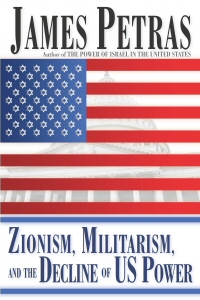
Zionism, Militarism, and the Decline OF US Power
By James Petras

Paperback: 192 pages
(Clarity Press, 2008)
ISBN-10: 0-932863-60-4
ISBN-13: 978-0-932863-60-7

Professor James Petras has written another book — Zionism, Militarism, and the Decline OF US Power — probing deeper into what he contends is a Zionist Power Configuration (ZPC) that has infiltrated and largely usurped US foreign policy even using the US military for its ends in the Middle East. Petras fills his book with lots of evidence backed by sound rationales.

Petras’s thesis is that Israel — and not Big Oil — was behind the push to invade and occupy Iraq. That has already happened. What concerns Petras now is the push by the ZPC to have the United States again breach international law and launch an attack against Iran.

Petras reasons that the ZPC’s purpose is to incorporate Palestine and consolidate its hegemony in the Middle East. Strategically, gaining and holding sway over the planet’s preeminent military power has been a major plank toward this goal.

The professor provides numerous examples of the sway the ZPC wields and how it wields it: through its propaganda and media arms (Petras cites how, pre-“war,” the Lobby produced about 8,800 pro-Iraq attack pieces which were circulated to major Anglo-American media versus zero pro-Iraq attack pieces published from Big Oil spokespeople); through its academic acolytes; through involving US soldiers to fight its wars (Petras charges that the Israel Firsters “ridicule the US military precisely to instigate them to prosecute wars and thereby avoid the loss of Israeli-Jewish lives”); through the relative silence of dissenting voices, including dissenting Jewish voices in mass media; through members of the US Congress beholden through acceptance of campaign contributions form the Lobby.

Campaign contributions turn out, actually, to be an investment. Through seeding the US Congress, Israel has become the prime beneficiary of US “aid,” even though Israel is a relatively well-to-do state, especially compared to many of its neighbors. Petras wavers on what the “US annual ‘tribute to Israel’” is. On page 68, he cites a figure of $6 billion a year; on page 68 he states $3 billion a year; on page 156, it is $2.4 billion a year; and on page 164 it is “well over $3 billion” a year. This irritation contributes to unevenness in Petras’s account.

Exacerbating this irritation is an uneven patchwork of endnotes. Sometimes key points are in the endnotes, and sometimes key points are not in the endnotes. For example, he writes that Big Oil is anxious and fearful about an Israeli-instigated warmongering destabilizing the Middle East citing a source for this claim (p. 32). On page 92 he claims electoral chicanery without citation. Whether the claims are true or not is beside the point, which is that the reader is hindered from checking the professor’s sources. And when there are endnotes, many convey scanty information (e.g., no author, no title, no page) that forces a reader to spend inordinate time tracking down a citation.

Petras, however, deserves kudos for taking on the Lobby which resorts to disreputable tactics to try and silence its critics. Petras does not shirk from identifying how he perceives the threat from the ZPC: “The lesson is clear: the rise of Judeo-fascism represents a clear and present danger to our democratic freedoms in the United States.”

The ZPC is ruthless says Petras, who observes that Israel reneges on obligations as an occupier in Palestine and engages in “meat-grinder genocidal policies in Gaza.” And yet, it has vulnerabilities, such as the “repeated failures and incredible stupidity of the Israeli intelligence agencies.”

The ZPC control apparatus is necessarily twined with the corporate media. “State provocations,” writes Petras, “require uniform mass media complicity in the lead-up to open warfare.”

With a massive media blitz and compliant government, Israel recruits US soldiers to fight its wars. The US, on the other hand, tries to get its victims to fight against their fellow countryfolk. This is a dubious strategy reasons Petras, as Iraqis fighters under occupation “recruited on basis of hunger and unemployment (caused by US war) are unreliable soldiers.”

This, according to Petras, is a losing tactic: “US colonization of Iraq is a blatant denial of the conditions necessary for reconciliation.”

Just how losing a strategy it is to run a militaristic economy is evidenced by the massive capitalistic expansion of non-belligerent China. In fact, the US is becoming less competitive and falling into an increasingly dire economic situation

Petras describes a schism among Jewry. He notes that “most Jewish Americans differ from the leaders of the major American Jewish organizations” … but that “they have not or do not challenge” this leadership. Antiwar sentiment among Jewish Americans, finds Petras, is quite vague.

He writes that “both the progressive majority of Jews and the reactionary minority … have a fundamental point of agreement and convergence: support for and identity with Israel and its anti-Arab prejudices, its expansion, and the dispossession of Palestine [sic].”

Given that the peace movement has gone AWOL, this bodes ill for the peoples of the Middle East. Here again, Petras holds the ZPC responsible since he charges that it has also infiltrated the antiwar movement and split it, rendering it anemic.

Petras notes that everywhere he visits around the globe people from all walks ask him why American citizens tolerate the killing done by the US government/military. This is a good question, but another question is unasked by Petras. Why do these citizens not demand the same answers from their complicit governments which, even when they do not contribute fighters to a so-called Coalition of the Willing, remain silent to the great criminal breaches of international law and the abandonment of morality?

That is why Petras’s thesis in Zionism, Militarism, and the Decline OF US Power is important: innocent people are dying for wicked reasons.

Kim Petersen is co-editor of Dissident Voice. He can be reached at: kim@dissidentvoice.org. Read other articles by Kim.

The Price of Hillary Clinton

November 26, 2008

by Srdja Trifkovic

Global Research, November 25, 2008

Chronicles – 2008-11-24

No secretary of state will come to that office with stronger pro-Israel credentials or closer ties to the Jewish community than Sen. Hillary Clinton, Douglas Bloomfield assures his readers in The Jerusalem Post. Good for them, and for Bosnia’s Muslims and Kosovo’s Albanians; but for the rest of us Mrs. Clinton’s appointment as the third woman U.S. Secretary of State is hugely problematic. It heralds “the end of the world as we know it” in some ways, although neither she nor her coterie necessarily know what they are doing.

At the technical level, Hillary Clinton is likely to deepen the chronic crisis of the once-venerable institution at Washington’s Foggy Bottom, to which her two female predecessors have contributed in two different ways.

Madeleine Albright was an activist who will be remembered for her hubris (“If we have to use force, it is because we are America. We are the indispensable nation. We stand tall. We see further into the future.”), coupled with studied callousness. Asked on “60 Minutes” about the death of a half-million Iraqi children due to sanctions, she promptly responded, “I think this is a very hard choice, but the price is worth it.” Her crowning glory was her premeditated 1999 war in the Balkans, prior to which she said that “the Serbs need a little bombing.” Her State Department contributed to the formulation, as well as execution, of Bill Clinton’s doctrine of “humanitarian intervention.”

Condoleezza Rice, less evil and more obtuse, will be remembered for nothing. She was an auxilliary tool of the Bush-Cheney team, with all key decisions made elsewhere.

Mrs. Clinton will try to rebuild the relative importance of the Department of State, which will become her personal fiefdom, but her labors will not be for the better. Her appointment, the most significant among several major figures from the Clinton era, belies Obama’s rhetoric of “change” when it comes to foreign affairs. There will be tectonic shifts, cultural and moral, at home. The established premises of an imperial presidency – which in world affairs inevitably translates into the quest for dominance and justification for global interventionism – will not be challenged, however.

Once it is accepted that Obama’s primary interest lies in an irreversible redistribution of power and money at home, it ceases to be surprising that he chose Hillary Clinton as his chief diplomat. Allowing her to indulge in some global grandstanding is acceptable to him, if that means the Clintons will not stand in the way of his domestic agenda. They are both revolutionaries, after all: that Mrs. Clinton is instinctively opposed to any traditional understanding of diplomacy became obvious during the primary campaign, when she accused Obama of “naivete” for saying he was willing to meet leaders of Iran, Syria and North Korea.

With Robert Gates staying at the Pentagon and Jim Jones as Obama’s national security adviser, there will be a lot of continuity in the U.S. foreign policy, not only with the 1990s but also with recent years. In Mrs. Clinton’s case there will be more lies, the hallmark of the family. During the primaries she listed a number of foreign policy accomplishments based on her husband’s legacy. She claimed that in 1999 she “negotiated open borders” in Macedonia to Albanian refugees from Kosovo, although the crossings were opened days before her arrival. She had repeatedly invoked her “dangerous” trip to Bosnia in 1996, including alleged snipers at Tuzla airport, whereas the Bosnian war had ended six months earlier and video footage shows smiling schoolchildren greeting her in Tuzla. (She later admitted “misspeaking” over sniper claims.)

In the same spirit Mrs. Clinton declared, in late 2002,

“Saddam Hussein has worked to rebuild his chemical and biological weapons stock, his missile-delivery capability and his nuclear program. He has also given aid, comfort and sanctuary to terrorists, including al-Qaida members. I want to insure that Saddam Hussein makes no mistake about our national unity and for our support for the president’s efforts to wage America’s war against terrorists and weapons of mass destruction.”

Hillary Clinton says that she has had second thoughts since that time, and a year ago she declared in Foreign Affairs magazine that “US troops should be brought home.” During the primary campaign, however, she was markedly less willing than Obama to commit to a withdrawal timetable. The woman who voted to authorize the Iraq war, and who parroted lies used to justify it, cannot be expected to clean up the mess created by that war. It is more likely that she will advocate a downsized, rebranded, and effectively open-ended U.S. occupation of Iraq for which the military has been preparing ever since the “Surge.”

In Afghanistan, far from disengaging, Mrs. Clinton will advocate greater troop deployments and an escalation of military activity. On Iran, during the primaries she sounded like John McCain: “I want the Iranians to know that if I’m the president, we will attack Iran” if it attacks Israel, she declared last April: “In the next 10 years, during which they might foolishly consider launching an attack on Israel, we would be able to totally obliterate them.” She will negotiate with the mullahs, however, if Tehran’s tacit support is considered necessary for the achievement of her major ambition: a breakthrough in the Middle East.

Bill Clinton came closer than any U.S. president to brokering Arab-Israeli peace in the final year of his presidency, and insiders say that Hillary will place this issue at the top of her agenda. She is a favourite of the pro-Israel lobby, however, and it is unclear what she can offer, or do, in 2009-2010 that was not offered or tried at Camp David a decade earlier.

Continued >>

Barack Obama mentor Abner Mikva warns over Hillary Clinton choice

November 26, 2008
From
November 26, 2008