Archive for the ‘Palestine’ Category

Jewish is fine, Zionist is not

August 13, 2009


Printer friendly page Print This ShareThis

By Joharah Baker
MIFTA
Axis of Logic, Thursday, Aug 13, 2009
Uri Davis


Not many Palestinians were familiar with the name Uri Davis until yesterday when the media reported that the “Jewish member of Fateh” had been nominated for a spot on the movement’s Revolutionary Council. Davis, recruited into Fatah in the 1980’s by assassinated Fatah leader Khalil Al Wazir, was born in Jerusalem in the early forties to Jewish immigrants who believed in the Zionist dream.

Obviously, Davis did not adopt his parents’ ideologies, calling himself a “Palestinian Jew.” An academic, Davis has been an avid proponent of human rights, Palestinian especially, and an opponent of the nature of Israel as a Jewish state. In 1987, he wrote a book entitled, “Israel: an apartheid state” and penned his autobiography in 1995 entitled, “An autobiography of an anti-Zionist Palestinian Jew.”

Continues >>

A Pro-Israel Panic

August 13, 2009

By Rami G. Khouri, Agence Global, released Aug 10, 2009

BEIRUT — Is the Israeli lobby in the United States in panic mode? The Obama administration hit the ground running when it took office in January, quickly appointing George Mitchell as a special envoy to Arab-Israeli peace-making, and making it clear that President Obama himself would devote time and energy to the goal of a comprehensive peace plan.

Not surprisingly, an American-Israeli disagreement on Israel’s settlements in occupied Arab lands materialized quickly, and may well expand into a full-blown showdown. The United States says it is making equal demands of Arabs and Israelis. But Israel and its zealot-like allies and proxies in the United States argue that Washington is putting undue pressure on Israel alone.

Continues >>

Israel starved Gaza of power and water

August 13, 2009

Vita Bekker, Foreign Correspondent, The National, Aug 13, 2009

A worker uses clay bricks to rebuild a Hamas police station destroyed in the Gaza Strip offensive. Mohammed Salem / Reuters

TEL AVIV // Israel deliberately brought the Gaza Strip’s infrastructure to the brink of collapse before its military offensive in the enclave in December and January and has since blocked any efforts of its rehabilitation as part of a strategy to defy Hamas, a report by an Israeli rights group claimed this week.

The damage to the impoverished Strip’s electricity network has prompted the company that distributes Gaza’s electricity this week to warn the 1.5 million residents that it will be forced to institute power cuts of up to 10 hours a day, five days a week, according to Tel Aviv-based Gisha, a group that advocates for Palestinian rights.

The group said such cuts would be the worst in the territory in at least six months and would hit especially hard in Gaza City and its surroundings, where key institutions such as Shifa Hospital are located.

Sari Bashi, executive director of Gisha, said: “Israel has deliberately drained Gaza of the fuel and supplies needed to maintain the water, sewage and electricity systems as part of a policy to pressure Hamas. Israel calls it economic warfare, we call it collective punishment.”

Israel launched its military campaign in Gaza in December, claiming it aimed to curtail rocket attacks on its southern communities by militants from Hamas, an Islamic group which controls Gaza, and other factions. Gaza health officials and local rights groups have said that more than 1,400 people were killed in the assault.

Israel controls all of Gaza’s border crossings except for Rafah, which is managed by Egypt. Israel also has authority over most of Gaza’s power supply, with an Israeli electricity company providing about half of the region’s power and Gaza’s own power station relying on Israel granting it access to industrial diesel.

Ahead of Israel’s recent attacks, the country brought Gaza’s infrastructure to a “weakened state”, the report said. Its restrictions on the supply of fuel, spare parts and building materials such as concrete and cement were tightened in 2007, when militants of Hamas violently took over the enclave by routing forces loyal to Fatah, a rival secular Palestinian movement that holds sway over the occupied West Bank.

Furthermore, the blockade on the coastal territory intensified after Israel’s shaky, six-month-old ceasefire agreement with Hamas, which included an easing of restrictions, broke down in November 2008 and the country almost completely closed off Gaza’s borders.

The nearly two-year-old blockade prompted a humanitarian predicament for many Gazans once the operation began in December, Gisha said.

It added: “At the height of the [fighting], more than half a million residents were cut off from running water, sewage flowed in the streets, and hospitals were left to operate on generators running 24 hours a day. All this took place while the strip was being bombarded from the air, sea and land, and its borders remained sealed, leaving residents with nowhere to run.”

Indeed, the restrictions have prompted daily power cuts, frequent disruptions to the water supply, tens of millions of litres of raw sewage being dumped into the sea and contaminating the groundwater that serve much of Gazans’ drinking needs, as well as the reliance of hospitals on decrepit generators.

The group claimed that more than six months following Israel’s assault, the country is still blocking efforts to repair the electricity, water and sanitation systems.

Gaza’s electricity system, for example, “urgently” needs 400 types of spare items such as transformers, power poles and electrical cables that are either completely missing from its inventory or available in limited amounts, Gisha said. Israel has for months been holding up more than 30,000 such parts in warehouses within its territory or in the West Bank, refusing to grant them permits to enter Gaza, the group added. As a result, some 10 per cent of Gazans have been completely disconnected from electricity since the onslaught.

The water system is not faring any better. The shortage of spare parts for its repair has resulted in 10,000 Gazans being deprived of running water since the attacks ended and another 100,000 residents having access only once every five to seven days, according to the report.

Gisha cites Khaider Abu Daher, a 34-year-old father of five in Gaza, who said the destruction of his home during the fighting has prompted his family to live in a tent since then, walk 1.5km twice a day to fetch water as well as scramble to gather wood on which it cooks meals.

The report suggested that Israel’s High Court of Justice colluded with the state’s destruction of the infrastructure by giving it a stamp of approval. According to Gisha, the three petitions it submitted along with other rights groups against Israel’s policies from October 2007 to January 2009 were all rejected. It said that the court accepted Israel’s justifications of its restrictions without holding a “serious discussion” to determine the country’s obligations towards Gazans.
Gisha added: “The rejection of the petitions and acceptance of the state’s claims, time and again, effectively legitimised the state’s policies and exposed the limitations of the High Court in reviewing the activities of the military in the occupied territories.”
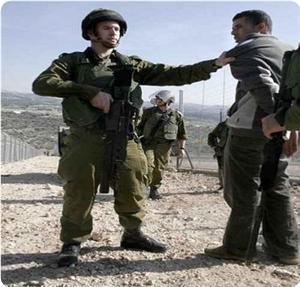
PCHR Condemns Harassment of Palestinian Civilians at Military Checkpoints

August 12, 2009

PCHR – Palestinian Centre for Human Rights

11_iof-arrest_300_0.jpg

Uruknet.info, August 11, 2009

The Palestinian Center for Human Rights (PCHR) strongly condemns the harassment and cruel and degrading treatment inflicted upon Palestinian civilians by Israeli troops positioned at military checkpoint throughout the West Bank.

PCHR field workers documents three cases of harassment against Palestinian civilians in the first three days of the week.

Continues >>

Israel PM vows never to evict settlers

August 10, 2009

Yahoo! News, Aug 9, 2009

AFP

AFP/File – An Israeli policeman stands guard as Jewish settlers enter a house following the eviction of a Palestinian …

JERUSALEM (AFP) – Prime Minister Benjamin Netanyahu pledged on Sunday that he will never evict Jewish settlers from occupied Palestinian land as Israel did in 2005 in the Gaza Strip.

“The withdrawal from the Gaza Strip brought us neither peace nor security. The territory has become a base for the pro-Iranian Hamas movement and we will never make the same mistake again,” Netanyahu said at the weekly cabinet meeting.

“We will not evict any more people from their homes,” he added in comments carried by public radio.

In September 2005, the government of prime minister Ariel Sharon unilaterally removed all Jewish settlements from Gaza in a move aimed at ending Israel’s costly 38-year military presence in the Gaza Strip.

Sharon vowed to follow up that withdrawal with further pullbacks from the West Bank, but a massive stroke incapacitated him and his successor Ehud Olmert abandoned the policy in the wake of the June 2006 capture of an Israeli soldier by Gaza-based militants in a deadly cross-border raid.

An opinion poll published on Sunday showed Israeli Jews back Netanyahu’s stance against halting construction of settlements in occupied territory, with 66 percent endorsing his view that Israel has the right to build in east Jerusalem, which Palestinians want as the capital of their proposed state.

The survey of 512 people by Tel Aviv University‘s BI Cohen Institute found that only 27 percent of Israeli Jews, mostly supporters of the leftwing Meretz and Labour parties, oppose Netanyahu’s position.

Netanyahu has risked a rift with Israel’s strongest ally, the United States, by refusing to heed Washington’s calls to freeze building of settlements, which the international community considers illegal.

Deputy Foreign Minister Dany Ayalon on Sunday rejected UN protests against last week’s expulsion of two Palestinian families from their homes in occupied east Jerusalem.

In a meeting with UN Middle East envoy Robert Serry, Ayalon told him the expulsion followed a decision in an Israeli court and that Israeli jurisdiction applied to the entire city, a senior diplomat told AFP.

On August 2 club-wielding Israeli riot police evicted two Palestinian families from their houses in Jerusalem‘s Sheikh Jarrah district.

US Secretary of State Hillary Clinton and the European Union condemned the evictions, which followed an announcement by Israel that it planned to build Jewish homes in the Arab neighborhood.

Israel annexed the eastern part of the city in 1967 but Israeli sovereignty over the conquered territory has not been recognised internationally.

Around 200,000 Jewish people are estimated to have moved into the dozen or so Israeli settlements in east Jerusalem, home to 270,000 Palestinians.

Obama’s Israel Albatross

August 10, 2009

Elections and Dissonance in the Middle East

By Elaine C. Hagopian, Counterpunch, Aug 7 – 9, 2009

Obama came into office vowing to resolve the Palestine question. He also vowed to approach the ME with civility and diplomacy, especially Iran, to iron out issues of mutual concern.  The two-pronged plan was aimed at removing the Palestine question from the regional agenda, clearing the deck for improved relations with area states and resolution of existing US/ME issues. The February Israeli election yielded Netanyahu as Prime Minister presiding over an ultra right wing government.  Netanyahu rejected Obama’s call for establishing a Palestinian state.  He argued that Iran’s nuclear program with its assumed threat to Israel and to US interests was the primary issue to address, not Palestine.  With the June election of anti-imperialist, anti-Zionist, Holocaust denier Ahmedinejad, Netanyahu claimed that the danger Iran represents increased precipitously, and aggressive action was required. Therefore, Palestine should be put on the back burner. Public dissonance between the U.S. and Israel over Obama’s Palestine and Iran agenda amplified after Iran’s presidential election.  The dissonance threatens Obama’s efforts to defuse ME volatility.

President Obama entered office with a promise of business not as usual.  Although American foreign policy objectives were not changed, Obama insisted on the priority of dialogue and diplomacy to realize them, Afghanistan (and Pakistan) notwithstanding. Obama articulated two immediate goals he sought in the Middle East:  1) to resolve the Palestinian/Israeli conflict in accordance with the international consensus for a two-state solution without significantly alienating Israel.  Israel is still considered important – wrongly as Mearsheimer and Walt  (“The Israel Lobby,” LRB, 23 March 2006) would have it – to securing American economic interests and political hegemony in that region.  As such, the US must guarantee key Israeli ME interests including area dominance.  And 2) to dissolve, or at least checkmate the only regional alliance challenging US/Israeli designs in the ME,  i.e., the alliance of Iran, Syria, Hezbollah, Hamas and political elements in Iraq.  Moving to resolve the Palestine question is seen by Obama as contributing to deflating the Iranian-led anti-US/Israel alliance by removing it as its cause célèbre, and thus making key alliance members amenable to American outreach. The thinking is that achieving these two interdependent goals would allow less hindered US maneuverability in taming Islamist movements in the region and prevailing in the energy grand game there.

Continues >>


BBC: Israeli troops ‘ill-treat kids’

August 8, 2009

BBC News, Aug 6, 2009

Israeli soldiers arrest boy near Qalandia, Sept 2008

Israel arrested 9,000 Palestinians last year, 700 of them children

A former Israeli military commander has told the BBC that Palestinian youngsters are routinely ill-treated by Israeli soldiers while in custody, reports the BBC’ s Katya Adler from Jerusalem and the West Bank.

“You take the kid, you blindfold him, you handcuff him, he’s really shaking… Sometimes you cuff his legs too. Sometimes it cuts off the circulation.

“He doesn’t understand a word of what’s going on around him. He doesn’t know what you’re going to do with him. He just knows we are soldiers with guns. That we kill people. Maybe they think we’re going to kill him.

Continued >>

Fateh delegates to Bethlehem conference demand a probe on Arafat’s death

August 7, 2009
author Thursday August 06, 2009 02:46author by IMEMC & Agencies Report this post to the editors

As Fateh’s conference, held in the West Bank city of Bethlehem, entered its second day, delegates participating in the conference criticized the movement’s leadership for not demanding an investigation into the death of late President, Yasser Arafat, and slammed it for not insisting on it.

Reprinted from PNN
Reprinted from PNN

The demands came during the evening session of the second day of the conference on Wednesday.

The issue of Arafat’s death resurfaced last month after one of the senior Fateh leaders in exile, Farouq Qaddoumi, stated accused the Palestinian President, Mahmoud Abbas, and senior Fateh leader, Mohammad Dahlan, were involved in an Israeli plot to poison Arafat.

Continues >>

Powerful pro-Israel lobby slams Obama

August 6, 2009

Middle East Online, Aug 5, 2009


For her role as president and as UN human rights commissioner

US President awards America’s highest civilian honor to staunch critic of Israel’s human rights record.

WASHINGTON – Powerful pro-Israel lobby group AIPAC Tuesday criticized President Barack Obama’s decision to grant a top honor to ex-Irish president Mary Robinson, accusing her of bias towards the Jewish state.

The American Israel Public Affairs Committee criticized Obama’s decision to award Robinson the Presidential Medal of Freedom, America’s highest civilian honor, citing her role at the UN’s Durban Conference on Racism in 2001, which criticised Israel.

Continues >>

Taking over Jerusalem

August 6, 2009

Evictions in Sheikh Jarrah and other Palestinian areas are part of a bid to turn East Jerusalem into a unified Jewish Jerusalem

A couple of months ago I spent a fortnight in Palestine with the International Solidarity Movement – activists who help Palestinians non-violently resistactivists. The most pressing of many issues during my stay was the attempts by an Israeli settler company, Nahalat Shimon, backed by the Israeli courts, to cleanse East Jerusalem of its Arab population, focusing its efforts at that time on the neighbourhood of Sheikh Jarrah.

Continues >>