The World Central Kitchen (WCK), a US-based charity, said on Wednesday that it was forced to shut down aid operations in Gaza due to the total Israeli blockade on the Palestinian territory.
“After serving more than 130 million total meals and 26 million loaves of bread over the past 18 months, World Central Kitchen no longer has the supplies to cook meals or bake bread in Gaza,” the WCK said in a statement on its website.
“Since Israel closed border crossings in early March, WCK has been unable to replenish the stocks of food that we use to feed hundreds of thousands of Gazans daily,” the statement said.
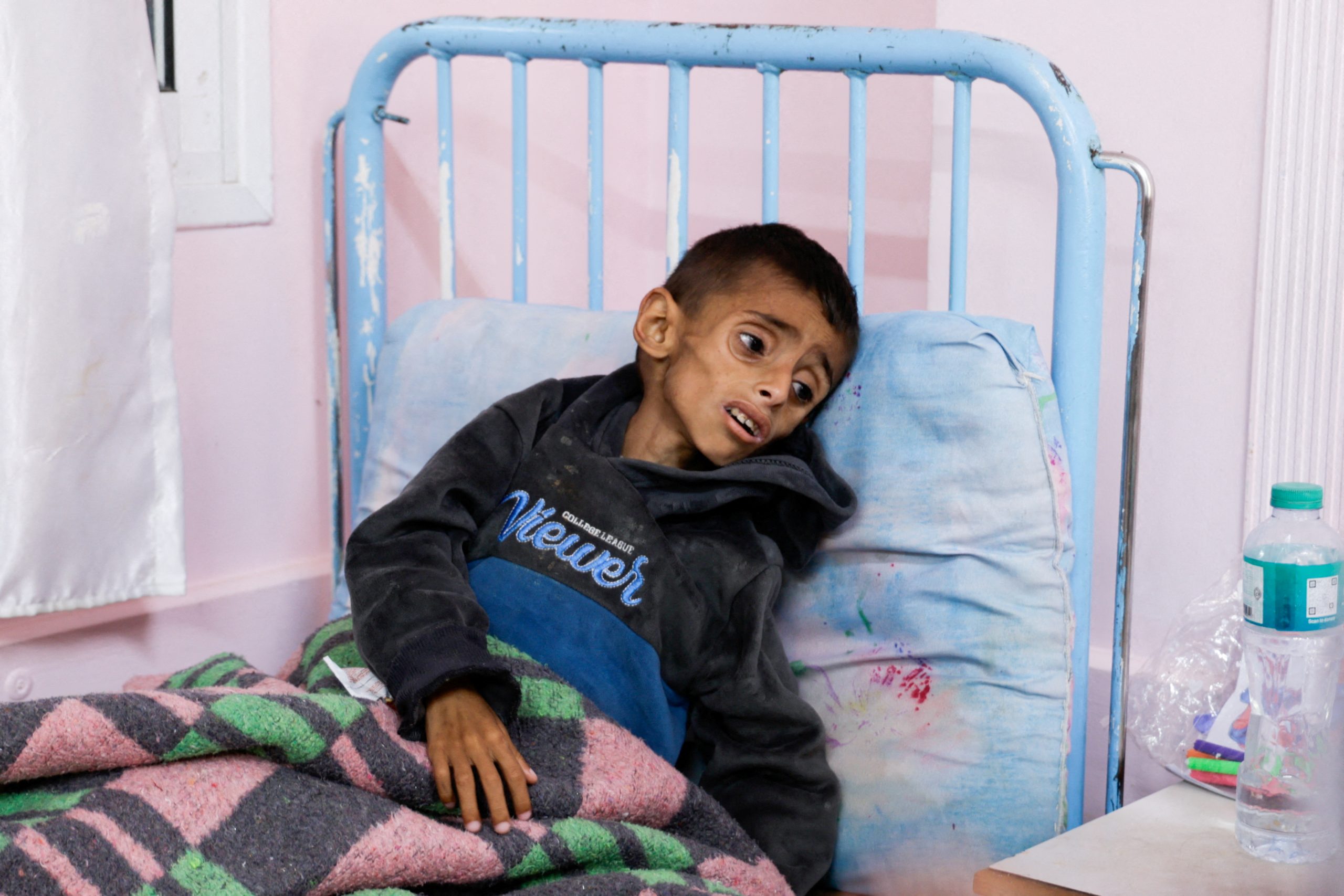
Palestinian boy Osama Al-Reqep, 5, lies on a bed at Nasser Hospital where he receives treatment, in Khan Younis, in the southern Gaza Strip, May 1, 2025. REUTERS/Hatem Khaled
The charity said that in recent weeks, its team in Gaza “stretched every remaining ingredient and fuel source using creativity and determination” but has now “reached the limits of what is possible.”
WCK field kitchens in Gaza have run out of ingredients, and its mobile bakery has run out of flour. The charity said that it has trucks loaded with food and cooking fuel ready to enter Gaza, but they are being blocked by Israel.
“Our trucks—loaded with food and supplies—are waiting in Egypt, Jordan and Israel, ready to enter Gaza,” said José Andrés, a celebrity chef who founded WCK. “But they cannot move without permission. Humanitarian aid must be allowed to flow.”
At least 11 WCK workers have been killed by Israeli attacks since October 7, 2023. The most notorious attack occurred on April 1, 2024, when an Israeli drone fired missiles at three clearly-marked cars carrying WCK employees, who were traveling on a route previously approved by the IDF. The attack killed seven WCK workers, including three British nationals and an American, 33-year-old Jacob Flickinger, a dual US-Canadian citizen who left behind a one-year-old son.
In November 2024, an Israeli attack on a car in Gaza killed three WCK workers. On March 27 of this year, the WCK said one of its volunteers was killed by a strike near a WCK kitchen in Gaza.
Within hours, Israeli forces demolished homes, wells, and even caves in the West Bank hamlet of Khilet al-Dabe’, leaving families with nowhere to shelter.
Israeli forces demolish buildings in Khirbet Khilet al-Dabe, in Masafer Yatta, the West Bank, May 5, 2025. (Wisam Hashlamoun/Flash90)
In the early hours of Monday morning, two massive Hyundai excavators and two Caterpillar bulldozers roared out of the gates of the Ma’on settlement in the South Hebron Hills — illegally built on Palestinian land belonging to the village of At-Tuwani. For residents living in the area, the sight of these “yellow monsters,” as they call them, is an omen: the day will be filled with destruction, and families will lose homes they woke up in just hours earlier.
Roughly 90 minutes later, the full force of the operation became clear. Military jeeps, soldiers from the Israeli army, Border Patrol units, Civil Administration officials, and a group of workers assembled and then moved as a unit toward Khirbet Khilet al-Dabe’, a small but resilient village nestled between the higher lands of Shafa Yatta and the lower hills of Masafer Yatta. I rushed there with other local activists to document what we feared was coming.
We were stopped by a group of masked soldiers about 80 meters from the village’s homes. “You are not allowed to move forward,” one soldier barked, dropping a rusty old bucket on the ground and declaring, “This is the boundary of a closed military zone: whoever crosses it will be arrested.”
Subscribe to The Landline
+972’s weekly newsletter
We asked if there was an official military order establishing the area as restricted. One soldier responded, “It will arrive in a few minutes.” But the demolition dragged on for hours, and no such order ever appeared. This wasn’t enforcement of a legal ruling, but rather an exercise of sheer military power. In truth, the soldiers didn’t even pretend to be upholding Israel’s own discriminatory laws. They simply threatened us with weapons and arrests.
As soldiers held us back, one excavator tore through two water wells, while others stormed into the community itself. Families were forcefully removed from their homes. Among them was 80-year-old Amna Dababseh and her husband Ali, 87.
Ali Dababseh stands near soldiers as Israeli forces demolish buildings in the West Bank village of Khilet al-Dabe’, May 5, 2025. (Wisam Hashlamoun/Flash90)
“My daughter brought us breakfast and we were just about to eat, when she said the army had entered the village,” Amna recounted. “Suddenly, soldiers were at our door. One pointed at our home and said, ‘Get out. We’re going to demolish this house.’ I told him: ‘My husband had a stroke and can barely walk. I have diabetes. Where do you expect us to go?’ He just said, ‘Go to the mountain. Move!’”
Amna’s voice cracked as she described the chaos. Border police walked around the homes, evicting family after family. Men, women, and children were pushed up a hill overlooking the destruction of their community. “This village has suffered demolitions for 20 years,” Amna said, “but never like this.”
She stood crying among dozens of others, watching her life’s work reduced to rubble. Despite the trauma and shock, she kept repeating: “I will never leave this village — not until my last day.” Her husband and others echoed the same sentiment, determined to defy and resist a system designed to erase them.
A Palestinian woman walks by as Israeli forces demolish buildings in the West Bank village of Khilet al-Dabe’, May 5, 2025. (Wisam Hashlamoun/Flash90)
“They want to erase us”
What took place in Khilet al-Dabe’ was not merely a demolition — it was a sweeping erasure. In total, nine homes were destroyed, along with six caves, seven wells, four livestock shelters, 10 water tanks, and the village’s only solar energy system and internet infrastructure.
Khirbet Khilet al-Dabe’ is one of the main communities featured in our documentary “No Other Land.” The village is known for its natural greenery and agricultural life, and unlike many others in Masafer Yatta, its residents focus less on livestock and more on cultivating almond, grape, and olive trees. They maintain traditional stone terraces and till the land year-round. The village’s elevated position and lush vegetation make it one of the most visually stunning in the area.
But geography is no protection. Over the past 18 months, four new settler outposts have been established to the east and west of Khilet al-Dabe’. Less than three months ago, on Feb. 10, Israeli forces had entered Khilet al-Dabe’ and destroyed seven homes and two caves. Amer Dababseh, Amna and Ali’s son, had his home and cave demolished that day. Since 2018, his property has been destroyed at least seven times. After the February attack, he and his family sought refuge with his elderly parents; now, that home has also been destroyed.
This time, Israeli forces left Amer and many others with literally nothing. Even the caves — historically used as emergency shelters for displaced families — were demolished. Now, many villagers, including children, have no choice but to sleep in the open.
The aftermath of Israeli demolitions in the West Bank village of Khirbet Khilet al-Dabe’, May 5, 2025. (Wisam Hashlamoun/Flash90)
Once the army withdrew, villagers returned to the site, digging through the rubble for anything salvageable: clothing, kitchenware, personal belongings. The scene resembled a natural disaster, as if an earthquake had flattened their homes, wells, and lives.
The goal of Monday’s demolition, locals believe, is part of a broader effort: to push Palestinian residents off their land and clear the way for further illegal settlement expansion. “They want to erase us — not just our homes, but our presence, our history, and our future,” Amer said. For the families of Khilet al-Dabe’, the rubble is not just debris — it is a reminder that they are standing in the way of an expanding occupation. And despite it all, they are refusing to leave.
In response to +972’s inquiry, Israel’s Coordinator of Government Activities in the Territories (COGAT) stated that its personnel “conducted enforcement activity against several illegal structures built without permits in Firing Zone 918, in violation of both planning regulations and military access restrictions,” and that “the operation was carried out in full compliance with legal procedures and approved enforcement priorities.”
An Israeli army spokesperson said that “the enforcement actions were carried out after the completion of all required administrative procedures and in accordance with the enforcement priority framework previously presented to the Supreme Court.” It further claimed that “a closure order was issued in the adjacent area, and the general order which applied to the location in question was known to the residents as well. The temporary order issued was presented upon request.”
Popular resistance to the Trump administration’s erratic, anti-people, and dangerous domestic and foreign policies is growing every day as seen with the massive demonstrations held throughout the country on and after April 5. We welcome these protests and the popular demands raised by them, but we must criticize significant flaws that block the political changes we desperately need.
Criticism is personalized against President Trump, Elon Musk, and the “billionaires” for actions that have been the hallmark of bipartisan policies for decades. Monied interests — not as individuals but as a class, and regardless of their political party — have always been in control of the U.S. government and have prioritized their interests over the interests of the majority, only limited by the organized people’s movements.
Personalizing the criticism and solely blaming the present administration for the problems created by both parties is tantamount to siding with one group of “billionaires” (Democrat) against the other (Republican). Such is the nature of the two-party duopoly as a system, regardless of personnel changes in the White House. Meanwhile, the entire U.S. body politic lurches from one administration to the next on a rightward trajectory toward fascism.
Largely organized by the Democratic party-based group Indivisible, the “Hands Off!” protests were silent about the U.S.’s bipartisan militaristic foreign policy and focused solely on domestic issues, except for “Hands Off NATO.” Revealingly, “Hands Off Palestine” was omitted from the official demands, though grassroots activists raised it.
This intentional silence on foreign policy, and its arbitrary separation from domestic issues, hide the fact that many domestic problems result from a militaristic foreign policy imposed on our country. Trillions of dollars of much needed funds are redirected from human needs to war mongering in Ukraine, West Asia, and Asia-Pacific. Achieving popular power can be most effectively galvanized if it is informed by politically and consciously recognizing the class basis of war and militarism. In contrast, official demands of the “Hands Off!” mobilization, with its embrace of NATO but silence on genocide in Gaza, obscures the class basis of war.
While official lawlessness did not start with Trump, the new president is bent on changing the present post-war imperialist order with another one that gives the empire even more impunity. The U.S. ruling class as a whole has been accelerating the tendency for the U.S. to operate outside the bounds of both national and international law, regardless of who is in office.
The West’s proxy war on Russia continues in Ukraine, while war clouds are gathering around creating another proxy war with the People’s Republic of China using Taiwan and South Korea. And, all the while, the U.S./Israel genocide continues against Palestine and its allies. The imminent war with Iran, supported by both parties, is yet another pressing issue that can best be explained within the framework of imperialism.
On top of all this, is a bipartisan commitment to enhance the repressive apparatus of the state domestically — from cop-cities to the repression on campuses, the criminalization of speech and assembly, restrictions on truthful education, and the further weaponization of the judicial system itself. Intensification of domestic austerity programs, deregulation and destruction of all government organizations that protect and enhance the lives of working people, and attacks on trade unions are the flip side for maintaining a militaristic empire.
All this should make clear that neither of the two billionaire-controlled parties will or can be the urgently needed opposition to imperialism. Current world conditions necessitate building an opposition movement to war and militarism that is even more materially focused on anti-imperialism. This requires understanding the clear link between the empire’s foreign and domestic policies and calling for an end to militarism and redirection of resources to human needs.
Instead of looking for the lesser of two evils, we urge joining people’s independent campaigns to cut the military budget, to close U.S. and NATO foreign military bases, to establish Zones of Peace in our region, and to stop the militarization of police and domestic repression. An anti-imperialist understanding is key to the success of our people’s struggle for peace and a more just society.
 By
By 


 Peace and Justice Post


You must be logged in to post a comment.