Posts Tagged ‘Palestine’

No normalization with ‘Israel’, Meshaal says at Istanbul Conference

December 8, 2025

By Al Mayadeen English
Source: Agencies
6 Dec 2025 14:37

4 Min Read

Hamas’s Khaled Meshaal urges rejection of normalization with “Israel,” defends resistance, and calls for Palestinian unity at a conference in Istanbul.


Speaking at the “Covenant to al-Quds: Towards Renewing the Nation’s Will in the Face of Genocide and Annihilation” conference held in Istanbul, Khaled Meshaal, head of Hamas’s diaspora office, emphasized the absolute rejection of all forms of normalization and ties with what he called the criminal Israeli entity.

He urged Arab and Islamic nations to hold firm against normalization, stressing that any engagement with “Israel” undermines the Palestinian cause and legitimizes occupation.

Meshaal reaffirmed the centrality of protecting the resistance project and its arms, declaring that the Resistance and its dignity are inseparable from the identity and will of the nation. He called for continued commitment to liberating prisoners and detainees held in occupation prisons, viewing their freedom as a collective responsibility.

The Hamas official stressed that victory for the Palestinian people cannot be achieved without unity and partnership, rejecting any monopolization of decision-making and national authority, asserting that the Palestinian people alone must govern themselves, free from external guardianship, whether in Gaza or the West Bank.

Meshaal warned of the growing threat of Judaization, settlement expansion, and forced displacement in the occupied West Bank. He described these policies as part of a broader effort by “Israel” to subjugate the region to its political and geographic agenda, including attempts to re-engineer Gaza’s territorial status.

He pointed to a “real and imminent danger” facing occupied al-Quds, al-Aqsa Mosque, and both Islamic and Christian holy sites across Palestine.

In a strong message to collaborators, Meshaal declared that “the fate that befell the agent Yasser Abu Shabab is the inevitable fate of anyone who betrays his people and his homeland.” The statement was a clear warning against collaboration with the occupation and a reaffirmation of the movement’s uncompromising stance on national loyalty.
Escalations in West Bank, aggression against Gaza

Meshaal’s statement comes amid raids in the West Bank and ongoing aggression against the Gaza Strip.

Several Palestinian citizens were injured on Saturday during confrontations with Israeli occupation forces amid a wave of IOF raids across the occupied West Bank. Confrontations were particularly intense in Jenin, where local Resistance fighters responded to the Israeli incursion with explosive devices.

In Beit Ummar, north of al-Khalil, violent confrontations broke out following an incursion by the occupation forces. Press sources confirmed that the use of explosives by Resistance fighters during the confrontations, amid several reported injuries, with some of the wounded transferred to hospitals for treatment.

During the early hours of Saturday, the occupation forces detained four Palestinian citizens in the village of Nabi Saleh, northwest of Ramallah, during a pre-dawn raid. Simultaneously, occupation troops raided a commercial shop in the suburb of Iktaba, east of Tulkarm, amid a wider military operation in the area.

In Gaza, the Israeli occupation once again breached the ceasefire on Saturday, carrying out artillery bombardments, airstrikes, and live fire across several areas of the Strip.

Israeli artillery targeted areas east of Khan Younis, inside zones currently occupied by the IOF, while warplanes struck other locations on the city’s eastern outskirts. Aircraft and armored units opened fire northeast of the al-Bureij refugee camp in central Gaza, while helicopter fire was reported east of Khan Younis.

Al Mayadeen’s correspondent in Gaza reported that Israeli forces are pressing ahead with the demolition of remaining civilian homes behind the “Yellow Line,” highlighting that the Shuja’iyya neighborhood east of Gaza City has now been entirely razed by occupation forces over nearly two years of genocidal warfare.

Israel to allow Palestinians to leave Gaza through a reopened border crossing, but not to return

December 4, 2025

Members of the International Committee of the Red Cross (ICRC) arrive at the site where Hamas militants are searching for the remains of hostages in Jabalia, northern Gaza Strip, December 1, 2025 

Roger McKenzie, Morning Star, 3 Dec 2025

ISRAEL said today that it will begin allowing Palestinians to leave Gaza through a reopened border crossing — but they would not be allowed to return.

This comes a day after aid groups revealed that at least 64,000 children have been killed or injured by Israeli attacks in Gaza since October 2023.

The decision by the Israelis is part of the so-called ceasefire deal reached with Hamas and the other Palestinian resistance groups, a deal Israeli forces are accused of violating with their continuing attacks on Palestinians.

The Gaza Health Ministry said that more than 360 Palestinians have been killed across Gaza since the ceasefire took effect on October 11. The ministry sets the total Palestinian death toll from Israeli attacks at over 70,100.

The statement about opening Rafah came from the Co-ordinator of Government Activities in the Territories (Cogat), the Israeli military body charged with facilitating aid to Gaza.

It said that Israel would co-ordinate with Egypt on the exit of Palestinians, under the supervision of a mission from the European Union. Those wishing to leave Gaza will require “Israeli security approval,” Cogat said.

The ceasefire deal calls for the crossing to be opened for medical evacuations and for travel to and from the strip.

But an Israeli source said that all Palestinians who want to exit Gaza will be able to exit through Rafah as long as Egypt agrees to receive them, but the crossing won’t be open for people wishing to return to Gaza.

The official said that the EU still had to make some adjustments to logistics before the crossing could open.

The crossing was sealed off in May 2024 when Israel’s military invaded the area. It was briefly opened in February this year for the evacuation of sick and wounded Palestinians for treatment, as part of the previous ceasefire deal.

The United Nations Children’s Fund, the Global Protection Cluster Network and the Child Protection Area of ​​Responsibility warned that more than 64,000 Palestinian children have been killed or injured by Israel in the Gaza Strip since October 2023.

In a statement, the organisations reported 658,000 school dropouts due to the devastation caused by systematic Israeli aggression, which has left at least 70,000 people dead in Gaza.

The statement said that children “are exposed to relentless violence, repeated displacement and severe deprivation.”

The three aid groups warned that as a consequence of Israel’s attacks, more than 11,000 children have suffered serious injuries and require long-term rehabilitation and are in desperate need of mental health support.

No, there is no ceasefire in Gaza

November 24, 2025

Israel’s bombing of Gaza is not a ‘violation of the ceasefire’. It is a continuing genocide under diplomatic cover.

By Yara Hawari

Co-director of Al-Shabaka, the Palestinian Policy Network.Published On 24 Nov 202524 Nov 2025

Share

Gaza
A child and a man injured in an Israeli army attack on the Nuseirat refugee camp await treatment at al-Awda Hospital, central Gaza Strip on November 22, 2025 [Moiz Salhi/Anadolu]

When on October 10, a “ceasefire” was declared in Gaza, many Palestinians breathed a sigh of relief. They had just endured two years of constant bombardment estimated to equal roughly six times the explosive force of the atomic bomb dropped on Hiroshima in 1945, concentrated on an area less than half the size of the Japanese city..

The devastation was all encompassing. All hospitals and universities had been bombed, most homes and schools destroyed and vital infrastructure, such as the sewage system and electricity lines, had been damaged beyond repair. An estimated 50 million tonnes of rubble was strewn across the strip and under it lay at least 10,000 bodies of Palestinians killed in bombardments who were yet to be recovered.

Recommended Stories

list 1 of 4

Why Russia’s liberal opposition is so anti-Palestinian

list 2 of 4

How Palestinian artists carry the New Visions spirit of resilience

list 3 of 4

Israeli settlers torch homes and vehicles in Palestinian West Bank villages

list 4 of 4

Photos: Israel pummels Gaza after Hamas’s unprecedented attack

end of list

And yet, the respite the people of Gaza expected to finally come never materialised. Almost immediately after the “ceasefire” announcement, the Israeli regime started bombing the strip again. It hasn’t stopped since then.

According to Gaza’s Government Media Office, Israel has violated the “ceasefire” nearly 500 times in 44 days, killing 342 civilians. The deadliest day was on October 29 when the Israeli Occupation Forces (IOF) killed 109 Palestinians, including 52 children. More recently, on Thursday, 32 Palestinians were killed, including an entire family in the Zeitoun neighbourhood of Gaza City when a bomb was dropped on a building they were sheltering in.

But it is not just the bombardment that hasn’t stopped. The starvation hasn’t either.

As per the “ceasefire” agreement, 600 trucks of aid were supposed to be allowed in every day, which Israel has not fulfilled. As Al Jazeera’s correspondent Hind al-Khoudary has reported from Gaza, the IOF is permitting only 150 trucks a day to cross into the strip. They are also preventing the entry of nutritious foods, including meat, dairy and vegetables, as well as much-needed medicine, tents and other materials for shelter.

A coalition of Palestinian relief agencies estimated that the aid that enters now doesn’t even cover a quarter of the basic needs of the population.

The United Nations agency for Palestinian refugees (UNRWA), which says it has enough food in its warehouses to feed everyone in Gaza for months, is still not allowed to bring in any of it. This is in direct contravention of an October advisory opinion by the International Court of Justice (ICJ) that the Israeli regime has a duty to not impede the supply of aid by UN agencies, including UNRWA.

The court also rejected Israeli accusations that the agency lacks neutrality and asserted that it is an indispensable actor in the humanitarian landscape. Nonetheless, the Israeli regime has rejected the advisory opinion and continues to limit UNRWA activities by preventing aid distribution and denying visas to its international staff.

The Israeli regime is also not abiding by the provisional measures that were laid out in an ICJ ruling in January 2024 that found that plausible acts of genocide were being committed in Gaza. These measures included preventing acts of genocide, preventing and punishing incitement to genocide and allowing humanitarian assistance into Gaza. Since then, the court has reaffirmed its provisional measures several times. The Israeli regime continues to ignore them.

And that is because on the international level, it continues to enjoy unprecedented diplomatic, financial and military cover. The latest iteration of that came on November 17 when the UN Security Council passed Resolution 2803, endorsing United States President Donald Trump’s 20-point plan for Gaza.

Among its provisions is the creation of two bodies that would take control of Gaza: the board of peace, chaired by Trump himself, and the international stabilisation force, tasked with maintaining security and enforcing the disarmament of Palestinian groups. The governing structure of both bodies remains unclear, but they would operate in coordination with the Israeli regime, effectively installing another layer of foreign control over the Palestinian people.

The resolution also allows for the bypassing of existing local and international structures in the distribution of aid. It makes no mention of the genocide and does not propose any mechanism for accountability for war crimes. Essentially, the resolution contravenes international law and gives the US – a co-perpetrator of genocide – control over Gaza.

All of this makes clear the fact that the “ceasefire” is not a ceasefire at all. The Israeli regime continues to attack Gaza, to starve the Palestinian population and to deny it access to proper shelter and healthcare.

Calling this arrangement a ceasefire allows third states to claim progress on conflict resolution and even peace when the core genocidal reality of the Palestinians on the ground remains largely unchanged. The “ceasefire” is a diplomatic sham – a cover for the continuing extermination, displacement and erasure of the Palestinian people in Gaza and a distraction for the international public and the media.

The views expressed in this article are the author’s own and do not necessarily reflect Al Jazeera’s editorial policy.


  • Yara HawariCo-director of Al-Shabaka, the Palestinian Policy Network.Yara Hawari is the co-director of Al-Shabaka, the Palestinian Policy Network. She previously served as the Palestine policy fellow and senior analyst. Yara completed her PhD in Middle East Politics at the University of Exeter, where she taught various undergraduate courses and continues to be an honorary research fellow. In addition to her academic work, which focused on indigenous studies and oral history, she is a frequent political commentator writing for various media outlets.

Evidence Shows Israel Used Weapon Banned for Its Civilian Impact on Lebanon

November 20, 2025

Cluster munitions release dozens or hundreds of “bomblets” that have a high failure rate, leaving explosive hazards.

By Sharon Zhang, Truthout Published November 19, 2025

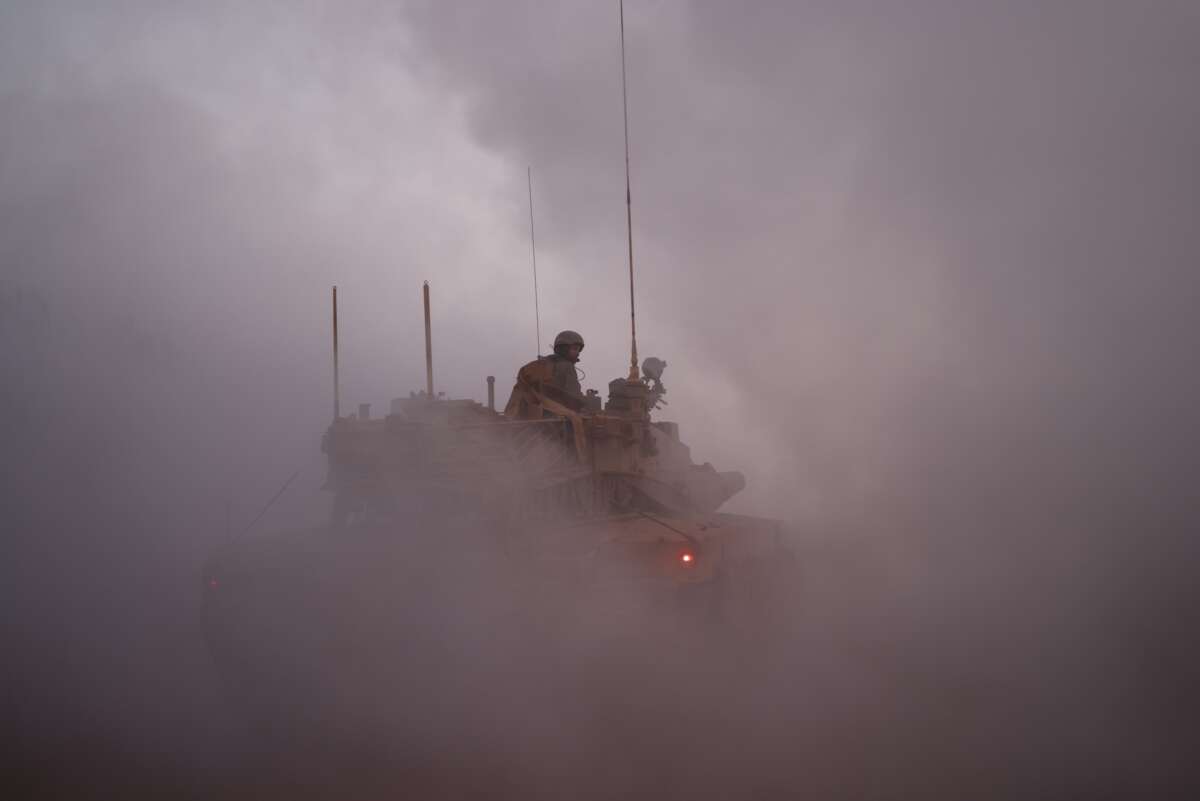
An Israeli soldier rides in the army Merkava main battle tank at a position in northern Israel along the border with southern Lebanon on November 6, 2025.

Support justice-driven, accurate and transparent news — make a quick donation to Truthout today! 

Israeli forces used a munition widely banned for its impact on civilians amid their war in Lebanon, new reporting finds as Israel carries out new assaults in Lebanon despite the ceasefire agreement.

Photo evidence of Israeli munitions remnants from three different locations in southern Lebanon suggests that the weapons were cluster munitions, The Guardian reported Wednesday, citing half a dozen arms experts who examined the photos.

These munitions scatter dozens or hundreds of “bomblets” across an area spanning several football fields. For decades, “civilians have paid dearly for [cluster munitions’] unreliability and inaccuracy,” the International Committee of the Red Cross (ICRC) has noted, as the weapons are imprecise by definition.

The evidence was found south of the Litani River, in Wadi Zibqin, Wadi Barghouz, and Wadi Deir Siryan, The Guardian found. The publication reports that this is the first evidence of such munitions being used in Lebanon since Israel first used them in its invasion of Lebanon in 2006.

They are especially dangerous as up to 40 percent of submunitions don’t explode on impact, leaving behind unexploded ordnance that could potentially harm civilians later if they come across them.

Related Story

Rescuers and residents gather around the rubble of a building levelled in an Israeli strike the village of Younine in eastern Lebanon's Bekaa Valley on November 21, 2024, amid the ongoing war between Israel and Hezbollah.

News

|

Human Rights

Human Rights Watch: Israel Used US Weapon in Likely War Crime in Lebanon

One strike killed 22 members of the same family, with three young boys surviving the attack. By Sharon Zhang , Truthout

April 24, 2025

These munitions can travel far and wide. ICRC has noted that “[t]heir small size, their use of parachutes and ribbons and other features mean that their descent is often affected by weather (wind, air density, etc.) and they may land far from the intended target. “

A 2008 treaty barring the use of the weapons has been signed by 123 states. Lebanon is party to the treaty, but Israel is not, nor is the United States.

Israel’s use of cluster bombs in the 2006 invasion was a major reason for the establishment of the treaty, but Israeli military authorities determined at the time that their use of the weapons was legal.

In recent years, human rights groups have raised alarm over Russian and Ukrainian forces’ extensive use of cluster munitions by both sides in their war, killing and injuring at least dozens of civilians. The U.S.’s widespread use of cluster bombs in its assault of Vietnam, Cambodia, and Laos represents a major contributor to the legacy of unexploded ordnance left behind by war.

In Lebanon, unexploded bombs from the 2006 invasion were still killing and maiming people years later. Israel dropped four million cluster munitions in the last days of the invasion, and UN officials estimated that up to 1 million of them didn’t explode.

The finding of the munition remnants comes as Israel is escalating its attacks on Lebanon, despite the ceasefire agreement signed nearly a year ago. Israel carried out a wave of air strikes on Tuesday and Wednesday. On Tuesday, Israel struck a Palestinian refugee camp in southern Lebanon, killing 13 people, Lebanese health officials said. These attacks come days after Israeli troops fired on UN peacekeepers stationed in southern Lebanon.

Lebanese officials are also filing a complaint to the UN Security Council over Israel’s construction of a concrete wall along Lebanon’s southern border. Officials say that it extends past the UN-established “blue line” that demarcates Lebanon from Israel and the Israeli-occupied Golan Heights.

Palestinians in Gaza reject UN Security Council approval of Trump’s plan: It’s a ‘new occupation’

November 19, 2025

On Monday, the UN Security Council voted to endorse the Trump administration’s “International Stabilization Force” in Gaza. Palestinians in Gaza say it is just a new face of the same Israeli occupation.

By Tareq S. Hajjaj November 18, 20250

A general view of the extensive destruction in the Zeitoun neighborhood, southeast of Gaza City, on November 17, 2025. (Photo: Omar Ashtawy/APA Images) A general view of the extensive destruction in the Zeitoun neighborhood, southeast of Gaza City, on November 17, 2025. (Photo: Omar Ashtawy/APA Images)
The UN Security Council voted on Monday in favor of a U.S.-backed resolution establishing an “International Stabilization Force” (ISF) in Gaza under a “Board of Peace” headed by U.S. President Donald Trump.

Under a two-year mandate, the stabilization force is reportedly planned to have an “executive” role in Gaza, not just as a peacekeeping force. The ISF is being established under Chapter 7 of the UN Charter, which means it is being granted the authority to disarm Palestinian resistance factions, aligning with Israeli demands, and could be established unilaterally, without the approval of the Palestinians.

The UN Security Council resolution voted 13-0 in favor of the resolution, with two permanent members, Russia and China, abstaining from the vote.

Hamas rejected and condemned the resolution, asserting that it does not satisfy the rights of the Palestinian people and imposes an international system of “guardianship” over Gaza, something the Palestinian people and Palestinian factions reject.

The Palestinian Islamic Jihad also rejected the resolution, saying it amounts to a new Western “mandate” over Palestine.

In Gaza, local reactions to the UN vote varied, but very few viewed the development as hopeful. 

Nader Qassem, one of the displaced in Gaza City, expressed his resentment over the resolution to Mondoweiss, pointing out that it is nothing more than a retrenchment of the Israeli occupation.

“Receiving the news was highly shocking to many families, including mine,” Qassem said. “After a long episode of suffering that has lasted through two years of death…after all this, we’re placed under international supervision?”

“It’s as if we are a people without a right to self-determination or the right to decide who protects us and manages our affairs,” he continued. “This is a disregard for our suffering in Gaza. The world is conspiring against us through international agreements that don’t serve the citizenry, helping out the occupier and its partners instead.”

Qassem adds that the ISF will not help preserve stability either. “This force will not be in a position to maintain security if it does not represent the Palestinians and if it does not result from a joint Palestinian process.”

“This force will increase the burdens of the Palestinian people and increase their suffering,” Qassem said.

“It’s as if we in Gaza have no opinion, no sovereignty over ourselves, not even a decision on who governs us,” Qassem continued.

Qassem also said that such decisions make Palestinians lose hope in reconstruction and returning to live in proper homes instead of tents. He also added that the vote makes it clear that the world is ignoring Palestinian rights and sovereignty when it gives guardianship to those who have no right to be in this land.

“These international forces,” Qassam explained, “belong to their countries and will not be closely connected to the Palestinians. They will not know the requirements of the Palestinian people and will not be able to provide them with safety or protection, because they do not know what the people of Gaza suffer or what they need. Whoever governs us must be from among us, aware of our suffering, so that they can solve these problems and provide us with a dignified life. These forces will not provide political, economic, or even social support to the population in Gaza.”

Others in Gaza agree that the stabilization force is a recipe for disaster. The minute it arrives in Gaza, it will be forced to engage in armed confrontations and start arresting people in Gaza, following Israeli recommendations. This will turn the international force into “a new occupation,” Gaza residents say.

Samir Al-Bakri, a resident of Gaza City, says that any force that is formed will be totally rejected by Palestinians so long as it isn’t formed through a Palestinian national consensus process.

Al-Bakri tells Mondoweiss that the international force will constitute a new occupation of the Strip. “Look at Lebanon. There is an international force operating in Lebanese territory, but does it prevent the daily shelling of Lebanon?” al-Bakri says. “No. Every day, we see Israeli shelling of Lebanese land and continual Israeli violations.” 

“It is as if the mission of the international force coming to Gaza is to protect Israel’s borders from Palestinians without offering anything in return to us,” al-Bakri continued. “And it won’t even offer us any real protection either; it won’t prevent Israel from carrying out its military operations or aerial bombardments of Gaza. It may even help Israel achieve its goals.”

The greatest fear, according to al-Bakri, is the confrontation between Palestinians in Gaza and these international forces, and the emergence of new problems with the countries that send these forces—including Egypt and Qatar. “We fear that our disputes will become with Egypt instead of Israel, and with Qatar as well, and this is what they are trying to establish.”

“If the international force arrests one of my relatives, there will be no enemy to confront except this international force composed of Egyptians and Qataris,” he explained. “They will become our enemies instead of the Israelis. And this force will serve as a helping hand for the Israelis to achieve their objectives.”

“After all this suffering, the Palestinian people deserve a unified Palestinian force, of the people and for them, to manage their affairs,” al-Bakri added. “It is a renewal of the Israeli occupation. The UN is rewarding us with a new occupation.”

Israel’s Ben Gvir Calls for the Killing of Palestinian Authority Officials If UN Backs Palestinian State

November 18, 2025

by Dave DeCamp | November 17, 2025

Israeli Minister of National Security Itamar Ben Gvir has called for the assassination of Palestinian Authority officials and for PA President Mahmoud Abbas to be placed in solitary confinement if the UN advances the recognition of a Palestinian state.

“A ‘Palestinian’ state of the ‘invented people’ who call themselves ‘Palestinian’ must never be established, because the aspiration of those seeking to establish such a state is to build it on the ruins of the State of Israel,” Ben Gvir said at a meeting of his Jewish Power party, according to The Times of Israel.

“If they accelerate recognition of a Palestinian terror state… orders must be given for targeted killings of senior Palestinian Authority officials — who are terrorists in every respect — as well as an order for the arrest of [Mahmoud Abbas]. There is a solitary confinement cell ready for him in Ketziot Prison,” he added.

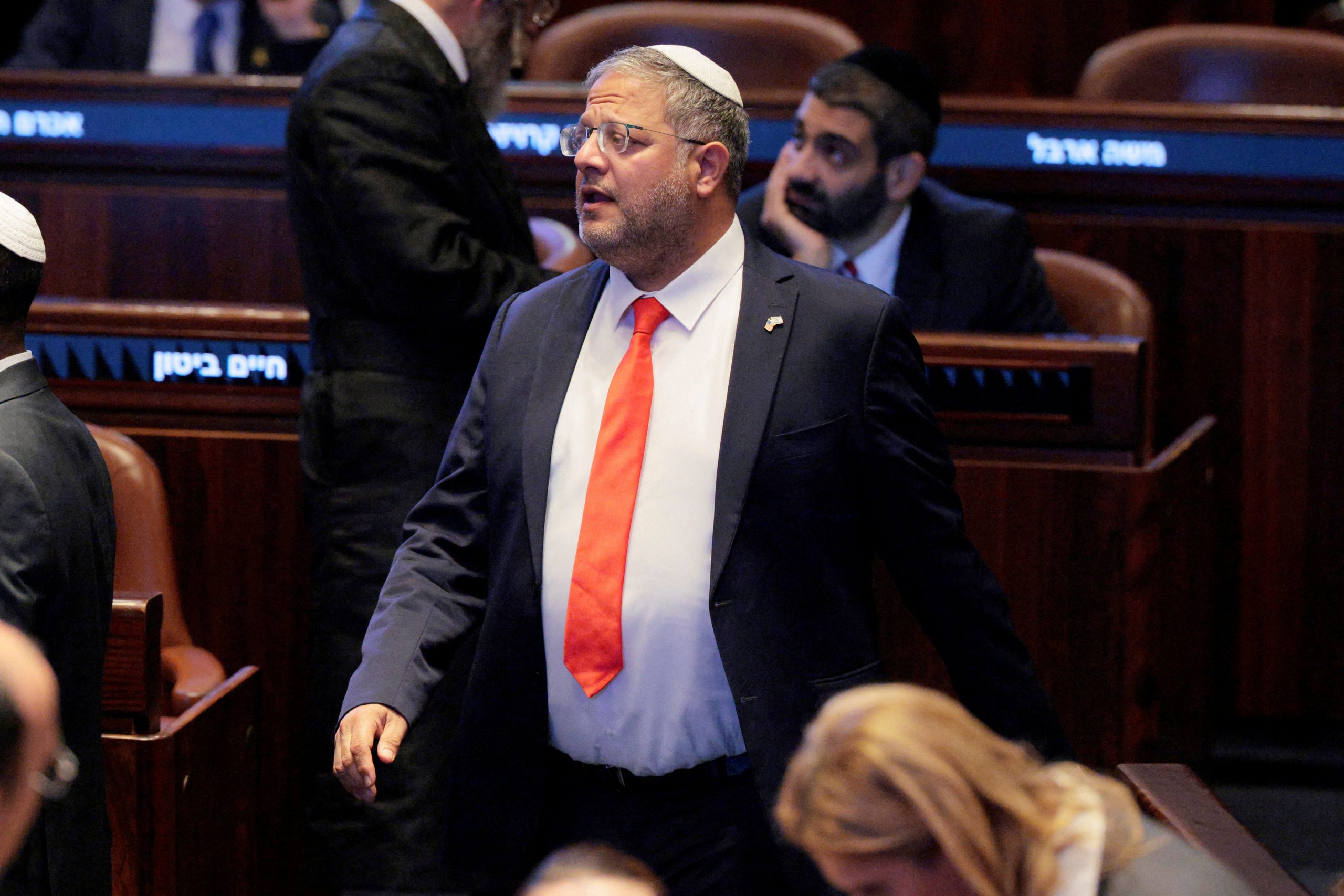
Israeli politician Itamar Ben-Gvir walks inside the Knesset, on the day US President Donald Trump delivers remarks, in Jerusalem, October 13, 2025. Chip Somodevilla/Pool via REUTERS/File Photo

As the minister of national security, Ben Gvir oversees Israeli prisons, where at least 98 Palestinians have died since October 7, 2023, according to new data, due to torture, food deprivation, medical neglect, and other Israeli abuses.

Ben Gvir’s call for the killing of PA officials came ahead of a UN Security Council resolution that would authorize the deployment of an “International Stabilization Force” to Gaza. Some states initially objected to the resolution because it made no mention of a Palestinian state, prompting the US to add an amendment that says once the PA “faithfully carried out and Gaza redevelopment has advanced, the conditions may be in place for a credible pathway to Palestinian self-determination and statehood.”

The US issued a joint statement with several Arab states on Friday that said the US resolution “offers a pathway to Palestinian self-determination and statehood.” But the Israeli government has made clear that it’s very opposed to the establishment of the Palestinian state, and the US plan for Gaza doesn’t address the Israeli occupation of the West Bank and the continued expansion of illegal Jewish settlements in the territory.

𝐈𝐬𝐫𝐚𝐞𝐥𝐢 𝐌𝐢𝐥𝐢𝐭𝐚𝐫𝐲 𝐇𝐚𝐬 𝐊𝐢𝐥𝐥𝐞𝐝 𝟐𝟔𝟔 𝐏𝐚𝐥𝐞𝐬𝐭𝐢𝐧𝐢𝐚𝐧𝐬 𝐢𝐧 𝐆𝐚𝐳𝐚 𝐒𝐢𝐧𝐜𝐞 ‘𝐂𝐞𝐚𝐬𝐞𝐟𝐢𝐫𝐞’ 𝐖𝐞𝐧𝐭 𝐈𝐧𝐭𝐨 𝐄𝐟𝐟𝐞𝐜𝐭: 𝐇𝐞𝐚𝐥𝐭𝐡 𝐌𝐢𝐧𝐢𝐬𝐭𝐫𝐲

November 17, 2025

by Dave DeCamp, Antiwar. com, November 16, 2025

The Israeli military has killed 266 Palestinians and wounded 635 since the US-backed “ceasefire” deal went into effect on October 10, Gaza’s Health Ministry said on Sunday.

The Health Ministry said that over the previous 72-hour period, at least two Palestinians were killed by Israeli forces. The Palestinian news agency WAFA reported on Sunday that at least one Palestinian was killed by an Israeli airstrike targeting a group of civilians to the east of Gaza City. A source at Nasser Hospital in southern Gaza told Al Jazeera that three Palestinians were killed by Israeli airstrikes east of Khan Younis.

Dozens of Palestinians have been killed while allegedly crossing or approaching the so-called “yellow line,” the boundary that Israeli troops withdrew to under the ceasefire deal. The IDF has maintained a policy of shooting or bombing anyone who approaches the line, which is not clearly marked for the Palestinians on the ground. Many Palestinians want to return to their homes or the rubble of their homes on the Israeli-occupied side of Gaza.

Mourners carry the bodies of children during the funeral of Palestinians who, according to the medics, were killed in overnight Israeli strikes, at Al-Ahli Arab Hospital in Gaza City, October 29, 2025. REUTERS/Dawoud Abu Alkas

The IDF also killed more than 100 Palestinians, including 46 children, in a single night of bombing at the end of October after alleging its troops were attacked by Hamas, an incident which resulted in the death of one Israeli soldier. According to Israeli media reports, the IDF soldier was killed by a group of Palestinian militants isolated in Rafah when the tunnel they were hiding in collapsed as a result of IDF operations in the area.

Hamas denied any role in the attack, and Israeli media reports said the IDF didn’t know if Hamas’s leadership was involved, but it still launched a massive bombardment across Gaza in response, a massacre that was supported by the Trump administration.

Israel has also violated the ceasefire by not fulfilling the stipulation in the deal for it to allow an “unrestricted” flow of humanitarian aid into Gaza, as it just recently allowed aid deliveries to enter a border crossing into northern Gaza. Israel was also supposed to open the Rafah border crossing connecting Gaza and Egypt, but it remains closed.

Gaza’s Health Ministry also said on Sunday that since the truce deal went into effect, the bodies of 548 deceased Palestinians have been recovered from the rubble, and Israel has handed over the remains of 330 Palestinians in exchange for the bodies of Israeli captives released by Hamas. Around 10,000 Palestinians are still missing in Gaza and presumed dead under the rubble.

Since October 7, 2023, the Health Ministry’s death toll has reached 69,483, and the number of wounded has climbed to 170,706. Studies have found that the ministry’s numbers are likely a significant undercount, and could be by as much as 40%, meaning the real violent death toll could be close to 100,000.

𝐓𝐫𝐮𝐦𝐩 𝐰𝐚𝐧𝐭𝐬 𝐭𝐨 𝐫𝐞𝐜𝐫𝐞𝐚𝐭𝐞 𝐭𝐡𝐞 𝐁𝐫𝐢𝐭𝐢𝐬𝐡 𝐦𝐚𝐧𝐝𝐚𝐭𝐞 𝐢𝐧 𝐏𝐚𝐥𝐞𝐬𝐭𝐢𝐧𝐞

November 14, 2025

The US president is pushing a UN resolution that would revive the mandate structure of 100 years ago almost entirely, simply replacing the UK with the US as the authority in control.

By Jeffrey Sachs and Sybil Fares
Aljazeera, 13 Nov 2025US President Donald Trump greets Palestinian President Mahmoud Abbas in Sharm El-Sheikh, Egypt
US President Donald Trump greets Palestinian Authority President Mahmoud Abbas during a world leaders’ summit on ending the Gaza war on October 13, 2025 in Sharm El-Sheikh, Egypt [Evan Vucci/Pool via Getty Images]

The Trump administration is pushing an Israeli-crafted resolution at the UN Security Council (UNSC) this week aimed at eliminating the possibility of a State of Palestine. The resolution does three things. It establishes US political control over the Gaza Strip. It separates Gaza from the rest of Palestine. And it allows the US, and therefore Israel, to determine the timeline for Israel’s supposed withdrawal from Gaza, which would mean never.

This is imperialism masquerading as a peace process. In and of itself, it is no surprise. Israel runs US foreign policy in the Middle East. What is a surprise is that the US and Israel might just get away with this travesty unless the world speaks up with urgency and indignation.

The draft UNSC resolution would establish a US-UK-dominated Board of Peace, chaired by none other than President Donald Trump himself, and endowed with sweeping powers over Gaza’s governance, borders, reconstruction, and security. This resolution would sideline the State of Palestine and condition any transfer of authority to the Palestinians on the indulgence of the Board of Peace.

This would be an overt return to the British mandate of 100 years ago, with the only change being that the US would hold the mandate rather than the United Kingdom. If it were not so utterly tragic, it would be laughable. As Marx said, history repeats itself, first as tragedy, then as farce. Yes, the proposal is a farce, yet Israel’s genocide is not. It is a tragedy of the first order.

Incredibly, according to the draft resolution, the Board of Peace would be granted sovereign powers in Gaza. Palestinian sovereignty is left to the discretion of the board, which alone would decide when Palestinians are “ready” to govern themselves – perhaps in another 100 years? Even military security is subordinated to the board, and the envisioned forces would answer not to the UNSC or to the Palestinian people, but to the board’s “strategic guidance”.

The US-Israel resolution is being put forward precisely because the rest of the world – other than Israel and the US – has woken up to two facts. First, Israel is committing genocide, a reality witnessed every day in Gaza and the occupied West Bank, where innocent Palestinians are murdered to the satisfaction of the Israeli military and illegal Israeli settlers in the West Bank. Second, Palestine is a state, albeit one whose sovereignty remains obstructed by the US, which uses its veto in the UNSC to block Palestine’s permanent UN membership. At the UN this past July and then again in September, the UN General Assembly voted overwhelmingly for Palestine’s statehood, a fact that put the Israel-US Zionist lobby into overdrive, resulting in the current draft resolution.

For Israel to accomplish its goal of Greater Israel, the US is pursuing a classic divide-and-conquer strategy, squeezing Arab and Islamic states with threats and inducements. When other countries resist the US-Israel demands, they are cut off from critical technologies, lose access to World Bank and IMF financing, and suffer Israeli bombing, even in countries with US military bases present. The US offers no real protection; rather, it orchestrates a protection racket, extracting concessions from countries wherever US leverage exists. This extortion will continue until the global community stands up to such tactics and insists upon genuine Palestinian sovereignty and US and Israeli adherence to international law.

Palestine remains the endless victim of US and Israeli manoeuvres. The results are not just devastating for Palestine, which has suffered an outright genocide, but for the Arab world and beyond. Israel and the US are currently at war, overtly or covertly, across the Horn of Africa (Libya, Sudan, Somalia), the eastern Mediterranean (Lebanon, Syria), the Gulf region (Yemen), and Western Asia (Iraq, Iran).

If the UNSC is to provide true security according to the UN Charter, it must not yield to US pressures and instead act decisively in line with international law. A resolution truly for peace should include four vital points. First, it should welcome the State of Palestine as a sovereign UN member state, with the US lifting its veto. Second, it should safeguard the territorial integrity of the State of Palestine and Israel, according to the 1967 borders. Third, it should establish a UNSC-mandated protection force drawn up from Muslim-majority states. Fourth, it should include the defunding and disarmament of all belligerent non-state entities, and it should ensure the mutual security of Israel and Palestine.

The two-state solution is about true peace, not about the politicide and genocide of Palestine, or the continued attacks by militants on Israel. It is time for both Palestinians and Israelis to be safe, and for the US and Israel to give up the cruel delusion of permanently ruling over the Palestinian people.

‘Everything is cut off’: Nearly 1,000 new barriers obstruct West Bank life

November 2, 2025

Israel has also escalated its violent raids in the occupied West Bank, coinciding with a surge in settler attacks on Palestinians

News Desk

OCT 30, 2025

(Photo credit: John Macdougall)

Close to 1,000 new barriers have been set up by the Israeli military in the occupied West Bank since the start of the genocide in Gaza two years ago, according to a Palestinian government body called the Wall and Settlement Resistance Commission. 

The commission said 916 gates, barriers, and walls have been erected across the territory since 7 October 2023. 

Many of these barriers are metal gates, sometimes manned by Israeli soldiers, which are put up at many town and village entrances, as well as between West Bank cities. 

The military uses these barriers to control the movement of Palestinians and prevent people from entering or exiting certain areas. 

The UN said last month that it documented the establishment of 18 new gates in the occupied West Bank. 

It also said Israel uses concrete blocks and large earth mounds to restrict Palestinian movement in the territory. Earth mounds are particularly common during the Israeli army’s violent raids in West Bank refugee camps. 

Residents in the village of Aboud told the Washington Post that the gates are closed daily from 6:00 am to 9:00 am, preventing students from reaching university and citizens from reaching their jobs. 

“Under the current circumstances, everything has been cut off. Everything has stopped,” a resident of Deir Dibwan village told the newspaper.

Around three million Palestinians are now forced to make long detours, sometimes taking more than an hour, for a journey not meant to take longer than 20 minutes. 

“This is all part of the occupation’s strategy to undermine people’s sense of security,” one resident, a taxi driver, said. 

As Israel solidifies its decades-old occupation, settler violence continues to escalate with the backing of the military.

In recent weeks, Palestinian olive harvesters have come under increased aggression by settlers. Earlier this month, harvesters were attacked by settlers in the village of Kafr Thulth. Shepherds were also assaulted, and a number of their goats were killed by settlers. 

Olive farmers from Farata were also shot at with live ammunition by settlers recently. The Israeli military has backed and contributed to the settler campaign against harvesters. 

The Israeli military has uprooted thousands of olive trees in the village of Al-Mughayyir, which comes under constant attacks by settler lynch mobs aiming to displace families from their land. 

In January this year, Israeli troops launched a massive operation in the occupied West Bank cities of Tulkarem and Jenin. The months that followed have seen Tel Aviv displace tens of thousands of civilians from the two cities and destroy massive amounts of civilian infrastructure in a targeted demolition campaign. 

Residents have not been allowed to return to their neighborhoods.

In response to a recent surge in resistance activity in the occupied West Bank, Israel has escalated its raids and has ordered the military to “take all necessary measures” against “terrorists.”

The Israeli military said on Tuesday that it assassinated three “terrorists” from the Jenin refugee camp, in a joint operation with the Shin Bet security service and the Yamam border police unit.

Terms of Surrender: The Conspiracy to Obstruct Justice in Palestine

November 1, 2025

Terms of Surrender: The Conspiracy to Obstruct Justice in Palestine

Shutterstock

A look at three possible tracks for a negotiated end to the genocide in Gaza. 

By Craig Mokhiber, FPIF, October 30, 2025

In the wake of two years of the globally broadcast extermination of the people of Palestine, three distinct tracks of international response have emerged. One is grounded in justice, international law, human rights, and accountability. Two others are dedicated to impunity, the continued subjugation of the victims, and the normalization of the perpetrator regime.

In the diplomatic struggle that has ensued, the justice track is under sustained attack. Left to their own devices, most states — the directly complicit and the timid alike — will undoubtedly take the easy way out, opting for impunity and normalization. But a growing people’s movement from across the globe is mobilized to demand justice.

A Textbook Genocide

The roots of the genocide in Palestine run deep, through a century of racist colonization, the Nakba of 1947-1948, eight decades of apartheid, 58 years of brutal occupation, and generations of persecution.

Now, for the past two years, the world has watched in horror as the Israeli regime planned, announced, perpetrated, and celebrated the accelerated genocide of the Palestinian people. Adding to the horror of this historic atrocity has been the ruthless complicity of so many governments, media corporations, weapons and tech companies, and Israel proxy groups planted among the populations of the West.

The unprecedented nature of this genocide has been driven home by so many terrifying “firsts.”

The first live-streamed genocide, witnessed by millions around the world. The first hi-tech genocide, perpetrated with state-of-the-art weapons systems, killer drones, autonomous weapons, surveillance technologies, and artificial intelligence. And the first globalized genocide, perpetrated with the direct and enthusiastic participation of so many governments (foremost among them the U.S., U.K., and Germany), and the active complicity so many corporations and organizations across the globe. Zionist repression has extended far beyond the shores of Palestine, with complicit Western institutions using state power to oppress and silence all who dare to speak out against the genocide and their governments’ complicity in it.

At the same time, in just two years, the Israeli regime has shattered record after bloody record for the murder of several categories of protected persons, including medical personnel, journalists, aid workers, UN staff, and children, as well as one of the highest civilian casualty rates ever recorded.

And it has achieved the dubious distinction of creating the widest global consensus on the perpetration of the crime of genocide ever recorded, with declarations of genocide issued by the UN’s Commission of Inquiry, its independent human rights rapporteurs, leading international human rights organizations like Amnesty International and Human Rights Watch, leading Palestinian and Israeli human rights organizations, the leading association of genocide scholars, and international lawyers across the world.

This is quintessential genocide, its genocidal intent declared out loud by Israeli leaders from the start, followed by a horrific catalogue of genocidal acts carried out with a violence as ruthless as it is systematic. Neighborhood after neighborhood, town after town, hospital after hospital, school after school, shelter after shelter, church after church, mosque after mosque, field after field, food store after food store.

Two years of siege, blocking aid, food, water, medicine, fuel, and every essential of human life. A chain of massacres, mass abductions, torture camps, sexual violence, intentionally imposed disease and starvation. Palestinian toddlers shot by snipers for sport. Palestinian captives tortured to death. Gaza reduced to a moonscape.

The Justice Track

So blatant were its crimes that within months of the launch of its genocidal onslaught, the Israeli regime was on trial for genocide in the World Court (ICJ) and its leaders were indicted for crimes against humanity at the International Criminal Court (ICC). Indeed, experts had sounded the genocide alarm already in October of 2023. And since then, human rights monitors have collected volumes of evidence.

Even as complicit states worked to buttress the impunity of the Israeli regime, the global public demand for accountability grew ever louder. It would ultimately compel the government of South Africa to brings it historic ICJ case against the regime under the United Nations Genocide Convention in December of 2023. The Court found the allegations of genocide plausible in January of 2024 and issued what would be the first of a series of provisional measures binding on the Israeli regime. Months later, the Chief Prosecutor of the ICC issued arrest warrants for Israeli Prime Minister Benjamin Netanyahu and Defense Minister Yoav Gallant for crimes against humanity.

In July of 2024, the ICJ would also issue a landmark advisory opinion concluding that Israel was committing apartheid and racial segregation, that all of the West Bank, East Jerusalem and Gaza are unlawfully occupied, that Israel must remove all settlements, settlers, soldiers, and occupation infrastructure, dismantle the apartheid wall in the West Bank, provide reparations to the Palestinians, and allow all those forced out to return home. The Court said that all states have a legal obligation not to recognize or assist the occupation and are obliged to help to bring an end to Israel’s occupation and other violations. And it found that all states must end all treaty relations with Israel that relate to the Palestinian territories, cease all economic, trade, and investment relations connected to the occupied territories.

Importantly, the Court rejected arguments by the U.S. and other Western governments that sought to claim that the Court should defer to post-Oslo negotiations between the occupier and the occupied, and to the politics of the Security Council, rather than the application of international law. The Court, in rejecting these claims, declared that such negotiations and agreements do not and cannot trump the rights of the Palestinians and the obligations of Israel under international human rights and humanitarian law. The Court found first that, in any event, the parties have to exercise any powers and responsibilities under those agreements with due regard for the norms and principles of international law.

Invoking article 47 of the Fourth Geneva Convention, the Court then put the matter to rest for good, reminding states that, as a matter of law, “the protected population ‘shall not be deprived’ of the benefits of the Convention ‘by any agreement concluded between the authorities of the occupied territories and the Occupying Power.’”

“For this reason,” the Court continued, “the Oslo Accords cannot be understood to detract from Israel’s obligations under the pertinent rules of international law applicable in the Occupied Palestinian Territory.” With the bang of a gavel, the Court had ended decades of Israeli legal exceptionalism and launched a process for the dismantling of the Western constructed Israeli wall of impunity.

In the meantime, at the United Nations, international human rights investigators were issuing their own findings of Israeli regime apartheid and genocide. The UN’s Special Rapporteur on human rights in Palestine issued a series of powerful reports documenting these crimes, followed by further reports from the UN’s thematic human rights rapporteurs, and, ultimately a UN-mandated Commission of Inquiry.

Outside the UN, international human rights organizations, as well as those in Palestine and Israel, joined the global consensus, as did prominent international lawyers and the International Association of Genocide Scholars, sealing the global consensus on genocide in Palestine.

Thereafter, the findings of the judicial and expert bodies of the international system finally broke through to the political bodies of the UN. On September 18, 2024, the United Nations General Assembly adopted a dramatic resolution effectively codifying the findings of the ICJ, declaring the occupation and apartheid unlawful, demanding an end to the entire occupation and the assault on Gaza, and setting a one-year deadline for Israeli compliance, after which the UNGA promised further measures.

For the first time in decades, the stage was set for real Israel regime accountability.

Global civil society activists, led by representatives of Palestinian civil society, seized on the unprecedented opportunity of the one-year deadline (violated entirely by the Israeli regime) to formulate an agenda for Israeli accountability and Palestinian protection. They developed a plan for adoption in the UNGA at the end of the deadline that would use the extraordinary power of the Assembly under the Uniting for Peace process to circumvent the U.S. veto in the Security Council and mandate concrete measures for accountability and protection.

This would include a UNGA call for sanctions, a military embargo, the rejection of the credentials of the Israeli regime, the establishment of a criminal tribunal, the reactivation of the UN’s anti-apartheid mechanisms, and the mandating of a UN protection force to protect civilians, ensure humanitarian aid, preserve evidence of Israeli crimes, and facilitate reconstruction. Importantly, the protection force would be mandated on the basis of Palestinian consent, with no Chapter 7 power to impose itself against the will of the indigenous people, thus obviating fears of a proxy occupation.

The initiative was subsequently embraced by Colombian President Gustavo Petro, who, in his speech before the 80th Session of the UNGA, promised to introduce the proposal, as a draft resolution was prepared and diplomatic action proceeded to secure other co-sponsors.

The French-Saudi Track

But the unprecedented possibility for Israeli accountability presented by the UNGA resolution and deadline was not lost on Israel’s allies either, who worked feverishly to forestall any possibility of such accountability coming into force.

The tactics they adopted had become all too familiar during the decades of Oslo: divert attention away from accountability under international law and into a loose political process and the promise of a possible Palestinian state at some point in the future; compel Palestinians to negotiate for their rights with their oppressor; and work to normalize the Israeli regime as it consolidates its conquest of Palestine.

In sum, the true focus of these initiatives is not on saving Palestine, but rather on saving Israel and Zionism, even in the wake of a genocide.

French President Emannuel Macron made the intentions of his initiative clear in a letter to his Israeli regime counterpart in September of 2025. In it, he openly brags about his efforts in France to equate anti-Zionism with antisemitism in order to punish dissent to his pro-Israel rule, and then tells Netanyahu that his actions at the UN (including recognizing an unarmed Palestinian Bantustan) are meant “to transform the military gains Israel has achieved on regional fronts into a lasting political victory, to the benefit of its security and prosperity…to [secure] Israel’s …full regional integration in the Middle East…its normalization…[and] the end of Hamas.”

In other words, the French-Saudi proposal is not about holding the regime accountable for its genocide and aggression in the region, but rather to shore up the Zionist project in Western Asia, to consolidate its unlawful gains, and to normalize it on the international stage.

The final product of the French-Saudi proposal was the New York Declaration on the Peaceful Settlement of the Question of Palestine and the Implementation of the Two-State Solution, endorsed by the UNGA in September of 2025, just eight days before the expiration of the deadline for Israeli compliance set by Assembly. Notably, the declaration mentions neither the genocide nor the crime of apartheid and contains no accountability measures for the Israeli regime whatsoever. It was, in effect, a last-minute defensive maneuver to preserve the wall of Israeli impunity that the West had so carefully built up over eight decades.

In essence, the declaration reads like a blueprint for the further entrenching of the unjust status quo that existed before October of 2023, but with some extra rewards for Israel, and an amorphous promise of a limited Palestinian state somewhere down the road. Indeed, it promises to advance normalization and regional cooperation for Israel on trade, infrastructure, energy, and security. Ignoring justice and accountability altogether, the declaration instead dedicates itself to “peace, security, and stability,” reduces the genocide in Gaza to an armed conflict in which both sides are at fault, and declares yet another political process toward a “two-state solution” as the only way forward. Ignoring the U.S. role as a co-perpetrator in the genocide, it explicitly supports the role of the U.S. as a mediator (alongside Egypt and Qatar).

While it demands that Hamas free all Israeli captives, it only provides for the “exchange” of some Palestinian captives. And in flagrant disregard for the right to self-determination of the Palestinian people, it purports to impose its own governance framework, with the Palestinian Authority (with “international support”) to be in charge of all Palestinian territory, and Hamas to be excluded from governance in Gaza. Eventual elections would be open only to those committed to respect the PLO (and therefore the PA) political platform.

Palestinian resistance groups defending their land and people against occupation, apartheid, and genocide are to be disarmed under the plan, while the Israeli perpetrator regime faces no such disarmament, and any eventual Palestinian state is itself envisaged by the plan to be a disarmed and defenseless entity. In other provisions, the plan would promote “deradicalization,” a dangerous concept born of the so-called “global war on terrorism,” in which populations are subjected to propaganda programmes (and often punitive measures) designed to discourage resistance to foreign domination and abusive regimes — despite the fact that such resistance is a right under international law.

The plan also proposes the deployment of troops to Palestine under a “stabilization mission” to be mandated by the UN Security Council. While the mandate of the mission would include civilian protection and security guarantees for Palestine, it would also be responsible for transferring “internal security responsibilities” to the security forces of the Palestinian Authority, disarming all other factions, providing “border security” (i.e., ensure no Palestinians escape from the Gaza cage), and for guaranteeing security for the (hyper-armed, nuclear capable, and thoroughly militarized) Israeli regime.

In other words, the mission would keep an eye on all Palestinian resistance and guarantee the impunity of the Israeli regime.

The Trump Track

Following up on his earlier King Leopold-esque promise to “own Gaza” and to build a colonized Riviera on the bones of its genocided population, Trump announced his 20-point plan at the end of September.

In the long-standing tradition of Western imperial arrogance in Palestine dating back to Sykes-Picot and the Balfour Declaration, Trump’s 20 points were not negotiated with the Palestinians before he issued them. Indeed, Palestinians were not consulted or involved in their drafting. Rather, in a blatant act of 21st Century gunboat diplomacy, they were presented as a unilateral dictate from the U.S.-Israel axis, accompanied by violent threats of total destruction if they were not accepted.

The document was the product of an international rogue’s gallery of characters — which, in addition to genocide-complicit Trump and ICC-indicted fugitive Netanyahu, included notorious figures like Iraq war criminal Tony Blair and Trump’s billionaire son-in-law (and family friend of Netanyahu) Jared Kushner. The group did consult some of its complicit Arab and Muslim allies, but they subsequently complained that the document had been changed in fundamental ways by Trump and Netanyahu after their endorsement.

Netanyahu, who was allowed to make last-minute changes to the text before issuance, then stood with Trump to say he agreed to it — but within hours, was publicly renouncing elements of the plan and pledging that there would never be a Palestinian state, and that Israeli soldiers would not leave Gaza.

To be clear, this is not a peace plan or a plan for ending the Israel Palestine conflict. It provides no promise of Palestinian liberation, no restoration of the rights of the Palestinian people, and no guarantee of Palestinian statehood and self-determination. Instead, it provides a vague and hyper-qualified reference to “conditions” that “may emerge” sometime in the future, if Gaza re-development advances, and if the PA reforms to the satisfaction of the U.S. imperial overlords. Outrageously, the plan concludes with the U.S. arrogating to itself the role of mediator between Palestine and its Israeli occupier for any future political settlement, which would guarantee many more horrific decades of Palestinian persecution as they are forced to negotiate for their rights with their oppressor and that oppressor’s chief sponsor.

Tellingly, the 20 points contain not a word about the genocide, about apartheid, or about root causes. There is to be no accountability for the perpetrators. No redress for the victims. And the plan promises not the deradicalization of the regime perpetrating genocide, but rather of the Palestinian victims of that genocide. It is directed at ensuring that the exterminated people of Gaza “pose no threat” to its neighbors, with no guarantee that the Israeli regime, the perpetrator of the genocide, the occupier of three Arab nations, and the author of serial aggression against half a dozen neighboring countries and a spate of transnational assassinations will pose no threat. Palestinian security forces will be vetted by the U.S.-led stabilization force. There will be no such vetting of Israeli forces, the ranks of which are rife with perpetrators of war crimes, crimes against humanity, and genocide.

The roots of this plan in Trump’s earlier threat to “own Gaza” and to exploit a “Gaza Riveria,” are revealed in the text itself. Under Trump’s new plan, Gaza will be ruled by a colonial body headed by Donald Trump himself, with another prominent place on the body held by disgraced UK politician Tony Blair. The body, in typical Trumpian style, is dubbed “The Board of Peace.”

This body would set the framework and handle the funding for the redevelopment of Gaza (through the “Trump Economic Development Plan”), positioning it to control all resources coming in from Gulf and European donors, with no oversight. The possibility of staggering levels of corruption would seem self-evident. The unchecked external control, extraction, and exploitation of Palestine’s economic resources would be inevitable. And note that there is no mention of Israel’s international legal obligations to provide compensation and reparations for the damage it has inflicted on Gaza.

While the plan usurps Palestinian agency by controlling Palestinian resources and designating Palestinian leaders, it also purports to exclude some Palestinians from the right to be involved in the governance of their own country. The role of Hamas, for example, should be a matter for Hamas and the Palestinian people to decide. Under this plan, Hamas is to be excluded not by decision of the Palestinian people, but rather by dictate from the U.S., which has decreed that Hamas (“and other factions”) will not have any role in the governance of Gaza, “directly, indirectly, or in any form.”

And in other provisions, the resistance is to be entirely disarmed, and its military infrastructure destroyed. Notably, the plan also provides for the destruction of Gaza’s tunnels, which have been essential not only for the defense of the territory, but also for the critical movement of persons and goods during the many unlawful Israeli sieges on the territory.

Reminiscent of the Eight Nation Invasion of China in 1900, the plan even proposes a multinational proxy occupation force led by the U.S. with the participation of “Arab and international partners” that will “stabilize” Gaza, impose “internal security,” secure the borders (i.e., ensure the continued caging of the Palestinians), and prevent the Palestinians from rearming, leaving them defenseless against Israeli aggression.

The plan provides no expectation of a complete Israeli withdrawal from Gaza, only the possibility of a phased redeployment to the margins of Gaza and the maintenance of an Israeli “security perimeter” to remain indefinitely inside Gaza. And any partial withdrawal of Israeli regime forces that may occur is to be based on as yet undefined “standards, milestones, and time frames” that are linked to the disarming of Palestinians, and that will be determined by the U.S., by the stabilization force headed by the U.S., and by the Israeli forces that are armed, funded, and supported by the U.S. — yet another indicator of the proxy occupation nature of the plan.

While the plan provides for a significant increase in aid to the survivors of the genocide in Gaza, that aid is (unlawfully) conditioned on the acceptance by Hamas of Trump’s terms — and even then, aid quantities would be limited by the terms of the previous ceasefire of January 19, 2025. Similarly, opening of the Rafah crossing is to be subject to the same mechanism implemented under the January agreement, and thus will be still subject to continued restrictions. And it provides for the possible denial of humanitarian aid to certain areas of Gaza if Hamas is deemed to have delayed the process.

Where key details are scarce in the plan, there is also reason for worry, given that the document explicitly cites Trump’s 2020 peace plan (as well as the French-Saudi proposal described above) as part of the basis for subsequent stages in the process. Readers will recall that the 2020 plan included the further expansion of Israeli territory, the annexation of much of the West Bank, the renunciation of all Palestinian legal claims against Israel, the exclusion of Palestine from East Jerusalem, and the creation of an archipelago of Palestinian Bantustans surrounded by Israeli settlements, borders, and walls.

Even the more concrete elements of the plan are heavily weighted in favor of the Israeli perpetrator and against the besieged and persecuted Palestinian people.

For example, the release of all Israeli captives (of whom there are only a few dozen) is to take place within 72 hours. The release of Palestinian captives unlawfully held by Israel (of whom there are some 11,000) on the other hand, will only include a small proportion of those held at some unspecified time after all Israelis are returned. In all, less than 2,000 of the 11,000 Palestinian captives held by Israel are to be released.

Similarly, the remains of approximately 25 Israeli captives are thought to be held in Gaza, while the remains of some 2,000 deceased Palestinians are held by the Israeli regime. While the Trump plan stipulates the release of all Israeli remains, it only provides for the release of a portion of the Palestinian remains.

And some potentially positive provisions of the document are undercut by contradictory provisions elsewhere in the document.

For example, the document promises a ceasefire, amnesty, and safe passage for Hamas members; a commitment that no one will be forced to leave Gaza and that those who wish to leave will be free to do so and to return; that Israel will not occupy or annex Gaza; and that aid will flow through the UN and Red Crescent without interference.

However, while committing to the free flow of aid, it elsewhere implicitly imposes restrictions on aid. While promising no Israeli occupation, it also implies that Israeli regime forces will remain in Gaza indefinitely. And vague wording leaves unclear whether the essential role of UNRWA (which the U.S. and Israel have falsely claimed is associated with Hamas) will be allowed, and whether the genocide-complicit role of the perfidious GHF scheme (which the U.S. falsely claims is not associated with the Israeli regime) will be allowed to continue.

In parts, the Trump plan itself is unlawful. The conditioning of humanitarian aid, implicit threats of collective punishment if Hamas does not agree, the explicit denial of Palestinian self-determination, restrictions on political rights, the requirement that Palestinians negotiate for their inalienable human rights with their oppressors, and the failure to seek accountability for Israeli crimes including genocide, are all breaches of the international legal obligations of the United States.

For its part, Hamas seized on the practical and implementable elements of the first phase of the plan (ceasefire, exchange of captives, etc.) for negotiation while refusing to surrender the cause of Palestine or to submit to the remainder of the document. Hamas said that the rest of the issues in the document were to be “discussed within a comprehensive Palestinian national framework, in which Hamas will be included and will contribute with full responsibility.”

And the outright rejection of the plan by representatives of Palestinian civil society demonstrates the dignified steadfastness of Palestinian society in struggling for their freedom, even in the darkest of times.

The Struggle Continues

As this goes to press, moves are underway to effectively merge the French-Saudi plan with the Trump plan, and to have it blessed in the UN Security Council. But the colonial machinations of Trump, Macron, and others cannot obscure the fundamental reality confronting the world today: a single colonial regime planted in the heart of Western Asia is perpetrating apartheid, genocide, belligerent occupation, and serial aggression across the region and corrupting governments and institutions far beyond.

The unprecedented, Western-sponsored impunity of that regime is undercutting the very sustainability of international law, trampling on human rights, and jeopardizing peace and security across the region. Finally holding that regime accountable remains a vital, even existential imperative for the world.

In the meantime, for a people enduring genocide, any ceasefire is to be celebrated. But few are under the illusion that this ceasefire means a definitive end to the genocide, or the beginning of Palestinian freedom. No sustainable peace can be built on the weak foundation of Trump’s vanity and greed, Macron’s colonial nostalgia, or Netanyahu’s deceit and racist brutality.

Only justice can provide that foundation. And among the three tracks discussed in this article, only one travels toward justice.

Palestinian society has pointed the way, the UN human rights mechanisms, the ICJ, and the landmark UNGA resolution of September 2024 have joined the cause, and the world has risen up in solidarity. Now more than ever, that solidarity must be sustained, multiplied, and acted upon. The Israeli regime, its co-perpetrators in Washington, its proxies across the West, complicit governments, media companies that have supported the genocide, and corporations that have profited from it must all be held accountable if justice is to be done.

Normalization of the Israeli regime and its crimes must end. Genocide must be a red line. And Palestine must be free.

Share this:

Craig Mokhiber is an international human rights lawyer and former senior United Nations Official. He left the UN in October of 2023, penning a widely read letter that warned of genocide in Gaza, criticized the international response, and called for a new approach to Palestine and Israel based on equality, human rights, and international law.