Posts Tagged ‘Israel’

By failing to sanction Israel, EU leaders are complicit in its crimes. They must act now

August 5, 2025

 Josep Borrell

Josep Borrell

Europe’s silence has allowed the genocide of Palestinians to continue unchecked – undermining all it stands for

  • Josep Borrell was the high representative of the EU for foreign affairs and security policy from 2019 to 2024

The Guardian, Fri 1 Aug 2025 10.00 CEST

If they survive Donald Trump’s attacks, the international courts will not deliver their final verdict for several years. But for all those who have ears to hear and eyes to see, there can be little doubt that the Israeli government is committing genocide in Gaza, slaughtering and starving civilians after systematically destroying all the infrastructure in the territory. In the meantime, settlers and the Israeli army are every day guilty of serious, massive and repeated violations of international law and international humanitarian law in the West Bank and East Jerusalem.

Those who do not act to stop this genocide and these violations of international law, even though they have the power to do so, are complicit in them. This is unfortunately the case with the leaders of the European Union and those of its member states, who refuse to sanction Israel even though the EU has a legal obligation to do so.

The EU has many levers it could pull to exert significant influence on the Israeli government. The EU is Israel’s biggest trading partner and its main partner in investment and people-to-people exchange. It is also one of its major arms suppliers. The association agreement between the EU and Israel, established in 2000 after the Oslo accords, is the most favourable of all those concluded by the bloc with third countries. In addition to zero customs duties on its exports of goods and services and visa-free travel for its citizens, the agreement gives Israel access to several major European funding and exchange programmes such as Horizon and Erasmus.

However, article 2 of this agreement makes it conditional on Israel’s respect for international law and fundamental human rights. Whether or not to suspend it is therefore not a choice that the EU can make at will. Since the EU foreign affairs ministers found that Israel was not respecting these rights, EU leaders now have a legal obligation to suspend the agreement. Failure to do so would also be a serious violation of the association agreement with Israel.

However, despite all my efforts to this end when I was high representative of the EU, and despite the dramatic deterioration of the humanitarian situation in Gaza and the increasing violations of international law in the West Bank in recent months, the EU and most EU governments have so far failed to use any of the levers available to them to exert pressure on the Israeli government.

As a result, faced with the intransigence of Benjamin Netanyahu’s government, the EU has for more than a year and a half been unable to assert its commitment to fundamental human rights, its defence of international law and multilateralism, or its longstanding position in favour of the two-state solution. This inaction has already seriously damaged its geopolitical standing, not only in the Muslim world but across the globe. The stark contrast between the firm response of the European authorities to Russia’s aggression against Ukraine and their passivity in the face of the war in Gaza has been widely exploited by Vladimir Putin’s propaganda against the EU. And with success, as we have seen in particular in the Sahel. This European double standard has also greatly weakened support for Ukraine in many developing countries.

By persisting in not suspending the association agreement despite its clear violation by Israel, in not blocking arms deliveries to that country despite the war crimes and crimes against humanity committed in Gaza, in not banning imports from illegal settlements despite the decisions of the international court of justice to that effect, by not sanctioning Israeli ministers and political leaders who make genocidal statements, by not banning Netanyahu from using European airspace despite the arrest warrant issued by the international criminal court, and by not supporting the judges of the court and UN officials sanctioned by the United States, the EU and its member states are discrediting themselves in the eyes of the world and undermining the international law and multilateral order they are supposed to defend. While under attack from Putin in the east and Trump in the west, the EU is thus deepening its isolation by cutting itself off from the rest of the world.

The leaders of the EU and its member states will probably be called to account in the future for their complicity in the crimes against humanity committed by Netanyahu’s government. And, with hindsight, Europeans will undoubtedly judge harshly their blindness to the genocide that is taking place. However, it is urgent to limit the damage now. The EU must finally decide to sanction Israel without further delay. This is the only language that can bring Israeli leaders to stop committing crimes against humanity.

  • Josep Borrell was the high representative of the EU for foreign affairs and security policy from 2019 to 2024. He is president of the Barcelona Centre for International Affairs, CIDOB

𝐇𝐚𝐦𝐚𝐬 𝐫𝐮𝐥𝐞𝐬 𝐨𝐮𝐭 𝐠𝐢𝐯𝐢𝐧𝐠 𝐮𝐩 𝐚𝐫𝐦𝐬 𝐮𝐧𝐥𝐞𝐬𝐬 ‘𝐢𝐧𝐝𝐞𝐩𝐞𝐧𝐝𝐞𝐧𝐭, 𝐬𝐨𝐯𝐞𝐫𝐞𝐢𝐠𝐧’ 𝐏𝐚𝐥𝐞𝐬𝐭𝐢𝐧𝐢𝐚𝐧 𝐬𝐭𝐚𝐭𝐞 𝐞𝐬𝐭𝐚𝐛𝐥𝐢𝐬𝐡𝐞𝐝

August 3, 2025

Middle East Monitor, August 2, 2025

The Palestinian resistance group Hamas said Saturday it will not give up its arms unless an “independent, fully sovereign” Palestinian state is established, Anadolu reports.

The statement came following reports by the Israeli daily Haaretz citing a recording attributed to US Middle East envoy Steve Witkoff: “Hamas has said that they are prepared to be demilitarized.”

“We are very, very close to a solution to end this war,” Witkoff is also heard saying, according to Haaretz.

“Commenting on reports by some media outlets quoting US envoy Steve Witkoff as saying the movement expressed willingness to disarm, we reiterate that resistance and its weapons are a national and legitimate right as long as the occupation continues — a right recognized by international laws and conventions,” Hamas said in a statement on Telegram.

The group added that such rights “cannot be relinquished except with the full attainment of our national rights, foremost being the establishment of an independent, fully sovereign Palestinian state with Jerusalem as its capital.”

Witkoff met families of Israeli hostages in Tel Aviv on Saturday, as hundreds rallied to demand a ceasefire deal that would secure their release from the Gaza Strip, Israel’s Haaretz newspaper reported.

Witkoff’s visit, his third to Hostage Square since the war began, came shortly after Palestinian groups Hamas and Islamic Jihad released footage showing two emaciated Israeli captives, Evyatar David and Rom Braslavski, prompting renewed outrage.

On Friday, Witkoff visited an aid center in southern Gaza operated by the controversial Gaza Humanitarian Foundation (GHF).

Diplomatic merchandise: Exploiting the issue of Palestinian recognition

He said the aim was to give US President Donald Trump “a clear understanding of the humanitarian situation and help craft a plan to deliver food and medical aid to the people of Gaza.”

The visit comes amid mounting criticism of US-Israeli coordination in Gaza, particularly regarding the group’s distribution model, which Palestinians say serves as a tool for displacement under the guise of humanitarian relief as well as a “death trap” for many Palestinian aid seekers, with over 1,300 killed since May while waiting for relief supplies.

Hamas on Thursday denounced the visit as a “propaganda stunt” aimed at deflecting global outrage over what rights groups and UN officials have described as Israel’s systematic starvation campaign.

Since Oct. 7, 2023, at least 169 Palestinians, including 93 children, have died of hunger-related causes, according to Gaza’s Health Ministry.

Rejecting international calls for a ceasefire, the Israeli army has pursued a brutal offensive on Gaza since Oct. 7, 2023, killing more than 60,000 Palestinians, most of them women and children.

Last November, the International Criminal Court issued arrest warrants for Israeli Prime Minister Benjamin Netanyahu and his former Defense Minister Yoav Gallant for war crimes and crimes against humanity in Gaza.​​​​​​​

Israel also faces a genocide case at the International Court of Justice for its war on the enclave.

This isn’t a ‘war’ — Israel is destroying a population

July 31, 2025

Starvation is just one weapon if eradicating ‘the enemy’ is the Netanyahu government’s ultimate objective

Analysis | Middle East

  1. regions middle east
  2. israel-gaza

Paul R. Pillar, Jul 30, 2025

The prospects for negotiating a ceasefire and an end to the humanitarian disaster in the Gaza Strip appear as dim as ever. Israeli and U.S. representatives walked out of talks with Hamas in Qatar that had been mediated by the Qataris and Egyptians. Israeli Prime Minister Benjamin Netanyahu is talking about “alternative” means of achieving Israel’s goals in the territory.

President Donald Trump, echoing Netanyahu’s levying of blame on Hamas, asserted that “Hamas didn’t really want to make a deal. I think they want to die.” Trump went on to mention a need to “finish the job,” evidently referring to Israel’s continued devastating assault on the Strip and its residents.

I have been thinking for a long time about the negotiation of ceasefires. Nearly 50 years ago, I wrote a book, “Negotiating Peace: War Termination as a Bargaining Process,” which explored the diplomatic and military dynamics of how two belligerents negotiate a peace while simultaneously fighting a war.

What is taking place in Gaza now is mostly not a war, even though that term commonly is applied to the violence there. It is instead a largely unilateral assault on a population and its means of living. It is a situation in which one side, Israel, has — as Trump might put it — nearly all the cards.

The news stories emerging almost daily from Gaza are not about pitched battles between the Israeli Defense Forces (IDF) and Hamas fighters. They are mostly not about battles at all. Instead, they are about the latest large-scale killing by Israel of Gazans, mostly civilians, at a rate that has averaged about 150 deaths per day since the current round of carnage began in late 2023. Civilians are killed largely with airstrikes but also more recently through getting shot while seeking ever-scarcer food.

Mass starvation has become perhaps the most gut-wrenching part of the Gaza catastrophe, and one where Israel has again tried to shift blame onto Hamas. A longtime Israeli accusation in endeavoring to shut down the United Nations Relief and Works Agency (UNRWA)—the principal international organization with the mission of aiding Palestinian refugees, including in Gaza—is that Hamas supposedly was stealing UNRWA-supplied food. Trump has echoed that accusation.

A study by the U.S. Agency for International Development (before the Trump administration dismantled the agency) of reported incidents of loss or theft of U.S.-supplied humanitarian assistance in Gaza found no evidence that Hamas has engaged in widespread diversion of aid. More recent press reporting shows that the IDF itself has found no evidence of Hamas seizing or diverting aid.

Israel’s opposition to UNRWA has nothing to do with Hamas or with theft of humanitarian aid. It instead concerns how UNRWA — because it is a United Nations agency explicitly focused on Palestinians — constitutes an international recognition that the Palestinians are a nation and that many of them are refugees from their homeland.

The humanitarian situation in Gaza got worse once Israel succeeded in pushing UNRWA aside. The U.S.-backed and Israeli-controlled alternative aid scheme is not only woefully inadequate in meeting immediate needs but also designed as an adjunct to Israel’s ethnic cleansing objectives. The limitation of aid to a few distribution points facilitates the forced relocation of surviving Gazans into what amounts to a concentration camp, as a possible prelude to removal from the Gaza Strip altogether.

Some aid has recently been dropped into Gaza by air. Airdrops are an ineffective and inefficient way of trying to relieve the starvation. The amounts delivered are a tiny fraction of what is needed. The cost of delivery is far higher than by land. As demonstrated by an earlier U.S. effort to deliver aid this way, some of the supplies are lost because they fall into the sea or, even worse, kill people crushed by falling pallets. But for some donors, an airdrop serves as a visually dramatic conscience-calming gesture.

For Israel, it serves as a distraction from the fact that the biggest impediment to getting humanitarian aid into the Gaza Strip is Israel’s continued land blockade of the territory. Valuing that distraction, Israel itself has joined in the airdrop gesture. At the same time, however, Israel continues to allow only a trickle of aid to cross the land border, with many hundreds of truckloads left to spoil and be destroyed by the IDF.

In my decades-old book, I identified a type of war ending that is an alternative to a negotiated settlement as “extermination/expulsion,” meaning that the militarily dominant side physically obliterates its opponent or pushes it out of contested territory. Extermination/expulsion of the opponent is an appropriate label for Israel’s objective in Gaza.

The prevailing Israeli conception of the opponent, or enemy, in Gaza is the entire Palestinian population, an attitude that was already well rooted on the Israeli Right before the Hamas attack in October 2023 and has grown even stronger and wider since then. The deaths already inflicted, directly or indirectly, by the IDF have significantly advanced the extermination objective. The expulsion part has mostly been the stuff of internal Israeli deliberations, although it came more into the open when Trump gave Netanyahu’s government the gift of endorsing the ethnic cleansing with his Riviera-in-Gaza proposal.

The Genocidal Partnership of Israel and the United States

July 30, 2025

 The politics of genocide in the United States involves papering over the big gap between the opinions of the electorate and the actions of the U.S. government. While the partnership between the governments of Israel and the United States has never been stronger, the partnership between the people of Israel and the United States has never been weaker. But in the USA, consent of the governed has not been necessary to continue the axis of genocide.

avatarBy Norman Solomon, July 28, 2025 

Source: Originally published by Z. Feel free to share widely.

For decades, countless U.S. officials have proclaimed that the bonds between the United States and Israel are unbreakable. Now, the ties that bind are laced with genocide. The two countries function as accomplices while methodical killing continues in Gaza, with both societies directly – and differently – making it all possible.

The policies of Israel’s government are aligned with the attitudes of most Jewish Israelis. In a recent survey, three-quarters of them (and 64 percent of all Israelis) said they largely agreed with the statement that “there are no innocent people in Gaza” – nearly half of whom are children.

“There is no more ‘permitted’ and ‘forbidden’ with regard to Israel’s evilness toward the Palestinians,” dissident columnist Gideon Levy wrote three months ago in the Israeli newspaper Haaretz. “It is permitted to kill dozens of captive detainees and to starve to death an entire people.” The biggest Israeli media outlets echo and amplify sociopathic voices. “Genocide talk has spread into all TV studios as legitimate talk. Former colonels, past members of the defense establishment, sit on panels and call for genocide without batting an eye.”

Last week, Levy provided an update: “The weapon of deliberate starvation is working. The Gaza ‘Humanitarian’ Foundation, in turn, has become a tragic success. Not only have hundreds of Gazans been shot to death while waiting in line for packages distributed by the GHF, but there are others who don’t manage to reach the distribution points, dying of hunger. Most of these are children and babies…. They lie on hospital floors, on bare beds, or carried on donkey carts. These are pictures from hell. In Israel, many people reject these photos, doubting their veracity. Others express their joy and pride on seeing starving babies.”

Unimpeded, a daily process continues to exterminate more and more of the 2.1 million Palestinian people who remain in Gaza – bombing and shooting civilians while blocking all but a pittance of the food and medicine needed to sustain life. After destroying Gaza’s hospitals, Israel is still targeting healthcare workers (killing at least 70 in May and June), as well as first responders and journalists.

The barbarism is in sync with the belief that “no innocent people” are in Gaza. A relevant observation came from Aldous Huxley in 1936, the same year that the swastika went onto Germany’s flag: “The propagandist’s purpose is to make one set of people forget that certain other sets of people are human.” Kristallnacht happened two years later.

Renowned genocide scholar Omer Bartov explained during an interview on Democracy Now! in mid-July that genocide is “the attempt to destroy not simply people in large numbers, but to destroy them as members of a group. The intent is to destroy the group itself. And it doesn’t mean that you have to kill everyone. It means that the group will be destroyed and that it will not be able to reconstitute itself as a group. And to my mind, this is precisely what Israel is trying to do.”

Bartov, who is Jewish and spent the first half of his life in Israel, said:

“What I see in the Israeli public is an extraordinary indifference by large parts of the public to what Israel is doing and what it’s done in the name of Israeli citizens in Gaza. In part, it has to do with the fact that the Israeli media has decided not to report on the horrors that the IDF [Israel Defense Forces] is perpetrating in Gaza. You simply will not see it on Israeli television. If some pictures happen to come in, they are presented only as material that might be used by foreign propaganda against Israel. Now, Israeli citizens can, of course, use other media resources. We can all do that. But most of them prefer not to. And I would say that while about 30 percent of the population in Israel is completely in favor of what is happening, and, in fact, is egging the government and the army on, I think the vast majority of the population simply does not want to know about it.”

In Israel, “compassion for Palestinians is taboo except among a fringe of radical activists,” Adam Shatz wrote last month in the London Review of Books. At the same time, “the catastrophe of the last two years far exceeds that of the Nakba.” The consequences “are already being felt well beyond Gaza: in the West Bank, where Israeli soldiers and settlers have presided over an accelerated campaign of displacement and killing (more than a thousand West Bank Palestinians have been killed since 7 October); inside Israel, where Palestinian citizens are subject to increasing levels of ostracism and intimidation; in the wider region, where Israel has established itself as a new Sparta; and in the rest of the world, where the inability of Western powers to condemn Israel’s conduct – much less bring it to an end – has made a mockery of the rules-based order that they claim to uphold.”

The loudest preaching for a “rules-based order” has come from the U.S. government, which makes and breaks international rules at will. During this century, in the Middle East, the U.S.-Israel duo has vastly outdone all other entities combined in the categories of killing, maiming, and terrorizing. In addition to the joint project of genocide in Gaza, and the USA’s long war on Iraq, the United States and Israel have often exercised an assumed prerogative to attack Lebanon, Syria, Yemen, and Iran, along with encore U.S. missile strikes on Iraq as recently as last year.

Israel’s grisly performance as “a new Sparta” in the region is coproduced by the Pentagon, with the military and intelligence operations of the two nations intricately entangled. The Israeli military has been able to turn Gaza into a genocide zone with at least 70 percent of its arsenal coming from the United States.

While writing an afterword about the war on Gaza for the paperback edition of War Made Invisible, I mulled over the relevance of my book’s subtitle: “How America Hides the Human Toll of Its Military Machine.” As the carnage in Gaza worsened, the reality became clearer that the Orwellian-named Israel Defense Forces and U.S. Defense Department are essentially part of the same military machine. Their command structures are different, but they are part of the same geopolitical Goliath.

“The new era in which Israel, backed by the U.S., dominates the Middle East is likely to see even more violence and instability than in the past,” longtime war correspondent Patrick Cockburn wrote this month. The lethal violence from Israeli-American teamwork is of such magnitude that it epitomizes international state terrorism. The genocide in Gaza shows the lengths to which the alliance is willing and able to go.

While public opinion is very different in Israel and the United States, the genocidal results of the governments’ policies are indistinguishable.

American public opinion about arming Israel is measurable. As early as June 2024, a CBS News poll found that 61 percent of the public said that the U.S. should not “send weapons and supplies to Israel.” Since then, support for Israel has continued to erode.

In sharp contrast, on Capitol Hill, the support for arming Israel is measurably high. When Bernie Sanders’s bills to cut off some military aid to Israel came to a vote last November, just 19 out of 100 senators voted yes. Very few of his colleagues voice anywhere near the extent of Sanders’s moral outrage as he keeps speaking out on the Senate floor.

In the House, only 26 out of 435 members have chosen to become cosponsors of H.R.3565, a bill introduced more than two months ago by Rep. Delia Ramirez that would prevent the U.S. government from sending certain bombs to Israel.

“Israel is the largest cumulative recipient of U.S. foreign assistance since World War II,” the Congressional Research Service reports. During just the first 12 months after the war on Gaza began in October 2023, Brown University’s Costs of War project found, the “U.S. spending on Israel’s military operations and related U.S operations in the region” added up to $23 billion.

The resulting profit bonanza for U.S. military contractors is notable. So is the fact that the U.S.-Israel partnership exerts great American leverage in the Middle East – where two-thirds of the world’s oil reserves are located.

The politics of genocide in the United States involves papering over the big gap between the opinions of the electorate and the actions of the U.S. government. While the partnership between the governments of Israel and the United States has never been stronger, the partnership between the people of Israel and the United States has never been weaker. But in the USA, consent of the governed has not been necessary to continue the axis of genocide.

Norman Solomon is the national director of RootsAction and executive director of the Institute for Public Accuracy. The paperback edition of his latest book, War Made Invisible: How America Hides the Human Toll of Its Military Machine, includes an afterword about the Gaza war.

𝐈𝐬𝐫𝐚𝐞𝐥𝐢 𝐅𝐨𝐫𝐜𝐞𝐬 𝐊𝐢𝐥𝐥 𝟗𝟖 𝐏𝐚𝐥𝐞𝐬𝐭𝐢𝐧𝐢𝐚𝐧𝐬 𝐢𝐧 𝐆𝐚𝐳𝐚 𝐎𝐯𝐞𝐫 𝟐𝟒 𝐇𝐨𝐮𝐫𝐬

July 29, 2025

Among the dead were 25 Palestinians killed by the IDF while seeking aid

by Dave DeCamp | July 28, 2025 at 11:10 am ET | Gaza, Israel, Palestine

Gaza’s Health Ministry said on Monday that Israeli Forces killed at least 98 Palestinians over the previous 24-hour period as relentless US-backed Israeli strikes continued and more aid seekers were gunned down by the IDF.

The Health Ministry said that the bodies of another two Palestinians were found in the rubble. “A number of victims are still under the rubble and in the streets, as ambulance and civil defense crews are unable to reach them until now.”

Israeli strikes on Monday included an attack that hit a house and neighboring tents in the al-Mawasi area of southern Gaza. At least 12 people were killed in the strike, including Soad al-Shaer, who was seven months pregnant.
Mourners react during the funeral of Palestinians killed in an overnight Israeli strike, according to medics, at Nasser hospital, in Khan Younis in the southern Gaza Strip, July 28, 2025. REUTERS/Ramadan Abed

According to The Associated Press, after Shaer was killed, her baby girl was delivered in a complex emergency cesarean at the Nasser Hospital. The baby was placed in an incubator and was breathing with assistance from a ventilator, but died later in the day.

Another Israeli strike hit a house in Khan Younis, killing 11 people. According to officials at the Nasser Hospital, more than half of the dead were women and children.

Israeli strikes also hit other parts of Gaza, with Gaza’s Civil Defense agency reporting that it conducted rescue operations in North Gaza, Gaza City, Deir el-Balaha, Rafah, and Khan Younis. The heavy Israeli attacks continued despite the IDF announcing on Sunday that it would hold daily “tactical pauses” to facilitate more aid deliveries amid an international outcry as Palestinians are starving to death every day due to the Israeli siege.

The Health Ministry also said that Israeli forces killed 25 aid seekers and wounded 237. Since the US and Israeli-backed Gaza Humanitarian Foundation (GHF) began operating at the end of May, the Health Ministry has recorded the Israeli killing of 1,157 aid seekers and the wounding of 7,758.

The ministry said that the latest violence has brought its overall death toll since October 7, 2023, to 59,921 and the number of wounded to 145,233. Studies have found that the ministry’s numbers are likely a significant undercount.

𝐓𝐫𝐮𝐦𝐩 𝐒𝐡𝐨𝐰𝐬 𝐒𝐭𝐫𝐨𝐧𝐠 𝐒𝐮𝐩𝐩𝐨𝐫𝐭 𝐟𝐨𝐫 𝐈𝐬𝐫𝐚𝐞𝐥 𝐚𝐬 𝐏𝐚𝐥𝐞𝐬𝐭𝐢𝐧𝐢𝐚𝐧𝐬 𝐢𝐧 𝐆𝐚𝐳𝐚 𝐒𝐭𝐚𝐫𝐯𝐞 𝐭𝐨 𝐃𝐞𝐚𝐭𝐡

July 28, 2025

After the US and Israel quit ceasefire talks, Trump suggested it was time for Israel to ‘finish the job’

–by Dave DeCamp, Antiwar. com, July 27, 2025

President Trump has shown strong support for Israel in recent days, while much of the world has been outraged over the images of Palestinians who are starving to death due to the US-backed Israeli siege on Gaza.

After the US and Israel quit ceasefire talks, Trump blamed the lack of progress on Hamas and suggested it was time for Israel to “finish the job” in Gaza. “I think they want to die, and it’s very, very bad,” Trump said on Friday, referring to Hamas.

For its part, Hamas has said that it was surprised by the US and Israel quitting the truce talks and that it was committed to continuing the process until a deal was reached.
Trump and Netanyahu at the White House on July 7, 2025 (White House photo)

In recent weeks, Trump has been claiming that a ceasefire deal was close, but now he is appearing to suggest that Israel should escalate its genocidal war. “They’re gonna have to fight, and they’re gonna have to clean it up. You’re gonna have to get rid of [Hamas],” he said.

Israeli officials told Axios that they weren’t sure if Trump’s comments were a negotiating tactic or a “green light” for Israeli Prime Minister Benjamin Netanyahu to use even more extreme military measures. The report said the Trump administration was rethinking its Gaza strategy, but there’s no sign it’s considering putting pressure on Israel to reach a ceasefire.

Israeli officials also told Axios that Trump has applied virtually no pressure on Netanyahu to end the slaughter in Gaza in recent months. “In most calls and meetings, Trump told Bibi, ‘Do what you have to do in Gaza.’ In some cases, he even encouraged Netanyahu to go harder on Hamas,” one official said.

While meeting with European Commission President Ursula von der Leyen in Scotland on Sunday, Trump was asked about the images of starving children in Gaza. The president said people were “stealing the food,” a reference to Israel’s unfounded claims that Hamas has been stealing massive amounts of aid, then quickly pivoted to different topics.

In other comments, Trump said the issue of food shortages in Gaza was an “international problem,” not a “US problem.” But Israel is reliant on US military aid to sustain its military operations in Gaza, and Trump has the power to end the genocidal war by leveraging that support.

The Guardian view on starvation in Gaza: it will take more than words to halt Israel’s genocide

July 24, 2025

Editorial

Condemnation is rightly growing. But until concrete action is taken, western allies will remain complicit with these horrifying crimes

Wed 23 Jul 2025 19.53 CEST

July has been one of the deadliest months of the war in Gaza, with Israel killing one person every 12 minutes. The UN says more than 1,000 Palestinians have died trying to get food, mostly when they attempted to collect aid from hubs.

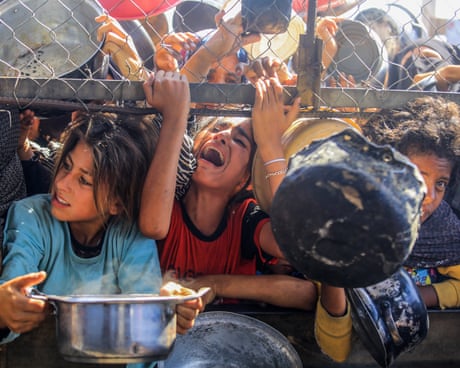
Behind these visible deaths lies the horror of systematic starvation: “minutely engineered, closely monitored, precisely designed”, in the words of Prof Alex de Waal, an expert on humanitarian crises. More than 100 aid groups warned that it is spreading fast. At least 10 people died of hunger and malnutrition on Tuesday alone, said Gaza’s health ministry. Parents watch their children wither. Adults collapse on the street.

Never mind other essential needs – water, medical supplies, shelter. Even if food could be distributed fairly under the new system – and it cannot be – it is utterly insufficient. And even if more arrived, which might or might not happen if a ceasefire were agreed, life is not sustainable when brief periods of partial respite alternate with months of deprivation.

Starvation wreaks lifelong damage on physical and mental health, perhaps including that of future generations, and destroys societies as well as lives. People are forced to make impossible choices, such as deciding which of their children needs food most, and do desperate things, snatching food from others. These acts too leave lasting scars. While many aid groups have run out of everything, others say social breakdown has made distributing meagre supplies too dangerous for both staff and recipients. Israel blames looting by Hamas for the hunger. This, from a government which armed a criminal gang accused of seizing aid.

To deliberately inflict starvation upon a society is to take it to pieces. The genocide convention prohibits “deliberately inflicting on the group conditions of life calculated to bring about its physical destruction in whole or in part”. Even if the trickle of aid keeps most Palestinians alive – just – the deprivation can still destroy Palestinians in Gaza as a group.

Condemnation is rightly growing. On Monday, the UK and 27 other countries issued a tough statement attacking Israel for depriving Palestinians of “human dignity”. The US ambassador to Israel, Mike Huckabee, called their assertion “disgusting”. But Israel’s other allies must keep working together. What matters is not what they say. It is what they do – including whether they impose sanctions and comprehensive arms embargos, and suspend preferential trade terms. Recognition of a Palestinian state is part of a necessary response, but not the only or most important issue.

Britain was right to place sanctions on far-right ministers, reinstate funding to the UN agency for Palestinian refugees, and suspend many arms exports. But these measures came too late, and they are still much too little. Kaja Kallas, the foreign policy chief of the EU – Israel’s biggest trading partner – has said that “all options [are] on the table”. But the bloc has yet to agree on action.

Faced with the systematic destruction of Palestinian life in Gaza, other states must together produce a systematic, comprehensive and concrete response. If not now, when? What more would it take to convince them? This is first and foremost a catastrophe for Palestinians. But if states continue to allow international humanitarian law to be shredded, the repercussions will be felt by many more around the world in years to come. History will not ask whether these governments did anything to stop genocide by an ally, but whether they did all they could.

Israel’s starvation of Gaza is a cruel display of the impunity of power

July 23, 2025

Ammiel Alcalay

Published date: 22 July 2025

Israel’s killing of starving Palestinians is built on a global order that has normalised the spectacle of violence, the silencing of dissent and the punishment of those who dare to resist

Palestinians, mostly children, push to receive a hot meal at a charity kitchen in the Mawasi area of Khan Yunis in the southern Gaza Strip on 22 July, 2025 (AFP)

A grim and powerful act of protest has taken place in Gaza.

In the midst of the IsraeliUS-imposed blockade on food and humanitarian aid – a policy that has already caused many Palestinians to die – a significant public figure has himself gone on hunger strike.

On Sunday, 20 July, Mahmoud Basal, spokesperson for the Palestinian Civil Defence in Gaza and long persecuted by the Israeli occupation for documenting conditions on the ground, announced a hunger strike.

“I am Mahmoud Basal, a Palestinian citizen, a free human being,” he declared. “For days now, I have been living on scraps of food, like more than two million citizens. Due to the lack of basic food in the Gaza Strip, I declare a full hunger strike in protest against the catastrophic famine striking Gaza, and in solidarity with more than two million people who have been left to face death by starvation amid shameful global silence.”

While Israel has long used food as a weapon – measuring out the bare minimum number of calories required to keep Gaza’s population on the brink of malnutrition – we are now witnessing the radical consequences of restrictions and blockades that have been normalised over decades.

New MEE newsletter: Jerusalem Dispatch

Sign up to get the latest insights and analysis on Israel-Palestine, alongside Turkey Unpacked and other MEE newsletters

This strategy was infamously outlined in a 2008 Israeli position paper, Food Consumption in the Gaza Strip – Red Lines.

‘Unbearable loss’

Incremental yet relentless waves of dehumanising propaganda in western media and political discourse, reinforced by repeated Israeli assaults on Gaza that leave mass death and devastation in their wake, have brought us to the horrific present reality.

Now, Israeli forces target unarmed, starving people in search of food using snipers, artillery and drones – people who are then presented not as victims, but as trespassers on their own land.

Relentless propaganda and repeated Israeli assaults have brought us to this horrific present reality

On the same day Basal announced his hunger strike, poet and Pulitzer Prize-winning writer Mosab Abu Toha – displaced from his destroyed home in Beit Lahia to Egypt and, eventually, the US – posted on X: “Today was a day of unbearable loss. My cousin was killed, my wife’s brother and another cousin were wounded, and many of my friends from the neighbourhood returned with amputated limbs. These were young men – sons, fathers – who had to set out, desperate to bring back even a little food for their families.”

While Israel foments further chaos in Syria and Lebanon to divert attention and consolidate territorial control – part of a meticulously planned attempt to fully dominate the region – British surgeon Nick Maynard has reported consistent patterns of gunshot injuries at newly established aid distribution sites.

Noting “clear patterns of injury”, Dr Maynard described victims – mainly teenage boys – as being deliberately targeted in different parts of the body, depending on the day.

“On one day they’ll all be abdominal gunshot wounds, on another they’ll all be head or neck gunshot wounds, on another they’ll be arm or leg gunshot wounds…It’s almost as if a game is being played, that they’re deciding to shoot the head today, the neck tomorrow, the testicles the day after,” he said. 

Campus complicity

Meanwhile, in the US, the news cycle functions as a constant distraction – through contrived political scandals, economic chaos driven by the tariff mood of the day, or congressional hearings on “antisemitism” at US universities.

At these show trials, the university administrators summoned for questioning are themselves among the institutional actors who have hollowed out academia to its core.

Why academic scholarship on Israel and Palestine threatens western elites

Read More »

Research fields that develop the technical means to kill and control populations that resist, while manufacturing consent for those very policies, receive institutional priority due to corporate sponsorship.

Yet these same administrators stand accused of not doing enough to ban, silence, arrest, or otherwise suppress any expression of free speech on campus – so long as that speech supports Palestinian liberation or criticises US or Israeli policy.

All of this reinforces the false dichotomies of US institutional discourse – as if most, if not all, institutions were not aligned with the bipartisan consensus on foreign policy.

Like a deer in headlights, Chancellor Felix Matos Rodriguez of the City University of New York (CUNY) feigned ignorance under Congresswoman Elise Stefanik’s relentless interrogation, repeatedly claiming he “wasn’t aware of” or “did not know about” this or that individual or event.

Yet even before the hearings, and in hopes of appeasing the insatiable bloodlust of genocide denial, Rodriguez had already offered up four contingent CUNY professors – the most precarious segment of academic labour – as sacrificial lambs, ensuring their dismissal without cause due to their involvement in Palestine-related activism.

How did we get here?

Fading empires

The famine in Yemen, a result of the US-supported Saudi intervention and blockade that began in 2016, was neither live-streamed nor regarded as a significant component of US foreign policy.

Thus, the steadfast support of Ansar Allah, Yemen’s armed Houthi movement, for Gaza and Palestine can be made to seem “irrational” – as though there were no link between past atrocities and present resistance.


Follow Middle East Eye’s live coverage of the Israel-Palestine war


As global power shifts towards multipolarity, and new alliances form along emergent trade routes, the US and EU have entered a phase of panic familiar to fading empires.

The years leading up to the sudden outbreak of the coronavirus in 2020 were characterised by some of the most massive public displays of political protest across the globe since the 1960s.

From the Great March of Return in Gaza and the Algerian Hirak, to mass uprisings in Iraq, Lebanon’s 17 October popular uprising, the Yellow Vests in France, and demonstrations in Catalonia, Chile, Hong Kong and beyond, the world seemed on fire.

But those determined to maintain power were often more attuned to the global resonances between these movements than many of the participants themselves.

New feudal order

As with the post-9/11 moment, the policies enacted in response to the pandemic reshaped societies almost overnight: restricting basic human rituals, from funerals to visiting the sick and elderly, while enabling massive wealth transfers.

People were taught to fear one another – to fear contact, proximity and community. New digital powers and the complete relativising of the principles of free speech and unrestrained movement transformed societies almost overnight.

Changes in civil liberties, economies, supply chains, trade routes – and almost every aspect of life – seemed to bring the future, so to speak, back to the past.

There is no justification for starving and killing Palestinians in Gaza – and claiming it can’t be stopped is a lie of the highest magnitude

That past is also the Cold War past that liberal democracies and a fading US empire continue to cling to, propped up by the perpetual manufacture of existential enemies.

In 1944, anthropologist Gregory Bateson – then working for the Office of Strategic Services (OSS), precursor to the CIA – remarked: “It is very important to sponsor spectatorship among the superiors and exhibitionism among the inferiors.”

Historically denied the means to defend themselves by far more powerful states, the present anguish of unarmed Palestinians searching for food to survive yet another day – in a world that has betrayed them on every front – is a harbinger to all rational people with eyes to see, ears to hear, and minds to think, as we enter a new feudal order.

There is no justification whatsoever for the forced starvation and wanton killing of Palestinians in Gaza, now or ever. And the idea that mechanisms to stop it are unavailable or do not exist is a lie of the highest magnitude.

The day after Basal’s declaration, a young Egyptian activist at the Hague chained shut the Egyptian embassy gates, scattered flour across the pavement, and smashed eggs against the entrance in protest. In that moment of small, defiant spectacle, a whole edifice of lies appeared to fall apart.

The only conclusion we can draw is that we are witnessing a deliberate effort to showcase the impunity of power, an effort designed to annihilate the very possibility of political reciprocity, justice and law.

This monstrosity must be defeated, at any cost – and everything must be remembered, in fine detail, to hold those responsible to account.

The views expressed in this article belong to the author and do not necessarily reflect the editorial policy of Middle East Eye.

Ammiel Alcalay is a poet, novelist, translator, essayist, critic and scholar. He is the author of more than 25 books, most recently Controlled Demolition: a work in four books, and his co-translation of Nasser Rabah’s Gaza: The Poem Said Its Piece. He is Distinguished Professor at Queens College, CUNY, and the CUNY Graduate Center in New York.

Scenes from the end of Zionism: Reflections on the Jewish Anti-Zionist Congress in Vienna

July 22, 2025

The first Jewish Anti-Zionist Congress, which drew 1,000 anti-Zionist Jews and their allies to Vienna, marked a significant moment in the rising tide against the settler-colonial state of Israel.

By Daniel Friedman, Mondoweiss, July 20, 2025

A billboard outside the first Jewish Anti-Zionist Conference, which was held June 13-15, 2025, in Vienna, Austria. (Photo: Daniel Friedman) A billboard outside the first Jewish Anti-Zionist Conference, which was held June 13-15, 2025, in Vienna, Austria. (Photo: Daniel Friedman)

The decision to hold the first Jewish Anti-Zionist Congress in Vienna was significant for historical reasons – being where Theodore Herzl formed the ideology that became modern Zionism, as well as Adolf Hitler’s birthplace – and for modern reasons – Austria, alongside Germany, provides unconditional support for Israel, a symptom of its guilt over the Holocaust. 

Western nations’ complicity in Israel’s ongoing genocide in Gaza has left the supposed ‘rules-based’ order they claim to represent in ruins. The U.S., UK, Europe, and their allies have provided Israel with the means to act with impunity through weapons, which flow freely, and information, which certainly does not. 

The Congress began just as Israel was bombing Iran, a reminder of the threat Zionism poses to global stability. Against this backdrop, over 1,000 anti-Zionist Jews and their allies from across the globe met in the Favoriten District in Vienna, June 13-15, 2025,at a time when the tide is turning, too slowly, but turning, against the settler-colonial ethnostate of Israel. 

Israel still has its well-funded lobby groups, and far too many people still believe its hasbara. It seems it’s up to a plucky group of not-so-well-funded anti-fascist dissidents in keffiyehs to turn the tide. While we have the truth and international law on our side, at times our goals seem insurmountable. But as several speakers highlighted, we must keep going, and we do not have the luxury of despondency. I was there representing South African Jews for a Free Palestine (SAJFP) alongside Roshan Dadoo, the conference’s only South African speaker and coordinator of the South African Boycott, Divestment, and Sanctions (BDS) coalition.

SAJFP sent me to Austria to advocate for a united, Jewish Anti-Zionist movement that is inclusive rather than Eurocentric. Our experience in fighting apartheid as South Africans is also significant, in terms of both our successes and our failures. As United Nations Special Rapporteur Francesca Albanese pointed out via live stream: While the political system underpinning apartheid was defeated in South Africa, the economic and social systems that enabled it remained in place.  

Ilan Pappe addresses the Jewish Anti-Zionist Conference, held June 13-15, 2025, in Vienna, Austria. (Photo courtesy of the Jewish Anti-Zionist Conference)
Ilan Pappe addresses the Jewish Anti-Zionist Congress, held June 13-15, 2025, in Vienna, Austria. (Photo courtesy of the Jewish Anti-Zionist Congress)

While the First Congress did not definitively represent the entirety of global anti-Zionism – hopefully, in time it will, as the follow-up Congress is already being planned for 2026 and is rumored to be taking place in Ireland – the turnout showed the movement is alive, well, and growing. Leading Jewish anti-Zionists in attendance included Israeli-born historian Ilan Pappe, U.S. journalist and filmmaker Katie Halper, and Hungarian/British Holocaust survivor Stephen Kapos. 

The voice of Palestinians, crucially, was heard there too, through the presence of people such as Gazan journalist and author Ramzy Baroud, who argued that his people should become a model of resistance against imperialism worldwide. Palestinian physician, academic, and writer Dr. Ghada Karmi was there to emphasize the right of return and Europe’s role in having “created the monster” that is Israel, as was politician Awad Abdelfatah, who has worked from within the Israeli political system, advocating for one, democratic state with equal rights for all who live in it. 

Ramzy Baroud and Dr. Ghada Karmi on a panel at the Jewish Anti-Zionist Conference, held June 13-15, 2025, in Vienna, Austria. (Photo courtesy of the Jewish Anti-Zionist Conference)
Ramzy Baroud and Dr. Ghada Karmi on a panel at the first Jewish Anti-Zionist Congress, held June 13-15, 2025, in Vienna, Austria. (Photo courtesy of the Jewish Anti-Zionist Congress)

The need to reclaim Judaism from Zionism – once seen as a fringe movement within global Jewry as UK writer and activist Tony Greenstein reminded us during a discussion – was a constant theme at the Congress, as was the need to embrace the Yiddish concept of doikayt, or hereness, the idea that Jewish people can, have and will live peacefully with their neighbors in countries across the globe, rather than needing to escape to a physical homeland.

We were also reminded that we were there not just as Jews, but as human beings, and that there is no place for exceptionalism of any kind in this struggle. We must join forces with anti-Zionists across the globe, and our primary duty is to the Palestinian people. Their suffering was highlighted through a video that made many in attendance emotional, in which a surgeon from Gaza detailed his attempts to keep going amid Israel’s systematic dismantling of the enclave’s entire medical system. 

The Congress demonstrated that some of the most effective opposition to the Zionist state comes from those born into it. Together with Pappe, others who were born in Israel or have lived there were heard. These included dissident activist Ronnie Barkan, filmmaker and academic Professor Haim Bresheeth-Žabner, and academic and activist Dalia Sarig. These voices provide hope that it’s possible to resist the propaganda that keeps most Israelis loyal to their state, regardless of its actions. 

Some speakers were not Jewish or Palestinian but simply anti-Zionists, reaffirming that this is an issue of common humanity. Alongside Albanese was Egyptian journalist Rahma Zein, providing another much-needed African perspective, and French/Palestinian juror and politician Rima Hassan, who managed to join the Congress virtually, despite having just been released from detention after Israel abducted her and other activists on the Madleen Flotilla.

Rahma Zein speaking on a panel at the Jewish Anti-Zionist Conference, held June 13-15, 2025, in Vienna, Austria. (Photo courtesy of the Jewish Anti-Zionist Conference)
Rahma Zein speaking on a panel at the Jewish Anti-Zionist Congress, held June 13-15, 2025, in Vienna, Austria. (Photo courtesy of the Jewish Anti-Zionist Congress)

A declaration written with input from all speakers at The Congress seeks to capture the collective positions that were reached during the three days. The declaration condemns the genocide as well as Israel’s apartheid-driven policies, rooted in ethnic cleansing. The document documents Israel’s systematic war crimes in Gaza, “including ethnic cleansing, militarised apartheid, urbicide, scholasticide, medicide, mass starvation”, and condemns Western governments, particularly the U.S., UK, EU, Canada, Australia, and New Zealand, for enabling these actions through military and diplomatic support.

It calls for immediate sanctions, Israel’s suspension from the UN, adherence to BDS (Boycott, Divestment, Sanctions), and nuclear disarmament under IAEA oversight. The declaration also affirms Palestinians’ right to resist occupation and demands an end to Zionist claims of representing global Jewry, urging Jews worldwide to reject Zionism and stand in solidarity with Palestinian liberation.

The signatories reject Israel’s legitimacy as a Jewish state, and note that Zionism is a racist ideology that endangers both Palestinians and Jews. They call for decolonization, the right of return for Palestinian refugees (per UN Resolution 194), and the withdrawal of Israeli forces from all occupied territory since 1948. 

The Congress could prove important only if all who attended absorb its message, take it back to our communities, and work hard to grow the movement. The need for greater collaboration between global anti-Zionist groups was evident, as was the need for anti-Zionist Jews to unite as one cohesive movement. Zionism is a highly funded, meticulously organized, and well-oiled machine, and we only have a chance of defeating it together. 

To me, more important than anything that came out of the Congress is that it happened, that we united to continue our work, and that it symbolized a return to the roots of Judaism as a religion of peace. Despite all the damage that has been done in our name, Jews can and must be part of building a better world. I believe deep down that a day will come when we truly can celebrate our achievements as anti-Zionists, Jewish or otherwise. But who knows how long that will take? For now, all I really know is that our work has just begun. 

Governments like mine have a duty to stand up to Israel. Far too many have failed

July 8, 2025

Gustavo Petro

Gustavo Petro

Without decisive action, we risk stripping the global legal order of its remaining protections for less-privileged nations

  • Gustavo Petro is the president of Colombia

The Guardian, Tue 8 Jul 2025

Over the past 600 days, the world has watched Benjamin Netanyahu lead a campaign of devastation in Gaza, the escalation of regional conflict, and a reckless abandonment of international law at large.

Governments such as mine cannot afford to remain passive. In September 2024, when we voted for the United Nations general assembly resolution on Israel’s policies and practices in the Occupied Palestinian Territory, we assumed concrete obligations – investigations, prosecutions, sanctions, asset freezes, and cessation of imports and arms. That resolution set a deadline of 12 months for Israel to “bring to an end without delay its unlawful presence”. One hundred and twenty-four states voted in favour, including Colombia. The clock is now ticking.

In the meantime, however, far too many states have allowed strategic calculations to override our duty. While we may face threats of retribution when we stand up for international law – as South Africa discovered when the United States retaliated against its case at the international court of justice – the consequences of abdicating our responsibilities will be dire. If we fail to act now, we not only betray the Palestinian people, we become complicit in the atrocities committed by Netanyahu’s government.

Some governments have already stepped up. My government suspended coal exports to Israel, for example, recognising that economic ties cannot be divorced from moral responsibilities. South Africa, meanwhile, has taken Israel to the world’s highest court. And Malaysia has banned all Israeli-flagged cargo ships from docking at its ports. Without such decisive action, we risk turning the multilateral system into a talking shop, stripping the legal order of its remaining protections for small, developing and less privileged nations – from west Asia to right here in Latin America.

Distressed-looking children crowd an opening in a fence to receive food

Read more

The next test for the international community is right around the corner. On 15 July, my government, alongside South Africa – the co-chairs of The Hague Group – will convene an emergency conference on Gaza, calling on ministers from states across the world to deliberate a multilateral defence of international law. Our goal is simple: to introduce concrete legal, diplomatic and economic measures that can halt Israel’s destruction – and uphold the foundational principle that no state is above the law.

The invitation is open and urgent. The indefinite postponement of the UN’s proposed International Conference for the Peaceful Settlement of the Palestinian Question, co-chaired by France and Saudi Arabia, has left a critical void in multilateral leadership, precisely when it is needed most.

The UN has declared Gaza the “hungriest place on Earth”, and its mission to send aid into Gaza as the “one of the most obstructed … in recent history”. In this dire humanitarian context, Bogotá’s emergency conference convenes states to move from condemnation to collective action. By cutting our ties of complicity – across our states’ courts, ports and factories – we can challenge Donald Trump and Netanyahu’s vision of a world where “might is right”.

The choice before us is stark and unforgiving. We can either stand firm in defence of the legal principles that seek to prevent war and conflict, or watch helplessly as the international system collapses under the weight of unchecked power politics. Let us be protagonists together – not supplicants apart.

For the billions of people in the global south who rely on international law for protection, the stakes could not be higher. The Palestinian people deserve justice. The moment demands courage. History will judge us harshly if we fail to answer its call.

  • Gustavo Petro is the president of Colombia