Posts Tagged ‘genocide’

Recognition of Palestine Is Not Enough

September 23, 2025

Israeli Knesset member Aida Touma-Suleiman argues that in order for the growing recognition of the state of Palestine to be meaningful, it must be accompanied by sanctions for Israel’s permanent illegal occupation.

By Aida Touma-SlimanSeptember 22, 2025Z ArticleNo Comments7 Mins Read

Source: Jacobin

Facebook Twitter Reddit Bluesky Email

A resistance mural in a rural Palestinian village. Credit: Credit: ISM (palsolidarity.org)

In recent months, as the genocidal killing of Gazans continues, an increasing number of countries have announced their intention to recognize a Palestinian state, joining the 147 that already have. Most of these come from among Israel’s Western allies, with the formalization of recognition due to take place at a United Nations (UN) summit to revive the two-state solution, cochaired by Saudi Arabia and France. As part of this effort, the UN General Assembly endorsed this initiative, in a resounding show of support with a supermajority of 142 countries in favor and only ten opposed. (Even one of Israel’s strongest allies, Germany, voted in favor of this initiative, although it said it would not recognize a Palestinian state at this stage.) The initiative could provide strong leverage for the basic demands of the Palestinian people to live free of Israeli occupation in their own independent state.

This recognition would have been a momentous occasion had it not come amid a war of annihilation waged against Gaza, and in tandem with a military-settler offensive against the Palestinian people in occupied East Jerusalem and the West Bank. Right now, the most urgent demand is to mount as much international pressure as possible to immediately stop the assault on Gaza, save its remaining residents from killing or ethnic cleansing, and prevent the permanent reoccupation of the entire territory for years to come.

Two Tracks

The world is moving on two parallel tracks: on one side, a wave of popular solidarity with the Palestinian cause and against the genocide, including increased discussion of real sanctions against Israel. On the other side, Israel’s unprecedented brutality against the Palestinian people, supported unconditionally by the United States.

The most recent example entailed a US violation of the terms of conditions for hosting the UN in its own country, when Secretary of State Marco Rubio’s announced a visa ban of eighty Palestinian Authority officials, including President Mahmoud Abbas, ahead of the UN conference.The very countries now declaring their intention to recognize Palestine in the coming days have been, and continue to be, enablers of the genocide against the same people whose right to self-determination they are belatedly acknowledging.

One of the problems with these two tracks is that they move at different paces: the translation of public pressure into actual policies that could curb Israel’s ability to wreak havoc has moved far slower than the terrifying pace of Israel’s war crimes. Israel’s Western allies seem to be caught between these two tracks, which has resulted in a schizophrenic policy toward Palestinians. The very countries now declaring their intention to recognize Palestine in the coming days have been, and continue to be, enablers of the genocide against the same people whose right to self-determination they are belatedly acknowledging.

Some countries have continued to profit through continued trade, whereas others have taken a more direct and active role in abetting Israel’s crimes in Gaza: from UK aircraft carrying out reconnaissance flights over Gaza to gather intelligence for Israel’s war machine, to German tank engines that have also been used to flatten the cities of Rafah and Khan Yunis.

These details help place the forthcoming recognition of Palestine into context. Anyone who believes this marks the peak of diplomatic efforts is mistaken. Recognition is not the end of the road but its beginning. It must be accompanied by concrete actions that guarantee the survival of the Palestinian people as well as their right to self-determination.

A Diversion?

Recognition of a Palestinian state may offer Western governments a way to absolve themselves in the face of mounting public pressure from Palestine solidarity movements. Polls, protests, and mountains of anecdotal evidence suggest that the public is disgusted by what Israel is doing to the Palestinians, and by the indifference and complicity of their own governments and very often of their own media. They are mobilized to pressure their governments, and it is to them we look to ensure that recognition, while important, does not replace the urgent need to end the war, prevent ethnic cleansing, and stop settler violence in the West Bank.

Without immediate interventions, the creeping process of annexation will proceed unchecked, and the already slim prospect of establishing a Palestinian state will further fade. Recognition of Palestine must be a platform to turn the tide on the two-state solution rather than serving as an atonement certificate for states complicit in its very death.Recognition of Palestine must be a platform to turn the tide on the two-state solution rather than serving as an atonement certificate for states complicit in its very death.

Palestinians have a legitimate fear that those states that are recognizing their right to self-determination will end up not only making of it a symbolic gesture, but that this gesture will be accompanied by greater demands on the Palestinians under occupation than on their Israeli occupier — that recognition will become yet another cudgel with which to undermine Palestinian rights and well-being rather than challenge Israeli criminality.

This is not a baseless fear: in statements made by Western leaders when announcing recognition, several conditions were attached (some in the UN Resolution itself), including limiting participation in Palestinian elections to those factions endorsing the Palestine Liberation Organization (PLO) platform and for Palestinians to agree that their state would be demilitarized, when Palestinians are unable to defend themselves against genocide.

Palestinians must get their political house in order, but such demands cannot be a distraction while Palestinians are enduring extermination, ethnic cleansing, and settlement expansion.

Recognition Is an Important First Step

In spite of these concerns, recognition of Palestine must be supported — it is something that my party, Hadash, has long called for. It is one way of consolidating a global consensus against the Israeli-American “Greater Israel” project and in favor of Palestinian self-determination, and is a necessary political task in these terrible times.

But to be meaningful, recognition must be accompanied by sanctions for the permanent illegal occupation of the state that is being recognized. The International Court of Justice, in its opinion last year, set out the illegality of the occupation itself and some of the measures states must take to not be complicit, ranging from restrictions in trade to military cooperation.To be meaningful, recognition must be accompanied by sanctions for the permanent illegal occupation of the state that is being recognized.

States such as Spain, Ireland, and Slovenia have already moved to position themselves in compliance with international law. And there is a sense that these states are only the first: even Germany has recently announced an apparent weapons embargo, which would be significant if properly implemented. The European Union as a whole, however, continues to fail Palestinians in its inability to pass an arms embargo.

The reason this is so important is not to reaffirm a unipolar order in its twilight, but because the West remains Israel’s hinterland: where Israel conducts the majority of its trade, parks many of its financial assets in Western banks, participates in international sports, and travels to frequently and visa-free. The West also claims to adhere to a rules-based and values-based system, and it is therefore the West that will determine how quickly the gap is closed between the two tracks of the destruction of Palestinians and holding Israel accountable.

Solidarity in the streets must translate into action in the halls of power, even if this is happening too late for so many Palestinians. Recognition is an important step, but it too must be translated into action.
11 Questions the Western Media Should Be Investigating About the Gaza Genocide

September 22, 2025

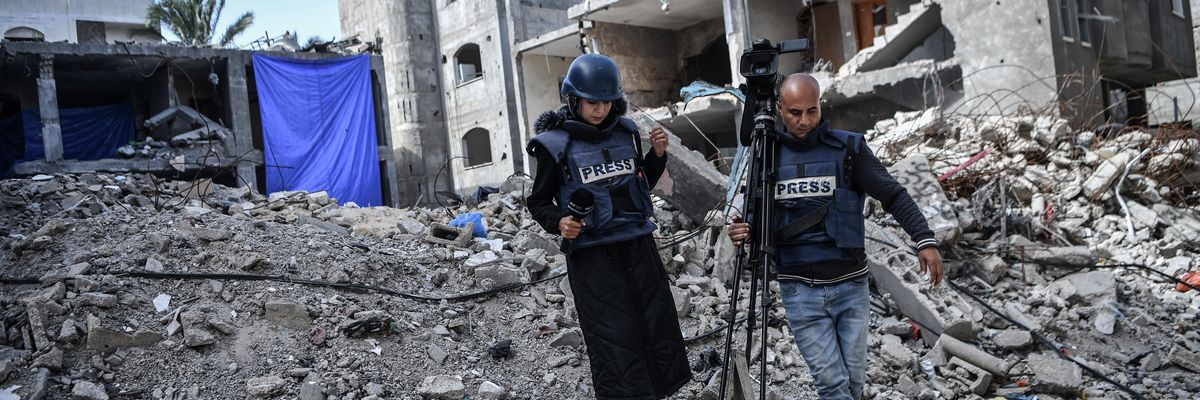
TRT Arabi Reporter Reba continues to spread knowledge about Gaza

TRT Arabi Reporter, Reba Khalid al-Ajami, reports from Gaza amid ongoing Israeli attacks in Rafah, Gaza on February 29, 2024.

(Photo by Abed Zagout/Anadolu via Getty Images)

Genocide thrives in darkness, so won’t some committed journalists shine a light?

Ralph Nader

Sep 21, 2025, Common Dreams

Some serious readers would like to see mainstream media and independent media cover several events and matters involving the Israeli war in tiny Gaza and the mass slaughter of its defenseless citizens.

  1. Israel keeps exaggerating the status and threat of the Hamas government, which is ridiculous. What about an article on what is left of Hamas, never a threat with a few thousand fighters with small arms and limited ammunition, hiding in tunnels, until the mysterious collapse on October 7, 2023 of the super-modern, multi-tiered border security system, all at the same time? What are the Israeli casualty figures in the past year in Gaza besides accidents and friendly fire? WHAT ABOUT THE VAST DEATH AND SERIOUS INJURY UNDERCOUNT? (See, “65 Doctors, Nurses, and Paramedics: What We Saw in Gaza” by Feroze Sidhwa, New York Times, Sunday, October 13, 2024; The Lancet, “Counting the dead in Gaza: Difficult but essential,” my column of March 28, 2025, “The Vast Gaza Death Undercount–Undermines Civic, Diplomatic and Political Pressures,” and my article in the August-September 2024 Capitol Hill Citizen).
  2. What is the situation in the Israeli prisons housing many thousands of Palestinians without charges (they are hostages too), and their mistreatment, including torture, documented by some Israeli prison doctors and domestic Israeli reports? Most of the media attention has been on the Israeli hostages in Gaza.
  3. What is the nature and scope of the Israeli resistance groups, dissenting reservists, and retired officials, the human rights groups, and others? It takes a lot of courage on their part to stand up to Israeli Prime Minister Benjamin Netanyahu. In May of this year, Yair Golan, former Israeli deputy minister of economy, said, “A sane country does not wage war against civilians, does not kill babies as a pastime, and does not engage in mass population displacement.”
  4. When Netanyahu rarely admits a “mistake” in hitting, for example, the medic team, the World Food Program vehicles, the ancient Catholic Church, and just recently Nasser hospital with a “double tap,” is there any demand for payment of damages to next of kin and property? The US Army in Afghanistan paid families $20,000 when they admitted to a civilian homicide.
  5. Why isn’t there a follow-up every time the Israeli government promises an investigation? What are the findings and sanctions of these many official inquiries that are announced to get the media off the Israeli government’s back on the day of the atrocity?
  6. What about a story on the sadistic snipers, who operate without rules of engagement, in this Palestinian Holocaust, and savagely kill infants, children, people desperately digging into the rubble to rescue loved ones, etc.? How are they chosen? They compete with one another with the most brutal, touted examples of their executions, their favorite prey being pregnant women, according to Israeli reporters.
  7. Why isn’t more made of what is being denied the American public (aka taxpayers) when no US journalists are allowed into Gaza, along with other foreign and Israeli journalists similarly barred? Genocides thrive in darkness.
  8. What about some reporting on claims that some Israeli opponents of the Netanyahu regime believe it has a devastating dossier on US President Donald Trump, which accounts for the 100% backing by toady Trump, even more than by toady Joe Biden?
  9. Why is so little written about Israel enforcing an illegal embargo on Gaza that became far more savage after October 7—“no food, water, medicine, healthcare, fuel, electricity,” etc.? How come there seems to be an ample supply of shrouds? Some observers in Israel believe there is an underground trade in this product. There is no capacity to produce them in the tens of thousands or more inside Gaza, which is almost totally destroyed.
  10. What about long-overdue features on the American Israel Public Affairs Committee’s power or a feature on Veterans for Peace blacked out by the major newspapers? Go to veteransforpeace.org and see for yourself if they are newsworthy. More coverage of the 50 Flotilla ships, which have passengers from 43 countries, and their safety is in order.
  11. Why is the “other antisemitism” totally ignored by the media? This “other antisemitism” is far more violent, with F-16s and other American-built weaponry daily and genocidally mass slaughtering starving civilian Palestinian semites.
    Scholar Dr. Jim Zogby delivered an address years ago at an Israeli University titled “The Other Antisemitism,” and also engaged two Jewish Americans on this topic in a civil exchange seen on the website DebatingTaboos.org.

RECOMMENDED…

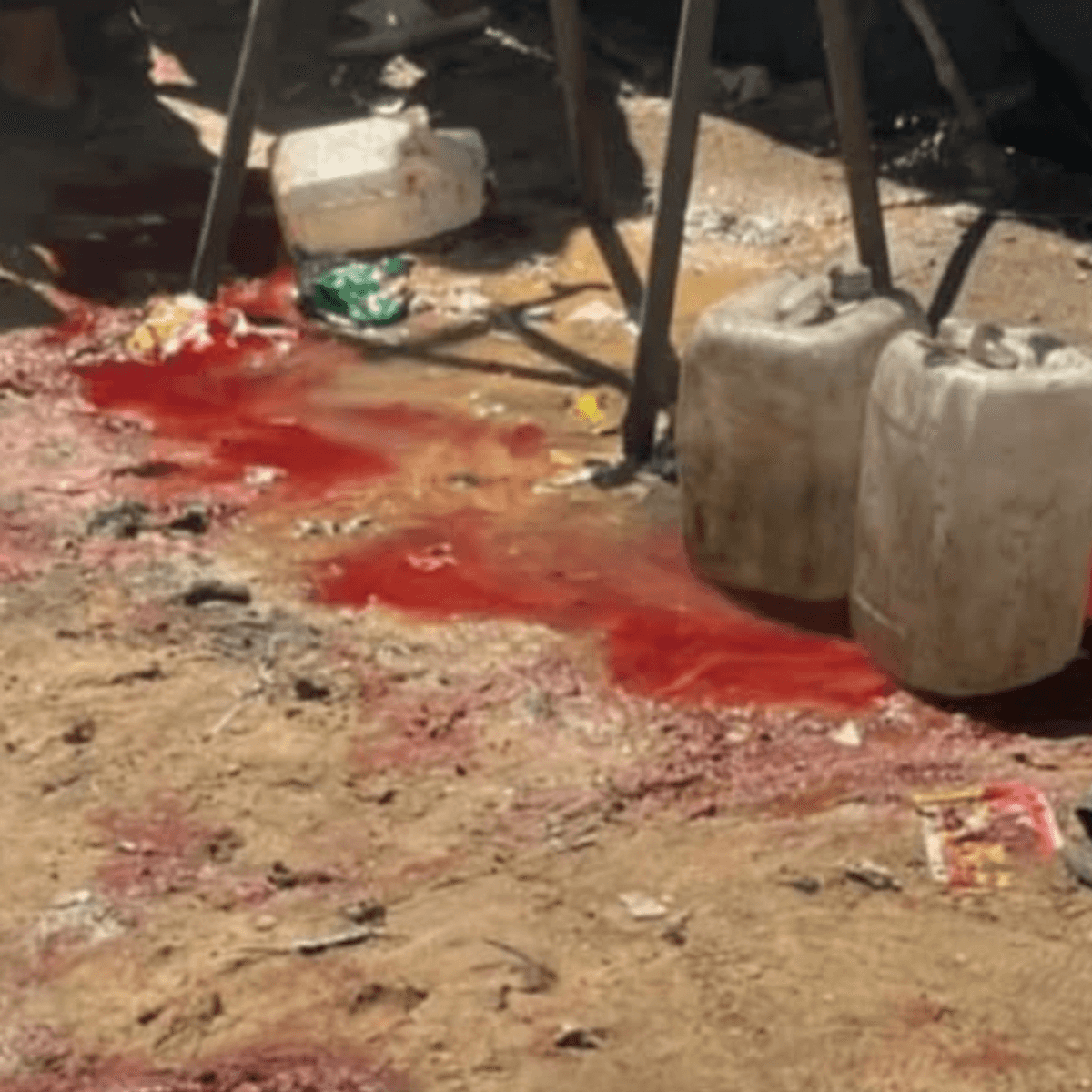
the bloody aftermath of an Israeli massacre of people collecting water

Israel Massacres Gaza Children Fetching Water, Starves 13 More Palestinians to Death

Israeli strike targets Nasser Hospital in southern Gaza; dead and injured reported

‘What a Live-Streamed Genocide Looks Like’: 5 Journalists, 4 Health Workers Among 21 Killed by Israel Hospital Bombing

Thank you for your professional curiosity.

An Urgent Message From Our Co-Founder


Dear Common Dreams reader,

The U.S. is on a fast track to authoritarianism like nothing I’ve ever seen. Meanwhile, corporate news outlets are utterly capitulating to Trump, twisting their coverage to avoid drawing his ire while lining up to stuff cash in his pockets.

That’s why I believe that Common Dreams is doing the best and most consequential reporting that we’ve ever done.

Our small but mighty team is a progressive reporting powerhouse, covering the news every day that the corporate media never will. Our mission has always been simple: To inform. To inspire. And to ignite change for the common good.

Now here’s the key piece that I want all our readers to understand: None of this would be possible without your financial support.

That’s not just some fundraising cliche. It’s the absolute and literal truth. We don’t accept corporate advertising and never will. We don’t have a paywall because we don’t think people should be blocked from critical news based on their ability to pay. Everything we do is funded by the donations of readers like you.

Will you donate now to help power the nonprofit, independent reporting of Common Dreams?

Thank you for being a vital member of our community. Together, we can keep independent journalism alive when it’s needed most.

– Craig Brown, Co-founder
about:blank

about:blank

Our work is licensed under Creative Commons (CC BY-NC-ND 3.0). Feel free to republish and share widely.

Ralph Nader

Ralph Nader is a consumer advocate and the author of “The Seventeen Solutions: Bold Ideas for Our American Future” (2012). His new book is, “Wrecking America: How Trump’s Lies and Lawbreaking Betray All” (2020, co-authored with Mark Green).

Full Bio >

From Your Site Articles

Join the Conversation

SUBSCRIBE TO OUR FREE NEWSLETTER

Daily news & progressive opinion—funded by the people, not the corporations—delivered straight to your inbox.

Follow Us

LATEST NEWS

Largest Caucus in House Endorses Bill to Block US Bombs to Israel

Largest Caucus in House Endorses Bill to Block US Bombs to Israel

“The United States cannot continue to send bombs we know will be used to commit terrible atrocities in Gaza.”

Jon Queally

Sep 21, 2025

Keep Reading

News

arms trade

‘Release the Tapes’: Lawmakers Demand Answers Over Alleged $50,000 Bribe of Trump Border Czar Tom Homan

“Seriously though, has anyone ever been handed $50,000 cash in a paper bag for something legit?”

Jon Queally

Sep 21, 2025

Keep Reading

News

tom homan

‘Celebratory and Uplifting’: Sun Day Events Champion Promise of Wind and Solar

Despite Trump’s shadow, organizers behind the day of action say the “clean energy revolution is here.”

Jon Queally

Sep 21, 2025

Keep Reading

News

Recognizing a Palestinian State Is Not a Policy on Its Own

September 17, 2025

As more Western states recognize Palestine, will they also take the action necessary to make this diplomatic step impactful in bringing a Palestinian state to life?

August 11, 2025

Anas Iqtait

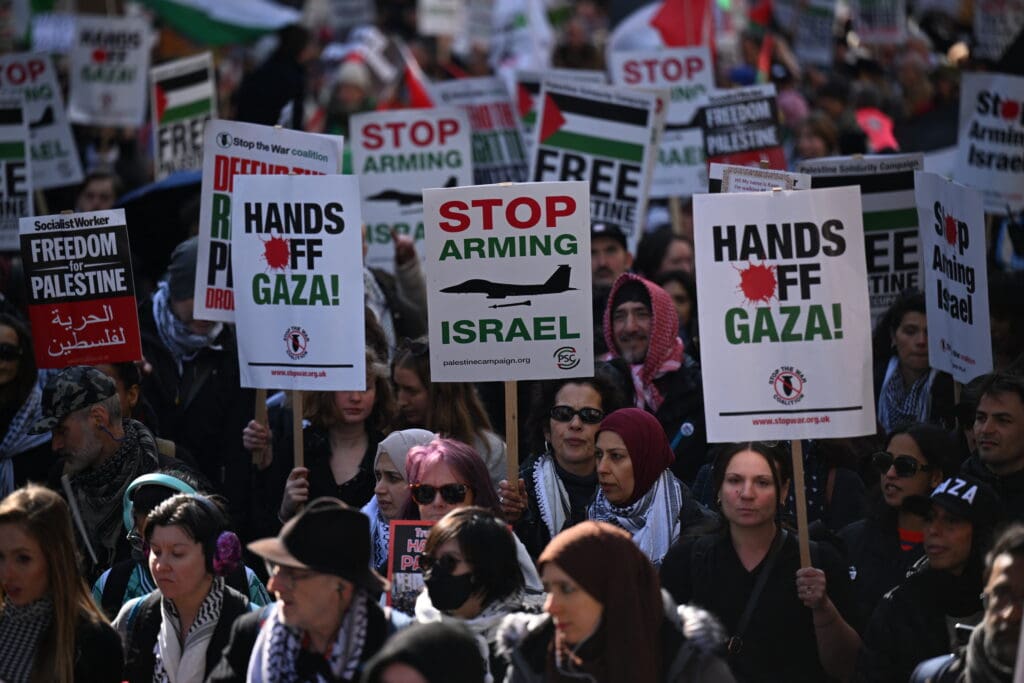
Tens of thousands of pro-Palestinian demonstrators march with banners through Whitehall towards 10 Downing Street, the official residence and office of the UK Prime Minister, to protest against Israel’s attacks on Gaza in London, United Kingdom on March 15, 2025. (Photo by Rasid Necati Aslim / ANADOLU / Anadolu via AFP)

Against the backdrop of the daily horrors taking place in Gaza, a wave of Western countries have decided to recognize the State of Palestine. After Ireland, Spain and Norway took the step in 2024, France and Australia have pledged to follow suit at the United Nations General Assembly in September. The United Kingdom and Canada have also expressed their intention to do so, albeit with a litany of conditions.  In short, the diplomatic map is shifting. But recognition is not a policy, it is an opening. The real work begins the day after.

Two persistent misconceptions cloud the debate. One is to mistake recognition for a peace plan rather than a tool to spur further action. The other is to imagine that it can revive a two-state formula rendered inoperable by the facts on the ground  Israel has established over decades of military occupation and colonization. More than 700,000 Israeli settlers now live across the West Bank, including East Jerusalem. Separation walls, settlements, checkpoints and a dense web of military orders fragment both physical space and jurisdiction. In the past year, the Israeli Knesset has voted to reject the establishment of a Palestinian state and to annex the West Bank. If diplomatic recognition is to have a meaningful role in reversing these developments, recognizing governments must align the leverage they possess with the outcome they say they support.

What does that require?

The only way to move the needle on the two-state solution is to take steps that force Israel’s government to reconsider its intransigent path toward annexation and the fulfillment of a “Greater Israel.” First, governments supporting two states must move from symbolic action to enforcing international law. Recognition should be anchored in the judgements of international courts and treaty bodies, not in open-ended “confidence-building” exercises that absorb pressure and deliver little. Governments that recognize Palestine should operationalize that commitment by barring economic support for the settlement enterprise, adopting import restrictions on settlement goods, and applying targeted measures to entities and individuals who enable annexation, settler violence and war crimes against the Palestinians. If recognition is to be followed by more than applause, it must change the incentive structure that keeps the status quo in place.

Secondly, recognizing states must pair recognition with steps that rebalance the vast asymmetry in power between Israel and Palestine, not just revive a deeply flawed peace process. For the past three decades, that process rested on the assumption that negotiations would furnish Palestinians with the bargaining power they otherwise lacked relative to Israel. In practice, the agreed framework made Palestinian rights conditional on successive rounds of talks, while imposing no costs on Israeli expansion. If recognition is to carry any substantive force, it must invert that dynamic.

Thirdly, these states need to support a credible roadmap for Palestinian governance . Many capitals are balancing their decision to recognize Palestine with demands to reform Palestinian governance institutions. However, without a clear policy, they are reaching for familiar but misguided prescriptions: empowering the Palestinian Authority; holding elections; reviving old reform packages. While reform is certainly needed, it cannot be a proxy for creating deeper dependency. A better approach would be to prioritize three elements: (1) Protect the institutional core of Palestinian representation, including, but not limited to, a reformed PLO, and the independent ecosystem of Palestinian civil society, so any transition is political rather than merely administrative; (2) support an accountable financial architecture insulated from donor micromanagement and Israeli control; (3) and back credible tracks for transitional justice, such as documentation, restitution and mechanisms addressing displacement and dispossession. These steps should affirm the rights to Palestinian freedom and self-determination, including the right to choose and renew their political representation, as all free peoples do.

Finally, these states need to be clear and candid about what achieving a Palestinian state means in practice. The current basis for diplomacy is that recognition will somehow “revive” the two-state solution without saying plainly what it entails. This could include reversing settlement expansion and Israeli annexation of East Jerusalem, creating a contiguous Palestinian territory, and establishing enforceable timelines for achieving outcomes. If these conditions cannot be met, the international community should abandon the empty rhetoric in support of two states, which only serves to provide cover for the existing colonial reality. Although a single, democratic state grounded in equal rights is not most capitals’ preference, it is the logical and moral alternative if equality rather than ethnoreligious privilege and apartheid is the organizing principle. Either way, clarity is better than evasion.

These steps do not require a reinvention of diplomacy. Governments need only do in Palestine what they claim to do elsewhere: defend the rights of vulnerable people; enforce protections from collective punishment and genocide; protect Palestinian society and its economy from settler-colonial predation; and refuse to bankroll a transnational system of oppression.

The UK, Canada and, increasingly, Australia are hedging their recognition of Palestine to demands for Palestinian Authority reform and elastic security benchmarks. But hedging is politics, not a plan. The quickest way to empty recognition of meaning is to announce it while leaving the fundamental obstacles to realizing a Palestinian state untouched. Recognition that does not change the behaviors of the occupier, the settlers, or Western supporters of Israel is an epitaph, not a breakthrough. It preserves the status quo, which, despite the name, shifts daily in a negative direction.

Given the trajectory of Western policy over the past three decades, it is reasonable to view recognition as a hollow gesture designed to deflect mounting pressure to halt the bloodshed and starvation in Gaza. Little thought is being given to the day after recognition. Put plainly, if state recognition of Palestine is followed by inaction, it is less a genuine diplomatic effort than a certificate of acquiescence to prevailing realities. At best, it registers formal objection to Israeli conduct. At worst, it becomes empty rhetoric that bears complicity in Israel’s immoral and illegal agenda.

𝐏𝐫𝐞𝐬𝐢𝐝𝐞𝐧𝐭 𝐓𝐫𝐮𝐦𝐩 𝐒𝐚𝐲𝐬 𝐇𝐞’𝐬 𝐃𝐨𝐧𝐞 𝐚 𝐋𝐨𝐭 𝐟𝐨𝐫 𝐈𝐬𝐫𝐚𝐞𝐥, 𝐈𝐧𝐜𝐥𝐮𝐝𝐢𝐧𝐠 𝐁𝐨𝐦𝐛𝐢𝐧𝐠 𝐈𝐫𝐚𝐧

September 3, 2025

The president also noted the Israel lobby’s strong influence on Congress and said it has waned in recent years

by Dave DeCamp, Antiwar. com, | September 2, 2025

President Trump said in an interview published on Tuesday that no one has done more for the state of Israel than himself and cited his recent airstrikes on Iranian nuclear facilities as an example.

“So, Israel is amazing, because, you know, I have good support from Israel,” the president told the Daily Caller. “Look, nobody has done more for Israel than I have, including the recent attacks with Iran, wiping that thing out. We, that plane, wiped them out like nobody ever saw before.”

Trump made the comments when asked if he was worried about the growing skepticism among young Republicans when it comes to the US relationship with Israel, and he noted the Israel lobby’s control over Congress, saying it has waned in recent years.

“But when, if you go back 20 years. I mean, I will tell you, Israel had the strongest lobby in Congress of anything or body, or of any company or corporation or state that I’ve ever seen. Israel was the strongest. Today, it doesn’t have that strong a lobby. It’s amazing,” Trump said.
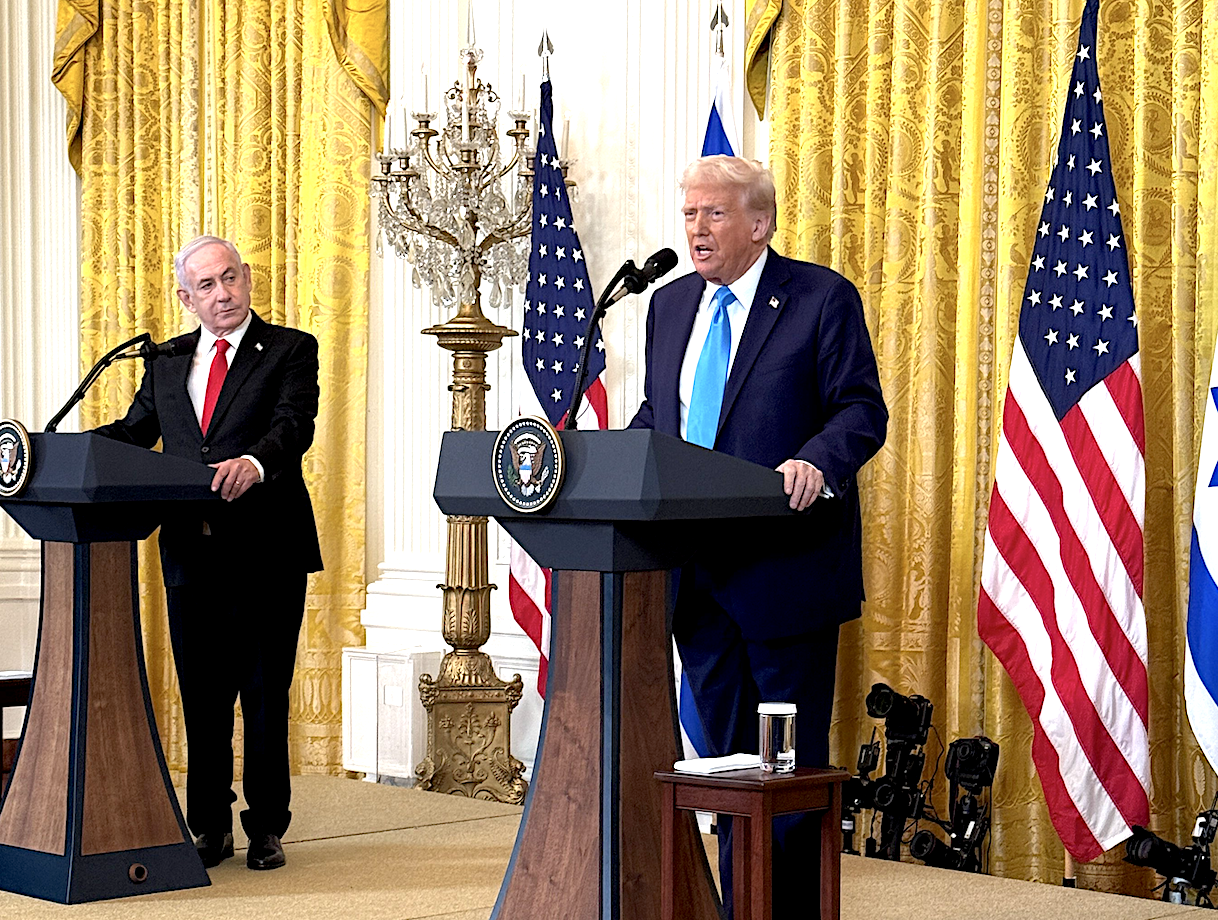
President Donald Trump and Israeli Prime Minister Benjamin Netanyahu speak privately in the Vermeil Room before a dinner, Monday, July 7, 2025, at the White House. (Official White House Photo by Daniel Torok)

“There was a time where you couldn’t speak bad, if you wanted to be a politician, you couldn’t speak badly. But today, you have, you know, AOC plus three, and you have all these lunatics, and they’ve really, they’ve changed it,” he added.

The criticism of Israel among a small number of members of Congress is no longer limited to Democrats, as Rep. Marjorie Taylor Greene (R-GA), who is considered a strong supporter of President Trump, has recently come out strongly against Israel’s campaign in Gaza and became the first Republican in Congress to label it a genocide. Rep. Thomas Massie (R-KY) is also known for his opposition to US aid to Israel and the pro-Israel lobby group AIPAC.

“Israel, you would understand this very much, Israel was the strongest lobby I’ve ever seen. They had total control over Congress, and now they don’t, you know, I’m a little surprised to see that,” Trump said.

The president, who is strongly backing Israel’s genocidal assault in Gaza, said the military campaign is not good for Israel’s public image. “They may be winning the war, but they’re not winning the world of public relations, you know, and it is hurting them. But Israel was the strongest lobby 15 years ago that there has ever been, and now it’s, it’s been hurt, especially in Congress,” he said.

Trump made similar comments while on the campaign trail last year, both about the Israel lobby and Israel’s public image being damaged by the destruction of Gaza. “Some 15 years ago, Israel had the strongest lobby. If you were a politician, you couldn’t say anything bad about Israel, that would be like the end of your political career. Today, it’s almost the opposite,” he told Israel Hayom in March 2024. 

How to Stop Israel from Starving Gaza

September 3, 2025
 By Jeffrey Sachs* and Sybil Fares* – Article sent to Other News by the authors

Israel has crossed the clear line into the darkest crimes.

Israel, with US complicity, is committing genocide in Gaza through the mass starvation of the population as well as direct mass murders and the physical destruction of Gaza’s infrastructure. Israel does the dirty work.  The US Government funds it and provides diplomatic cover through its UN veto.  Palantir, through “Lavendar,” provides the AI for efficient mass murder. Microsoft, through Azure cloud services, and Google and Amazon  through the “Nimbus” initiative, supply core tech infrastructure for the Israeli army. 

This marks 21st-century war crimes as an Israel-US public-private partnership.  Israel’s mass starvation of the people of Gaza has been confirmed by the United NationsAmnesty International, Red Cross, Save the Children and many others. The Norwegian Refugee Council, along with 100 organizations, have been calling for an end to Israel’s weaponization of food relief.  This is the first time that mass starvation has been officially confirmed in the Middle East.

The scale of the starvation is staggering. Israel is systematically depriving food to more than 2 million people. Over half a million Palestinians face catastrophic hunger and at least 132,000 children aged under five are at risk of death from acute malnutrition. The scale of the horror is thoroughly documented by Haaretz in a recent article entitled “Starvation is Everywhere.” Those who are able to somehow access food distribution sites are routinely fired on by the Israeli army.

As a former US ambassador to Israel has recently explained, the intention to starve the population has been present from the start.  Israel’s Heritage Minister Amichai Eliyahu recently declared, “there is no nation that feeds its enemies.”  Minister Bezalel Smotrich recently stated, “whoever doesn’t evacuate, don’t let them. No water, no electricity; they can die of hunger or surrender. This is what we want.”

Yet despite these glaring declarations of genocide, US representatives at the UN repeatedly deny the facts and cover for Israel’s war crimes. The US alone vetoed Palestine’s admission to the UN in 2024.  The US now denies visas to Palestinian leaders to come to the UN in September, yet another violation of international law. 

The US has used its power and especially its veto in the UN Security Council to abet Israel’s genocide of the Palestinians and to block even the most basic humanitarian responses.  The world is aghast but seems paralyzed before the the Israel-US murder machine.  Yet the world can act, even in the face of US intransigence.  The US will stand naked and alone in its criminal complicity with Israel. 

Let’s be clear.  The overwhelming voice of humanity is on the side of the people of Palestine.  Last December, 172 countries, with more than 90 percent of the world population, voted to support Palestine’s right to self-determination.  Israel and the US were essentially isolated in their opposition.  Similar overwhelming majorities are repeatedly expressed on behalf of Palestine and against the actions of Israel. 
Israel’s thuggish government now counts solely on US support, but even that may not be there for long.  Despite Trump’s intransigence and US government attempts to stifle pro-Palestinian voices, 58% of Americans want the UN to recognize the State of Palestine, compared to only 33% who do not. Moreover, 60% of Americans oppose Israel’s actions in Gaza.

Here are practical steps that the world can take.

First, Türkiye has set the correct course by ending all economic, trade, shipping, and air links with Israel. Israel is currently a rogue state, and Türkiye is right to treat it as such until Israeli-created mass starvation ends, and a State of Palestine is admitted to the UN as the 194th member, with the borders of June 4, 1967.  Other states should immediately follow Türkiye’s lead. 

Second, all UN member states that have not yet done so should recognize the State of Palestine.  So far, 147 countries recognize Palestine.  Dozens more should do so at the UN Summit on Palestine on September 22, even over the vociferous objections of the US. 

Third, the Arab signatories to the Abraham Accords, Bahrain, Morocco, Sudan, and the UAE, should suspend their diplomatic relations with Israel until the Gaza siege ends and the State of Palestine is admitted to the UN.

Fourth, the UN General Assembly, by a vote of two-thirds present and voting, should suspend Israel from the UN General Assembly until it lifts its murderous siege on Gaza, based on the precedent of suspending South Africa during its Apartheid regime.  The US has no veto in the UN General Assembly.

Fifth, UN member states should stop the export of all technology services that support the war, until the siege of Gaza ends and Palestine’s membership in the UN is adopted by the UN Security Council.  Consumer companies such as Amazon and Microsoft that persist in aiding the Israel Defence Forces in the context of a genocide should face the wrath of consumers worldwide.   

Seventh, the UN General Assembly should dispatch a UN Protection Force to Gaza and the West Bank. Typically, it would be the UN Security Council that mandates a protection force, but in this case, the US will block the Security Council with its veto.  There is another way. 

Under the “Uniting for Peace” mechanism, when the Security Council is deadlocked, the authority to act passes to the General Assembly. After a Security Council session and the almost inevitable US veto, the issue would be brought before the UNGA in a resumed 10th emergency special session on the Israel-Palestine conflict.  There, the General Assembly can, by a two-thirds majority not subject to US veto, authorize a protection force in response to an urgent request from the State of Palestine.  There is a precedent: in 1956, the General Assembly authorized the UN Emergency Force (UNEF) to enter Egypt and protect it from the ongoing invasion by Israel, France, and the United Kingdom.

At the invitation of Palestine, the protection force would enter Gaza to secure emergency humanitarian aid for the starving population. If Israel were to attack the UN protection force, the force would be authorized to defend itself and the Gazans. Whether Israel and the US would dare to fight a UNGA-mandated force protecting the starving Gazans remains to be seen.

Israel has crossed the clear line into the darkest crimes — starving civilians to death and shooting them as they line up, emaciated, for food. There is no further line to cross, nor time to lose. The family of nations is being tested and summoned to action as it has not been in decades.

*Jeffrey D. Sachs, Professor and Director of the Center for Sustainable Development at Columbia University. 

*Sybil Fares, Senior Advisor on the Middle East and Africa for UN Sustainable Development Solutions Network.

𝐓𝐡𝐞 𝐆𝐮𝐚𝐫𝐝𝐢𝐚𝐧 𝐯𝐢𝐞𝐰 𝐨𝐧 𝐭𝐡𝐞 𝐤𝐢𝐥𝐥𝐢𝐧𝐠 𝐨𝐟 𝐆𝐚𝐳𝐚’𝐬 𝐣𝐨𝐮𝐫𝐧𝐚𝐥𝐢𝐬𝐭𝐬: 𝐈𝐬𝐫𝐚𝐞𝐥 𝐰𝐚𝐧𝐭𝐬 𝐭𝐨 𝐬𝐭𝐨𝐩 𝐭𝐡𝐞 𝐰𝐨𝐫𝐥𝐝 𝐟𝐫𝐨𝐦 𝐬𝐞𝐞𝐢𝐧𝐠 𝐰𝐡𝐚𝐭 𝐢𝐭’𝐬 𝐝𝐨𝐢𝐧𝐠 𝐄𝐝𝐢𝐭𝐨𝐫𝐢𝐚𝐥

September 2, 2025

 This is the most lethal war for the media in recent times. A generation of journalists is being wiped out

Sun 31 Aug 2025 18.30 CEST

Day by day, the death toll rises, the war crimes mount, and the outrage grows. Last Wednesday, the pope demanded that Israel stop its “collective punishment” of Gaza’s population. A day later, António Guterres, the United Nations secretary general, warned that “the levels of death and destruction … are without parallel in recent times”. More than 500 UN staff have pressed the human rights chief, Volker Türk, to call it genocide. Half of registered voters in the US have already concluded that that is what Israel is doing in Gaza.

The agony is deepening. On Friday, the Israeli military declared famine-hit Gaza City to be a combat zone, intensifying its assault and ending “tactical pauses” that allowed limited – if utterly inadequate – food delivery. Many inhabitants are physically incapable of fleeing again, and fear that they would be no safer elsewhere. Israel has attacked parts of areas that it has labelled as “humanitarian zones”.

Israel could end the international condemnation by stopping its campaign of annihilation. Instead, it tries to stop us learning about it, by silencing those who bear witness. It is determined to control the narrative of the war – though even its own figures at times offer a bleak view of conditions – and will go to shocking lengths. This has become the most lethal war for the media in recent history. According to the Committee to Protect Journalists (CPJ), at least 189 Palestinian journalists are dead in Gaza; others put the toll still higher. Five were killed in a single strike last week.

Reporters Without Borders (RSF) and Avaaz, a non-profit organisation promoting global activism, are calling on Israel to abide by its international obligations to protect journalists as civilians, and open Gaza’s borders so that international journalists can report freely.

The Guardian is printing the names of all of those whom the CPJ has listed as killed: women and men such as Fatma Hassona, Hamza al-Dahdouh and Anas al-Sharif, admired for their work and, of course, dearly loved as daughters, fathers, sisters and friends. These are deeply personal losses. But they also represent a generation of journalists that is being wiped out and cannot be replaced.

“At the rate journalists are being killed in Gaza by the Israeli army, there will soon be no one left to keep you informed,” warned Thibaut Bruttin, RSF’s director general.

The civilian death toll in Gaza is staggering, and journalists are put at particular risk when they run to danger to report as others try to escape. But the killing of so many who have been clearly identified as members of the media, in some cases after they were threatened over their work or smeared, leaves no doubt that they have been targeted. This is “the deadliest and most deliberate effort to kill and silence journalists that CPJ has ever documented”, the organisation has said. “Palestinian journalists are being threatened, directly targeted and murdered by Israeli forces, and are arbitrarily detained and tortured in retaliation for their work.”

Journalists in Gaza work in unbearable conditions – hungry and exhausted, breaking off reporting to find food for their families, help carry bodies from rubble or assist wounded relatives in finding shelter. Many are separated from those they love; many have buried loved ones. All know that in bearing witness, they increase the danger that they face. They carry on to defend the truth against Israel’s attempts to extinguish it. They must be defended themselves.

The Challenge of Genoa’s Dockworkers: ‘If They Touch the Flotilla, We Will Block Europe’

September 1, 2025

August 31, 2025

Thousand of people marched in Genoa, Italy to bid farewell to the Global Sumud Flotilla. (Photo: video grab, via social media)

By Palestine Chronicle Staff  

Genoa’s dockworkers, engaged in collecting and shipping aid for Gaza, vow to block Europe if the Sumud Flotilla faces attacks or intimidation.

The Port of Genoa has turned into a symbol of resistance and international solidarity.

Italian media reported that for weeks, Genoese dockworkers have been collecting aid for the people of Gaza, and on Saturday evening they renewed their clear and determined message: if the Global Sumud Flotilla, which set sail today loaded with food supplies, were to find itself in danger, an unprecedented response will follow.

“If we lose contact with our boats even for just 20 minutes, we will block all of Europe. From the Port of Genoa nothing will leave anymore,” declared representatives of the Autonomous Collective of Dockworkers (Calp).

Their words, spoken before 40,000 people, expressed the unbreakable bond between the Ligurian city and the international mission to break Israel’s siege on Gaza.

The collective’s spokesperson explained that the most delicate stage will begin “around mid-September, when these boats will arrive near the coast of Gaza, in the critical zone.”

He then added: “If we lose contact with our boats, with our comrades, even for just 20 minutes, we will block all of Europe. Together with our Usb union, together with all dockworkers, together with the entire city of Genoa.”

During the torchlight vigil, the dockworkers reaffirmed their commitment: “Our girls and boys must return without a scratch, and all our goods, which belong to the people, down to the very last box, must reach their destination.”

They also reminded that every year 13-14,000 containers leave the Genoa port for Israel, issuing a stern warning: “We will not let a single nail leave anymore. We will launch an international strike, we will block the roads. We will block everything.”

Words were matched with actions. Over 280 tons of foodstuffs have been collected and shipped thanks to the joint efforts of the dockworkers and the association Music for Peace.

“We want to show that the Port of Genoa is a civilian port and not a port of war. We want to send the signal that not only do we block weapons, but we also physically deliver aid to the Palestinian population,” explained the dockworkers.

The historic “Sala della Compagnia Unica” has been transformed into a warehouse of resistance, where teams of volunteer dockworkers organized, packed, and loaded the aid. Not only their labor, but also their vehicles and resources, were put at the service of a cause they consider not abstract solidarity but a duty of class and humanity.

The Sumud Flotilla therefore sets out from Genoa not only as a humanitarian mission, but as a direct challenge to an inhuman siege. 

And the dockworkers, long at the forefront of struggles for dignity and justice, have made it clear they will not stand by: if anyone tries to stop the boats, “we will block all of Europe.”

(PC, Italian Media)

Jeffrey Sachs: Ending the Genocide Now

August 28, 2025

Consortium News, August 27, 2025

Shares

A U.N. Security Council vote to grant Palestine permanent U.N. membership would end Israel’s zealous delusions of permanent control over Palestine, write Jeffrey Sachs and Sybil Fares. But the U.S. stands in the way.

U.S. President Donald Trump at the White House, with Israeli Prime Minister Benjamin Netanyahu looking on, February 2025 (The White House, Wikimedia Commons, Public domain)

By Jeffrey D. Sachs and Sybil Fares

Common Dreams

President Donald Trump wants a Nobel Peace Prize, and his efforts toward peace in Ukraine, if successful, could possibly help him earn one—but only if he also ends U.S. complicity in the ongoing genocide in Gaza.

Under Trump, as under former President Joe Biden, the U.S. has served as Israel’s partner in mass murder, annexation, starvation, and the escalating torment of millions of Palestinians. The genocide can, and will, stop if Trump wills it. So far he has not.

Israel is committing genocide—everyone knows it, even its staunchest defenders. The Israeli human rights organization B’Tselem has recently made a poignant acknowledgment of “Our Genocide.” In Foreign Affairs, former U.S. Ambassador to Israel Jack Lew recently admitted that extremist parties in Netanyahu’s government openly aim to starve Palestinians in Gaza.

Lew frames his piece as praise for the former Biden administration (and for himself) for their supposedly valiant efforts to prevent mass starvation by pressuring Israel to allow minimal food entry, while blaming Trump for easing that pressure.

Yet the actual importance of the piece is that an ardent Zionist insider certifies the genocidal agenda sustaining Netanyahu’s rule. Lew recounts that in the aftermath of Oct. 7, Israelis frequently pledged that “not a drop of water, not a drop of milk, and not a drop of fuel will go from Israel to Gaza,” a stance that still shapes Israel’s cabinet policy. The International Court of Justice (ICJ) can use Lew’s article as confirmation of Israel’s genocidal intent.

“The U.S. aids and protects Israel every day in these horrific crimes against the Palestinian people.”

The genocide in Gaza, coupled with the annexation in the West Bank, aims to fulfill the Likud vision of a Greater Israel that exercises territorial control between the Sea and Jordan. This will destroy any possibility of a Palestinian state, and any possibility of peace.

Indeed, Bezalel Smotrich, the extremist minister of finance and minister in the ministry of defense, recently vowed to “permanently bury the idea of a Palestinian state” while the Knesset has recently called for annexation of the occupied West Bank.

Bezalel Smotrich celebrating election victory in March 2021. (Wikimedia Commons, CC BY-SA 4.0)

The U.S. aids and protects Israel every day in these horrific crimes against the Palestinian people. The U.S. provides billions of dollars in military support, goes to war alongside Israel, and offers diplomatic cover for Israel’s crimes against humanity. The vacuous mantra that “Israel has the right to defend itself” is the U.S. pat excuse for Israel’s mass murder and starvation of innocent civilians.

Generations of historians, psychologists, sociologists, philosophers, and inquiring minds will ask how the descendants and coreligionists of the Jews murdered by Hitler’s genocidal regime came to become genocidaires. Two factors, deeply intertwined, come to the fore.

First, the Nazi Holocaust lent credence among Jews to the Zionist claim that only a state with overwhelming military power and ready to use it can protect the Jewish people. For these militarists, every Arab country opposed to Israel’s ongoing occupation of Palestine became a dire foe to be crushed by war.

This is Netanyahu’s doctrine of violence, which was first unveiled in the Clean Break strategy, and which has produced nonstop Israeli mobilization and war, and a society now gripped by implacable hatred even of innocent women and children in Palestine, Lebanon, and Syria. Netanyahu has dragged the U.S. into countless devastating and futile wars out of Netanyahu’s blindness to the reality that only diplomacy, not war, can achieve Israel’s security.

Second, this non-stop resort to violence reignited a dormant strain of Biblical Judaism, notably based on the Book of Joshua, which presents God’s covenant with Abraham as justification for genocides committed in conquering the Promised Land. Ancient zealotry of this kind, and the belief that God would redeem his chosen people through violence, fueled suicidal revolts against the Roman Empire between 66 and 135 AD. Whether the genocides in the Book of Joshua ever occurred (probably not) is beside the point. For today’s zealots, the license to commit genocide is vivid, immediate, and biblically ordained.

Netanyahu has dragged the U.S. into countless devastating and futile wars out of Netanyahu’s blindness to the reality that only diplomacy, not war, can achieve Israel’s security.

Aware of the danger of self-destructive zealotry, the rabbis who shaped the Babylonian Talmud proscribed Jews from attempting to return en masse to the promised land (Ketubot 111a). They taught that Jews should live in their own communities and fulfill God’s commandments where they are, rather than seeking to recapture a land from which they had been exiled following decades of suicidal revolt.

“Netanyahu has dragged the U.S. into countless devastating and futile wars out of Netanyahu’s blindness to the reality that only diplomacy, not war, can achieve Israel’s security.”

Whatever the fundamental reasons for Israel’s murderous turn, Israel’s survival among nations is at risk today as it has become a pariah state. For the first time in history, Israel’s Western allies have repudiated Israel’s violent ways.

France, the United Kingdom, Australia, and Canada have each pledged to formally recognize the State of Palestine at the upcoming U.N. General Assembly in September. These countries will finally join the will of the overwhelming global majority in recognizing that the two-state solution, enshrined in international law, is the true guarantor of peace.

The majority of the American people are rightly revulsed by Israel’s brutality and are also turning their support massively to the Palestinian cause. In a Reuters poll released Aug. 20, 58 percent of Americans now believe that the U.N. should recognize the State of Palestine, against just 32 percent who oppose that.

American politicians will surely note the change, at Israel’s peril, unless the two-state solution is rapidly implemented. (Logical arguments can also be given for a peaceful one-state, bi-national solution, but this alternative has essentially no backing among U.N. member states and no basis in the international law regarding the Israel-Palestine conflict that has developed over more than seven decades.)

This Israeli government will not change course on its own. Only the Trump administration can end the genocide through a comprehensive settlement agreed by the world’s nations at the U.N. Security Council and U.N. General Assembly. The solution is to stop the genocide, make peace, and salvage Israel’s standing in the world by creating a Palestinian state alongside Israel on the June 4, 1967 borders.

Trump must force Israel to see reality: that Israel cannot continue to rule over the Palestinian people, murder them, starve them, and ethnically cleanse them.

United Nations General Assembly emergency special session meeting on the situation in the Occupied Palestinian Territory, June 2025 (UN Photo/Evan Schneider)

For decades, the entire Arab and Islamic world has supported the two-state solution and advocated to normalize relations with Israel and guarantee security for the entire region. This solution is in full accordance with international law, and was again espoused clearly by the U.N. General Assembly in the New York Declaration last month at the conclusion of the United Nations High-Level International Conference on the Peaceful Settlement of the Question of Palestine and the Implementation of the Two-State Solution (July 29, 2025).

Trump has come to understand that to save Ukraine, he must force it to see reality: that NATO cannot expand to Ukraine as that would directly threaten Russia’s own security. In the same way, Trump must force Israel to see reality: that Israel cannot continue to rule over the Palestinian people, murder them, starve them, and ethnically cleanse them. The two-state solution thereby saves both Palestine and Israel.

An immediate U.N. Security Council vote to grant Palestine permanent membership in the U.N. next month would put an end to Israel’s zealous delusions of permanent control over Palestine, as well as its reckless territorial ambitions in Lebanon and Syria.

The focus of the crisis would then shift to immediate and practical issues: how to disarm non-state actors within the framework of the new state and regional peace, how to enable mutual security for Israel and Palestine, how to empower the Palestinians to govern effectively, how to finance the reconstruction, and how to provide urgent humanitarian assistance to a starving population.

Trump can make this happen at the U.N. in September. The U.S., and only the U.S., has vetoed the permanent membership of Palestine in the UN. The other members of the U.N. Security Council have already signaled their support.

Peace in the Middle East is possible now — and there is no time to lose.

Jeffrey D. Sachs is a university professor and director of the Center for Sustainable Development at Columbia University, where he directed The Earth Institute from 2002 until 2016. He is also president of the U.N. Sustainable Development Solutions Network and a commissioner of the U.N. Broadband Commission for Development.

Sybil Fares is a specialist and adviser in Middle East policy and sustainable development at SDSN.

This article is from Common Dreams

A History of Israel’s Military Occupations of Gaza

August 11, 2025

By Seraj Assi, Jacobin, 8 Aug 2025

Israel’s current genocide in Gaza and recently announced plans to occupy Gaza City are both part of a long and tortured history of Israeli military occupations of the tiny strip.

A convoy of Israeli military vehicles drives down a road on the border with the Gaza Strip on October 15, 2023. (Menahem Kahana / AFP via Getty Images)

Jacobin‘s summer issue, “Speculation,” is out now. Follow this link to get a discounted subscription to our beautiful print quarterly.

Whenever we imagine that Israel’s genocide has reached its nadir, the country plumbs new depths of evil. Israel’s genocidal energy in Gaza seems bottomless.

On Thursday, nearly two years into the genocide, Israeli prime minister Benjamin Netanyahu announced on Fox News that Israel intends to take military control of the entire Gaza Strip. On Friday, Israel’s security cabinet approved a plan to occupy Gaza City, which will involve the mass displacement of “all Palestinian civilians from Gaza City.”

If implemented, the planned reoccupation, which comes exactly twenty years after Israel’s unilateral withdrawal from Gaza in August 2005, will unleash Israel’s third military occupation of Gaza, culminating a decades-long history marked by brutal violence, mass slaughter and ethnic cleansing, and endless displacements. Not that Israel is not already an occupying force in Gaza. According to the United Nations, Israel is still occupying Gaza, because it continues to control the territory by land, air, and sea. Freely touting its ethnic cleansing schemes there, now Israel wants Gaza without its people. It’s a settler-colonial campaign branded as military occupation.

Gaza is not a state in conflict with Israel. It’s the largest refugee camp on earth. Squeezed in a tiny sliver of land (1.3 percent of Palestine), the majority of its two million people live in cramped refugee camps, most of which have been in existence for over seven decades.

It started during the Nakba, the mass displacement of Palestinians at Israel’s founding in 1948 when over 750,000 Palestinians were forcibly expelled from their land and homes in Israel and made lifetime refugees. Nearly 250,000 of those uprooted flooded into Gaza, the last surviving Palestinian city along the Mediterranean coast, tripling its population overnight and rendering it a colossal refugee camp squashed between desert and sea. Providing shelter to the displaced inhabitants of over 250 razed Palestinian towns and villages, Gaza became a Noah’s ark for Palestine after the Nakba.

The tragedy was so profound that the United Nations set up that year a special agency to provide aid to Palestinian refugees, the United Nations Relief for Palestinian Refugees, which was shortly succeeded by the UN Relief and Works Agency for Palestine Refugees in the Near East (UNRWA), and soon moved its headquarters to Gaza City.Gaza is not a state in conflict with Israel. It’s the largest refugee camp on earth.

Most of the refugees who flooded into Gaza came from towns and villages in central and southern Palestine and from northern parts as far as Galilee. But those from villages around Gaza had to endure the tragedy of being displaced within sight of their lost lands and homes. As Israeli military leader Moshe Dayan later confessed,

Jewish villages were built in the place of Arab villages. You do not even know the names of these Arab villages, and I do not blame you because geography books no longer exist. Not only do the books not exist, the Arab villages are not there either. Nahlal arose in the place of Mahlul; Kibbutz Gvat in the place of Jibta; Kibbutz Sarid in the place of Huneifis; and Kefar Yehushu’a in the place of Tal al-Shuman. There is not one single place built in this country that did not have a former Arab population.

Those settlements, built on the ruins of uprooted Palestinians, served as a constant reminder of the Nakba. To cite the late Lebanese writer Elias Khoury, voice of the Palestinian refugees: “Nahal Oz was a military settlement founded by the Nahal units of the Israeli army to harass Palestinian farmers who had been driven out of their villages and had become refugees in Gaza.”

Over the next seven decades, Gaza’s bleak refugee reality would set into motion a long and tortured history of Israeli military occupations of the tiny strip.

Israel’s Brutal Invasions

In November 1956, embarking on its first occupation of Gaza, Israeli forces invaded the territory by launching military raids on its impoverished refugee camps. The occupation took place during Tripartite Aggression against Egypt, which was then controlling Gaza. It started with a series of horrific massacres. Israeli soldiers entered Khan Yunis and collected all adult males from their homes and shot them at their doorsteps and in the streets, killing at least 520 people.

Even Rafah in the south was not safe from Israeli invasions and mass slaughter. On November 12, Israeli forces invaded the refugee camps in Rafah, rounded up male residents, and killed and wounded hundreds of people in cold blood. The bodies of the victims were dumped in the district of Tell Zurab, west of Rafah, where families had to risk curfews to pick up the bodies of loved ones and bury them, though most of the burials were carried out without identification. The bloodshed, known as the Rafah massacre, sent waves of horror through the camps.

And so Gaza got a first taste of what an Israeli occupation was like: thousands of civilians were killed and wounded throughout the whole Gaza Strip, and hundreds of prisoners summarily executed. The carnage was described by the Red Cross as “scenes of terror.” It was so appalling that E. L. M. Burns, the head of the UN observer mission in Gaza, warned that Israel’s atrocities there intended to wipe out Gaza’s refugee population, which according to international law, amounted to an act of genocide.

Because Gaza was essentially a massive refugee camp of displaced Palestinians who were expelled from their homes inside Israel during the Nakba, Israel became the first occupying power in history that uprooted a native population, chased it into exile, and occupied it. (Isarel’s invasion of Lebanon in the early 1980s would mete out the same fate to Palestinian refugees there, culminating in the horrific Sabra and Shatila massacre, which was also condemned by the UN as “an act of genocide.”)

Even Israeli military leaders like Dayan were forced to admit that grim reality. As he confessed that year: “What can we say against their terrible hatred of us? For eight years, they have sat in the refugee camps of Gaza and have watched how, before their very eyes, we have turned their lands and villages, where they and their forefathers dwelled, into our home.”

But the Nakba was only the beginning. Unsatisfied with uprooting Palestinians, Israel would routinely invade Gaza, wreak horror, and carry out a series of massacres. Frequently after 1948, Israeli forces would raid Gaza’s refugee camps, slaughtering and displacing thousands of refugees, and demolishing their homes and camps. In January 1949, with the bloody memory of the Nakba still fresh in Gaza, Israeli forces bombed food distribution centers in Deir al-Balah and Khan Yunis at peak hours, killing hundreds of Palestinians. Those refugees who attempted to return to their homes, labeled by Israel as “infiltrators,” were routinely shot on sight by Israeli soldiers.

In August 1953, an Israeli military unit, led by Ariel Sharon, the future prime minister of Israel, invaded the Bureij refugee camp and killed some fifty people in their beds. According to UN officials, Israeli forces threw bombs through the windows of huts where Palestinian refugees were sleeping and shot at those who tried to flee. The massacre was described by a UN commission as an “appalling case of deliberate mass murder.”

Those repeated massacres were part of a wider Israeli campaign to ethnically cleanse Gaza’s refugee population. Following the Nakba, Israel’s founders, including David Ben-Gurion, foresaw the risk of concentrating hundreds of thousands of Palestinian refugees in a coastal strip straddled between the Negev and Sinai deserts with no real way out and no hope for escape or dispersion. Haunted by Gaza’s refugee population and the prospect of Palestinian right of return, and fearing the spectacle of “waves of refugees marching on Israel from Gaza,” Israel attempted to solve the crisis by wiping it out.

When that failed, Israel moved to reoccupy Gaza.

Massacre Upon Massacre

In 1967, war again broke out and Israel invaded Gaza for the second time. It was no easy feat: it took Israel six days to win the war but four years to take control of Gaza. The resistance spurred a second exodus, as tens of thousands of refugees, still traumatized by the memory of the first occupation, were forced to flee the coastal strip to Jordan and Egypt — never to return. Israel’s second and decades-long occupation of Gaza was underway.

The refugee population of Gaza continued to haunt Israeli leaders after 1967. Transfer plans abounded. During Israel’s prolonged occupation of Gaza — which placed refugees under the control of the very forces that had uprooted them two decades earlier — Israeli leaders, notably Levi Eshkol and Dayan, contemplated transferring Gaza refugees to the West Bank, or Sinai in Egypt, or Iraq, or an Arab country in North Africa (the “Libyan Operation”). They even hatched a secret plan, the “Moshe Dayan plan,” to transfer Gazan refugees to Latin America by air, though luckily for the people of Gaza, the plan was deemed costly and unfeasible.

Unsatisfied with military occupation, Israeli forces moved quickly to uproot Palestinians in Gaza, demolish their homes and seize their land, and build Jewish settlements on the ruins of displaced refugees. The settlements prospered while Palestinians suffered under occupation.

Even peace proved costly for Gaza’s refugees. The 1979 Camp David Accords closed off Gaza’s border with Egypt, dividing families by barbed wires, causing further population displacements and house demolitions along the newly demarcated border, depriving Gaza’s fishermen of their traditional access to Egyptian territorial waters. The destruction of Israeli settlements in Sinai was further compensated by an upsurge in settlement activity in Gaza.For nearly two decades, Israel has imposed a total blockade on Gaza, while routinely assaulting and raiding its population.

During the second intifada, after nearly four decades of protracted occupation, Israel seemingly withdrew from Gaza, leaving behind over one million camped refugees. When its forces left the coastal strip, Israeli leaders were confident they had finally swept Gaza’s refugee crisis under the rug of “disengagement.”

Meanwhile, Israel continued to control Gaza’s frontier posts, airspace, and territorial waters. Declaring the impoverished enclave a “hostile territory” and viewing its refugee population as a security threat of “existential” proportions that required disproportionate force, Israel routinely subjected Gaza to collective punishment. It continued to subject its population to military operations and invasions. Israel’s pullout was branded to the outside world as a concession, the end of occupation, and the fulfillment of Israel’s obligations toward Gaza and its refugees.

In reality, the withdrawal made the refugee population an easy target for its military incursions and conquests, with entire sections of the camps declared no-go areas for the Israeli patrols. Meanwhile, Israel moved its settlers to new settlements in the West Bank and around Gaza, and before long, Gaza was placed under total siege.

For nearly two decades, Israel has imposed a total blockade on Gaza, while routinely assaulting and raiding its population — a brutal chapter that would culminate in the ongoing genocide. All that time, the refugees of Gaza had to suffer the horrifying fate of living under the yoke of the very forces that had ethnically cleansed them decades earlier. Bombarded, under siege, penned in a slaughterhouse, and trapped in an iron cage fashioned by Israel, the refugees of Gaza have come to fathom the depth of their tragedy: there is one thing worse than being displaced, and that is not being able to leave. Many still fear that leaving would amount to a second Nakba, which Israeli leaders have been so determined to carry out.

Every year or so after the Nakba, Israeli forces would invade Gaza. For decades, Israel would subject Gaza to a brutal series of military invasions and occupations, raids and offenses, military incursions and administrations, bombing campaigns and air strikes, repeated massacres and mass displacements, a yearslong blockade that is still in place, and an ongoing genocide with no end in sight.

Israel’s brutality in Gaza has often spawned resistance. Owing to its refugee history, Gaza was the birthplace of the first intifada, known as the stone uprising, which broke out in Jabalya refugee camp (nicknamed “Vietnam Camp”), and was led by unarmed young Palestinians who were born refugees and grew up under Israeli occupation. Gaza then became the symbolic battlefield of the second intifada when, at a crossroads near Bureij refugee camp, twelve-year-old Muhammad al-Durrah was shot dead in his father’s arms, the iconic image of the uprising.

According to French historian Jean-Pierre Filiu, Israel has waged at least fifteen wars on Gaza since the Nakba, which has resulted in the near annihilation of Gaza’s 4,000-year-old civilization. In the five wars it has waged on Gaza since the blockade, Israel has killed hundreds of thousands Palestinians while displacing over two million others. In summer 2014, during Operation Protective Edge, Israeli forces slaughtered over two thousand Palestinians in Gaza. Two Palestinian popular uprisings, or intifadas, were brutally suppressed by Israel. Even when seven years ago Palestinians staged a symbolic March of Return within the sealed walls of Gaza, to commemorate the Nakba, they were mercilessly slaughtered by Israel in the hundreds, including children flying kites. Today nearly two years into the Gaza genocide, those past massacres have become a daily spectacle in Gaza.

The tragic irony is that the refugees in Gaza now being slaughtered and displaced were created in the heat of war by Israel itself more than seventy-seven years ago. Except this time, the refugees have nowhere left to go.

Yet Israel’s obsession with Gaza’s refugees is not completely misplaced and will certainly be met with Palestinian steadfastness. As Khoury put it: “For seventy years the refugees have not stopped knocking on the gates of Gaza, which are locked with hatred and death, and they will continue to knock on them until the locks are broken, and Palestine will reach out its hands to its people who return to it invaded by the water and mud of the earth, and build from their death a gate to life.”

Share this article

FacebookTwitterEmail

Contributors

Seraj Assi is a Palestinian writer living in Washington, DC, and the author, most recently, of My Life As An Alien (Tartarus Press).

Until Our Last Breath

August 11, 2025

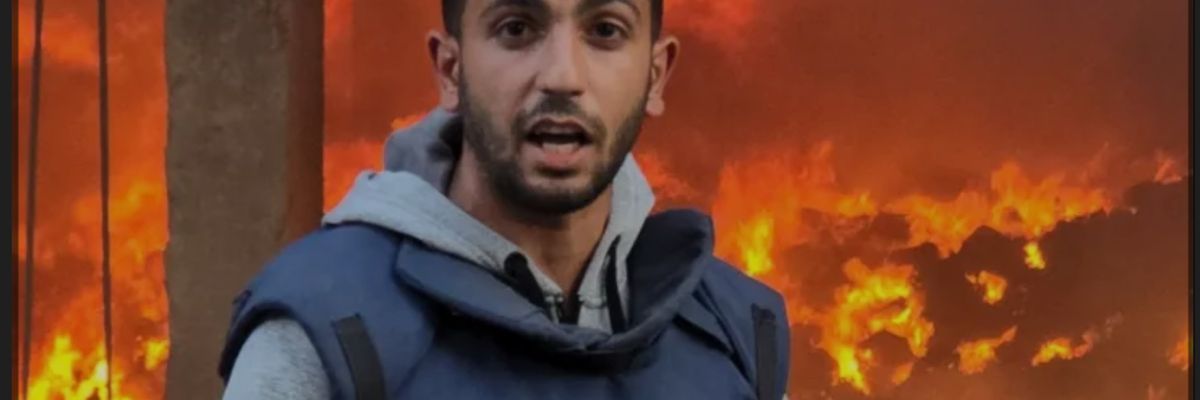
Journalist Anas Al-Sharif, murdered by Israel

Journalist Anas Al-Sharif, murdered by Israel

Photo from Al Jazeera

Abby Zimet, Common Dreams, Aug 11, 2025

Israel has murdered Anas Al-Sharif, 28, a steadfast, well-known Al Jazeera correspondent called “the voice of Gaza to the world,” in a targeted strike in Gaza City that also killed four other journalists. Long threatened by Israel for his relentless coverage of Israeli atrocities, Al-Sharif vowed to continue “every day and every hour to report what is happening – this is our cause.” In a last message, Al-Sharif wrote, “I lived pain in all its details and I tasted loss and grief time and again…Do not forget Gaza.”

Al-Sharif was among five Al Jazeera journalists killed in a clearly targeted strike on a tent housing them outside the main gate of al-Shifa Hospital late Sunday. The other victims were Al Jazeera correspondent Mohammed Qreiqeh and camera operators Ibrahim Zaher, Mohammed Noufal and Moamen Aliwa. In his last post before his death, al-Sharif said Israel had launched intense bombing, called “fire belts,” on Gaza City; his final video showed the sky lit by orange flashes as loud booms sounded.

Calling Al-Sharif “one of Gaza’s bravest journalists” – and one of the most prominent with over half a million followers online – Al Jazeera said he and his colleagues were among the last remaining voices in Gaza “conveying its tragic reality to the world.” It accused Israel of waging a “campaign of incitement” against its journalists by repeatedly fabricating evidence seeking to link them to Hamas; in the last 22 months, the Israeli military has killed over 230 journalists, including multiple ones from Al Jazeera.

A U.N. rapporteur had earlier cited Israel’s “repeated threats and accusations” against Al-Sharif, arguing, “Fears for (his) safety are well-founded.” Last month, Israel claimed it had “unequivocal proof” he was a member of Hamas, and on Sunday they admitted to a deliberate strike against Al-Sharif, “the head of a terrorist cell.” Colleagues dismissed the claim as propaganda, with “zero evidence” to support it. Said a colleague of Al-Sharif’s: “His entire daily routine was standing in front of a camera from morning to evening.”

Other journalists also charge Israel is waging “a deliberate war on journalists” purely for their willingness to risk their lives to document Israel’s genocidal crimes, from mass bombardment to mass starvation. “Israel’s strategy is clear: Silence the truth by murdering those who report it,” said The Palestine Chronicle‘s Ramzi Baroud, who mourned having to lose so many journalists solely for their “commitment to the truth.” Still, he insisted, “Their deaths will not bury the Palestinian story.”

Al-Sharif had earlier written that, “despite all (the) difficulties and tragic circumstances” he and his colleagues had faced over the last brutal year and a half, he held to his belief that “it is the duty of the world to see and witness what we are documenting…This drives us to continue in our coverage to our last breath.” Still, he knew death likely awaited. “This is my will and final message,” he wrote in April. “If these words reach you, know that Israel has succeeded in killing me and silencing my voice.”

“First, peace and God’s mercy and blessings be upon you,” he wrote in the translated post published by his family. “God knows I have given all my effort and strength to be a support and a voice for my people since I opened my eyes to life in the alleys and streets of Jabalia Refugee Camp. My hope was that God would grant me life so I could return with my family and loved ones to our original town of Ashkelon (Al-Majdal), now occupied. But God’s will was swifter, and His judgment is inevitable.”

Berating “those who remained silent, who accepted our killing,” he goes on to entrust those reading “with Palestine, the jewel of the Muslim crown and the heartbeat of every free person in this world…with its people and its innocent children who were not granted a lifetime to dream or live in safety and peace,” and with his wife and two children he did not live to see grow. “I die steadfast in my principles,” he writes. “Forgive me if I have fallen short, and pray for mercy for me, for I have kept my promise…Do not forget Gaza.”

“I lost my voice screaming, ‘Massacre, massacre,’ hoping that the world takes action. But it is an unjust world.” – Anas Jamal Al-Sharif.