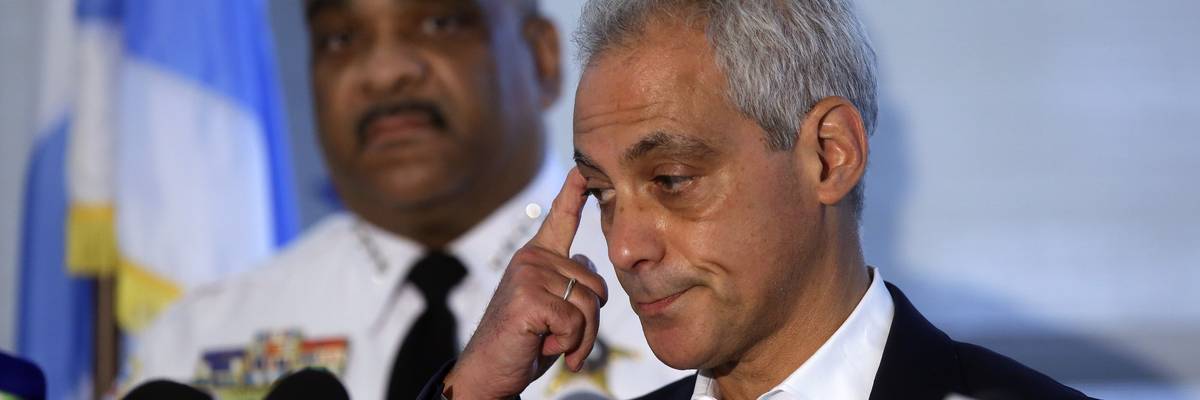
Former Chicago Police Superintendent Eddie Johnson listens as former Chicago Mayor Rahm Emanuel speaks about Chicago’s weekend of gun violence during a news conference at the Chicago Police Department 6th District station August 6, 2018 in Chicago, Illinois.
(Photo by Joshua Lott/Getty Images)
The Democratic base is fed up with a system that gives inordinate power to the wealthy and to large corporations.
Aug 17, 2026, Common Dreams
We’ve been hearing a lot of panicky warnings lately after Democratic primary voters chose socialists and other leftists instead of “moderates” in several major elections. The alarm bells got louder this month after Michigan’s progressive Senate candidate Abdul El-Sayed defeated Rep. Haley Stevens—who was, the New York Times reported, “the moderate establishment-backed candidate.”
The soothing “moderate” label routinely goes to candidates like Stevens who’ve supported continual arming of Israel. She “benefited from about $62 million in advertising spending from half a dozen outside groups,” the Times noted. “Over half of that sum came from the super PAC arm of the American Israel Public Affairs Committee, the country’s most influential pro-Israel group.”
RECOMMENDED…
House Democrats Probe Use of Trump’s NSPM-7 to Target ‘Left-Leaning Political Groups’

Possibly ‘Best Political Ad Yet This Season’ Shows Texas Republican Ken Paxton’s 2012 Pen Theft
What’s so “moderate” about supporting genocide?
Politicians are also routinely dubbed “moderate” when they’re running interference for extreme income inequality and deadly healthcare inequities – helping to block popular policy options like tax hikes on the rich and Medicare for All, which is supported by three-quarters of Democrats.
The Democratic base is fed up with a system that gives inordinate power to the wealthy and to large corporations. In the real world, the so-called “moderates” are aligned with a status quo that continues to inflict widespread suffering and preventable death at home and abroad.
To hear timeworn party strategists like James Carville and Paul Begala tell it, leftwing candidates are duping the Democratic electorate. As this month began, Carville threatened to leave the party. Begala made headlines by declaring, “I don’t like the socialists. I can’t stand them.”
But last month, a CNN poll found that “about a third of Democrats and Democratic-leaning adults identify as democratic socialists.” At a time when defeating the fascistic Republican Party is imperative, any strategist’s prescription that would denigrate or seek to exclude them amounts to political malpractice.
Treating so many Democratic voters like interlopers to be scolded might play well with corporate donors. But it’s a feeble swim against the political current. Polling shows that the younger Democratic voters are, the more favorable they’re apt to be toward socialism. “Younger adults are more likely to be in groups on the left, while older adults tend to cluster in more conservative groups,” the Pew Research Center noted.
Drawing on the results of its new public opinion survey, Global Strategy Group just reported that “socialist Democrats skew younger, with 57 percent of them being between the ages of 18 and 44.” Another poll, released a month ago by Tufts University’s Center for Information and Research, found that two-thirds of young people “said that their political views have changed in some way in recent years”—and “youth whose views did shift were almost twice as likely to become more liberal/progressive instead of more conservative.”
As socialists and others on the left prevail in many high-profile races, the refrains of condemnation coming from some of the Democratic Party establishment are potshots in a losing battle. By definition, young voters are the future of the party. Its prospects for winning elections are diminished to the extent that younger voters are made to feel unwelcome, or even vilified.
To the ears of many young Democratic voters, derision about how they cast their ballots is coming from out-of-touch party elders who treat crucial problems as abstractions or matters worthy only of lip service. Millions of Americans in early adulthood are facing financial stress with bleak outlooks for jobs and careers. College tuitions are often prohibitive, and college debt can be debilitating. Rents and mortgages are high. Everyday expenses are worse than a challenge. The climate crisis is real.
Such realities cast a shadow over the future. The last thing those voters want is arrogant leadership that refuses to grasp the urgency of this political moment.


Notorious warlord returns to Afghanistan to help Karzai
August 17, 2009By Jonathan S. Landay and Tom Lasseter | McClatchy Newspapers, Aug 16, 2009
KABUL — A notorious Afghan warlord accused of allowing the murder of hundreds, if not thousands, of prisoners and then destroying the evidence returned to Afghanistan Sunday night as part of what appears to be a political deal brokered with President Hamid Karzai.
Gen. Abdul Rashid Dostum arrived from Turkey just four days before the Afghan presidential elections, in which his support could be key to Karzai’s chances of securing more than 50 percent of the vote – the threshold for avoiding a second round of elections.
Karzai has come under criticism for consolidating his position by striking deals with warlords like Dostum and those suspected of connections to the country’s opium trade.
Dostum comes with considerable baggage. There have been repeated allegations that his men were responsible for the deaths of up to 2,000 alleged Taliban and al Qaida prisoners in late-2001, a time when Dostum worked closely with U.S. special forces and intelligence teams in northern Afghanistan.
A McClatchy investigation last year uncovered information suggesting that Dostum later directed the removal of the remains of those slain prisoners, destroying the evidence of the original crime.
President Barack Obama recently said that he’s asked his national security team to collect as many facts as possible about the incident to determine whether to launch a full investigation.
Seamak Herawi, a spokesman for Karzai, told reporters that there was no reason why Dostum could not return home.
“There is no legal obstacle for Gen. Dostum’s return to Afghanistan,” he said.
Hundreds of jubilant members of Dostum’s Jumbish Party converged on Kabul International Airport to greet Dostum, an Uzbek former communist general who repeatedly switched sides in the devastating civil war that erupted between Islamic guerrilla groups after the Soviet occupation.
His head clad in a silver turban and his shoulders draped with a chapan, a traditional long green coat, Dostum rode into the city followed by his loyalists and rifle-toting members of his private militia in a caravan of honking cars and buses.
More supporters were awaiting him at his massive red three-story mansion in Sherpur, a neighborhood filled with “poppy palaces” allegedly built with opium profits.
Dostum’s name has been in the news recently – first in a McClatchy report last December that made public the fact that a gravesite in a north Afghanistan desert known as Dasht-e Leili had been dug up, and then again this July in The New York Times, which reported on the lack of U.S. investigation into the original incident.
Locals interviewed by McClatchy last year said that it was common knowledge that Dostum’s men were responsible for having removed the bones of the dead men with bulldozers or similar equipment.
Satellite imagery obtained by Physicians for Human Rights indicates that the digging took place as early as 2006. There appears to have also been subsequent excavation last year – a McClatchy reporter saw three smaller ditches that were apparently dug between June and November.
The site is still not being guarded by either Western or Afghan forces, according to Nathaniel Raymond, the lead investigator on the Dasht-e Leili case for Physicians for Human Rights.
“Though Dostum has returned to Kabul, he still should not be allowed to return to a position of power in the Afghan government until a full, transparent investigation of the Dasht-e Leili incident is complete,” Raymond said.
Interior Ministry spokesman Zemari Bashari said he could not discuss whether Dostum was under investigation for the alleged removal of the remains.
Dostum was put under house arrest in Afghanistan last year after he and his men were said to have dragged a rival leader out of his home, beaten him and his family and then held the man hostage. Then, after a meeting with Karzai in late-November, he left for Turkey.
Dostum at the time was stripped of his mostly honorary title of chief of staff to the commander in chief, but it was later reinstated.
Dostum has denied that the prisoners in 2001 died in large numbers, a position that he repeated in a statement last month, saying it was “confirmed by those who were responsible for accepting the surrender of these prisoners of war — including doctors and members of the military forces of the United States. In addition, it was reported to me that the U.S. Defense Department had also confirmed this.”
Some of the former prisoners, though, have said that they were stuffed into shipping containers in which hundreds of men suffocated to death or died from gunshots fired by Dostum’s men.
On Sunday, Dostum made a brief statement to thank Karzai for allowing him to return before retreating behind closed doors. The pair are expected to travel to Dostum’s hometown of Sheberghan, the capital of northern Jawzjan Province, on the final day of campaigning for Thursday’s presidential election.
Hundreds of his followers milled around the garden and glitzy reception hall of his mansion, whose inlaid floor of green, black and white stone, carved wooden columns and crystal chandeliers testified to Dostum’s immense wealth.
Haji Shah Mahmoud Nazari, a Jumbish candidate for the provincial council in northeastern Takhar Province, dismissed the allegations against Dostum as the “propaganda of Dostum’s enemies and the propaganda of the enemies of the Jumbish Party.”
“He came to participate in a very historical election which will determine the next five years of the country’s future,” he said. “He wants to be beside his people.”
Sayed Ahmad Sayed, a Jumbish official who is heading Karzai’s campaign in northern Fariab Province, said Dostum could deliver more than 1 million votes to the president’s re-election drive.
Share this:
Tags:Afghanistan, elections, Gen. Abdul Rashid Dostum, President Hamid Karzai, prisoners
Posted in Afghanistan, Commentary, Uncategorized | Leave a Comment »