Radical political activist Hassan Gardezi
By Nasir Khan, January 8, 2009
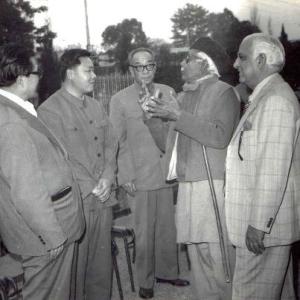
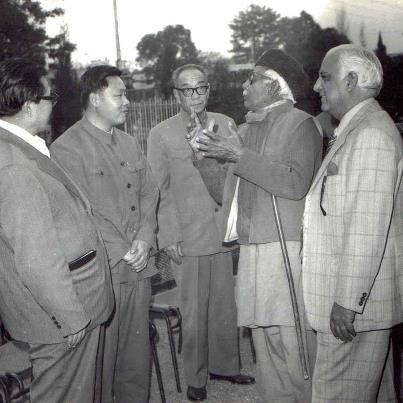
Dada Amir Khan (with cap, d. 1989), Dr Ayub Mirza and the Chinese Ambassador to Pakistan (Photo: 1982)
The renowned Pakistani sociologist and radical activist Professor Hassan Gardezi has been a life-long human rights campaigner. Through his books and articles, he has staunchly stood for the rule of law and has shown the importance and relevance of socialist values in shaping an egalitarian society.
He opposed the policies of General Zia-ul-Haq, whose brutal dictatorship in the 1980s was simply a reign of terror in Pakistan. Under Zia’s rule, thousands of ordinary political workers and activists were rounded up and incarcerated with a view to silence any opposition to his tyrannical rule. Many people were flogged by police publicly and this was meant to be a message from the military ruler to all those who dared to oppose him. The general used his army and police to beat and mishandle Pakistanis as Nazi rulers of the Third Reich did with their opponents, or the Zionist rulers of Israel have been doing and are still doing with the captive population of Palestine. Anyhow, in those beak years in Pakistani history, Hassan Gardezi , who was living in Canada, played an important part to combat Zia’s obscurantist policies of so-called Islamisation and the sharia laws, which, by the way, had nothing to do with Islamic faith or its benevolent moral and social laws.
Dr Gardezi had been a close and trustworthy friend of the great Indo-Pakistani revolutionary Dada Amir Haider Khan. The autobiographical manuscripts that Dada had compiled while in jail in the 1930s or his later updated sketches, notes and letters were in a precarious condition. To organise and systematise all such papers was a daunting task for any editor or schoalr. But Gardezi was the right man for the difficult job; he with a single-minded determination organised and re-wrote the entire manuscript and notes to compile the memoirs of Dada. Last year, he finally published the two-volume autobiography of the great revolutionary. I solute Dr Gardezi for his great work.
I have never me Gardezi, who has lived and taught in Canada for many decades whereas I have worked and lived in Europe for almost five decades; however, Dada had kept me informed about his close friend Hassan Gardezi, his scholarly work and his political activities.
I have great admiration for the work and worldview of Comrade Hassan Gardezi and I offer him my best wishes for the period of his active retirement. I hope he will continue to inspire us, the old radical guard as well as the younger generation, in the years to come.
——————————————————-
Pakistan Today: A Travelogue
By Hassan Gardezi
Periods of national unrest have not been uncommon or unfamiliar occurrences in the history of Pakistan. But the political and economic turbulence the country is facing today is bound to come as a shock to any visitor who has been away from the country for even a couple of years. It is as if all the contradictions that were being nurtured within the institutional structure of the state since the creation of the country have suddenly come to a head, threatening to spell the collapse of the entire edifice.
“How does Pakistan look to you today?” was the question most frequently asked, with some variation, everywhere I went this time, whether it was a meeting with old students, colleagues and political comrades in Lahore, a chat at the “tea” before or after a talk I was invited to give somewhere, a social meeting in Islamabad, or a gathering of close relatives in Multan.
Pakistan’s existential situation of course does not look very good today and everyone in the country knows this. The question being asked was perhaps more of an expression of common anxiety about what is happening in the country, a subterfuge rather than a real question.
The problems behind Pakistan’s latest crisis are not really new. But the one that is being
most palpably felt is that of religious extremism accompanied by unprecedented acts of terrorism. Bombs planted or carried on the person of suicidal individuals went off almost every day in some part of the country when I was there, killing and maiming their hapless victims. The biggest carnage took place in the heart of Peshawar on Dec. 5 when a powerful bomb went off in the Qisa Khwani bazaar crowded with Eid shoppers, killing scores of women and children and lighting up a huge fire. It was intended to destroy a shia imambara. These acts of terror are being committed by Islamic extremists, generally known as Pakistani Taliban, who are most active in the seven agencies of the Federally Administered Areas (FATA) and also control a substantial part of the northerly settled districts of NWFP province, renamed Pakhtunkhwa.
The leaders of the Awami National Party (ANP) which heads the provincial government and their relatives are the latest individual targets of terrorist killings (ostensibly for hobnobbing with Afghanistan’s president, Karzai). The national chairman of the party, Isfandyar Wali, survived a murderous attack on October 2, which killed four of his companions. Peshawar, the seat of provincial government, is virtually a war zone. Neither the once formidable Frontier Corps nor the Pakistan army seem to be able to establish the writ of the government over vast northerly tracts of the province. It has also become impossible for the Pakistani truck convoys to carry supplies for the NATO troops in Afghanistan from the Karachi port through the Peshawar terminals.
The operations of Pakistan army in trying to restore governmental control in FATA and adjoining settled districts of Pakhtunkhwa are neither effective nor hold much credibility in the eyes of the people, despite heavy casualties suffered by soldiers in fighting with the Islamic militants. Many questions are being raised regarding the involvement of the armed forces on the northwestern front. Are they serious in eradicating the menace of Islamic terrorists inside Pakistan? Is the army rank and file willing to kill their Muslim brothers while for decades they have been regimented to fight “Hindu India?” What role did the army and its intelligence services play in creating and nurturing the Islamic insurgents or jihadis as a foreign policy tool in the first place? Whose “war on terror” is the Pakistan army fighting any way? Is it serving the imperial interests of the United States on the northwestern front? and so on go the questions.
In October 2008 the newly elected government decided to hold an in-camera session of the national parliament under tight security to get “everyone on board” on the rationale of fighting the menace of “extremism, militancy and terrorism.” After two weeks of deliberations and extensive briefings on the situation provided by the army High Command, the parliament passed a resolution hailed as representing the consensus of its members. Somewhere in this resolution it was written down that the “nation stands united to combat this growing menace” by addressing its “root causes.”
it appeared that addressing the root causes of extremism and terrorism in Pakistan would be a great opportunity for the elected representatives of the people to face the truth and make a beginning to move towards establishing a new political culture of peace and tolerance. But when I reached Pakistan in November, everyone was talking about the menace of terrorism and religious extremism but there was no sign anywhere of addressing its root causes.
I brought this issue to the first of the talks I was invited to give at the Lahore School of Economics. Any honest attempt to trace the roots of religious extremism and associated terrorism would inevitably lead to two interrelated fundamentals of state policy that have been pursued by every Pakistani government, which has ruled the country since independence, I said. One of these fundamentals is the Islamisation of Pakistani state and society while the other is catering to the global strategic interests of the Unites States of America.
Moves to Islamise the state of Pakistan began as the first order of business for the founding fathers of Pakistan (the worthy exception being Muhammad Ali Jinnah) whatever their political motives, and they were certainly not spiritual. Assembled in the first Constituent Assembly of Pakistan, these men came up with a document known as the Objectives Resolution in 1949, which declared that “Sovereignty belongs to Allah alone but He has delegated it to the state of Pakistan . . .” It further proclaimed that “Muslims shall be enabled to order their lives in accordance with the teachings of Islam as set out in the Holy Quran and Sunnah.” With these beginnings, all subsequent rulers of Pakistan made their own contributions to inject Islam into the affairs of the state, thereby empowering a parasitic and rabidly patriarchal class of mullahs. It was however left to General Zia-ul-Haq to effectively demonstrate what it meant for the Muslims of Pakistan to order their lives in accordance with the teachings of Islam after his coup d’etat in1977.
Islamisation of the Pakistani state and political culture was also a useful asset for the United States to exploit in its aim to keep the country tied to its Cold War military alliances against Soviet communism. Ultimately, with Zia the most ardently Islamist dictator in power, the United States was able to mobilize Pakistan army, intelligence services and Islamist parties to launch its proxy war, designed as Jihad, to overthrow the infant Marxist government of Afghanistan backed by the Soviet Union. This was the critical event which, through various political turns and twists unfolded into today’s global terrorism with Pakistan as its epicentre.
Thus it is reasonable to conclude that the mess that Pakistan is currently in is of its own making, with the opportunistic backing of the United States, I said in my submission to the small professorial circle that had gathered to hear me in the brightly lit library of Lahore School of Economics. How to get out of this mess? The only logical course that I could see was the reversal by the state of its Islamisation, and Americanisation policies.
On the sunny morning of November 21, I was sitting among a hall full of students at the campus of the newly established University of Gujarat. I was invited to speak on the current political and economic crisis, but my mind was picturing the young men and women sitting in front of me as little playful toddlers when Gen. Zia had let lose an orgy of public floggings to implement his primitive sharia laws taken from the books of Jamat-e-Islami, his new found political ally. Do these young people remember all that? I was wondering. Was there anything in their history and Pakistan Studies textbooks about a military dictator who had installed himself as the Islamic ruler, Amir–ul–Momineen, of the wretchedly poor people of Pakistan? Do they know who created and fostered the present day Islamic extremists terrorizing the people, killing them in their mosques, imambaras, and bazaars while taking over the northern areas of Pakistan?
Once I got up to speak I pretty much repeated to my young audience what I had said at the Lahore School of Economics about the roots of Islamic extremism and terrorism in today’s Pakistan. Injecting the beliefs and rituals of a particular religion in the affairs of a modern, pluralistic, state is like playing with fire, I said. And the proof is all around us today as the country’s mosques, imambaras, bazaars and hotels burn, set on fire by the bombs and explosives of religious zealots. It is time for the people of Pakistan to make it very clear that most of them are Muslims, they were born Muslims, They have learned their faith from their elders, and neither the state mullah nor any jihadi has the right to tell them how to practice their faith.
But is it realistic to suggest that Pakistan dismantle its Islamisation project and break its ties with the only superpower on earth? Yes it is, if the government is a democracy run by the consent of the majority. The majority of the people of Pakistan have never endorsed Islamic rule as they have rejected the Islamist parties in every election held in Pakistan which has not been rigged. Religious fervour that is observed today in Pakistan is largely confined to the small middle class, always ready to compromise to protect its precarious existence. The people in general are fed up with the mayhem created by the Islamic militants. Several recent public opinion polls have also confirmed that an overwhelming majority of the adult population does not want the United States to interfere in the affairs of Pakistan.
After a brief stay at the beautifully laid out campus of the University of Gujrat, which incidentally is headed by a noteworthy academic and not a retired military heavy-weight, I was driven to Islamabad.
Islamabad, as the capital of Pakistan has many reasons to be visited, but lately I have been going there to spend a few restful days with a friend, sheltered by the Marghala hills, and to browse through the stores selling used and new books in the F/6 and F/7 markets. But it looks like what used to be the most calm and cloistered capital city in the world is now wide open to scarification by a new breed of militant Islamists. Last time I was there a large area of the city was fenced off where once was a mosque called Lal Masjid. This time my friend drove me by an enormous pile of debris which once was the imposing structure of Marriott Hotel surrounded by the shinny cars of its clients. It was indeed a grim reminder of the deadly power wielded by the men of God in today’s Pakistan.
Next I took a bus to Multan and was hardly in that city of the saints for long when the news broke out of November 26 terrorist attacks on Mumbai hotels. The irate Indian prime minister immediately called up his Pakistani counterpart, naming not only the rabidly anti-Indian jihadist outfit, the Lashkar-e-Tayyiba (LeT), as the perpetrator but also accusing Pakistan’s Inter-services Intelligence agency (ISI) as having directed the atrocity. The Pakistani prime minister, a fellow Multani not known for much political astuteness, denied all accusations and even offered to send the director of the ISI to help in finding out the culprits. However, the poor fellow had to retract his offer soon thereafter and went into the denial mode.
Within next few days all signs of official or unofficial contrition vanished from Pakistan’s media coverage, washed away by a tide of national jingoism. Indian admonitions that Pakistan rein in its Islamic militants were met by a chorus of patriotic war cries vouching to defend Pakistan from its perennial enemy, India. If on the one hand spokespersons of the venerable Lawyer’s Movement were issuing patriotic statements, on the other hand there were the villainous terrorists, the likes of Baitullah Mehsud and Mangal Bagh, voicing eagerness to march their lashkers to the Indian border to defend Pakistan. The rest of this drama is still to unfold.
I had yet to go to Karachi to participate in a discussion panel on Dada Amir Haider Khan’s book of memoirs, Chains to Lose, which I was finally able to get published last year. But Karachi was once again in the grip of riots. This time the riots were sparked by MQM’s fears that Pakhtun refugees from Waziristan and the districts of Pakhtunkhwa, displaced by Pakistan army’s anti-terrorist operations and constant missile attacks launched from the US predatory drones, were flocking to Karachi and taking control of local markets.
In any case I was able to make it to the Karachi event, thanks to an interlude of peace in the city in preparation for the Eid holidays. The book discussion was organized by Dr. Jaffer Ahmed, the able and tireless director of Karachi University’s Pakistan Studies Centre, the publisher of the Chains to Lose. Some half a dozen people, journalists, writers, political activists, presented their very well informed and perceptive reviews. Zahida Hina was one of them whose presentation in Urdu caught the general sense of the house. She said:
Dada’s memoir is a great historical document if one seeks to understand a glorious 20th century movement in South Asia for freedom from world colonialism and imperialism.
If our generation has no idea of who Dada Amir Haider Khan is, it cannot be blamed. This generation has never been told anything about our great compatriots. We make giants out of dwarfs and treat our persons of great stature like lowly creatures.
Feeling happy that Dada’s contributions as a committed communist to make Pakistan, South Asia and the world a better place for humanity are becoming known I returned to Lahore on December 6. Next evening there was a sitting with some like-minded comrades arranged by Awaji Jamhoree Forum. It turned out to be a free-wheeling discussion of the present global economic crisis, war on terror and the rise of Islamic terrorism in Pakistan, terrorist attacks on Mumbai hotels, the US elections and the victory of Obama.
Perhaps the most serious concern was the position and the role of the socialist left in all this. I maintained that the greatest asset of the socialist left is its set of values. These values of freedom, peace, opposition to all wars, human rights, respect for nature and all life, economic, racial and gender equality, religious and ethnic tolerance, are together a powerful antidote to the present global crisis. There is every chance for the socialist left to succeed in its own right if it stops wasting its resources to support the lesser evil in political contests. I gave the example of very active and resourceful anti-war and anti-poverty groups in the United States who squandered their assets by supporting Barack Obama as the lesser evil in the contest between the two mainstream bourgeois parties. There is no sushi thing as more or less evil, I said. All war is evil whether it is more or less, all poverty and all inequality is evil whether it is more or less. A similar mistake was made in the last elections in Pakistan when parties calling themselves “communist” rushed to support the PPP.
I better end here. My apologies if I have bored you with my long story. If you do have any questions and comments I will be glad to receive them. I wish you a very happy new year.
Hassan Gardezi

![[A Palestinian boy, who also holds Russian citizenship, sits atop a Red cross vehicle as he waits with his family to leave the Gaza Strip January 8, 2009. (Suhaib Salem/Reuters)]](https://i0.wp.com/www.commondreams.org/files/article_images/redcross-0108.jpg "redcross-0108.jpg") A Palestinian boy, who also holds Russian citizenship, sits atop a Red cross vehicle as he waits with his family to leave the Gaza Strip January 8, 2009. (Suhaib Salem/Reuters)
A Palestinian boy, who also holds Russian citizenship, sits atop a Red cross vehicle as he waits with his family to leave the Gaza Strip January 8, 2009. (Suhaib Salem/Reuters)




How Israel brought Gaza to the brink of humanitarian catastrophe
January 9, 2009Oxford professor of international relations Avi Shlaim served in the Israeli army and has never questioned the state’s legitimacy. But its merciless assault on Gaza has led him to devastating conclusions
A wounded Palestinian policeman gestures while lying on the ground outside Hamas police headquarters following an Israeli air strike in Gaza City. Photograph: Mohammed Abed/AFP/Getty Images
The only way to make sense of Israel’s senseless war in Gaza is through understanding the historical context. Establishing the state of Israel in May 1948 involved a monumental injustice to the Palestinians. British officials bitterly resented American partisanship on behalf of the infant state. On 2 June 1948, Sir John Troutbeck wrote to the foreign secretary, Ernest Bevin, that the Americans were responsible for the creation of a gangster state headed by “an utterly unscrupulous set of leaders”. I used to think that this judgment was too harsh but Israel’s vicious assault on the people of Gaza, and the Bush administration’s complicity in this assault, have reopened the question.
I write as someone who served loyally in the Israeli army in the mid-1960s and who has never questioned the legitimacy of the state of Israel within its pre-1967 borders. What I utterly reject is the Zionist colonial project beyond the Green Line. The Israeli occupation of the West Bank and the Gaza Strip in the aftermath of the June 1967 war had very little to do with security and everything to do with territorial expansionism. The aim was to establish Greater Israel through permanent political, economic and military control over the Palestinian territories. And the result has been one of the most prolonged and brutal military occupations of modern times.
Four decades of Israeli control did incalculable damage to the economy of the Gaza Strip. With a large population of 1948 refugees crammed into a tiny strip of land, with no infrastructure or natural resources, Gaza’s prospects were never bright. Gaza, however, is not simply a case of economic under-development but a uniquely cruel case of deliberate de-development. To use the Biblical phrase, Israel turned the people of Gaza into the hewers of wood and the drawers of water, into a source of cheap labour and a captive market for Israeli goods. The development of local industry was actively impeded so as to make it impossible for the Palestinians to end their subordination to Israel and to establish the economic underpinnings essential for real political independence.
Gaza is a classic case of colonial exploitation in the post-colonial era. Jewish settlements in occupied territories are immoral, illegal and an insurmountable obstacle to peace. They are at once the instrument of exploitation and the symbol of the hated occupation. In Gaza, the Jewish settlers numbered only 8,000 in 2005 compared with 1.4 million local residents. Yet the settlers controlled 25% of the territory, 40% of the arable land and the lion’s share of the scarce water resources. Cheek by jowl with these foreign intruders, the majority of the local population lived in abject poverty and unimaginable misery. Eighty per cent of them still subsist on less than $2 a day. The living conditions in the strip remain an affront to civilised values, a powerful precipitant to resistance and a fertile breeding ground for political extremism.
In August 2005 a Likud government headed by Ariel Sharon staged a unilateral Israeli pullout from Gaza, withdrawing all 8,000 settlers and destroying the houses and farms they had left behind. Hamas, the Islamic resistance movement, conducted an effective campaign to drive the Israelis out of Gaza. The withdrawal was a humiliation for the Israeli Defence Forces. To the world, Sharon presented the withdrawal from Gaza as a contribution to peace based on a two-state solution. But in the year after, another 12,000 Israelis settled on the West Bank, further reducing the scope for an independent Palestinian state. Land-grabbing and peace-making are simply incompatible. Israel had a choice and it chose land over peace.
The real purpose behind the move was to redraw unilaterally the borders of Greater Israel by incorporating the main settlement blocs on the West Bank to the state of Israel. Withdrawal from Gaza was thus not a prelude to a peace deal with the Palestinian Authority but a prelude to further Zionist expansion on the West Bank. It was a unilateral Israeli move undertaken in what was seen, mistakenly in my view, as an Israeli national interest. Anchored in a fundamental rejection of the Palestinian national identity, the withdrawal from Gaza was part of a long-term effort to deny the Palestinian people any independent political existence on their land.
Israel’s settlers were withdrawn but Israeli soldiers continued to control all access to the Gaza Strip by land, sea and air. Gaza was converted overnight into an open-air prison. From this point on, the Israeli air force enjoyed unrestricted freedom to drop bombs, to make sonic booms by flying low and breaking the sound barrier, and to terrorise the hapless inhabitants of this prison.
Israel likes to portray itself as an island of democracy in a sea of authoritarianism. Yet Israel has never in its entire history done anything to promote democracy on the Arab side and has done a great deal to undermine it. Israel has a long history of secret collaboration with reactionary Arab regimes to suppress Palestinian nationalism. Despite all the handicaps, the Palestinian people succeeded in building the only genuine democracy in the Arab world with the possible exception of Lebanon. In January 2006, free and fair elections for the Legislative Council of the Palestinian Authority brought to power a Hamas-led government. Israel, however, refused to recognise the democratically elected government, claiming that Hamas is purely and simply a terrorist organisation.
America and the EU shamelessly joined Israel in ostracising and demonising the Hamas government and in trying to bring it down by withholding tax revenues and foreign aid. A surreal situation thus developed with a significant part of the international community imposing economic sanctions not against the occupier but against the occupied, not against the oppressor but against the oppressed.
As so often in the tragic history of Palestine, the victims were blamed for their own misfortunes. Israel’s propaganda machine persistently purveyed the notion that the Palestinians are terrorists, that they reject coexistence with the Jewish state, that their nationalism is little more than antisemitism, that Hamas is just a bunch of religious fanatics and that Islam is incompatible with democracy. But the simple truth is that the Palestinian people are a normal people with normal aspirations. They are no better but they are no worse than any other national group. What they aspire to, above all, is a piece of land to call their own on which to live in freedom and dignity.
Like other radical movements, Hamas began to moderate its political programme following its rise to power. From the ideological rejectionism of its charter, it began to move towards pragmatic accommodation of a two-state solution. In March 2007, Hamas and Fatah formed a national unity government that was ready to negotiate a long-term ceasefire with Israel. Israel, however, refused to negotiate with a government that included Hamas.
It continued to play the old game of divide and rule between rival Palestinian factions. In the late 1980s, Israel had supported the nascent Hamas in order to weaken Fatah, the secular nationalist movement led by Yasser Arafat. Now Israel began to encourage the corrupt and pliant Fatah leaders to overthrow their religious political rivals and recapture power. Aggressive American neoconservatives participated in the sinister plot to instigate a Palestinian civil war. Their meddling was a major factor in the collapse of the national unity government and in driving Hamas to seize power in Gaza in June 2007 to pre-empt a Fatah coup.
The war unleashed by Israel on Gaza on 27 December was the culmination of a series of clashes and confrontations with the Hamas government. In a broader sense, however, it is a war between Israel and the Palestinian people, because the people had elected the party to power. The declared aim of the war is to weaken Hamas and to intensify the pressure until its leaders agree to a new ceasefire on Israel’s terms. The undeclared aim is to ensure that the Palestinians in Gaza are seen by the world simply as a humanitarian problem and thus to derail their struggle for independence and statehood.
The timing of the war was determined by political expediency. A general election is scheduled for 10 February and, in the lead-up to the election, all the main contenders are looking for an opportunity to prove their toughness. The army top brass had been champing at the bit to deliver a crushing blow to Hamas in order to remove the stain left on their reputation by the failure of the war against Hezbollah in Lebanon in July 2006. Israel’s cynical leaders could also count on apathy and impotence of the pro-western Arab regimes and on blind support from President Bush in the twilight of his term in the White House. Bush readily obliged by putting all the blame for the crisis on Hamas, vetoing proposals at the UN Security Council for an immediate ceasefire and issuing Israel with a free pass to mount a ground invasion of Gaza.
As always, mighty Israel claims to be the victim of Palestinian aggression but the sheer asymmetry of power between the two sides leaves little room for doubt as to who is the real victim. This is indeed a conflict between David and Goliath but the Biblical image has been inverted – a small and defenceless Palestinian David faces a heavily armed, merciless and overbearing Israeli Goliath. The resort to brute military force is accompanied, as always, by the shrill rhetoric of victimhood and a farrago of self-pity overlaid with self-righteousness. In Hebrew this is known as the syndrome of bokhim ve-yorim, “crying and shooting”.
To be sure, Hamas is not an entirely innocent party in this conflict. Denied the fruit of its electoral victory and confronted with an unscrupulous adversary, it has resorted to the weapon of the weak – terror. Militants from Hamas and Islamic Jihad kept launching Qassam rocket attacks against Israeli settlements near the border with Gaza until Egypt brokered a six-month ceasefire last June. The damage caused by these primitive rockets is minimal but the psychological impact is immense, prompting the public to demand protection from its government. Under the circumstances, Israel had the right to act in self-defence but its response to the pinpricks of rocket attacks was totally disproportionate. The figures speak for themselves. In the three years after the withdrawal from Gaza, 11 Israelis were killed by rocket fire. On the other hand, in 2005-7 alone, the IDF killed 1,290 Palestinians in Gaza, including 222 children.
Whatever the numbers, killing civilians is wrong. This rule applies to Israel as much as it does to Hamas, but Israel’s entire record is one of unbridled and unremitting brutality towards the inhabitants of Gaza. Israel also maintained the blockade of Gaza after the ceasefire came into force which, in the view of the Hamas leaders, amounted to a violation of the agreement. During the ceasefire, Israel prevented any exports from leaving the strip in clear violation of a 2005 accord, leading to a sharp drop in employment opportunities. Officially, 49.1% of the population is unemployed. At the same time, Israel restricted drastically the number of trucks carrying food, fuel, cooking-gas canisters, spare parts for water and sanitation plants, and medical supplies to Gaza. It is difficult to see how starving and freezing the civilians of Gaza could protect the people on the Israeli side of the border. But even if it did, it would still be immoral, a form of collective punishment that is strictly forbidden by international humanitarian law.
The brutality of Israel’s soldiers is fully matched by the mendacity of its spokesmen. Eight months before launching the current war on Gaza, Israel established a National Information Directorate. The core messages of this directorate to the media are that Hamas broke the ceasefire agreements; that Israel’s objective is the defence of its population; and that Israel’s forces are taking the utmost care not to hurt innocent civilians. Israel’s spin doctors have been remarkably successful in getting this message across. But, in essence, their propaganda is a pack of lies.
A wide gap separates the reality of Israel’s actions from the rhetoric of its spokesmen. It was not Hamas but the IDF that broke the ceasefire. It di d so by a raid into Gaza on 4 November that killed six Hamas men. Israel’s objective is not just the defence of its population but the eventual overthrow of the Hamas government in Gaza by turning the people against their rulers. And far from taking care to spare civilians, Israel is guilty of indiscriminate bombing and of a three-year-old blockade that has brought the inhabitants of Gaza, now 1.5 million, to the brink of a humanitarian catastrophe.
The Biblical injunction of an eye for an eye is savage enough. But Israel’s insane offensive against Gaza seems to follow the logic of an eye for an eyelash. After eight days of bombing, with a death toll of more than 400 Palestinians and four Israelis, the gung-ho cabinet ordered a land invasion of Gaza the consequences of which are incalculable.
No amount of military escalation can buy Israel immunity from rocket attacks from the military wing of Hamas. Despite all the death and destruction that Israel has inflicted on them, they kept up their resistance and they kept firing their rockets. This is a movement that glorifies victimhood and martyrdom. There is simply no military solution to the conflict between the two communities. The problem with Israel’s concept of security is that it denies even the most elementary security to the other community. The only way for Israel to achieve security is not through shooting but through talks with Hamas, which has repeatedly declared its readiness to negotiate a long-term ceasefire with the Jewish state within its pre-1967 borders for 20, 30, or even 50 years. Israel has rejected this offer for the same reason it spurned the Arab League peace plan of 2002, which is still on the table: it involves concessions and compromises.
This brief review of Israel’s record over the past four decades makes it difficult to resist the conclusion that it has become a rogue state with “an utterly unscrupulous set of leaders”. A rogue state habitually violates international law, possesses weapons of mass destruction and practises terrorism – the use of violence against civilians for political purposes. Israel fulfils all of these three criteria; the cap fits and it must wear it. Israel’s real aim is not peaceful coexistence with its Palestinian neighbours but military domination. It keeps compounding the mistakes of the past with new and more disastrous ones. Politicians, like everyone else, are of course free to repeat the lies and mistakes of the past. But it is not mandatory to do so.
• Avi Shlaim is a professor of international relations at the University of Oxford and the author of The Iron Wall: Israel and the Arab World and of Lion of Jordan: King Hussein’s Life in War and Peace.
Share this:
Tags: a gangster state, America and EU, Ariel Sharon, assault on Gaza, brutality of Israel's soldiers, death toll in Gaza, Hamas, Israel a rogue state, Israeli army, Israeli control over Gaza, Israeli war on Gaza, Jewish settlements, Professor Avi Shlaim, Sir John Troutbeck, Zionist colonial project, Zionist expansion
Posted in Commentary, Human rights, Palestine, Peace Movement, War Criminals, Zionist Israel | Leave a Comment »