Archive for the ‘Zionist Israel’ Category

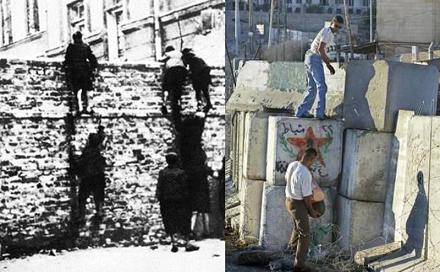
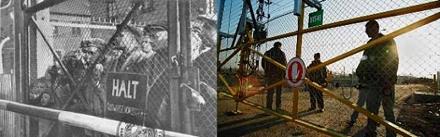
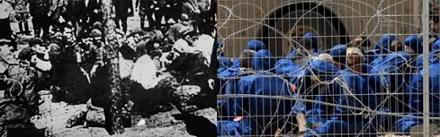
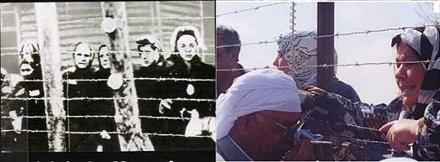
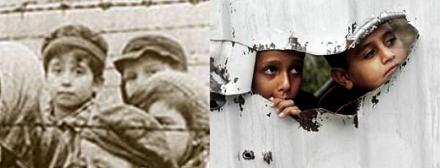
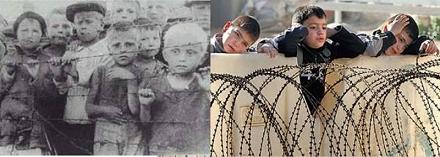
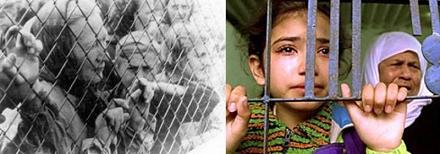
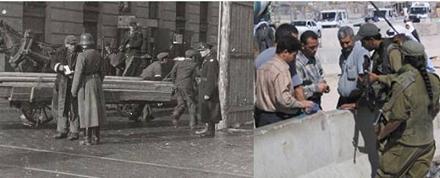
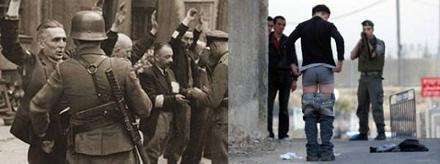
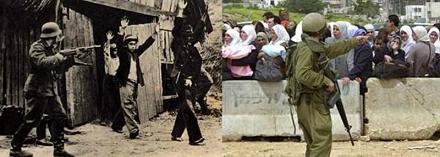
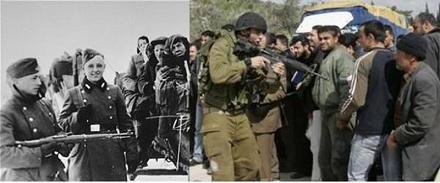
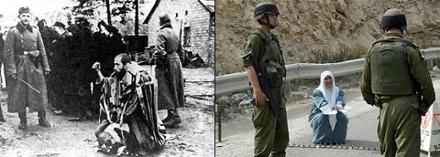
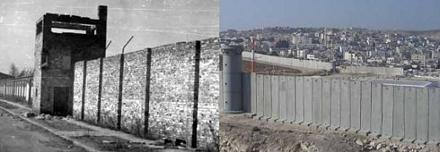
PHOTO ESSAY: JEWISH HOLOCAUST AND GAZA – PART I

January 19, 2009

Axis of Logic, January 18, 2009

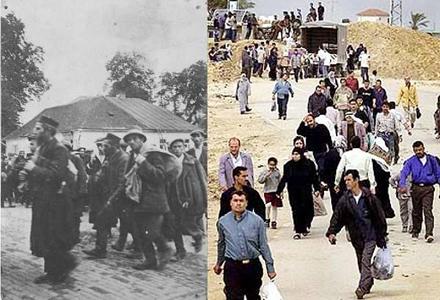
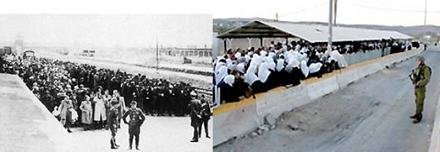
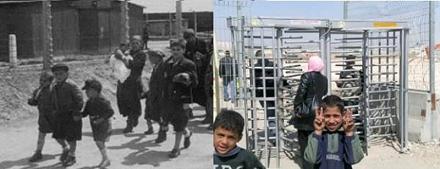
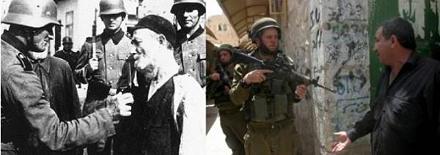
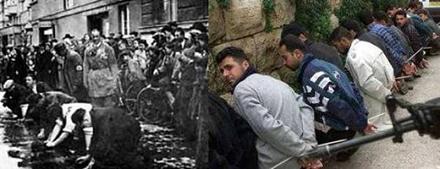
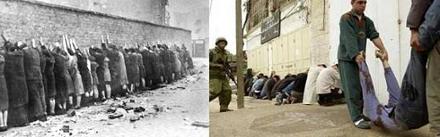
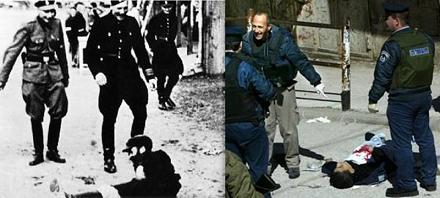
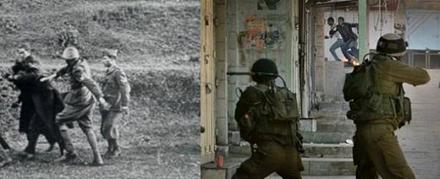
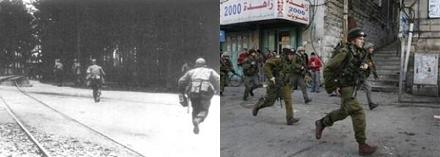
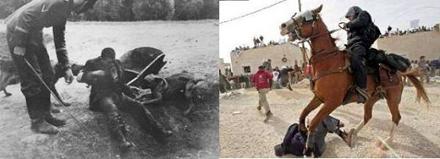
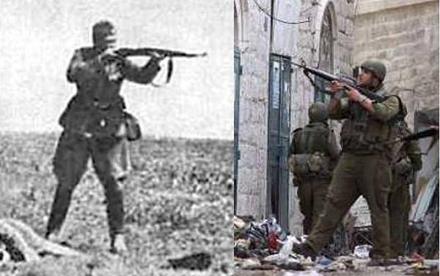
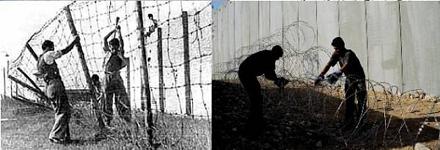
The grandchildren of Jewish holocaust survivors from World War II are doing to the Palestinians exactly what was done to them by Nazi Germany.

BUILDING WALLS & FENCES TO KEEP PEOPLE IN PRISONS

CHECK POINTS NOT TO ALLOW PEOPLE
BASIC FREEDOM OF MOVEMENT

ARRESTS & HARASSMENTS

Received via email at Axis of Logic. Original source, unknown

See: Photo Essay: Jewish Holocaust and Gaza, Part II

Israelis Applaud Massacre of Palestinians

January 19, 2009

Press Action, January 17, 2009

Israel’s massacre of Palestinians in the Gaza Strip represents a terrible atrocity committed by a terrorist, outlaw state. And yet the intensity of Israel’s killing machine is probably not the most disturbing part of its three-week-long onslaught. Shamefully, we’ve grown accustomed to Israel committing one atrocity after another against Palestinians while other nation-states sit on their hands—or in the case of the U.S. Congress, pass almost unanimous resolutions endorsing the slaughter—and let the rogue state get away with its terrible crimes.

Perhaps more appalling is how the Israeli public is cheering on the massacre. The Associated Press reported Jan. 17 that a Haaretz-Dialog poll found that 82% of Israelis believe their military has not “gone too far” with its attacks against Palestinians in Gaza.

Regarding U.S. public opinion, the Jerusalem Post reports that two new polls show Americans strongly back Israel over Palestinians in Israel’s assault on Gaza.

“A McClatchy/Ipsos poll found that 44 percent of Americans support Israel’s use of force, in comparison to 18% who think Hamas’s use of force is appropriate. And 57% think the latter is using excessive force – something only 36% believe Israel to be doing.

The poll also found that more Americans now oppose rather than support creating a Palestinian state, with 45% saying the US shouldn’t favor one, versus 31% who said it should and 24% who didn’t know. …

A large plurality, 49%, put the blame for the current conflict squarely on Hamas, with only 14% blaming Israel and 29% undecided. Nine percent said both, and 4% said neither.

A recent poll by the pro-Israel advocacy group The Israel Project also found that more Americans (55%) hold Palestinians responsible for the violence rather than Israelis (11%), with 23% blaming both and 5% blaming neither. They also fault Palestinian leaders over Israeli ones for the humanitarian crisis (66%-17%), and see the latter as working toward peace more than the Palestinians (48%-5%).”

Several commentators have highlighted the bloodthirstiness of both the Israeli and U.S. public with regard to Israel’s attack on Palestinians. Gary Corseri, for example, writes on Thomas Paine’s Corner:

Among the terrible pictures that I have seen on the Web, pictures that Palestinians and friends of Palestine have sent me, the most terrible was not of shattered, mutilated bodies, of blasted lives and unendurable pain. The most terrible was a picture of young Israelis standing within their secure borders (of occupied Palestine!) looking at the devastation being visited on the terrified civilians of Gaza a couple of miles away. And the unremitting horror of that image was that those who watched the bombs bursting in air and the puffs of death rising—they were smiling.

I searched my memory banks to recall where I’d seen such an image before. It was many years ago in a book about the Civil Rights struggle in America and it showed a lynching of a black man and a crowd of grinning whites—men, women and children in a party mood under the limbs of the tree upon which hung the burnt and crucified corpse. It used to be possible for travelers in the apartheid US south to purchase postcards depicting such scenes—and they had captions like, “One less Nigger to worry about!”

Broken town shows Gaza destruction

January 19, 2009

BBC, January 18, 2009

Gazans returning to their homes in Beit Lahiya were shocked

The BBC’s Paul Wood is part of the first group of journalists to gain independent access to Gaza from Israel. He reports from Gaza City on his impressions as he entered northern Gaza hours after Israel declared a unilateral ceasefire.

The Erez crossing from Israel into Gaza is an eerie place at the best of times.

The first hours of a shaky ceasefire are not “the best of times”.

As we stepped out of the concrete tunnel which leads from Israeli passport control, we could hear tanks manoeuvring nearby.

Their spent shells were on the ground. Israeli drones – un-manned aircraft – were circling overhead.

Unsurprisingly, the road was completely deserted, save for a couple of wild dogs and a donkey whose owner had long since fled.

The Hamas customs post, too, was abandoned – destroyed by Israeli fire.

Residents in Gaza describe their ordeal

But it was in the nearby town of Beit Lahiya that we saw the first real destruction and a hint of how so many lives have been lost here.

There were streets churned up by Israeli heavy armour; overturned cars; a lake of raw sewage in the street and a mosque left as a broken, charred ruin and smoke was still rising from a large school building across the way.

A Palestinian man carrying a white cane told me how his 13-year-old son had been killed by a tank shell.

“We were sleeping in our beds,” he says, “I am nearly blind. We were no threat to the Israelis.”

Everyone here denied there were military targets in the homes fired on by the Israeli forces.

But Hamas officials stopped us from filming at one site where bodies were still being removed.

This was a sign, perhaps, that there had indeed been some kind of military target if not in the houses then nearby.

Who is to blame for the loss of life in Gaza will be fiercely disputed between Israel and Hamas even as the final death toll is calculated.

Another War, Another Defeat

January 19, 2009

The Gaza offensive has succeeded in punishing the Palestinians but not in making Israel more secure.

By John J. Mearsheimer | The American Conservative, January 26, 2009

Israelis and their American supporters claim that Israel learned its lessons well from the disastrous 2006 Lebanon war and has devised a winning strategy for the present war against Hamas. Of course, when a ceasefire comes, Israel will declare victory. Don’t believe it. Israel has foolishly started another war it cannot win.

The campaign in Gaza is said to have two objectives: 1) to put an end to the rockets and mortars that Palestinians have been firing into southern Israel since it withdrew from Gaza in August 2005; 2) to restore Israel’s deterrent, which was said to be diminished by the Lebanon fiasco, by Israel’s withdrawal from Gaza, and by its inability to halt Iran’s nuclear program.

But these are not the real goals of Operation Cast Lead. The actual purpose is connected to Israel’s long-term vision of how it intends to live with millions of Palestinians in its midst. It is part of a broader strategic goal: the creation of a “Greater Israel.” Specifically, Israel’s leaders remain determined to control all of what used to be known as Mandate Palestine, which includes Gaza and the West Bank. The Palestinians would have limited autonomy in a handful of disconnected and economically crippled enclaves, one of which is Gaza. Israel would control the borders around them, movement between them, the air above and the water below them.

The key to achieving this is to inflict massive pain on the Palestinians so that they come to accept the fact that they are a defeated people and that Israel will be largely responsible for controlling their future. This strategy, which was first articulated by Ze’ev Jabotinsky in the 1920s and has heavily influenced Israeli policy since 1948, is commonly referred to as the “Iron Wall.”

What has been happening in Gaza is fully consistent with this strategy.

Let’s begin with Israel’s decision to withdraw from Gaza in 2005. The conventional wisdom is that Israel was serious about making peace with the Palestinians and that its leaders hoped the exit from Gaza would be a major step toward creating a viable Palestinian state. According to the New York Times’ Thomas L. Friedman, Israel was giving the Palestinians an opportunity to “build a decent mini-state there—a Dubai on the Mediterranean,” and if they did so, it would “fundamentally reshape the Israeli debate about whether the Palestinians can be handed most of the West Bank.”

This is pure fiction. Even before Hamas came to power, the Israelis intended to create an open-air prison for the Palestinians in Gaza and inflict great pain on them until they complied with Israel’s wishes. Dov Weisglass, Ariel Sharon’s closest adviser at the time, candidly stated that the disengagement from Gaza was aimed at halting the peace process, not encouraging it. He described the disengagement as “formaldehyde that’s necessary so that there will not be a political process with the Palestinians.” Moreover, he emphasized that the withdrawal “places the Palestinians under tremendous pressure. It forces them into a corner where they hate to be.”

Arnon Soffer, a prominent Israeli demographer who also advised Sharon, elaborated on what that pressure would look like. “When 2.5 million people live in a closed-off Gaza, it’s going to be a human catastrophe. Those people will become even bigger animals than they are today, with the aid of an insane fundamentalist Islam. The pressure at the border will be awful. It’s going to be a terrible war. So, if we want to remain alive, we will have to kill and kill and kill. All day, every day.”

In January 2006, five months after the Israelis pulled their settlers out of Gaza, Hamas won a decisive victory over Fatah in the Palestinian legislative elections. This meant trouble for Israel’s strategy because Hamas was democratically elected, well organized, not corrupt like Fatah, and unwilling to accept Israel’s existence. Israel responded by ratcheting up economic pressure on the Palestinians, but it did not work. In fact, the situation took another turn for the worse in March 2007, when Fatah and Hamas came together to form a national unity government. Hamas’s stature and political power were growing, and Israel’s divide-and-conquer strategy was unraveling.

To make matters worse, the national unity government began pushing for a long-term ceasefire. The Palestinians would end all missile attacks on Israel if the Israelis would stop arresting and assassinating Palestinians and end their economic stranglehold, opening the border crossings into Gaza.

Israel rejected that offer and with American backing set out to foment a civil war between Fatah and Hamas that would wreck the national unity government and put Fatah in charge. The plan backfired when Hamas drove Fatah out of Gaza, leaving Hamas in charge there and the more pliant Fatah in control of the West Bank. Israel then tightened the screws on the blockade around Gaza, causing even greater hardship and suffering among the Palestinians living there.

Hamas responded by continuing to fire rockets and mortars into Israel, while emphasizing that they still sought a long-term ceasefire, perhaps lasting ten years or more. This was not a noble gesture on Hamas’s part: they sought a ceasefire because the balance of power heavily favored Israel. The Israelis had no interest in a ceasefire and merely intensified the economic pressure on Gaza. But in the late spring of 2008, pressure from Israelis living under the rocket attacks led the government to agree to a six-month ceasefire starting on June 19. That agreement, which formally ended on Dec. 19, immediately preceded the present war, which began on Dec. 27.

The official Israeli position blames Hamas for undermining the ceasefire. This view is widely accepted in the United States, but it is not true. Israeli leaders disliked the ceasefire from the start, and Defense Minister Ehud Barak instructed the IDF to begin preparing for the present war while the ceasefire was being negotiated in June 2008. Furthermore, Dan Gillerman, Israel’s former ambassador to the UN, reports that Jerusalem began to prepare the propaganda campaign to sell the present war months before the conflict began. For its part, Hamas drastically reduced the number of missile attacks during the first five months of the ceasefire. A total of two rockets were fired into Israel during September and October, none by Hamas.

How did Israel behave during this same period? It continued arresting and assassinating Palestinians on the West Bank, and it continued the deadly blockade that was slowly strangling Gaza. Then on Nov. 4, as Americans voted for a new president, Israel attacked a tunnel inside Gaza and killed six Palestinians. It was the first major violation of the ceasefire, and the Palestinians—who had been “careful to maintain the ceasefire,” according to Israel’s Intelligence and Terrorism Information Center—responded by resuming rocket attacks. The calm that had prevailed since June vanished as Israel ratcheted up the blockade and its attacks into Gaza and the Palestinians hurled more rockets at Israel. It is worth noting that not a single Israeli was killed by Palestinian missiles between Nov. 4 and the launching of the war on Dec. 27.

As the violence increased, Hamas made clear that it had no interest in extending the ceasefire beyond Dec. 19, which is hardly surprising, since it had not worked as intended. In mid-December, however, Hamas informed Israel that it was still willing to negotiate a long-term ceasefire if it included an end to the arrests and assassinations as well as the lifting of the blockade. But the Israelis, having used the ceasefire to prepare for war against Hamas, rejected this overture. The bombing of Gaza commenced eight days after the failed ceasefire formally ended.

If Israel wanted to stop missile attacks from Gaza, it could have done so by arranging a long-term ceasefire with Hamas. And if Israel were genuinely interested in creating a viable Palestinian state, it could have worked with the national unity government to implement a meaningful ceasefire and change Hamas’s thinking about a two-state solution. But Israel has a different agenda: it is determined to employ the Iron Wall strategy to get the Palestinians in Gaza to accept their fate as hapless subjects of a Greater Israel.

This brutal policy is clearly reflected in Israel’s conduct of the Gaza War. Israel and its supporters claim that the IDF is going to great lengths to avoid civilian casualties, in some cases taking risks that put Israeli soldiers in jeopardy. Hardly. One reason to doubt these claims is that Israel refuses to allow reporters into the war zone: it does not want the world to see what its soldiers and bombs are doing inside Gaza. At the same time, Israel has launched a massive propaganda campaign to put a positive spin on the horror stories that do emerge.

The best evidence, however, that Israel is deliberately seeking to punish the broader population in Gaza is the death and destruction the IDF has wrought on that small piece of real estate. Israel has killed over 1,000 Palestinians and wounded more than 4,000. Over half of the casualties are civilians, and many are children. The IDF’s opening salvo on Dec. 27 took place as children were leaving school, and one of its primary targets that day was a large group of graduating police cadets, who hardly qualified as terrorists. In what Ehud Barak called “an all-out war against Hamas,” Israel has targeted a university, schools, mosques, homes, apartment buildings, government offices, and even ambulances. A senior Israeli military official, speaking on the condition of anonymity, explained the logic behind Israel’s expansive target set: “There are many aspects of Hamas, and we are trying to hit the whole spectrum, because everything is connected and everything supports terrorism against Israel.” In other words, everyone is a terrorist and everything is a legitimate target.

Israelis tend to be blunt, and they occasionally say what they are really doing. After the IDF killed 40 Palestinian civilians in a UN school on Jan. 6, Ha’aretz reported that “senior officers admit that the IDF has been using enormous firepower.” One officer explained, “For us, being cautious means being aggressive. From the minute we entered, we’ve acted like we’re at war. That creates enormous damage on the ground … I just hope those who have fled the area of Gaza City in which we are operating will describe the shock.”

One might accept that Israel is waging “a cruel, all-out war against 1.5 million Palestinian civilians,” as Ha’aretz put it in an editorial, but argue that it will eventually achieve its war aims and the rest of the world will quickly forget the horrors inflicted on the people of Gaza.

This is wishful thinking. For starters, Israel is unlikely to stop the rocket fire for any appreciable period of time unless it agrees to open Gaza’s borders and stop arresting and killing Palestinians. Israelis talk about cutting off the supply of rockets and mortars into Gaza, but weapons will continue to come in via secret tunnels and ships that sneak through Israel’s naval blockade. It will also be impossible to police all of the goods sent into Gaza through legitimate channels.

Israel could try to conquer all of Gaza and lock the place down. That would probably stop the rocket attacks if Israel deployed a large enough force. But then the IDF would be bogged down in a costly occupation against a deeply hostile population. They would eventually have to leave, and the rocket fire would resume. And if Israel fails to stop the rocket fire and keep it stopped, as seems likely, its deterrent will be diminished, not strengthened.

More importantly, there is little reason to think that the Israelis can beat Hamas into submission and get the Palestinians to live quietly in a handful of Bantustans inside Greater Israel. Israel has been humiliating, torturing, and killing Palestinians in the Occupied Territories since 1967 and has not come close to cowing them. Indeed, Hamas’s reaction to Israel’s brutality seems to lend credence to Nietzsche’s remark that what does not kill you makes you stronger.

But even if the unexpected happens and the Palestinians cave, Israel would still lose because it will become an apartheid state. As Prime Minister Ehud Olmert recently said, Israel will “face a South African-style struggle” if the Palestinians do not get a viable state of their own. “As soon as that happens,” he argued, “the state of Israel is finished.” Yet Olmert has done nothing to stop settlement expansion and create a viable Palestinian state, relying instead on the Iron Wall strategy to deal with the Palestinians.

There is also little chance that people around the world who follow the Israeli-Palestinian conflict will soon forget the appalling punishment that Israel is meting out in Gaza. The destruction is just too obvious to miss, and too many people—especially in the Arab and Islamic world—care about the Palestinians’ fate. Moreover, discourse about this longstanding conflict has undergone a sea change in the West in recent years, and many of us who were once wholly sympathetic to Israel now see that the Israelis are the victimizers and the Palestinians are the victims. What is happening in Gaza will accelerate that changing picture of the conflict and long be seen as a dark stain on Israel’s reputation.

The bottom line is that no matter what happens on the battlefield, Israel cannot win its war in Gaza. In fact, it is pursuing a strategy—with lots of help from its so-called friends in the Diaspora—that is placing its long-term future at risk. __________________________________________

John J. Mearsheimer is a professor of political science at the University of Chicago and coauthor of The Israel Lobby and U.S. Foreign Policy.
Israel’s deadly ceasefire

January 19, 2009

Eric Ruder reports that the number of Palestinian dead in Gaza will continue to rise despite Israel’s “ceasefire.”

The aftermath of Israel's assault on Gaza (Sameh A. Habeeb)

The aftermath of Israel’s assault on Gaza (Sameh A. Habeeb)

ISRAEL DECLARED a unilateral ceasefire Sunday after a 23-day onslaught on Gaza that left more than 1,250 Palestinians dead and more than 4,000 wounded. Among the dead are at least 280 children and 95 women, according to estimates by the Al Mezan Center for Human Rights, and there are 860 children and 488 women among the wounded.

Israeli Prime Minister Ehud Olmert claimed that the Israel Defense Force (IDF) had waged an effective and successful campaign in Gaza.

“The conditions have been brought about that enable us to say that the aims of the operations have been reached,” said Olmert. He said Israel “will consider withdrawing completely from Gaza at a date that suits us,” on the condition that rockets are no longer fired from Gaza at southern Israel.

Olmert said the Hamas, the Islamist party that controls what exists of a government in Gaza, “has been dealt a very serious blow, both in terms of its military infrastructure and the infrastructure of its government. Many of its people have been killed. Its leaders are in hiding. The tunnels that armed them have been destroyed.

Twelve hours later, Hamas leaders declared their own ceasefire, but made full Israeli withdrawal from Gaza and the opening of Gaza’s border crossings a condition of a full end of hostilities.

“We stress our demand that Israel withdraw its forces within a week and then open the crossings to humanitarian aid and various types of merchandise,” read the statement from Hamas. Hamas spokesperson Fawzi Barhoum added, “A unilateral ceasefire does not mean ending the aggression and ending the siege…These constitute acts of war, so this won’t mean an end to resistance.”

As news of the ceasefire spread, Gazans who had fled the fighting returned to shocking scenes of destruction–overturned cars, torn-up streets, sewage running in the streets, leveled homes and still smoldering mosques and government buildings. Many bodies remain buried in homes flattened by Israeli tanks or strafed by air strikes.

In fact, the menacing sound of Israeli drones circling overhead, the churn of tank treads and the occasional crackle of gunfire were steady reminders that Israel’s “ceasefire” hadn’t ended the killing, and reports of Israeli attacks on civilians continued to pile up.

According to the BBC, “At least 1,600 people, displaced from their homes, were sheltering in a UN school in Gaza [Sunday] morning when it took a direct hit from an Israel shell. Two young brothers, aged five and seven, were killed.”

A press release issued by the Al Mezan Center confirmed similar acts of aggression throughout Gaza. “Shooting and shelling from artillery batteries, tanks and naval vessels have occurred in various areas throughout the day,” according to the release. “Israeli aircraft also launched raids on open areas. At 10:30 a.m. [Sunday], Israeli troops opened fire at civilians who were trying to reach their homes in Khuzaa village, east of Khan Younis. A man, 22-year-old Mahir Abu Irjila, was killed as a result. The victim and his family had evacuated their house and stayed in a UN shelter.”

– – – – – – – – – – – – – – – –

ISRAEL ANNOUNCED that it would continue to occupy positions in Gaza until it could be certain that no more rockets would be launched at towns in southern Israel, and warned that any such fire would be met with “a massive, disproportionate assault,” according to Israel’s Ha’aretz newspaper.

But the announcement of the “ceasefire” was enough to draw praise from UN Secretary General Ban Ki-moon, who was meeting with European leaders at the Egyptian resort of Sharm al-Sheikh. “This should be the first step leading to the full withdrawal of Israeli troops from Gaza,” said the secretary general.

But the terms of what was agreed to at Sharm al-Sheikh betray the complicity of the international community in the barbarism inflicted on the residents of Gaza during the last three weeks.

Six European countries–Britain, France, Germany, Italy, Spain and the Czech Republic–agreed to supply soldiers and technological assistance as part of efforts, in alliance with Egypt and the U.S., to stop Hamas from transporting weapons into Gaza. No officials from these countries uttered a word of criticism of Israel’s blatant disregard for civilian life and infrastructure.

Thus, there was no rebuttal to Olmert, who was also present, when he stated, “We did not want to hurt them or their children…They are the victims of Hamas.”

Olmert and other Israeli leaders have regularly returned to this justification–that Hamas had it within its power to stop Israel’s attack, but failed to do so–for unleashing the world’s fourth most powerful military against the residents of Gaza, who lack even basic necessities, such as adequate food, medical supplies and electricity.

Three years ago, Israel unilaterally withdrew its military forces and settlers from Gaza, but remained in control of all traffic into and out of Gaza via land, sea and air–which is why many observers describe Gaza as the world’s largest prison colony, with 1.5 million residents eking out an appalling existence in squalid refugee camps.

If Israeli officials really believed that the civilian casualties were “victims of Hamas,” they wouldn’t have been so concerned with barring reporters and photographers to suppress reports of the carnage in Gaza from the military’s punishing assault.

Nevertheless, enough reports did leak out to spark massive protests–across the Middle East, and throughout Europe and the U.S. These protests were not only larger than previous demonstrations in support of the Palestinian struggle for self-determination, but they were also accompanied, especially in the U.S., by a significant increase in polls showing opposition to Israel’s attack.

It will be up to activists in the U.S. and elsewhere around the world to seize on the enormous outpouring of sympathy for Israel’s victims in Gaza to build a sustained movement against the apartheid conditions facing Palestinians.

In the words of Haidar Eid, a Gaza resident who helped to spearhead a call for an international movement to sanction, boycott and divest from Israel, Israel’s attack on Gaza could be “the Sharpeville Massacre in 1960, when 69 Blacks were killed by the white racist regime of apartheid South Africa.” As he said in an interview with SocialistWorker.org last week:

This massacre gave rise to the [divestment] campaign against apartheid South Africa, which ultimately led to the release of Nelson Mandela in 1990 and his election as the first Black president of multicultural, multiracial, secular, democratic South Africa as we know it now.

Gaza could be the spark that could initiate a different ‘new Middle East’ than what Condoleezza Rice talked about in 2006. She meant a ‘new Middle East’ characterized by American and Israeli hegemony. What I’m saying now is that I can see the birth pangs of a new Middle East characterized by the end of despotic, dictatorial pro-American regimes.

The UN in Israel’s Crosshairs

January 19, 2009

By Rannie Amiri | Counterpunch, January  16 – 18, 2009

History will record Israel’s onslaught in Gaza as noteworthy not only for the wide destruction of institutions of state and civil society, but for the deliberate targeting of the United Nations and the refugees it aided and sheltered. And it certainly would not be the first time Israel has done so.

On Jan. 15, in its most brazen act yet, the Israel Defense Force (IDF) shelled the Gaza headquarters of the United Nations Relief and Words Agency (UNRWA), the primary body responsible for feeding and assisting Palestinian refugees in the Gaza Strip and beyond. At the time of the attack, the compound housed more than 700 civilians seeking shelter from the war and its warehouses stored thousands of pounds of critical, and desperately needed, food and humanitarian supplies.

Even more sinister was the weapon employed: White Phosphorus (WP).

WP is known to cause severe, deep, and difficult to treat burns when it comes in contact with skin. Despite denials by the IDF, there is evidence of its use in Gaza and reports detailing significant burn injuries to civilians as a result. Its use as a weapon is a flagrant violation of international law and the UN’s Convention on Certain Conventional Weapons.

WP bombs and shells are classified as incendiary devices and the structures they hit continue burn for long periods since the fires they cause are not extinguished by conventional means (water, fire extinguishers, etc).

As food, fuel and other supplies went up in flames at the headquarters—a location well-known to the Israelis who were given its precise GPS coordinates—UNRWA spokesman Chris Gunness aptly remarked, “What more stark symbolism do you need?”

Indeed, the sordid history and pattern of Israel’s intentional targeting of UN compounds and schools in Lebanon and Gaza is ripe with symbolism, as is the usual flurry of contradictory excuses, apologies and justifications that predictably follow.

Defense Minister Ehud Barak deemed this most recent attack a “grave mistake” while Prime Minister Ehud Olmert said it was justified because missiles were allegedly launched there.

This very same sequence of events has been played out time and time again: a UN facility targeting refugees Israel helped create is shelled, a subsequent apology, excuse, and justification issued (usually that it was being used by ‘militants’), then little to no evidence substantiating the attack presented.

The following all share in this tragic history; where the innocent were massacred, and the assumption that the humanitarian auspices of the UN could protect non-combatants from Israeli shelling, shattered.

Qana, 1996

The year was 1996 and Israel was only six weeks away from upcoming elections (sound familiar?). Prime Minister Shimon Peres was expecting a stiff challenge from Likud’s Benjamin Netanyahu. At the time, Israel was occupying southern Lebanon. Along with its proxy militia, the South Lebanese Army, they continued to fruitlessly battle Hezbollah despite their repeated failure to eradicate the group’s resistance. What Israel really needed to do, and has done prior to all its military adventures, was provoke the enemy enough to elicit a significant response. That response would then be used as pretext for initiating an all-out assault.

It came on March 30 when an Israeli gunship fired on two men, both civilians, working on a water tower in Yater, Lebanon, killing both. Hezbollah retaliated by firing missiles into northern Israel. Then, when a teenager died after a roadside bomb exploded in the village of Barashit and Hezbollah again responded with rockets, Peres had what he needed. Under the pretense of stopping the attacks and protecting the country’s northern border, “Operation Grapes of Wrath” was launched on April 11.

It didn’t take long before Israel committed its first wartime atrocity. On April 18, a UN compound in the southern Lebanese village of Qana, where more than 800 civilians had sought refuge, was shelled. One hundred and six civilians were massacred.

Peres said, “We did not know that several hundred people were concentrated in that camp. It came to us as a bitter surprise.” The military claimed it was due to “incorrect targeting based on erroneous data.” That was hard to believe, however, considering they had long been made aware of the compound’s location. In fact, a UNIFIL soldier filmed a drone and helicopters flying above the facility at the time of the attack. Tired allegations that Hezbollah fighters were using civilians as ‘human shields’ also fell flat.

A UN investigation concluded that: “The pattern of impacts is inconsistent with a normal overshooting of the declared target (the mortar site) … as suggested by the Israeli forces; during the shelling, there was a perceptible shift in the weight of fire from the mortar site to the United Nations compound”; and it was “unlikely that the shelling of the United Nations compound was the result of gross technical and/or procedural errors.”

The investigation conducted by Amnesty International succinctly stated: “The IDF intentionally attacked the UN compound … The IDF have failed to substantiate their claim that the attack was a mistake.”

The shifting explanations and excuses the Israelis had offered were solely for appeasing the international community. They knew their real message had been delivered.

Jabaliya, 2009

The assault on Gaza, dubbed “Operation Cast Lead” is almost into itsfourth week. It was on Jan. 6, though, that the single largest loss of life since the beginning of the campaign occurred. Not surprisingly, it was another UN facility that was targeted. This time it was the Al-Fakhura girls school located in the Jabaliya refugee camp north of Gaza City. Two-hundred eighty families had taken refuge there, numbering 1,674 people. Most came from the town of Beit Lahiya to the north after being ordered to evacuate by the IDF.

Despite the school flying the distinctive UN flag and its location by GPS coordinates known, Israeli tank shells struck the school, spraying shrapnel inside and outside the building. Forty-six people were killed (including 20 children) and 55 wounded. Paramedics and eyewitnesses reported seeing “limbs and meat” in the street afterward.

As with Qana, the same justifications for the attack—conducted “according to procedures”—were put forth by the Israelis and just as quickly refuted.

It was alleged that Hamas fighters were operating out of the school. John Ging, director of the UNRWA in Gaza vehemently denied this, saying all people taking shelter there had been thoroughly vetted and there were “…no military people inside the school; it is fully controlled.”

The Israelis then decided to release footage of the purported “militant gunfire” coming from the school. But not only did the footage date back to 2007, it was of a different school, in a different city! (and not run by the UN).

It was ultimately acknowledged that no shooting came from there. According to Gunness:

“In briefings senior officers conducted for foreign diplomats, they admitted the shelling to which IDF forces in Jabaliya were responding did not originate from the school” (Haaretz, 11 Jan 2009).

Many different and often contradictory stories have since been issued by the Israelis. As before, the underlining message had been effectively delivered.

Other UN schools – Al-Shouka, Asma

Al-Shouka school in Rafah and Asma primary school in Gaza City were also bombed by the Israelis in “Operation Cast Lead”. At Asma, three cousins were killed among the 400 people housed there who had fled fighting to the north.

So what were the Qana and Jabaliya massacres and the deliberate attack on Gaza’s UN headquarters meant to illustrate?

It is that not only sympathizers, but any civilian located in remote proximity to Israel’s enemies will be targeted. In addition, retribution will not only be exacted against the UN in general for the countless resolutions it has levied against Israel, but against the UNRWA specifically for the body’s assistance and advocacy on behalf of Palestinians. All are extensions of the doctrine of collective punishment, but with a particularly ominous message for civilians:

There is nowhere to run and nowhere to hide. There is not an institution or organization on earth that will be able to protect you from us.

Rannie Amiri is an independent commentator on the Arab and Islamic worlds. He may be reached at: rbamiri at yahoo dot com.

Is Israel’s Gaza War a New War Crime?

January 19, 2009

The use of the internationally banned substance white phosphorus in highly densely populated areas of the Gaza Strip gives new meaning to the phrase “white power.” White western supremacy enforced by latest advanced weaponry.

And not only white phosphorus, but also the latest in bunker buster bombs, unmanned drones, not to mention U.S.-made F-16 fighter jets, Apache helicopters, etc.

Journalists, human rights officials, international aid workers, and many doctors and field medics, including high officials of the Red Cross and the UN, have accused the Israelis of using white phosphorus illegally against civilian populations, as well as other advanced weaponry. They have repeatedly witnessed burns on civilians, including women and children, consistent with the use of white phosphorous.

Meanwhile, Richard Falk, internationally respected legal scholar, and Special Reporter for the UN on Human Rights in Occupied Palestine, stated in a recent interview that Israel has potentially committed a new kind of war crime, by making it impossible for endangered civilians to flee a war zone.

Israel “has basically locked the population into this war zone and as far as I know, that hasn’t really happened before in such a systematic way and it probably should be considered a new kind of war crime,” said Falk.

On Jan. 15, Israeli forces bombed several hospitals and a UN compound. As many as 500 people were sheltering in the Al-Quds Hospital in the city’s southwestern Tal Al-Hawa district when it was bombed multiple times by Israel and set on fire.

A hospital spokesman said the fire was sparked by phosphorus shells. “We have been able to control the fire in the hospital,” the spokesman told reporters, “but not in the administrative building. We hope that the flames don’t spread again to the wings of the hospital.”

Sharon Lock is an independent journalist and human rights activist from Australia. For the past two weeks, Lock has been riding in a Red Crescent ambulance in Gaza, documenting attacks on medics and ambulances, as they try to reach hundreds of victims of the bombings, people cut down in the streets or caught under the rubble of hundreds of destroyed buildings.

According to Lock, who was in Al-Quds Hospital when it was struck multiple times, 80 percent of the calls for help have gone unanswered, because Israeli forces “attack the medics” when they try to retrieve the wounded and the dead, “even after they have been given permission to move in.”

In an interview on Jan. 16, Lock described the attack on Al-Quds Hospital, in a densely populated part of Gaza City, one of three medical centers bombed by Israel in a single day.

“During the night we had quite a lot of attacks, about 50 strikes people counted in our immediate area,” she told me, “and about 4 or 5 had actually hit our building. The two that did involve major damage happened in the morning …

“One was a rocket that went through the wall of the hospital, into the pharmacy building, and we retrieved the rocket shell. The other went through the roof of the social center, which was a part of the hospital complex, and that started the fire on the roof which the medics were fighting.

“We did manage to put it out eventually but it was quite difficult. And then, actually, we were only in the middle of getting the last bits of the fire out, when we heard shouting from upstairs and went up to the main steps and I saw my medical colleague covered in blood.

“He said that he’d just picked up a little girl who was part of a family fleeing their house, and who had come to the hospital to take shelter. He heard screaming and had gone out and saw she had been shot by a sniper, and had gunshot wounds to her face and also to her abdomen and so he swept her off and brought her in for surgery. ”

Later the central building at Al-Quds was bombed and also set ablaze. Lock and other medical staff had to walk hundreds of Palestinians, who had fled to the hospital for safety, through the darkened streets to another location in front of Israeli snipers who had taken positions on the roofs of various building near the hospital.

Overflowing Morgues

Caoimhe Butterly is an Irish human rights activist working in Gaza City as a volunteer with ambulance services and as co-coordinator for the Free Gaza Movement. Butterly describes in troubling detail what life was like at Shifa Hospital, another key medical center attacked by Israel with U.S.-made weaponry.

“The morgues of Gaza’s hospitals are overflowing. The bodies in their blood-soaked white shrouds cover the entire floor space of the Shifa Hospital’s morgue. Some are intact, most horribly deformed, limbs twisted into unnatural positions, chest cavities exposed, heads blown off, skulls crushed in.

“Family members wait outside to identify and claim a brother, husband, father, mother, wife, child. Many of those who wait their turn have lost numerous family members and loved ones. … Blood is everywhere. Hospital orderlies hose down the floors of operating rooms, bloodied bandages lie discarded in corners, and the injured continue to pour in – bodies lacerated by shrapnel, burns, bullet wounds. Medical workers, exhausted and under siege, work day and night and each life saved is seen as a victory over the predominance of death.”

On the same day, Israeli shells rained down on a UN compound in Gaza City, setting fire to its warehouses and reducing to ashes tons of sorely needed food and medical aid. Some 700 Palestinians had fled to the UN complex at the time of the bombings and a number of them were wounded.

John Ging, director of United Nations Relief and Works Agency in the Gaza Strip, accused the Israelis of bombing the UN Food Complex with phosphorus shells.”They are phosphorus fires so they are extremely difficult to put out because, if you put water on, it will just generate toxic fumes and do nothing to stop the burning,” he said.

On Jan. 17, two Palestinian young boys, brothers aged five and seven, were killed when Israeli tank fire hit a UN school in Gaza. Twenty-five other Gazans were wounded in the shelling at the school run by the UN relief agency in Beit Lahiya, The school was the third UN shelter to be hit by Israeli fire in its 22-day war on the tiny Gaza strip.

Christopher Gunness, a spokesman for the UN-run school, said several tank rounds hit the school. The third floor of the school took a direct hit after a short pause, killing the pair of brothers and injuring another 14 people.

Gunness said about 1,600 civilians had sought refuge from the fighting inside the building when it was hit. And he made it clear that Israel knew what it was hitting.

“The Israeli army knew exactly our GPS coordinates and they would have known that hundreds of people had taken shelter there,” he told Arab-run news services. “When you have a direct hit into the third floor of a UN school, there has to be an investigation to see if a war crime has been committed.”

John Ging added “People today are alleging war crimes here in Gaza. Let’s have it properly accounted for. Let’s have the legal process which will establish exactly what has happened here. It is another failure for our humanity and it is exposing the impotence of our [the international community’s] inability to protect civilians in conflict.”

The statistics through the 20th day of the war – over 1,100 Palestinians dead, of which 300 are children, and 5,400 more wounded, some critically. So far the Israeli strikes have claimed over 15 mosques, many schools, at least three hospitals, several UN facilities, more than six field medics, and hundreds of private homes and civilian apartment buildings.

Tutu’s Concern

In 2006, Nobel Laureate Bishop Desmond Tutu, one of the leaders of the South African anti-apartheid movement, was prevented from entering Israel and the Gaza Strip to investigate another potential massacre of innocent Palestinian civilians.

It took him two years to finally get in. Tutu has been quoted many times in regards to the similarities between the former apartheid system in South Africa and the current treatment of occupied Palestinians.

Tutu wrote in 2003, “Yesterday’s South African township dwellers can tell you about today’s life in the Occupied Territories. To travel only blocks in his own homeland, a (Palestinian) grandfather waits on the whim of a teenage soldier.

Dennis Bernstein is an award-winning investigative reporter and public radio producer. He is co-host and executive producer of the daily radio news magazine, Flashpoints, on Pacifica Radio, and a contributing editor to the Pacific News Service.

MIDEAST: A ‘Police State’ Celebrates

January 19, 2009

By Nora Barrows-Friedman | Inter Press Service

JERUSALEM, Jan 19 (IPS) – The Israeli government is stepping up efforts to suppress dissent and crush resistance in the streets. Police have been videotaping the demonstrations and subsequently arresting protesters in large numbers.

According to Israeli police reports, at least 763 Israeli citizens, the majority of them Palestinian and 244 under 18 years old, have been arrested, imprisoned or detained for participating in such demonstrations. Most have been held and then released, but at least 30 of those arrested over the past three weeks are still being held in prison.

Ameer Makhoul, director of Ittijah, the Union of Arab Community-Based Associations in Haifa, tells IPS that these demonstrations “are part of the uprising here inside the Green Line, to share responsibility and to share the challenge with the people in the Gaza strip.”

As an organiser of many of these solidarity demonstrations inside Israel, Makhoul himself was arrested by the Shin Bet (the Israeli secret service). “They called me, came to my home and held me for four hours,” he tells IPS. “They accused me of being a terrorist and supporting terror. They said that they are watching me and monitoring me.” Israel, he said, “has become a terror state.”

The Shin Bet has accused Makhoul and the hundreds of others arrested of “being a rebel, threatening the security of the State of Israel during war time.”

Makhoul believes that such threats are being implemented by Israel’s security forces “(in order to) break our will and the spirit of our people. But I think our spirit is much, much stronger here in Haifa and in Gaza than the Israeli oppression.”

On Jan. 15, a Haaretz-Dialog public opinion poll taken in Israel found that 82 percent of the Israeli population believes that Israel did not go too far in its three-week operation in Gaza, “despite pictures from Gaza depicting massive destruction and a large number of wounded and killed, including women and children,” reports Haaretz.

At a demonstration last week in front of Kishon prison north-east of Haifa, where some of the Palestinian demonstrators are being held, Israeli anarchist and professor of mathematics Kobi Snitz tells IPS that this figure is indicative of the current social climate inside the state.

“People are made to be afraid. Virtually all Israelis, particularly Israeli Jews, are convinced that Hamas was the one that violated the ceasefire. This just isn’t true…(But) you won’t find this in the Israeli media. There is no understanding of the level of violence used on Gaza by the Israeli military. And the police operate under the assumption and guidelines that every political expression now is to be repressed and prevented.”

IPS asked Snitz to describe the momentum of these daily protests across the country. “These demonstrations happened virtually by themselves,” he says. “At this point, anybody who is not severely indoctrinated or ignorant just feels compelled to do something every day. It’s unbearable to sit at home and not do anything.”

Last Saturday night in the coastal town of Jaffa, south of Tel Aviv, several thousand demonstrators – including Palestinians, various peace groups, Israeli anarchists and teenaged Israeli refusniks fresh from jail for refusing to serve in the mandatory military – marched through the main street in the old city with flags, banners, and vociferous determination to keep up the fight inside Israeli society against their government’s lethal operations in Gaza. Israeli security forces, carrying weapons and video cameras, heavily flanked the protesters.

But activists say it is crucial to expand the discussion from this current struggle for Palestinians inside the Gaza strip outward into the larger context. “I’m here to take a stand for Gaza,” Mahmood Jreri of the acclaimed Palestinian hip-hop group DAM, based in Lydd (east of Tel Aviv), tells IPS during the march.

“The main reason (I’m here) is to say that we are not part of what the Israeli government is doing. The Palestinian people are fighting for their freedom and fighting against the occupation. When Palestinians have their freedom, then there will be peace here.” (END/2009)

More photos of latest Israeli attack on Palestinians of Gaza

January 18, 2009

Source:  Desert Peace

Image by Abonoon
The following were taken yesterday….. zionism in action. Even the camera cried as can be seen above. Share these photos with all…. ISRAEL MUST NOT GET AWAY WITH THESE CRIMES.

Hat tip to The Philistine for publishing these.

Pat Buchanan: Is Ehud Olmert’s Poodle Acting Up?

January 18, 2009

by Patrick J. Buchanan | Antiwar.com, January 17, 2009

As Israel entered the third week of its Gaza blitz, Prime Minister Ehud Olmert regaled a crowd in Ashkelon with an astonishing tale.

He had, said Olmert, whistled up George Bush, interrupted him in the middle of a speech and told him to instruct Condi Rice not to vote for a U.N. resolution Condi herself had written. Bush did as told, said Olmert.

The crowd loved it. Here is the background.

After intense negotiations with Britain and France, Secretary of State Rice had persuaded the Security Council to agree on a resolution calling for a cease-fire. But Olmert wanted more time to kill Hamas.

So, here, in Olmert’s words, is what happened next.

“In the night between Thursday and Friday, when the secretary of state wanted to lead the vote on a cease-fire at the Security Council, we did not want her to vote in favor.

“I said, ‘Get me President Bush on the phone.’ They said he was in the middle of giving a speech in Philadelphia. I said I didn’t care. ‘I need to talk to him now.’ He got off the podium and spoke to me.”

According to Olmert, Bush was clueless.

“He said: ‘Listen. I don’t know about it. I didn’t see it. I’m not familiar with the phrasing.’

“I told him the United States could not vote in favor. It cannot vote in favor of such a resolution. He immediately called the secretary of state and told her not to vote in favor.”

The UN diplomatic corps was astonished when the United States abstained on the 14-0 resolution Rice had crafted and claimed her country supported. Arab diplomats say Rice promised them she would vote for it.

State Department spokesman Sean McCormack, with Rice at the United Nations during the debate on the resolution, said Olmert’s remarks were “just 100 percent, totally, completely untrue.”

But the White House cut Rice off at the knees, saying only that there were “inaccuracies” in the Olmert story. The video does not show Bush interrupting his speech to take any call.

Yet, the substance rings true and is widely believed, and Olmert is happily describing the egg on Rice’s face:

“He [Bush] gave an order to the secretary of state, and she did not vote in favor of it – a resolution she cooked up, phrased, organized and maneuvered for. She was left pretty shamed. …”

With Bush and Rice leaving office in hours, and Olmert in weeks, the story may seem to lack significance.

Yet, public gloating by an Israeli prime minister that he can order a U.S. president off a podium and instruct him to reverse and humiliate his secretary of state may cause even Ehud’s poodle to rise up on its hind legs one day and bite its master.

Taking such liberties with a superpower that, for Israel’s benefit, has shoveled out $150 billion and subordinated its own interests in the Arab and Islamic world would seem a hubristic and stupid thing to do.

And there are straws in the wind that, despite congressional resolutions giving full-throated approval to all that Israel is doing in Gaza, this is becoming a troubled relationship.

Two weeks ago, Foreign Minister Tzipi Livni, in opposing any truce, assured the world there “is no humanitarian crisis in the (Gaza) Strip,” and the humanitarian situation there “is completely as it should be.”

Not so to Hillary Clinton. In her confirmation hearings, the secretary of state-designate, reports the New York Times, “struck a sharper tone toward Israel on violence in the Middle East.”

Clinton “seemed to part from the tone set by the Bush administration in calling attention to what she described as the ‘tragic humanitarian costs’ borne by Palestinians, as well as Israelis.”

More dramatic was a weekend report by the Times‘ David Sanger that the White House had rebuffed Olmert’s request for new U.S. bunker-buster bombs and denied Israel permission to overfly Iraq in any strike on Iran’s nuclear enrichment plant at Natanz.

Sanger described these U.S.-Israeli talks as “tense.”

Repeatedly, Israel has warned that Iran is close to a bomb and threatened to attack unilaterally. Indeed, Israel simulated such an attack in an air exercise of 100 planes that went as far as Greece.

Bush both blocked and vetoed that attack, says Sanger. But he did assure Olmert that America is engaged in the sabotage of Iran’s nuclear program by helping provide Tehran with defective parts.

This would seem a stunning breach of security secrets, but no outrage has been heard from the White House, nor has any charge come that the Times compromised national security.

With Olmert, Rice and Bush departing, and Obama and Hillary taking charge committed to talking to Iran, can the old intimacy survive the new friction and colliding agendas?

COPYRIGHT CREATORS SYNDICATE, INC.