Archive for the ‘USA’ Category

Propagandist of the American Revolution

June 11, 2009

British socialist and author Mike Marqusee pays tribute to one of history’s great revolutionaries on the anniversary of his death 200 years ago.

Socialist Worker, June 11, 2009

Thomas Paine (Auguste Millière)

Thomas Paine (Auguste Millière)

“THIS INTERMENT was a scene to affect and to wound any sensible heart. Contemplating who it was, what man it was, that we were committing to an obscure grave on an open and disregarded bit of land, I could not help but feel most acutely.”

The occasion for this lament was the sparsely attended funeral of Thomas Paine, who died 200 years ago in June 1809, at the age of 72, and was buried in the small farm he owned in what was then the rural hamlet of New Rochelle, 20 miles north of New York City.

Not long before, New Rochelle’s bigwigs had barred Paine from voting, claiming he was not a U.S. citizen. Paine, who had virtually invented the idea of U.S. citizenship, was furious.

But this was not the end of his indignities. When he sought a place to be buried, even the Quakers would not oblige him. Hence, the muted funeral of the man who had inspired and guided revolutions in North America and France–and equally important, the revolution that did not happen in Britain.

Continued >>

Moves, Rhetoric Reveal Massive US Commitment to Afghanistan War

June 11, 2009
Gates Urges WW2-Style Unity in Seemingly Endless Afghan Mission

by Jason Ditz, Antiwar.com, June 10, 2009

NATO Commander Major General Mart de Kruif says that the Obama Administration’s 21,000 troop “surge” into Afghanistan is on schedule to be completed in time for the August elections. At one point forgotten as America’s other war, nearly eight years after the initial US invasion of the nation signs are that the government’s commitment to continuing the war in face of seemingly indefatigable insurgents and growing unrest among the local population is stronger than ever.

Lt. Gen. Stanley McChrystal

Visiting the Netherlands today, Secretary of Defense Robert Gates sought to use a visit to World War II era graves as a chance to press the nation’s NATO allies to observe World War II style unity in the conflict. Much of NATO has refused to commit additional troops to the seemingly endless war, despite administration pressures.

But the most telling aspect is the enormous collection of officers being picked by new US commander Lieutenant General McChrystal for the conflict. The 400-strong team will be committed to the war in Afghanistan for at least three more years, which is probably time for the administration to have to unveil at least two new major strategy changes given the war’s recent history.

2008 saw record levels of violence in Afghanistan, and nearly half-way through 2009 seems set to far surpass it. Officials have predicted that the surge will dramatically increase the amount of violence in Afghanistan and may also push militants into neighboring Pakistan, where they may destablize the already weakened government.

In America Fear Rules

June 11, 2009

Who Spent All That Money For What?

By PAUL CRAIG ROBERTS | Counterpunch, June 10, 2009

The power of irrational fear in the US is extraordinary.  It ranks up there with the Israel Lobby, the military/security complex, and the financial gangsters.  Indeed, fear might be the most powerful force in America.

Americans are at ease with their country’s aggression against Afghanistan, Iraq, and Pakistan, which has resulted in a million dead Muslim civilians and several million refugees,  because the US government has filled Americans with fear of terrorists.  “We have to kill them over there before they come over here.”

Fearful of American citizens, the US government is building concentration camps, apparently all over the country.  According to news reports, a $385 million US government contract was given by the Bush/Cheney Regime to Cheney’s company, Halliburton, to build “detention centers” in the US. The corporate media never explained for whom the detention centers are intended.

Most Americans dismiss such reports.  “It can’t happen here.”  However, In northeastern Florida not far from Tallahassee, I have seen what might be one of these camps.  There is a building inside a huge open area fenced with razor wire.  There is no one there and no signs.  The facility appears new and unused and does not look like an abandoned prisoner work camp.

What is it for?

Who spent all that money for what?

There are Americans who are so terrified of their lives being taken by terrorists that they are hoping the US government will use nuclear weapons to  destroy “the Muslim enemy.”  The justifications concocted for the use of nuclear bombs against Japanese civilian populations have had their effect.  There are millions of Americans who wish “their” government would kill everyone that “their” government has demonized.

When I tell these people that they will die of old age without ever seeing a terrorist, they think I am insane. Don’t I know that terrorists are everywhere in America?  That’s why we have airport security and homeland security.  That’s why the government is justified in breaking the law to spy on citizens without warrants.  That’s why the government is justified to torture people in violation of US law and the Geneva Conventions.  If we don’t torture them, American cities will go up in mushroom clouds.  Dick Cheney tells us this every week.

Terrorists are everywhere.  “They hate us for our freedom and democracy.”  When I tell
America’s alarmed citizens that the US has as many stolen elections as any country and that our civil liberties have been eroded by “the war on terror”  they lump me into the terrorist category.  They automatically conflate factual truth with anti-Americanism.

The same mentality prevails with regard to domestic crime.  Most Americans, including, unfortunately, juries, assume that if the police make a case against a person and a prosecutor prosecutes it, the defendant is guilty.  Most Americans are incapable of believing that police or a prosecutor would frame an innocent person for career or bureaucratic reasons or out of pure meanness.

Yet, it happens all the time.  Indeed, it is routine.

Frame-ups are so routine that 96 per cent of the criminally accused will not risk a “jury of their peers,” preferring to negotiate a plea bargain agreement with the prosecutor. The jury of their peers are a brainwashed lot, fearful of crime, which they have never experienced but hear about all the time.  Criminals are everywhere, doing their evil deeds.

The US has a much higher percentage of its population in prison than “authoritarian” countries, such as China, a one-party state.  An intelligent population might wonder how a “freedom and democracy” country could have incarceration rates far higher than a  dictatorship, but Americans fail this test.  The more people that are put in prison, the safer Americans feel.

Lawrence Stratton and I describe frame-up techniques in The Tyranny of Good Intentions. Police and prosecutors even frame the guilty, as it is easier than convicting them on the evidence.

One case that has been before us for years, but is resolutely neglected by the corporate media, whose function is to scare the people, is that of Troy Davis.

Troy Davis was convicted of killing a police officer.  The only evidence connecting him to the crime is the testimony of “witnesses,” the vast majority of whom have withdrawn their testimony.  The witnesses say they testified falsely against Troy Davis because of police intimidation and coercion.

One would think that this would lead to a new hearing and trial.  But not in America.  The Republican judicial nazis have created the concept of “finality.”  Even if the evidence shows that a wrongfully convicted person is innocent, finality requires that we execute him.  If the convicted person is executed, we can assume he was guilty, because America has a pure justice system and never punishes the innocent.  Everyone in prison and everyone  executed is guilty.  Otherwise, they they wouldn’t be in prison or executed.

It is all very simple if you are an American.  America is pure, but other countries, except for our allies, are barbaric.

The same goes for our wars.  Everyone we kill, whether they are passengers on Serbian commuter trains or attending weddings, funerals, or children playing soccer in Iraq, is a terrorist, or we would not have killed them. So was the little girl who was raped by our terrorist-fighting troops and then murdered, brutally, along with her family.

America only kills terrorists.  If we kill you, you are a terrorist.

Americans are the salt of the earth.  They never do any wrong.  Only those other people do.  Not the Israelis, of course.

And police, prosecutors, and juries never make mistakes.  Everyone accused is guilty.

Fear has made every American a suspect, eroded our rights, and compromised our humanity.

Paul Craig Roberts was Assistant Secretary of the Treasury in the Reagan administration. He is coauthor of The Tyranny of Good Intentions.He can be reached at: PaulCraigRoberts@yahoo.com

Vietnam’s Legendary General Giap

June 10, 2009
The Korean Times, June 11, 2009

By Lee Keun-yeop

HANOI, Vietnam ― Hanoi’s Ba Dinh Square is the same as it was on Sept. 2, 1945 when President Ho Chi Minh delivered to the nation the “Declaration of Independence” before half a million Hanoians here.

The slight difference is that at the western rim of the square stands the massive Ho Chi Minh Mausoleum. The same trust and respect can be seen on the face of every pilgrim from all over the land and overseas, waiting for their turn to pay tribute to the man they have cherished in their hearts intimately as Bac (Uncle) Ho in a queue of several hundred meters.


Gen. Vo Nguyen Giap

Under a shady grove at the southern rim nestles a modest two-story house facing a red flag with a golden star hoisted on top of the nearby Army Museum tower. This is the residence of Gen. Vo Nguyen Giap, Vietnam’s legendary lord of the battle field.

Here he strolls, meets with visitors, and most of all writes a lot. His major works are “Dien Bien Phu” and “Road to Dien Bien Phu.” The former represents his strategies, the latter being his autobiographical depictions in which readers may peep into his humanitarian views on the war.

The May 9, 1954, front-page headline in The Korea Times in blunt letters reads: “DIEN BIEN PHU FALLS.” The wire service story says, “Dien Bien Phu fell today (May 7) in the Asian debacle that sealed with blood one of the most glorious and disastrous chapters in the annals of French armies … Fate of de Castries, the garrison commander and the defenders is not immediately ascertained …”

Prior to it, Time magazine (May 3, 1954) reported, “To Colonel De Casties in his commanding bunker came an unexpected message from President Eisenhower, `In common with millions of my countrymen, I salute the gallantry and stamina of the commander and soldiers who are defending Dien Bien Phu.”’

“The next day Sir Winston Churchill, the British prime minister, paid tribute to the `heroic resistance’ of the defenders of the Dien Bien Phu garrison.”

The Dien Bien Phu campaign (March 13-May 7, 1954) was a battle between the French colonial army led by Colonel Christian De Castries and the Viet Minh regular army led by Gen. Giap in a densely fortified valley in the northwestern highland of Vietnam.

Colonel De Castries represented “Gallantry.” General Vo Nguyen Giap (Mars the Armour) was called by a French journalist “a snow-covered volcano.”

On the evening of May 7, 1954 after 55 days of bloody fighting, Giap’s spokesman through Peking Radio announced the fall of Den Bien Phu. This marked the end of 96 years of French colonial rule.

Yet President Ho Chi Minh in 1954 said that the victory was just the beginning (hinting another war against the United States). Considering Eisenhower and Churchill’s concerns over Dien Bien Phu, we can easily understand the view that the Vietnam War was a continuation of the 1950-53 Korean War.

Young Vo Nguyen Giap left home in An Xa commune and was admitted to the Lycee Quoc Hoc in the royal city of Hue in central Vietnam.

At the school we find the following names: Nguyen Tat Thanh (Ho Chi Minh’s name when young), Ngo Dinh Diem, Pham Van Dong, Vo Nguyen Giap. Time magazine called the three men “the Iron Triangle of the Vietnam War.”

In 1926, at the school, Giap joined the Revolutionary Party for New Vietnam. He led the students’ anti-French strike, for which he first experienced the bitter taste of six months detention.

After graduating from another Lycee and the University of Indo-China in Hanoi with a bachelor’s degree, he became a professor at Thang Long College in Hanoi and went on to teach history. His history lectures were full of inspiration and revelations.

In 1940 after a pathetic parting with a newlywed wife at Hanoi’s West Lakeside, he crossed the Sino-Vietnamese border with Pham Van Dong and reached Kunming to meet Ho Chi Minh who was returning from the Soviet Union. Shortly after his wife was arrested and died at Vinh Prison two years later.

On Dec. 22, 1944, Giap organized the first Viet Minh unit. His troops grew to be one of the most fearsome armies of the world through countless ordeals.

During a Sino-Vietnamese border campaign between October and November 1947, Giap’s units delivered several powerful blows to the 12,000-men French corps and drove them to surrender.

During the campaign Giap’s father, a village scholar teacher, was arrested and guillotined. No one has seen his tears through the 30 years of war: through the Dien Bien Phu campaign (1954) and Quang Tri-Thua-Thuen-Hue campaign (1972), another landmark victory comparable to the Dien Bien Phu victory of 18 years before.

Professor Dang Bic Ha, wife of Gen. Giap, loved and encouraged the general during times of difficulty as a staff member at headquarters.

Bernard Fall writes, “… the sentimental history professor of the 1930s, the self-taught guerrilla leader of the early 1940s, and the brilliant strategist of the 1950s ― the West may find it difficult to produce a worthy match for him in the foreseeable future.” (“Vo Nguyen Giap,” 1962).

I feel very much rewarded that my somewhat “lonesome” comparative study of Gen. Helmut Bernhardt von Moltke and Gen. Giap was given relevance by Mark Henderson’s work, “Top 100 Greatest Military Leaders,” (Times of London, News International 1997) in which Moltke and Giap rank 39th and 40th respectively.

I think, apart from ranking, the combination of both men is fantastic.

Moltke wrote historical fiction, while Giap was a history professor-turned general. Moltke was the builder of the Prussian army that brought about German unification. Giap is the builder of the Viet Minh army which brought about Vietnamese reunification.

Moltke’s Prussian army defeated Denmark, Austria, and France, while Giap defeated the Japanese garrison in early 1945, France, and the mighty United States. Moltke fought in the imperialistic power conflict.

As defense minister for 34 years and the right arm of President Ho Chi Minh, Giap fought the longest war in the 20th century for his fatherland. Giap will remain in military annals as does Moltke as a classic.

Once again Hanois’s Ba Dinh Square. The green foliage of the happy grove reflects the celestial light. Here, Gen. Giap enjoys good health at the age of 97. Long live, Gen. Vo Nguyen Giap!

Dr. Lee Keun-yeop taught education philosophy at Yonsei University in Seoul. He is director of the nonprofit Korea Center for Social Sciences and Humanities on Vietnam and an Eastern Europe and Balkan analyst. He is a regular contributor to The Korea Times. He can be reached at Kylee300110@hanmail.net

UN Human Rights Council Blasts US for Killing Civilians, Drone Attacks and Using Mercenaries

June 10, 2009

The UN group is also calling on the US to appoint a Special Prosecutor to investigate crimes by US officials.

By Jeremy Scahill, RebelReports, June 10, 2009

The UN Human Rights Council has issued a report blasting the US for killing civilians, violating human rights and creating a “zone of impunity” for unaccountable private contractors to fight its wars. The UN group also criticized the US use of drones to attack Pakistan. The report, released this week was authored by Philip Alston, the U.N. special rapporteur on extrajudicial, summary or arbitrary executions.

“First, the government has failed to track and make public the number of civilian casualties, or the conditions under which deaths occurred,” he said. “Second, the military justice system fails to provide ordinary people, including U.S. citizens and families of Iraqi and Afghan victims, basic information on the status of investigations into civilian casualties or prosecutions resulting therefrom.”

Alston called on the US to establish a national commission to investigate the killing of civilians and for the appointment of a Special Prosecutor to criminally investigate government officials accused of crimes.

“The government has failed to effectively investigate and punish lower-ranking soldiers for such deaths, and has not held senior officers responsible,” Alston said. “Worse, it has effectively created a zone of impunity for private contractors and civilian intelligence agents by only rarely investigating and prosecuting them.”

On the issue of drone attacks, Alston said, “Targeted killings carried out by drone attacks on the territory of other states are increasingly common and remain deeply troubling… The U.S. government should disclose the legal basis for such killings and identify any safeguards designed to reduce collateral civilian casualties and ensure that the government has targeted the correct person.”

According to Reuters:

U.S. diplomat Lawrence Richter objected to Alston’s remarks, saying the U.N. investigator did not have the mandate to cover military and intelligence operations related to armed conflict.

Richter told the Human Rights Council that the United States has an extensive legal framework to respond to unlawful killings and is doing all it can to provide information about the deaths that occur in its armed conflicts.

Alston, who is an Australian law professor, visited the United States last year, before Obama became president.

Governor Bush told Houston Journalist: If Elected. “I’m Going to Invade Iraq”

June 9, 2009

by Sherwood Ross| Global Research, June 2, 2009

Two years before the 9/11 attacks on America, George W. Bush told a Houston journalist if elected president, “I’m going to invade Iraq.”

Bush made the comments about starting an aggressive war to veteran Houston Chronicle reporter Mickey Herskowitz, then working with Bush on his book “A Charge To Keep,” later brought out by publisher William Morrow.

This disclosure was uncovered by Russ Baker, an award-winning investigative reporter when he interviewed Herskowitz for his own book, “Family of Secrets” (Bloomsbury Press) about the Bush dynasty. However, Baker says, when he approached The Washington Post and The Los Angeles Times with the potentially devastating story to President Bush prior to the 2004 presidential election, they declined to publish it.

In a new book, “Media In Crisis”(Doukathsan), Baker quotes Herskowitz as telling him: “He (Bush) said he wanted to do it(invade Iraq), and the reason he wanted to do it is he had been led to understand that you could not really have a successful presidency unless you were seen as commander-in-chief, unless you were seen as waging a war.”

Bush told Herskowitz that his father (President George H.W. Bush) knew that from Panama and (President Ronald)Reagan knew that from Grenada and…(UK Prime Minister)Maggie Thatcher knew this from the Falklands.”

According to Baker, Bush told Herskowitz, “The ideal thing was a small war, and this is why Bush said nobody was going to be killed in Iraq because he thought it would be small war.”

Bush co-authored his book “A Charge To Keep” with Karen Hughes. In his introduction to the work, Bush wrote, “I thank Mickey Herskowitz for his help and work in getting the project started.”

Baker said he believed if a major daily ran his Herskowitz interview it “could have changed the election” but “I could not get it published.” The story was turned down by both The Los Angeles Times and The Washington Post. He described the Post as “scared because of the Dan Rather thing, and they said to me, ‘What do you have in the way of evidence?’” Baker replied, “Here’s a tape of Mickey Herskowitz, who’s published 20-some books, long-time journalist of the Houston Chronicle, friend of the Bush family, telling me this story.” The Post said, “It’s not enough. In this climate, we need Bush on tape saying this.” Expressing his disappointment over the rejection, Baker said, “Well, that standard has never applied anywhere.”

The story about Bush’s comments to Herskowitz is one of many about the frustrations journalists face in getting the truth to the public that appear in “Media In Crisis.” The book contains the comments of five Pulitzer Prize-winning journalists, among others, and officials of various journalism foundations, as well as veteran broadcasters. The book also covers the economic woes of daily newspapers and their future, the rise of Internet bloggers and other news-purveying media, the quality of reporting, and the quality of instruction in journalism schools.

Publisher Doukathsan Press is affiliated with the Massachusetts School of Law at Andover, where a “Media In Crisis” conference was held last March upon which the new book is based. The cost of “Media In Crisis” is $15. To obtain a copy, send check or money order to Ms. Rosa Figueiredo at Massachusetts School of Law, 500 Federal Street, Andover, Mass. 01810. #

Sherwood Ross is a Media Consultant to the Massachusetts School of Law at Andover. Reach him at sherwoodr1@yahoo.com

Top US lawyers were overruled on ‘torture’ of terror suspects

June 9, 2009

The Australian, June 8, 2009

WASHINGTON: Senior US Justice Department lawyers in 2005 sought to limit tough interrogation tactics against terror suspects but were overruled.

James Comey, who was then the No2 official at the Justice Department, tried to convince Attorney-General Alberto Gonzales that some of the tactics were wrong and they would eventually damage the reputation of the department.

The New York Times reported that Mr Comey had sent an email at the time describing his efforts to curtail the use of the tactics that critics call torture. “I told him the people who were applying pressure now would not be there when the s… hit the fan,” Mr Comey wrote in an email obtained by the Times.

“It would be Alberto Gonzales in the bull’s-eye.

“I told him it was my job to protect the department and the A-G and that I could not agree to this because it was wrong.”

A person familiar with Mr Comey’s concerns, speaking anonymously, said Mr Comey had sought to put limits on the use of the interrogation tactics on moral and ethical grounds, and because they didn’t work.

The Justice Department has been conducting an investigation into the conduct of the lawyers, who wrote memos authorising the CIA to use a variety of measures, including sleep deprivation, slamming suspects into walls and waterboarding to make them talk. The memos were the subject of internal debates within the Bush administration and were later made public by the Obama administration.

AP

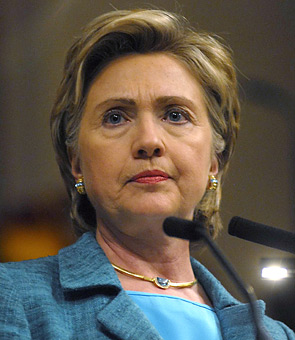
Hillary Clinton Threatens to Attack Iran ‘The Way That We Did’ Iraq

June 8, 2009
Secretary of State Says US or “Some Other Enemy” May Launch First Strike Against Iran

by Jason Ditz | Antiwar.com, June 8, 2009

Citing the disastrous 2003 US invasion of Iraq as an example, Secretary of State Hillary Clinton today warned that by continuing to refuse to abandon its civilian nuclear program, Iran was risking the possibility of an invasion by the US or “some other enemy that would do that to them.”

The comments came during an interview on ABC’s “This Week” program, and when asked by interviewer and former Clinton-era official George Stephanopoulus, Secretary Clinton reiterated “that’s right, as a first strike.”

The bulk of the interview emphasized US opposition to the Iranian program, along with unquestioned claims that the nation was pursuing nuclear weapons. Secretary Clinton also extended the American nuclear umbrella over Israel in the event that Iran attacked them.

Considering it was no more than 72 hours ago that President Obama made his historic call for a “new beginning” to US relations with the Muslim world, it seems incredible that his administration is already raising the prospect of an Iraq-style invasion of Iran.

Already six years in, the Iraq occupation has killed thousands of US soldiers, sucked trillions from the American economy, and is stretching the military to its limits. It is unfathomable that with this war still far from over, the Obama Administration is considering an Iraq redux in its larger neighbor to the east.

Words and War

June 8, 2009

by Norman Solomon | The Huffington Post, June  8, 2009

It takes at least tacit faith in massive violence to believe that after three decades of horrendous violence in Afghanistan, upping the violence there will improve the situation.

Despite the pronouncements from high Washington places that the problems of Afghanistan can’t be solved by military means, 90 percent of the spending for Afghanistan in the Obama administration’s current supplemental bill is military.

Often it seems that lofty words about war hopes are boilerplate efforts to make us feel better about an endless warfare state. Oratory and punditry laud the Pentagon’s fallen as noble victims of war, while enveloping its other victims in a haze of ambiguity or virtual nonexistence.

When last Sunday’s edition of the Washington Post printed the routine headline “Iraq War Deaths,” the newspaper meant American deaths — to Washington’s ultra-savvy, the deaths that really count. The only numbers and names under the headline were American.

Ask for whom the bell tolls. That’s the implicit message — from top journalists and politicians alike.

A few weeks ago, some prominent U.S. news stories did emerge about Pentagon air strikes that killed perhaps a hundred Afghan civilians. But much of the emphasis was that such deaths could undermine the U.S. war effort. The most powerful media lenses do not correct the myopia when Uncle Sam’s vision is impaired by solipsism and narcissism.

Words focus our attention. The official words and the media words — routinely, more or less the same words — are ostensibly about war, but they convey little about actual war at the same time that they boost it. Words are one thing, and war is another.

Yet words have potential to impede the wheels of war machinery. “And henceforth,” Albert Camus wrote, “the only honorable course will be to stake everything on a formidable gamble: that words are more powerful than munitions.”

A very different type of gamble is routinely underway at the centers of political power, where words are propaganda munitions. In Washington, the default preference is to gamble with the lives of other people, far away.

More than 40 years ago, Country Joe McDonald wrote a song (“An Untitled Protest”) about war fighters: who “pound their feet into the sand of shores they’ve never seen / Delegates from the western land to join the death machine.” Now, tens of thousands more of such delegates are on the way to Afghanistan.

In pseudo-savvy Washington, “appearance is reality.” Killing and maiming, fueled by appropriations and silence, are rendered as abstractions.

The deaths of people unaligned with the Pentagon are the most abstract of all. No wonder the Washington Post is still printing headlines like “Iraq War Deaths.” Why should Iraqis qualify for inclusion in Iraq war deaths?

There’s plenty more media invisibility and erasure ahead for Afghan people as the Pentagon ramps up its war effort in their country.

War thrives on abstractions that pass for reality.

There are facts about war in news media and in presidential speeches. For that matter, there are plenty of facts in the local phone book. How much do they tell you about the most important human realities?

Millions of words and factual data pour out of the Pentagon every day. Human truth is another matter.

My father, Morris Solomon, recently had his ninetieth birthday. He would be the first to tell you that his brain has lost a lot of capacity. He doesn’t recall nearly as many facts as he used to. But a couple of days ago, he told me: “I know what war is. It’s stupid. It’s ruining humanity.”

That’s not appearance. It’s reality.

Norman Solomon is a journalist, historian, and progressive activist. His book “War Made Easy: How Presidents and Pundits Keep Spinning Us to Death” has been adapted into a documentary film of the same name. His most recent book is “Made Love, Got War.” He is a national co-chair of the Healthcare NOT Warfare campaign. In California, he is co-chair of the Commission on a Green New Deal for the North Bay; www.GreenNewDeal.info.

As Obama Tries to Shift the Debate, Will Democrats Continue to Endorse Israel’s Colonization of the West Bank?

June 8, 2009

By Stephen Zunes, AlterNet. Posted June 6, 2009.

Obama has inherited a difficult challenge in pushing Israel to end the expansion of its illegal settlements in the occupied West Bank.

President Barack Obama has inherited a difficult challenge in pushing Israel to end the expansion of its illegal settlements in the occupied West Bank. With the right-wing Israeli government of Prime Minister Benjamin Netanyahu categorically rejecting the idea of a freeze and with Democratic-controlled Congress ruling out using the billions of dollars of U.S. military aid to Israel as leverage, the situation remains deadlocked.

Along with many Israelis and other supporters of Israel, Obama recognizes that these settlements are one of the chief obstacles to Israeli-Palestinian peace. Given that Israel cannot be secure unless the Palestinians are also given the right to a state of their own and that a viable Palestinian state cannot be created as long as Israel continues colonizing Palestinian land on the West Bank, Obama sees a settlement freeze as critical.

Continued >>