As long as the ruling elites of the United States are controlled by the Israeli political machine by its various devious machinations, Washington is hamstrung. It cannot make or follow any peace plan in Gaza in earnest by taking the legitimate political rights of its people there and in the West Bank or any other country in the region, including Iran.
In fact, whatever Israel has done in Gaza was carefully coordinated and planned by Israel and the United States. That happened under Biden and Blinken. Since Trump took power for his second term as president, the same policy of enmity and deceptive plays towards the people of Palestine and other countries of the region is in place.
All this is done is to further the expansion and hegemony of Israel, and thus strengthen the imperial stranglehold over the region and its resources. A few puppets in the Arab countries will willingly do as told by their masters.
By Al Mayadeen English
Source: Agencies
6 Dec 2025 14:37
4 Min Read
Hamas’s Khaled Meshaal urges rejection of normalization with “Israel,” defends resistance, and calls for Palestinian unity at a conference in Istanbul.
Speaking at the “Covenant to al-Quds: Towards Renewing the Nation’s Will in the Face of Genocide and Annihilation” conference held in Istanbul, Khaled Meshaal, head of Hamas’s diaspora office, emphasized the absolute rejection of all forms of normalization and ties with what he called the criminal Israeli entity.
He urged Arab and Islamic nations to hold firm against normalization, stressing that any engagement with “Israel” undermines the Palestinian cause and legitimizes occupation.
Meshaal reaffirmed the centrality of protecting the resistance project and its arms, declaring that the Resistance and its dignity are inseparable from the identity and will of the nation. He called for continued commitment to liberating prisoners and detainees held in occupation prisons, viewing their freedom as a collective responsibility.
The Hamas official stressed that victory for the Palestinian people cannot be achieved without unity and partnership, rejecting any monopolization of decision-making and national authority, asserting that the Palestinian people alone must govern themselves, free from external guardianship, whether in Gaza or the West Bank.
Meshaal warned of the growing threat of Judaization, settlement expansion, and forced displacement in the occupied West Bank. He described these policies as part of a broader effort by “Israel” to subjugate the region to its political and geographic agenda, including attempts to re-engineer Gaza’s territorial status.
He pointed to a “real and imminent danger” facing occupied al-Quds, al-Aqsa Mosque, and both Islamic and Christian holy sites across Palestine.
In a strong message to collaborators, Meshaal declared that “the fate that befell the agent Yasser Abu Shabab is the inevitable fate of anyone who betrays his people and his homeland.” The statement was a clear warning against collaboration with the occupation and a reaffirmation of the movement’s uncompromising stance on national loyalty. Escalations in West Bank, aggression against Gaza
Meshaal’s statement comes amid raids in the West Bank and ongoing aggression against the Gaza Strip.
Several Palestinian citizens were injured on Saturday during confrontations with Israeli occupation forces amid a wave of IOF raids across the occupied West Bank. Confrontations were particularly intense in Jenin, where local Resistance fighters responded to the Israeli incursion with explosive devices.
In Beit Ummar, north of al-Khalil, violent confrontations broke out following an incursion by the occupation forces. Press sources confirmed that the use of explosives by Resistance fighters during the confrontations, amid several reported injuries, with some of the wounded transferred to hospitals for treatment.
During the early hours of Saturday, the occupation forces detained four Palestinian citizens in the village of Nabi Saleh, northwest of Ramallah, during a pre-dawn raid. Simultaneously, occupation troops raided a commercial shop in the suburb of Iktaba, east of Tulkarm, amid a wider military operation in the area.
In Gaza, the Israeli occupation once again breached the ceasefire on Saturday, carrying out artillery bombardments, airstrikes, and live fire across several areas of the Strip.
Israeli artillery targeted areas east of Khan Younis, inside zones currently occupied by the IOF, while warplanes struck other locations on the city’s eastern outskirts. Aircraft and armored units opened fire northeast of the al-Bureij refugee camp in central Gaza, while helicopter fire was reported east of Khan Younis.
Al Mayadeen’s correspondent in Gaza reported that Israeli forces are pressing ahead with the demolition of remaining civilian homes behind the “Yellow Line,” highlighting that the Shuja’iyya neighborhood east of Gaza City has now been entirely razed by occupation forces over nearly two years of genocidal warfare.
Members of the International Committee of the Red Cross (ICRC) arrive at the site where Hamas militants are searching for the remains of hostages in Jabalia, northern Gaza Strip, December 1, 2025
ISRAEL said today that it will begin allowing Palestinians to leave Gaza through a reopened border crossing — but they would not be allowed to return.
This comes a day after aid groups revealed that at least 64,000 children have been killed or injured by Israeli attacks in Gaza since October 2023.
The decision by the Israelis is part of the so-called ceasefire deal reached with Hamas and the other Palestinian resistance groups, a deal Israeli forces are accused of violating with their continuing attacks on Palestinians.
The Gaza Health Ministry said that more than 360 Palestinians have been killed across Gaza since the ceasefire took effect on October 11. The ministry sets the total Palestinian death toll from Israeli attacks at over 70,100.
The statement about opening Rafah came from the Co-ordinator of Government Activities in the Territories (Cogat), the Israeli military body charged with facilitating aid to Gaza.
It said that Israel would co-ordinate with Egypt on the exit of Palestinians, under the supervision of a mission from the European Union. Those wishing to leave Gaza will require “Israeli security approval,” Cogat said.
The ceasefire deal calls for the crossing to be opened for medical evacuations and for travel to and from the strip.
But an Israeli source said that all Palestinians who want to exit Gaza will be able to exit through Rafah as long as Egypt agrees to receive them, but the crossing won’t be open for people wishing to return to Gaza.
The official said that the EU still had to make some adjustments to logistics before the crossing could open.
The crossing was sealed off in May 2024 when Israel’s military invaded the area. It was briefly opened in February this year for the evacuation of sick and wounded Palestinians for treatment, as part of the previous ceasefire deal.
The United Nations Children’s Fund, the Global Protection Cluster Network and the Child Protection Area of Responsibility warned that more than 64,000 Palestinian children have been killed or injured by Israel in the Gaza Strip since October 2023.
In a statement, the organisations reported 658,000 school dropouts due to the devastation caused by systematic Israeli aggression, which has left at least 70,000 people dead in Gaza.
The statement said that children “are exposed to relentless violence, repeated displacement and severe deprivation.”
The three aid groups warned that as a consequence of Israel’s attacks, more than 11,000 children have suffered serious injuries and require long-term rehabilitation and are in desperate need of mental health support.
It shouldn’t shock anyone, this long into both of their careers, to learn that Donald Trump and Benjamin Netanyahu are habitual liars. They lie, and they lie, and they lie, practically every time they make a public statement. There’s “no inflation” in Trump’s America, except there obviously is. Israel would never bomb a hospital on purpose, unless perhaps a “Hamas camera” was located there. The official stories grow more incredible by the day. So why, we might ask, do so many journalists and politicians still accept anything these men say at face value? And why are they acting as if a ceasefire and a peace process were happening in Gaza, when Israel’s bombing and killing is still raging on?
When he made his speech about the ceasefire to a summit in Sharm el-Sheikh, Egypt on October 13, Trump was his usual bombastic self. “Together, we’ve achieved what everybody said was impossible. At long last, we have peace in the Middle East[…] After years of suffering and bloodshed, the war in Gaza is over,” he said. And if you trust certain big media outlets, you might even think that’s true. In the Atlantic, we were told that Trump “has achieved a remarkable success and deserves full credit for it,” with his ceasefire marking “the first steps toward peace in Gaza.” The New York Times has consistently described a ceasefire which is “brittle” (October 14) or “very fragile” (October 24) but still essentially intact. The Bezos-owned Washington Posttouts the Trump administration’s “efforts to promote the success of the Gaza ceasefire deal.” The overall narrative is that, while there might still be a minor flare-up of tensions here and there, Trump’s diplomacy is working, and the war is over. Peace on earth, good will to all.
The trouble is, the “fire” hasn’t actually “ceased.” The truce exists mainly on paper and in sound bites. In the real, flesh-and-blood world, Israel violates it on a near-daily basis, conducting airstrikes, shootings, and other assaults on the people of Gaza much as it did before the agreement was signed. Only the scale and strategy of the violence has changed. From all-out genocide, Israeli leaders have shifted to a quieter, more sporadic series of attacks that they clearly hope will be ignored or excused by the Trump administration, along with others in the U.S. who have a vested interest in pretending a meaningful peace has been reached.
In fact, Al Jazeera reports that “Israel [has] violated the ceasefire agreement at least 497 times from October 10 to November 22,” including “attacks by air, artillery and direct shootings.” That’s an average of 11 violations per day. Experts at the United Nations have compiled slightly more modest numbers, reporting on November 24 that “Since the ceasefire was announced on 11 October, Israel has reportedly committed at least 393 violations, killing 339 Palestinians, including more than 70 children, and injuring over 871 others.” Whether you take the high or low estimate, the picture is the same: a continuous barrage of deadly assaults.
Particular incidents stand out from the list. The worst of them was the Israeli airstrikes on October 28, which killed 104 Palestinians in a single bombing run. These attacks came in retaliation for the death of a single IDF soldier who was reportedly killed by Hamas, which would be a ceasefire violation in itself. But in their typical form, the Israelis struck “homes, schools and residential blocks” indiscriminately, and the BBC reports that “46 children and 20 women” were among the dead—that is, more than 60 percent of the total casualties.
Even beyond direct attacks, Israel isn’t abiding by the terms of its agreement. The deliberate starvation hasn’t ended, as government officials in Gaza say that only around 200 trucks of food per day are being allowed through their borders, far short of the agreed-upon 600. As a result, malnutrition levels are still around 90 percent. Likewise, the latest UN report states that the IDF hasn’t actually withdrawn its forces from Gaza, with “40 active Israeli sites still operating beyond the agreed withdrawal line, in clear breach of the ceasefire terms.” Or, as Forensic Architecture puts it more bluntly, “nowhere in Gaza is safe.” The so-called “yellow line,” which ostensibly marks the point beyond which Israel has withdrawn, is in reality “unclear and contradictory,” with the line on the maps Israel releases not matching the line they actually occupy—and if Palestinians even venture near the line, even if they’re completely unarmed, they can be summarily shot and killed. Palestinians’ homes are still being demolished on a daily basis. In short, this “ceasefire” is not a ceasefire at all. The more accurate term would be a “reduction in fire,” or possibly a “temporary lull.” The ethnic cleansing and genocide is still ongoing, just by different means.
The really incredible thing, though, is that so many U.S. journalists seem determined to clap their hands over their eyes, like the “see no evil” monkey, and pretend there really is “peace in the Middle East.” No example is more blatant than that of the Associated Press, who keep saying that Israel’s various attacks are “tests” of the ceasefire. An airstrike that “targeted a vehicle, killing 11 and wounding over 20 Palestinians” was the “Gaza ceasefire’s latest test,” according to the AP. (The majority of the dead were children.) Earlier, they reported that “The Israeli army launched a barrage of attacks in Gaza” after a dispute with Hamas over the return of a dead hostage’s body, killing “at least seven Palestinians”—but, astonishingly, wrote in the same article that the “Fragile ceasefire holds so far despite tests.” On another occasion, “Israel’s intense bombardment of the Gaza Strip this week marked the most serious challenge yet for a fragile, U.S.-brokered ceasefire.”
I’m sorry, but that just isn’t what those words mean. You can’t have both a “ceasefire” and “intense bombardment,” because you are bombing and not ceasing. It’s like walking up to your friend, shooting them in the shoulder with a handgun, and saying it’s a “test of your friendship.” And of course, there’s the usual double standard: if it were Hamas that were constantly bombing and killing hundreds of Israelis, it would not be described euphemistically as a “test.” Then, reporters would suddenly be able to call it what it is: a clear-cut violation, whose perpetrators should be held accountable.
There are immediate, life-or-death consequences to this lying. In a grim article from November 21, the Guardian reports that charities dealing with humanitarian aid for Palestinians have seen a “catastrophic drop-off in donations” ever since the “ceasefire” was announced, with one organizer saying that “the world thinks Palestinians don’t need our help any more.” As a result, the aid groups are now struggling to get desperately-needed blankets and clothing to Gaza, which is entering a bitterly cold winter. The Gaza Soup Kitchen reports that donations have fallen by 51 percent. Because of the “ceasefire” narrative, people will starve. And this, of course, is the purpose of spreading the narrative to begin with: to draw the eyes of the world away from Gaza, tamp down the anger and urgency that fuels anti-genocide protests, and let Palestinians suffer and die in silence.
“It’s harmful and disingenuous for American media to continue the charade that there’s a ceasefire in place,” said Representative Joaquin Castro in a recent social media post. “There is no ceasefire. It’s a lie,” says Representative Rashida Tlaib. Exactly right. Trump and Netanyahu, the premier liars of the modern world, have simply lied again. The fire has not ceased, the food aid is not coming, and true peace is still a long way off. They can’t be allowed to get away with it. We’ve got to see through this false ceasefire, and renew the pressure on our leaders to actually end the violence. When Israeli soldiers kill Palestinian civilians under the guise of a truce, we can’t call it a “test,” shrug, and walk away. We need to demand the names and ID numbers of the commanders responsible, and put them on trial. We need to demand all the aid be let through, and make politicians’ lives hell until it is. The people of Gaza still need our solidarity, as much as they did when the war was officially on. For their sake, we can’t look away.
In one of the scariest moments in modern history, we're doing our best at ScheerPost to pierce the fog of lies that conceal it but we need some help to pay our writers and staff. Please consider a tax-deductible donation.
Italy is on general strike for the third time in less than three months, following a call by the grassroots union Unione Sindacale di Base (USB). Pickets, industrial actions, and demonstrations were organized in over 40 cities, with massive rallies demanding an end to rearmament plans and the war budget shaped by Giorgia Meloni’s government.
On Friday, workers stressed that their mobilization is tied both to worsening material conditions at home and to international events, specifically the struggle of the Palestinian people – whose fate, they insist, is inseparable from Europe’s expanding war economy. As a result, those striking today reiterated their commitment to join the national march for Palestine in Rome, taking place on Saturday, November 29.
“The Meloni government’s rearmament budget is in line with the warmongering policies pursued in recent years, but it also represents a further leap in quality, with public services being sacrificed on the altar of the war economy, all while inflation continues to rise and wages have been stagnant for decades,” USB and the dockworkers’ collective CALP wrote in one of the strike calls.
“We want at least €2,000 in base pay, retirement no later than 62, an end to subcontracting, reduced working hours with no loss of pay, guaranteed housing rights, new public-sector hiring, and free, universal public health care,” USB added. “These are urgent needs in an exhausted country, needs that are incompatible with the government’s warmongering.”
Italy’s social situation is “a political choice,” workers say
Like other European governments, Meloni’s administration has aligned itself with the European Union’s armament agenda. According to trade unions, this will mean billions for the military and related industries while essential public services fall apart. CALP described the new budget as one that freezes wages, ignores inflation, and prioritizes banks and capital gains. “While prices keep rising, salaries stay stagnant and pensions are cut every year,” the collective stated. “We work more, earn less, and live worse. This isn’t a crisis: it’s a political choice, and workers are the ones paying for it.”
Calls for the government’s dismissal could be heard across today’s actions, together with refusals to accept the shift toward militarization and military enrollment. Groups including left party Potere al Popolo and student collectives CAU and Cambiare Rotta marched with striking workers, blocking roads and picketing companies set to profit from military budgets while healthcare and education are left underfunded.
Messages of support arrived from abroad as well. UN Special Rapporteur Francesca Albanese and Freedom Flotilla participants Greta Thunberg and Thiago Ávila announced they would join the 28-29 November mobilizations in person. Artists including Roger Waters, as well as international trade unions and Palestine solidarity coalitions, expressed solidarity with the strike. “USB’s strikes have shed a bright light on the shameful complicity of the Italian government and Italian corporations in enabling Israel’s genocide, illegal occupation and apartheid against Palestinians,” the BDS National Committee wrote. “They have shown the power of the people and inspired many across the globe.”
In a letter to USB, the Galician Unions Confederacy (CIG) emphasized the strike’s relevance in the context of the EU’s ReArm Europe strategy and the rise of the far right. “We reject the policies promoted by the EU and its member states, which fuel a warmongering escalation and commit to increasing military budgets at the expense of public services and social support,” CIG stated. “And we are concerned about the fascist drift toward which Europe is heading, of which the Meloni government is a clear example.”
Unlike the general strike in October, in which the confederation CGIL joined USB’s call in a rare moment of unity, the call for today’s action came from grassroots unions alone, with CGIL planning its own strike in mid-December. This, however, did not diminish USB’s determination. “Calling the third general strike in just over two months is not a decision to be taken lightly or symbolically,” they wrote.
Instead, they reiterated that today’s strike was intended to table concrete demands and alternatives. The strike, USB added, should not be perceived as a one-off protest but as “an event that represents not only a stage of mobilization, but also a decisive political step to give a voice to those who can’t make ends meet, those working for starvation wages, and those watching their futures crushed by wars, inequality, and the choices of a government hostile to workers.”
Editor’s Note: At a moment when the once vaunted model of responsible journalism is overwhelmingly the play thing of self-serving billionaires and their corporate scribes, alternatives of integrity are desperately needed, and ScheerPost is one of them. Please support our independent journalism by contributing to our online donation platform, Network for Good, or send a check to our new PO Box. We can’t thank you enough, and promise to keep bringing you this kind of vital news.
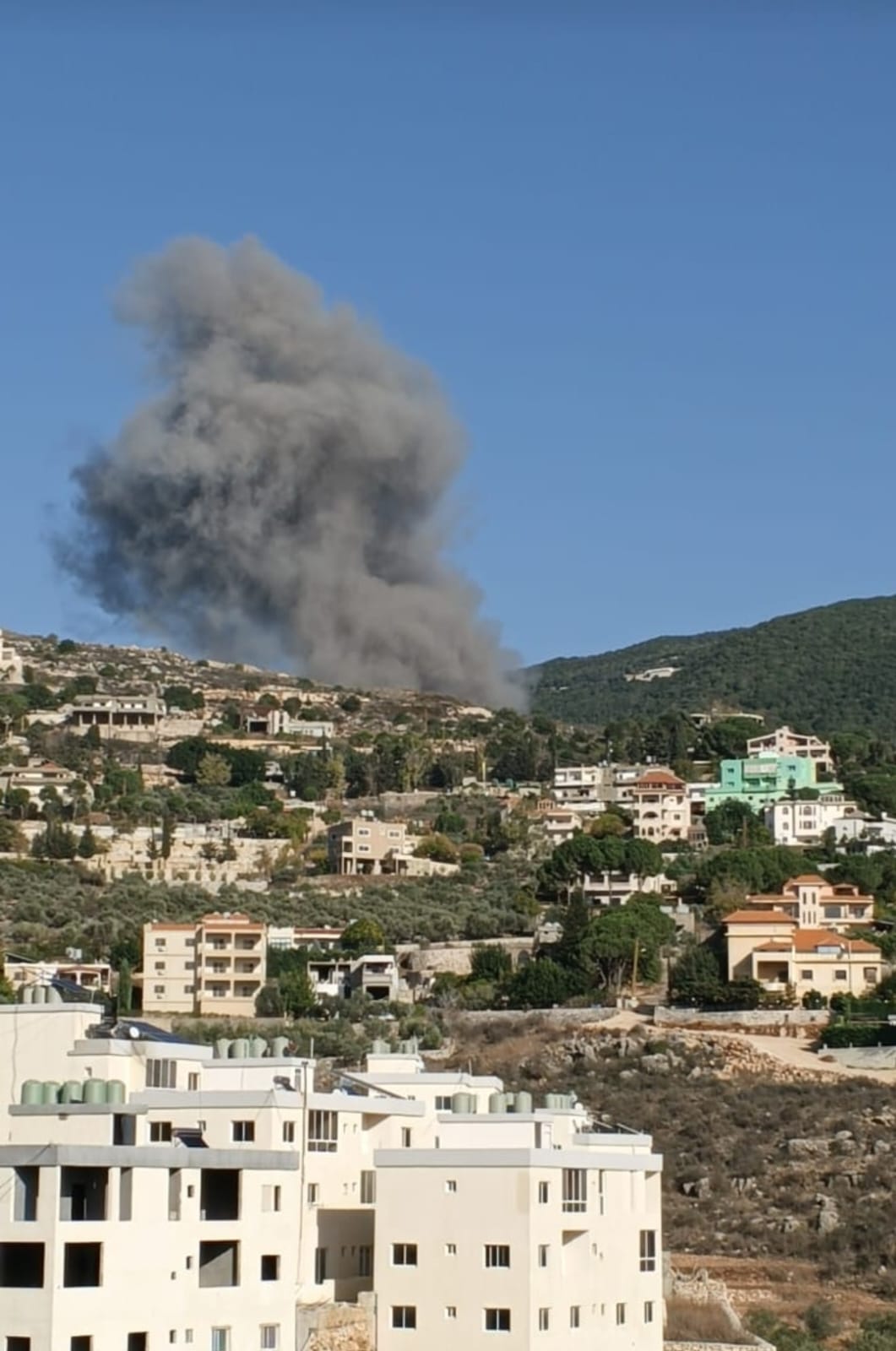
Israel continued with its attacks on southern Lebanon on Thursday. A year on from the ceasefire with Lebanon, the strikes show no signs of abating, and indeed come with persistent threats of further escalation by the Israeli military.
A series of strikes were reported against al-Mahmoudiyah and Jezzine, and there were also media reports of a strike near the village of Jarmaq, though no casualties have yet been confirmed.
The IDF claimed the strikes targeted weapons depots and terror infrastructure belonging to Hezbollah, though as usual they provided no evidence this was actually the case. Their statement added that the presence of the purported infrastructure violated the understandings of the ceasefire, ignoring as usual the literal thousands of IDF violations of the same ceasefire.
Smoke rises after Israeli strikes on the outskirts of al-Mahmoudiyah | Image from X
Israel carries out strikes against Lebanon almost daily, and officials have repeatedly threatened to escalate the conflict, with Israeli DM Israel Katz only yesterday suggesting that Israel might launch a “new” war against Lebanon soon.
This ultimatum is nothing new, and is effectively identical to one presented by Katz just a day prior, as well as statements made by US envoy Tom Barrack since September. The deadline is just as artificial, and just as unachievable as it was then.
The implication of a new Israeli war is a common talking point against Lebanon, though how big of a threat it is seen as is unclear, as Israel never really stopped attacking from the last war, so the distinction between an active war with Israel and an active ceasefire with Israel seems to be functionally very similar.
Jason Ditz is Senior Editor for Antiwar.com. He has 20 years of experience in foreign policy research and his work has appeared in The American Conservative, Responsible Statecraft, Forbes, Toronto Star, Minneapolis Star-Tribune, Providence Journal, Washington Times, and the Detroit Free Press.
Mr Trump, who likes to promote himself as a powerful MAGA leader, has been a sustainer and dedicated accomplice to the mass slaughters of Palestinians in Gaza and the destruction of the enclave since he took office this year. In addition, he has been and will always be an instrument in the hands of Israeli war machine.
We should keep in mind that he won’t be able to change the direction of his policy, either, because the reins of his Zio-chariot are firmly in the hands of Israel, AIPAC and his billionaire donors, who helped him to be in the White House for the second term.
Co-director of Al-Shabaka, the Palestinian Policy Network.Published On 24 Nov 202524 Nov 2025
Share
A child and a man injured in an Israeli army attack on the Nuseirat refugee camp await treatment at al-Awda Hospital, central Gaza Strip on November 22, 2025 [Moiz Salhi/Anadolu]
When on October 10, a “ceasefire” was declared in Gaza, many Palestinians breathed a sigh of relief. They had just endured two years of constant bombardment estimated to equal roughly six times the explosive force of the atomic bomb dropped on Hiroshima in 1945, concentrated on an area less than half the size of the Japanese city..
The devastation was all encompassing. All hospitals and universities had been bombed, most homes and schools destroyed and vital infrastructure, such as the sewage system and electricity lines, had been damaged beyond repair. An estimated 50 million tonnes of rubble was strewn across the strip and under it lay at least 10,000 bodies of Palestinians killed in bombardments who were yet to be recovered.
And yet, the respite the people of Gaza expected to finally come never materialised. Almost immediately after the “ceasefire” announcement, the Israeli regime started bombing the strip again. It hasn’t stopped since then.
According to Gaza’s Government Media Office, Israel has violated the “ceasefire” nearly 500 times in 44 days, killing 342 civilians. The deadliest day was on October 29 when the Israeli Occupation Forces (IOF) killed 109 Palestinians, including 52 children. More recently, on Thursday, 32 Palestinians were killed, including an entire family in the Zeitoun neighbourhood of Gaza City when a bomb was dropped on a building they were sheltering in.
But it is not just the bombardment that hasn’t stopped. The starvation hasn’t either.
As per the “ceasefire” agreement, 600 trucks of aid were supposed to be allowed in every day, which Israel has not fulfilled. As Al Jazeera’s correspondent Hind al-Khoudary has reported from Gaza, the IOF is permitting only 150 trucks a day to cross into the strip. They are also preventing the entry of nutritious foods, including meat, dairy and vegetables, as well as much-needed medicine, tents and other materials for shelter.
The United Nations agency for Palestinian refugees (UNRWA), which says it has enough food in its warehouses to feed everyone in Gaza for months, is still not allowed to bring in any of it. This is in direct contravention of an October advisory opinion by the International Court of Justice (ICJ) that the Israeli regime has a duty to not impede the supply of aid by UN agencies, including UNRWA.
The court also rejected Israeli accusations that the agency lacks neutrality and asserted that it is an indispensable actor in the humanitarian landscape. Nonetheless, the Israeli regime has rejected the advisory opinion and continues to limit UNRWA activities by preventing aid distribution and denying visas to its international staff.
The Israeli regime is also not abiding by the provisional measures that were laid out in an ICJ ruling in January 2024 that found that plausible acts of genocide were being committed in Gaza. These measures included preventing acts of genocide, preventing and punishing incitement to genocide and allowing humanitarian assistance into Gaza. Since then, the court has reaffirmed its provisional measures several times. The Israeli regime continues to ignore them.
And that is because on the international level, it continues to enjoy unprecedented diplomatic, financial and military cover. The latest iteration of that came on November 17 when the UN Security Council passed Resolution 2803, endorsing United States President Donald Trump’s 20-point plan for Gaza.
Among its provisions is the creation of two bodies that would take control of Gaza: the board of peace, chaired by Trump himself, and the international stabilisation force, tasked with maintaining security and enforcing the disarmament of Palestinian groups. The governing structure of both bodies remains unclear, but they would operate in coordination with the Israeli regime, effectively installing another layer of foreign control over the Palestinian people.
The resolution also allows for the bypassing of existing local and international structures in the distribution of aid. It makes no mention of the genocide and does not propose any mechanism for accountability for war crimes. Essentially, the resolution contravenes international law and gives the US – a co-perpetrator of genocide – control over Gaza.
All of this makes clear the fact that the “ceasefire” is not a ceasefire at all. The Israeli regime continues to attack Gaza, to starve the Palestinian population and to deny it access to proper shelter and healthcare.
Calling this arrangement a ceasefire allows third states to claim progress on conflict resolution and even peace when the core genocidal reality of the Palestinians on the ground remains largely unchanged. The “ceasefire” is a diplomatic sham – a cover for the continuing extermination, displacement and erasure of the Palestinian people in Gaza and a distraction for the international public and the media.
The views expressed in this article are the author’s own and do not necessarily reflect Al Jazeera’s editorial policy.
Yara HawariCo-director of Al-Shabaka, the Palestinian Policy Network.Yara Hawari is the co-director of Al-Shabaka, the Palestinian Policy Network. She previously served as the Palestine policy fellow and senior analyst. Yara completed her PhD in Middle East Politics at the University of Exeter, where she taught various undergraduate courses and continues to be an honorary research fellow. In addition to her academic work, which focused on indigenous studies and oral history, she is a frequent political commentator writing for various media outlets.
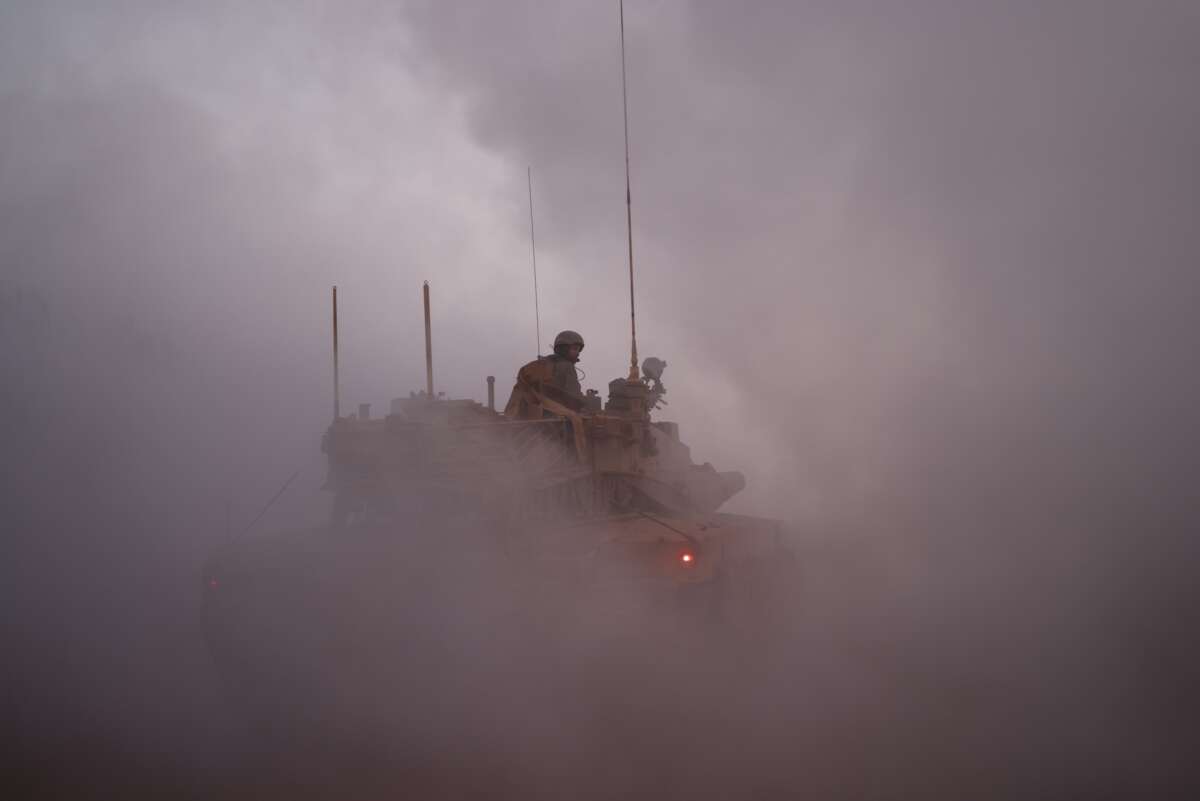
An Israeli soldier rides in the army Merkava main battle tank at a position in northern Israel along the border with southern Lebanon on November 6, 2025.
Support justice-driven, accurate and transparent news — make a quick donation to Truthout today!
Israeli forces used a munition widely banned for its impact on civilians amid their war in Lebanon, new reporting finds as Israel carries out new assaults in Lebanon despite the ceasefire agreement.
Photo evidence of Israeli munitions remnants from three different locations in southern Lebanon suggests that the weapons were cluster munitions, The Guardian reported Wednesday, citing half a dozen arms experts who examined the photos.
The evidence was found south of the Litani River, in Wadi Zibqin, Wadi Barghouz, and Wadi Deir Siryan, The Guardian found. The publication reports that this is the first evidence of such munitions being used in Lebanon since Israel first used them in its invasion of Lebanon in 2006.
They are especially dangerous as up to 40 percent of submunitions don’t explode on impact, leaving behind unexploded ordnance that could potentially harm civilians later if they come across them.
One strike killed 22 members of the same family, with three young boys surviving the attack. By Sharon Zhang , Truthout
April 24, 2025
These munitions can travel far and wide. ICRC has noted that “[t]heir small size, their use of parachutes and ribbons and other features mean that their descent is often affected by weather (wind, air density, etc.) and they may land far from the intended target. “
A 2008 treaty barring the use of the weapons has been signed by 123 states. Lebanon is party to the treaty, but Israel is not, nor is the United States.
Israel’s use of cluster bombs in the 2006 invasion was a major reason for the establishment of the treaty, but Israeli military authorities determined at the time that their use of the weapons was legal.
In recent years, human rights groups have raised alarm over Russian and Ukrainian forces’ extensive use of cluster munitions by both sides in their war, killing and injuring at least dozens of civilians. The U.S.’s widespread use of cluster bombs in its assault of Vietnam, Cambodia, and Laos represents a majorcontributor to the legacy of unexploded ordnance left behind by war.
In Lebanon, unexploded bombs from the 2006 invasion were still killing and maiming people years later. Israel dropped four million cluster munitions in the last days of the invasion, and UN officials estimated that up to 1 million of them didn’t explode.
The finding of the munition remnants comes as Israel is escalating its attacks on Lebanon, despite the ceasefire agreement signed nearly a year ago. Israel carried out a wave of air strikes on Tuesday and Wednesday. On Tuesday, Israel struck a Palestinian refugee camp in southern Lebanon, killing 13 people, Lebanese health officials said. These attacks come days after Israeli troops fired on UN peacekeepers stationed in southern Lebanon.
Lebanese officials are also filing a complaint to the UN Security Council over Israel’s construction of a concrete wall along Lebanon’s southern border. Officials say that it extends past the UN-established “blue line” that demarcates Lebanon from Israel and the Israeli-occupied Golan Heights.
On Monday, the UN Security Council voted to endorse the Trump administration’s “International Stabilization Force” in Gaza. Palestinians in Gaza say it is just a new face of the same Israeli occupation.
A general view of the extensive destruction in the Zeitoun neighborhood, southeast of Gaza City, on November 17, 2025. (Photo: Omar Ashtawy/APA Images)
The UN Security Council voted on Monday in favor of a U.S.-backed resolution establishing an “International Stabilization Force” (ISF) in Gaza under a “Board of Peace” headed by U.S. President Donald Trump.
Under a two-year mandate, the stabilization force is reportedly planned to have an “executive” role in Gaza, not just as a peacekeeping force. The ISF is being established under Chapter 7 of the UN Charter, which means it is being granted the authority to disarm Palestinian resistance factions, aligning with Israeli demands, and could be established unilaterally, without the approval of the Palestinians.
The UN Security Council resolution voted 13-0 in favor of the resolution, with two permanent members, Russia and China, abstaining from the vote.
Hamas rejected and condemned the resolution, asserting that it does not satisfy the rights of the Palestinian people and imposes an international system of “guardianship” over Gaza, something the Palestinian people and Palestinian factions reject.
The Palestinian Islamic Jihad also rejected the resolution, saying it amounts to a new Western “mandate” over Palestine.
In Gaza, local reactions to the UN vote varied, but very few viewed the development as hopeful.
Nader Qassem, one of the displaced in Gaza City, expressed his resentment over the resolution to Mondoweiss, pointing out that it is nothing more than a retrenchment of the Israeli occupation.
“Receiving the news was highly shocking to many families, including mine,” Qassem said. “After a long episode of suffering that has lasted through two years of death…after all this, we’re placed under international supervision?”
“It’s as if we are a people without a right to self-determination or the right to decide who protects us and manages our affairs,” he continued. “This is a disregard for our suffering in Gaza. The world is conspiring against us through international agreements that don’t serve the citizenry, helping out the occupier and its partners instead.”
Qassem adds that the ISF will not help preserve stability either. “This force will not be in a position to maintain security if it does not represent the Palestinians and if it does not result from a joint Palestinian process.”
“This force will increase the burdens of the Palestinian people and increase their suffering,” Qassem said.
“It’s as if we in Gaza have no opinion, no sovereignty over ourselves, not even a decision on who governs us,” Qassem continued.
Qassem also said that such decisions make Palestinians lose hope in reconstruction and returning to live in proper homes instead of tents. He also added that the vote makes it clear that the world is ignoring Palestinian rights and sovereignty when it gives guardianship to those who have no right to be in this land.
“These international forces,” Qassam explained, “belong to their countries and will not be closely connected to the Palestinians. They will not know the requirements of the Palestinian people and will not be able to provide them with safety or protection, because they do not know what the people of Gaza suffer or what they need. Whoever governs us must be from among us, aware of our suffering, so that they can solve these problems and provide us with a dignified life. These forces will not provide political, economic, or even social support to the population in Gaza.”
Others in Gaza agree that the stabilization force is a recipe for disaster. The minute it arrives in Gaza, it will be forced to engage in armed confrontations and start arresting people in Gaza, following Israeli recommendations. This will turn the international force into “a new occupation,” Gaza residents say.
Samir Al-Bakri, a resident of Gaza City, says that any force that is formed will be totally rejected by Palestinians so long as it isn’t formed through a Palestinian national consensus process.
Al-Bakri tells Mondoweiss that the international force will constitute a new occupation of the Strip. “Look at Lebanon. There is an international force operating in Lebanese territory, but does it prevent the daily shelling of Lebanon?” al-Bakri says. “No. Every day, we see Israeli shelling of Lebanese land and continual Israeli violations.”
“It is as if the mission of the international force coming to Gaza is to protect Israel’s borders from Palestinians without offering anything in return to us,” al-Bakri continued. “And it won’t even offer us any real protection either; it won’t prevent Israel from carrying out its military operations or aerial bombardments of Gaza. It may even help Israel achieve its goals.”
The greatest fear, according to al-Bakri, is the confrontation between Palestinians in Gaza and these international forces, and the emergence of new problems with the countries that send these forces—including Egypt and Qatar. “We fear that our disputes will become with Egypt instead of Israel, and with Qatar as well, and this is what they are trying to establish.”
“If the international force arrests one of my relatives, there will be no enemy to confront except this international force composed of Egyptians and Qataris,” he explained. “They will become our enemies instead of the Israelis. And this force will serve as a helping hand for the Israelis to achieve their objectives.”
“After all this suffering, the Palestinian people deserve a unified Palestinian force, of the people and for them, to manage their affairs,” al-Bakri added. “It is a renewal of the Israeli occupation. The UN is rewarding us with a new occupation.”

 Members of the International Committee of the Red Cross (ICRC) arrive at the site where Hamas militants are searching for the remains of hostages in Jabalia, northern Gaza Strip, December 1, 2025





 A general view of the extensive destruction in the Zeitoun neighborhood, southeast of Gaza City, on November 17, 2025. (Photo: Omar Ashtawy/APA Images)
 Peace and Justice Post
You must be logged in to post a comment.