|
Archive for the ‘Commentary’ Category
Pope ‘publicly distorted’ science in condom row
March 28, 2009

Number of Chronically Hungry Tops 1 Billion
March 28, 2009by Javier Blas | Financial Times, March 27, 2009
LONDON – The number of chronically hungry people has surpassed the 1bn mark for the first time as the economic crisis compounds the impact of high food prices, the United Nations’ top agriculture official has warned.
 A boy displays a placard during a feeding program inside a Catholic church in Manila March 27, 2009. Child advocates group, Akap-Bata Philippines (Hug a Child), in a statement said on Friday, disapproves the result of a recent survey released last Monday by Social Weather Stations (SWS), an independent pollster, stating that hunger situation in the country has eased from 23.7 percent to 15.5 percent from December 2008 till March 2009. Akap-Bata Philippines said that the outcome of the study is absurd especially in this time of deep domestic crisis. The placard reads “Social services not war; Food not bullets”. (REUTERS/Romeo Ranoco)
In an interview with the Financial Times, Jacques Diouf, director-general of the Food and Agriculture Organisation, warned that the increasing numbers of undernourished people could trigger political instability in developing countries.”The issue of world food security is an issue of peace and national security,” he said, urging world leaders who are discussing ways to resolve the economic crisis not to forget that last year more than 30 countries suffered food riots.
The Rome-based organisation estimated last year that about 960m people were chronically hungry in 2008. Mr Diouf said that had since risen and “unfortunately, we are already quoting a number of 1bn people on average for this year”.
Before the food crisis started in 2007, there were less than 850m chronically hungry people in the world, a level that has been roughly constant since the early 1990s owing to the global fight against poverty and countries such as China lifting their economic growth.
Mr Diouf’s assessment signals that the food and economic crisis have reversed the past quarter-century’s slow but constant decline in the proportion of undernourished people as a percentage of the developing world’s population.
The percentage fell from 20 per cent in 1990-92 to a low of just below 16 per cent in the 2003-05 period. But with 1bn people chronically hungry now, the percentage has risen to almost 18 per cent.
As a consequence, the FAO’s director-general proposed ditching the UN’s Millennium Development Goal of halving the number of the world’s undernourished by 2015 and replacing it with a target of “eradicating hunger by 2025”. He said to meet that aim, the world should learn from the mistakes of the 1990s, when investment in agriculture fell sharply, paving the way for the surge in food prices of the past two and a half years.
Mr Diouf is pressing world leaders for a summit in Rome in November to tackle the roots of food insecurity, rather than to continue reacting to every crisis with ad hoc measures. “The food crisis is not over,” he said, warning that although international benchmark prices for major agricultural commodities such as wheat, corn, rice and soyabean had fallen from last year’s peak, they remained almost 30 per cent above the 2005 level. He added that domestic prices in developing countries had not tracked the drop in international prices as their crops had been disappointing.
Now, he said, “the financial crisis is worsening the situation by increasing unemployment, limiting the credit for trading [agricultural commodities] and lowering remittances, which in poor countries were used to purchase food”.
“Combining all the elements we are in a very unstable situation,” he added.
At the proposed summit, Mr Diouf said that world leaders should commit to investing in agriculture, particularly in the developing world, as the rise in the world’s population from today’s 6.5bn people to 9bn by 2050 will mean the world needs to double its current food output.
He added that leaders also should agree to revive the FAO’s Committee on World Food Security, elevating it to ministerial level to “allow policy decisions [to] be made”.
Mr Diouf said that several heads of state and governments already back its idea of a summit in November to tackle the food problem. Previous summits, however, have yielded few policy results.
Palestinian Revolution?
March 26, 2009by Roane Carey | The Nation, March 26, 2009
On Friday I went to the anti-separation wall demo in Ni’lin in the West Bank, the same village where International Solidarity Movement activist Tristan Anderson was critically wounded last week. Several hundred villagers were accompanied by Jewish Israeli activists (most with Anarchists Against the Wall ) and ISMers, plus a few journalists like me. The IDF started firing tear gas at us even before we got close to the wall. The shebab (Palestinian youth) responded with stones, and the game was on: back and forth street battles, with the soldiers alternating between tear gas, rubber-coated steel bullets and occasional live ammunition, often fired by snipers, and the shebab hurling their stones by slingshot against the Israeli Goliath.
The IDF often fires tear gas now with a high-velocity rifle that can be lethal, especially when they fire it straight at you rather than pointed up in the air. Pointed straight, it comes at you like a bullet. That’s what seriously wounded Anderson. I saw these projectiles coming very near us, and saw how dangerous they could be. Not to mention the live ammo they occasionally fired–but they fired live rounds only at the shebab, never at the Jews or internationals. After a few hours, the clashes died down. Six were injured, one critically. Me, I just coughed and teared up from the gas on occasion. (In simultaneous demos in the nearby village of Bi’lin, three were injured, including two Americans.)
I mistakenly thought the army would be less aggressive on Friday, and not only because of the negative publicity surrounding the shooting of Anderson (the killing of Palestinians is of course routinely ignored in Western media; in Ni’lin alone, four villagers have been killed in the past eight months, with hundreds injured). The day before Friday’s march, revelations from Israeli veterans about war crimes they’d committed in the recent Gaza campaign made world headlines .
As villagers prepared yesterday’s march, Jonathan Pollock, a veteran activist with AATW, showed me where Anderson was standing when he was shot and where the IDF soldier was standing who shot him, just up the hill. The soldier had fired a high-velocity tear-gas canister at close range–what looked to me like about fifty or sixty meters–directly at Anderson, hitting him in the head. It was hard to imagine the intention could have been anything other than to seriously maim or kill.
The courage and steadfast resistance of the people of Ni’lin, and many other West Bank villages just like it that are fighting the wall’s illegal annexation of their land, is truly remarkable. Every week, for years now, West Bank Palestinians have stood up against the world’s fourth-most-powerful military machine, which shows no compunction about shooting unarmed demonstrators. This grassroots resistance–organized by the villagers themselves, not Fatah or Hamas–has gotten little publicity from the world media , which seem to prefer stories about Hamas rockets and the image of Palestinians as terrorists.
The village protests against the wall are inspiring, and not just because they’ve continued for so long, against such daunting odds. The villagers recognize the power and revolutionary potential of mass, unarmed resistance, and the shebab with their slingshots hearken back to the first intifada of the late 1980s and the “children of the stones,” when hundreds of thousands of men, women and children were directly involved in the struggle against the occupation. The Israeli government knows how difficult it is to suppress that kind of mass resistance, which is why it has used such brutality and provocation against the villagers. The army wants to shut this uprising down before it spreads, and would like nothing more than for the villagers to start using guns, as the IDF is certain to win a purely military confrontation. The other inspiration of this struggle is the courage and solidarity of the Israeli and ISM activists. They risk their lives day after day, and the villagers appreciate it. I saw signs in Ni’lin praising Tristan Anderson, who, just like Rachel Corrie six years ago, was willing to sacrifice his life for Palestinian justice.
Istanbul statement backs Hamas and sets out ‘obligations’ to the people of Gaza
March 25, 2009- The Guardian, UK, Wednesday 25 March 2009
The Istanbul statement claims God has granted victory to Gazans over their “Zionist Jewish occupiers”. But it also complains of an “international and local conspiracy” against Gaza, implicating Palestine leaders in the West Bank and accusing the Egyptian government of treason (though without mentioning it by name). The statement then sets out eight “obligations” for the Muslim community – “its religious scholars, its rulers and its peoples”:
• To aid the people of Gaza in rebuilding “what the Zionist aggression destroyed”; to compensate the injured and support widows and orphans.
• In the delivery of aid and reconstruction, to deal only with Hamas.
• Not to recognise the Palestinian Authority as representative of the Palestinian people.
• To withhold aid from the undeserving or untrustworthy and to punish those who cause “mayhem, negligence and waste” of funds.
• To find a fair formula for reconciliation “between the sons of the Palestinian people” (ie Fatah and Hamas), so as to establish a legitimate authority that will “carry on with jihad and resistance against the occupier until the liberation of all Palestine”.
• To open all crossings in and out of Palestine, giving the Palestinians access to “money, clothing, food, medicine, weapons and other essentials”.
• To regard all those who contribute substantially to the “crimes and brutality” of Israel in the same way as Israel itself.
• To reject and “fight by all means” the sending of foreign warships into Muslim waters on the basis of “claiming to control the borders and prevent the smuggling of arms to Gaza”.
U.N. reports say Israel targeted civilians in Gaza
March 24, 2009- Reports say child used as human shield
- Right to food, health violated, report says
- Report also cites Hamas violations
By Robert Evans | Reuters, March 23, 2009
GENEVA, March 23 (Reuters) – United Nations investigators said on Monday Israel violated a range of human rights during its invasion of Gaza, including targeting civilians and using a child as a human shield.
The accusations came in reports to the U.N. Human Rights Council which also called for an urgent end to Israeli restrictions on humanitarian supplies to Gaza and a full international investigation into the conflict.
“Civilian targets, particularly homes and their occupants, appear to have taken the brunt of the attacks, but schools and medical facilities have also been hit,” said one report by Radhika Coomaraswamy, the U.N. Secretary-General’s Special Representative for Children and Armed Conflict.
The Sri Lankan human rights lawyer visited the region in early February. She cited a long series of incidents to back her charges.
In one, she said, Israeli soldiers shot a father after ordering him out of his house and then opened fire into the room where the rest of the family was sheltering, wounding the mother and three brothers and killing a fourth.
In another, on January 15, at Tal al Hawa south-west of Gaza City, Israeli soldiers forced an 11-year-old boy to walk in front of them for several hours as they moved through the town, even after they had been shot at.
An Israeli commander in the 22-day Gaza invasion said on Monday Israel’s efforts to protect troops from Palestinian fire may have contributed to unwarranted killing of civilians.
“If you want to know whether I think that in doing so we killed innocents, the answer is, unequivocally, yes,” Tzvika Fogel, a reserve brigadier-general, told Reuters. Fogel added that such incidents were exceptional.
ISRAEL CRITICISES REPORT
Coomaraswamy’s comments formed part of a much longer report from nine U.N. investigators including specialists on the right to health, to food, to adequate housing and education and on summary executions and violence against women.
All cited violations by Israel — and in some cases by the Hamas Islamic movement that controls Gaza — during the invasion from December 27 until January 17 which Israeli leaders say was launched to stop rocket attacks by Hamas from the territory.
Palestinian officials say 1,434 people in Gaza — 960 of them civilians — were killed in the fighting, a figure Israel contests. The report from the nine gave the total as 1,440, saying of these 431 were children and 114 women.
The overall report was criticised in the 47-nation Council by Israel’s ambassador Aharon Leshno Yar, who said it “wilfully ignores and downplays the terrorist and other threats we face,” and the use by Hamas of human shields.
Leshno Yar said the 43-page document was part of a pattern of “demonising Israel” in the Council — where an informal bloc of Islamic and African nations usually backed by Russia, China and Cuba has a built-in majority.
Another report presented to the Council on Monday came from Robert Falk, a U.S. academic and the body’s special rapporteur on human rights in the occupied Palestinian territories.
Falk, whom Israel barred from entry last year after accusing him of bias and prejudice, said Israel had subjected civilians in Gaza to “an inhuman form of warfare that kills, maims and inflicts mental harm.”
His report, in which he called for an independent experts group to probe possible war crimes by Israel and Hamas and also suggested that the U.N. Security Council set up an ad hoc criminal tribunal, was issued late last week. (Editing by Dominic Evans)
Israel has a case to answer
March 24, 2009The Guardian, UK, Tuesday 24 March 2009
Evidence that Israel committed war crimes in its 23-day operation in Gaza mounts by the week. Amnesty and Human Rights Watch have both appealed for a United Nations inquiry, after conducting their own investigations. Last week Ha’aretz published the testimonies of Israeli soldiers who alleged that a sniper shot a Palestinian mother and her two children, and that a company commander ordered an elderly woman to be killed. Yesterday Physicians for Human Rights accused soldiers of ignoring the special protection that Palestinian medical teams are entitled to receive. Today the Guardian releases three films in which our reporter Clancy Chassay reveals evidence that Israel used drones to fire at civilian targets, killing at least 48; he interviews three Palestinian youths used by Israeli soldiers as human shields and alleges that soldiers targeted paramedics and hospitals.
None of this is to deny that a case also exists against Hamas and other militant groups in Gaza. Firing unaimable rockets at civilians in southern Israel is also a war crime. But there is no symmetry of guilt. Israel has weapons it can place to within a metre of its intended targets. Its drones have high-quality optics that can see the colour of the target’s sweater. And they film everything both before and after each attack. The army has the means to refute these allegations, but feels no obligation to do so. An international inquiry should be launched for no other reason than to hold it accountable.
Israel has not got a history of co-operating with international inquiries into the actions of its army, but it has reacted twice to domestic allegations. It admitted that one of its tanks fired two shells at the apartment of a Hebrew-speaking Palestinian doctor whose three daughters were killed and whose grief touched the nation, but it concluded that the action was “reasonable”. The Ha’aretz material prompted a criminal inquiry by the military advocate, and two unusual statements by the outgoing defence minister, Ehud Barak, and the chief of staff, General Gabi Ashkenazi, each of whom praised the “moral” actions of the army. The prospects of a full international investigation of these allegations are mixed. The international criminal court has received more than 220 complaints from the Palestinian National Authority, the Arab League and the Palestinian justice minister. But whether the court has jurisdiction is another matter.
If the ICC route fails, there is always the UN, whose schools and stores found themselves in the line of fire. The secretary general, Ban Ki-moon, will this week receive the results of a private board of inquiry. This is narrow in scope, only examining incidents at UN facilities. But what happened there was bad enough, including the use of white phosphorus shells.
There are five reasons why we should have an international inquiry into the Israeli assault on Gaza. First, the conflict has not gone away. It could reignite at any moment under a prime minister, Binyamin Netanyahu, who is determined to finish the job. Second, the weight of evidence points not to isolated incidents, but to a new and deadly relaxation of the rules of engagement. This emerges from the soldiers’ own testimony in Ha’aretz. “That’s what is so nice, supposedly, about Gaza,” one soldier said. “You see a person on a road … He doesn’t have to be with a weapon. You don’t have to identify him with anything. You can just shoot him.” Gaza was fought to a certain mood music. It suggested that the lives of Palestinian civilians did not matter when weighed against those of Israeli soldiers. Third, Israel is not immune to international opinion. A narrow rightwing coalition under Mr Netanyahu will be sensitive to criticism from Barack Obama, who has yet to reveal his cards. Fourth, what Israel does or is allowed to get away with doing affects attempts to establish the rule of international law in other conflicts. Fifth, we know what doing nothing leads to: another war, and ultimately a third intifada.
Iraq’s most ancient sect in need of protection to escape extinction
March 22, 2009
By Kareem Zair, Azzaman
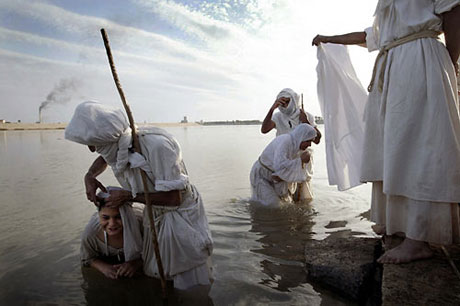 |
uruknet.info, March 21, 2009 One of Iraq’s most ancient sects is on its way to become extinct after nearly 2,000 years of existence. The Mandeans, the world’s only surviving representatives of Gnosticism, have been living in southern Iraq since the 1st century A.D. But their existence is under serious threat. Prior to the U.S. invasion, more than 30,000 lived in Iraq, mainly along the banks of the Tigris and Euphrates rivers and their tributaries. “We fear for our lives particularly following several fatwas in which we are denied the status of the People of the Book,” said Sheikh Sattar al-Hilou, the Mandeans’ chief in Iraq. The term ‘the People of the Book’ refers to non-Muslims who have been accorded special protection under Islamic Jurisprudence. The Koran calls them Ahl al-Kitab, a term, which besides Christians and Jews has historically covered the Mandeans. Religious militias are using these fatwas, or religious decrees, against the Mandeans to force them to enter Islam, Hilou said. He said he was not aware of anyone of his people converting to Islam despite threats of death. “As a result more than 22,000 of my community have fled the country,” he added. He warned the Mandeans would cease to exist as the country’s most ancient sect if the government fails to protect them. The Mandeans are called in Iraq Subbas and for centuries they have been Iraq’s best goldsmiths and canoe makers. They are strongly pacifist and are not known to have ever resorted to violence. Former leader Saddam Hussein was very fond of the sect and had constructed a modern shrine for the Mandeans on the banks of the Tigris River in Baghdad. The sect’s rituals, all of great antiquity, cannot be performed without flowing water, hence their preference to live close to rivers and streams. Hilou said he believed less than 8,000 Mandeans were still living in Iraq and most of them away from their ancestral habitat. The Mandeans have extensive religious literature. Most important are their Ginza Raba (Great Treasure) and Drasha ed Yahia (Book of John). John the Baptist is their most revered saint and they date their religion to him but historians believe their faith is of much older antiquity.
|
The Forked-Tongue Eunuchs and Israel
March 22, 2009By Rami G. Khouri | Information Clearing House, March 21, 2009
If rhetoric is the first step toward action, then one of the rhetorical trends of our time indicating a giant step backward toward inaction is the American and European tendency to describe Israel’s aggressive and illegal actions in the occupied Palestinian territories in increasingly soft and imprecise terms.
For years, US administrations called Israeli settlements “illegal” and an “obstacle to peace,” but in recent years those terms have been replaced by a mere “unhelpful.” On her first official trip to the region earlier this month, Secretary of State Hilary Clinton referred to the Israeli demolition of Palestinian Arab homes in East Jerusalem as “unhelpful.” Earlier this week, the European Union presidency said that Israel’s demolition of homes in the Silwan neighborhood of Jerusalem “threatens the viability of a comprehensive, just and lasting settlement, in conformity with international law.”
If I were the Israeli government, I would be laughing all the way to my next colonial adventure in destroying Palestinian homes and infrastructure, uprooting Palestinian Arabs and replacing them with imported settlers from Israel, or Brooklyn, or Russia, or from wherever the world’s longest running modern colonization venture gets its human ammunition and reinforcements.
It is bad enough when two of the world’s powerhouses pull back from their previous positions of branding Israel’s contraventions of international law and United Nations resolutions as illegal and impermissible and instead call them “unhelpful” or just a threat to a lasting settlement. It is infinitely worse when the United States and the European Union, who spend half their waking hours trying to spread democracy and the rule of law to the rest of the world, end up watering down Israeli contraventions of international law so that Israel spends half its waking hours laughing at every American and European official in sight.
The rhetorical downgrading of Israel’s criminality is a problem (assuming it is still okay to use the word criminality to describe undermining the law). That, at least, is what my British and American teachers in primary and high school taught me when I learned English: Use the precise, accurate word when you have it at hand, and do not beat around the bush. Clarity is good for communication.
The first problem with Western obsequiousness to Israel is that it perpetuates the Zionist colonial enterprise in a manner that is harmful to all concerned, including Israelis, Palestinians and Westerners who end up being sucked into our maelstrom of violence. The second problem is that it helps to disqualify the US and EU and others who share their position – such as the UN, increasingly – from playing the role of an active, credible mediator. Arabs and Israelis cannot solve their conflict on their own, and mediation by the Turks or Egyptians can only move things forward so much. A permanent, comprehensive negotiated peace agreement requires intensive American and European involvement in negotiations, consummating an agreement, peace-keeping, and promoting post-peace economic growth. This is impossible if the US and EU have no credibility.
A third problem with the cowardice of sheltering in the safe world of “unhelpful” rather than “illegal and impermissible,” is that those Western powers that choose this route send a terrible message: They deny and ignore the rule of law when it comes to more than four decades of Israeli actions, but enthusiastically promote it when it comes to their aspirations to transform the Arab and Islamic world. A little bit of hypocrisy is standard fare for politicians; but when this becomes elevated to the level of official policy that transcends administrations, decades and generations, it enters the realm of the pathological.
Great powers and noble organizations that disrespect their own rules are not so great in the eyes of a bewildered world that thought that decolonization concluded about half a century ago, but wakes up every morning to find itself the continuing victim of new forms of criminal colonization – in the form of Zionist-Israeli settlers, or Western diplomats whose tongues are so forked they often resemble rattlesnakes walking on two feet.
Colonialism is either legal or illegal, acceptable or criminal. Laws matter or they don’t matter. There is no such thing as “unhelpful” colonialism, any more than there is merely naughty rape, awkward murder, or unfortunate incest. Why is it that those in the West who celebrate and seek to export their commitment to the rule of law find it so hard to adopt both the rhetoric and policies that acknowledge the criminal illegality and political catastrophe that is the modern and continuing Israeli colonial rampage? What is it that makes giants in the West become eunuchs in the face of Israeli deeds?
Rami G. Khouri is published twice-weekly by THE DAILY STAR.


Taking Off the Blinders in the U.S.
March 28, 2009By A.M. Khan | ZNet, March 28. 2009
A.M. Khan’s ZSpace Page
“There has been anti-Semitism, the Nazis, Hitler, Auschwitz but was that their [the Palestinians] fault? They only see one thing: We have come here and stolen their country.”
–David Ben-Gurion, one of the founders of Israel and the first Prime Minister
Now that Israel’s bombardment of Gaza is off the front page and the Gazans are left to deal with the aftermath outside of world media attention, it makes sense to step back and review how the Israel-Palestine conflict is depicted in U.S. mainstream media. This depiction shapes how the U.S. public views the recent events in Gaza. It also shapes how the public understands what constitutes a just resolution to the conflict.
The nature of U.S. mainstream media coverage of events in Gaza and of the Israel-Palestine conflict renders Americans grossly misinformed. U.S. media representations are largely absent of historical context and omit the fact that for decades Israel has committed human rights violations against the Palestinian people and occupied their land. The media lens in mainstream U.S. coverage (print and television) obscures core issues and creates a false framework of the conflict. In the U.S., the Israel-Palestine conflict is framed as “a cycle of violence” between two adversaries of equal power engaged since millennia in a conflict based on religious and ethnic difference. Not a single element of this frame is true.
Myth Number 1: The conflict has been ongoing since millennia.
The conflict is less than 100 years old. Before 1900, Jews, Christians, and Muslims lived together in the Holy Land mostly peacefully in a quiet agrarian society. While some European Jews immigrated in the late 1800’s to what was then Ottoman Empire-controlled Palestine, their numbers were small. In 1917, as World War I was coming to a close, the British government became the colonial power in control of historic Palestine (the area known today as Israel, the West Bank, and the Gaza Strip). With the 1917 “Balfour Declaration” the British made clear their support for a Jewish state in Palestine. After 1917, immigration of European Jews to Palestine escalated, increasing each year as time wore on. Many of these new immigrants were in flight from anti-Semitism in Europe.
As the Nazis came to power in Germany in the early 1930’s and began their oppression and later genocide of European Jews, the numbers of European Jewish immigrants to Palestine increased dramatically. Through these early decades of the 20th century, between the British commitment to creating a Jewish state in Palestine and as more European Jews flooded in, tensions between the European newcomers and the native Palestinian Arabs began and increased over time. After the genocide and near annihilation of European Jewry by the Nazis during World War II, the movement to make a Jewish homeland in Historic Palestine found understandable sympathy. The fly in the ointment was the fact that another people already lived in that land.
In 1948 the state of Israel was established by these European Jewish immigrants, adherents of an ideology called “Zionism.” There were different opinions among Zionist leaders as to how to deal with the native Palestinian Arabs. Some advocated peaceful co-existence and others advocated dispossession and expulsion. There were also positions in between. In the end, the more regressive positions prevailed. In their writings, Zionist leaders like David Ben-Gurion, the first Prime Minister of Israel, were explicit and unapologetic about their aim to expel the native Palestinian Arabs and take their land.
The 1948 nation building of Israel was premised on dispossession of the natives, including a premeditated campaign of ethnic cleansing and massacre. In 1948, Zionist military forces expelled about 750,000 Palestinians from 78% of Historic Palestine into the West Bank, Gaza Strip, and exile abroad. After statehood, these Zionist forces became the Israeli army. In 1967, again through military means, Israel took control of the remaining 22% of historic Palestine (i.e., the West Bank and Gaza Strip). The Palestinians driven into the West Bank and Gaza Strip in 1948 (as well as those already there) came under Israeli military occupation in 1967, where they remain today 41 years later. Thus, in 1948 Israel proper was created on 78% of historic Palestine and since 1967 Israel has occupied the remaining 22% of historic Palestine.
Myth Number 2: The conflict is a cycle of violence between adversaries of similar power
The Israel-Palestine conflict is between two parties vastly unequal in power. Israel, the nuclear-armed occupier, has the fourth most powerful army in the world and cutting edge military weaponry. The Palestinians, an occupied and stateless people, are largely unarmed. The Palestinians have no army, no air force, no planes, no tanks, no gunships, and no nuclear weapons. This is why we see pictures of Palestinians throwing stones at tanks. If you possessed anything more powerful, would a stone really be your weapon of choice against a tank?
Myth Number 3: The conflict is based on religious and ethnic differences
The Israel-Palestine conflict is about possession and control of a small piece of land approximately the size of New Jersey. Israel believes itself entitled to all of the land because in the Bible God promised all of historic Palestine to the Jews. Since 1967, in violation of international law, Israel has moved 500,000 of its citizens into the West Bank. These settlers are connected to Israel through Israeli-only roads that crisscross the West Bank. West Bank Palestinians are not allowed to use these roads and must take circuitous routes on older roads in order to go around Israeli settlements, often adding hours to their journeys.
Regarding the “peace process,” Israel’s talk of making peace has been a rhetorical screen. Behind this screen each and every Israeli government since 1967,whether its flavor was left, right, or center, has continued the campaign begun in 1948, of land grab, human rights violations, and imprisonment of the Palestinians into multiple separate enclaves within the Occupied Territories of the West Bank and Gaza Strip. Since 1967 every Israeli government has continued a national construction project (based on a plan created in the late 1960’s by Labor Minister Yigal Allon)to separate, isolate, and enclose every Palestinian city and most towns and villages by surrounding them with Israeli settlements. Today, that project is essentially complete. In addition to the settlement building, Israel’s construction of the Wall (86% of which is in the West Bank rather than along the 1967 border) and ongoing annexation of land and water resources have created facts on the ground establishing Israel’s dominance over all of historic Palestine. Today, Israel’s mission of total dominance is near completion.
In 1988, the Palestine Liberation Organization (as representative of the Palestinian people) agreed to recognize Israel, forego claim to 100% of historic Palestine, and accept a nation on 22% of their original land (i.e., on the West Bank and Gaza Strip). Israel has never agreed to this. Israel has made clear that it wants a future Palestinian state to be a version of 80% of 22% of 100%. Such a “state” would be a non-contiguous series of disconnected cantons. Israel’s Wall cuts deep into the West Bank and incorporates into Israel West Bank settlements and aquifers. This is the desert after all, and water is treasure. The Wall and settlements segment the West Bank and make a contiguous Palestinian state unlikely, if not impossible. Israel also wants control over exit and entry from that 80% of 22% of 100%. An analogy for this: imagine that in each of the rooms of your house you can do as you wish but that someone with guns controls all the hallways between the rooms. Is this a viable structure for life?
What holds all this in place and allows it to continue is that Israel has the multibillion dollar per year financial support and diplomatic cover of the most powerful nation in history, the United States. The U.S. has agreed to provide Israel with $30 billion dollars in military aid over the next 10 years and has provided billions upon billions of dollars in aid to Israel in the past. For decades, Israel has been the largest recipient of U.S. foreign aid and receives one-third of the total U.S. foreign aid budget. The U.S., a veto-wielding member of the United Nations Security Council, has also vetoed each and every resolution put forward by the United Nations in response to Israel’s multiple violations of international law. In each of the U.N. votes on these resolutions against Israeli government actions, year after year, the U.S. and Israel (and a few small Pacific Island nations) stand alone against the rest of the international community in siding with Israel against international law and world opinion.
All of the facts above are available from easily accessible public sources. The facts are not in dispute. However, they have been obscured by a web of misinformation that hides the truth. Because the facts are what they are, when Israel is criticized, its proponents, who cannot rely on facts to support their cause, resort to personal attacks and charges of “anti-Semitism.” Their charges of anti-Semitism presuppose that all criticism of Israel as a state actor and all efforts to hold Israel, which is after all a nation state like any other, accountable for its actions are inherently anti-Semitic. When the truth cannot be bent to their narrative, proponents of Israeli government actions, no matter what those actions are, resort to the cudgel of anti-Semitism to silence and censor criticism of the actions of the state of Israel. So far, this method of silencing critics has proven highly effective in the U.S. Publicly criticizing Israel has cost academics their jobs and members of congress political office. These examples keep the rest of us in line as well.
Decades of misinformation and a mythical story (i.e., a land without a people for a people without a land), as well as the daily falsehoods we continue to be fed, can make the situation in Israel-Palestine seem more murky, complicated, and relativistic than it actually is.
When the American colonists were dispossessing the Native Americans, there was violent resistance. A people being dispossessed will resist. They resist because of their dispossession (not because they are crazy, evil, or filled with hate because of their religion). And, of course, violent native resistance hurts the occupier and harms innocents. However, when the occupier casts itself as the victim and says it is acting only in “self-defense” against native “attack”, it has turned logic on its head. Israel’s propaganda campaign over the last 41 years, casting itself as the only and perpetual victim, has been extremely successful in making this bizarre topsy-turvy spin seem logical and correct. It is yet another example of the effectiveness of saying the same thing over and over again until people start believing it is true.
There are many situations in history where two opposing perspectives are not of equal moral weight. The colonial campaign China continues in Tibet, the former British Empire’s actions around the globe, the apartheid system in South Africa, Belgium’s enslavement and killing of 10 million Congolese for natural resources, the genocide of the Jews by the Nazis, the genocide of the Armenians by Turkey all come to mind. The moral equation in Israel-Palestine is as simple and clear.
While discussion of U.S. national interest and geopolitical strategy take up much space in newspapers and conversation among the pundit class, the dimension of morality, the concern with doing the right thing, rarely enters our public discourse. In the end, the situation in the Occupied Territories of Gaza and the West Bank calls on our moral sense. It calls on our humanity, compassion, and sense of fairness. Our silence and complicity in Israel’s dispossession of the Palestinians and its ongoing human rights abuses over decades is a moral lapse of huge proportion.
Americans have a larger stake in this issue than citizens of other countries because we foot the bill to the tune of $8 million a day in aid to Israel. All of us who pay U.S. income taxes funded the recent atrocities in Gaza. We paid to drop white phosphorus on civilians. We paid to level homes, clinics, and schools. We paid to kill children and whole families as they slept in their beds. We are complicit in the bloodbath in Gaza. We are complicit in children starving to death laying next to their dead mothers buried in rubble as the International Red Cross documented in Gaza. We fund acts of state terror in which people watch their beloved daughter, son, father, mother be literally torn apart. We pay for a military machine that maims, kills, and holds captive an unarmed civilian population of men, women, and children, enclosing them in prison-like cantons within the West Bank and Gaza. For decades, we have been paying for the slow annihilation of a society and people who have done absolutely nothing to us.
So what can we do as individual citizens? Call your congresspeople to demand an even-handed U.S. policy in Israel-Palestine. Call the Obama White House to do the same. Learn about the growing Boycott, Divestment, Sanctions campaign against Israel (modeled on the anti-apartheid campaign against South Africa). Don’t buy Israeli products. Tell your local grocer you won’t shop there until they stop carrying Israeli products. Educate your neighbor. Educate yourself. Watch the documentary film “Occupation 101.” Read “The Ethnic Cleansing of Palestine” by Israeli historian Ilan Pappe. Read the writings of Palestinian intellectuals Edward Said and Rashid Khalidi. Go to www.endtheoccupation.org to find a political group in your area working for justice in Israel-Palestine. Most of all, do something. Do not be silent. Do not be complicit.
A.M. Khan is an Indian American psychologist by day and an activist and beginning documentary filmmaker by night. She welcomes correspondence on her work and can reached at: amkhan601@gmail.com.
Share this:
Tags:anti-Semitism, Gaza, human rights violations, Israel, Israel-Palestine conflict, myths, Palestine, U.S. mainstream media, Zionist military forces
Posted in Commentary, Human rights, Palestine, USA, warmongers, Zionist Israel | Leave a Comment »