Archive for the ‘Commentary’ Category

Israel scuppers UN war crimes probe

June 10, 2009

Morning Star Online, Tuesday 09 June 2009

Some 1,400 Palestinians were killed in the Israeli assault on Gaza, most of them civilians

Some 1,400 Palestinians were killed in the Israeli assault on Gaza, most of them civilians

The UN war crimes probe into Israel’s assault on Gaza is likely to be scuppered by Tel Aviv’s refusal to co-operate, the chief investigator has admitted.

Judge Richard Goldstone (pictured), who led a UN fact-finding team to Israel and Gaza, said the investigation was unlikely to lead to prosecutions.

Israel has refused to co-operate, depriving Mr Goldstone’s team of access to military sources.

The chief barrier remains the lack of a court with clear jurisdiction to hear any resulting cases stemming from the investigation into Israel’s bloody three-week onslaught on Gaza which ended in January.

And Hamas security often accompanied his team during last week’s trip to Gaza, raising questions about witnesses’ ability to testify freely, Mr Goldstone said.

“From a practical political point of view, I wish I could be optimistic,” he said.

Nevertheless, he hoped that his group’s report, due in September, will spur action by other UN bodies and foreign governments.

Mr Goldstone, a South African judge involved in the war crimes trials regarding the former Yugoslavia and Rwanda and who was involved in the settlement to end apartheid, refused to comment on the investigation’s content.

But Gazans who had spoken to the team revealed some of their accusations.

Majed Hajjaj said that he had watched Israeli soldiers shoot his mother and sister dead as they fled their home waving white flags.

But he said: “The committee was just like all the others who have come. There are lots of reports written but they’re nothing more than ink on paper.”

The UN team also visited a mosque which witnesses said had been hit by an Israeli missile, killing 16.

Palestinian human rights groups say that more than 1,400 Gazans were killed in the Israeli assault, most of them civilians.

Thirteen Israelis were killed, three of them civilians.

Israeli Foreign Minister Avigdor Lieberman said Israel had made a “clear decision” not to co-operate with Mr Goldstone’s team, alleging anti-Israeli bias by the probe’s sponsor the UN Human Rights Council.

Tel Aviv’s stance meant that Mr Goldstone – who is Jewish and has close ties to Israel – had to enter Gaza via Egypt.

Governor Bush told Houston Journalist: If Elected. “I’m Going to Invade Iraq”

June 9, 2009

by Sherwood Ross| Global Research, June 2, 2009

Two years before the 9/11 attacks on America, George W. Bush told a Houston journalist if elected president, “I’m going to invade Iraq.”

Bush made the comments about starting an aggressive war to veteran Houston Chronicle reporter Mickey Herskowitz, then working with Bush on his book “A Charge To Keep,” later brought out by publisher William Morrow.

This disclosure was uncovered by Russ Baker, an award-winning investigative reporter when he interviewed Herskowitz for his own book, “Family of Secrets” (Bloomsbury Press) about the Bush dynasty. However, Baker says, when he approached The Washington Post and The Los Angeles Times with the potentially devastating story to President Bush prior to the 2004 presidential election, they declined to publish it.

In a new book, “Media In Crisis”(Doukathsan), Baker quotes Herskowitz as telling him: “He (Bush) said he wanted to do it(invade Iraq), and the reason he wanted to do it is he had been led to understand that you could not really have a successful presidency unless you were seen as commander-in-chief, unless you were seen as waging a war.”

Bush told Herskowitz that his father (President George H.W. Bush) knew that from Panama and (President Ronald)Reagan knew that from Grenada and…(UK Prime Minister)Maggie Thatcher knew this from the Falklands.”

According to Baker, Bush told Herskowitz, “The ideal thing was a small war, and this is why Bush said nobody was going to be killed in Iraq because he thought it would be small war.”

Bush co-authored his book “A Charge To Keep” with Karen Hughes. In his introduction to the work, Bush wrote, “I thank Mickey Herskowitz for his help and work in getting the project started.”

Baker said he believed if a major daily ran his Herskowitz interview it “could have changed the election” but “I could not get it published.” The story was turned down by both The Los Angeles Times and The Washington Post. He described the Post as “scared because of the Dan Rather thing, and they said to me, ‘What do you have in the way of evidence?’” Baker replied, “Here’s a tape of Mickey Herskowitz, who’s published 20-some books, long-time journalist of the Houston Chronicle, friend of the Bush family, telling me this story.” The Post said, “It’s not enough. In this climate, we need Bush on tape saying this.” Expressing his disappointment over the rejection, Baker said, “Well, that standard has never applied anywhere.”

The story about Bush’s comments to Herskowitz is one of many about the frustrations journalists face in getting the truth to the public that appear in “Media In Crisis.” The book contains the comments of five Pulitzer Prize-winning journalists, among others, and officials of various journalism foundations, as well as veteran broadcasters. The book also covers the economic woes of daily newspapers and their future, the rise of Internet bloggers and other news-purveying media, the quality of reporting, and the quality of instruction in journalism schools.

Publisher Doukathsan Press is affiliated with the Massachusetts School of Law at Andover, where a “Media In Crisis” conference was held last March upon which the new book is based. The cost of “Media In Crisis” is $15. To obtain a copy, send check or money order to Ms. Rosa Figueiredo at Massachusetts School of Law, 500 Federal Street, Andover, Mass. 01810. #

Sherwood Ross is a Media Consultant to the Massachusetts School of Law at Andover. Reach him at sherwoodr1@yahoo.com

Words and War

June 8, 2009

by Norman Solomon | The Huffington Post, June  8, 2009

It takes at least tacit faith in massive violence to believe that after three decades of horrendous violence in Afghanistan, upping the violence there will improve the situation.

Despite the pronouncements from high Washington places that the problems of Afghanistan can’t be solved by military means, 90 percent of the spending for Afghanistan in the Obama administration’s current supplemental bill is military.

Often it seems that lofty words about war hopes are boilerplate efforts to make us feel better about an endless warfare state. Oratory and punditry laud the Pentagon’s fallen as noble victims of war, while enveloping its other victims in a haze of ambiguity or virtual nonexistence.

When last Sunday’s edition of the Washington Post printed the routine headline “Iraq War Deaths,” the newspaper meant American deaths — to Washington’s ultra-savvy, the deaths that really count. The only numbers and names under the headline were American.

Ask for whom the bell tolls. That’s the implicit message — from top journalists and politicians alike.

A few weeks ago, some prominent U.S. news stories did emerge about Pentagon air strikes that killed perhaps a hundred Afghan civilians. But much of the emphasis was that such deaths could undermine the U.S. war effort. The most powerful media lenses do not correct the myopia when Uncle Sam’s vision is impaired by solipsism and narcissism.

Words focus our attention. The official words and the media words — routinely, more or less the same words — are ostensibly about war, but they convey little about actual war at the same time that they boost it. Words are one thing, and war is another.

Yet words have potential to impede the wheels of war machinery. “And henceforth,” Albert Camus wrote, “the only honorable course will be to stake everything on a formidable gamble: that words are more powerful than munitions.”

A very different type of gamble is routinely underway at the centers of political power, where words are propaganda munitions. In Washington, the default preference is to gamble with the lives of other people, far away.

More than 40 years ago, Country Joe McDonald wrote a song (“An Untitled Protest”) about war fighters: who “pound their feet into the sand of shores they’ve never seen / Delegates from the western land to join the death machine.” Now, tens of thousands more of such delegates are on the way to Afghanistan.

In pseudo-savvy Washington, “appearance is reality.” Killing and maiming, fueled by appropriations and silence, are rendered as abstractions.

The deaths of people unaligned with the Pentagon are the most abstract of all. No wonder the Washington Post is still printing headlines like “Iraq War Deaths.” Why should Iraqis qualify for inclusion in Iraq war deaths?

There’s plenty more media invisibility and erasure ahead for Afghan people as the Pentagon ramps up its war effort in their country.

War thrives on abstractions that pass for reality.

There are facts about war in news media and in presidential speeches. For that matter, there are plenty of facts in the local phone book. How much do they tell you about the most important human realities?

Millions of words and factual data pour out of the Pentagon every day. Human truth is another matter.

My father, Morris Solomon, recently had his ninetieth birthday. He would be the first to tell you that his brain has lost a lot of capacity. He doesn’t recall nearly as many facts as he used to. But a couple of days ago, he told me: “I know what war is. It’s stupid. It’s ruining humanity.”

That’s not appearance. It’s reality.

Norman Solomon is a journalist, historian, and progressive activist. His book “War Made Easy: How Presidents and Pundits Keep Spinning Us to Death” has been adapted into a documentary film of the same name. His most recent book is “Made Love, Got War.” He is a national co-chair of the Healthcare NOT Warfare campaign. In California, he is co-chair of the Commission on a Green New Deal for the North Bay; www.GreenNewDeal.info.

Police Violently Attack Peaceful Indigenous Blockade in the Peruvian Amazon

June 7, 2009

From Axis of Logic

By Press Release
Amazon Watch, Saturday, June 6, 2009

The clash is the latest in a series over land rights in Peru. AFP

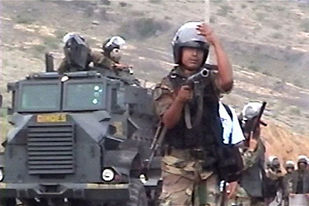
Bagua, Peru (June 5, 2009) – At approximately 5 am this morning, the Peruvian special forces police staged a violent raid on a group of indigenous people at a peaceful blockade on a road outside of Bagua, in a remote area of northern Peruvian Amazon. Several thousand Awajun and Wambis indigenous peoples were forcibly dispersed by tear gas and real bullets, among them are confirmed reports of at least 50 injured and 22 indigenous people and 9 police officers dead.

At 2am police began to approach the demonstrators as they were sleeping along the Fernando Belaúnde Terry road. Demonstrators refused to move from the roadblock as helicopters dropped teargas bombs from overhead. Eyewitnesses report that police attacked from both sides firing real bullets into the crowd as people fled into the steep hillsides. Many had no where to go. As the unarmed demonstrators were killed and injured some wrestled the Police and took away their guns and fought back in self-defense. The violence was clearly provoked by the Police as protesters had been peacefully blockading the road for over 56 days.

In local radio reports, the chief of Police claimed that the indigenous demonstrators were armed with guns necessitating the use of bullets for dispersal. This claim is refuted by dozens of local eyewitnesses including local journalists. A local conservationist reported from the scene that the Amazonian demonstrators have been entirely peaceful and only bear   traditional spears and in no way provoked any violence. However several conservative media sources are propagating the government’s misinformation campaign that aims to blame the victims for the violence.

The Garcia Government yesterday accused the indigenous movement of being violent, conflating non-violent civil disobedience with violent rebellion to justify its actions. The President issued an order for the police to begin forcibly removing indigenous demonstrations that have paralyzed the Amazon region of Peru for nearly two months.

Gregor MacLennan of Amazon Watch who is currently in Peru stated: “It is outrageous and absolutely untrue that indigenous   peoples provoked violence. Rather, they are engaged in peaceful and non-violent civil disobedience. It has been the Peruvian Government forces who have provoked violence against peaceful people who are trying to protect their forests, their sacred   lands from shortsighted pollution and industrial development. They are sacrificing a lot to safeguard the Amazon for future  generations and for all Peruvians.”

Indigenous peoples have vowed to continue protests until the Peruvian Congress revokes the “free trade” decrees issued by  President Garcia under special powers granted by Congress in the context of the Free Trade Agreement with the United States.

In the past two weeks, the constitutional committee of Congress has ruled that legislative decree 994 and 1090 were unconstitutional. The Peruvian Congress was scheduled to debate the revocation of decree 1090 again yesterday, however, Garcia’s political party for the third time prevented the debate preferring instead to attack the peaceful blockades. The   government Ombudsman office has filed a legal action with the constitutional tribunal on the unconstitutionality of decree 1064, which affects the land rights laws in Peru.

The protests have provoked national debate about government policies in the Amazon that ignore indigenous peoples and encourage large-scale extractive industries and the privatization of Amazonian lands. Indigenous peoples claim that new laws undermine their rights and open up their ancestral lands to private companies for mining, logging, plantations and oil drilling.

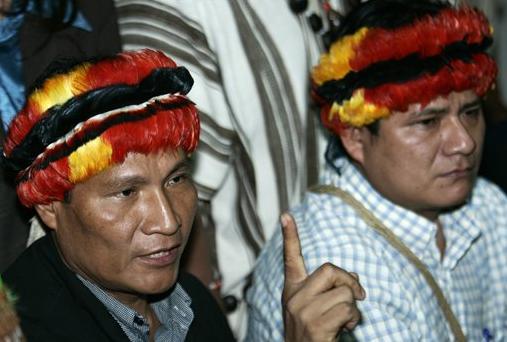
Alberto Pizango, left, president of the Peruvian Jungle Inter-Ethnic Development Association, speaks during a news conference in Lima, June 5, 2009. Karel Navarro


AIDESEP, the national indigenous organization of Peru presented a legal petition for “precautionary measures” to the Inter-American Commission on Human Rights requesting intervention to prevent more bloodshed. Orders for the arrest of leaders of AIDESEP, including Alberto Pizango was put in effect today.

Indigenous Peoples are planning a nationwide general strike starting June 11th.

A coalition of human rights and environmental organizations are urging the Garcia Government to stand down and cease violent   confrontations by the military and calling for solidarity demonstrations at Peruvian Embassies around the world. Today, there were demonstrations at the Peruvian Government Mission in San Francisco and Washington DC.

For Background information see www.amazonwatch.org or www.aidesep.org.pe

Amazon Watch

Gorbachev calls for reform

June 7, 2009
Former Soviet leader Mikhail Gorbachev.
Former Soviet leader Mikhail Gorbachev
Worldpress.org, June 7, 2009
AFP

Former Soviet leader Mikhail Gorbachev called for a perestroika, or top-to-bottom reform, in the West, arguing that its current economic model was “unsustainable” and needed replacement.

Commenting on the current global economic crisis, the ex-Soviet president who presided over the collapse of the USSR, said that it was now clear to him “that the new Western model was an illusion that benefited chiefly the very rich”.

“The model that emerged during the final decades of the 20th century has turned out to be unsustainable,” Gorbachev wrote in an op-ed piece in The Washington Post.

“It was based on a drive for super-profits and hyper-consumption for a few, on unrestrained exploitation of resources and on social and environmental irresponsibility.”

Gorbachev predicted “perhaps even greater upheaval down the road” and insisted that the current economic and social model existing in the West needed replacing.

“I have no ready-made prescriptions,” Gorbachev said. “But I am convinced that a new model will emerge, one that will emphasise public needs and public goods, such as a cleaner environment, well-functioning infrastructure and public transportation, sound education and health systems and affordable housing.”

From the mid-1980s, Gorbachev was the initiator of a series of fundamental reforms in the Soviet Union.

Obama in Cairo: a new face for American imperialism

June 7, 2009

Patrick Martin | wsws.com, 5 June 2009

The speech delivered by US President Barack Obama in Cairo yesterday was riddled with contradictions. He declared his opposition to the “killing of innocent men, women, and children,” but defended the ongoing US wars in Iraq and Afghanistan and the US proxy war in Pakistan, while remaining silent on the most recent Israeli slaughter of Palestinians in Gaza. These wars have killed at least one million Iraqis and tens of thousands in Afghanistan, Pakistan and the Palestinian territories.

Obama declared his support for democracy, human rights and women’s rights, after two days of meetings with King Abdullah of Saudi Arabia and Egyptian President Hosni Mubarak, two of the most notorious tyrants in the Middle East. He said nothing in his speech about the complete absence of democratic rights in Saudi Arabia, or about the ongoing repression under Mubarak’s military dictatorship. In the days before the US president’s arrival at Al-Azhar University, the campus was raided by Egyptian secret police who detained more than 200 foreign students. Before leaving on his Mideast trip, Obama praised Mubarak as a “steadfast ally.”

While posturing as the advocate of universal peace and understanding, Obama diplomatically omitted any reference to his order to escalate the war in Afghanistan with the dispatch of an additional 17,000 US troops. And he tacitly embraced the policy of his predecessor in Iraq, declaring, “I believe the Iraqi people are ultimately better off without the tyranny of Saddam Hussein.” He even seemed to hedge on the withdrawal deadline of December 2011 negotiated by the Bush administration, which he described as a pledge “to remove all our troops from Iraq by 2012.”

Obama rejected the charge that America is “a self-interested empire”—a perfectly apt characterization—and denied that the United States was seeking bases, territory or access to natural resources in the Muslim world. He claimed that the war in Afghanistan was a “war of necessity” provoked by the 9/11 terrorist attacks. This is the same argument made by the Bush-Cheney administration at the time, which deliberately conceals the real material interests at stake. The war in Afghanistan is part of the drive by US imperialism to dominate the world’s two most important sources of oil and gas, the Persian Gulf and the Caspian Basin.

There was of course a distinct shift in the rhetorical tone from the bullying “you’re either with or against us” of George W. Bush to the reassuring “we’re all in this together” of Obama. But as several commentators noted (the New Republic compared the speech line-for-line to that given by Bush to the United Nations on September 16, 2006), if you turned off the picture and the sound and simply read the prepared text, the words are very similar to speeches delivered by Bush, Condoleezza Rice and other officials of the previous administration.

The vague and flowery rhetoric, the verbal tributes to Islamic culture and the equal rights of nations, constitute an adjustment of the language being used to cloak the policy of US imperialism, not a change in substance. Obama made not a single concrete proposal to redress the grievances of the oppressed peoples of the Middle East. That is because the fundamental source of this oppression is the profit system and the domination of the world by imperialism, of which American imperialism is the most ruthless.

Obama made one passing reference to colonialism, and to the US role in the overthrow of the democratically elected Mossadegh government in Iran in 1953. But in his litany of “sources of tension” in the region, he offered the same checklist as his predecessor, with the first place given to “violent extremism”, Obama’s rhetorical substitute for Bush’s “terrorism.”

The reaction to the Obama speech in the American media was across-the-board enthusiasm. Liberal David Corn of Mother Jones magazine said Obama’s great advantages were “his personal history, his non-Bushness, his recognition of US errors, his willingness to at least talk as if he wants to be an honest broker in the Mideast.”

Michael Crowley wrote in the pro-war liberal magazine New Republic, “to see him unfold his biography, to cut such an unfamiliar profile to the world, is to appreciate how much America will benefit from presenting this new face to the world.”

Perhaps most revealing was the comment by Max Boot, a neoconservative arch-defender of the war in Iraq, who wrote: “I thought he did a more effective job of making America’s case to the Muslim world. No question: He is a more effective salesman than his predecessor was.”

In his speech in Cairo, Obama was playing the role for which he was drafted and promoted by a decisive section of the US financial elite and the military and foreign policy apparatus. This role is to provide a new face for US imperialism as part of a shift in the tactics, but not the strategy, of Washington’s drive for world domination.

Nearly two years ago, former US national security adviser Zbigniew Brzezinski gave his public backing to the presidential candidacy of a still-obscure senator from Illinois, holding out the prospect that as an African-American with family ties to the Muslim world, Obama would improve the worldwide image of the United States.

Brzezinski was the leading hawk in the administration of Democrat Jimmy Carter and helped instigate the political upheavals in Afghanistan in the hopes of inciting a Soviet invasion that would trap the Moscow bureaucracy in a Vietnam-style quagmire. He has remained steadily focused on what he calls the “great chessboard” of Eurasia, and particularly on oil-rich Central Asia, where a struggle for influence now rages between the United States, Russia, China and Iran.

According to Brzezinski in August 2007, Obama “recognizes that the challenge is a new face, a new sense of direction, a new definition of America’s role in the world… Obama is clearly more effective and has the upper hand. He has a sense of what is historically relevant and what is needed from the United States in relationship to the world.”

Brzezinski, a ruthless defender of the interests of US imperialism, has repeatedly issued warnings to the American ruling elite of the danger of what he calls the “global political awakening.”

In one particularly pointed comment, he told the German magazine Der Spiegel, only months before he endorsed Obama, that the vast majority of humanity “will no longer tolerate the enormous disparities in the human condition. That could well be the collective danger we will have to face in the next decades.”

To call it by its right name, what the more perceptive elements in the US ruling class fear is world revolution. The effort to prevent such a social upheaval is what impelled them to install Obama in the White House and what set him on his pilgrimage to Cairo.

Understanding the root causes of problems in Pakistan

June 6, 2009
by Zafar Bangash | Media Monitors Network, June 5, 2009

For a state and society to function smoothly, some basic services must be provided to its citizens: security, decent education, access to healthcare, prospects of a reasonable job and sound economy. Participation in the political process as well as justice are other important considerations for peace and tranquility. Judged by these criteria, Pakistan falls short on each of these requirements. This is not to suggest that there is no security for anyone or that nobody is making money; a tiny minority is making huge amounts of money sharpening differences in society even further. The ruling elites will even point to the fact that only last March, the activist Chief Justice of Pakistan, Iftikhar Muhammad Chaudhry, was reinstated after an 18-month struggle led by lawyers and the civil society. So what precisely is the problem and why is Pakistan gripped by an endless series of crises the latest of which has been described by some as an “existential threat”?

Pakistan is not one but several societies in which people of diverse backgrounds, ethnicity and languages reside. This is not unique to Pakistan; neighboring India is far more diverse with a cacophony of languages spoken by people of different religions and backgrounds yet it does not face the kinds of problems confronting Pakistan. Why? Pakistan’s divisions are not merely because of ethnicity although this is a contributing factor. It is a society deeply polarized along class lines. Most privileges and facilities are reserved for the tiny ruling minority while the overwhelming majority languishes in poverty and deprivation.

Coninued >>

Israel’s Indiscriminate Use of Indiscriminate Weapons

June 5, 2009
by Stephen Green | Antiwar.com, June 05, 2009

On May 9, Israel announced to the UN Department of Peacekeeping Operations in New York that it would release a set of maps showing where cluster munitions had been dropped by the Israeli Defense Forces during the IDF military incursions into South Lebanon in July-August of 2006.

There has been some speculation in Washington about the timing of the release, coming as it did two days prior to the arrival in the U.S. of Israel’s new Prime Minister Benjamin Netanyahu for his first official visit, and first “face to face” with President Obama.

The near three-year delay in release of the maps has been costly. The United Nations Mine Action Coordination Center of South Lebanon (MACC-SL), which is primarily responsible for defusing and removal of the cluster bomblets, estimates that approximately ½ to one million of these remain unexploded in South Lebanon, and that 30 people have been killed and some 203 have been injured since the termination of hostilities in August, 2006.

The MACC-SL figures for total cluster munitions used by the Israeli Defense Forces correspond closely with information given by the Israeli Defense Forces to Ha’aretz reporter Meron Rapoport and published in an op-ed on September 13, 2006. For this piece, Rapoport interviewed numerous soldiers and officers to the level of battalion commander.

He was told that cluster munitions were delivered primarily by IDF MLRS (Multiple Launch Rocket System) units, but also by bombs dropped from aircraft and shot in shells fired by 155mm artillery. Some of the other artillery shells used were phosphorous rounds. The MLRS units alone fired 1,800 cluster rockets containing over 1.2 million cluster bomblets, the vast majority of which, according to the IDF officers and soldiers he interviewed were fired into villages in South Lebanon, near the Israeli border, in the last 10 days of the operation.

Cluster munitions, however delivered, are by definition “indiscriminate” weapons prohibited by Article 50 of the 1977 Protocols to the Geneva Conventions. In the summer of 2006, these indiscriminate weapons were used indiscriminately and often against Lebanese villages which were “civilian objects” as defined by Article 52 of the Protocols.

Perhaps the most accessible and comprehensive history to date of the military operations conducted by Israel in the summer of  2006, is “Eyewitness Lebanon: An International Law Inquiry,” published by the American-Arab Anti-Discrimination Committee (ADC) in 2007. As the title indicates, this study focuses directly upon those aspects of the operations which constituted violations of international law, and upon those individuals with general and local command authority who committed the violations, and are named in the study.

The vast majority of the cluster munitions used by Israel in  July-August 2006 military operation in South Lebanon were provided under U.S.-Israel military assistance grants which are governed by the 1952 Mutual Defense Assistance Agreement (TIAS 2675) between the two countries, which includes this section:

“The Government of Israel assures the United States Government that such equipment, materials, or services as may be required from the United States… are required for and will be used solely to maintain its internal security, its legitimate self-defense, or to permit it to participate in the defense of the area of which it is a part, or in United Nations collective security arrangements and measures, and that it will not undertake any act of aggression against any other state.”

The sanctions which are the muscle in all such U.S. military assistance agreements with  countries involved in concessionary sales, are contained in the Arms Export Control Act (AECA). As detailed in a 2005 report to Congress by the Congressional Research Service (CRS), there had been three possible violations of the AECA by Israel prior to the 2006 invasion of South Lebanon:

  1. In April of 1978 and August of 1979, the Carter Administration formally notified Congress that Israel “may have violated” its military assistance agreement with the U.S. during military raids into South Lebanon. No action was taken, however, to suspend arms sales or credits to Israel;
  2. In June of 1981, the Reagan Administration informed Congress that U.S. aircraft sold on a concessionary basis had been used to attack a nuclear reactor in Iraq. In this instance, shipments of  F-15 and F-16 aircraft were suspended, but only for two months;

There were two other instances: the 1976 air rescue mission at Entebbe, Uganda, and the 1985 bombing of PLO Headquarters in Tunis where the Ford and Reagan Administrations, respectively, simply reported that U.S.-provided aircraft to Israel had been used, but no violation of relevant military assistances were deemed to have occurred.

Given this history of U.S. presidential and congressional attentiveness to Israel’s implementation of military assistance agreements in the past, those Israelis in the government and military involved in the gross misuse of American weapons in South Lebanon by the IDF in the summer of 2006, and the Bush Administration which looked the other way, did more than break the U.S.-Israel military assistance agreement; to paraphrase Mark Twain, they threw it down upon the ground and danced upon it.

Ironically, the reaction to the crimes in South Lebanon was far more rigorous in Israel. Defense Minister Amir Peretz ordered an internal IDF inquiry into the use of cluster munitions (particularly) in the last weeks of the operation, and the Knesset launched an investigation of its own. As testimony was taken, responsibility began to climb up the chain of command, and within days of the beginning of the investigation, it became clear that heavy MLRS and artillery strikes had, according to Haaretz (again, Meron Rapoport) dumped between 1.2 million (IDF figures) and 3 million (UN estimates) cluster bomblets on the densely populated areas in South Lebanon, near the Israeli border.

It got worse. Phosphorous shells had been used. United Nations demining staff who moved into South Lebanon to begin the clean-up discovered  that the vast majority of cluster bombs used by the IDF had been taken from older stocks of US weapons (again, concessionary sales) and not from plentiful IDF supplies of newer, Israeli-made weapons.

The difference was that the high dud-rates of the former made the work of demining far more dangerous for both Lebanese and UN troops — and insured that the Lebanese farmers and their children would be maimed and killed for many years to come.

And then the questions began to be asked about the Geneva Conventions. Article 50 of the 1977 protocols specifically prohibit “indiscriminate attacks” which are not directed at a specific military objective, and may be expected to cause incidental loss of or injury to civilians and damage to civilian objects. Sooner or later, senior Israeli military and civilian leaders will be called to account in the Hague.

Obama emerged in Cairo as a true friend of Israel

June 5, 2009

By Gideon Levy | Haaretz/Israel, June 5, 2009

Neither Tel Aviv nor Ramallah held their breaths Thursday as the American president gave a speech in Cairo; the traffic in both crowded cities continued normally. Tel Aviv was indifferent, Ramallah sunk in desperation: Both cities have already had their fill of nice, historic speeches.

Nonetheless, no one can ignore the speech given by Barack Obama: The mountain birthed a mountain. Obama remained Obama. Only the Israeli analysts tried to diminish the speech’s importance (“not terrible”), to spread fear (“he mentioned the Holocaust and the Nakba in a single breath”), or were insulted on our behalf (“he did not mention our right to the land as promised in the Bible”). All these were redundant and unnecessary. Obama emerged Thursday as a true friend of Israel.

The prime minister ordered the ministers to say nothing, but of course they could not help but invade the studios. Uzi Landau said that a Palestinian state is tantamount to an “Iranian state.” Isaac Herzog appeared even more ridiculous when he said that the problem with the settlements is one of “public relations.” In essence, both were busy with the same problem: How can we manage to pull the new America’s leg as well? Israeli politicians have never before appeared as pathetic, as small as they did Thursday, compared to the bearer of promise in Cairo.

Indeed, there was promise in Cairo, of the dawn of a new age. A U.S. president talking about negotiations with Iran without preconditions or tacit threats, even willing to accept Iran having civilian nuclear capability; a president who talked about Hamas as a legitimate organization that represents part of Palestinian society, but that needs to relinquish violence; who spoke with empathy about Palestinian suffering; who spoke, believe it or not, about security not only for Israelis but also for Palestinians; who said that all the settlements are illegal; who called for nuclear disarmament of the entire region. All are sensational messages, headlines whose significance cannot be exaggerated, even if there are those who desperately tried to argue yesterday that “there was nothing new in his speech.”

Not enough? Obama also spoke in Cairo (!) against denying the Holocaust, about the rights of women and Copts, and on the need for democracy tailored to each society’s culture.

This is the thinking of a great leader, who walked with wisdom and sensitivity between the Holocaust and the Nakba, between Israelis and Palestinians, between Americans and Arabs, between Christians, Jews and Muslims. How easy it is to imagine his predecessor, George Bush the Terrible, in the same position: a complete opposite.

Our right-wingers were disappointed that he did not approve at least of Gush Etzion, and the peace lovers were disappointed that he did not offer a timetable. But a speech is just that, and the time for carrying things out is still to come.

But why waste words? Israeli news shows still opened Thursday with the Dudu Topaz story; that is what really interests Israelis. Never mind Obama; Israel has its own concerns.

Robert Fisk: Words that could heal wounds of centuries

June 5, 2009

President Obama reaches out to the Islamic world in a landmark speech

Robert Fisk | The Independent/UK, June 5, 2009

President Obama's speach reached out to the Islamic world
AFP/Getty

President Obama’s speach reached out to the Islamic world

Preacher, historian, economist, moralist, schoolteacher, critic, warrior, imam, emperor. Sometimes you even forgot Barack Obama was the President of the United States of America.

Will his lecture to a carefully chosen audience at Cairo University “re-imagine the world” and heal the wounds of centuries between Muslims and Christians? Will it resolve the Arab-Israeli tragedy after more than 60 years? If words could do the job, perhaps…

It was a clever speech we heard from Obama yesterday, as gentle and as ruthless as any audience could wish for – and we were all his audience. He praised Islam. He loved Islam. He admired Islam. He loved Christianity. And he admired America. Did we know that there were seven million Muslims in America, that there were mosques in every state of the Union, that Morocco was the first nation to recognise the United States and that our duty is to fight against stereotypes of Muslims just as Muslims must fight against stereotypes of America?

Related articles

But much of the truth was there, albeit softened to avoid hurting feelings in Israel. To deny the facts of the Jewish Holocaust was “baseless, ignorant and hateful”, he said, a remark obviously aimed at Iran. And Israel deserved security and “Palestinians must abandon violence…”

The United States demanded a two-state solution to the Israeli-Palestinian conflict. He told the Israelis there had to be a total end to their colonisation in the West Bank. “The United States does not accept the legitimacy of continued Israeli settlements.”

Continued >>