Alex Lantier and V. Gnana, WSWS, 16 Nov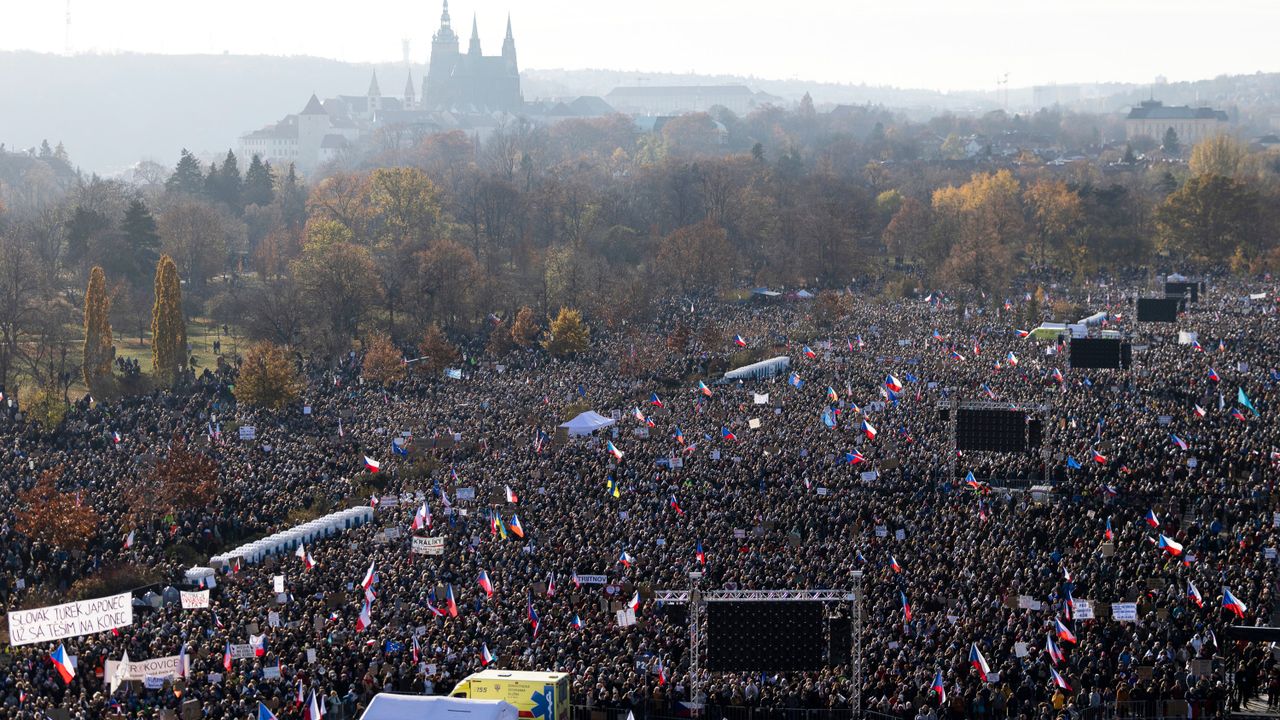
Over the weekend, protests hit countries across Europe. A mass anti-government protest shook Prague, while housing protests unfolded across Portugal, and youth and “yellow vests” marched in France. These protests point to the accelerating radicalization of workers and youth across Europe, before a week of nationwide strikes in several European countries.
A coalition of student unions has called a European youth strike on November 20 that will see actions in Germany, Britain, France, Italy, Spain and Greece. On November 17, French unions have called a one-day nationwide strike, while Italian unions have called such a strike on November 20, the day of a Portuguese public administration strike. Protests are called on November 21 in Lisbon and November 23 in Brussels.
Protests across Europe have started on a wide variety of issues, such as crumbling schools, surging housing costs and opposing the draft. However, workers and youth in them largely share opposition to problems deeply rooted within the capitalist system: the austerity diktat of the capitalist oligarchy, police-state rule and official promotion of neo-fascism, and the slashing of social funding to finance war. There is a growing sense of the pan-European and indeed global character of these problems and of the protest movements they are provoking.
The movement increasingly places before workers and youth the necessity of preparing a unified, European general strike, independently of the union bureaucracies, that would pose the question of a direct assault by the working class on the power and wealth of the capitalist class.
On Sunday, a huge crowd filled Letná Plain in Prague to oppose the government’s bill abolishing licence fees that fund Czech Television and Czech Radio and financing them from the state budget. The Milion Chvilek association, which organized the rally, put attendance at 350,000 to 450,000, while police declined to provide estimates. Opposition to the bill, which would bring public broadcasting directly under state control, has grown steadily since its adoption on October 24. On November 3, staff at both public broadcasters went on strike.
Speakers at the rally called to withdraw the law and remove Prime Minister Andrej Babiš’s coalition partner, Tomio Okamura of the far-right SPD party, as speaker of the house. However, these speakers largely came from opposition parties close to President Petr Pavel, a former NATO official and leading advocate of waging NATO’s war with Russia in Ukraine.
On Saturday, tens of thousands of people marched in Lisbon and dozens of other Portuguese cities for housing. Organizers estimated 60,000 marchers in Lisbon. The final square on the route, Martim Moniz, could not hold everyone who arrived. Protesters demanded the reversal of the government’s new rental law, which would end the cap on rent increases, allow evictions after two months of arrears instead of three, and allow pre-1990 controlled rents to be raised. It passed its first reading in parliament thanks to the far-right Chega party abstaining.
While the Madrid Tenants Union has called on Portuguese unions to call a nationwide one-day strike like the November 11 strike in Spain, Portugal’s CGTP and UGT union leaderships have to date refused to call such an action. Instead, the CGTP limited itself to calling a demonstration in Lisbon on November 21 and a rally outside parliament three days later.
In France, hundreds of thousands participated in joint youth and “yellow vest” protests in the run-up to tomorrow’s one-day nationwide strike against austerity. Organizers counted 200,000 participants including 100,000 in Paris, 35,000 in Bordeaux and 10,000 in Lille, while police officials banned protests in Marseille, Nantes and other cities. Clashes broke out between police and protesters in several cities, and police reported 219 arrests nationwide.
WSWS reporters in Paris interviewed marchers, whose comments revealed the continuing radicalization of significant sections of youth and workers, as well as an escalating discussion of the political perspectives facing the movement. While the union bureaucracies and layers of the media present a vote for pro-capitalist, populist presidential candidate Jean-Luc Mélenchon of La France Insoumise (LFI) party as the only possible outcome of the protest, many workers and youth are seeking a revolutionary policy.
Ewan and Mathis, two students, said they supported WSWS journalists’ call to organize rank-and-file committees of action to prepare a unified, European general strike. Ewan said, “We have to show solidarity, as it is violence and injustice that are not limited to France but also appear in Europe and elsewhere in the world.”
Mathis commented, “Can we really make it happen, that everyone blocks everything at the same time? That’s a serious question. But as an idea, theoretically, it’s really a great idea, to block the economy and show the true power of these movements of workers and students.”
Kelly, who comes from the French Antilles, stressed the connection between social struggles in mainland France and its overseas territories as she spoke to the WSWS with her friend, Diego.
“There are my cousins who are in totally run-down schools, without teachers. … Already we’re badly treated here, but it’s even worse over there,” Kelly said. “If people have to get operations done, they have to come here, to mainland France, for treatment. So already the treatment is too expensive, but we have to also get a plane ticket on top of that. … And we wash with rain water there, it’s unacceptable in a territory that is supposed to be ‘French.’ It’s because the running water is dirty, it comes out brown from the tap.”
Kelly said she plans to vote for Mélenchon to avoid the election of neo-fascist Marine Le Pen next year: “I’ll vote LFI not because I love Mélenchon, as I see it Mélenchon is a populist. But thinking realistically, if you look at what each candidate proposes, I don’t think Mélenchon can do everything he says, but it’s the closest to helping people who look like me.”
For his part, Diego said: “LFI is a pro-system party. Workers have to act directly, because LFI, at the end of the day, is guys in suits in an office. They will not change very much.”
Jean-Charles, a student, indicated that the class struggle, not next year’s presidential elections, would be key to resolving issues facing the movement. “Even if people don’t necessarily agree with certain demands appearing in different protests, it is important at least to show the government that we don’t agree with how they oppress us,” he said. “They impose their cuts and so on against the people. So for me, the only thing to do is indeed to go on to mobilizations such as a strike, which is really a way to block the country and its economy.”
“As I see it, [Mélenchon] is just someone who wants to take over demands so he can get a big vote,” he said, adding: “Mélenchon is a charlatan. He’s not someone who should be in power, who could change things. First of all, he doesn’t have a real economic and financial program. If we do not get out of the debt trap and restart the economy, whatever else we do, all the other demands, all the other issues in his program will not ultimately get changed.”
Achille, a social worker, told the WSWS that protests are continuing in France because “For a decade, living standards have been falling in France, and the government imposed neoliberal policies that weaken society, that make all French people more precarious. So today, I think nothing can stop these protests that take place every week.”
He stressed his disillusionment with the union bureaucracies and Mélenchon. “The guiding principle of the unions is to dialogue with the state. So they have to make compromises. And the more compromises they make, the more they are integrated into the system. Today, they are totally part of the system, they are in fact the first bulwark of capitalism. The unions are a mechanism to channel the anger of the workers while doing virtually nothing.”
“In the 2027 elections, I don’t feel like I am finding many solutions,” he said, adding: “A social-democratic party like Mélenchon, even if it gives a lot of hope and I will probably end up voting for him … if it tries to accompany and not overthrow capitalism, he will ultimately make too many compromises and mess up.”
Achille said he was looking for a revolutionary policy not of appealing to the government, but of fighting for a broader mobilization of the working class.
“We’re not sending a message to the institutions or the government, but to the rest of the population, to join us and that our cause is just. We’re going beyond the institutions here. We know the only response we will get is police batons and tear gas. We’re appealing to the rest of the population to join us and fight for a better future,” he said. “What is ruining our lives today is capitalism. The struggle against this system, which is global, must also be global. It knows no borders. So it’s totally necessary to have a unified movement in several different countries.”
Tags: Europe, France, History, Marxism, news, politics, protests


Leave a Reply