Ali Abunimah Rights and Accountability 11 May 2026
https://www.youtube.com/embed/UoyDOx5KOWM?feature=oembed& When representatives of Palestinian resistance factions arrived in Cairo in mid-March for talks with Egyptian and Qatari mediators, they were not told in advance that Nickolay Mladenov would be waiting for them.
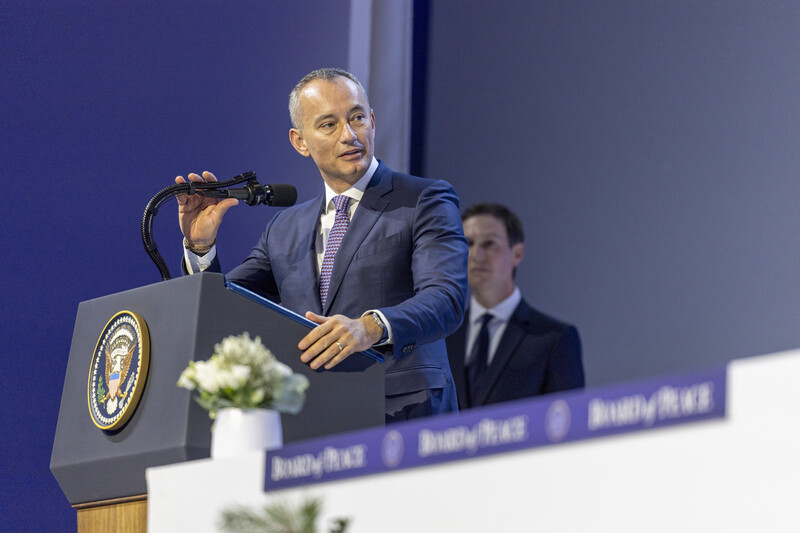
Mladenov is no neutral broker. The former UN official now serves as director-general of US President Donald Trump’s so-called Board of Peace and its “High Representative for Gaza.”
According to Muhammad Shehada, Mladenov did not come to mediate. He came to deliver an ultimatum on behalf of Israel and the United States: Accept full unconditional disarmament or face a renewed Israeli onslaught.
On The Electronic Intifada Livestream on 7 May, Shehada said Palestinian factions saw Mladenov as “an emissary or an envoy of Benjamin Netanyahu,” the Israeli prime minister.
Citing accounts from participants, Shehada said Mladenov was “extremely condescending,” issuing a threat “that if you don’t accept my proposal, immediately, unconditionally, Israel would get a free hand in Gaza and would resume its military operations.”
A Palestinian writer and researcher from Gaza, Shehada is a visiting fellow at the European Council on Foreign Relations.
You can watch his full conversation with co-hosts Ali Abunimah and Nora Barrows-Friedman in the video above.
From the UN to the Israel lobby
Mladenov’s bias is hardly hidden. After leaving his post as UN special coordinator for the “peace process” in 2021, he immediately joined the Washington Institute for Near East Policy, an offshoot of the Israel lobby group AIPAC.
His conduct in Cairo exposed what this whole process has really been about: forcing and formalizing Palestinian surrender.
In October, Israel agreed on paper to a ceasefire framework. The Palestinian resistance would ensure the return from Gaza of all living and dead Israeli prisoners of war and captives.
Israel, in turn, was supposed to stop its genocidal attack on Gaza, halt “all military operations,” pull back its forces, allow at least 600 aid trucks a day into the territory, permit 200,000 tents and 60,000 temporary homes, open the Rafah crossing and allow both an International Stabilization Force and the National Committee for the Administration of Gaza – a Palestinian-run body meant to begin civilian governance – to enter the territory.
From there, negotiations on a second phase were supposed to begin.
All this was set out in Trump’s so-called peace plan for Gaza, endorsed by the UN Security Council in November – in the face of united opposition from Palestinians who viewed the resolution as capitulating to Tel Aviv and Washington and violating fundamental principles of international law.
The Palestinian resistance nevertheless kept its side of the deal. Israel, to no one’s surprise, violated virtually all of its commitments, while the supposed mediators, especially the United States, did nothing.
As Shehada explained on the Livestream, the only item ever fulfilled was the release of Israeli captives.
Since then, Israel has continued killing Palestinians, choking off aid, blocking temporary shelters and preventing the Palestinian-run administrative committee from even entering the territory.
Yet Washington, the other so-called mediators and much of the media shifted the focus away from Israel’s violations and ongoing crimes and back onto the old colonial demand that Palestinians surrender all means to resist and defend themselves.
Palestinian factions rejected the ultimatum, infuriating Mladenov.
“Israel never fulfilled phase one of the Trump deal. How are you asking us to move to phase two when the first phase was never fulfilled?” Shehada said, summarizing the position Palestinian resistance representatives put to Mladenov.
Terms of surrender
In a recent +972 Magazine article, Shehada reports on two Arabic-language documents laying out Mladenov’s demands.
Mladenov set out a 250-day timeline ending with Palestinians handing over even personal weapons and, “only once an investigative committee verifies that Gaza is completely free of any weapons whatsoever – a very elusive process – would Israel make a limited and ‘gradual’ withdrawal over an undefined period of time to the ‘Red Line’ that would still leave it in control of about 38 percent of Gaza.”
“Rubble removal and reconstruction under Mladenov’s proposal would only begin on day 251,” Shehada adds.
The documents – reviewed by The Electronic Intifada – strip Hamas and the other factions of any governing role. They place Gaza under external control, similar to the colonial Mandate under which Britain ruled Palestine after World War I.
Israel would remain in control of Gaza deep into the process, with the final stage still preserving an indefinite Israeli “security perimeter” inside the territory.
The point is plain enough. Israel and the US want to keep using hunger, destruction, despair and blackmail to impose what Israel’s army – despite more than two years of genocide and devastation – could not impose by force.
Shehada summarized the logic clearly on Livestream. Mladenov, he said, demanded that Palestinians “become absolutely defenseless, weaponless,” and trust their lives to an occupier and its backers who have never stopped killing them.
What then is the endgame? According to Shehada, Mladenov’s proposals aim “to completely rewrite the Trump plan to [Israeli Prime Minister Benjamin] Netanyahu’s satisfaction,” in order to render it unworkable and “give Israel an absolute free hand to do whatever it wants.”
While humanitarian relief and recovery were supposed to begin immediately in phase one, Mladenov is holding the civilian population’s most basic rights and their very survival hostage to total surrender by the resistance.
He is, according to Shehada, seeking the “destruction of everything that they [Palestinians] have that might be used as either defensive weaponry or as basic leverage in any future negotiations.”
Decommissioning vs. disarmament
Trump’s plan does not even mention disarmament. Instead it calls for “placing weapons permanently beyond use through an agreed process of decommissioning.”
That language comes directly from the Northern Ireland peace process. In practice, decommissioning meant armed groups did not immediately give up their weapons, but placed them out of sight and out of use so long as the political process advanced and Britain took reciprocal steps to withdraw its forces and dismantle its repressive apparatus in the north of Ireland.
The weapons remained an insurance card if commitments were violated. Indeed, the Irish Republican Army slowed, and at crisis points suspended, its participation in decommissioning to pressure the British government to fulfill its promises.
“Hamas was saying that we can do this,” according to Shehada. “Lock all the weapons up in depots for the next five years, 10 years, 15 years, 20 years, and then you need an agreement to end the Palestinian question, to end Israel’s apartheid.”
Actual disarmament – the final destruction of resistance weapons – would therefore be the result of a political settlement and a reciprocal process, not a precondition imposed only on one side.
As flawed and Israel-biased as it was, Shehada acknowledged that by adopting the concept of decommissioning, the Trump framework “was premised on the idea that you don’t have to surrender, you don’t have to capitulate.”
According to Shehada, Saudi Arabia, Egypt, Ireland and the United Kingdom support decommissioning as a mechanism for Gaza.
Netanyahu and Mladenov replaced that with demands for outright disarmament – meaning, as Shehada put it, “surrender everything you have. You have absolutely no leverage whatsoever.”
But the comparison has limits.
Northern Ireland involved a political process that at least formally recognized the rights and aspirations of all participants and established a path towards a united Ireland, the core objective of the Irish anti-colonial struggle.
With Palestine, even states backing decommissioning still start from the colonial premise that Palestinian resistance is the problem, not Zionist colonization, apartheid, siege and genocide.
Iran changes the power balance
This is why the regional dimension matters. The demand that the Palestinian – and for that matter Lebanese – resistance surrender rests on the assumption that the US and Israel still dominate the region so completely that they can dictate terms and everybody else must obey.
But the US-Israeli war of aggression against Iran, and Hizballah’s formidable resistance in Lebanon, have exposed real limits to that power.
Iran has not only withstood a full-scale joint assault by the world’s and the region’s strongest and most genocidal military forces, it has arguably emerged stronger.
Shehada said Trump’s Board of Peace “began to unravel” once the US and Israel attacked Iran.
He noted that Indonesia suspended its participation and said Gaza’s factions drew a blunt lesson from the regional confrontation: “If you stand your ground, if you hit back, you strike back, you maintain steadfastness, you will get your way.”
“That lesson was immediately caught by people in Gaza,” Shehada said. It made the resistance factions “even more uncompromising on accepting the Mladenov proposal.”
Despite the catastrophic humanitarian situation Israel deliberately maintains, Washington and Tel Aviv have not secured the regional omnipotence they claim.
The existence of Palestinian weapons is not the root problem, but the consequence of the root problem: Zionist occupation, land theft, apartheid and genocide, sustained by US imperial power.
This basic truth cannot be wished away.
Any plan that begins by demanding Palestinian submission while leaving Israeli colonial power intact is a fraud.
Palestine, especially Gaza, does not need more such scams dressed up as “peace.” Its people need liberation and the restoration of all their rights.
The durable Western support for Israel even as it has perpetrated genocide since 7 October 2023 underscores that liberation will not be a gift from the likes of Mladenov, nor a reward for what Israel’s arms suppliers and financiers consider Palestinian good behavior.
As in every anti-colonial struggle, liberation will be won by Palestinians through their own efforts and sacrifices – and through the broader regional struggle to end the US imperial domination without which the Zionist colony in Palestine would disintegrate.
 Peace and Justice Post
Leave a comment