The years 2024 and 2025 were the deadliest for reporters worldwide since records began. In those two years, Israeli attacks were responsible for 70% of the deaths

Madrid – APR 24, 2026 – 11:23 CEST
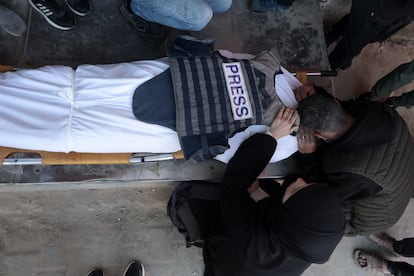
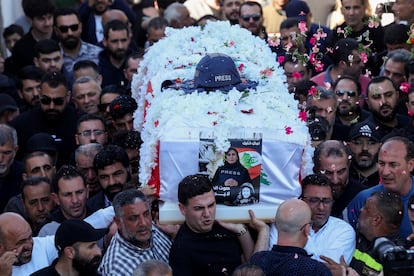
The death of Amal Khalil, 43, a Lebanese reporter for the media outlet Al Akhbar, brings up to nine the number of journalists killed by the Israeli army in seven weeks of offensive in Lebanon, according to the Committee to Protect Journalists (CPJ). The reporter’s killing occurred even though a ceasefire, which called for a 10-day cessation of hostilities by Israeli troops in Lebanon, was in effect since Thursday.
These figures add to the 264 other journalists killed in the line of duty in the context of the wars in Gaza and Iran since October 7, 2023. According to CPJ, 260 of these deaths were caused by Israel. The majority of the victims were Palestinian journalists in Gaza, although the count also includes 31 journalists killed in Yemen, 15 in Lebanon, and four in Iran in the last two and a half years. According to the Lebanese Press Editors Syndicate, the number of reporters killed in Lebanon since October 2023 stands at 27.
While Lebanon remains in shock over Khalil’s death, Beirut has announced it will seek international justice, considering the Israeli attack that killed her a war crime. The Lebanese government accuses Israel of deliberately targeting her and her colleague Zeinab Faraj. The two women had taken shelter in a house in the southern village of al-Tiri after an initial airstrike killed two people traveling in a vehicle. Shortly afterward, the building where they were located was also attacked. The Lebanese Red Cross rescued Faraj, who was taken to a hospital, but as teams searched for Khalil, an Israeli drone dropped another grenade on the building.
“This is not the first time that Israel has prevented emergency services from reaching journalists injured in their strikes,” said CPJ CEO Jodie Ginsberg. “Journalists are civilians and protected under international law. Israel’s blatant disregard for such norms — and the international community’s failure to hold them accountable — is abhorrent.”
In many cases, Israeli troops justify the attacks by claiming the journalists have connections to Hamas or Hezbollah. In Khalil’s case, the Israeli army, without denying the Lebanese government’s version of events, maintains that the two journalists had just left a building used by Hezbollah for military purposes. According to a spokesperson, both vehicles had crossed the defensive line and approached Israeli troops, thus constituting “an imminent threat.”
“Targeted assassinations”
2024 and 2025 were the deadliest years for journalists worldwide since the Committee to Protect Journalists (CPJ) began documenting these cases in 1992. In both years, Israel was responsible for 70% of the recorded deaths, according to the organization. In addition to the 264 journalists who were killed, 174 were wounded and 106 imprisoned since the start of the war in Gaza.
The CPJ counts both journalists killed while carrying out their work and those whose deaths are linked to their professional activity, whether accidentally in conflict zones or as a result of deliberate attacks. According to the organization, Israeli troops have carried out more targeted killings of journalists than the military of any other government since records began. To date, the CPJ has documented 64 cases of journalists deliberately killed by Israeli forces between 2023 and 2025 in Gaza, Lebanon, Iran, and Yemen.
Among the dead was Anas Al Sharif, an Al Jazeera reporter and one of the most recognizable faces of the Gaza war. He was killed in August 2025 in an Israeli attack on the journalists’ tent where he lived with five other reporters, outside Al Shifa Hospital in Gaza City. Anticipating he might be targeted, Al Sharif had left a farewell message.
That same month, five other journalists were killed in a bombing of Nasser Hospital in Khan Younis, in the southern Gaza Strip. After an initial explosion at the building, where civilians and reporters had gathered to assess the damage, a second blast occurred and was broadcast live by several television stations.
The head of Al Jazeera’s Gaza bureau has also been targeted: he was wounded and lost several family members, including a son who was also a journalist. This April, Al Jazeera journalist Muhammad Washah was killed in an Israeli airstrike on the vehicle he and another Palestinian were driving on the coastal road in Gaza City, according to health officials cited by Reuters.
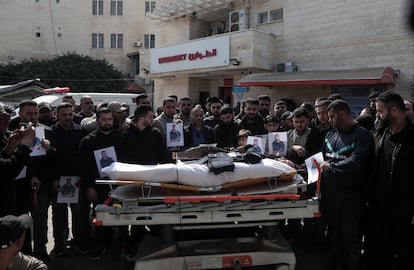
In the last incident in Lebanon recorded by the CPJ before Khalil’s death, three other journalists were killed in the south of the country. An Israeli attack on a vehicle on the Jezzine road killed journalist Ali Shoaib of the Hezbollah-affiliated Al Manar TV; journalist Fatima Ftouni of Al Mayadeen TV; and her brother, freelance photojournalist Mohamad Ftouni.
War crimes
“The deliberate attacks and killings of journalists by Israeli forces constitute war crimes under international humanitarian law,” Amnesty International notes on its website.
Since October 2023, Reporters Without Borders has filed five complaints with the International Criminal Court against Israel for “war crimes against Palestinian journalists in Gaza.”
These actions are in addition to previous ones, such as the lawsuit filed by Al Jazeera in 2022 after the death of journalist Shireen Abu Akleh, who was killed in May of that year while covering a raid by Israeli troops on a refugee camp in Jenin, in the West Bank.
Sign up for our weekly newsletter to get more English-language news coverage from EL PAÍS USA Edition


Leave a Reply