Archive for August, 2008

GEORGIA: Where the Cold War Never Ended

August 12, 2008

Analysis by Zoltán Dujisin

PRAGUE, Aug 11 (IPS) – As war breaks out in Georgia, the geopolitical struggle between the U.S. and Russia becomes more violent and closer to Russia’s border than ever.

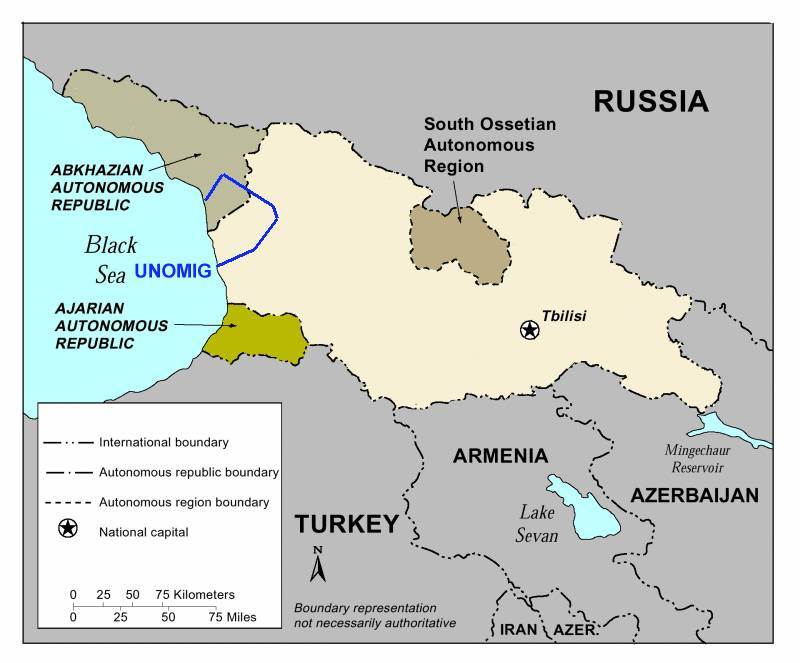
The conflict started after Georgian troops tried to take control of the Georgian breakaway region of South Ossetia, which had been de facto independent and protected by Russian peacekeeping forces since 1992.

Russia has responded by launching an extensive military operation in South Ossetia, repelling Georgian forces from regional capital Tskhinvali, 100 km northwest of the Georgian capital Tbilisi, and advancing into Georgian territory.

Mikheil Saakashvili, President of the 4.6 million Caucasus country, claims the Russian “invasion” was premeditated.

Abkhazia, another breakaway region in Western Georgia that proclaimed independence in the same year, has also become entangled in the conflict by taking Russia’s side.

Sporadic clashes between Georgian and separatist soldiers were not rare, but hostilities never reached the current extent.

The Georgian move apparently took Western leaders, who had warned against attempting a military solution, by surprise.

Ivan Sukhov, a journalist specialised in the region told Radio Free Europe on Friday that Saakashvili had taken “a position that is awkward for the West, since Georgia has consistently positioned itself as a principled opponent of military action. Even if the Georgian actions were provoked by the South Ossetians, this is a serious political mistake.”

Georgia seemed determined to expose Russia’s involvement in Abkhazia and South Ossetia and present the conflict as one between Western democracy and Eastern authoritarianism, possibly hoping to obtain a more decisive Western intervention in the conflict.

The attempt to revive cold war rhetoric was palpable in Saakashvili’s parallels of Georgia’s situation with the 1956 Hungarian and 1968 Czechoslovak interventions by the Soviet Union.

One possible goal of the Georgian leadership’s military intervention was to internationalise the conflict so as to change the format of the present Russian-dominated peacekeeping mission, and facilitate the regions’ peaceful or forcible reintegration.

Many have seen in Georgia’s rash decision the first consequence of Kosovo’s unilateral independence from Serbia last February.

The move has encouraged the separatist claims of the South Ossetian and Abkhaz leaderships, and Georgia’s renewed determination to fully regain its territorial sovereignty.

The leaders of the separatist regions trust that after Kosovo’s independence, the consent of the sovereign state is no longer necessary if a greater power can guarantee its security.

Moreover they have deployed similar arguments to those applied in Kosovo: a past of ethnic-driven war which left thousands of civilians dead and countless displaced on both sides.

Unhappy with the U.S.-promoted Kosovo independence, Moscow had promised an adequate response to the latest violation in international law, and its first step came with the institutionalisation of ties with Georgia’s two breakaway regions in March.

Unlike the West in Kosovo, Russia can claim the conflict in its southern regions directly affects its own security, and above all, that of a population of which 80 percent hold Russian passports.

Russian claims of arbitrary killings of up to 1,600 civilians by Georgian forces have not been independently verified, although a few Western journalists have started to take interest in testimonies by Ossetian refugees allegedly witness to human rights abuses by Georgian troops.

If the claims were to be at least partially verified and Russia was to show self-restraint and restore order, its ambition of a role as a legitimate world power and a regional pacifier could gain credibility.

Besides Kosovo, Russia was irritated by Washington’s enthusiastic promotion of North Atlantic Treaty Organisation (NATO) membership for two of Russia’s neighbours, Ukraine and Georgia, as well as U.S. plans to build a missile defence system in Eastern Europe which it claims will alter the balance of forces in Europe.

Georgia’s NATO bid was presented by the U.S. and Georgia’s former communist Eastern European allies as a chance to expand the area of freedom and democracy and to limit the expansion of Moscow’s authoritarian tendencies in Russia’s near abroad.

Many elites in the post-communist countries tend to believe that Russia is inherently inclined towards authoritarianism and expansionism and that the Soviet Union was just another expression of this impulse.

But the Western European member states, aware that Georgia’s commitment to liberal democracy was dubious and territorial tensions on the rise, decided to postpone the discussion on Georgia’s membership of NATO.

Many have noted an increase in Saakashvili’s authoritarian tendencies over the last year, with the arrest of opposition activists and the abuse of state resources by merely citing the “Russian threat”.

The U.S. has also been openly providing military support and training to the Georgian army while often encouraging Georgia to see itself as a crusader for democracy in the midst of authoritarianism. But as a member of NATO, a young and nationalistic state like Georgia could have drawn the entire alliance into a direct military confrontation with Russia.

Musharraf locked in battle to avoid impeachment as allies turn away

August 12, 2008

Pakistan President ‘unfit’ to rule, declares regional assembly

By Andrew Buncombe and Omar Waraich in Islamabad
The London Independent, Tuesday, 12 August 2008

Supporters of Pakistan's largest Islamic party Jamaat-e-Islami in Islamabad yesterday burn an effigy of President Pervez Musharraf

Reuters

Supporters of Pakistan’s largest Islamic party Jamaat-e-Islami in Islamabad yesterday burn an effigy of President Pervez Musharraf

Change font size: A | A | A

Pakistan’s government is finalising a “charge-sheet” against Pervez Musharraf as battle lines are drawn in the bitter struggle over the President’s future.

Several allies of Mr Musharraf began to distance themselves from him, saying he should stand down for the good of the country, but the former general again insisted he would fight the impeachment charges being prepared by his opponents. Meanwhile, the process to oust Mr Musharraf gathered additional pace as a crucial regional assembly overwhelmingly passed a vote of no confidence against him, saying he was “unfit” to rule.

Aftab Sherpao, a formerinterior minister in Mr Musharraf’s government and leader of a small regional party, said he was considering joining those seeking to force out the President. “[Mr Musharraf] is going to fight these charges on a moral ground to try to disprove them… But when it comes to the numbers, I think he’s lost it,” he said.

The coalition government led by the Pakistan People’s Party (PPP) of the late Benazir Bhutto and the former prime minister Nawaz Sharif’s Pakistan Muslim League-N (PML-N) had been expected to table their allegations against Mr Musharraf at a session of the parliament yesterday evening. But a coalition spokesman said the process was taking longer than expected because the charge sheet and its supporting documents was running to “100 hundred pages”.

Government officials have said the charges against Mr Musharraf will focus on eight key points, including violating the constitution, damaging the economy and the sacking of senior members of the judiciary. The head of the PPP, Ms Bhutto’s husband Asif Ali Zardari, upped the stakes over the weekend when he said Mr Musharraf could also be investigated for corruption.

Continued . . .

Mourners killed as Indian soldiers fire into Kashmiri funeral crowd

August 12, 2008

Indian security forces today fired into a crowd that had gathered for the funeral of a prominent Kashmiri separatist leader who was shot dead yesterday, killing three people.

The shootings, on the second day forces had fired into the crowd, came amid rising violence in Indian Kashmir, India’s only Muslim majority state.

The violence has seen many parts of the region, including the winter capital, Srinagar, put under curfew.

The roots of the crisis lie in a tug of war between the state’s Hindus and Muslims over 100 acres of land.

Tensions escalated after a blockade of the highway by Hindu groups cut off the mountainous Kashmir region, where Muslims predominate, from the plains of Jammu, where Hindus are the majority.

As a result, traders in Kashmir have been trying to sell their goods in neighbouring Pakistan.

Kashmiri separatists called on protesters to continue their march to Muzaffarabad, in Pakistani Kashmir, today.

Yesterday, Sheik Abdul Aziz, a senior figure in the separtist Hurriyat Conference, was killed along with four other people as they attempted to cross the disputed border with Pakistan. More than 150 were injured.

“Sheikh Aziz’s death is big loss to the Kashmir nation … we will take his mission to its logical end,” Mirwaiz Umar Farooq, the chairman of Hurriyat, told Indian television.

Violence began when the state government handed over 100 acres of land for pilgrimage facilities to be built at a popular Hindu shrine at Amarnath, in the Himalayas, in May.

The land dispute has deeply divided Indian Kashmir, and this week has seen some of the region’s worst religious rioting.

Spiralling violence has shattered the relative peace of the past four years in Indian Kashmir, which is also known as Jammu and Kashmir.

The state could still face a violent insurgency, but tensions had eased after India and Pakistan agreed to a peace process in 2004.

See BBC latest: : at least 11 protesters shot dead

US lighting Mideast powder keg?

August 12, 2008

Press TV, Mon, 11 Aug 2008 13:58:40 GMT

USS Theodor Roosevelt

Three more US warships are reportedly heading towards the Persian Gulf amid ongoing tension in the region.

DEBKAfiles– an Israeli web site with alleged close links with the regime’s military and intelligence sources– claimed that the USS Theodore Roosevelt, the USS Ronald Reagan and the USS Iwo Jima are sailing towards the Persian Gulf to reinforce the US strike forces deployed to the region.

The report said the expedition could be linked to a conflict between Russia and Georgia over the breakaway region of South Ossetia.

Citing military experts, the web site reported that through sending more strike forces to the Persian Gulf, the US is tightening its grip on oil resources in the Persian Gulf, after Russia extended its control over Caspian oil resources.

The report added that the US fleet could also support Israeli forces in case of any attack on Iran over the country’s nuclear activities.

According to the Israeli web site the expedition can also be considered as a sign of preparations by the US and its allies to impose partial naval blockade on Iran outside the framework of the UN Security Council, and to keep the Hormuz Striate open in case of a conflict.

Israel has been calling on the US to take a hard line in dealing with Iran’s nuclear issue. The pressure by hawkish Israeli politicians, however, has met with a cold response by many US military and political figures, who see the outcome of any military attack on Iran disastrous.

SB/DA

War in the Caucasus: Towards a Broader Russia-US Military Confrontation?

August 11, 2008
Global Research, August 10, 2008

During the night of August 7, coinciding with the opening ceremony of the Beijing Olympics, Georgia’s president Saakashvili ordered an all-out military attack on Tskhinvali, the capital of South Ossetia.

The aerial bombardments and ground attacks were largely directed against civilian targets including residential areas, hospitals and the university. The provincial capital Tskhinvali was destroyed. The attacks resulted in some 1500 civilian deaths, according to both Russian and Western sources. “The air and artillery bombardment left the provincial capital without water, food, electricity and gas. Horrified civilians crawled out of the basements into the streets as fighting eased, looking for supplies.” (AP, August 9, 2008). According to reports, some 34,000 people from South Ossetia have fled to Russia. (Deseret Morning News, Salt Lake City, August 10, 2008)

The importance and timing of this military operation must be carefully analyzed. It has far-reaching implications.

Georgia is an outpost of US and NATO forces, on the immediate border of the Russian Federation and within proximity of the Middle East Central Asian war theater. South Ossetia is also at the crossroads of strategic oil and gas pipeline routes.

Georgia does not act militarily without the assent of Washington. The Georgian head of State is a US proxy and Georgia is a de facto US protectorate.

Who is behind this military agenda? What interests are being served? What is the purpose of the military operation.

There is evidence that the attacks were carefully coordinated by the US military and NATO.

Moscow has accused NATO of “encouraging Georgia”. Russia’s Foreign Minister Sergey Lavrov underscored the destabilizing impacts of “foreign” military aid to Georgia: .

“It all confirms our numerous warnings addressed to the international community that it is necessary to pay attention to massive arms purchasing by Georgia during several years. Now we see how these arms and Georgian special troops who had been trained by foreign specialists are used,” he said.(Moscow accuses NATO of having “encouraged Georgia” to attack South Ossetia, Russia Today, August 9, 2008)

Moscow’s envoy to NATO, Dmitry Rogozin, sent an official note to the representatives of all NATO member countries:

“Russia has already begun consultations with the ambassadors of the NATO countries and consultations with NATO military representatives will be held tomorrow,” Rogozin said. “We will caution them against continuing to further support of Saakashvili.”

“It is an undisguised aggression accompanied by a mass propaganda war,” he said.

(See Moscow accuses NATO of having “encouraged Georgia” to attack South Ossetia, Russia Today, August 9, 2008)

According to Rogozin, Georgia had initially planned to:

“start military action against Abkhazia, however, ‘the Abkhaz fortified region turned out to be unassailable for Georgian armed formations, therefore a different tactic was chosen aimed against South Ossetia’, which is more accessible territorially. The envoy has no doubts that Mikheil Saakashvili had agreed his actions with “sponsors”, “those with whom he is negotiating Georgia’s accession to NATO “. (RIA Novosti, August 8, 2008)

Contrary to what was conveyed by Western media reports, the attacks were anticipated by Moscow. The attacks were timed to coincide with the opening of the Olympics, largely with a view to avoiding frontpage media coverage of the Georgian military operation.

On August 7, Russian forces were in an advanced state readiness. The counterattack was swiftly carried out.

Russian paratroopers were sent in from Russia’s Ivanovo, Moscow and Pskov airborne divisions. Tanks, armored vehicles and several thousand ground troops have been deployed. Russian air strikes have largely targeted military facilities inside Georgia including the Gori military base.

The Georgian military attack was repealed with a massive show of strength on the part of the Russian military.

In this image made from television, Russian military vehicles are seen moving towards the capital of South Ossetia, Tskhinvali, on Friday, Aug. 8, 2008. (AP / APTN)

Act of Provocation?

US-NATO military and intelligence planners invariably examine various “scenarios” of a proposed military operation– i.e. in this case, a limited Georgian attack largely directed against civilian targets, with a view to inflicting civilian casualties.

The examination of scenarios is a routine practice. With limited military capabilities, a Georgian victory and occupation of Tskhinvali, was an impossibility from the outset. And this was known and understood to US-NATO military planners.

A humanitarian disaster rather than a military victory was an integral part of the scenario. The objective was to destroy the provincial capital, while also inflicting a significant loss of human life.

If the objective were to restore Georgian political control over the provincial government, the operation would have been undertaken in a very different fashion, with Special Forces occupying key public buildings, communications networks and provincial institutions, rather than waging an all out bombing raid on residential areas, hospitals, not to mention Tskhinvali’s University.


Tskhinvali’s University before the bombing

The Russian response was entirely predictable.

Georgia was “encouraged” by NATO and the US. Both Washington and NATO headquarters in Brussels were acutely aware of what would happen in the case of a Russian counterattack.

The question is: was this a deliberate provocation intended to trigger a Russian military response and suck the Russians into a broader military confrontation with Georgia (and allied forces) which could potentially escalate into an all out war?

Georgia has the third largest contingent of coalition forces in Iraq after the US and the UK, with some 2000 troops. According to reports, Georgian troops in Iraq are now being repatriated in US military planes, to fight Russian forces. (See Debka.com, August 10, 2008)

This US decision to repatriate Georgian servicemen suggests that Washington is intent upon an escalation of the conflict, where Georgian troops are to be used as cannon fodder against a massive deployment of Russian forces.

US-NATO and Israel Involved in the Planning of the Attacks

In mid-July, Georgian and U.S. troops held a joint military exercise entitled “Immediate Response” involving respectively 1,200 US and 800 Georgian troops.

The announcement by the Georgian Ministry of Defense on July 12 stated that they US and Georgian troops were to “train for three weeks at the Vaziani military base” near the Georgian capital, Tbilisi. (AP, July 15, 2008). These exercises, which were completed barely a week before the August 7 attacks, were an obvious dress rehearsal of a military operation, which, in all likelihood, had been planned in close cooperation with the Pentagon.

The war on Southern Ossetia was not meant to be won, leading to the restoration of Georgian sovereignty over South Ossetia. It was intended to destabilize the region while also triggering a US-NATO confrontation with Russia.

On July 12, coinciding with the outset of the Georgia-US war games, the Russian Defense Ministry started its own military maneuvers in the North Caucasus region. The usual disclaimer by both Tblisi and Moscow: the military exercises have “nothing to do” with the situation in South Ossetia. (Ibid)

Let us be under no illusions. This is not a civil war. The attacks are an integral part of the broader Middle East Central Asian war, including US-NATO-Israeli war preparations in relation to Iran.

The Role of Israeli Military Advisers

While NATO and US military advisers did not partake in the military operation per se, they were actively involved in the planning and logistics of the attacks. According to Israeli sources (Debka.com, August 8, 2008), the ground assault on August 7-8, using tanks and artillery was “aided by Israeli military advisers”. Israel also supplied Georgia with Hermes-450 and Skylark unmanned aerial vehicles, which were used in the weeks leading up to the August 7 attacks.

Georgia has also acquired, according to a report in Rezonansi (August 6, in Georgian, BBC translation) “some powerful weapons through the upgrade of Su-25 planes and artillery systems in Israel”. According to Haaretz (August 10, 2008), Israelis are active in military manufacturing and security consulting in Georgia.

Russian forces are now directly fighting a NATO-US trained Georgian army integrated by US and Israeli advisers. And Russian warplanes have attacked the military jet factory on the outskirts of Tbilisi, which produces the upgraded Su-25 fighter jet, with technical support from Israel. (CTV.ca, August 10, 2008)

When viewed in the broader context of the Middle East war, the crisis in Southern Ossetia could lead to escalation, including a direct confrontation between Russian and NATO forces. If this were to occur, we would be facing the most serious crisis in US-Russian relations since the Cuban Missile crisis in October 1962.

Continued . . .

Oh the Pangs of Reunion: Reversing 1947

August 11, 2008

Tanveer Ahmed, August 8, 2008

Blunt realism can lead one to the depths of darkness and despair, idealism invariably provides scope for hope…

Indeed, it’s time for people in Jammu and the Valley to trade in their verminous polemics and self-destructing demeanour to prepare for the lofty heights of economic dynamism, communal cohesion and environmental revitalisation. Meanwhile, the governments of India and Pakistan should each swallow an ample dose of sober medication and realise it’s time to confess; “We tried for almost 61 years to control the tempo, fracture the identity and dictate the destiny of Kashmir: We’re terribly sorry, it hasn’t worked out well for any of us, not least because we attempted to defy nature: It’s over to you folks, we both hereby concede that you’re more than capable of reversing the mess we’ve put you in.”

(An imaginary and quite wishful quote no doubt – but to paraphrase the venerable Kashmiri pandit film-maker Sanjay Kak “The obnoxious silence has to break.”)

Background

The Kashmiri people, be they Hindu, Muslim, Sikh or Buddhist, are an incredibly accommodating lot. Judging by how they’ve overlooked and tolerated the rule of ‘outsiders’ in these past few centuries; functioning as a tug of the pernicious post ‘47 two-nation theory was an absolute given. Pakistan tried in earnest to make the Muslim much more of a Muslim than he needed to be while India gradually did much the same to the Hindu. Where did that leave the poor Hindus in Pakistan or the hapless Muslims in India? Marooned in their very own ancestral abode!

The millions of ‘desis’ that had been forcibly uprooted from either side of the un-natural divide, found it excruciatingly difficult to come to terms with the loss of their loved ones, left behind or killed in cold-blooded communal frenzy. The Sikh of Rawalpindi (undivided India and post partition Pakistan) who escaped with his bare life to Jallandhar (India), didn’t merely change his address in the Punjab, it was a blood-soaked divided Punjab. His centuries old identity and ancestral roots were ripped in exchange for a new identity, which defined his roots as enemy territory. The Muslim from pre-‘47 Agra (India) led a contorted existence in Karachi (Pakistan), her family members who didn’t migrate with her became her nascent nation’s enemies.

As the decades passed by, progress and development for India and Pakistan was a laborious struggle. Amongst other factors, unprecedented population growth and unhealthy military expenditure made post-colonial restructuring nigh on impossible for both countries. Whilst poverty in the region rippled; education, health and infrastructure were coldly sacrificed. Intellectual and artistic advancement was and still is sadly, deemed a luxury, ill-affordable to a pair of overly paranoid nation states.

Muslim Pakistan and Hindu India were an existential threat to each other and so sermonised Doordarshan and PTV, not to forget Radio Pakistan or All-India Radio. Their favourite playground for battle was of course Kashmir, attrition after attrition. The intelligence agencies of India and Pakistan, in conjunction with local lackeys; ensured that the Kashmiris were forever obliging hosts. Dissension or god-forbid obstruction was never an option. Pakistan’s “Jugular Vein” (Shah Ragh-Urdu) and India’s “Integral Part” (Atoot Ang-Hindi) were loaded oxymorons that quite literally made morons of the Kashmiri mentality.

Setting aside the moral liability of nuclearisation for just a moment, 1998 was a year of technological accomplishment for the region. Both countries demonstrated vigour to defy the “International Community”. Nevertheless, Kashmir as an issue that accompanied the creation of Pakistan and independence of a crippled India was the perfect binary foil that prevented the “International Community” from prolonging its dismay. The “Islamic” and “Hindu” bombs were here to stay.

1999 and Kargil’s fiasco; followed by 9/11 have mercifully in retrospect, changed the modus operandi, if not modus vivendi, from the proverbial ‘war-war’ to ‘jaw-jaw’.

Dialogue and communication as a means of conflict resolution, is not only plausible, efficient, cost-effective and positively natural. For Kashmiris of whatever persuasion, it’s the only possible method; an alternative simply did not and will not exist. It would be far too rich and ludicrous for either India or Pakistan to suggest any indigenous provocation of violence. Contrary to what some Kashmiris and others have suggested, there is little evidence of any of the many ethnicities in Kashmir espousing martial instincts.

Moving on to the “irreversible Peace Process” initiated in January 2004; this has thankfully proven to be the freshest of fresh airs since 1947. Both entities have shown an element of maturity and resolve, tit-for-tat provocations notwithstanding. Dialogue between Indian and Pakistani civil society has invoked and propelled fresh thinking as well as nostalgia of an un-divided past. Ruefully, at the insistence of both countries, most of this ‘dialogue’ has taken place outside the region in the wider “International Community”. Both governments still feel it un-nerving and unsafe for barrier-breaking intra-dialogue and initiatives to take root in the region.

Of utter frustration to the Kashmiri is that any peace dividends that have accrued so far have been primarily gobbled up by the Indian and Pakistani national. Movement between the two countries has increased exponentially while between the two parts of Kashmir, it’s still barely a trickle. The contrast is startling if one considers that many ‘well-connected’ Indians and Pakistanis have travelled to each other’s country on numerous occasions and at will, to “merry-make” while there are ample Kashmiris belonging to divided families, who have yet to meet their siblings after 61 years!

Intra-Kashmir movement and dialogue, though unprecedented has been lacklustre to say the least. By extension, reference may be extended to economic activity, cultural interaction, administrative reform and well…the list is endless. In short, India and Pakistan have not kept pace with global socio-economic/geo-political changes: Elements of an ‘Iron Curtain’ reminiscent of the ‘Cold War’ are starkly evident, particularly in Kashmir. Their respective administrative mechanisms are not quite equipped or even focused on speeding things up, both having a tendency of getting bogged down in inevitable cul-de-sacs. Old habits do die hard!

A bit of historical perspective

It’s an indisputable fact that pre-colonial India was an economic powerhouse of global proportion (in relative terms, way ahead of it’s current trajectory) and a fabulous specimen of world-class culture and art; driven by an amazing array of diversity in food, clothes, language and construction; organised and administered by a harmonious fusion of Hindu/Muslim spirit.

Ideas, people, goods and services in whatever dimension flowed freely. If an artisan of Attock (NWFP/Punjab-Pakistan) decided one day that he wished to venture East for work…his destination may well have been no less than modern day Myanmar….traversing the breadth of modern day Pakistan, India and Bangladesh…others of his ilk had little hesitation in setting up home en-route, if a place took their fancy…indeed, Tagore’s “The Kabuli Wallah” fails to escape reminiscence.

Symptoms

In its current collective predicament and despite modern advancement in transport and information networks, the region has poisoned itself with a mad concoction of Westphalia and inappropriate religious fuel, amidst a rotten basket of other self-inflicted ills. As a consequence, entities within the historic ‘whole’, repeatedly fail to recognise the humane aspirations of those it has been programmed to categorise as the ‘other’, this blinds it from visualising the stupendous potential; that a harmonised region with an efficient governing structure can deliver.

Pakistan and India, despite their vast potential, have cultivated fractured societies with fault-lines in every direction. Pro & anti-US, extremist-moderate, local-national, Muslim-Hindu, pro-establishment & anti, Punjabi-Other, progressive-traditional, spiritual-material, Aryan-Dravidian even etc etc. Though both are unanimous on progress, they are blinkered on any form of reform or revision: In the meantime, those who consider themselves victimised and/or isolated, are screaming out for recognition and opportunity.

A major irritant is the glut of misinformation that public opinion is subjected to. There is only one way to make democracy work: to provide accurate, unbiased information and contextual education, particularly of our common history.

An example from another tormented region may be apt: Alan Hart is a seasoned British journalist with arguably unrivalled exposure to the Israeli-Palestinian issue. The following is an excerpt from an interview he gave to worldpress.org last month.

URL reference> http://www.worldpress.org/Mideast/3206.cfm

“Most citizens throughout the Judeo-Christian world are totally ignorant about the truth of history. I’m a classic example. I came out of my mother’s womb conditioned by Zionism’s version of history. It took me 12 to 15 years of being an ITN TV reporter to actually get to the other side of the story. I can understand how people who didn’t have my exposure to it don’t challenge.”

The Kashmiris are akin to being stuck in a sardine can, compelled to either defer to India or Pakistan. Lack of freedom to evolve their own identity, traps them in the communal mess that we repeatedly witness.

Fears

The current crisis in Indian-administered Kashmir has the un-needed potential of repeating the horrors of 1947. The symptoms are all clearly visible. There is ample human potential in the region, forever un-utilised and repressed; conditions perfect for dancing towards collective doom.

The peace process at its current pace is blatantly ill-equipped to neutralise the situation. India and Pakistan simply do not have the requisite time or the broad strategy necessary to solve a problem which has thus far, exasperated them and caused an unwanted shift of focus from their respective schedules. If anything, a hands-on approach on their part could exacerbate the tension. When people are suffocating on one side (Valley) and lava-laden on the other (Jammu), military instruction/obstruction or ‘intelligent’ manipulation could cause an uncontrollable eruption.

There is ample evidence to suggest that Muslims in Indian-administered Kashmir are galvanising and by extension contemplating isolation of the minority Hindu community. As death tolls rise and economic activity on the Jammu road from the Valley dwindles to a complete halt, consequential blocking of India’s only surface route in and out of Kashmir could be a precursor to a communal division of the state. Anathema for the construction of a global “super-power”, forever exposing the region to become servile to the machinations of ‘others’.

Recommendations

Solidifying the whole region; not on communal lines but by re-aligning diversity to the whole region. Pakistan and India need to get over the idea of restricting movement via borders and imposing separate identities. It is important for both to not come across as inveterate narcissists who do not like to be crossed. They should provide an historic opportunity for Kashmiris to demonstrate how calmly they can, through penetrating dialogue and inspiring initiative, solve problems that have afflicted the State. This will change the perception of seeing the Kashmiris as a liability to witnessing them as a force that cements the region together.

Thus far, political rhetoric alluding to some of the above has not been translated into practice. Those who can instigate a change in approach are metaphorically tied in chains e.g. writers, artists, activists and other energetic members of civil society. Whereas, lackadaisical technocrats and bureaucrats, wearing the badge of either country are given the duty of enacting the rhetoric.

That doesn’t work. It raises false hopes at best and repeatedly exemplifies a frustrating inability to bridge the gap between political decisions and implementation on the ground. We’re not living in the 5th century BC; this is the age of instant communication, overt round-the-clock economic consciousness and unbridled movement of people and ideas.

If one were to sincerely make an effort to convert looming tragedy into benign opportunity, the current scenario could be viewed as “The Pangs of Reunion”, an actual desire by the public to revert the region back to it’s natural formation, minus borders of course.

A broad strategy could focus on provisioning a return of religious space to the Hindus and Sikhs who were forced to leave Pakistan and Pak-administered Kashmir. Hence re-vitalising their ancestral roots and giving those areas the much-needed diversity they have sorely lacked for 61 years. L.K. Advani and others should work vigorously with the Pakistani establishment to re-create Hindu space in Pakistan, especially in his home province of Sindh where remaining Hindus live in isolation.

Giving the Hindus and Sikhs who live in the border areas of Indian-administered Kashmir, an opportunity to rebuild their mandirs and gurdwaras in their ancestral land in Pak-administered Kashmir is a crucial part of this suggestion.

In light of all above, Amarnath is but a minor issue, perhaps not worth the environmental degradation and political agitation that it has evoked. Symbolising it as a landmark of the re-union of the sub-continent could have unlimited positive consequences.

The 61 year old Indo-Pak mess could be transformed into giving the Kashmiris what the Moghuls, Afghans, Ranjit’s Sikhs, the Brits and Dogra rule couldn’t give them…the freedom to utilise their abundance of talent.

The writer is a freelance journalist, activist and consultant

E: sahaafi@gmail.com

W: maloomaat.net

Obituary: Mahmoud Darwish

August 11, 2008

Poet, author and politician who helped to forge a Palestinian consciousness after the six-day war in 1967

Mahmoud Darwish

A file photo dated February 2008 shows Palestinian poet Mahmoud Darwish. Photograph: Jamal Nasrallah/EPA

They fettered his mouth with chains,
And tied his hands to the rock of the dead.
They said: You’re a murderer.
They took his food, his clothes and his banners,
And threw him into the well of the dead.
They said: You’re a thief.
They threw him out of every port,
And took away his young beloved.
And then they said: You’re a refugee.

With poems from the 1960s such as this, Mahmoud Darwish, who has died in a Texas hospital aged 67 of complications following open-heart surgery, did as much as anyone to forge a Palestinian national consciousness, and especially after the six-day war of June 1967. His poems have been taught in schools throughout the Arab world and set to music; some of his lines have become part of the fabric of modern Arabic culture.

Darwish was born in the village of Birwa, east of Acre. His parents were from middle-ranking peasant families. Both were preoccupied with work on their land and Mahmoud was effectively brought up by his grandfather. When he was six, Israeli armed forces assaulted the village and Mahmoud fled with his family to Lebanon, living first in Jezzin and then in Damour.

When, the following year, the family returned to their occupied homeland, their village had been obliterated: two settlements had been erected on the land, and they settled in Deir al-Asad in Galilee. There were no books in Darwish’s own home and his first exposure to poetry was through listening to an itinerant singer on the run from the Israeli army. He was encouraged to write poetry by an elder brother.

Israeli Arabs lived under military rule from 1948 to 1986. They were curbed in their movements and in any political activity. As a child, Darwish grew up aware that as far as those in control were concerned he, his family and his fellow Palestinians were second-class citizens. Yet they were still expected to join in Israeli state celebrations. While at school, he wrote a poem for an anniversary of the foundation of the state. The poem was an outcry from an Arab boy to a Jewish boy. “I don’t remember the poem,” he recalled many years later, “but I remember the idea of it; you can play in the sun as you please, and have your toys, but I can’t. You have a house, and I have none. You have celebrations, but I have none. Why can’t we play together?” He recalls being summoned to see the military governor, who threatened him: “If you go on writing such poetry, I’ll stop your father working in the quarry.”

But relations with individual Jewish Israelis varied. Some he liked, including at least one of his teachers, some he loathed. Relationships with Jewish girls were easier than with girls from the more conservative Arab families.

At his school, contemporaries remember him being very good in Hebrew. Israeli Palestinian culture was cut off from mainstream Arab developments. Arab poets who did impress him were the Iraqis Abd al-Wahhab al-Bayati and Badr Shakir al-Sayyab. Exciting innovations such as the Beirut group that clustered round the magazine al-Shi’r and the prosodic and thematic innovations of the Syrian poets Adonis (Ali Ahmad Said Asbar) and Nizar Kabbani did not reach the beleaguered Palestinians directly. Instead, much of Darwish’s early reading of the poetry of the world outside Palestine was through the medium of Hebrew. Through Hebrew translations he got to know the work of Federico García Lorca and Pablo Neruda. He also became influenced by Hebrew literature from the Torah to the modern poet Yehuda Amichai.

His first poetry symbolised the Palestinian resistance to Israeli rule. His first volumes, Leaves of the Olive Tree (1964), A Lover from Palestine (1966) and End of the Night (1967), were published in Israel. During this time Darwish was a member of the Israeli Communist party, Rakah, and edited the Arabic edition of the party’s newspaper, Al-Ittihad. Israeli Palestinians were restricted in any expression of nationalist feeling. Darwish went to prison several times and was frequently under house arrest.

His earliest poetry followed classical forms, but, from the mid-1960s, it became populist and direct. He used imagery that he could relate intimately to Palestinian villagers. He wrote of olive groves and orchards, the rocks and plants, basil and thyme. These early poems have a staccato effect, like verbal hand-grenades. In spite of an apparent simplicity, his short poems have several levels of meaning. There is a sense of anger, outrage and injustice, notably in the celebrated Identity Card, in the voice of an Arab man giving his identity number:

Write down at the top of the first page:

I do not hate people.
I steal from no one.
However
If I am hungry
I will eat the flesh of my usurper.
Beware beware of my hunger
And of my anger.

But his poetry also contained irony and a universal humanity. For Darwish the issue of Palestine became a prism for an internationalist feeling. The land and history of Palestine was a summation of millennia, with influences from Canaanites, Hebrews, Greeks, Romans, Ottoman Turks and British. Throughout all this has survived a core identity of Palestine. He was able to see the Israeli soldier as a victim of circumstances like himself. He expresses the bureaucratic absurdities of an oppressive military occupation.

Darwish left Israel in 1971, to the disappointment of many Palestinians, and studied at Moscow University. After a brief period in Cairo he went to Beirut and held a number of jobs with the Palestine Research Centre. He remained in Beirut during the first part of the civil war and left with Yasser Arafat and the PLO in 1982. He moved on to Tunis and Paris, and became editor-in-chief of the influential literary review Al-Karmel. Although he became a member of the PLO executive committee in 1987 and helped to draft the Palestinian Declaration of Statehood, he tried to keep away from factionalism. “I am a poet with a particular perspective on reality,” he said.

His literary work was changing. He wrote short stories and developed a style of writing poems that was a mixture of observation, humanity and irony. He argued that poetry was easier to write than prose. But the poetry continued inspired by incidents or relationships. There is often an optimism against all the odds in his works of the 1980s:

Streets encircle us
As we walk among the bombs.
Are you used to death?
I’m used to life and to endless desire.
Do you know the dead?
I know the ones in love.

During his Paris years Darwish wrote Memory for Forgetfulness, a memoir of Beirut under the saturation Israeli bombing of 1982 which has been translated into English. A poem in prose, it is a medley of wit and rage, with reflections on violence and exile.

His later work became more mystical and less particularly concerned with Palestine. Often it was preoccupied with human mortality. He was careless of his own health and suffered heart attacks in 1984 and in early 1998.

Darwish resigned from the PLO executive committee over the 1993 Oslo Agreements between Israel and the PLO, which he saw as a “risky accord”. He was able to return to Israel to see his aged mother in 1995. The Israeli authorities also gave him permission for an unlimited stay in the self-ruling parts of the Palestinian West Bank, and he spent his last years in Ramallah and Amman, the capital of Jordan.

In 2000 the Israeli ministry of education proposed to introduce his works into the school curriculum, but met strong opposition from rightwing protesters. The then prime minister, Ehud Barak, said the country was not ready.

Darwish’s work has been translated into Hebrew and, in July 2007, Darwish returned to Israel on a visit and gave a reading of his poetry to 2,000 people in Haifa. He deplored the Hamas victory in Gaza the previous month. “We have triumphed,’ he observed with grim irony. “Gaza has won its independence from the West Bank. One people now have two states, two prisons who don’t greet each other. We are dressed in executioners’ clothes.”

Over the years Darwish received many honours. He was given the Soviet Union’s Lotus prize in 1969, and the Lenin peace prize in 1983. He was president of the Union of Palestinian Writers. Married and divorced twice, he had no children; his first wife was the Syrian writer Rana Kabbani, who elegantly translated some of his poetry into English.

Margaret Obank writes: Mahmoud was a completely secular person, rather philosophical, an avid reader, elegant in his dress, and supremely modest in his opinion of himself. He liked to be alone, but would always be ready to speak on the telephone.

While I had been reading his poems since the early 1970s, I got to know him through my husband, the Iraqi author Samuel Shimon. Mahmoud supported Banipal, the literary magazine we founded in 1998, and took pride both in issues of the journal and the many dialogues we helpled to promote.

It presents work by Arab authors and poets in English for the first time. When we rang Mahmoud three months ago about doing a special issue on him, his reaction was: “Do you think I deserve that? If you think I do, then I like the idea.” Now it will be a tribute to him.

We were with Mahmoud when he was awarded the Prince Claus Fund of principal prize in Amsterdam in 2004, the theme being asylum and migration. His acceptance speech was both powerful and thoughtful: “A person can only be born in one place. However, he may die several times elsewhere: in the exiles and prisons, and in a homeland transformed by the occupation and oppression into a nightmare. Poetry is perhaps what teaches us to nurture the charming illusion: how to be reborn out of ourselves over and over again, and use words to construct a better world, a fictitious world that enables us to sign a pact for a permanent and comprehensive peace … with life.”

· Mahmoud Darwish, poet, born March 15 1941; died August 9 2008

Afghans check reports foreign forces killed civilians

August 11, 2008

Source: uruknet.info

Reuters

civilians_wounded.gif

KABUL, Aug 10, 2008 (Reuters) – Afghan authorities were checking on Sunday reports more than a dozen civilians were killed by a foreign forces air strike in an area to the northeast of the capital, an official said.

Civilian deaths caused by foreign troops while hunting Taliban insurgents are highly sensitive for the Western-backed Afghan government and its allies as the incidents feed popular resentment.

The latest reported incident occurred on Saturday after a group of foreign soldiers came under attack by suspected Taliban insurgents in Tagab district of Kapisa province, an official in Kabul said, quoting provincial authorities.

“We do not have a lot of details now and are checking the reports saying more than 12 civilians were killed and 18 more wounded,” the official said on condition of anonymity.

Other officials could not be reached immediately for comment about the reports of deaths.

Some 400 non-combatants have been killed so far this year during operations of NATO and U.S.-led forces as well as Afghan troops, according to Afghan officials and aid agencies.

Tagab lies some 90 kms to the northeast of Kabul and is located to the east of Bagram air base, the hub of operation of U.S.-led forces in Afghanistan.

Troops from NATO and the U.S.-led military have clashed with suspected militants on several occasions in Kapisa in recent months and provincial officials in the past have complained of some civilian deaths. (Reporting by Sayed Salahuddin; Editing Jerry Norton)

War in Georgia: The Israeli connection

August 11, 2008

For past seven years, Israeli companies have been helping Gerogian army to preparer for war against Russia through arms deals, training of infantry units and security advice

Arie Egozi | YNet News, August 10, 2008 var

The fighting which broke out over the weekend between Russia and Georgia has brought Israel’s intensive involvement in the region into the limelight. This involvement includes the sale of advanced weapons to Georgia and the training of the Georgian army’s infantry forces.

The Defense Ministry held a special meeting Sunday to discuss the various arms deals held by Israelis in Georgia, but no change in policy has been announced as of yet.

Advice
Foreign Ministry warns Israelis against traveling to Georgia / Roee Nahmias
Ministry ups travel warning due to ongoing military conflict with Russia, asks Israelis already in Georgia to contact embassy in Tbilsi or ministry’s situation room in Israel
Full story

“The subject is closely monitored,” said sources in the Defense Ministry. “We are not operating in any way which may counter Israeli interests. We have turned down many requests involving arms sales to Georgia; and the ones which have been approves have been duly scrutinized. So far, we have placed no limitations on the sale of protective measures.”

According to Israeli sources, Gal Hirsch gave the Georgian army advice on the establishment of elite units such as Sayeret Matkal and on rearmament, and gave various courses in the fields of combat intelligence and fighting in built-up areas.

Israel began selling arms to Georgia about seven years ago following an initiative by Georgian citizens who immigrated to Israel and became businesspeople.

“They contacted defense industry officials and arms dealers and told them that Georgia had relatively large budgets and could be interested in purchasing Israeli weapons,” says a source involved in arms exports.

The military cooperation between the countries developed swiftly. The fact that Georgia’s defense minister, Davit Kezerashvili, is a former Israeli who is fluent in Hebrew contributed to this cooperation.

“His door was always open to the Israelis who came and offered his country arms systems made in Israel,” the source said. “Compared to countries in Eastern Europe, the deals in this country were conducted fast, mainly due to the defense minister’s personal involvement.”

Among the Israelis who took advantage of the opportunity and began doing business in Georgia were former Minister Roni Milo and his brother Shlomo, former director-general of the Military Industries, Brigadier-General (Res.) Gal Hirsch and Major-General (Res.) Yisrael Ziv.

Roni Milo conducted business in Georgia for Elbit Systems and the Military Industries, and with his help Israel’s defense industries managed to sell to Georgia remote-piloted vehicles (RPVs), automatic turrets for armored vehicles, antiaircraft systems, communication systems, shells and rockets.

Continued . . .

Battle lines move from Kashmir to Kabul

August 11, 2008

Asia Times, August 9, 2008

By M K Bhadrakumar

There is wide acclaim today among Indian strategic analysts and diplomatic editors that New Delhi has scored a major diplomatic victory in Afghanistan and that its “influence” in Kabul has “peaked”. This victory has come on the back of Washington’s strategic pro-India tilt and, in the period since end-2001 to date, India’s earmarking of a staggering US$1.2 billion as assistance for Afghan “reconstruction”.

Some Indian cheerleaders expound the thesis that it is the hallmark of an aspiring great power to “first learn to become a net provider of regional security” – and Delhi must therefore step in and lend a hand in fixing the Afghan problem. Others visualize Afghanistan providing a “unique opportunity” to be of help to the United States, and that Delhi will eventually benefit from the payback by a grateful superpower that is sure to come. Yet another Indian viewpoint is that it simply pays to rattle Islamabad by creating space for Afghan President Hamid Karzai. An invidious Indian argument is that Delhi should use Afghan soil to retaliate against Islamabad’s support of Kashmiri militants.

In diplomacy, maybe, it pays to sidestep historical memory. Archives may contain only chronicles of wasted time. Very few Indian strategic analysts who at present hold forth on Afghanistan seem to be even remotely aware of how, like Karzai, the then head of state in Kabul, Dr Mohammad Najibullah, was a frequent visitor to Delhi in the late 1980s.

That, too, was a twilight zone in the 30-year-old Afghan war when the conflict, like today’s, uneasily lingered in the shade. Fortunately for Delhi, though, the slow-rolling coup that worked its way through the Afghan labyrinth for months before culminating in the morning of April 16, 1992, with Najib’s ouster, didn’t come entirely as surprise. Indian diplomats soon began diligently seeking out the Afghan mujahideen in the dangerous Hindu Kush mountains, to explain to those new masters the cold rationale of India’s exceedingly warm friendship with Najib.

They explained patiently that it was after all a strictly state-to-state, government-to-government relationship with Najib, shorn of ideology or religion or commitments. The Northern Alliance’s Ahmad Shah Massoud still looked away as elements in his militia systematically ransacked the Indian Embassy, forcing its diplomats to flee Kabul.

Yet, within no time, by the mid-1990s, Massoud had become India’s key Afghan ally – or, as much as he could be anyone’s ally. Certainly, it remains a tantalizing proposition whether with all the Indian help Taliban rule could have been overthrown but for al-Qaeda’s historic decision to attack New York and Washington in September 2001.

Continued . . .