Posts Tagged ‘war crimes’

Israel may face UN court ruling on legality of Gaza conflict

January 14, 2009

Children at a UN-supported school for pupils displaced from their homes Link to this video

Israel faces the prospect of intervention by international courts amid growing calls that its actions in Gaza are a violation of world humanitarian and criminal law.

The UN general assembly, which is meeting this week to discuss the issue, will consider requesting an advisory opinion from the international court of justice, the Guardian has learned.

“There is a well-grounded view that both the initial attacks on Gaza and the tactics being used by Israel are serious violations of the UN charter, the Geneva conventions, international law and international humanitarian law,” said Richard Falk, the UN’s special rapporteur on the Palestinian territories and professor emeritus of international law at Princeton University.

“There is a consensus among independent legal experts that Israel is an occupying power and is therefore bound by the duties set out in the fourth Geneva convention,” Falk added. “The arguments that Israel’s blockade is a form of prohibited collective punishment, and that it is in breach of its duty to ensure the population has sufficient food and healthcare as the occupying power, are very strong.”

A Foreign Office source confirmed the UK would consider backing calls for a reference to the ICJ. “It’s definitely on the table,” the source said. “We have already called for an investigation and are looking at all evidence and allegations.”

An open letter to the prime minister signed by prominent international lawyers and published in today’s Guardian states: “The United Kingdom government … has a duty under international law to exert its influence to stop violations of international humanitarian law in the current conflict between Israel and Hamas.”

The letter argues that Israel has violated principles of humanitarian law, including launching attacks directly aimed at civilians and failing to discriminate between civilians and combatants.

The letter follows condemnation earlier this week from leading QCs of Israel’s action as a violation of international law, and a vote by the UN’s human rights council on Monday on a resolution condemning the ongoing Israeli military operation in the Gaza Strip.

“The blockade of humanitarian relief, the destruction of civilian infrastructure, and preventing access to basic necessities such as food and fuel are prima facie war crimes,” a group of leading QCs and academics, including Michael Mansfield QC and Sir Geoffrey Bindman, wrote in a letter to the Sunday Times.

Israel has already been found to have violated its obligations in international law by a previous advisory opinion of the ICJ, and is likely to vigorously contest arguments that it is an occupying power. It previously stated that occupation ceased after disengagement from Gaza in 2005.

Its stance raises questions as to the utility of an advisory opinion by the ICJ after Israel rejected its finding in a previous case, which found the wall being constructed in the Palestinian territories to be a violation of Israel’s obligations under international humanitarian law.

Questions are also being raised as to whether the international criminal court, which deals with war crimes and crimes against humanity, would have any jurisdiction to hear cases against perpetrators of the alleged crimes on both sides of the conflict. Neither Israel nor the Palestinian territories are signatories to the Rome statute, which brings states within the jurisdiction of the ICC.

More likely, experts say, is the establishment of ad-hoc tribunals of the kind created to deal with the war in the former Yugoslavia and the genocide in Rwanda.

“If there were the political will there could be an ad-hoc tribunal established to hear allegations of war crimes,” Falk said. “This could be done by the general assembly acting under article 22 of the UN charter which gives them the authority to establish subsidiary bodies.”

Israel Is Committing War Crimes

January 13, 2009

Hamas’s violations are no justification for Israel’s actions.

By GEORGE E. BISHARAT | The Wall Street Journal, January 10, 2009

Israel’s current assault on the Gaza Strip cannot be justified by self-defense. Rather, it involves serious violations of international law, including war crimes. Senior Israeli political and military leaders may bear personal liability for their offenses, and they could be prosecuted by an international tribunal, or by nations practicing universal jurisdiction over grave international crimes. Hamas fighters have also violated the laws of warfare, but their misdeeds do not justify Israel’s acts.

The United Nations charter preserved the customary right of a state to retaliate against an “armed attack” from another state. The right has evolved to cover nonstate actors operating beyond the borders of the state claiming self-defense, and arguably would apply to Hamas. However, an armed attack involves serious violations of the peace. Minor border skirmishes are common, and if all were considered armed attacks, states could easily exploit them — as surrounding facts are often murky and unverifiable — to launch wars of aggression. That is exactly what Israel seems to be currently attempting.

Israel had not suffered an “armed attack” immediately prior to its bombardment of the Gaza Strip. Since firing the first Kassam rocket into Israel in 2002, Hamas and other Palestinian groups have loosed thousands of rockets and mortar shells into Israel, causing about two dozen Israeli deaths and widespread fear. As indiscriminate attacks on civilians, these were war crimes. During roughly the same period, Israeli forces killed about 2,700 Palestinians in Gaza by targeted killings, aerial bombings, in raids, etc., according to the Israeli human rights group B’Tselem.

But on June 19, 2008, Hamas and Israel commenced a six-month truce. Neither side complied perfectly. Israel refused to substantially ease the suffocating siege of Gaza imposed in June 2007. Hamas permitted sporadic rocket fire — typically after Israel killed or seized Hamas members in the West Bank, where the truce did not apply. Either one or no Israelis were killed (reports differ) by rockets in the half year leading up to the current attack.

Israel then broke the truce on Nov. 4, raiding the Gaza Strip and killing a Palestinian. Hamas retaliated with rocket fire; Israel then killed five more Palestinians. In the following days, Hamas continued rocket fire — yet still no Israelis died. Israel cannot claim self-defense against this escalation, because it was provoked by Israel’s own violation.

An armed attack that is not justified by self-defense is a war of aggression. Under the Nuremberg Principles affirmed by U.N. Resolution 95, aggression is a crime against peace.

Israel has also failed to adequately discriminate between military and nonmilitary targets. Israel’s American-made F-16s and Apache helicopters have destroyed mosques, the education and justice ministries, a university, prisons, courts and police stations. These institutions were part of Gaza’s civilian infrastructure. And when nonmilitary institutions are targeted, civilians die. Many killed in the last week were young police recruits with no military roles. Civilian employees in the Hamas-led government deserve the protections of international law like all others. Hamas’s ideology — which employees may or may not share — is abhorrent, but civilized nations do not kill people merely for what they think.

Deliberate attacks on civilians that lack strict military necessity are war crimes. Israel’s current violations of international law extend a long pattern of abuse of the rights of Gaza Palestinians. Eighty percent of Gaza’s 1.5 million residents are Palestinian refugees who were forced from their homes or fled in fear of Jewish terrorist attacks in 1948. For 60 years, Israel has denied the internationally recognized rights of Palestinian refugees to return to their homes — because they are not Jews.

Although Israel withdrew its settlers and soldiers from Gaza in 2005, it continues to tightly regulate Gaza’s coast, airspace and borders. Thus, Israel remains an occupying power with a legal duty to protect Gaza’s civilian population. But Israel’s 18-month siege of the Gaza Strip preceding the current crisis violated this obligation egregiously. It brought economic activity to a near standstill, left children hungry and malnourished, and denied Palestinian students opportunities to study abroad.

Israel should be held accountable for its crimes, and the U.S. should stop abetting it with unconditional military and diplomatic support.

George E. Bisharat is a professor at Hastings College of the Law in San Francisco.

Rashid Khalidi: What You Don’t Know About Gaza

January 11, 2009

By Rashid Khalidi | New York Times,
Published: January 7, 2009

NEARLY everything you’ve been led to believe about Gaza is wrong. Below are a few essential points that seem to be missing from the conversation, much of which has taken place in the press, about Israel’s attack on the Gaza Strip.

THE GAZANS Most of the people living in Gaza are not there by choice. The majority of the 1.5 million people crammed into the roughly 140 square miles of the Gaza Strip belong to families that came from towns and villages outside Gaza like Ashkelon and Beersheba. They were driven to Gaza by the Israeli Army in 1948.

THE OCCUPATION The Gazans have lived under Israeli occupation since the Six-Day War in 1967. Israel is still widely considered to be an occupying power, even though it removed its troops and settlers from the strip in 2005. Israel still controls access to the area, imports and exports, and the movement of people in and out. Israel has control over Gaza’s air space and sea coast, and its forces enter the area at will. As the occupying power, Israel has the responsibility under the Fourth Geneva Convention to see to the welfare of the civilian population of the Gaza Strip.

THE BLOCKADE Israel’s blockade of the strip, with the support of the United States and the European Union, has grown increasingly stringent since Hamas won the Palestinian Legislative Council elections in January 2006. Fuel, electricity, imports, exports and the movement of people in and out of the Strip have been slowly choked off, leading to life-threatening problems of sanitation, health, water supply and transportation.

The blockade has subjected many to unemployment, penury and malnutrition. This amounts to the collective punishment — with the tacit support of the United States — of a civilian population for exercising its democratic rights.

THE CEASE-FIRE Lifting the blockade, along with a cessation of rocket fire, was one of the key terms of the June cease-fire between Israel and Hamas. This accord led to a reduction in rockets fired from Gaza from hundreds in May and June to a total of less than 20 in the subsequent four months (according to Israeli government figures). The cease-fire broke down when Israeli forces launched major air and ground attacks in early November; six Hamas operatives were reported killed.

WAR CRIMES The targeting of civilians, whether by Hamas or by Israel, is potentially a war crime. Every human life is precious. But the numbers speak for themselves: Nearly 700 Palestinians, most of them civilians, have been killed since the conflict broke out at the end of last year. In contrast, there have been around a dozen Israelis killed, many of them soldiers. Negotiation is a much more effective way to deal with rockets and other forms of violence. This might have been able to happen had Israel fulfilled the terms of the June cease-fire and lifted its blockade of the Gaza Strip.

This war on the people of Gaza isn’t really about rockets. Nor is it about “restoring Israel’s deterrence,” as the Israeli press might have you believe. Far more revealing are the words of Moshe Yaalon, then the Israeli Defense Forces chief of staff, in 2002: “The Palestinians must be made to understand in the deepest recesses of their consciousness that they are a defeated people.”

Rashid Khalidi, a professor of Arab studies at Columbia, is the author of the forthcoming “Sowing Crisis: The Cold War and American Dominance in the Middle East.”

Copyright 2009 The New York Times Company

Robert Fisk: Why do they hate the West so much, we will ask

January 7, 2009

The Independent, UK,

Wednesday, 7 January 2009

A child injured in the Israeli bombardment of a UN school yesterday is taken to Shifa hospital in Gaza City

AP

A child injured in the Israeli bombardment of a UN school yesterday is taken to Shifa hospital in Gaza City

Change font size: A | A | A

So once again, Israel has opened the gates of hell to the Palestinians. Forty civilian refugees dead in a United Nations school, three more in another. Not bad for a night’s work in Gaza by the army that believes in “purity of arms”. But why should we be surprised?

Have we forgotten the 17,500 dead – almost all civilians, most of them children and women – in Israel’s 1982 invasion of Lebanon; the 1,700 Palestinian civilian dead in the Sabra-Chatila massacre; the 1996 Qana massacre of 106 Lebanese civilian refugees, more than half of them children, at a UN base; the massacre of the Marwahin refugees who were ordered from their homes by the Israelis in 2006 then slaughtered by an Israeli helicopter crew; the 1,000 dead of that same 2006 bombardment and Lebanese invasion, almost all of them civilians?

What is amazing is that so many Western leaders, so many presidents and prime ministers and, I fear, so many editors and journalists, bought the old lie; that Israelis take such great care to avoid civilian casualties. “Israel makes every possible effort to avoid civilian casualties,” yet another Israeli ambassador said only hours before the Gaza massacre. And every president and prime minister who repeated this mendacity as an excuse to avoid a ceasefire has the blood of last night’s butchery on their hands. Had George Bush had the courage to demand an immediate ceasefire 48 hours earlier, those 40 civilians, the old and the women and children, would be alive.

What happened was not just shameful. It was a disgrace. Would war crime be too strong a description? For that is what we would call this atrocity if it had been committed by Hamas. So a war crime, I’m afraid, it was. After covering so many mass murders by the armies of the Middle East – by Syrian troops, by Iraqi troops, by Iranian troops, by Israeli troops – I suppose cynicism should be my reaction. But Israel claims it is fighting our war against “international terror”. The Israelis claim they are fighting in Gaza for us, for our Western ideals, for our security, for our safety, by our standards. And so we are also complicit in the savagery now being visited upon Gaza.

I’ve reported the excuses the Israeli army has served up in the past for these outrages. Since they may well be reheated in the coming hours, here are some of them: that the Palestinians killed their own refugees, that the Palestinians dug up bodies from cemeteries and planted them in the ruins, that ultimately the Palestinians are to blame because they supported an armed faction, or because armed Palestinians deliberately used the innocent refugees as cover.

The Sabra and Chatila massacre was committed by Israel’s right-wing Lebanese Phalangist allies while Israeli troops, as Israel’s own commission of inquiry revealed, watched for 48 hours and did nothing. When Israel was blamed, Menachem Begin’s government accused the world of a blood libel. After Israeli artillery had fired shells into the UN base at Qana in 1996, the Israelis claimed that Hizbollah gunmen were also sheltering in the base. It was a lie. The more than 1,000 dead of 2006 – a war started when Hizbollah captured two Israeli soldiers on the border – were simply dismissed as the responsibility of the Hizbollah. Israel claimed the bodies of children killed in a second Qana massacre may have been taken from a graveyard. It was another lie. The Marwahin massacre was never excused. The people of the village were ordered to flee, obeyed Israeli orders and were then attacked by an Israeli gunship. The refugees took their children and stood them around the truck in which they were travelling so that Israeli pilots would see they were innocents. Then the Israeli helicopter mowed them down at close range. Only two survived, by playing dead. Israel didn’t even apologise.

Twelve years earlier, another Israeli helicopter attacked an ambulance carrying civilians from a neighbouring village – again after they were ordered to leave by Israel – and killed three children and two women. The Israelis claimed that a Hizbollah fighter was in the ambulance. It was untrue. I covered all these atrocities, I investigated them all, talked to the survivors. So did a number of my colleagues. Our fate, of course, was that most slanderous of libels: we were accused of being anti-Semitic.

And I write the following without the slightest doubt: we’ll hear all these scandalous fabrications again. We’ll have the Hamas-to-blame lie – heaven knows, there is enough to blame them for without adding this crime – and we may well have the bodies-from-the-cemetery lie and we’ll almost certainly have the Hamas-was-in-the-UN-school lie and we will very definitely have the anti-Semitism lie. And our leaders will huff and puff and remind the world that Hamas originally broke the ceasefire. It didn’t. Israel broke it, first on 4 November when its bombardment killed six Palestinians in Gaza and again on 17 November when another bombardment killed four more Palestinians.

Yes, Israelis deserve security. Twenty Israelis dead in 10 years around Gaza is a grim figure indeed. But 600 Palestinians dead in just over a week, thousands over the years since 1948 – when the Israeli massacre at Deir Yassin helped to kick-start the flight of Palestinians from that part of Palestine that was to become Israel – is on a quite different scale. This recalls not a normal Middle East bloodletting but an atrocity on the level of the Balkan wars of the 1990s. And of course, when an Arab bestirs himself with unrestrained fury and takes out his incendiary, blind anger on the West, we will say it has nothing to do with us. Why do they hate us, we will ask? But let us not say we do not know the answer.

Will Bush Officials Face War Crimes Trials? Few Expect It

December 21, 2008

by Marisa Taylor | McClatchy Newspapers, Dec 19, 2008

WASHINGTON – Emboldened by a Democratic win of the White House, civil libertarians and human rights groups want the incoming Obama administration to investigate whether the Bush administration committed war crimes. They don’t just want low-level CIA interrogators, either. They want President George W. Bush on down.

[CONFESSED WAR CRIMINAL DICK CHENEY  "It is mind boggling to say eight years later that there is not going to be some sort of criminal accountability for what happened," said David Glazier, a law of war expert at Loyola Law School in Los Angeles and a retired naval officer. "It certainly undermines our moral authority and our ability to criticize other countries for doing exactly the same thing. But given the legal issues and the political reality, I am hard pressed to see any other outcome."]CONFESSED WAR CRIMINAL DICK CHENEY “It is mind boggling to say eight years later that there is not going to be some sort of criminal accountability for what happened,” said David Glazier, a law of war expert at Loyola Law School in Los Angeles and a retired naval officer. “It certainly undermines our moral authority and our ability to criticize other countries for doing exactly the same thing. But given the legal issues and the political reality, I am hard pressed to see any other outcome.”


In the past eight years,  administration critics have demanded that top officials be held accountable for a host of expansive assertions of executive powers from eavesdropping without warrants to detaining suspected enemy combatants indefinitely at the Guantanamo Bay military prison. A recent bipartisan Senate report on how Bush policies led to the abuse of detainees has fueled calls for a criminal investigation.

But even some who believe top officials broke the law don’t favor criminal prosecutions. The charges would be too difficult legally and politically to succeed.

Without wider support, the campaign to haul top administration officials before an American court is likely to stall.

In the end, Bush administration critics might have more success by digging out the truth about what happened and who was responsible, rather than assigning criminal liability, and letting the court of public opinion issue the verdicts, many say.

“It is mind boggling to say eight years later that there is not going to be some sort of criminal accountability for what happened,” said David Glazier, a law of war expert at Loyola Law School in Los Angeles and a retired naval officer. “It certainly undermines our moral authority and our ability to criticize other countries for doing exactly the same thing. But given the legal issues and the political reality, I am hard pressed to see any other outcome.”

Robert Turner, a former Reagan White House lawyer who supported several of the Bush administration’s assertions of executive powers, but not the use of harsh interrogation techniques, said that war crimes “may well have been committed,” given reports by human-rights organizations that some prisoners may have been beaten to death.

Turner was outraged when Bush signed an executive order in 2007 that he believes permitted highly abusive treatment, so long as the “purpose” was to acquire intelligence to stop future terrorist attacks, rather than just to humiliate or degrade the detainee.

He recalls telling senior Justice Department officials during a conference call prior to the public release of the order: “Do you people understand that you are setting up the president of the United States to be tried as a war criminal?” The conference call, he said, quickly came to an end.

Turner, who co-founded the University of Virginia’s Center for National Security Law in 1981, rebuts the administration’s defense that waterboarding, which simulates the sensation of drowning, isn’t torture and therefore is legal.

He also challenges the administration’s argument that Common Article 3 of the 1949 Geneva Conventions, prohibiting inhumane treatment of detainees, isn’t binding. “The standard is not torture. It’s humane treatment. That’s a much higher standard,” he said, noting that after World War II, the U.S. prosecuted Japanese soldiers for using waterboarding on American troops.

Continued >>

Committing war crimes for the “right reasons”

December 19, 2008

by Glenn Greenwald | Salon.com, December 18, 2008

The Atlantic‘s Ross Douthat has a post today — “Thinking About Torture” — which, he acknowledges quite remarkably, is the first time he has “written anything substantial, ever, about America’s treatment of detainees in the War on Terror.”  He’s abstained until today due to what he calls “a desire to avoid taking on a fraught and desperately importantly (sic) subject without feeling extremely confident about my own views on the subject.”

I don’t want to purport to summarize what he’s written.  It’s a somewhat meandering and at times even internally inconsistent statement.  Douthat himself characterizes it as “rambling” — befitting someone who appears to think that his own lack of moral certainty and borderline-disorientation on this subject may somehow be a more intellectually respectable posture than those who simplistically express “straightforward outrage.”  In the midst of what is largely an intellectually honest attempt to describe the causes for his ambiguity, he actually does express some “straightforward outrage” of his own.  About the widespread abuse, he writes:  “it should be considered impermissible as well as immoral” and “should involve disgrace for those responsible, the Cheneys and Rumsfelds as well as the people who actually implemented the techniques that the Vice President’s office promoted and the Secretary of Defense signed off on.”

Nonetheless, Douthat repeatedly explains that he is burdened by “uncertainty, mixed together with guilt, about how strongly to condemn those involved,” and one of the central reasons for that uncertainty — one that is commonly expressed — is contained in this passage:

But with great power comes a lot of pressures as well, starting with great fear: The fear that through inaction you’ll be responsible for the deaths of thousands or even millions of the Americans whose lived you were personally charged to protect. This fear ran wild the post-9/11 Bush Administration, with often-appalling consequences, but it wasn’t an irrational fear – not then, and now. It doesn’t excuse what was done by our government, and in our name, in prisons and detention cells around the world. But anyone who felt the way I felt after 9/11 has to reckon with the fact that what was done in our name was, in some sense, done for us – not with our knowledge, exactly, but arguably with our blessing. I didn’t get what I wanted from this administration, but I think you could say with some justification that I got what I asked for. And that awareness undergirds – to return to where I began this rambling post – the mix of anger, uncertainty and guilt that I bring to the current debate over what the Bush Administration has done and failed to do, and how its members should be judged.

This is the Jack Goldsmith argument:  while what Bush officials did may have been misguided and wrong, they did it out of a true fear of Islamic enemies, with the intent to protect us, perhaps even consistent with the citizenry’s wishes.  And while Douthat presents this view as some sort of candid and conflicted complexity, it isn’t really anything more than standard American exceptionalism — more accurately:  blinding American narcissism — masquerading as a difficult moral struggle.

The moral ambiguity Douthat thinks he finds is applicable to virtually every war crime. It’s the extremely rare political leader who ends up engaging in tyrannical acts, or commits war crimes or other atrocities, simply for the fun of it, or for purely frivolous reasons. Every tyrant can point to real and legitimate threats that they feared.

Ask supporters of Fidel Castro why he imprisoned dissidents and created a police state and they’ll tell you — accurately — that he was the head of a small, defenseless island situated 90 miles to the South of a huge, militaristic superpower that repeatedly tried to overthrow his government and replace it with something it preferred. Ask Hugo Chavez why he rails against the U.S. and has shut down opposition media stations and he’ll point out — truthfully — that the U.S. participated to some extent in a coup attempt to overthrow his democratically elected government and that internal factions inside Venezuela have done the same.

Iranian mullahs really do face internal, foreign-funded revolutionary groups that are violent and which seek to overthrow them. Serbian leaders — including those ultimately convicted of war crimes — had legitimate grievances about the treatment of Serbs outside of Serbia proper and threats posed to Serbian sovereignty. The complaints of Islamic terrorists regarding U.S. hegemony and exploitation in the Middle East are grounded in factual truth, as are those of Gazan terrorists who point to the four-decades-old Israeli occupation. Georgia really did and does face external threats from Russia, and Russia really did have an interest in protecting Russians and South Ossetians under assault from civilian-attacking Georgian artillery.  The threat of Israeli invasion which Hezbollah cites is real. Some Muslims really have been persecuted by Hindus.

But none of those facts justify tyranny, terrorism or war crimes.  There are virtually always “good reasons” that can be and are cited to justify war crimes and acts of aggression. It’s often the case that nationalistic impulses — or genuine fears — lead the country’s citizens to support or at least acquiesce to those crimes. War crimes and other atrocities are typically undertaken in defense against some real (if exaggerated) threat, or to target actual enemies, or to redress real grievances.

But we don’t accept that justifying reasoning when offered by others. In fact, those who seek merely to explain — let alone justify — the tyranny, extremism and/or violence of Castro, or Chavez, or Hamas, or Slobodan Milosevic or Islamic extremists are immediately condemned for seeking to defend the indefensible, or invoking “root causes” to justify the unjustifiable, or offering mitigating rationale for pure evil.

Yet here we have American leaders who now, more openly than ever, are literally admitting to what has long been known — that they violated the laws of war and international treaties which, in the past, we’ve led the way in advocating and enforcing. And what do we hear even from the most well-intentioned commentators such as Douthat? Yes, it was wrong. True, they shouldn’t have done it.  But they did it for good reasons:  they believed they had to do it to protect us, to guard against truly bad people, to discharge their heavy responsibility to protect the country, because we were at war.

All of the same can be said for virtually every tyrant we righteously condemn and every war criminal we’ve pursued and prosecuted.  The laws of war aren’t applicable only in times of peace, to be waived away in times of war or crisis. To the contrary, they exist precisely because the factors Douthat cites to explain and mitigate what our leaders did always exist, especially when countries perceive themselves at war.  To cite those factors to explain away war crimes — or to render them morally ambiguous — is to deny the very validity of the concept itself.

The pressures and allegedly selfless motivations being cited on behalf of Bush officials who ordered torture and other crimes — even if accurate — aren’t unique to American leaders.  They are extremely common.  They don’t mitigate war crimes.  They are what typically motivate war crimes, and they’re the reason such crimes are banned by international agreement in the first place — to deter leaders, through the force of law, from succumbing to those exact temptations.  What determines whether a political leader is good or evil isn’t their nationality.  It’s their conduct.  And leaders who violate the laws of war and commit war crimes, by definition, aren’t good, even if they are American.

Glenn Greenwald was previously a constitutional law and civil rights litigator in New York. He is the author of the New York Times Bestselling book “How Would a Patriot Act?,” a critique of the Bush administration’s use of executive power, released in May 2006. His second book, “A Tragic Legacy“, examines the Bush legacy.

U.S. Keeps Silent as Afghan Ally Removes War Crime Evidence

December 12, 2008

RINF.COM, Friday, December 12th, 2008

McClatchy Newspapers|

DASHT-E LEILI, Afghanistan – Seven years ago, a convoy of container trucks rumbled across northern Afghanistan loaded with a human cargo of suspected Taliban and al Qaida members who’d surrendered to Gen. Abdul Rashid Dostum, an Afghan warlord and a key U.S. ally in ousting the Taliban regime.

When the trucks arrived at a prison in the town of Sheberghan, near Dostum’s headquarters, they were filled with corpses.. Most of the prisoners had suffocated, and others had been killed by bullets that Dostum’s militiamen had fired into the metal containers.

Dostum’s men hauled the bodies into the nearby desert and buried them in mass graves, according to Afghan human rights officials. By some estimates, 2,000 men were buried there.

Earlier this year, bulldozers and backhoes returned to the scene, reportedly exhumed the bones of many of the dead men and removed evidence of the atrocity to sites unknown. In the area where the mass graves once were, there now are gaping pits in the sands of the Dasht-e-Leili desert.

A U.N.-sponsored team of experts first spotted two large excavations on a visit in June, one of them about 100 feet long and more than 9 feet deep in places. A McClatchy reporter visited the site last month and found three additional smaller pits, which apparently had been dug since June.

Faqir Mohammed Jowzjani, a former Dostum ally and the deputy governor of Jowzjan province, where the graves were located, told McClatchy that it’s common knowledge that Dostum sent in the bulldozers.

He speculated that Dostum wanted to destroy the evidence because of local political trouble that could have made him more prone to prosecution for the killings.

Last year, Dostum and the then-Jowzjan governor became embroiled in a feud that killed seven people and wounded more than 40. This year, Dostum and his men kidnapped and reportedly beat a rival Afghan leader.

“Maybe General Dostum did it because of a fear of prosecution in the future,” Jowzjani said.

Another local Afghan official said that Dostum had begun to worry that the 2001 killings could come back to haunt him. “Everyone in the city (Sheberghan) knows that the evidence has been removed,” said the official, who spoke on the condition of anonymity because of worries about being killed for talking about the subject.

“When the crime happened, (Dostum and his commanders) didn’t think they would ever be prosecuted,” the official said. “But later they began to worry . . . they have taken all the bones and thrown them into the river” that’s about half a mile from the graves.

NATO — which has command authority over a team of troops less than three miles from the grave site — the United Nations and the United States have been silent about the destruction of evidence of Dostum’s alleged war crimes.

“The truth is that General Dostum went out with bulldozers and dug up those graves,” Jowzjani charged. “I don’t know why UNAMA” — the U.N. mission in Afghanistan — “hasn’t said anything in this regard . . . maybe because of fears about his power, or maybe they made a deal.”

Gen. Ghulam Mujtaba Patang, the commander of Afghanistan’s national police in the north, said that he knew that the graves had been emptied. He noted that “the digging was done very professionally” and said that U.N. and NATO-led teams in the area were also aware. (While provincial reconstruction teams are led by individual nations, their military components are under NATO command.)

“I don’t understand why they didn’t secure the area,” Patang said in an interview. Perhaps, he said, Western officials “are nervous” about the power that Dostum has locally and don’t want to upset local security by pushing him on the matter.

Dostum was unavailable for comment, and one of his senior aides, Gen. Ghani Karim Zada, declined several interview requests.

The Bush administration, too, has remained silent. U.S. officials claimed that they had no knowledge of the deaths of the prisoners in the convoy until the news media revealed them in 2002, and now the administration has remained silent about Dostum’s reported effort to destroy the evidence of them, which also would be a major violation of international law.

American officials say that Dostum’s alleged war crimes are a matter for the Afghan authorities. But the U.S.-backed government of President Hamid Karzai is weak and depends on American and NATO troops to fight a growing Taliban insurgency that now operates in most of Afghanistan and all but surrounds Kabul, the capital.

However, the fact that U.S. special forces and CIA operatives were working closely with Dostum in late 2001, when the killings took place, has fueled suspicions that the warlord got a free pass.

The U.S. Defense Department has said that it found no evidence of American involvement or presence during the 2001 incident. If there was an investigation, however, its findings have never been made public.

“At the time, we had a handful of special forces and CIA, and there was no way we could have exercised any oversight” of the thousands of detainees under Afghan control, said Joseph Collins, who was then the deputy assistant secretary of defense for stability operations.

When he was asked about the detainees suffocating in metal shipping containers, Collins, who’s now a professor at the National War College, said that “I think most people just took for granted what he (Dostum) said: that it was a horrible accident.”

McClatchy interviewed eight Pakistani men last year who said that Dostum’s gunmen had stuffed them in the containers. The men, mostly low-level Taliban volunteers, said they’d had to climb over dozens of dead bodies to get out of the containers.

“We were all sitting on the dead bodies which were lying on the floor; they were lifeless,” said Abdul Haleem, who said that many of the approximately 200 men in his container died. “An arm was sticking up in the air here, a leg was sticking up in the air there.”

Another man who said he’d made the trip to Sheberghan in a container full of dead and dying men was Tariq Khan. He said that when Dostum’s men shot into the metal box, “some people were shot in the eye; some were shot in the neck.”

Dostum offered to take Pierre-Richard Prosper, who was then the U.S. ambassador-at-large for war crimes issues, on a tour of the grave site in late 2002, but Prosper declined. He was pressing a reluctant Afghan government and the U.N. to take the lead in investigating the killings.

“We felt the Afghans needed to play a role,” Prosper said in a telephone interview. “If you’re a new government, and you want to move forward, you have to deal with the past.”

However, no investigation was likely without strong U.S. backing, and Prosper said that he couldn’t recall whether Washington ever gave funding for a probe.

Farid Mutaqi, a senior investigator for the Afghanistan Independent Human Rights Commission in the nearby city of Mazar-e-Sharif, said that it was almost impossible to visit the site because of Dostum’s power in northern Afghanistan.

Mutaqi said there’d been threats on his life and those of his staff members from Dostum. There are rumors that the site was mined and that Dostum’s men would torture or kill people if they were caught researching in the area. At least three Afghans who witnessed the original digging of the mass grave or who investigated it later reportedly were killed, and a handful of others were beaten.

Mutaqi said that he told officials at the United Nations and the local provincial reconstruction team that Dostum’s men had disturbed the mass graves this year. They did nothing, he said.

Now, Mutaqi said, “You can see only a hole. In the area around it you can find a few bones or some clothes. The site is gone . . . as for evidence, there is nothing.”

A spokesman for the United Nations in Afghanistan, Adrian Edwards, acknowledged in an e-mail statement that the U.N. had known that the graves had been dug up but had kept quiet.

“You’re right that we don’t always make public statements, but that’s because we’re in a conflict environment and have to weigh up whether doing so will stall chances of progress against impunity in other areas or put lives at risk,” the statement said. “It’s a judgment call we constantly strive to get right, and this is not the only instance where the choices we have to make can be extraordinarily tough ones.” Edwards noted that the U.N. is awaiting a report about the site by a forensic specialist.

The spokesman for the U.N.’s Office of the High Commissioner for Human Rights, Rupert Colville, said that while he didn’t know the details of the digging at the site, “there cannot be impunity for war crimes of this nature and scale . . . it’s a real shame.”

Spokesmen for NATO and the U.S. Embassy in Kabul denied knowing that the remains of hundreds of men had been removed from the site, and had no further comment.

“We have no information about bulldozers or digging at the site,” said Lt. Cmdr. James Gater, a spokesman for the NATO mission in Afghanistan. The U.S. general who heads NATO forces in Afghanistan, Gen. David McKiernan, wouldn’t do an interview, Gater said.

U.S. Embassy spokesman Mark Stroh said that he’d checked with several officials at the embassy and “nobody seemed to have any visibility on this.” Stroh added that “We don’t necessarily monitor all of Dostum’s behavior.”

A McClatchy reporter, traveling without official escort, took GPS readings of the open pits last month, and a forensic investigator with Physicians for Human Rights, a group contracted by the U.N. to examine the site, confirmed that they were in the same area where the grave site was found in early 2002.

In May 2002, the U.N. announced that a Physicians for Human Rights team had dug a test trench in the area and found 15 bodies, three of which had been exhumed and found to have died recently of asphyxiation

In November 2002, amid the Physicians for Human Rights findings and news reports, a top-secret cable from the State Department’s Bureau of Intelligence and Research said that the number of people killed during transport to Sheberghan “may approach 2,000.”

The cable also said that while there was no security at Dasht-e Leili, U.N. personnel from Mazar-e-Sharif were monitoring the grave ” ‘every few days’ for signs of tampering.” There’d been plans for a detailed forensic investigation of the site in spring 2003.

“The hope had been to do a full exhumation in 2003,” said Nathaniel Raymond, a senior investigator at Physicians for Human Rights. “It didn’t happen.”

The U.N. monitoring of the site stopped. Edwards, the U.N. spokesman, said that he was still trying to reach officials who’d been present to get an explanation. The U.N., NATO, U.S. forces and the Afghan government never took any formal responsibility for patrolling the grave site.

Physicians for Human Rights made several requests to top U.S. officials to secure the mass graves, including an August 2002 letter to then-Secretary of Defense Donald H. Rumsfeld asking that he “reconsider the position of the Defense Department and assure security at the grave site.” Four months later, the organization sent a letter to then-Deputy Defense Secretary Paul Wolfowitz saying that it was crucial to provide a small security detachment.

“From the time we discovered the site in January 2002, we had been advocating privately and publicly to the United Nations, the U.S. and the Afghan government to ensure consistent site protection and protection of forensic evidence,” Frank Donaghue, the chief executive officer of Physicians for Human Rights, said in a statement to McClatchy. “And clearly that did not happen.”

Dostum has long experience with mass graves being used in the Afghan political arena. In 1997, he revealed the discovery of mass graves of Taliban members killed by a former ally turned rival, Gen. Abdul Malik Pahlawan, in the Dasht-e Leili desert. The grave sites, which Dostum’s men brought in international journalists to document, helped cement Pahlawan’s exile from the area at the time.

Afghanistan’s attorney general, its top law enforcement official, said that given the bad security conditions in the country it was hard to think about investigating possible war crimes.

“So for the time being, we have put these issues off for the future,” Mohammed Ishaq Aloko said in an interview at his Kabul office.

Aloko, who’s seen as being very close to President Karzai, didn’t respond directly to repeated questions about Dostum.

“I believe that those who committed crimes against humanity will be prosecuted one day,” Aloko said. Just not anytime soon, he said.

Obama’s first problem is US war crimes

December 1, 2008

The president-elect has to take a stand on Bush’s dark legacy

Asmall and largely unnoticed spat among the transition planners for the president-elect, Barack Obama, broke out last week. It was the first genuinely passionate debate among the Obamaites and it centres on a terribly difficult and terribly important decision that will be among the first that Obama has to make.

How does he deal with the legacy of criminal actions of his predecessor’s administration when it comes to detention, interrogation, abuse and torture of terror suspects? That has long hovered in the back of the minds of those of us who supported Obama, in large part because he alone had the moral authority to draw a line underneath the criminality of the George Bush-Dick Cheney years and restore credibility and hon-our to America’s antiterror policies.

And so when it emerged Obama was planning to appoint one John Brennan as CIA director, alarm bells went off. Brennan had been close to George Tenet at the time Tenet devised what he called “enhanced interrogation techniques”.

Brennan, a CIA company man who had left the agency for private employment, had made statements in the past couple of years suggesting some sympathy for the Bush-Cheney policy. “When it comes to individuals who are determined to destroy our nation, though, we have to make sure that we take every possible measure,” he said elliptically. Including torture?

When pressed, he kept emphasising the need for a “debate” without tipping his own hand about what he personally believed. Take this Brennan statement looking forward to a change in administration from Bush: “I’m hoping there will be a number of professionals coming in who have an understanding of the evolution of the capabilities in the community over the past six years, because there is a method to how things have changed and adapted.”

This plea for understanding for the Bush-Cheney era did not go down well with the Obamasphere – the network of bloggers who helped build momentum for Obama’s victory. The influential blogger Glenn Greenwald exploded in anger; the centrist Democratic blogger Scott Horton urged Brennan to clarify, and then urged Obama to reject him.

On my own blog The Daily Dish, I wrote that if Brennan were picked, Obama supporters “will, in fact, have to go to war with Obama before he even takes office. And if Obama doubts our seriousness, I have three words for him. Yes we can”.

Brennan, facing more protests, withdrew his name from consideration last week. In the first skirmish over the issue in the Obama era, the antitorture forces won.

But the question remains: what is to be done? It is not Obama’s style to launch into a prosecutorial investigation of intelligence officials or to open new partisan wounds by subjecting Bush, Cheney, Tenet, Donald Rumsfeld and others to war crime charges. He is intent on unifying the country, not further dividing it. He needs the professionals running the antiterror effort and, after eight years of Bush-Cheney, it is hard to find people not tainted by torture.

There is also the possibility that Bush himself might make a preemptive strike and, upon his departure from Washington, issue a blanket pardon for all his aides and underlings who aided and abetted war crimes in the past seven years. Leaving those pardons in place while prosecuting low-level officials or CIA agents would be deeply unfair.

That was the rationale behind the 2006 Military Commissions Act, which gave retroactive immunity for war crimes to civilians in the administration, but not to the military grunts who enforced the policy, and which carved out a continuing exception for torture to CIA agents.

So perhaps the sanest way forward is a truth commission, modelled on those in Chile and South Africa that maintained governmental continuity for a while but set up a process that allowed for a maximal gathering of the relevant facts and names. The president could appoint a powerful and respected prosecutor to begin the process. The commission would focus not just on the military and CIA but also on the Bush justice department and Office of Legal Counsel, and the abuse of the law and its interpretation that gave Bush and Cheney transparently phoney legal cover for war crimes.

At the end of the second world war, US officials prosecuted Nazi lawyers and civilians who tortured no one themselves but came up with legal flimflam to turn war crimes into legal policy. Why not apply the same logic to Bush’s legal architects – the men who declared the president was bound by no law and no treaty in subjecting prisoners to torture up to the very edge of death?

The commission would need strong subpoena powers and the full backing of the president. Only once the commission has reported, the decision on whether to prosecute or not could be made, with much wider public awareness, and much deeper examination of the facts and documents now hidden. There is much, after all, we still do not know – and that information may make the war crimes seem less or more defensible.

There are some limits on transparency, of course, because of the sensitive intelligence matters that are involved. But when war crimes are at issue, it is more important for a democracy to seek transparency from its highest officials than to engage in anything but the most pressing concealment of the most vital secrets. In international law, there are no pardons for war crimes. And if America is going to regain moral authority in the world, it has to demonstrate it lives by the same standards it expects from everyone else.

Bush has even signalled that he will pardon no one because he does not believe they have committed any crimes. But the transparent way in which laughably sourced legal “cover” was provided by Bush’s own legal counsel proves the Bush administration knew full well it was breaking the law, and was willing to force the justice department to put its imprimatur on such illegality.

And the evidence we now have, undisputed evidence, proves already that war crimes were indeed committed – by the president and vice-president on down. I mean: why else Guantanamo Bay and secret black sites if the president believed he was obeying domestic American law?

There is, in the end, a simple and sobering truth: these people have to be brought to justice if the rule of law is to survive in America. In his constitutional soul, Obama knows this. He also knows, however, the political exigencies of taking over a national security apparatus where continuity and lawful vigilance against terrorism remain vital.

How he bridges the demands of the law with the pressures of politics will tell us much about him. And because every act performed by the CIA will soon become his responsibility as much as President Bush’s, he has no time to dither.

The constitutional crisis is in some ways deeper than the financial one. We will find out soon enough if this really is change we can believe in rather than merely hope for.

You Cannot Pardon a Crime You Authorized

November 28, 2008

RINF.COM, Nov 28, 2008

Statement from the Steering Committee for the Prosecution for War Crimes of President Bush and His Subordinates

Never before has a president pardoned himself or his subordinates for crimes he authorized. The closest thing to this in U.S. history thus far has been Bush’s commutation of Scooter Libby’s sentence. Bush is widely expected to follow that commutation with a pardon. Not only did Libby work for the White House, but he was convicted of obstruction of justice in an investigation that was headed to the president. Evidence introduced in the trial, including a hand-written note by the vice president, implicated Bush, and former press secretary Scott McClellan has since testified that Bush authorized the exposure of an undercover agent, that being the crime that was under investigation.

There are widespread concerns that Bush might pardon other subordinates for various other crimes that he authorized, potentially including torture, warrantless spying, a variety of war crimes, taking the nation to war on fraudulent evidence, and the abuses of the politicized Justice Department. Voices in the media advising Bush to issue such pardons include: Stuart Taylor Jr. (Newsweek 7/12/08) and Alan Dershowitz (Wall St Journal 9/12/08), while many additional voices have urged Obama to commit to not prosecuting.

The idea that the pardon power constitutionally includes such pardons ignores a thousand year tradition in which no man can sit in judgment of himself, and the fact that James Madison and George Mason argued that the reason we needed the impeachment power was that a president might some day try to pardon someone for a crime that he himself was involved in. The problem is not preemptive pardons of people not yet tried and convicted. The problem is not blanket pardons of unnamed masses of people. Both of those types of pardons have been issued in the past and have their appropriate place. The problem is the complete elimination of any semblance of the rule of law if Bush pardons his subordinates for crimes he instructed or authorized them to commit.

If Bush attempts this, here are possible responses:

1. Immediate impeachment of Bush and Cheney and various pardonees, even if they are out of office. (Here are arguments for the permissibility of such impeachments: http://afterdowningstreet.org/node/37834 )

2. Overturning of the pardons by the new president or by Congress, as Bush’s lawyers told him he could do to Clinton’s pardon of Marc Rich, which was a far more minor abuse of the pardon power.

3. Legislation banning self-pardons and pardons of crimes authorized by the president.

4. A Constitutional Amendment banning self-pardons and pardons of crimes authorized by the president.

5. Refusal by the courts to honor the supposed pardons.

6. Prosecution of Bush, Cheney, and their subordinates for their crimes.

With thanks to all who have aided over the past millennia in the establishment of the rule of law.

***

Lawrence Velvel, Dean of Massachusetts Law School, chairs the Steering Committee whose members include Ben Davis, Marjorie Cohn, Chris Pyle, Elaine Scarry, Peter Weiss, David Swanson, Kristina Borjesson, Colleen Costello, Valeria Gheorghiu, and Andy Worthington.

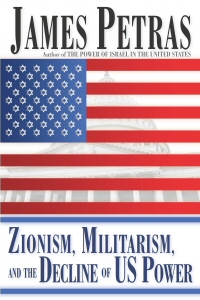
Zionism, the United States, and Hegemony in the Middle East

November 26, 2008

Zionism, Militarism, and the Decline OF US Power
By James Petras

Paperback: 192 pages
(Clarity Press, 2008)
ISBN-10: 0-932863-60-4
ISBN-13: 978-0-932863-60-7

Professor James Petras has written another book — Zionism, Militarism, and the Decline OF US Power — probing deeper into what he contends is a Zionist Power Configuration (ZPC) that has infiltrated and largely usurped US foreign policy even using the US military for its ends in the Middle East. Petras fills his book with lots of evidence backed by sound rationales.

Petras’s thesis is that Israel — and not Big Oil — was behind the push to invade and occupy Iraq. That has already happened. What concerns Petras now is the push by the ZPC to have the United States again breach international law and launch an attack against Iran.

Petras reasons that the ZPC’s purpose is to incorporate Palestine and consolidate its hegemony in the Middle East. Strategically, gaining and holding sway over the planet’s preeminent military power has been a major plank toward this goal.

The professor provides numerous examples of the sway the ZPC wields and how it wields it: through its propaganda and media arms (Petras cites how, pre-“war,” the Lobby produced about 8,800 pro-Iraq attack pieces which were circulated to major Anglo-American media versus zero pro-Iraq attack pieces published from Big Oil spokespeople); through its academic acolytes; through involving US soldiers to fight its wars (Petras charges that the Israel Firsters “ridicule the US military precisely to instigate them to prosecute wars and thereby avoid the loss of Israeli-Jewish lives”); through the relative silence of dissenting voices, including dissenting Jewish voices in mass media; through members of the US Congress beholden through acceptance of campaign contributions form the Lobby.

Campaign contributions turn out, actually, to be an investment. Through seeding the US Congress, Israel has become the prime beneficiary of US “aid,” even though Israel is a relatively well-to-do state, especially compared to many of its neighbors. Petras wavers on what the “US annual ‘tribute to Israel’” is. On page 68, he cites a figure of $6 billion a year; on page 68 he states $3 billion a year; on page 156, it is $2.4 billion a year; and on page 164 it is “well over $3 billion” a year. This irritation contributes to unevenness in Petras’s account.

Exacerbating this irritation is an uneven patchwork of endnotes. Sometimes key points are in the endnotes, and sometimes key points are not in the endnotes. For example, he writes that Big Oil is anxious and fearful about an Israeli-instigated warmongering destabilizing the Middle East citing a source for this claim (p. 32). On page 92 he claims electoral chicanery without citation. Whether the claims are true or not is beside the point, which is that the reader is hindered from checking the professor’s sources. And when there are endnotes, many convey scanty information (e.g., no author, no title, no page) that forces a reader to spend inordinate time tracking down a citation.

Petras, however, deserves kudos for taking on the Lobby which resorts to disreputable tactics to try and silence its critics. Petras does not shirk from identifying how he perceives the threat from the ZPC: “The lesson is clear: the rise of Judeo-fascism represents a clear and present danger to our democratic freedoms in the United States.”

The ZPC is ruthless says Petras, who observes that Israel reneges on obligations as an occupier in Palestine and engages in “meat-grinder genocidal policies in Gaza.” And yet, it has vulnerabilities, such as the “repeated failures and incredible stupidity of the Israeli intelligence agencies.”

The ZPC control apparatus is necessarily twined with the corporate media. “State provocations,” writes Petras, “require uniform mass media complicity in the lead-up to open warfare.”

With a massive media blitz and compliant government, Israel recruits US soldiers to fight its wars. The US, on the other hand, tries to get its victims to fight against their fellow countryfolk. This is a dubious strategy reasons Petras, as Iraqis fighters under occupation “recruited on basis of hunger and unemployment (caused by US war) are unreliable soldiers.”

This, according to Petras, is a losing tactic: “US colonization of Iraq is a blatant denial of the conditions necessary for reconciliation.”

Just how losing a strategy it is to run a militaristic economy is evidenced by the massive capitalistic expansion of non-belligerent China. In fact, the US is becoming less competitive and falling into an increasingly dire economic situation

Petras describes a schism among Jewry. He notes that “most Jewish Americans differ from the leaders of the major American Jewish organizations” … but that “they have not or do not challenge” this leadership. Antiwar sentiment among Jewish Americans, finds Petras, is quite vague.

He writes that “both the progressive majority of Jews and the reactionary minority … have a fundamental point of agreement and convergence: support for and identity with Israel and its anti-Arab prejudices, its expansion, and the dispossession of Palestine [sic].”

Given that the peace movement has gone AWOL, this bodes ill for the peoples of the Middle East. Here again, Petras holds the ZPC responsible since he charges that it has also infiltrated the antiwar movement and split it, rendering it anemic.

Petras notes that everywhere he visits around the globe people from all walks ask him why American citizens tolerate the killing done by the US government/military. This is a good question, but another question is unasked by Petras. Why do these citizens not demand the same answers from their complicit governments which, even when they do not contribute fighters to a so-called Coalition of the Willing, remain silent to the great criminal breaches of international law and the abandonment of morality?

That is why Petras’s thesis in Zionism, Militarism, and the Decline OF US Power is important: innocent people are dying for wicked reasons.

Kim Petersen is co-editor of Dissident Voice. He can be reached at: kim@dissidentvoice.org. Read other articles by Kim.