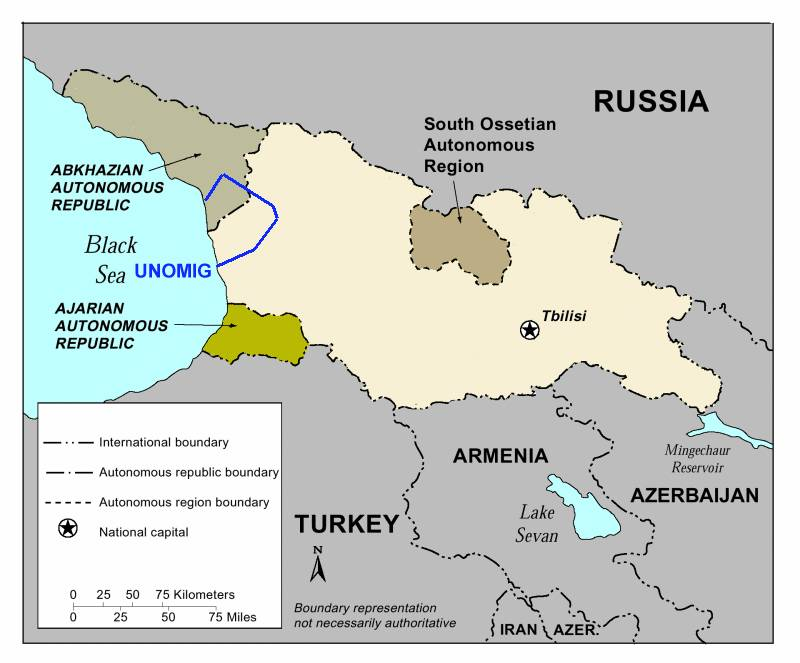
During the night of August 7, coinciding with the opening ceremony of the Beijing Olympics, Georgia’s president Saakashvili ordered an all-out military attack on Tskhinvali, the capital of South Ossetia.
The aerial bombardments and ground attacks were largely directed against civilian targets including residential areas, hospitals and the university. The provincial capital Tskhinvali was destroyed. The attacks resulted in some 1500 civilian deaths, according to both Russian and Western sources. “The air and artillery bombardment left the provincial capital without water, food, electricity and gas. Horrified civilians crawled out of the basements into the streets as fighting eased, looking for supplies.” (AP, August 9, 2008). According to reports, some 34,000 people from South Ossetia have fled to Russia. (Deseret Morning News, Salt Lake City, August 10, 2008)
The importance and timing of this military operation must be carefully analyzed. It has far-reaching implications.
Georgia is an outpost of US and NATO forces, on the immediate border of the Russian Federation and within proximity of the Middle East Central Asian war theater. South Ossetia is also at the crossroads of strategic oil and gas pipeline routes.

Georgia does not act militarily without the assent of Washington. The Georgian head of State is a US proxy and Georgia is a de facto US protectorate.
Who is behind this military agenda? What interests are being served? What is the purpose of the military operation.
There is evidence that the attacks were carefully coordinated by the US military and NATO.
Moscow has accused NATO of “encouraging Georgia”. Russia’s Foreign Minister Sergey Lavrov underscored the destabilizing impacts of “foreign” military aid to Georgia: .
“It all confirms our numerous warnings addressed to the international community that it is necessary to pay attention to massive arms purchasing by Georgia during several years. Now we see how these arms and Georgian special troops who had been trained by foreign specialists are used,” he said.(Moscow accuses NATO of having “encouraged Georgia” to attack South Ossetia, Russia Today, August 9, 2008)
Moscow’s envoy to NATO, Dmitry Rogozin, sent an official note to the representatives of all NATO member countries:
“Russia has already begun consultations with the ambassadors of the NATO countries and consultations with NATO military representatives will be held tomorrow,” Rogozin said. “We will caution them against continuing to further support of Saakashvili.”
“It is an undisguised aggression accompanied by a mass propaganda war,” he said.
(See Moscow accuses NATO of having “encouraged Georgia” to attack South Ossetia, Russia Today, August 9, 2008)
According to Rogozin, Georgia had initially planned to:
“start military action against Abkhazia, however, ‘the Abkhaz fortified region turned out to be unassailable for Georgian armed formations, therefore a different tactic was chosen aimed against South Ossetia’, which is more accessible territorially. The envoy has no doubts that Mikheil Saakashvili had agreed his actions with “sponsors”, “those with whom he is negotiating Georgia’s accession to NATO “. (RIA Novosti, August 8, 2008)
Contrary to what was conveyed by Western media reports, the attacks were anticipated by Moscow. The attacks were timed to coincide with the opening of the Olympics, largely with a view to avoiding frontpage media coverage of the Georgian military operation.
On August 7, Russian forces were in an advanced state readiness. The counterattack was swiftly carried out.
Russian paratroopers were sent in from Russia’s Ivanovo, Moscow and Pskov airborne divisions. Tanks, armored vehicles and several thousand ground troops have been deployed. Russian air strikes have largely targeted military facilities inside Georgia including the Gori military base.
The Georgian military attack was repealed with a massive show of strength on the part of the Russian military.

In this image made from television, Russian military vehicles are seen moving towards the capital of South Ossetia, Tskhinvali, on Friday, Aug. 8, 2008. (AP / APTN)
Act of Provocation?
US-NATO military and intelligence planners invariably examine various “scenarios” of a proposed military operation– i.e. in this case, a limited Georgian attack largely directed against civilian targets, with a view to inflicting civilian casualties.
The examination of scenarios is a routine practice. With limited military capabilities, a Georgian victory and occupation of Tskhinvali, was an impossibility from the outset. And this was known and understood to US-NATO military planners.
A humanitarian disaster rather than a military victory was an integral part of the scenario. The objective was to destroy the provincial capital, while also inflicting a significant loss of human life.
If the objective were to restore Georgian political control over the provincial government, the operation would have been undertaken in a very different fashion, with Special Forces occupying key public buildings, communications networks and provincial institutions, rather than waging an all out bombing raid on residential areas, hospitals, not to mention Tskhinvali’s University.

Tskhinvali’s University before the bombing
The Russian response was entirely predictable.
Georgia was “encouraged” by NATO and the US. Both Washington and NATO headquarters in Brussels were acutely aware of what would happen in the case of a Russian counterattack.
The question is: was this a deliberate provocation intended to trigger a Russian military response and suck the Russians into a broader military confrontation with Georgia (and allied forces) which could potentially escalate into an all out war?
Georgia has the third largest contingent of coalition forces in Iraq after the US and the UK, with some 2000 troops. According to reports, Georgian troops in Iraq are now being repatriated in US military planes, to fight Russian forces. (See Debka.com, August 10, 2008)
This US decision to repatriate Georgian servicemen suggests that Washington is intent upon an escalation of the conflict, where Georgian troops are to be used as cannon fodder against a massive deployment of Russian forces.
US-NATO and Israel Involved in the Planning of the Attacks
In mid-July, Georgian and U.S. troops held a joint military exercise entitled “Immediate Response” involving respectively 1,200 US and 800 Georgian troops.
The announcement by the Georgian Ministry of Defense on July 12 stated that they US and Georgian troops were to “train for three weeks at the Vaziani military base” near the Georgian capital, Tbilisi. (AP, July 15, 2008). These exercises, which were completed barely a week before the August 7 attacks, were an obvious dress rehearsal of a military operation, which, in all likelihood, had been planned in close cooperation with the Pentagon.
The war on Southern Ossetia was not meant to be won, leading to the restoration of Georgian sovereignty over South Ossetia. It was intended to destabilize the region while also triggering a US-NATO confrontation with Russia.
On July 12, coinciding with the outset of the Georgia-US war games, the Russian Defense Ministry started its own military maneuvers in the North Caucasus region. The usual disclaimer by both Tblisi and Moscow: the military exercises have “nothing to do” with the situation in South Ossetia. (Ibid)
Let us be under no illusions. This is not a civil war. The attacks are an integral part of the broader Middle East Central Asian war, including US-NATO-Israeli war preparations in relation to Iran.
The Role of Israeli Military Advisers
While NATO and US military advisers did not partake in the military operation per se, they were actively involved in the planning and logistics of the attacks. According to Israeli sources (Debka.com, August 8, 2008), the ground assault on August 7-8, using tanks and artillery was “aided by Israeli military advisers”. Israel also supplied Georgia with Hermes-450 and Skylark unmanned aerial vehicles, which were used in the weeks leading up to the August 7 attacks.
Georgia has also acquired, according to a report in Rezonansi (August 6, in Georgian, BBC translation) “some powerful weapons through the upgrade of Su-25 planes and artillery systems in Israel”. According to Haaretz (August 10, 2008), Israelis are active in military manufacturing and security consulting in Georgia.
Russian forces are now directly fighting a NATO-US trained Georgian army integrated by US and Israeli advisers. And Russian warplanes have attacked the military jet factory on the outskirts of Tbilisi, which produces the upgraded Su-25 fighter jet, with technical support from Israel. (CTV.ca, August 10, 2008)
When viewed in the broader context of the Middle East war, the crisis in Southern Ossetia could lead to escalation, including a direct confrontation between Russian and NATO forces. If this were to occur, we would be facing the most serious crisis in US-Russian relations since the Cuban Missile crisis in October 1962.
Continued . . .


 Peace and Justice Post
Time to Quit Afghanistan
March 16, 2009by Eric Margolis | Toronto Sun (Canada), March 15, 2009
It’s taken far too long for Prime Minister Stephen Harper to finally admit the war in Afghanistan cannot be won. Better late than never. Kudos to Harper for facing facts and telling Canadians the truth.
If the war can’t be won, why risk lives of Canadian troops for nothing? Why stay in harm’s way a day longer when the writing is on the wall in Afghanistan? President Barack Obama, who is sending more troops to Afghanistan, ought to be asking himself the same questions.
We must think hard about waging an increasingly bloody war against lightly-armed mountain tribesmen who face the 24/7 lethal fury of the U.S. air force’s heavy bombers, strike aircraft, helicopter and AC-130 Spectre gunships, killer drones and heavy artillery. Do we really want a test of wills against men who have the courage to endure cluster bombs with thousands of sharp fragments, white phosphorus that burns through flesh to the bone, fuel/air explosives that burst the lungs and tear apart bodies? Will Canada’s use of Soviet helicopters and Israeli drones win Afghan hearts and minds?
Our propaganda brands these Pashtun tribesmen as “Taliban terrorists.” They call themselves warriors fighting occupation by the western powers and their local Communist, Tajik and Uzbek allies.
Al-Qaida’s few hundred members long ago vanished.
Fatuous claims we occupy Afghanistan to protect women are belied by the continued plight of Afghan females under western rule. A British report just concluded 100,000 Indian women are burned alive each year for their dowries. Will we now send troops to India?
Only the first step
Admitting the U.S. and NATO cannot bludgeon the Afghan resistance into submission is only the first step. If the war can’t be won, then Canadian soldiers should remain in their bases, stop aggressive patrolling and cease attacks on Taliban supporters and civilians. Other NATO members are doing so.
The next step is to understand that wars are waged for political objectives, not simply to kill your enemies.
The U.S.-led forces in Afghanistan have no coherent political objectives. The U.S.-installed Karzai regime in Kabul has no political legitimacy and commands no respect or loyalty. It is engulfed by corruption and massive drug dealing. The Obama administration is casting about for a new puppet, but so far can’t find one who could do any better than poor Karzai. You can’t make a puppet into a real national leader.
Worse, as Kabul flounders and the Taliban and its allies are on the offensive, events in neighbouring Pakistan are going from awful to calamitous. The West cannot wage war in Afghanistan without the support of Pakistan’s army, air bases, intelligence service and logistical infrastructure. That means keeping a government in power in Islamabad responsive to U.S. demands and that will continue renting its army to Washington.
But Pakistan is in political chaos. After easing former discredited dictator Pervez Musharraf out of power, Washington eased into power Pakistan People’s Party leader, Asif Ali Zardari, widower of Benazir Bhutto. His popularity ratings are rock bottom.
Zardari recently got his stooges on the corrupt Supreme Court to ban Pakistan’s most popular democratic opposition leader, Pakistan Muslim League chief Nawaz Sharif, from running for office. Nawaz’s brother, Shabaz, also was judicially deposed as minister of Punjab, Pakistan’s largest state.
Violent demonstrations against Zardari’s dictatorial ploy are shaking Pakistan. It would be surprising if the unpopular Zardari, who is dogged by grave corruption charges, manages to cling to power. But Nawaz also has plenty of skeletons in his closets. The army — Pakistan’s other government — is watching the nation’s descent into bankruptcy and political chaos with mounting concern.
The military fortunes of the U.S. and NATO in South Asia thus rest on political quicksand in both Afghanistan and Pakistan. Plans by the U.S. to arm tribes on Pakistan’s North-West Frontier are sure to bring even more violence and chaos.
NATO, which has no strategic interest in the region, would be wise to get its troops out of this boiling mess.
Share this:
Tags:Afghan resistance, Afghanistan, Canadian troops, Pakistan, PM Stephen Harper, President Barack Obama, US and NATO, war
Posted in Afghanistan, Commentary, Uncategorized, warmongers | Leave a Comment »