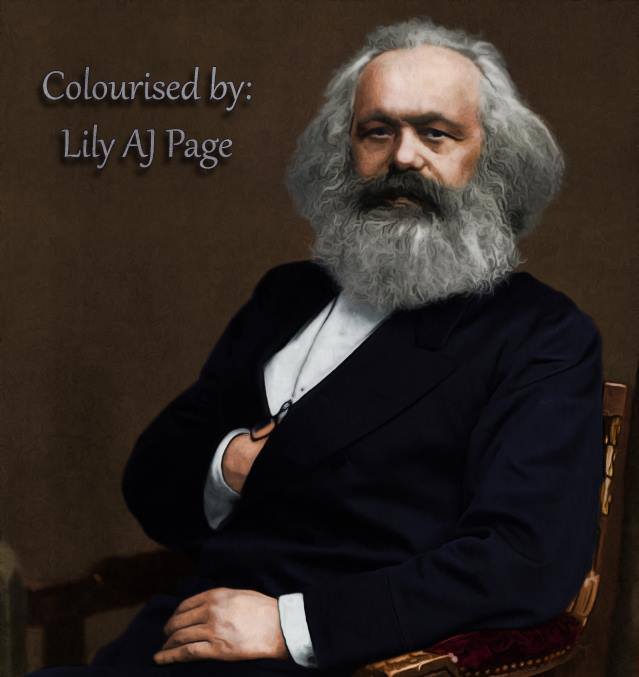
Posts Tagged ‘Karl Marx’

๐€๐ˆ ๐‘๐ž๐ฏ๐ข๐ž๐ฐ ๐จ๐Ÿ “๐ƒ๐ž๐ฏ๐ž๐ฅ๐จ๐ฉ๐ฆ๐ž๐ง๐ญ ๐จ๐Ÿ ๐ญ๐ก๐ž ๐‚๐จ๐ง๐œ๐ž๐ฉ๐ญ ๐š๐ง๐ ๐“๐ก๐ž๐จ๐ซ๐ฒ ๐จ๐Ÿ ๐€๐ฅ๐ข๐ž๐ง๐š๐ญ๐ข๐จ๐ง ๐ข๐ง ๐Œ๐š๐ซ๐ฑ’๐ฌ ๐–๐ซ๐ข๐ญ๐ข๐ง๐ ๐ฌ, ๐Œ๐š๐ซ๐œ๐ก ๐Ÿ๐Ÿ–๐Ÿ’๐Ÿ‘ ๐ญ๐จ ๐€๐ฎ๐ ๐ฎ๐ฌ๐ญ ๐Ÿ๐Ÿ–๐Ÿ’๐Ÿ’”

July 2, 2025

ย Nasir Khanโ€™s work on Marxโ€™s theory of alienation presents a meticulous analysis of this critical period in Marxโ€™s early thought. By narrowing the focus to just seventeen months, the study provides a detailed exploration of the evolution of Marxโ€™s ideas on alienation, offering a nuanced understanding of Marx’s journey toward articulating a mature theory. Khanโ€™s work situates Marx’s discussions on alienation within the broader intellectual movements of the time and evaluates Marxโ€™s dialogue with his contemporaries, like Feuerbach and Hegel. This work stands out for its in-depth textual analysis and the clarity it brings to complex conceptual developments.

Overview

The main contribution of Nasir Khan’s study is a precise, historically situated analysis of Marx’s concept of alienation spanning March 1843 to August 1844, a crucial period in Marx’s intellectual development. The work meticulously traces the evolution of Marxโ€™s thoughts on alienation against the backdrop of his engagement with the philosophical ideas of Feuerbach and Hegel and highlights the continuous thread of alienation throughout Marx’s oeuvre. The study further attempts to clarify the distinctions between Marx’s early and mature views, emphasizing the foundational role of alienation within Marxian theory.

Relevant References

Including a clear literature review helps reviewers quickly see what’s new and why it matters, which can speed up the review and improve acceptance chances. The following references were selected because they relate closely to the topics and ideas in your submission. They may provide helpful context, illustrate similar methods, or point to recent developments that can strengthen how your work is positioned within the existing literature.

Mรฉszarรณs, Istvรกn. Marx’s Theory of Alienation. 2000, https://ci.nii.ac.jp/ncid/BA18224533.

Yi-xia, Wei. โ€œAlienation Theory and the Essence of the Philosophical Revolution of K.Marx.โ€ Journal of Harbin Techers College, 2001, https://en.cnki.com.cn/Articl…/CJFDTOTAL-HEBS200101004.htm.

Galazova, Svetlana S. Chapter 14 Scientific Projections of K. Marxโ€™s โ€œConcept of Alienation.โ€ 2018, doi:10.1108/s1569-375920180000100015.

Hui-yi, Yuan. โ€œThe Logical Evolution of Marx’s Theory of Alienation.โ€ Journal of Guangdong Peizheng College, 2010, https://en.cnki.com.cn/Articl…/CJFDTOTAL-GDPZ201002009.htm.

Thompson, Lanny Ace. โ€œThe Development of Marx’s Concept of Alienation: An Introduction.โ€ Social Thought & Research, University of Kansas, 1979, doi:10.17161/str.1808.6083.

Wandan, Xin. โ€œLimitations of the Theory of Alienation Propounded by Marx in His Youth.โ€ Chinese Studies in Philosophy, Taylor & Francis, 1984, doi:10.2753/csp1097-1467160190.

Chen, Dezhi. โ€œTHE EVOLUTION OF MARX ALIENATION THEORY AND SEVERAL PONDERS.โ€ Journal of Chaohu College, Chaohu University, 2007, https://en.cnki.com.cn/Articl…/CJFDTOTAL-CHXY200701003.htm.

Qing-fa, Zeng. โ€œOn Marxs Alienation Theory.โ€ Journal of Wuhan Institute of Shipbuilding Technology, Wuhan Vocational and Technical College of Shipbuilding, 2003, http://en.cnki.com.cn/Article_en/CJFDTOTAL-WHCB200304013.htm.

Xiao, Jin. โ€œMarx’s Theory on Alienation.โ€ Journal of Huanggang Normal Universirt, 2002, http://en.cnki.com.cn/Article_en/CJFDTOTAL-HGXB200204000.htm.

Gui, Zhou. โ€œMarx’s Theory of Alienation: Unity of Humanity Solicitude Dimension and Science Guidance Dimension.โ€ Journal of Southern Yangtze University, Jiangnan University, 2004, http://en.cnki.com.cn/Article_en/CJFDTOTAL-WXQS200403002.htm.

Strengths

Nasir Khan’s manuscript exhibits a high level of scholarly rigor, offering a deep dive into the historical and intellectual contexts that shaped Marx’s understanding of alienation. The focused timeline allows for a detailed examination of the progression of Marxโ€™s thoughts and provides compelling evidence of the continuity of alienation as a central theme throughout Marx’s work. The study is notable for its thorough engagement with primary sources, complemented by an impressive command of the secondary literature, which enhances the reader’s comprehension of complex theoretical developments.

Major Comments

Methodology

The methodology employed in the manuscript is largely based on historical and textual analysis, which suits the research aim of tracking the evolution of a philosophical concept. However, it could benefit from a more explicit framework that would help in teasing out the comparative aspects between Marx’s early and later writings. A structured methodological explanation would strengthen the workโ€™s overall coherence and would facilitate a clearer understanding for readers.

Clarity and Framing

While the manuscript excels in depth, some sections could be made more accessible. For example, explanations of key philosophical terms and clearer sub-sections within chapters could guide the reader through the dense theoretical material. Providing more context or summaries of discussions in the preface or introduction might also aid non-specialists in following Khanโ€™s arguments more easily.

Minor Comments

Glossary Placement

Introducing a glossary of key terms at the beginning rather than the end might help readers less familiar with Marxian terminology better engage with the text. This change could facilitate a smoother reading experience, particularly for interdisciplinary audiences.

Figures and Diagrams

Considering the abstract nature of many points, inclusion of diagrams to represent the interconnections between different elements of Marxโ€™s theory of alienation could be beneficial. Visual aids could provide readers with a concise overview of Khanโ€™s sophisticated analyses.

Reviewer Commentary

Nasir Khan’s work prompts reflection on the relevance of Marx’s theory of alienation today, highlighting its enduring significance in understanding human nature and societal structures. The focus on an early period in Marxโ€™s intellectual journey opens fresh avenues for interdisciplinary discourse, particularly in sociology, economics, and political science. Khan’s analysis reminds us that foundational philosophical theories continue to provide insightful frameworks for examining current socio-economic paradigms.

Summary Assessment

Overall, Nasir Khan’s manuscript offers a thorough and well-researched analysis of Marxโ€™s theory of alienation during a pivotal period of his intellectual life. By tracing the development of Marxโ€™s thoughts with precision and insight, the work contributes meaningfully to Marxist scholarship and invites further exploration of alienation within contemporary contexts. This study stands as a significant scholarly piece that engages both historical and philosophical dimensions, advancing the academic conversation on one of Marx’s most critical and still-relevant concepts.

Upon completion of this review, it becomes apparent that Nasir Khan’s contributions present a scholarly endeavor that enriches our comprehension of Marx’s concept of alienation, prompting continued dialogue and reflection across diverse intellectual traditions.

๐•†๐•Ÿ ๐•‚๐•’๐•ฃ๐• ๐•„๐•’๐•ฃ๐•ฉ’๐•ค ๐•ƒ๐•š๐•—๐•– ๐•’๐•Ÿ๐•• ๐•€๐••๐•–๐•’๐•ค

October 27, 2024

–Nasir Khan

โ€œAll mysteries which lead theory to mysticism find their rational solution in human practice and in the comprehension of this practice.โ€

โ€• Karl Marx

Karl Marx was born on May 5, 1818, in the Prussian province of Rhine, and died in London in March 1883, at the age of 65. He was the most influential socialist philosopher and revolutionary thinker, whose ideas have deeply influenced the course of human history and human thought.

His writings cover philosophy, history, political economy, anthropology, social criticism, history, theory of revolutionary practice, and he himself participated in revolutionary activities. When he was a student at the university, he was deeply involved in the Young Hegelian movement. The members of this group in their articles and pamphlets criticized Christian culture. Feuerbachโ€™s materialism was opposed to Hegel’s idealism. He reduced Hegel’s ‘Absolute Spirit’ to human ‘species being’.

Because of Marx’s critical articles in the Rheinische Zeitung, the government closed this paper. He went to Paris in 1843 where he made contacts with French socialist groups and emigre German workers. Here he met Frederick Engels and the two became friends for the rest of their lives. But his stay there was short. He was expelled from Paris in 1844.

After his expulsion from Paris, Marx, along with Engels, moved to Brussels, where they lived for three years. After an intensive study of history, he formulated the theory of history commonly known as historical materialism.

In his theory of history, Marx accepted Hegelโ€™s idea that the world develops according to dialectical process. But the two had different ideas about what the dialectic process entails. For Hegel, historical developments take place through the mystical entity called Absolute Spirit. Marx rejected the notion of Absolute Spirit, and said what moved society was not the Absolute Spirit, but manโ€™s relation to matter, of which the most important part was played by the mode of production.

In this way, Marxโ€™s materialism becomes closely related to economics. Human labour shaped society, and material conditions determined the superstructures. The part played by labour, not some mystical Absolute Spirit, formed the basis of social life. Marxโ€™s dialectal view of social change is shorn of Hegelโ€™s idealist dialectics. The two stand on different levels, and their philosophies of history differ.

For Marx, man working on nature remakes the world and in doing so he also remakes himself by increasing his powers. Marx wrote in the German Ideology, โ€˜Men have history because they must produce their life.โ€™

Marx went to Paris in 1848 where the revolution first took place and then to Germany. But the failure of the revolutions forced him to seek refuge in London in 1849, where he spent the rest of his life.

He and his family had to face many economic hardships in London. His friend Engels helped him economically and he himself wrote articles as a foreign correspondent for the New York Daily Tribune for which he was paid reasonably well. But he and his family had unending economic problems.

However, the revolutionary thinker devoted much time to the First International and its annual Congresses. The rest of the time, he spent in the British Museum library, collecting material and taking notes and analysing the material for studies of political economy. In 1867, he published the first volume of Capital, in which he discussed the capitalist mode of production. He explained his views on the labour theory of value, the conception of surplus value, accumulation of capital and the โ€˜so-called primitive accumulationโ€™ in the final part of the book. He had completed the volumes II and II in the 1860s, which Engels published after the death of Marx in 1883.

The profound analysis of capital, Marx undertook in the nineteenth century, is still relevant to our understanding the global capitalism and the forces that control it. He had shown the tendency of capital under the general law of capitalist accumulation. A few own more wealth, but others have little to live on. A recent Oxfam report says that eight men own the same wealth as the 3.6 billion people, who form the poorest half of humanity. In the global economy, rich industrialists and producers take advantage of the global workforce that mostly lives in the global South. The abundant cheap labour from the poor countries is used to produce goods that are sold at high prices in the industrialized western countries.

The problem to end the exploitation of the working-class people was a core issue for Marx, and his theory to end this exploitation can only take place when a more equitable form of society is created that stands opposed to the accumulation of capital by a few and the poverty or meagre existence of the majority. That objective of a human society is not possible under capitalism.

Socialist philosopher and sociologist Dag ร˜sterberg (1938-2017)

March 22, 2017
Dag ร˜sterberg

by Nasir Khan
Since 1960 Dag ร˜sterberg had the distinction of being a leading social theoretician and a resourceful intellectual in Norway, who made lasting contributions especially in sociology and social philosophy. His death on 22 February 2017 removed a uniquely talented scholar from the social and academic life of Norway, but his books that represent his critical thinking and social concerns will continue to play a role and inspire students, researchers and others.
He earned his Ph.D. degree in sociology from the University of Oslo (UiO) in 1974 for his work on Emile Durkheim and Karl Marx. From 1981 to 1991, he was a professor of sociology at UiO. For a few years he worked as an adjunct professor in music. But his passion was writing and he left such highly-coveted academic positions to concentrate on writing. The area of his authorship was extensive, covering political and social philosophy, sociology, history of ideas as well as musicology, art and classic literature. He wrote some 20 books and published numerous papers and articles on a wide range of issues in scholarly journals and periodicals.
Within the academic milieus in UiO logical positivism had gained much ground in the 1960s. Some prominent Norwegian philosophers held differing views about its role in the social sciences. ร˜sterberg was of the view that social sciences cannot be objective in the sense the natural sciences are objective, but rather they had to be reflective and interpretive. At present, more people have come to accept this view of positivism in the age of postpositivism and postmodernism.
For most of his life, ร˜sterberg was deeply attracted to the works of the influential French philosopher Jean-Paul Sartre. He had a profound understanding of Sartreโ€™s philosophy of existentialism. He translated and published three books dealing with Sartreโ€™s works, and also wrote an authoritative biography Jean-Paul Sartre โ€“ Philosophy, Art, Politics, Private Life, which was published in 1993.
Since he started writing, he showed he had the ability to go to the core of the complex philosophical and sociological issues by analysing and synthesising them. As an intellectual he was a social critic in the radical leftist tradition. Having imbibed much of the critical sociological thought of Max Weber, Emile Durkheim, Georg Simmel, ร˜sterberg approached Marx well-oriented with the European philosophical and cultural tradition.
We may ask when did ร˜sterberg turn seriously to the works of Karl Marx? This question is lucidly summed up by Professor Per Otnes, a Marxist sociologist and a fellow-colleague of ร˜sterberg when the latter taught in the department of sociology:
โ€œThere is, however, a telling appendix to a re-edition [Essays i samfunnsteori theory, Oslo: Pax,1975, p. 28] of this text, where ร˜sterberg states that his command of Marxism as of 1967 was less than adequate. That signals a revised approach. Up to c. 1970 he remained, not unlike Bourdieu, something of a dialectic phenomenologist, influenced by Husserl, Sartre, Merleau-Ponty and others, but not yet influenced very much by Marxโ€™s works. Sartreโ€™s great Critique de la raison dialectique, only just out in 1960, was instrumental in bringing about the inclusion of (neo-)Marxism, to which his A Preface to Marxโ€™s Capital (1972) testifies, summing up critically in no more than c. 60 [79] pp. Marxโ€™s c. 2,500.โ€ 1
Beside Sartre, ร˜sterbergโ€™s discussion of sociological theories included the works of Emile Durkheim, Talcott Parsons, Pierre Bourdeau, and Karl Marx. He summarised the salient theories of such writers and offered his synthesis in his usual incisive manner.
He interpreted and defended the social and political thought of Marx. But he was not a dogmatic defender of Marx, as some Marx enthusiasts or disciples have been for more than a century. Primarily, he saw Marx as a social philosopher and an economist whose theories explored the contradictions of capitalism and showed the way to a better alternative that met the needs of the people on a wider scale. Even towards the end of his life, he continued to emphasise the importance of understanding the economic thought of Marx. This can be seen in his last book he wrote Fra Marxโ€™ til nyere kapitalkritikk [From Marxโ€™s to recent critique of capital] (2016).
As a writer, ร˜sterbergโ€™s language is clear, precise and has a natural flow. Ludwig Wittgenstein had said: What can be said at all can be said clearly. In ร˜sterbergโ€™s case that remark applies admirably well. Unlike some academic writers and authors who occasionally embellish their texts with some Latin terms or foreign words, he was a puritan in the use of his native language, Norwegian; he avoided the use of foreign words as far as he could. However, he had great mastery over English, German and French, but he was averse to the idea of bringing in any foreign words in his texts. He wrote mostly in Norwegian, except for one major work Metasociology: An Inquiry into the Origins and Validity of Social thought (1988). This remarkable volume shows his immense erudition and mastery of modern western social and political thought, whose reading will help English readers become acquainted with this great intellectual. Obviously, his use of his native language for most of his authorship has certainly enriched Norwegian. However, this has also limited the circulation of his books internationally because Norwegian is understood only in Norway, Denmark and Sweden.
During his lifetime ร˜sterberg had received a wide recognition in the Nordic sociology. He was regarded as a leading sociologist who contributed to the western sociological tradition. His books on sociology are popular among students and are included in the syllabuses. But he was not the type of person looking for reputation or acclaim. He was anti-hero, unassuming and followed a simple lifestyle.
Last but not least, I will mention him in a personal context. When I started research for my Ph.D. degree at UiO in 1985, he was my academic supervisor. He was the leading scholar of Marx and Marxist thought teaching as a professor of sociology at that time and I was lucky to have him supervise my work. In 1991, he graciously wrote a preface to my thesis Development of the Concept and Theory of Alienation in Marxโ€™s Writings that was published in 1995. Our contact led to a lasting friendship that lasted over 30 years. The last time we met in Oslo was 2016. On that occasion he offered me a copy of his newly-published book Fra Marxโ€™ til nyere kapitalkritikk.
References:
1. Otnes, Per, Dag ร˜sterberg: The Dialectic of Post-Positvism, Acta Sociologica March 2006 โ—† Vol 49(1): p. 22.

Frederick Engels about his role in Marxist theory

February 9, 2017

Nasir Khan, February 9, 2017

The names of Karl Marx and Frederick Engels are inseparably linked for laying the foundations of Scientific Socialism in contrast to the previous versions known as utopian socialism. As long they lived, their intellectual partnership was in the service of a common cause but deeply rooted in rigorous scientific work in social sciences including history, economics and the socialist movement.

After the death of Marx in 1883, Engels had the ardous task of sorting out the unfinished notes and scripts that eventually he published as the rest of the volumes of Das Kapital. He wrote a number of books on history and philosophy which hold a pre-eminent position within Marxism.

But how did he see his contribution to the new theories the two friends had developed? Any normal human being who works all his life and produces so much worthwhile scientific works will take pride in his/her accomplishments and will not allow anyone or anything to take away the credit he/she deserves. It is just being human to think so.

But the co-founder of Marxism was a great human being in another respect also. He refused to take any credit for his contributions and instead accredited Marx with developing the fundamental theories that are called Marxism. In fact, I can’t find another example of a dedicated thinker and writer anywhere in world history who showed so much modesty as Engels did about his role.

While reading once again Engels’s Ludwig Feuerbach and the End of Classical German Philosophy (first published in German in 1886), the following marginal note he wrote profoundly stirred me. Such was the friend of Karl Marx!

“Lately repeated reference has been made to my share in this theory, and so I can hardly avoid saying a few words here to settle this point. I cannot deny that both before and during my forty years’ collaboration with Marx I had a certain independent share in laying the foundations of the theory, and more particularly in its elaboration. But the greater part of its leading basic principles, especially in the realm of economics and history, and, above all, their final trenchant formulation, belong to Marx. What I contributedโ€”at any rate with the exception of my work in a few special fieldsโ€”Marx could very well have done without me. What Marx accomplished I would not have achieved. Marx stood higher, saw further, and took a wider and quicker view than all the rest of us. Marx was a genius; we others were at best talented. Without him the theory would not be by far what it is today. It therefore rightly bears his name. (Note by Engels, in Chapter IV)

upload.wikimedia.org

On the unity of workers for a socialist world order

December 27, 2016

Nasir Khan, December 27, 2016

When the workers of all countries unite for the common cause of a creating a society where the capitalists and owners of the means of production do not control the lives and destinies of the 99% of human beings in the world, any such unity in Marxist thought is known as proletarian internationalism.

The goal of the struggle of the working masses including peasants and landless serfs is primarily to defend themselves against the power and domination of the owners of means of production that they mostly use for augmenting their own wealth and upholding their privileges. The ideas about the unity of working classes to create a humane world has been the focus of theoretical and practical activities of generations of socialists since the founders of Scientific Socialism formulated their economic and political theories in the 19th century.

The first major step in creating a socialist society took place in Czarist Russia where the Bolsheviks under the leadership of Vladimir Lenin overthrew the old dynastic rule and introduced the Soviet system.

The success of the Bolshevik Revolution in 1917 was a catalyst for revolutionary activities of the working masses in many countries and also a clarion call to the colonised people to overthrow their colonial masters. As a result, anti-colonial struggles became a powerful force in many Afro-Asian countries. Many countries, big and small, succeeded in throwing off the yoke of European masters.

But in many instances the local ruling classes that emerged had their roots in privileged classes or groups. The struggle for political and economic exploitation became their sole interest. While such leaders plundered their own people and used the political system as a camouflage for furthering their interests, the plight of the poor people remained a non-issue for them. In any case, it is little consolation to the working class, poor or starving people that their โ€œgloriousโ€ saviours and leaders have hundreds of millions of dollars stacked in secret banks accounts in Switzerland, France, Britain and America!

However, such exploitation and downright plunder is not incidental. It is endemic, and closely related to how the capitalist political and economic system works. As long as capitalism lives, such exploitation will have its sway. In the third world countries, the problem of institutionalied brainwashing coupled with the exploitation of religion and cheap deceptive slogans at the hands of the ruling elites will continue to play havoc with the people of many Afro-Asian countries.

No doubt, capitalism is wonderful for a few but a disaster for many. To address such issues, Karl Marx and Frederick Engels advocated socialist democracy and a socialist system in place of capitalism. To achieve that goal, political education of working classe people is the first step and that education is part of the political activity that is expressed by the unity of the workers.

ย Image may contain: 2 people
LikeShow More Reactions

Comment

Karl Marx on Religion

November 24, 2015

.

Karlย  MarxMarx a photo

.

Dr Nasir Khan, November 24, 2015

Note: I am reproducing one section of Chapter 4 (pp. 146-153) from my book, Development of the Concept and Theory of Alienation in Marxโ€™s Writings (1995). My aim is to present Marxโ€™s ideas on religion in the context of his theory of alienation for a wider audience. For complete abbreviations and references, see the book (link provided at the end of this paper).

For Marx religion is primordially an active form of ideological alienation, where inverted world-consciousness and mystification become the essential elements of the alienative process. Marx’s writings show that he hardly ever thought it worthwhile to discuss theological formulations or religious dogmas. The question of religious consciousness for Marx was a matter of little interest. Karl Lรถwith writes: ‘By advancing towards the criticism of man’s material conditions, Marx does not simply leave behind the criticism of religion but rather assumes it on a new level; for though, on the basis of the social-political world, religion is but a false consciousness, the question has still to be answered: Why did this real world at all develop an inadequate consciousness?

If we assume with Feuerbach that the religious world is only a self-projection of the human world, one has to ask: Why do the latter project the first and create a religious superstructure? . . . It is not enough to state with Feuerbach that religion is a creation of man; this statement has to be qualified by the further insight that religion is the consciousness of that man who has not yet returned from his self-alienation and found himself at home in his worldly conditions’ (Lรถwith 1949, 48, 49).

Marx’s approach to religion in his early thinking can be seen in his letter of November 1842 to Arnold Ruge, where he says that ‘religion should be criticised in the framework of criticism of political conditions rather than that political conditions should be criticised in the framework of religion … for religion in itself is without content, it owes its being not to heaven but to the earth, and with the abolition of distorted reality, of which it is the theory, it will collapse of itself’ (CW1, 394-95). If religion is without any content, then the whole problematic of religion can be reduced to a particular mode of products and as such it is always a reflection of the material historical developments. In Anti-Dรผhring, Engels writes: ‘All religion, however, is nothing but the fantastic reflection in men’s minds of those external forces which control their daily life, a reflection in which the terrestrial forces assume the form of supernatural forces. In the beginnings of history, it was the forces of nature which were so reflected and which in the course of further evolution underwent the most manifold and varied personifications among the various peoples . . . But it is not long before, side by side with the forces of nature, social forces begin to be active — forces which confront man as equally alien and at first equally inexplicable, dominating him with the same apparent natural necessity as the forces of nature themselves’ (Engels 1978, 382-83). In this lucid exposition, Engels points to the roots of religion in the early phase of historical development of mankind. At this stage, the primitive man comes to the realisation of his helplessness when he is face to face with the gigantic and mighty forces of nature. His effort to appease these, leads to primitive nature worship. But at a later stage under the antagonistic class society, the exploited classes of society face to face with the social oppression, and in their helplessness give birth to and foster religion, the belief in a better life hereafter, the alleged reward for suffering on earth (see Foreword to Marx & Engels 1972, 8).

In this connection, Kostas Axelos, the French Marxist of Arguments group, sums up the Marxian position: ‘Being the expression of impotence and alienation, religion in turn, in its own modality, alienates man from his life and from his essential forces. Far from being some kind of index of the strength of human being, religion comes about only owing to man’s weakness, his frustrations, his dissatisfactions, his alienation. An abstraction from concrete conditions, religion is a product of the alienation of man on the level of both practice and theory. Mystery, far from implying a truth of its own, veils the truth of reality and masks its own mystification’ (Axelos 1976, 160). Within the sphere of developed productive forces under the institutionalized private ownership, ‘religion begins to express the alienation of man in relation to the products of his labour as the imaginary satisfaction of unsatisfied real drives. The non-development of productive forces determines the genesis of religion, and this later development determines its subsequent “evolution” ‘ (ibid. 159-160).

At the time of writing the Introduction, Marx’s conversion to the standpoint of theoretical communism takes place. In the beginning of the essay, he excellently summarises his views on religion. Marx is referring to the philosophical critique of religion and the religious alienation accomplished by the Young Hegelians from Strauss to Feuerbach when he says: ‘For Germany, the criticism of religion is in the main complete, and criticism of religion is the premise of all criticism’ (CW3, 175). There are possibly two main reasons for Marx’s viewing of religious criticism as the premise of all criticism. First, religion stood in the way of any political change in Germany by its adamant support of the Prussian state. It meant that any change in the political sphere was possible when the powerful support of religion to the status quo was removed. Secondly, religion per se represented the most extreme form of alienation, and it was at this point that secularisation had to start; religion was the pivotal point for the criticism of other forms of alienation (see McLellan 1972, 185).

Marx succinctly summarises the accomplishment of Feuerbach’s religious philosophy: ‘The profane existence of error is discredited after its heavenly oratio pro aris et focis [speech for the altars and hearths] has been disproved. Man, who looked for a superhuman being in the fantastic reality of heaven and found nothing there but the reflection of himself, will no longer be disposed to find out but the semblance of himself, only an inhuman being, where he seeks and must seek his true reality’ (CW3, 175). Religion, in Marx’s view, was ‘the self-consciousness and self-esteem of man who has either not yet found himself or has already lost himself again’ (CW3, 175). The intellectual climate in which the young Marx lived was dominated by the Young Hegelians’ atheistic critique of religion. In the beginning, he shared their viewpoint, but ‘he became disenchanted with their war of words. What eventually turned Marx against philosophical forms of atheism, as he understood them, was their failure to grasp the fact that religion has a justificatory function which resists philosophical critique’ (Myers 1981, 317).

A recurrent theme in Marx’s criticism is the transformational characteristic of religion. The social structure in the first place provides the basis for the inverted world of religion because it is in itself an inverted world. In this, he differs from Feuerbach. Marx does not simply reduce religious elements to any more fundamental elements: ‘The basis of irreligious criticism is: Man makes religion, religion does not make man . . . But man is no abstract being encamped outside the world. Man is the world of man, the state, society. This state, this society, produce religion, an inverted world-consciousness, because they are an inverted world’ (CW3, 175).

Marx in his evaluation of religion uses a series of illuminating metaphors to show the place of religion in an inverted world: ‘Religion is the general theory of that world, its encyclopaedic compendium, its logic in a popular form, its spiritualistic point d’honneur, its enthusiasm, its moral sanction, its solemn compliment, its universal source of consolation and justification. It is the fantastic realisation of the human essence because the human essence has no true reality’ (CW3, 175). Religion, on the one hand, expresses the real social distress, and on the other, it seeks to justify the social oppression. ‘The struggle against religion is therefore indirectly a fight against the world of which religion is the spiritual aroma. Religious distress is at the same time the expression of real distress and also the protest against real distress. Religion is the sigh of the oppressed creature, the heart of a heartless world, just as it is the spirit of spiritless conditions. It is the opium of the people’ (CW3, 175). Presumably, Marx thought that taking drugs like opium helped to bring about a condition of illusions and hallucinations; it also proved as a palliative, a consolatory refuge from the heartlessness and hardships of the real world. Religion for Marx is a medium of social illusions. An alienated and alienating human existence calls for these illusions. The need for these illusions is not illusory; it is real. Marx in his much later work, Capital, describes religious world as ‘a reflex of the real world’ (Marx 1977, 83).

Marx’s description of religion in the Introduction has sometimes been seen to contain a positive evaluation of religion. However, this view can be attributed to a perfunctory understanding of Marx’s ideas. McLellan in his book, Marxism and Religion, rightly says that if it was so, then it was an extremely backhanded compliment: ‘Religion may well represent humanity’s feeble aspirations under adverse circumstances, but the whole tenor of the passage is that religion is metaphysically and sociologically misguided and that its disappearance is the pre-condition for any radical amelioration of social conditions’ (McLellan 1987, 13).

The way to overcome religious consciousness is therefore through the changing of the conditions, which provide a material base to inverted consciousness in society. ‘A strictly materialistic critique of religion consists neither in pure and simple rejection (Bauer) nor in mere humanisation (Feuerbach) but in the positive postulate to create conditions which deprive religion of all its source and motivation. The practical criticism of the existing society can alone supersede religious criticism’ (Lรถwith 1949, 49). Religious persecution and coercion as a political tool only serve to strengthen the chains of religion. The critique of religion, accordingly, addresses itself to the issues in the world that produce and keep religion.

The editors of Marx and Engels: On Religion point out that ‘Marx and Engels most resolutely denounced the attempts of the anarchists and Blanquists, Dรผhring and others to use coercive methods against religion. . . . They proved that the prohibition and persecution of religion can only intensify religious feeling. On the other hand, Marxism, contrary to bourgeois atheism with its abstract ideological propaganda and its narrow culturalism, shows that religion cannot be eliminated until the social and political conditions which foster it are abolished’ (Marx & Engels 1972, 9). The illusory consolation of religion cannot be remedied by the removal of religion: ‘To abolish religion as the illusory happiness of the people is to demand their real happiness. The demand to give up illusions about the existing state of affairs is the demand to give up a state of affairs which needs illusions. The criticism of religion is therefore in embryo the criticism of vale of tears, the halo of which is religion’ (CW3, 176).

Marx in the Introduction makes it abundantly clear that the criticism of religion is not a goal in itself. The criticism of religion is only a premise for every other kind of criticism; it is not more than that. The real aim in the exposure of religion is not that it tears up the imaginary flowers camouflaging the alienated life of the people, but rather that the people ‘shake off the chain and pluck the living flower’ (CW3, 176). It is essential, therefore, that the criticism of religion becomes a criticism of politics: ‘The task of history, therefore, once the world beyond the truth has disappeared, is to establish the truth of this world. The immediate task of philosophy, which is at the service of history, once the holy form of human self-alienation has been unmasked, is to unmask self-alienation in its unholy forms. Thus, the criticism of heaven turns into the criticism of the earth, the criticism of religion into the criticism of law and the criticism of theology into the criticism of politics’ (CW3, 176).

In these formulations, Marx went beyond the Young Hegelians like D.F. Strauss, Bruno Bauer, Max Stirner, and Feuerbach, who criticised everything by making everything a matter of religious representation. ‘The total domination,’ writes Axelos, ‘was presupposed, and religious concepts dominated all realities and all ideas; so that, after first interpreting everything in a religious and theological way, these critical critics would attack that very domination as a usurpation of the true and natural life of man. They wanted to free man from their religious bonds. And yet, since they are the ones who viewed everything through religion, their negation of what held man in chains remained ideologically critical, abstract, theological in an anti-theological form, and simply long-winded’ (Axelos 1976, 161).

Marx’s critique of religion, on the other hand, focuses on the world from which it takes shape, and it is this malaise of alienation, which needs to be extirpated. He gives a materialist explanation to the religious consciousness. ‘Marx undertakes a critique of reality as it is and of the ideology that corresponds to it, a critique that would end by compelling the practical and revolutionary transformation of everything in existence. The battle is engaged not in the name of “philosophic truth” but in order to supersede alienation on a practical level and free both productive forces and men’ (ibid. 161).

Marx, in his early theory of alienation, views religion as a fantasy of the alienated man. ‘Religion rests on a want, a defect, a limitation. Its truth resides in practice, though religion itself, as religion, possesses no practice, just as it does not have a history of its own. Since practice, of which religion is always the sublimation, did not contain real truth, religion has been only the alienated expression of a real alienation and, of course, has contributed to the continuance of that alienation. Marx does not recognise any formative and basic role for religion . . . There is not even any question of the “divine” or the “sacred”; these are but products of the alienation of religious imagination, which is itself a by-product of alienated material production’ (ibid. 165). In Marx’s estimation, religion being a phenomenon of secondary importance merited no independent criticism. In his later works, the element of class ideology becomes his major concern.

Some writers have characterised Marxism as a religion, and have also questioned Marx’s atheism. Robert Tucker, for instance, writes: ‘The religious essence of Marxism is superficially obscured by Marx’s rejection of the traditional religions. This took the form of a repudiation of “religion” as such and espousal of “atheism”. Marx’s atheism, however, meant only a negation of the trans-mundane God of traditional Western religion. It did not mean the denial of a supreme being . . . Thus his atheism was a positive religious proposition. It rules out considerations of Marxism as a religious system of thought only if, with Marx, we equate the traditional religions with religion as such’ (Tucker 1972, 22; see also Reding 1961, 160). According to this approach, Marxism is to be analysed as a religious system within the Judaeo-Christian tradition, and as such it can be assimilated in theology. Eberhard Jรผngel in his book God as the Mystery of the World advocates this: ‘The Marxist critique of religion could much more easily be accepted by theology than that of Feuerbach, if the latter were not presupposed by the former. Certainly one can integrate critically the specific interest of Marx’s critique of religion into theology — and in some ways it must be done. But that is the current fashion anyway, so that there is scarcely too little being done along these lines theologically’ (Jรผngel 1983, 341, footnote 43).

The positions taken by Tucker and Jรผngel concerning Marx’s atheism in fact confuse the issue. Our point of departure in this matter is that Marx viewed religion, without any reservations, as a medium of social illusions, and that all the religious belief claims were false. Marx was a thoroughgoing atheist. In his writings from the earliest to the latest, there is no indication, explicit or implicit, admitting the existence of God. Marx absolutely rejects any idea of a transcendent God or a personal God (i.e. God in the human form); therefore, any religious belief claims like God becoming a human being or a human being becoming God, etc. are false and nonsensical linguistic aberrations and they are nothing more than that. Marx’s atheism cannot be reconciled with religious and theological presuppositions. The loud exclamations about God from the authoritarian pulpits cannot bring into being which is a non-being. Turner rightly suggests:

‘It simply will not do, as some Christian apologists maintain, that Marx was only a relative atheist, that he rejected only the God espoused by the Christians of his day, that this God (primarily the God of the nineteenth-century orthodox Lutheran establishments) is not the God of contemporary Christianity, or that as others suggest, his hostility to theism may have no purchase on that contemporary Christianity. Marx rejected not only particular forms of theism but also any reference whatever to a transcendent reality’ (Turner 1991, 322; see also Lobkowicz 1967, 303-35).

According to Marx, the history of the world is the creation of man through his labour, which is explicable solely with reference to man without the mediation of a divine being. In the EPM, for instance, Marx writes: ‘But since for the socialist man the entire so-called history of the world is nothing but the creation of man through human labour, nothing but the emergence of nature for man, so he has the visible, irrefutable proof of his birth through himself, of his genesis. Since the real existence of man and nature — since man has become for man as the being of nature, and nature for man as the being of man has become practical, sensuous, perceptible — the question about an alien being, about a being above nature and man — a question which implies the admission of the unreality of nature and of man — has become impossible in practice’ (EPM 100). This pronouncement leaves little room for any other interpretation of Marx except that there is no room for God in this world or anywhere else outside it.

Marx’s discussion of religion in the Introduction, shows that he was well acquainted with the Western religions and their various traditions. In OJQ and the Introduction, Marx, no doubt, has the contemporary dogmatic Lutheranism in Germany in his view, but he writes about religion in general and therein his rejection of it is absolute. For him atheism, as a negation of God was inseparable from humanism which postulates the existence of man through this negation.

——-

Abbreviations used:

Introduction ย ย ย ย  โ€˜Contribution to the Critique of Hegelโ€™s Philosophy of Rightโ€™
OJQย ย ย ย ย ย ย ย ย ย ย ย ย ย ย ย ย  ย ย ย  โ€˜On the Jewish Questionโ€™
EPM ย  ย  ย  ย  ย  ย  ย  ย ย ย  Economic and Philosophic Manuscripts of 1844
CW 3ย ย ย ย ย ย ย ย ย ย ย ย ย ย ย ย ย  Marx/Engels, Collected Works, Volume 3, Moscow, 1975

——–

For downloading the book, click on the following:

Dr. Nasir Khan. Development of the Concept and Theory of Alienation in Marxโ€™s Writings March 1843 to August 1844ย (1995)


Book Review: Perceptions of Islam in the Christendoms (Khan)

October 17, 2015

Editor’s Note: This is a recentย  review by Jacob J. Prahlow of my book Perceptions of Islam in the Christendoms: A Historical Survey.

This book can be downloaded by clicking on the following link.

https://www.dropbox.com/s/b94nzes5l8ydub4/Perceptions%20of%20Islam.pdf?dl=0

— Nasir Khan, Editor

————————————————————————————————–

Book Review: Perceptions of Islam in the Christendomsย (Khan)

History is contested. Though far from a novel statement, we often need to be reminded that the past is not as clean and easy as our history textbooks make it out to be. This is especially true in matters of religious history and conflict, where seemingly everyone wants to contribute their two cents to hot button issues. Occasionally, however, someone will produce a historical narrative thatโ€”while outside the mainstreamโ€”remains valuable enough to warrant consideration. Nasir Khanโ€™s Perceptions of Islam in the Christendoms may be one such book.

In Perceptions of Islam in the Christendoms: A Historical Survey (Oslo: Solum Forlag, 2006), Khan traces the history of Christianity and its interactions with Islam, admittedly writing from the perspective of a Muslim historian and political analyst. Weighing in at nearly five hundred pages, Khanโ€™s tome-like work stands as one of the most thorough treatments of Islamic-Christian in recent decades. After three chapters on early Christianity and the pre-Islamic world, Khan devotes two sections to the rise of Islam and early doctrinal differences between Christianity and Islam and two chapters on political influence and spread of Islam. Next come two chapters on the Crusades, a section on Islamic interaction with the Mongol empire, and three chapters on โ€œshifting perceptionsโ€ of Islam and then rise of Enlightenment perspectives. Perceptions of Islam closes with two chapters on late-nineteenth and twentieth century interactions between Islam and Christianity.

There is much of value in this volume. In the first place, it is well written and easy to follow, something that cannot be said of every attempt at a historical survey. Khan does an especially admirable job providing a Muslim perspective on the history of Christianity, world history, and Muslim-Christian relations. Books that provide other ways of engaging historyโ€”even if they are ultimately disagreeableโ€”are integral to properly engaging the complexities of the past. In this vein, Khan provides a good sense of Muslim interpretations of important eventsโ€”the Crusades in particularโ€”and how these events continue to shape Muslim perceptions of the West. Finally, he offers some solid reading in the general history of Middle East. Overall, there is much that students of history will find useful in Khanโ€™s presentation.

However, much here also stands in need to critique. Two primary issues loom large throughout this volume: the assumption of modernity and its harshest critiques of Christianity without reciprocity toward Islam and a fundamentally faulty understanding of early Christianity. In the first place, Khan takes a thoroughly modernist approach to historyโ€”Marxist it seems, both in term of approach and the laudatory citation of Marx and Lenin. This historiography relies heavily upon considerably older scholarship, especially when it comes to discussing the ills of Christianity. Khanโ€™s primary authorities when considering the history of Christianity are Voltaire, Thomas Paine, and Gibbon. Further, he relies on โ€˜First Questโ€™ Historical Jesus scholarsโ€”Wrede and Renan primarilyโ€”when talking about the historical Jesus. This would be problematic in itself, but Khan also almost entirely avoids similarly dated and perspectival criticisms of Islam. This approach to scholarship is simply not acceptable for something published as recently as 2006. Second, Khanโ€™s chapters on early Christianity are filled with numerous inaccuracies, the most troubling of which is a flawed understanding of the Trinity. For a writer who consistently criticizes Christians for not coming to a proper understanding of Islam,[1] this is disappointing.

Overall, Khanโ€™s work stands as something of a mixed bag. The most valuable use of Perspectives of Islam may be that it offers a good indication of โ€œwhere weโ€™re atโ€ in terms of Muslim-Christian dialogue. Whereas many interfaith-minded authors seem to put the best face possible on any given situation, Khan gives what appears to be his honest opinion, no holds barred. In that sense, this book may serve as a valuable source for where Christians and Muslims need to seek further clarification and understanding. This book comes recommended for those thinking about Muslim-Christian dialogue, and those who already possess a solid foundation in the history of Christianity. For other readers, Perceptions of Islam in the Christendoms should only serve as piecemeal source or an example of Muslim perspectives on the history of Christianity.

All opinions in this review belong solely to the reviewer.

[1] For one example of this, see page 329.

Why youโ€™re wrong about communism: 7 huge misconceptions about it (and capitalism)

February 9, 2014

Most of what Americans think they know about capitalism and communism is total nonsense. Here’s a clearer picture

Why you're wrong about communism: 7 huge misconceptions about it (and capitalism)Karl Marx, Gordon Gecko

As the commentary around the recent deaths of Nelson Mandela, Amiri Baraka and Pete Seeger made abundantly clear, most of what Americans think they know about capitalism and communism is arrant nonsense. This is not surprising, given our countryโ€™sย history of Red Scaresย designed to impress that anti-capitalism is tantamount to treason. In 2014, though, we are too far removed from the Cold War-era threat of thermonuclear annihilation to continue without taking stock of the hype weโ€™ve been made, despiteย Harry Allenโ€™s famous injunction, to believe.ย So, here are seven bogus claims people make about communism and capitalism.

1. Only communist economies rely on state violence.

Obviously, no private equity baron worth his weight in leveraged buyouts will ever part willingly with his fortune, and any attempt to achieve economic justice (like taxation) will encounter stiff opposition from the ownership class. But state violence (like taxation) is inherent in every set of property rights a government can conceivably adopt โ€“ including those that allowed the aforementioned hypothetical baron to amass said fortune.

In capitalism, competing ownership claims are settled by the stateโ€™s willingness to use violence to exclude all but one claimant. If I lay claim to one of David Kochโ€™s mansions, libertarian that he is, heโ€™s going to rely on big government and its guns to set me right. He owns that mansion because the state says he does and threatens to imprison anyone who disagrees. Where there isnโ€™t a state, whoever has the most violent power determines who gets the stuff, be that a warlord, a knight, the mafia or a gang of cowboys in the Wild West. Either by vigilantes or the state, property rights rely on violence.

Continues >>

Marx and Darwin: Two great revolutionary thinkers of the nineteenth century

November 10, 2009

Part 1

By Chris Talbot, WSWS.og, June 17, 2009

This is the first of a three-part series comprising a lecture by WSWS correspondent Chris Talbot to meetings of the International Students for Social Equality in Britain. Part 2 was posted on June 18 and Part 3 on June 19.

We have organised these meetings of the International Students for Social Equality in honour of Charles Darwin from a different standpoint from the many other bicentenary events. We want to bring out the connection between Darwin and that other great thinker of the mid-19th century, Karl Marx.

Darwin
Charles Darwin

The importance of Marx hits you when you take in the events of the last few months. We are now in a world economic crisis comparable to, if not more severe than, that of the 1930s, which will have a major effect on all of our futures. Current economic theory completely failed to predict this crisis. The economists cannot explain how it happened and have no answer to it [1]. In contrast, Karl Marx spent much of his life developing an economic analysis that explains the inherent instability of capitalism and provides a scientific basis for the development of the socialist working class movement.

Continues >>

Marx and Lenin Revisited

October 8, 2009
by Paul Craig Roberts, Foreign Policy Journal, Oct 6, 2009

karl-marx

โ€œCapital is dead labor, which, vampire-like, lives only by sucking living labor, and lives the more, the more labor it sucks.โ€ โ€” Karl Marx

If Karl Marx and V. I. Lenin were alive today, they would be leading contenders for the Nobel Prize in economics.

Marx predicted the growing misery of working people, and Lenin foresaw the subordination of the production of goods to financial capitalโ€™s accumulation of profits based on the purchase and sale of paper instruments. Their predictions are far superior to the โ€œrisk modelsโ€ for which the Nobel Prize has been given and are closer to the money than the predictions of Federal Reserve chairmen, US Treasury secretaries, and Nobel economists, such as Paul Krugman, who believe that more credit and more debt are the solution to the economic crisis.

Continues >>