|
|
|
Posts Tagged ‘human rights abuses’
Abuse of Palestinians ‘widespread’
June 14, 2010
Iran: Crackdown’s Torrent of Abuses
February 11, 2010Rights Violations Mounting as Government Celebrates Revolution’s Anniversary
Human Rights Watch, February 10, 2010
-
“The Iranian government’s effort to use anniversary celebrations to deflect attention from its human rights violations isn’t going to work. Instead, it should use the occasion to finally hold the abusers accountable.”
Joe Stork, deputy Middle East director
(Washington, DC) – The scope of the Iranian government’s crackdown on dissent since the disputed June 2009 elections is even broader and the abuses more flagrant than previously reported, Human Rights Watch said in a report released today that documents numerous instances of abuse. The government should immediately release all those still being held for peacefully expressing dissent and make certain that those responsible for human rights abuses are held accountable, Human Rights Watch said.
China: Drug ‘Rehabilitation’ Centers Deny Treatment, Allow Forced Labor
January 8, 2010Anti-Drug Law Perpetuates Rights Abuses
Human Rights Watch, January 6, 2010
-

Inmates sew at a compulsory drug detention center in Yunnan province.
-
Instead of putting in place effective drug dependency treatment, the new Chinese law subjects suspected drug users to arbitrary detention and inhumane treatment. The Chinese government has explained the law as a progressive step towards recognizing drug users as ‘patients,’ but they’re not even being provided the rights of ordinary prisoners.
Joe Amon, Health and Human Rights Division director at Human Rights Watch
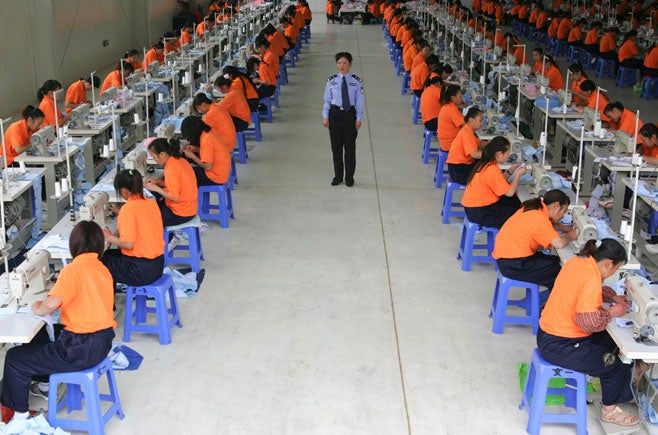
(New York) – Chinese authorities are incarcerating drug users in compulsory drug detention centers that deny them access to treatment for drug dependency and put them at risk of physical abuse and unpaid forced labor, Human Rights Watch said in a new report released today. Half a million people are confined within compulsory drug detention centers in China at any given time, according to the Joint United Nations Programme on HIV/AIDS (UNAIDS).
Kashmir key to peace
November 22, 2009The Nation, November 22, 2009
IT reflects poorly on New Delhi’s political sense that it has failed to realise that the more it tries to suppress the Kashmiris’ urge to get out of its cruel hold, the more entrenched in the people’s psyche becomes the freedom struggle and the more conscious the world gets of the urgency with which the dispute needs to be resolved. Amnesty International recently called upon President Obama to raise the issue of India’s brutal oppression in Occupied Kashmir when he meets Prime Minister Singh in Washington. Its words, “The Indian side of Kashmir is an area where the security forces commit mass human rights abuses with impunity…facilitated by the Armed Forces (Special Powers) Act and other similar laws.” Similarly, President Hu and President Obama, in a joint statement, have observed that the two sides, “agreed to cooperate…(in) bringing about more stable, peaceful relations in all of South Asia”. Secretary of State Clinton maintained, in an interview on Friday, that the US wanted the resumption of talks between India and Pakistan to sort out their differences, including Kashmir.
However, India has been greatly upset at these declarations and continues to defy the calls for an understanding look at the situation that the lingering dispute creates both within Occupied Kashmir and outside. It is a measure of Pakistan’s disappointment that Foreign Minister Qureshi had to say that though we were urging for the resumption of talks, we were not looking for a photo session; we wanted ‘constructive engagement and meaningful dialogue’. He stressed that any talks without the participation of Pakistan would be futile. He had in mind India’s efforts to engage the Kashmiri leaders from the occupied state to find a solution. Foreign Office spokesman Abdul Basit did some plain speaking, when he remarked that India did not want peace in the region. His conclusion is absolutely justified since New Delhi refuses to come to the negotiating table just because it would have to discuss Kashmir. It is well known that even when the composite dialogue was going on it avoided coming to grips with the issue. As the history of post-partition reveals, the fate of Indo-Pakistan relations is closely linked to the settlement of the Kashmir dispute in accordance with the aspirations of Kashmiris.
Saudi rights abuses rise due to counter-terrorism methods
July 24, 2009Middle East Online, First Published 2009-07-22


Saudi used its ‘powerful international clout’ to get away with abuses
Amnesty International: thousands detained in virtual secrecy under guise of security in Saudi.
LONDON – Human rights abuses in Saudi Arabia have soared as a result of counter-terrorism measures introduced since the 2001 attacks in the United States, Amnesty International said Wednesday.
The London-based rights organisation warned in a new report that under the guise of national security, thousands of people had been arrested and detained in virtual secrecy and others had been killed in “uncertain circumstances”.
There have long been human rights problems in the kingdom but Amnesty said the number of people being held arbitrarily, including both Saudi nationals and foreigners, “has risen from hundreds to thousands since 2001”.
“These unjust anti-terrorism measures have made an already dire human rights situation worse,” said Malcolm Smart, director of Amnesty’s Middle East and North Africa programme.
Amnesty noted that in June 2007, the Saudi interior ministry reported that 9,000 security suspects had been detained between 2003 and 2007 and that 3,106 of these were still being held.
Some of those held are prisoners of conscience, targeted for their criticism of government policies, the report said.
The majority are suspected of supporting groups that are opposed to Saudi Arabia’s close links to the United States and have carried out a number of attacks targeting Westerners and others.
Amnesty said trials of people suspected of terrorism offences are carried out in secret, despite sentences ranging from fines to the death penalty. The names of those involved or the charges against them are not disclosed.
“Detainees are held with no idea of what is going to happen to them,” Smart said. “Most are held incommunicado for years without trial, and are denied access to lawyers and the courts to challenge the legality of their detention.”
The Saudi authorities were not immediately available for comment, but the country’s top human rights official said last month that suspected militants being tried in special courts were allowed lawyers to help their defence.
“They can choose a lawyer… or the ministry of justice will provide one,” said Bandar al-Aiban, president of the official Saudi Human Rights Commission.
He said he regretted that the trials were being kept secret but said the government was worried some defendants would use a public trial as a soapbox to preach radical ideology. “We have to be mindful of other dangers,” he said.
Amnesty accused the international community of failing to hold the Saudi government to account over the alleged violations, saying the kingdom “has used its powerful international clout to get away with it”.
The group also reported that many people were thought to have been tortured “in order to extract confessions or as punishment after conviction”.
Methods include severe beatings by sticks, suspension from the ceiling and the use of electric shocks and sleep deprivation, while “flogging is also imposed as a legal punishment by itself or in addition to imprisonment”.
From beyond the grave: A searing indictment of Putin’s protegé
July 17, 2009A report by Natalya Estemirova, the Russian activist murdered in Chechnya as she investigated human rights abuses
The Independent/UK, July 17, 2009

Getty
President Ramzan Kadyrov displaying his shooting skills
The abductions in Chechnya started nearly a decade ago. In 2000, Russian forces took control of practically the entire territory of the republic, and started extensive mop-up operations in villages.
Thousands of murders and abductions took place; these operations were declared to be an efficient method in the fight against rebels. In reality, however, the troops and police were looting the houses of unprotected civilians, at times taking away everything from them, from cars and furniture to shampoos and female underwear.
Most horrifically of all, women were raped in front of their male relatives, and all the men were detained, from teenagers to old men: they were either cruelly beaten, or released for ransom, or else they disappeared forever.
Human rights activist Natalya Estemirova shot dead in Russia
July 16, 2009
Times Online, July 15, 2009
Nico Hines

(AFP)
Natalya Estemirova dedicated her career to uncovering Russian human rights abuses

 Peace and Justice Post
Sri Lankan troops shot Tamil prisoners of war
August 28, 2009Graphic footage which appears to show Sri Lankan forces summarily executing Tamil prisoners during or after the recent bloody conflict has been handed to the British media.
The footage, captured on a mobile phone, was supplied to the media on Wednesday by Journalists for Democracy in Sri Lanka.
It shows uniformed troops dragging naked and bound prisoners into a clearing and shooting them in the back of the head.
Continues >>
Share this:
Tags:arms exports to Sri Lanka, civilian deaths, execuation of prisoners, human rights abuses, journalists not allowed, Liberation Tigers of Tamil Eelam, Sri Lankan forces, Tamil prisoners
Posted in Commentary, crime, Human rights, Sri Lanka, Uncategorized, war crimes | Leave a Comment »