Immanuel Wallerstein, Commentary No. 239, Aug. 15, 2009
The world has been witness this month to a mini-war in the Caucasus, and the rhetoric has been passionate, if largely irrelevant. Geopolitics is a gigantic series of two-player chess games, in which the players seek positional advantage. In these games, it is crucial to know the current rules that govern the moves. Knights are not allowed to move diagonally.
From 1945 to 1989, the principal chess game was that between the United States and the Soviet Union. It was called the Cold War, and the basic rules were called metaphorically “Yalta.” The most important rule concerned a line that divided Europe into two zones of influence. It was called by Winston Churchill the “Iron Curtain” and ran from Stettin to Trieste. The rule was that, no matter how much turmoil was instigated in Europe by the pawns, there was to be no actual warfare between the United States and the Soviet Union. And at the end of each instance of turmoil, the pieces were to be returned to where they were at the outset. This rule was observed meticulously right up to the collapse of the Communisms in 1989, which was most notably marked by the destruction of the Berlin wall.
It is perfectly true, as everyone observed at the time, that the Yalta rules were abrogated in 1989 and that the game between the United States and (as of 1991) Russia had changed radically. The major problem since then is that the United States misunderstood the new rules of the game. It proclaimed itself, and was proclaimed by many others, the lone superpower. In terms of chess rules, this was interpreted to mean that the United States was free to move about the chessboard as it saw fit, and in particular to transfer former Soviet pawns to its sphere of influence. Under Clinton, and even more spectacularly under George W. Bush, the United States proceeded to play the game this way.
There was only one problem with this: The United States was not the lone superpower; it was no longer even a superpower at all. The end of the Cold War meant that the United States had been demoted from being one of two superpowers to being one strong state in a truly multilateral distribution of real power in the interstate system. Many large countries were now able to play their own chess games without clearing their moves with one of the two erstwhile superpowers. And they began to do so.
Two major geopolitical decisions were made in the Clinton years. First, the United States pushed hard, and more or less successfully, for the incorporation of erstwhile Soviet satellites into NATO membership. These countries were themselves anxious to join, even though the key western European countries – Germany and France – were somewhat reluctant to go down this path. They saw the U.S. maneuver as one aimed in part at them, seeking to limit their newly-acquired freedom of geopolitical action.
The second key U.S. decision was to become an active player in the boundary realignments within the former Federal Republic of Yugoslavia. This culminated in a decision to sanction, and enforce with their troops, the de facto secession of Kosovo from Serbia.
Russia, even under Yeltsin, was quite unhappy about both these U.S. actions. However, the political and economic disarray of Russia during the Yeltsin years was such that the most it could do was complain, somewhat feebly it should be added.
The coming to power of George W. Bush and Vladimir Putin was more or less simultaneous. Bush decided to push the lone superpower tactics (the United States can move its pieces as it alone decides) much further than had Clinton. First, Bush in 2001 withdrew from the 1972 U.S.-Soviet Anti-Ballistic Missile Treaty. Then he announced that the United States would not move to ratify two new treaties signed in the Clinton years: the 1996 Comprehensive Test Ban Treaty and the agreed changes in the SALT II nuclear disarmament treaty. Then Bush announced that the United States would move forward with its National Missile Defense system.
And of course, Bush invaded Iraq in 2003. As part of this engagement, the United States sought and obtained rights to military bases and overflight rights in the Central Asian republics that formerly were part of the Soviet Union. In addition, the United States promoted the construction of pipelines for Central Asian and Caucasian oil and natural gas that would bypass Russia. And finally, the United States entered into an agreement with Poland and the Czech Republic to establish missile defense sites, ostensibly to guard against Iranian missiles. Russia, however, regarded them as aimed at her.
Putin decided to push back much more effectually than Yeltsin. As a prudent player, however, he moved first to strengthen his home base – restoring effective central authority and reinvigorating the Russian military. At this point, the tides in the world-economy changed, and Russia suddenly became a wealthy and powerful controller not only of oil production but of the natural gas so needed by western European countries.
Putin thereupon began to act. He entered into treaty relationships with China. He maintained close relations with Iran. He began to push the United States out of its Central Asian bases. And he took a very firm stand on the further extension of NATO to two key zones – Ukraine and Georgia.
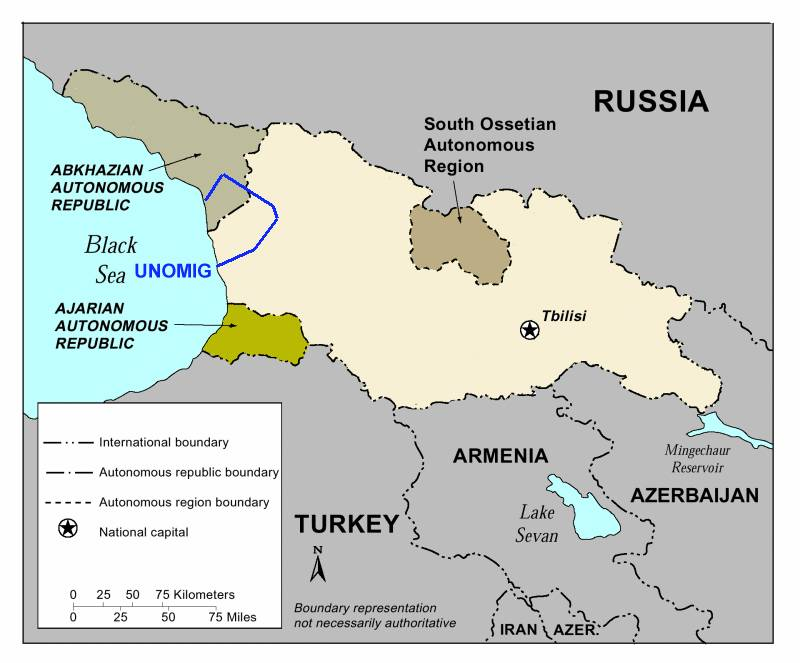
The breakup of the Soviet Union had led to ethnic secessionist movements in many former republics, including Georgia. When Georgia in 1990 sought to end the autonomous status of its non-Georgian ethnic zones, they promptly proclaimed themselves independent states. They were recognized by no one but Russia guaranteed their de facto autonomy.
The immediate spurs to the current mini-war were twofold. In February, Kosovo formally transformed its de facto autonomy to de jure independence. Its move was supported by and recognized by the United States and many western European countries. Russia warned at the time that the logic of this move applied equally to the de facto secessions in the former Soviet republics. In Georgia, Russia moved immediately, for the first time, to recognize South Ossetian de jure independence in direct response to that of Kosovo.
And in April this year, the United States proposed at the NATO meeting that Georgia and Ukraine be welcomed into a so-called Membership Action Plan. Germany, France, and the United Kingdom all opposed this action, saying it would provoke Russia.
Georgia’s neoliberal and strongly pro-American president, Mikhail Saakashvili, was now desperate. He saw the reassertion of Georgian authority in South Ossetia (and Abkhazia) receding forever. So, he chose a moment of Russian inattention (Putin at the Olympics, Medvedev on vacation) to invade South Ossetia. Of course, the puny South Ossetian military collapsed completely. Saakashvili expected that he would be forcing the hand of the United States (and indeed of Germany and France as well).
Instead, he got an immediate Russian military response, overwhelming the small Georgian army. What he got from George W. Bush was rhetoric. What, after all, could Bush do? The United States was not a superpower. Its armed forces were tied down in two losing wars in the Middle East. And, most important of all, the United States needed Russia far more than Russia needed the United States. Russia’s foreign minister, Sergei Lavrov, pointedly noted in an op-ed in the Financial Times that Russia was a “partner with the west on…the Middle East, Iran and North Korea.”
As for western Europe, Russia essentially controls its gas supplies. It is no accident that it was President Sarkozy of France, not Condoleezza Rice, who negotiated the truce between Georgia and Russia. The truce contained two essential concessions by Georgia. Georgia committed itself to no further use of force in South Ossetia, and the agreement contained no reference to Georgian territorial integrity.
So, Russia emerged far stronger than before. Saakashvili had bet everything he has and was now geopolitically bankrupt. And, as an ironic footnote, Georgia, one of the last U.S. allies in the coalition in Iraq, withdrew all its 2000 troops from Iraq. These troops had been playing a crucial role in Shi’a areas, and would now have to be replaced by U.S. troops, which will have to be withdrawn from other areas.
If one plays geopolitical chess, it is best to know the rules, or one gets out-maneuvered.




 Peace and Justice Post
In Europe, as in Asia, Nato leaves a trail of catastrophe
August 20, 2008Nato is useless. It has failed to bring stability to Afghanistan, as it failed to bring it to Serbia. It just breaks crockery. Nato has proved a rotten fighting force, which in Kabul is on the brink of being sidelined by exasperated Americans. Nor is it any better at diplomacy: witness its hamfisted handling of east Europe. As the custodian of the west’s postwar resistance to the Soviet Union’s nuclear threat it served a purpose. Now it has become a diplomats’ Olympics, irrelevant but with bursts of extravagant self-importance.
Yesterday’s Nato ministerial meeting in Brussels was a fig leaf over the latest fiasco, the failure to counter the predictable Russian intervention in Georgia. Ostensibly to save Russian nationals in South Ossetia, the intervention was, in truth, to tell Georgia and Ukraine that they must not play games with the west along Russia’s frontier. Nato, which Russia would (and should) have joined after the collapse of the Soviet Union, is now a running provocation along the eastern rim of Europe.
There was no strategic need for Nato to proselytise for members, and consequent security guarantees, among the Baltic republics and border states to the south. Nor is there any strategic need for the US to place missile sites in Poland or the Czech Republic. This was mere Nato self-aggrandisement reinforcing the lobbying of the Pentagon hawks.
These moves were bound to infuriate the hypersensitive Russians, and did. There is no point in western pundits saying that the thrust of Nato close to the Russian border is quite different from the cold war location of Soviet missiles in Cuba. It seems the same to Russian nationalists.
Nor is it any good pundits remarking that Russia’s defence of Russian minorities in Georgia is quite different from Nato’s intervention to defend the Kurdish minority in Iraq or the Albanian minority in Serbia. Again, that is just how it seems to Russia.
George Bush said earlier this month that “the age of spheres of influence is over”. In that case why push that most potent sphere of influence, Nato, to the Russian border? And what of the sphere-of-influence theory that underpinned Bush’s neoconservative plan to conquer the Muslim world for democracy?
The US’s two greatest bugbears at present, Russia and Iran, both have grounds for feeling encircled by hostile forces. However badly they behave, they too are vulnerable to the politics of irrational fear. Both countries display the rudiments of democratic activity, with paranoia playing on pluralism.
The glib response of Nato’s leaders has been hawkish, that the only thing “these people” understand is tough talk and big sticks. But that just apes Russia’s attitude towards Georgia and Ukraine, which at least Russia has the power to enforce.
The west is not threatened by Russia. Turning its border into a zone of bluff and counter-bluff, so Nato can boast 10 extra flags outside its headquarters, has proved destabilising and provocative. Intelligence, like morality, is supposedly the tribute power should pay to reason. Russia is boorish and belligerent enough already. Why encourage it?
With Russia, Nato is playing with fire. In Afghanistan/Pakistan – which should always be yoked together – it is playing with dynamite. Here Osama bin Laden and Donald Rumsfeld must be laughing in unison: the former because Nato’s conduct of the war against the Taliban has been a recruiting sergeant for al-Qaida in Pakistan; the latter because everything he said about nation-building has proved true. “Get in fast and get out fast” was his strategy, and he was right.
The fall of Pervez Musharraf might be good news for Pakistan’s democrats. It is dreadful news for Nato’s proconsuls in their fortified enclaves in Kabul. The likelihood of political turbulence in Pakistan can only increase the hold that pro-Taliban tribes have over the long frontier with Afghanistan and, with it, the certainty of an escalating war.
Nato’s performance here has been dreadful. A half-hearted peacekeeper, it had displayed divided counsels, divided leadership and divided rules of engagement. It has reflected the view of the US general in Kosovo, Wesley Clark, that US units should never again be placed under international command. International command means no command at all.
A Pentagon report by General Barry McCaffrey, revealed last week, criticises the lack of command unity in Kabul. “Afghanistan is in misery,” it says. “A sensible coordination of all political and military elements of the Afghan theatre of operation does not exist.”
There is said to be a plan for a 12,000-strong reinforcement of US troops to stage a Baghdad-style “surge”, outside the remit of Nato. The idea that the rural Taliban might be susceptible to the same handling as Iraq’s urban militias may be senseless, but is on the cards. Such a surge would mean three rival armies – Afghan, Nato and American – roaming this troubled land, a gift to any enemy.
The newly triumphant coalition in Islamabad must long for the days when its Afghan backyard was quiet. The Taliban regime was funded by opium and the Saudis, and of no strategic (as opposed to terrorist) concern to the west. There were no US Predators bombing villages, no CIA phone-tapping, no suborned Pakistan intelligence officers, no outside interference. Pakistan’s sphere of influence might not be to every taste, but it was roughly stable.
We shall now have the world’s sixth largest country, and with an active nuclear arsenal, in internal turmoil because of a doomed Nato adventure on its border. Taliban units are operating freely throughout the south and east of Afghanistan and within miles of the capital, Kabul, flatly contradicting the mendacious spin of Nato spokesmen over the past two years.
Western governments seem never to learn. Counter-insurgency wars of this sort never work if they become drawn out. At best they leave broken, corrupted, failed states such as Lebanon and Kosovo – and, soon, Iraq. At worst they mean defeat. If ever America were walking into another Vietnam, it is now in Afghanistan, fast replacing Iraq as the mecca for every anti-western fanatic on earth.
Peace in Afghanistan might not matter over much. But its absence will grossly destabilise Pakistan, and that matters greatly. Is this to be another feather in Nato’s cap?
simon.jenkins@guardian.co.uk
Share this:
Tags:Afghanistan, Gen. Barry McCaffrey's report, George W. Bush, Georgia, Iran, Musharraf's fall, NATO, Pakistan, Russia, Russian minorities, United States
Posted in Commentary, USA | Leave a Comment »