Posts Tagged ‘Bush administration’

The trail of torture

October 17, 2008

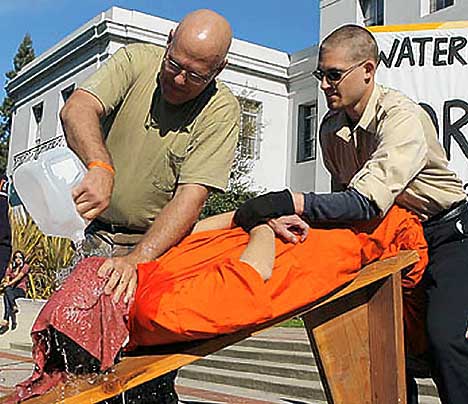
That the White House authorised ‘waterboarding’ is disturbing. But that no one in mainstream US politics seems to care is worse


The revelation, in yesterday’s Washington Post, that the Bush administration “issued a pair of secret memos to the CIA in 2003 and 2004 that explicitly endorsed the agency’s use of interrogation techniques such as waterboarding against al-Qaida suspects” will increase calls for the administration to be held to account for its actions.

It is unlikely, though, that this revelation will lead to significant activity, beyond adding more voices to grassroots impeachment campaigns in the United States – although it may lead to a strengthening of plans in various European countries to indict senior officials for war crimes. As law professor Scott Horton explained in June, the best that opponents of the regime can hope for is that the “Bush administration officials who pushed torture will need to be careful about their travel plans.”

The problem for all parties concerned is that the administration itself still refuses to concede that it has engaged in torture, and is being allowed to get away with it in the two places where opposition could really count: the Senate and the House of Representatives. Rather than pursuing senior officials, house Democrat leader Nancy Pelosi declared that impeachment was “off the table” after the Democrats gained a majority in the House of Representatives two years ago. A month earlier, politicians had endorsed the executive’s attempts to shield itself and its employees from any liability for their actions by passing the Military Commissions Act, parts of which were clearly intended to exempt US officials from being prosecuted for war crimes.

Freed from direct challenges, the administration has, instead, attempted to stifle all mention of torture in its dealings with prisoners seized in the “war on terror”.

A case in point is the British resident Binyam Mohamed. According to his lawyers at the legal action charity Reprieve, Mr Mohamed, who was seized in Pakistan in April 2002, was sent to Morocco by the CIA (before the agency brought torture “in-house”), where proxy torturers extracted a number of false confessions from him. As a result, he was accused of plotting to detonate a radioactive “dirty bomb” in a US city, and was put forward for trial by military commission at Guantánamo.

However, just last week, when a judge in Washington, DC finally had the opportunity to review his case, the US justice department chose to drop the charges relating to the “bomb plot” rather than pursue them, presumably because senior officials were aware that the entire trail of decision-making as to why Mr Mohamed was rendered to Morocco led to the highest levels of government, and to the kinds of discussions between the CIA and senior officials – including Vice President Dick Cheney and defence secretary Donald Rumsfeld – that were discussed in yesterday’s article in the Washington Post.

Even so, Mr Mohamed may still face the same charges in a trial by military commission, because the defence department, safe from judicial scrutiny, still believes that it can pursue prosecutions in a system that is so rigged that, when one of the prosecutors, Lt Col Darrel Vandeveld, resigned two weeks ago, he expressed his profound doubts that the system was “capable of delivering justice”.

The fact that some of these cases – like that of Mr Mohamed – involve the alleged use of extraordinary rendition and torture by or on behalf of the CIA only serves to confirm that even confirmed critics and opponents of the administration’s detention and interrogation policies in the “war on terror” are a long way from holding senior officials to account. Perhaps the greatest shame, however, is that out on the campaign trail, where these issues ought to count for something, they are not being mentioned at all.

Waterboarding Got White House Nod

October 15, 2008

CIA Tactics Endorsed In Secret Memos

Joby Warrick
Washington Post Staff Writer
Wednesday, October 15, 2008; Page A01

The Bush administration issued a pair of secret memos to the CIA in 2003 and 2004 that explicitly endorsed the agency’s use of interrogation techniques such as waterboarding against al-Qaeda suspects — documents prompted by worries among intelligence officials about a possible backlash if details of the program became public.

The classified memos, which have not been previously disclosed, were requested by then-CIA Director George J. Tenet more than a year after the start of the secret interrogations, according to four administration and intelligence officials familiar with the documents. Although Justice Department lawyers, beginning in 2002, had signed off on the agency’s interrogation methods, senior CIA officials were troubled that White House policymakers had never endorsed the program in writing.

The memos were the first — and, for years, the only — tangible expressions of the administration’s consent for the CIA’s use of harsh measures to extract information from captured al-Qaeda leaders, the sources said. As early as the spring of 2002, several White House officials, including then-national security adviser Condoleezza Rice and Vice President Cheney, were given individual briefings by Tenet and his deputies, the officials said. Rice, in a statement to congressional investigators last month, confirmed the briefings and acknowledged that the CIA director had pressed the White House for “policy approval.”

The repeated requests for a paper trail reflected growing worries within the CIA that the administration might later distance itself from key decisions about the handling of captured al-Qaeda leaders, former intelligence officials said. The concerns grew more pronounced after the revelations of mistreatment of detainees at the Abu Ghraib prison in Iraq, and further still as tensions grew between the administration and its intelligence advisers over the conduct of the Iraq war.

Continued . . .

JOEL BRINKLEY: Evidence grows that Israel, with U.S. aid, is preparing to attack Iran

October 11, 2008
McClatchy-Tribune News Service | bnd.com, Oct 9, 2008

Month after month, the nation’s attention seems to ping-pong back and forth between the world’s two egregious nuclear malefactors, North Korea and Iran.

For the last few weeks, all eyes have been on North Korea, as the nation’s idiosyncratic leadership began reopening a plant that manufactures weapons-grade plutonium. Christopher Hill, an assistant secretary of state, met, to no effect, with North Korea’s leaders in Pyongyang last week – a visit that would have been inconceivable while hawks still dominated the Bush administration.

But, as anyone might guess, the problems in Iran did not suddenly freeze while everyone looked east. In fact several recent developments leave the strong suggestion that Israel is preparing to attack Iran – with significant help from the United States.

The likelihood of an American attack has diminished. American commanders “think it would complicate the situation in Iraq and the region,” John Bolton, the former U.N. ambassador, told me. He favors an attack but says “the Bush administration was much more inclined to do it a few years ago.” Secretaries Condoleezza Rice and Robert Gates, at State and Defense – relative moderates within the Bush administration – now dominate discussion of issues like this.

Would Washington support an Israeli attack? Recently, the administration has given clear signals that it would not. But then, why did the Pentagon announce last month that it planned to sell Israel 1,000 new GBU-39 bunker-busting bombs? They are small weapons that can be dropped from the wings of the fighter jets in Israel’s air force. Each can penetrate 6 feet of reinforced concrete. If several aircraft hit the same target the total penetration could be much deeper.

Why does Israel need those bombs? Israeli military analysts have been saying they are for attacking underground weapons depots in Gaza or southern Lebanon. Perhaps.

But then, why about the same time did the Pentagon agree to sell Israel sophisticated upgrades for the country’s Patriot anti-missile missiles – and send more than 100 technicians to install them? If Israel attacked, Iran has warned that it would fire volleys of ballistic missiles in response.

And there’s more: Just last week came the news that the United States has deployed an advanced early-warning radar system in Israel for detecting incoming missiles. It is so sophisticated that, for now, U.S. Army crews will be stationed there to operate it.

Bolton and others advised against “reading all of that into this,” as he put it. The United States continually sells military equipment to Israel. Most years the United States gives Israel about $2 billion in military aid, and it must be spent on American arms.

What is more, Abbas Milani, an expert on Iran at Stanford University, told me that the Iranian press of late has been saying “the time is past” when the United States might attack. And while there is some concern about Israel, the Iranian papers correctly note that the country is locked in negotiations to form a new government that aren’t likely to be settled for several weeks. Israel would not attack before a new government forms.

At the same time, though, Israelis certainly saw Mahmoud Ahmedinejad, the Iranian president, telling the United Nations last month that “the Zionist regime is on a definite slide toward collapse, and there is no way for it to get out of this cesspool.”

Still, all of this may be a hall of mirrors. The United States may be arming Israel purely for defensive reasons. Israel’s military exercises and blustery threats may simply be the state’s way of warning Iran. On the other hand, the Bush administration’s statements cautioning Israel may simply be an attempt to prevent Iran from blaming Washington if Israel does attack.

In any case, Bolton said, “Israel’s decision will not be based on what the Pentagon wants.” And if Israel does attack, Iran will consider Washington responsible, no matter what the administration has said.

“So if the U.S. is going to be blamed anyway,” Bolton offered, “we ought to go ahead and assist them.”


Joel Brinkley is a former Pulitzer Prize-winning foreign correspondent for The New York Times and now a professor of journalism at Stanford University. Readers may send him e-mail at: brinkley@foreign-matters.com

Afghan Peace Talks Widen US-UK Rift on War Policy

October 10, 2008

Analysis by Gareth Porter | Inter-Press Service

WASHINGTON, Oct 9 – The beginning of political talks between the Afghan government and the Taliban revealed by press accounts this week is likely to deepen the rift that has just erupted in public between the United States and its British ally over the U.S. commitment to an escalation of the war in Afghanistan.

According to a French diplomatic cable that leaked to a French magazine last week, Prime Minister Gordon Brown’s government is looking for an exit strategy from Afghanistan rather than an endless war, and it sees a U.S. escalation of the war as an alternative to a political settlement rather than as supporting such an outcome.

The first meetings between the two sides were held in Saudi Arabia in the presence of Saudi King Abdullah Sep. 24 to 27, as reported by CNN’s Nic Robertson from London Tuesday. Eleven Taliban delegates, two Afghan government officials and a representative of independent former mujahideen commander Gulfadin Hekmatyar participated in the meetings, according to Robertson.

Brigadier Mark Carleton-Smith of the British command in Afghanistan enthusiastically welcomed such talks. He was quoted by The Sunday Times of London as saying, “We want to change the nature of the debate from one where disputes are settled through the barrel of the gun to one where it is done through negotiations.”

If the Taliban were prepared to talk about a political settlement, said Carleton-Smith, “that’s precisely the sort of the progress that concludes insurgencies like this.”

The George W. Bush administration, however, was evidently taken by surprise by news of the Afghan peace talks and was decidedly cool toward it. One U.S. official told The Washington Times that it was unclear that the meetings in Saudi Arabia presage government peace talks with the Taliban. The implication was that the administration would not welcome such talks.

A U.S. defence official in Afghanistan told the paper the Bush administration was “surprised” that it had not been informed about the meeting in advance by the Afghan government.

Defence Secretary Robert Gates, on his way to discuss Afghanistan with NATO defence ministers in Budapest, made it clear that the Bush administration supports talks only for the purposes of attracting individual leaders to leave the Taliban and join the government. “What is important is detaching those who are reconcilable and who are willing to be part of the future of the country from those who are irreconcilable,” he said.

Gates said he drew line at talks with the head of the Taliban, Mullah Mohammad Omar.

However, representatives of the Taliban leader are apparently involved in the talks, and President Hamid Karzai is committed to going well beyond the tactic of appealing to individual Taliban figures.

Afghan Defence Minister Abdul Rahim Wardak said in a news conference Oct. 4 that resolution of the conflict required a “political settlement with the Taliban”. He added that such a settlement would come only “after Taliban’s acceptance of the Afghan constitution and the peaceful rotation of power by democratic means.”

The Afghan talks come against the backdrop of a Bush administration decision to send 8,000 more U.S. troops to Afghanistan next year, and the expressed desire of the U.S. commander, Gen. David. D. McKiernan, for yet another 15,000 combat and support troops. Both Democratic candidate Barack Obama and Republican candidate John McCain have said they would increase U.S. troop strength in Afghanistan.

Obama has said he would send troops now scheduled to remain in Iraq until next summer to Afghanistan as an urgent priority, whereas McCain has not said when or how he would increase the troop level.

Such a U.S. troop increase is exactly what the British fear, however. The British ambassador in Afghanistan, Sir Sherard Cowper-Coles, was quoted in a diplomatic cable leaked to the French investigative magazine “Le Canard enchaine” last week as telling the French deputy ambassador that the U.S. presidential candidates “must be dissuaded from getting further bogged down in Afghanistan”.

In the French diplomatic report of the Sep. 2 conversation, Cowper-Coles is reported as saying that an increase in foreign troop strength in Afghanistan would only exacerbate the overall political problem in Afghanistan.

The report has the ambassador saying that such an increase “would identify us even more strongly as an occupation force and would multiply the targets” for the insurgents.

Cowper-Coles is quoted as saying foreign forces are the “lifeline” of the Afghan regime and that additional forces would “slow down and complicate a possible emergence from the crisis.”

In an obvious reference to the intention to rely on higher levels of military force, Cowper-Coles said U.S. strategy in Afghanistan “is destined to fail”.

Cowper-Coles is reported to have put much of the blame for the deterioration of the situation in Afghanistan on the Karzai government. “The security situation is getting worse,” the report quoted him as saying. “So is corruption, and the government had lost all trust.”

The report makes it clear that the British want to withdraw all their troops from Afghanistan within five to 10 years. Cowper-Coles is said to have suggested that the only way to do so is through the emergence of what he called an “acceptable dictator”.

The British foreign office has denied that the report reflected the policy of the government itself. Nevertheless, statements by Brigadier Carleton-Smith, the senior British commander in Afghanistan, last week, underlined the gulf between U.S. and British views on Afghanistan.

“We’re not going to win this war,” said Carleton-Smith, according to The Sunday Times of London Sep. 28. Carleton-Smith, commander of an air assault brigade who completed two tours in Afghanistan, suggested that foreign troops would and should leave Afghanistan without having defeated the insurgency. “We may leave with there still being a low but steady ebb of rural insurgency,” he said.

Like Cowper-Coles, Carleton-Smith suggested that the real problem for the coalition was not military but political. “This struggle is more down to the credibility of the Afghan Government,” he said, “than the threat from the Taliban.”

When Gordon Brown replaced Tony Blair as British prime minister in June 2007, British officials concluded that the Taliban was too deep-rooted to be defeated militarily, according to a report in The Guardian last October. The Brown government decided to pursue a strategy of courting “moderate” Taliban leaders and fighters who were believed to be motivated more by tribal obligation than jihadi ideology.

That idea was in line with U.S. strategy as well. Now, however, both Karzai and the British have moved beyond that to a policy of negotiating directly and officially with the Taliban. For the British it appears to be part of an exit strategy that is not shared by Washington.

Defence Secretary Gates responded to Carleton-Smith’s remarks Tuesday by reiterating the official U.S. view that additional forces are needed in Afghanistan and implying that the British’s officer’s views are “defeatist”. Gates said, “[T]here certainly is no reason to be defeatist or to underestimate the opportunity to be successful in the long run.”

*Gareth Porter is an investigative historian and journalist specialising in U.S. national security policy. The paperback edition of his latest book, “Perils of Dominance: Imbalance of Power and the Road to War in Vietnam”, was published in 2006.

Paul Wolfowitz Up to More Mischief?

October 3, 2008

Jim Lobe | LobeLog.com

Just 15 months after being forced to resign as president of the World Bank over a conflict of interest regarding his professional and personal relationships with his girlfriend, former Deputy Defense Secretary Paul Wolfowitz may be involved in another, far more geo-strategic conflict of interest involving his dual roles as chairman of the State Department’s International Security Advisory Board (ISAB) and chairman of the U.S.-Taiwan Business Council, among whose U.S. members are military contractors who have been dying to get the Bush administration’s approval to sell about 11 billion dollars worth of arms to the island to protect it against the threat of an attack by the mainland.

Condi Rice appointed Wolfowitz — apparently part of her campaign that featured the appointment of Eliot Cohen to become to her Counselor at the State Department to co-opt neo-cons — back in January this year. Like the Defense Policy Board, the ISAB became under Bush a stronghold for all manner of national-security hawks (among the members are former Undersecretary for Arms Control and International Security Affairs Robert Joseph; James Woolsey; former Defense Secretary James Schlesinger; and missile-defense devotees associated with the Center for Security Policy, the National Institute for Public Policy, and Southwest Missouri State University, including Keith Payne, Robert Pfaltzgraff, and William Van Cleave), as well as executives from the arms industry (Lockheed, Boeing, SAIC, to name a few). Wolfowitz’s appointment, coming after his disgrace at the Bank — not to mention his performance as Rumsfeld’s deputy and Douglas Feith’s superior from 2001 to 2005 — was seen as a kind of token public redemption that would presumably have little consequence in actual policy terms.

That assessment may have been premature, because, judging by an article appearing in Wednesday’s Washington Times by Bill Gertz, Wolfowitz’s ISAB may be trying to gin up tensions with China, acting as a new “Team B” in persuading policymakers and the public at large that Beijing’s military modernization, especially its missile program, is more threatening to the U.S. than, in Gertz’s words, “many current government and private-sector analyses” have depicted it. At least, that’s the message of the article, which is purportedly based on a draft of an ISAB report that Gertz says is due out in a few weeks.

According to Gertz’s account, the report, the product of a task force headed by Joseph, recommends that the U.S. “should undertake the development of new weapons, sensors, communications, and other programs and tactics to convince China that it will not be able to overcome the U.S. militarily” and specifically that it obtain, in Gertz’s words, “new offensive space and cyber warfare capabilities and missile defenses as well as ‘more robust sea- and space-based capabilities’ to deter any crisis over Taiwan.” As Gertz points out, Washington has until now repeatedly reassured Beijing that its missile defense efforts were directed solely against “rogue states” like North Korea and Iran.

The report also predicts that China will have more than 100 nuclear missiles, some with multiple warheads, capable of reaching the U.S. by 2015, compared to only 20 missiles at the present time. “To avoid an ‘emerging creep’ by China toward strategic nuclear coercion, ‘the United States will need to pursue new missile defense capabilities, including taking full advantage of space,’” Gertz quotes the report as asserting.

The report, according to Gertz, also stresses — and this is where Wolfowitz’s stewardship of the U.S.-Taiwan Business Council raises questions — the pivotal importance of Taiwan in all this. Again quoting from the draft, Gertz writes:

“‘In China’s view, Taiwan is the key to breakout: If China is to become a global power, the first step must include control of this island.’ Taking over the island would allow China to control the seas near ts coasts and to project power eastward, the report said.

“China views Taiwan …as central to ‘the legitimacy of the regime and key to power projection,’ the report said. Taiwan is seen by China as a way to deny the United States a key ally in ‘a highly strategic location’ of the western Pacific, the report said.

“…The advisory panel report also recommended that the U.S. increase sales of advanced conventional forces to allies in Asia…”

Now, one has to be careful about anything that Gertz reports, particularly about China. A charter member of the “Blue Team” — the group of hawkish policy specialists, Congressional staff, and journalists (including Kristol and Kagan and their Project for the New American Century) who, from the end of the Cold War until 9/11, insisted that Beijing represented the single greatest threat to U.S. hegemony and global peace and security — Gertz has been obsessed with the ChiComs for years and has certainly been known to exaggerate and take things out of context in his zeal to alert the world to the looming peril that confronts it. It’s also important to stress that this remains a draft, which could be substantially toned down before it reaches final form. It may not yet have even been seen by Wolfowitz, whose chapter on China policy in Present Dangers, the book published by PNAC before the 2000 elections, was almost certainly considered insufficiently alarmist by Blue Team stalwarts like Gertz.

That said, it’s clear that someone associated with ISAB wanted to leak what — to China anyway — will be seen as a highly provocative document that will tend to confirm the worst fears of its military (which, according to the draft, already suffers from “clear paranoia”) about U.S. intentions, particularly with respect to missile defense and the military use of space. And it’s also clear that the leaker is also very concerned about the pivotal role Taiwan can play in thwarting what the task force sees as China’s military ambitions and hence the importance not only of enhancing U.S. capabilities, but, presumably, of selling advanced weapons to the island, as well.

Moreover, the leak comes at a critical moment in the administration’s deliberations about the long-pending arms package for Taiwan whose approval Wolfowitz and other advocates had hoped would have been forthcoming last week. Wolfowitz had virtually assured his friends in the Business Council Taipei in July that Bush would go ahead with the package some time after the Olympics, but, according to my daily guide on the subject, Chris Nelson of the Nelson Report, a recent study by a Naval War College expert that has gained considerable attention from administration policymakers argues that much in the pending package will do very little, if anything, to improve Taiwan’s ability to resist an attack by Beijing. The study proposed an alternative “porcupine” strategy for defending the island which, it noted, would likely be strongly opposed by “the arms manufacturers who stand to benefit form the sale of aircraft, ships, and supporting systems to Taiwan” that are included in the current package.

Needless to say, some of those same arms manufacturers were behind Wolfowitz’s selection as the (well-paid) chairman of the Business Council, and they would be sorely disappointed if his influence and connections with the administration did not yield the anticipated dividends. (See Tim Shorrock’s excellent article in the Asia Times on Wolfowitz’s help in promoting their interests when he became Number Two at the Pentagon.) In fact, Chris reports this evening that they have indeed won the day and that most, if not all of the package will be approved by the White House.

But the episode still raises important questions, particularly in light of the current election debate over the influence of lobbyists in Washington policy-making, about conflicts of interests. Once again, Wolfowitz’s actions suggest that his grasp of the concept is pretty shaky. On the other hand, the presence of senior executives from Lockheed (a huge beneficiary of the current package) and Boeing, among other arms contractors heavily invested in missile defense and space weapons, on the State Department’s board indicate that Wolfowitz is not exactly alone in that respect. (Gertz reports that Allison Fortier, a Lockheed vice president, served on the task force that produced the draft.) “It’s basically functioning like a lobbyist group,” Chris told me.

Why not a bailout for the rest of us?

October 1, 2008

What’s really required in this crisis is an entirely different kind of government intervention in the economy.

Quickly organized protests around the U.S. drew opponents of the bailout for Wall Street (Joe Newman)Quickly organized protests around the U.S. drew opponents of the bailout for Wall Street (Joe Newman)

AS THE smoke cleared after Monday’s stunning House of Representatives vote against a $700 billion financial bailout for Wall Street, the politicians immediately got down to the business of blaming each other–and scheming about the next attempt to push through this rescue of the super-rich.

But for working people trying to figure out what the hell has happened to the U.S. financial system–and why the leaders of the U.S. government, apparently regardless of political party, are prepared to spend more than $2,000 for every man, woman and child in this country to save Wall Street–the reaction was different.

For one thing, there was sweet satisfaction to be taken in the fact that the bankers and stockbrokers didn’t get their way for once–especially since they’re out to steal $700 billion in taxpayers’ money to cover their bad investments, under a program devised by former Wall Street CEO and now Treasury Secretary Henry Paulson.

With the business world ratcheting up political pressure and Paulson predicting certain doom if no action was taken, the Bush administration and the leadership of both parties in both the House and Senate were all sure that the bailout bill would go through. Yet the legislation was derailed because members of Congress are feeling the heat from a growing popular outrage over the staggering scale of a giveaway to the very same people who led the economy to the edge of the abyss.

It was an all-too-rare turn of events for the U.S. political system–the opinions of ordinary Americans actually mattered in what happened.

At the same time, though, there’s a sense of foreboding. If the government can’t agree on a bailout, will Wall Street really crash and burn–and cause an economic catastrophe on Main Street, too?

After all, that’s the claim of “King Henry” Paulson and his nominal boss, George W. Bush. They’re basically extortionists, insisting that if Congress doesn’t agree to a king’s ransom for the banks, the economy gets it–in the form of a worldwide financial meltdown that would wipe out workers’ savings and eliminate millions of jobs overnight.

The stock market plunge that followed the House vote Monday will have reinforced such fears. Few workers have the resources to play the stock market, of course, but their lives are affected by its ups and downs, especially the downs–for example, the loss of retirement savings in 401(k) accounts that many workers rely on, now that defined benefit pension plans are going the way of the dinosaur.

So is it true? Are we all–the multi-millionaire bankers on Wall Street and the tens of millions of workers on every other street–in the same boat after all? Do we really need the Paulson bailout to avert a second Great Depression?

The answer is no.

The argument that a bailout of the banks is good of all us is an ideological smokescreen, to cover the specifics of the Paulson proposal, as sanctioned by the Democrats–which benefits the rich and powerful, at the expense of the rest of us.

There are plenty of ways that government intervention could alleviate the financial crisis and provide urgently needed relief to working people. But that would involve programs, policies and priorities that the bankers despise–and that political leaders in Washington want nothing to do with.

Paulson is right to say that Wall Street is facing its most severe crisis since the Great Depression–a catastrophe entirely of its own making–and that the U.S. government has to respond. But the form that response takes–a huge handout for the super-rich or a progressive plan to rein in the banks and help ordinary people–depends on whether workers organize to make their voices heard and felt in Washington.

Continued . . .

ECONOMY-US: Bailout for Who?

September 27, 2008


By Adrianne Appel | Inter-Press Service


BOSTON, Sep 26 – U.S. lawmakers and the George W. Bush administration are continuing their closed-door meetings through the weekend to try and fashion a softer 700-billion-dollar deal for Wall Street that will appeal to citizens angry at the prospect of the mega-corporate bailout.

Treasury Secretary Henry Paulson brought the plan to Congress on Sep. 19 in a three-page outline, and said it was necessary to prevent the collapse of the finance market due to complex trades involving subprime mortgages.

The plan would have allowed Paulson, a former CEO of Goldman Sachs, complete control of the massive payout with no oversight, no auditing and no plan of a payback to the taxpayer.

ACORN president Maude Hurd captured the nation’s sentiment when she hinted at the potential electoral fallout in a speech this week: “There is a palpable populist revolt rolling through towns and cities across the country, and if Main Street doesn’t get any real help with the mortgage out of this deal, the American people only have to wait a few weeks for a constructive outlet for their anger.”

ACORN is the nation’s largest grassroots community organisation of low- and moderate-income people, with over 400,000 member families in 110 cities across the country.

At the Capitol, members of Congress attempted to convince taxpayers — and voters — that they had their best interests in mind, and that meant a big bailout for Wall Street.

“Hundreds of billions of dollars that Americans invested in retirement accounts and mutual funds have evaporated,” and more surely would, warned Democrat Chris Dodd, Senate Banking Committee chairman, while giving the impression that the income security of average people is at stake.

This couldn’t be further from the truth, say those who study stock ownership. The average U.S. citizen owns very little or no stock, and wouldn’t be helped directly by an up-market.

“I think the middle class are not going to be very affected at all by a bailout. It’s something that is going to affect the very wealthy. Changes in the stock market won’t make much difference to the middle class,” Edward Wolff, a New York University economist, told IPS.

“It’s just a political gambit to help the rich recover from the stock market collapse. If you claim that everyone is suffering, it’s easier to get a bailout from Washington,” Wolff said.

In 2001, the richest 10 percent of families owned 85 percent of all outstanding stocks, about 85 percent of all financial securities and 90 percent of all business assets, according to Wolff.

As for the rest of the country, only 32 percent of households owned more than 10,000 dollars of stock, and only 25 percent of households owned more than 25,000 dollars worth of stock, Wolff said.

A 2007 report by the Government Accountability Office found that in 2004, just 36 percent of workers had any savings at all in a retirement account. Most U.S. citizens will depend on Social Security in retirement, the government programme that provides 30-40 percent of what was earned in their lifetimes.

The bad practices of the mortgage lending industry targeted people of colour and the elderly, in particular, according to a report by United for a Fair Economy.

Only 11 percent of subprime loans went to first-time buyers last year. The vast majorities were refinancing that caused borrowers to owe more on their homes under the guise that they were saving money. Many borrowers were talked into refinancing their homes to gain additional cash for things like medical bills, the report says.

African American borrowers will lose between 71 billion and 92 billion dollars, and Latino borrowers will lose between 75 billion and 98 billion dollars as a result of bad subprime loans, according to the report.

“A couple decades of deregulation have allowed people at the top of the financial food chain to benefit from millions of people, through unscrupulous mortgage lending practices,” Michael Lapham of United for a Fair Economy told IPS.

“Who are we most concerned about helping? Homeowners facing foreclosure or people who’ve made millions and billions on subprime lending?” Lapham asked.

The U.S. public seems especially peeved at the idea of helping companies that pay exorbitant salaries to their bosses, at a time when many people have seen a decline in their standard of living.

According to the Institute for Policy Studies, CEOs of large U.S. companies last year made an average of 10.5 million dollars, while the top 50 private equity and hedge fund managers pocketed an average of 588 million dollars each.

The institute notes that draft proposals floated by the chairs of both the House and Senate banking committees would allow Paulson to determine what qualifies as “inappropriate or excessive” executive compensation under the bailout plan.

“Secretary Paulson amassed a personal stock stash worth over three-quarters of a billion dollars as the CEO at Goldman Sachs,” said analyst Sarah Anderson. “He hardly strikes us as the appropriate arbiter of what’s excessive and what’s not.”

In a statement, Anderson said the nation needs clear and strict limits on CEO pay “so that taxpayers won’t have to worry about their money flooding into the pockets of top executives and encouraging another round of reckless behaviour.”

On Thursday, unions, and anti-poverty and peace groups took to the streets, staging large demonstrations on Wall Street and in many cities chanting, “No bailouts for billionaires.”

At the end of the day Thursday, it was hard-line Republicans, including Sen. Richard Shelby and Rep. Spencer Bachus, who stood firm against the bailout. Bachus told reporters that the Republicans do not want the U.S. to buy the bad debts of the companies, but instead to loan the companies money.

Their argument that the market could do more to fix itself was bolstered later Thursday evening, when troubled Washington Mutual bank, riddled with bad mortgages, was bought by J.P. Morgan Chase.

The Democrats want the bailout, one that would meter out the billions in installments and somewhat restrict the pay of CEOs, Dodd said.

“I don’t understand why the Democrats in particular didn’t feel they have the leverage to get more out of this deal. Congress has squandered an opportunity to actually help homeowners facing foreclosure,” Brenda Muniz, legislative director for ACORN, told IPS.

According to an analysis of U.S. Census data by the Centre for Budget and Policy Priorities, 18 percent of U.S. children lived in poverty in 2007.

The willingness of Congress to consider a 700-billion-dollar payout makes clear that Congress could budget other large sums to help end homelessness and hunger, and improve public education.

“When people go to Congress to ask for more affordable housing funds and are told there isn’t money, then along comes Wall Street and they say, ‘Oh sure we have 700 billion dollars for your bailout.’ It definitely makes you question our nation’s priorities,” Lapham said.
POLITICS-US: Vested Interests Drove New Pakistan Policy

September 18, 2008

Analysis by Gareth Porter | Inter-Press Service News

WASHINGTON, Sep 17 – The George W. Bush administration’s decision to launch commando raids and step up missiles strikes against Taliban and al Qaeda figures in the tribal areas of Pakistan followed what appears to have been the most contentious policy process over the use of force in Bush’s eight-year presidency.

That decision has stirred such strong opposition from the Pakistani military and government that it is now being revisited. Adm. Mike Mullen, chairman of the Joint Chiefs of Staff, arrived in Pakistan Tuesday for the second time in three weeks, and U.S. officials and sources just told Reuters that any future raids would be approved on a mission-by-mission basis by a top U.S. administration official.

The policy was the result of strong pressure from the U.S. command in Afghanistan and lobbying by the Special Operations Command (SOCOM) and the CIA’s operations directorate (DO), both of which had direct institutional interests in operations that coincided with their mandate.

State Department and some Pentagon officials had managed to delay the proposed military escalation in Pakistan for a year by arguing that it would be based on nearly nonexistent intelligence and would only increase support for the Islamic extremists in that country.

But officials of SOCOM and the CIA prevailed in the end, apparently because Bush and Vice President Dick Cheney believed they could not afford to be seen as doing nothing about bin Laden and al Qaeda in the administration’s final months.

SOCOM had a strong institutional interest in a major new operation in Pakistan.

The Army’s Delta Force and Navy SEALS had been allowed by the Pakistani military to accompany its forces on raids in the tribal area in 2002 and 2003 but not to operate on their own. And even that extremely limited role was ended by Pakistani President Pervez Musharraf in 2003, which frustrated SOCOM officials.

Defence Secretary Donald Rumsfeld, whose antagonism toward the CIA was legendary, had wanted SOCOM to take over the hunt for bin Laden. And in 2006, SOCOM’s Joint Special Operations Command branch in Afghanistan pressed Rumsfeld to approve a commando operation in Pakistan aimed at capturing a high-ranking al Qaeda operative.

SOCOM had the support of the U.S. command in Afghanistan, which was arguing that the war in Afghanistan could not be won as long as the Taliban had a safe haven in Pakistan from which to launch attacks. The top U.S. commander, Lt. Gen. Karl Eikenberry, worked with SOCOM and DO officers in Afghanistan to assemble the evidence of Pakistan’s cooperation with the Taliban. .

Despite concerns that such an operation could cause a massive reaction in Pakistan against the U.S. war on al Qaeda, Rumsfeld gave in to the pressure in early November 2006 and approved the operation, according to an account in the New York Times Jun. 30. But within days, Rumsfeld was out as defence secretary, and the operation was put on hold.

Nevertheless Bush and Cheney, who had been repeating that Musharraf had things under control in the frontier area, soon realised that they would be politically vulnerable to charges that they weren’t doing anything about bin Laden.

The July 2007 National Intelligence Estimate (NIE) was the signal for the CIA’s DO to step up its own lobbying for control over a Pakistan operation, based on the Afghan model — CIA officers training and arming a local militia while identifying targets for strikes from the air.

In a Washington Post column only two weeks after the NIE’s conclusions were made public, David Ignatius quoted former CIA official Hank Crumpton, who had run the CIA operation in Afghanistan after the Sep. 11, 2001 attacks, on the proposed DO operation: “We either do it now, or we do it after the next attack.”

That either-or logic and the sense of political vulnerability in the White House was the key advantage of the advocates of a new war in Pakistan. Last November, the New York Times reported that the Defence Department had drafted an order based on the SOCOM proposal for training of local tribal forces and for new authority for “covert” commando operations in Pakistan’s frontier provinces.

But the previous experience with missile strikes against al Qaeda targets using predator drones and the facts on the ground provided plenty of ammunition to those who opposed the escalation. It showed that the proposed actions would have little or no impact on either the Taliban or al Qaeda in Pakistan, and would bring destabilising political blowback.

In January 2006, the CIA had launched a missile strike on a residential compound in Damadola, near the Afghan border, on the basis of erroneous intelligence that Ayman al-Zawahiri would be there. The destruction killed as many 25 people, according to local residents interviewed by The Telegraph, including 14 members of one family.

Some 8,000 tribesmen in the Damadola area protested the killing, and in Karachi tens of thousands more rallied against the United States, shouting “Death to America!”

Musharraf later claimed that the dead included four high-ranking al Qaeda officials, including al-Zawahiri’s son-in-law. The Washington Post’s Craig Whitlock reported last week, however, that U.S. and Pakistani officials now admit that only local villagers were killed in the strike.

It was well known within the counter-terrorism community that the U.S. search for al Qaeda leaders in Pakistan was severely limited by the absence of actionable intelligence. For years, the U.S. military had depended almost entirely on Pakistan’s Inter-Services Intelligence Directorate, despite its well-established ties with the Taliban and even al Qaeda.

One of the counter-terrorism officials without a direct organisational stake in the issue, State Department counterterrorism chief Gen. Dell L. Dailey, bluntly summed up the situation to reporters last January. “We don’t have enough information about what’s going on there,” he said. “Not on al Qaeda, not on foreign fighters, not on the Taliban.”

A senior U.S. official quoted by the Post last February was even more scathing on that subject, saying “Even a blind squirrel finds a nut now and then.”

Meanwhile, the Pakistani military, reacting to the U.S. aim of a more aggressive U.S. military role in the tribal areas, repeatedly rejected the U.S. military proposal for training Frontier Corps units.

The U.S. command in Afghanistan and SOCOM increased the pressure for escalation early last summer by enlisting visiting members of Congress in support of the plan. Texas Republican Congressmen Michael McCaul, who had visited Afghanistan and Pakistan, declared on his return that was “imperative that U.S. forces be allowed to pursue the Taliban and al Qaeda in tribal areas inside Pakistan.”

In late July, according to The Times of London, Bush signed a secret national security presidential directive (NSPD) which authorised operations by special operations forces without the permission of Pakistan.

The Bush decision ignored the disconnect between the aims of the new war and the realities on the ground in Pakistan. Commando raids and missile strikes against mid-level or low-level Taliban or al Qaeda operatives, carried out in a sea of angry Pashtuns, will not stem the flow of fighters from Pakistan into Afghanistan or weaken al Qaeda. But they will certainly provoke reactions from the tribal population that can tilt the affected areas even further toward the Islamic radicals.

At least some military leaders without an institutional interest in the outcome understood that the proposed escalation was likely to backfire. One senior military officer told the Los Angeles Times last month that he had been forced by the “fragility of the current government in Islamabad,” to ask whether “you do more long-term harm if you act very, very aggressively militarily”.

*Gareth Porter is an investigative historian and journalist specialising in U.S. national security policy. The paperback edition of his latest book, “Perils of Dominance: Imbalance of Power and the Road to War in Vietnam”, was published in 2006.

(END/2008)

Dennis Kucinich: Impeach President Bush now

September 11, 2008

Johanna Neuman | Los Angeles Times, Sept 10, 2008

One day before the anniversary of the 9/11 attacks, Rep. Dennis Kucinich is presenting a petition to House Speaker Nancy Pelosi with 50,000 signatures urging the impeachment of President Bush — adding to the 100,000 he has already filed.

Calling the Bush administration’s military response to 9/11 “errant retributive justice,” the Ohio Democrat called for a Commission on Truth and Reconciliation to “compel testimony and gather official documents” on why the Bush administration went to war in Iraq. In advance of a news conference today with grass-roots organizations lobbying Congress on the issue, Kucinich said:

Impeachment has been the first step in our efforts toward truth. The American people were lied to. We went to war based on lies. Iraq had nothing to do with 9/11. …

In the face of a destructive war against Iraq, preparations for war against Iran, the initiation of a cold war with Russia, the inevitable destruction of our domestic economy from the extraordinary cost of a great military buildup, and the gutting of civil liberties, the call for impeachment has been the only remedy. Millions of Americans recognize this.

Kucinich’s pitch comes one day before the nation mourns the death of 3,000 Americans killed on 9/11, and one day after Democratic Rep. Jim McDermott of Washington endorsed impeachment. McDermott visited Saddam Hussein’s Iraq before the war, earning him the nickname “Baghdad Jim.” Here’s what he said:

For the last two years I’ve struggled with the issue of whether the House should impeach a sitting president. Next to declaring war, impeachment is the gravest matter the House of Representatives must consider. I fully understand the gut-wrenching consequences such a national debate could precipitate. Yet there is one fact we cannot over look or escape: America cannot regain its moral leadership in the world if America cannot hold its leaders accountable for their actions at home.

With Bush leaving office in about four months, and a presidential election campaign in full swing, no one in Washington seriously expects the impeachment drive to succeed. Pelosi has repeatedly taken the issue off the table, saying voters expect Congress to work on economic issues, not spend its remaining months trying to push Bush from office early.

But David Swanson, co-founder of AfterDowningStreet.org, argued in a press release that impeachment is crucial to possible criminal trials against the president and Vice President Dick Cheney once they leave office.

When Cheney and Bush finally face trial in a criminal court, their first line of defense is likely to be, “We served the American people, whose representatives chose not to impeach us.” If on the other hand they are impeached even after having left office, the likelihood of prosecution and of successful prosecution will increase dramatically.

BOOKS-US: “A Policy of Deliberate Cruelty”

September 11, 2008

By Mark Weisenmiller | Inter-Press Service News

TAMPA, Florida, Sep 10 (IPS) – Perhaps the most thorough and informative book about the George W. Bush administration’s approval of the use of torture and “extraordinary renditions” of alleged terrorists to third countries has continued to stay on bestseller lists.

First published in July, “The Dark Side: The Inside Story of How the War on Terror Turned into a War on American Ideals” (Doubleday) by Jane Mayer is still listed among the top 10 nonfiction best-selling books of 2008 by The New York Times.

In the book, Mayer, a reporter for The New Yorker magazine, shows in detail how high-level officials of the Bush administration, particularly in the office of Vice President Dick Cheney, took advantage of the fear and paranoia that gripped the country after the terrorist attacks of Sep. 11, 2001 to launch “an ideological trench war” and “a policy of deliberate cruelty that would’ve been unthinkable on Sept. 10”.

While Bush supported the overall strategy, he was almost a minor player, Mayer reports. “President Bush is not typically interested in fine details. He left those to others in the formation of the military commissions, and other areas,” she told IPS.

Arguably, the two administration officials whose post-9/11 policy decisions are most responsible for leaving the United States’ “reputation as a lead defender of democracy and human rights…in tatters”, in Mayer’s words, were Cheney and his Chief of Staff David Addington, whom Mayer notes the vice president came to rely on heavily for legal advice in prosecuting the “war on terror”.

In June this year, Addington was subpoenaed to testify before the House Judiciary Committee — along with former Justice Department attorney John Yoo — about detainee treatment, interrogation methods and the limits of executive authority.

Mayer, who was in the room when Addington testified, said “I…was struck by his utter contempt for both the Congressional panel that was quizzing him, and the gathering press.”

“He evidently thought that hauteur was the way to win the day, which was another example of his astoundingly poor political sense…I think at the moment, it’s a stretch to think that there is the necessary political will to prosecute top administration figures like Addington, who could argue that they were simply doing what they thought was necessary to protect the country.”

Regarding Cheney, she writes in “The Dark Side” that the vice president lived in such a state of anxiety after the 9/11 attacks that “…he was chauffeured in an armoured motorcade that varied its route to foil possible attackers. On the back seat behind Cheney rested a duffle bag stocked with a gas mask and a biochemical survival suit.”

Mayer asked repeatedly to interview Addington and Cheney and was refused. A one-paragraph statement by the CIA, regarding the conduct of its agents in the interrogation of alleged terrorists, is on the last page of “The Dark Side”.

However, she did manage to interview hundreds of sources in and around the Bush White House, as well as sources from the Red Cross, compiling a grim picture of interrogation and abuse of prisoners in Iraq, Guantanamo Bay and elsewhere.

The book describes the use of alleged forms of torture by members of a little-known U.S. military programme called SERE (Survival, Evasion, Resistance, and Escape). It also explores the CIA’s hiring of psychologists of questionable abilities and morals, who proceeded to encourage the use of interrogation methods that were created decades ago, ironically enough by the former Soviet Union’s KGB secret police agency, and points out how essentially no piece of relevant information has ever resulted from such interrogations.

Mayer also looks at renditions, the transfer of suspected terrorists by U.S. authorities, mainly the CIA, to countries known to employ harsh interrogation techniques and torture. Asked if she believed that renditions were still being done by U.S. government agents, even though the practice has now been exposed by the world’s media, Mayer told IPS, “After the bad publicity surrounding them, there is likely a greater effort to ensure that they (U.S. government agencies) are not ‘rendering’ mistaken suspects, or sending them to be tortured, in contravention of the law, but the programme exists in a classified realm where this is hard to determine.”

Among the many disturbing incidents recounted in the book is the last night of Manadel al-Jamadi.

He was an Iraqi suspect who was detained outside of Baghdad at approximately four a.m. local time on Nov. 4, 2003. “An hour later, he was dead. An autopsy performed by military pathologists classified his death as a homicide,” writes Mayer.

She goes on to report that “Jamadi was driven first to an Army base for debriefing, where the (U.S. Navy special forces unit) SEALs punched, kicked, and struck him with their rifle muzzles for some 20 minutes.” Jamadi was later interrogated by CIA operatives at Abu Ghraib prison, where he was hung up by his wrists, and subsequently killed.

Eight members of the SEALs platoon received administrative punishment for abuse of al-Jamadi and other prisoners, but Mark Swanner, the CIA interrogator, has faced no charges.

“I hope readers (of “The Dark Side”) come away with a vivid sense of how far from American traditions the Bush administration strayed in choosing to set aside the rule of law, in it’s approach to the war on terror,” noted Mayer. “There have been other lapses in the past, but as Arthur Schlesinger Jr., the late presidential historian told me ‘Nothing has hurt America more (in the world) ever.’.”