Posts Tagged ‘Afghanistan’

9/11 and the American Inquisition

September 11, 2008
Global Research, September 11, 2008

Today’s “Global War on Terrorism” is a modern form of inquisition. It has all the essential ingredients of the French and Spanish inquisitions.

Going after ” Islamic terrorists”, carrying out a Worldwide preemptive war to ” protect the Homeland” are used to justify a military agenda.

“The Global War on Terrorism” (GWOT) is presented as a “Clash of Civilizations”, a war between competing values and religions, when in reality it is an outright war of conquest, guided by strategic and economic objectives.

The GWOT is the ideological backbone of the American Empire. It defines US military doctrine, including the preemptive use of nuclear weapons against the “state sponsors” of terrorism. 

The preemptive “defensive war” doctrine and the “war on terrorism” against Al Qaeda constitute essential building blocks of America’s National Security Strategy as formulated in early 2002. The objective is to present “preemptive military action” –meaning war as an act of “self-defense” against two categories of enemies, “rogue States” and “Islamic terrorists”, both of which are said to possess weapons of mass destruction.

The logic of the  “outside enemy” and the evildoer, responsible for civilian deaths, prevails over common sense. In the inner consciousness of Americans, the attacks of September 11, 2001 justify acts of war and conquest:

“As was demonstrated by the losses on September 11, 2001, mass civilian casualties is the specific objective of terrorists and these losses would be exponentially more severe if terrorists acquired and used weapons of mass destruction.” (National Security Strategy, White House, Washington, 2002)

America’s Inquisition

The legitimacy of the inquisition is not questioned. The “Global War on Terrorism” justifies a mammoth defense budget at the expense of health and education. It requires “going after” the terrorists, using advanced weapons systems. It upholds a preemptive religious-like crusade against evil, which serves to obscure the real objectives of military action.

The lies underlying 9/11 are known and documented. The American people’s acceptance of this crusade against evil is not based on any rational understanding or analysis of events.

America’s inquisition is used to extend America’s sphere of influence and justify military intervention, as part of an international campaign against “Islamic terrorists”. Its ultimate objective, which is never mentioned in press reports,  is territorial conquest and control over strategic resources.

The GWOT dogma is enunciated and formulated by Washington’s neoconservative think tanks. It is carried out by the military-intelligence establishment. It is embodied in presidential speeches and press conferences:

“We’ve been warned there are evil people in this world. We’ve been warned so vividly. … And we’ll be alert. Your government is alert. The governors and mayors are alert that evil folks still lurk out there. As I said yesterday, people have declared war on America and they have made a terrible mistake. … My administration has a job to do and we’re going to do it. We will rid the world of the evil-doers,” (George W. Bush, CNN, September 16, 2001)

The objective of the “Global War on Terrorism” launched in September 2001 is to galvanize public support for a Worldwide campaign against heresy. In the eyes of public opinion, possessing a “just cause” for waging war is central. A war is said to be Just if it is waged on moral, religious or ethical grounds.

The Demonization of Muslims and the Battle for Oil

The US led war in the broader Middle East Central Asian region consists in gaining control over extensive reserves of oil and natural gas. The Anglo-American oil giants also seek to gain control over oil and gas pipeline routes out of the region. (See table and maps below).

Muslim countries possess 66 percent of total oil reserves. (Michel Chossudovsky, The “Demonization” of Muslims and the Battle for Oil, Global Research, Jannuary 4, 2007). In contrast, the United States of America has barely 2 percent of total oil reserves. Iraq has five times more oil than the United States.

Demonization is applied to an enemy, which possesses more than 60 percent of the world’s oil reserves. “Axis of evil”, “rogue States”, “failed nations”, “Islamic terrorists”: demonization and vilification are the ideological pillars of America’s Inquisition. They serve as a casus belli for waging the battle for oil.

The Battle for Oil requires the demonization of those who possess the oil. The enemy is characterized as evil, with a view to justifying military action including the mass killing of civilians. (Ibid)

Historical Origins of the Inquisition

The objective is to sustain the illusion that “America is under attack” by Al Qaeda. Under the American inquisition, Washington has a self-proclaimed holy mandate to extirpate Islamic fundamentalism and “spread democracy” throughout the world.

“Going after Bin Laden” is part of a consensus. Fear and insecurity prevail over common sense. Despite the evidence, the White House, the State Department, the two Party system, cannot, in the minds of Americans, be held responsible for a criminal act resulting in the deaths of American civilians.

What we are dealing with is an outright and blind acceptance of the structures of power and political authority.

In this regard, the American Inquisition as an ideological construct, is, in many regards, similar to the inquisitorial social order prevailing in France and Spain during the Middle Ages. The inquisition, which started in France in the 12th century, was used as a justification for conquest and military intervention.

Continued . . .

Bush Said to Give Orders Allowing Raids in Pakistan

September 11, 2008

By ERIC SCHMITT and MARK MAZZETTI | The New York Times, Sep 10, 2008

WASHINGTON — President Bush secretly approved orders in July that for the first time allow American Special Operations forces to carry out ground assaults inside Pakistan without the prior approval of the Pakistani government, according to senior American officials.

The classified orders signal a watershed for the Bush administration after nearly seven years of trying to work with Pakistan to combat the Taliban and Al Qaeda, and after months of high-level stalemate about how to challenge the militants’ increasingly secure base in Pakistan’s tribal areas.

American officials say that they will notify Pakistan when they conduct limited ground attacks like the Special Operations raid last Wednesday in a Pakistani village near the Afghanistan border, but that they will not ask for its permission.

“The situation in the tribal areas is not tolerable,” said a senior American official who, like others interviewed for this article, spoke on condition of anonymity because of the delicate nature of the missions. “We have to be more assertive. Orders have been issued.”

The new orders reflect concern about safe havens for Al Qaeda and the Taliban inside Pakistan, as well as an American view that Pakistan lacks the will and ability to combat militants. They also illustrate lingering distrust of the Pakistani military and intelligence agencies and a belief that some American operations had been compromised once Pakistanis were advised of the details.

The Central Intelligence Agency has for several years fired missiles at militants inside Pakistan from remotely piloted Predator aircraft. But the new orders for the military’s Special Operations forces relax firm restrictions on conducting raids on the soil of an important ally without its permission.

Pakistan’s top army officer said Wednesday that his forces would not tolerate American incursions like the one that took place last week and that the army would defend the country’s sovereignty “at all costs.”

It is unclear precisely what legal authorities the United States has invoked to conduct even limited ground raids in a friendly country. A second senior American official said that the Pakistani government had privately assented to the general concept of limited ground assaults by Special Operations forces against significant militant targets, but that it did not approve each mission.

Continued . . .

Disaster in Afghanistan

September 10, 2008

John W. Warnock | Global Research,  September 9, 2008

It is difficult to find out what is really going on in Afghanistan. The focus of the mass media is almost entirely on the military activities of the Canadian and NATO forces. There is absolutely no coverage of political developments.  The news on the economy is limited to the state of the poppy industry. This is no accident. The North American media, including the CBC, has strongly supported the U.S./NATO strategy and the administration of President Hamid Karzai. Contrary to the mainstream message, things are not going well.

Rise in civilian casualties

Over the past few weeks NATO forces have killed civilians in a number of incidents, and popular opposition to the western military effort is increasing. On August 22 the United States bombed the village of Azizabad in Herat province; the result was the death of 91 civilians, including over 60 children. Rockets and missiles were also used. Many homes were destroyed. Local citizens stoned the Afghan army when they tried to distribute supplies. NATO forces in Paktika province launched an artillery attack on a village on September 1 as part of a general sweep-and-destroy mission against Taliban forces. Three children were killed and seven injured. That same day U.S. and Afghan forces carried out an overnight raid in Hud Kheil, east of Kabul. A family of four, including two children, were killed when hand grenades were thrown into their house. In Kabul hundreds blocked the main road out of town protesting the military practices of the international forces.

Afghan government and NATO attacks In response to the steady increase of civilian deaths this year, the Afghan parliament passed a resolution in August calling on the Karzai administration to negotiate a new status-of-forces agreement with NATO and United States, making it consistent with Afghan and international law. President Karzai’s cabinet demanded “an end to air attacks in civilian areas, illegal detentions and unilateral house searches.” There is growing opposition to the presence of the occupying forces. The Senlis Council reported in June 2008 that in their most recent recent public opinion survey “more than six out of ten of those interviewed … said that foreign troops should leave.” This is the position taken by many of the democratic parties in Afghanistan. Malalai Joya, the outspoken critic of the Karzai government, has called for all foreign troops to leave the country. She argues that Afghans can settle this dispute better on their own.

The approaching famine

However, the most important current issue in Afghanistan is the drought, the crop failure, and the prospect of famine. This story has received no coverage in the North American media. Over the last winter Afghanistan received well-below normal rainfall and mountain snow pack. The spring runoff was light, and crop yields from irrigated agriculture have been significantly reduced. There are conditions of drought throughout the country. In many areas there are no crops and livestock has perished from lack of pasture. Wheat provides the staple food, and production is 60 percent below average. Recent rains have brought flooding, as the land has been hardened by the drought. Floods are more common because over the past few decades 60% of the woodland has been removed by the population seeking fuel for cooking and winter heating. The jump in fuel prices has raised the cost of the delivery of food from neighbouring countries. Food prices are rising. The price of a 50 kg bag of wheat flour is now $35. One half of the population in Afghanistan lives on less than $2 per day. The government of Afghanistan reports that 42% of the population lives in “extreme poverty”, defined as a per capita income of less than $120 per year. The United Nations Mission in Afghanistan reported in August that “at least four million most vulnerable people have already been pushed into the ‘high-risk food-insecurity ‘ category.” Children are the most vulnerable. One in five children die before the age of five, mainly due to malnutrition. In response, the United Nations and other food agencies have called for an emergency fund of $404 million in order to purchase food. To date less than 20% has been forthcoming from donor countries.

What is happening to women’s rights?

Supporters of the U.S. project in Afghanistan always point to how many girls are now going to school. But as Ann Jones points out, the number cited (5 million) is fewer than half the children of school age. In Kabul 85% are in school; in the Pashtun south, less than 20% and “near zero for girls.” Radio Free Afghanistan’s Jan Alekozai recently toured eastern Afghanistan. He noted that there were schools but no teachers, no chairs and tables, no electricity or water, no books, and no labs. “The participation of women is zero in the provinces,” he argued. While some are going to school “they cannot walk, for example, in a park – or with their families.” In February 2008 Womankind Worldwide (UK) released a survey of the status of women in Afghanistan. They found that 87% of Afghan women report domestic violence, 60% of all marriages are still forced, and 57% of all recent marriages involved girls under the age of sixteen, which is contrary to the law. Ann Jones, who spent a number of years in Afghanistan working for women’s rights, is not surprised. President Karzai’ wife is a qualified gynecologist but does not practice her skills. She remains locked up in the presidential fortress, the Arg, and is not seen by the general public. Since the onset of the 20th century, she is the first wife of a state leader who has not publicly championed women’s rights.

Change of regime in Afghanistan

Few Canadians would know that there is a presidential election scheduled for Afghanistan in 2009. Hamid Karzai has announced that he will run again. After his tour of eastern Afghanistan, Jan Alekozai reported strong opposition to the local warlords and the Karzai government. He judged that Karzai would have a hard time getting 20% of the votes in the 2009 election. The people blame the Americans and NATO for the increase in the power of the warlords. The main opposition to Karzai will come from the United National Front, which is largely a coalition of the warlords and Islamist leaders based in the parliament. They have demanded a change in the constitution to bring in a parliamentary system of government with political parties and elections by proportional representation. The Front is dominated by the Islamist forces from the Northern Alliance. The Front has called for a new international meeting to settle the ongoing civil war in Afghanistan. This would be hosted by the United Nations and include all neighbouring states as well as representation from Afghanistan’s political groups, including the armed opposition. In late August Fazel Sangcharaki, speaking for the Front, stated that many foreign envoys have supported this proposal. But the problem is the opposition of the U.S. government.

Canadian government stresses militarism

The policy of the Canadian government since 2001 has been to put the highest priority on its military role in Afghanistan. In support of the Afghan “war on terrorism”, the Canadian government has been spending around $1 billion per year on the military and only $100 million on humanitarian assistance and economic development. Much of the military budget has been spent on acquiring new military hardware, needed for counter-insurgency warfare.. Just before Stephen Harper forced a fall election, polls emerged which showed that Canadians remain skeptical of the role in Afghanistan. A poll by Ipsos Reid for the Department of National Defence revealed that the majority of Canadians still want Canada to emphasize peacekeeping. A CBC poll done by Environics reported that 56% of Canadians disapprove of Canada’s military role in Afghanistan. Since the March 2008 agreement by the Conservatives and Liberals to extend Canada’s mission to 2011, Afghanistan has largely disappeared from political discussion. The challenge for Canadians is to make this disastrous war in Afghanistan an issue in the current election.

John W. Warnock is a Regina political economist and author of Creating a Failed State: the US and Canada in Afghanistan. (Winnipeg: Fernwood Publishing, May 2008).

Asif Ali Zardari: the godfather as president

September 9, 2008

He may be a pliant partner for the west, but with his record of corruption, Zardari is the worst possible choice for Pakistan

Tariq Ali | Guardian, uk, Sunday September 07 2008 09:35 BST

Asif Ali Zardari – singled out by fate to become Benazir Bhutto’s husband and who, subsequently, did everything he could to prevent himself from being returned to obscurity – is about to become the new President of Pakistan. Oily-mouthed hangers-on, never in short supply in Pakistan, will orchestrate a few celebratory shows and the ready tongues of old cronies (some now appointed ambassadors to western capitals) will speak of how democracy has been enhanced. Zardari’s close circle of friends, with whom he shared the spoils of power the last time around and who have remained loyal, refusing all inducements to turn state’s evidence in the corrruption cases against him, will also be delighted. Small wonder then that definitions of democracy in Pakistan differ from person to person.
There will be no expressions of joy on the streets to mark the transference of power from a moth-eaten general to a worm-eaten politician. The affection felt in some quarters for the Bhutto family is non-transferable. If Benazir were still alive, Zardari would not have been given any official post. She had been considering two other senior politicians for the presidency. Had she been more democratically inclined she would never have treated her political party so scornfully, reducing it to the status of a family heirloom, bequeathed to her son, with her husband as the regent till the boy came of age.

This, and this alone, has aided Zardari’s rise to the top. He was disliked by many of his wife’s closest supporters in the People’s Party (or the Bhutto Family Party, as it is referred to by disaffected members) even when she was alive. They blamed his greed and godfatherish behaviour to explain her fall from power on two previous occasions, which I always thought was slightly unfair. She knew. It was a joint enterprise. She was never one to regard politics alone as the consuming passion of her life and always envied the lifestyle and social behaviour of the very rich. And he was shameless in his endeavours to achieve that status.

Today, he is the second richest person in the country, with estates and bank accounts littered on many continents, including a mansion in Surrey worth several million. Many of Benazir’s inner circle, sidelined by the new boss (Zardari did rub their noses in excrement by having his apolitical sister elected from Larkana, hitherto a pocket borough of the Bhutto family) actively hate him. Benazir’s uncle, Mumtaz Bhutto (head of the clan) has sharply denounced him. Some even encourage the grotesque view that he was in some way responsible for her death. This is foolish. He is only trying to fulfill her legacy. He was certainly charged with ordering the murder of his brother-in-law, Murtaza Bhutto, when Benazir was prime minister, but the case was never tried. Characteristically, one of Zardari’s first acts after his party’s victory in the February polls was to appoint Shoaib Suddle, the senior police officer connected to the Murtaza Bhutto ambush and killing, as the boss of the Federal Intelligence Agency. Loyalty is always repaid in full.

In the country at large, his standing, always low, has sunk still further. The majority of Pakistan’s 190 million citizens may be poor, illiterate or semi-literate, but their instincts are usually sound. An opinion poll carried out by the New America Foundation some months ago revealed Zardari’s approval ratings at a low ebb – less than 14%. These figures confirm the view that he is the worst possible slice of Pakistan’s crumbly nationhood. The people has had no say in his election. parliamentary cabals have already determined the result. I do not take too seriously the recent revelation that a psychiatrist had pronounced him suffering from acute dementia, incapable of recognising his children due to a chronic loss of memory. This was, as is known, designed for the courtroom had he been prosecuted in London or Geneva for large-scale money-laundering and corruption. All that is in abeyance now, since he has been elevated into a crucial figure in the “war on terror”.

A small mystery remained. Why did the US suddenly withdraw support from General Musharraf? An answer was provided on August 26 by Helene Cooper and Mark Mazzetti in the New York Times. The State Department, according to this report, was not in favour of an undignified and hasty departure, but unknown to them a hardcore neocon faction led by Zalmay Khalilzad, the US ambassador to the Security Council, was busy advising Asif Zardari in secret and helping him plan the campaign to oust the general:

“Mr Khalilzad had spoken by telephone with Mr Zardari, the leader of the Pakistan Peoples party, several times a week for the past month until he was confronted about the unauthorised contacts, a senior United States official said, “Can I ask what sort of ‘advice and help’ you are providing?” … Mr. Boucher wrote in an angry email message to Mr Khalilzad. “What sort of channel is this? Governmental, private, personal?” Copies of the message were sent to others at the highest levels of the State Department; the message was provided to the New York Times by an administration official who had received a copy.”

Khalilzad is an inveterate factionalist and a master of intrigue. Having implanted Hamid Karzai in Kabul (with dire results as many in Washington now admit), he had been livid with Musharraf for refusing to give 100% support to his Afghan protege. Khalilzad now saw an opportunity to punish Musharraf and simultaneously try and create a Pakistani equivalent of Karzai.

Zardari fitted the bill. He is perfectly suited to being a total creature of Washington. The Swiss government helpfully decided to release millions of dollars from Zardari’s bank accounts that had, till now, been frozen due to the pending corruption cases. Like his late wife, Zardari, too, is now being laundered, just like the money he made when last in office as minister for investment. This weakness will make him a pliant president of Pakistan.

The majority of the population is deeply hostile to the US/Nato presence in Afghanistan. Almost 80% favour a negotiated settlement and withdrawal of all foreign troops. Three days ago, a team of US commandos entered Pakistan “in search of terrorists” and 20 innocents were killed. Zardari was being tested. But if he permits US troops to enter the frontier province on “search-and-destroy” missions his career will be short-lived and the military will return in some shape or form. The High Command cannot afford to ignore the growing anger within its junior ranks at being forced to kill their own people.

The president of Pakistan was designed in the 1972 constitution as an ornamental figure. Military dictators subverted and altered the constitution to their advantage. Will Zardari revert to his late father-in-law’s constitution or preserve its existing powers?

The country desperately needs a president capable of exercizing some moral authority and serving as the conscience of the country. The banished chief justice, Iftikhar Chaudhry, automatically comes to mind, as do the figures of Imran Khan and IA Rehman (the chairman of the Human Rights Commission), but the governing elite and its self-serving backers in Washington have always been blind to the real needs of this country. They should be careful. The sparks flying across the Afghan border might ignite a fire that is difficult to control.

Tariq Ali’s latest book, The Duel: Pakistan on the Flightpath of American Power, will be published by Simon and Schuster on September 15

AFGHANISTAN: US-NATO Airstrikes Bring Higher Civilian Toll

September 9, 2008

Ali Gharib | Inter-Press Service, Sep 8, 2008


WASHINGTON, – Ramped-up U.S. and NATO airstrikes in Afghanistan are causing an increased civilian death toll, raising concerns about the fallout from civilian deaths on the war effort against the Taliban insurgency, according to a major new report by Human Rights Watch (HRW) released here Monday.

The 43-page report, “Troops in Contact: Airstrikes and Civilian Deaths in Afghanistan”, warned that the cost in civilian casualties caused by the increase in bombings goes well beyond the loss of human life and could put the nearly seven-year U.S.-NATO war effort at risk.

“The harm caused by airstrikes is not limited to the immediate civilian casualties,” said the report, which also cited the destruction of homes and property and the displacement of their civilian occupants caused by the bombing.

“Civilian deaths from airstrikes act as a recruiting tool for the Taliban and risk fatally undermining the international effort to provide basic security to the people of Afghanistan,” said Brad Adams, HRW’s Asia director of HRW.

Citing HRW statistics, an editorial in Saturday’s New York Times went further, asserting that civilian deaths caused by the stepped up bombing played into the hands of the Taliban and other insurgents: “America is fast losing the battle for hearts and minds, and unless the Pentagon comes up with a better strategy, the United States and its allies may well lose the war.”

Fuelling a growing controversy here, both the Times and the report said that the increase in air attacks — and the “collateral damage” they caused — was due in part to the relative lack of NATO and U.S. troops on the ground whose fire tends to be considerably more discriminating in their impact than aerial attacks.

Both the Pentagon and leading Democrats have been arguing for months for deploying at least 10,000 more U.S. troops to Afghanistan but have been unable to overcome resistance by military commanders in Iraq who, backed by President George W. Bush, are reluctant to draw down troop levels there below the current 144,000. U.S. ground forces are so stretched globally that deploying additional forces to Afghanistan must await further withdrawals from Iraq.

The increased level of bombing has come as a result of a stepped-up insurgency led by anti-government Taliban fighters and associated groups. Fighting in Afghanistan has intensified dramatically over the past year. At least 540 civilians have been killed in the conflict so far this year, a sharp increase over last year’s total. Casualties among the more than 60,000 U.S. and NATO troops in Afghanistan have also risen sharply this year.

U.S. and NATO forces, according to the report, dropped 362 tonnes of munitions in Afghanistan during the first seven months of this year, including a flurry of bombings in June and July that, by itself, nearly equaled the total amount of bombs, by weight, dropped by the coalition forces on suspected enemy positions in all of 2006.

“[…] While attacks by the Taliban and other insurgent groups continue to account for the majority of civilian casualties,” said the report, “civilian deaths from U.S. and NATO airstrikes nearly tripled from 2006 to 2007 (from 116 to 321).”

That increase prompted Afghan President Hamid Karzai to demand changes in targeting tactics, including using smaller munitions, delaying attacks where civilians might be harmed, and turning over house-to-house searches to the Afghan National Army.

Those changes were adopted by the NATO-led International Security Assistance Force (ISAF) with the result that, despite increased bombing during the first seven months of this year, fewer civilians (119) were killed compared to the same period in 2007.

But that figure does not include a controversial air strike Aug 22 on the village of Azizabad in western Afghanistan which, according to the Afghan government and a U.N. investigating team, killed 90 people, the vast majority of whom were women and children. The U.S. military, which carried out the attack, has insisted that 42 people were killed, 35 of them insurgents.

In some incidents, according to the report, U.S.-NATO air strikes may have violated the laws of war, particularly adherence to the principles of proportionality and the requirement that parties take all feasible precautions to prevent non-combatant casualties.

The report suggested that blame for civilian deaths can be focused fairly narrowly. While most foreign troops in Afghanistan operate under the banner of the NATO-led International Security Assistance Force (ISAF), a disproportionate number of civilian casualties resulted from air strikes called in by the nearly 20,000 U.S. troops who operate exclusively under U.S. command as part of Operation Enduring Freedom. Their rules of engagement, including when they can call for air support, are less strict than NATO’s.

The most problematic engagements have come when insurgents take U.S. Special Operations Forces (SOF) by surprise, and the SOF call in air support. The military term, “troops in contact” (TIC), gave the HRW report its name.

In TIC situations, U.S. forces have often engaged insurgents who then retreat to nearby villages, taking up positions in homes and preventing their civilian residents from leaving.

Faced with a standoff, U.S. troops have called in rapid-response air support to bomb the homes from which they were taking hostile fire. That appears to have been what took place in Azizabad.

While condemning of Taliban “shielding” — using civilian human shields or putting civilians at unnecessary risk so that when hurt, the story can be used as propaganda — the report noted that this does not excuse U.S. forces from the laws of war and considerations of civilian populations.

The report outlined several incidents where questionable rapid-response bombings caused civilian deaths. In one of them, two anti-government fighters were seen entering a compound that was then hit with an airstrike that caused nine casualties.

The U.S. claimed to have killed the two insurgents, but a local Afghan authority denied the claim, and journalists at the scene found no evidence supporting it. Moreover, U.S. troops and local villagers said that U.S. forces had visited the home the day before and should have known that civilians were present.

“The available information about the attack — in particular evidence suggesting that U.S. forces knew the house was inhabited by civilians and that only two lightly armed fighters may have been present — raises serious concerns that the airstrikes violated the international humanitarian law prohibition against disproportionate attacks,” said the report.

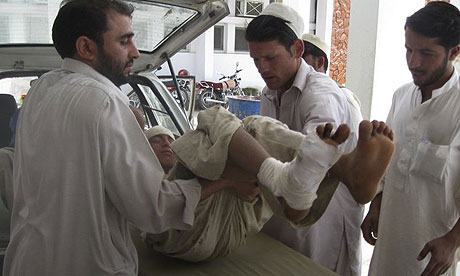
US air power triples deaths of Afghan civilians, says report

September 8, 2008
Afghan boy injured in US air strike

An injured Afghan boy is put on a stretcher at a hospital in Jalalabad city, Afghanistan. Photograph: Nesar Ahmad

Civilian deaths in Afghanistan from US and Nato air strikes have nearly tripled over the past year, with the onslaught continuing in 2008 and fuelling a public backlash, a leading human rights group says today.

The report by Human Rights Watch Human Rights Watch says that despite changes in the rules of engagement which had reduced the rate of civilian casualties since a spike in July last year, air strikes killed at least 321 civilians in 2007, compared with at least 116 in 2006. In the first seven months of this year at least 540 Afghan civilians were killed in fighting related to the armed conflict, with at least 119 killed by US or Nato air strikes, such as this July’s attack on a wedding party which killed 47, says Human Rights Watch.

“There has been a massive and unprecedented surge in the use of air power in Afghanistan in 2008,” the report says. It found that few civilians casualties were the result of planned air strikes on suspected Taliban targets. Instead, most were from air strikes during rapid response missions mostly carried out in support of “troops in contact” – ground troops under insurgent attack. Such strikes included situations where American special forces – normally small in number and lightly armed – came under insurgent attack.

“In response to increased insurgent activity, twice as many tons of bombs were dropped in 2007 than in 2006,” the report says. “In 2008, the pace has increased: in the months of June and July alone the US dropped approximately as much as it did in all of 2006. Without improvements in planning, intelligence, targeting, and identifying civilian populations, the massive use of air power in Afghanistan will continue to lead to unacceptably high civilian casualties.”

“Mistakes by the US and Nato have dramatically decreased public support for the Afghan government and the presence of international forces providing security to Afghans,” said Brad Adams, Asia director at Human Rights Watch. The report criticises the response given by US officials when civilian deaths occur. Before conducting investigations, US officials often immediately deny responsibility for civilian deaths or place all blame on the Taliban, the report says.

US investigations have been “unilateral, ponderous, and lacking in transparency, undercutting rather than improving relations with local populations and the Afghan government”.

Last night the US military announced it would reopen its investigation of an air strike last month in which the Afghan government says 90 civilians, mainly women and children, were killed. An initial US inquiry found that up to 35 suspected insurgents and seven civilians died in the attack on Azizabad in Herat province, but General David McKiernan, the senior US officer in Afghanistan, announced a review in the light of “new information”. Afghan and western officials say that videos of the bombing’s aftermath shows dozens of dead civilians.

US attack inside Pakistan threatens dangerous new war

September 6, 2008

Global Research, September 5, 2008

A ground assault by US Special Forces troops on a Pakistani village on Wednesday threatens to expand the escalating Afghanistan war into its neighbour. Pakistan is already confronting a virtual civil war in its tribal border regions as the country’s military, under pressure from Washington, seeks to crush Islamist militias supporting the anti-occupation insurgency inside Afghanistan.

The attack, which left up to 20 civilians dead, marks a definite escalation of US operations inside Pakistan. While US Predator drones and war planes have been used previously to bomb targets, Wednesday’s raid was the first clear case of an assault by American ground troops inside Pakistani territory. The White House and Pentagon have refused to comment on the incident but various unnamed US officials have acknowledged to the media that the raid took place and indicated that there could be more to come.

The attack was unprovoked. US troops landed by helicopter in the village of Jalal Khei in South Waziristan at around 3 a.m. and immediately targetted three houses. The engagement lasted for about 30 minutes and left between 15 and 20 people dead, including women and children.

A US official acknowledged to CNN that there may have been women and children in the immediate vicinity but when the mission began “everyone came out firing from the compound”. Even this flimsy justification for a naked act of aggression is probably a lie. “It was very terrible as all of the residents were killed while asleep,” a villager Din Mohammad told the Pakistan-based International News.

The newspaper provided details of the dead and injured: nine family members of Faujan Wazir, including four women, two children and three men; Faiz Mohammad Wazir, his wife and two other family members; and Nazar Jan and his mother. Two other members of Nazar Jan’s family were seriously wounded.

The US and international media have described the Angoor Adda area around the village as “a known stronghold of the Taliban and Al Qaeda” but offered no evidence to support the claim. A villager, Jabbar Wazir, told the International News: “All of those killed were poor farmers and had nothing to do with the Taliban.”

In comments to the International Herald Tribune, a senior Pakistani official branded the raid a “cowboy action” that had failed to capture or kill any senior Al Qaeda or Taliban leader. “If they had gotten anyone big, they would be bragging about it,” he commented.

The attack has provoked outrage in Pakistan. Pakistan’s Foreign Ministry issued a statement branding the attack as “a gross violation of Pakistan territory” and summoned US ambassador Anne Patterson to provide an explanation. North West Frontier Province (NWFP) governor Owais Ahmed Ghani declared that “the people expect that the armed forces of Pakistan would rise to defend the sovereignty of the country”. He put the number killed at 20.

Pakistani military spokesman Major General Athar Abbas said the raid was “completely counterproductive” and risked provoking an uprising even among those tribesmen who have previously supported the army’s operations in the border areas.

The International News reported: “Angry villagers later blocked the main road between Pakistan and Afghanistan in Angoor Adda by placing the bodies of their slain tribesmen on the road. They chanted slogans against the US and NATO military authorities for crossing the border without any provocation and killing innocent people.”

The US raid has compounded the political crisis inside Pakistan, where the selection of a new president is due to take place tomorrow. The ruling Pakistan Peoples Party (PPP) has been engaged in a delicate balancing act—continuing to support US demands for a crackdown by the Pakistani military along the border with Afghanistan, while trying to defuse widespread anger and fend off accusations that it is a US puppet.

Reaffirming his support for the Bush administration’s bogus “war on terror”, PPP presidential candidate Asif Ali Zardari declared in a column in yesterday’s Washington Post: “We stand with the United States, Britain, Spain and others who have been attacked.” Zardari went on to promise that he would ensure that Pakistani territory would not be used to launch raids on US and NATO forces inside Afghanistan.

However, as PPP spokesman Farhatullah Babar explained, the US attack was politically compromising. “We have been very clear that any action on this side of the border must be taken by Pakistani forces themselves,” he told the Associated Press. “It is very embarrassing for the government. The people will start blaming the government of Pakistan.”

An expanded war

The decision to launch Wednesday’s attack was undoubtedly taken at the top levels of the White House and Pentagon. As the New York Times reported in articles earlier this year, a high-level debate has been taking place in Washington over the use of US Special Forces inside Pakistan as well as the intensification of existing CIA operations, which include Predator missile strikes.

A meeting in early January involved Vice President Dick Cheney, Secretary of State Condoleezza Rice, Joint Chiefs of Staff chairman Admiral Mike Mullen and top national security and intelligence officials advisers. According to the New York Times on January 6, options discussed included “loosening restrictions on the CIA to strike selected targets in Pakistan” and operations involving US Special Operations forces, such as the Navy Seals.

The Times reported on January 27 that then Pakistani President Pervez Musharraf rejected proposals put by US Director of National Intelligence Mike McConnell and CIA Director Michael Hayden for an expanded American combat presence in Pakistan, either through covert CIA missions or joint operations with Pakistani security forces. While apparently accepting the refusal, the US intensified pressure on Pakistan to bring its border areas under control.

As the anti-occupation insurgency has expanded in Afghanistan, claiming a growing number of US and NATO casualties, Pakistan has become a convenient scapegoat. Washington has repeatedly accused the Pakistani military of failing to suppress Islamist militia and alleged that Pakistani military intelligence is actively supporting anti-US guerrillas inside Afghanistan.

Admiral Mullen has held five meetings since February with his Pakistani counterpart, army chief General Ashfaq Parvez Kayani, to press for tougher action. The most recent took place last weekend aboard the aircraft carrier USS Abraham Lincoln, stationed in the Arabian Sea. In comments to CNN, a US official “declined to say” whether there were any new agreements for US troops to operate inside Pakistani airspace or on the ground to attack Taliban and Al Qaeda.

Whether the Pakistani military quietly approved Wednesday’s attack or not, the Bush administration is making clear that it intends to extend the war into Pakistan. Citing top American officials, the New York Times reported on Wednesday that the raid “could be the opening salvo in a much broader campaign by Special Operations forces against the Taliban and Al Qaeda inside Pakistan, a secret plan that Defence Secretary Robert Gates has been advocating for months within President George W. Bush’s war council”.

This utterly reckless policy, which risks the eruption of a US war against Pakistan, is bipartisan in character. In fact, Democratic presidential candidate Barack Obama has repeatedly declared his support for broadening the “war on terror” through unilateral US attacks on insurgents based inside Pakistan. His candidacy has been strongly backed by sections of the US establishment that have been critical of the Bush administration’s invasion of Iraq for undermining US interests. Far from opposing aggressive US military action, Obama has become the political vehicle for shifting its focus to Afghanistan and Pakistan as the means of advancing US strategic interests in Central Asia and the Indian subcontinent.

The US attack on the village of Jalal Khei is another demonstration that the shift in policy, with all its potentially catastrophic consequences, is already underway.


Peter Symonds is a frequent contributor to Global Research.
Global Research Articles by Peter Symonds

US-led forces kill 15 Pakistani civilians

September 3, 2008

US-led forces alleged involved in Pakistan attack; at least 15 said killed

ISHTIAQ MAHSUD |AP News, Sep 02, 2008 23:47 EST

At least 15 people, including women and children, the border were killed in an attack involving U.S.-led forces in a remote Pakistani village near with Afghanistan, intelligence officials and a witness said Wednesday.

The U.S.-led coalition in Afghanistan said it had no report of such an incursion, said to have happened in the militant-infested South Waziristan tribal region. Pakistan’s army confirmed an attack but did not specify if it believed foreign troops were involved.

The U.S. and Pakistan, allies in the war on terror, have had tensions over cross-border attacks, including suspected American missile strikes in Pakistani territory. In one high-profile incident earlier this year, Pakistan said 11 of its soldiers died when U.S. aircraft bombed their border post.

Habib Khan Wazir, an area resident, said the latest incident happened before dawn, shortly after an American helicopter landed in the village of Musa Nikow in South Waziristan.

He said as the owner of a home nearby came outside with his wife, the “American and Afghan soldiers starting firing.”

Khan said later the troops entered the house and killed seven other people, including women and children. He said the troops also killed six other residents.

Two local intelligence officials confirmed the account on condition of anonymity because they were not authorized to speak to media. One official said 19 people died.

The U.S. embassy in Islamabad declined to comment.

Maj. Murad Khan, a spokesman for Pakistan’s army, said it could confirm an attack on a house near the Pakistan-Afghan border.

“We are collecting details,” Khan said, without specifying if Americans were involved.

American officials say Pakistan’s tribal regions along the Afghan border have turned into havens for al-Qaida and Taliban-linked militants involved in attacks on U.S. and NATO forces in Afghanistan. South Waziristan is the base for Pakistan’s top Taliban leader, Baitullah Mehsud.

The U.S. has pushed Pakistan to crack down on the militancy inside its territory, and there have been debates in Washington over how far the U.S. can go in carrying out its own strikes.

U.S. rules of engagement allow ground forces to go a few miles into Pakistan when in “hot pursuit” and when forces were targeted or fired on by the enemy. U.S. rules also allow aircraft to go several miles into Pakistan air space.

Source: AP News

Read also: News International, Sept 3, Coalition forces’ attack kills 20 in S Waziristan

Afghan human rights commission: US troops are committing war crimes

September 3, 2008

RINF.Com,Wednesday, September 3rd, 2008

By Parwiz Shamal

AN AFGHAN human rights organisation has accused the United States army of committing war crimes in Afghanistan.

The Afghanistan Independent Human Rights Commission (AIHRC) said on Tuesday that, according to their own investigations, civilians are killed in most operations conducted by US forces.

AIHRC expressed strong concern about the death of innocent Afghans during military operations and urged those responsible for the killings to face trial.

“According to our investigations, 98% of civilian casualties caused by the coalition forces in Afghanistan are intentional,” the head of the AIHRC, Lal Gul, said.

“The actions of the coalition forces, especially the American forces, are not only against the human rights laws, but are considered war crimes. Therefore, these forces have committed war crimes in Afghanistan,” he said.

Foreign forces maintain that they try their best to minimise civilian casualties in their operations.

They also accuse the Taliban of using civilians as human shields by taking shelter in residential homes and areas.

A spokesman for the AIHRC, Nadir Nadiri, said: “Whenever a military force, or one of the two sides in a war, kill innocent people intentionally, it has broken the international human rights law, and according to the human rights law, such people must be tried.”

NATO and the US-led coalition have come under fire from Afghan politicians, ordinary people and the local media for killing innocent civilians in recent weeks.

On Monday, residents accused foreign troops of killing four members of the same family during a midnight raid in Kabul, a claim the international troops strongly deny.

On August 22, a coalition raid on a village in the western province of Herat killed as many as 90 civilians, 60 of them children, a United Nations investigation into the ground and air operation revealed.

Karzai, who has also chided western generals for their failure to minimise civilian casualties, says the death of innocent Afghans only plays into the hands of the Taliban, who use the killings to turn people against the government.

More than 500 civilians have been killed during operations led by foreign and Afghan forces against militants this year, according to the Afghan government and some aid groups.

The UN says the civilian death-toll has increased “sharply” this year on last.

Afghan children killed by Nato fire

September 2, 2008
Al Jazeera, Sep 1, 2008

Protesters blocked a road in Kabul accusing US-led troops of killing Afghan children [REUTERS]

Nato-led troops have killed three Afghan children and injured seven during artillery fire in Afghanistan’s eastern province of Paktika.

Nato officials said that the attack on Monday happened by accident.

The deaths in Paktika province are expected to deepen the rift between foreign forces and the Afghan government.

The Afghan government has said that more than 500 civilians have been killed during operations by foreign and Afghan forces this year.

‘Investigation under way’

In the latest incident, troops fired artillery rounds after a patrol came under fire from Taliban fighters in Paktika’s Gayan district, Nato’s International Security Assistance Force (Isaf) said.

The rounds fell close to a house where the children were later found dead.

“ISAF deeply regrets this accident and an investigation as to the exact circumstances of this tragic event is now under way,” the ISAF said in a statement.

Dad Mohammad Khan, a former provincial intelligence chief and politician, said: “There is basically no Taliban [killed]. The Taliban fire and then escape and then these people [foreign troops] come and bombard. Three hundred people have been killed and wounded”.

The incident came hours after the US-led coalition command said its troops killed more than 220 fighters in a week of fighting in the same province. The coalition did not say where the militants were killed.

Fuelling anger

Meanwhile in Kabul, Afghanistan’s capital, hundreds of protesters blocked a road, accusing foreign troops of killing a family of four, including two children.

The family members were killed in an overnight raid by international troops, a police official and witnesses said.

Residents in Hud Kheil in the east of Kabul said one of the two children was eight months old and grenades killed the family members during a joint Afghan-US special forces operation.

However, US special forces said they were not involved.

“It was past one o’clock when the troops came and surrounded our houses,” Sulaiman, one resident, said.

“They threw hand grenades in one house and killed three family members,” he said.

Some locals told Al Jazeera there was an exchange of fire and that the family may have been caught in the crossfire.

The latest deaths are likely to further strain relations between Afghanistan and the US and other foreign forces in the country, who have been accused of using excessive force in civilian areas.

The operation came a day after Nato said it received information from a “reliable source” that pro-Taliban fighters may be planning to falsely claim that international forces killed up to 70 civilians in southern Afghanistan.

The operation also comes after Hamid Karzai, Afghanistan’s president, sacked an Afghan army general and a major after more than 100 civilians were reported to have been killed in an attack by US-led coalition forces.

Violence in Afghanistan is at its worst level this year, the bloodiest period since the Taliban was forced from power in 2001.