No Amnesty for Cheney, et al, Say Torture Opponents

November 27, 2008


Ali Gharib | Inter Press Service


WASHINGTON, 25 Nov (IPS) – Judging by the rare leaks from President-elect Barack Obama’s transition team, investigations and prosecutions of high-level George W. Bush administration officials for torture and war crimes are a distant prospect. But likely or not, that won’t stop pundits from debating the question of whether those officials responsible should be held accountable.

Irrespective of whether Vice President Dick Cheney, former Secretary of Defence Donald Rumsfeld or others are dragged before juries, one glaring change seems absolutely certain: Obama stands unequivocally against torture, and the practice is likely to come to an end under his administration.

‘Even though I’ve been disappointed in other presidents in the past, I do listen and I do believe Obama when he says we won’t torture. I think that’s crucial,’ said Michael Ratner, the president of the Centre for Constitutional Rights.

But foreswearing controversial and harsh interrogation methods may not be enough to permanently reestablish the moral high ground that the Obama administration has promised to bring back to the U.S.’s interactions with the rest of the world.

If Obama doesn’t take on torture that occurred, as opposed to simply discontinuing the practice, the door may be left open for future administrations to resurrect the harshest of interrogation techniques, said Ratner at a recent forum at Georgetown University Law School.

‘If Obama really wants to make sure we don’t torture, he has to launch a criminal investigation,’ said Ratner, the author of ‘The Trial of Donald Rumsfeld: A Prosecution in Book.’

He said that the targets of such an investigation would be the easily identifiable ‘key players’ and ‘principals’ in the Bush administration who hatched plans to allow and legally justify harsh interrogation methods that critics allege are torture, including the controversial ‘waterboarding’ simulated drowning technique.

Those pursued, said Ratner, would include high-ranking administration officials such as Cheney, Rumsfeld, and former Central Intelligence Agency chief George Tenet, as well as the legal team that drummed up what is now regarded as a sloppy legal justification for torture.

Key Bush administration lawyers involved in providing legal cover to harsh practices, including the roundly criticised ‘torture memo’ from the Justice Department’s Office of Legal Counsel (OLC), include former attorney general and earlier White House counsel Alberto Gonzales; Cheney’s chief of staff and former legal counsel to the vice president’s office David Addington; and the University of California, Berkeley law professor and former OLC lawyer John Yoo.

If the characters behind the questionable techniques are not held accountable for violating U.S. and international laws, said Ratner, presidents after Obama may simply say, ‘well, in the name of national security I can just redo what Obama just put in place. I can go torture again.’

Ratner also spoke to the concern that, from the view of the rest of the world, ‘to not do an investigation and prosecution gives the impression of impunity.’

But opposing Ratner on the dais, Stewart Taylor, Jr. argued that an investigation and prosecution were not appropriate.

‘The people who are called ‘war criminals by [Ratner] and others do not think they acted with impunity,’ said Taylor, a Brookings Institution fellow and frequent contributor to Newsweek and the National Journal.

In the Jul. 21 edition of Newsweek, Taylor called for Bush to preemptively pardon any administration official who could be held to account for torture or war crimes. Taylor’s rationale was that without fear of prosecution, a full and true account of what he called ‘dark deeds’ could never come to light.

Furthermore, at the Georgetown Law event Taylor said investigation and eventual prosecution would ‘tear the country apart’.

That may be the thinking of Obama, who, in addition to hints he wouldn’t investigate Bush administration malfeasance, declared his intention to govern as a political reconciliation president in his election victory speech.

In Grant Park in Chicago on Nov. 4, Obama rehashed a quote from slain civil rights leader Martin Luther King, Jr., but instead of rhetorically bending the ‘arc of history’ towards ‘justice’, as King did, Obama called for it to be bent ‘toward the hope of a better day.’

But Ratner said that the country was already divided, and that divide is exactly what a future administration could politically exploit to reinstate torture. He said that Obama must close the divide and doing so is not rehashing the past.

‘You’re making sure that in the future, we don’t torture again,’ Ratner said. ‘This is not looking backwards.’

Another potential problem with investigation and prosecution, says Taylor, is that the Bush administration officials ostensibly had sought to find out whether the methods they were about to approve were justified, and, indeed, they were told they were in the legal clear.

‘There is no that high ranking officials acted with criminal intent,’ he said. ‘They were relying in good faith on the advice of legal counsel.’

Taylor said that since the legal advice originated from the Department of Justice, it would be wrong for the same Justice Department to ‘turn around’ and prosecute people for actions that its previous incarnation had explicitly told were legal.

But Taylor’s point misses two issues: that the crimes were allegedly given a legal green light because of collusion with the White House, and that Ratner proposes to investigate those selfsame Justice officials who were involved in giving approval.

Despite referring to John Yoo as a ‘gonzo executive imperialist’, Taylor said that ‘those officials, like them or not, were honourably motivated’ because they were ‘desperately afraid’ of another terrorist attack.

Ratner insists that the officials, part of a ‘group, cabal or conspiracy’, may be culpable because they were ‘aiders and abetters’.

‘[OLC] was not giving independent counsel,’ insisted Ratner. ‘They were shaping memos to fit a policy that had already been determined.’

And while Taylor was quick to point out that many U.S. administrations had been accused of war crimes by various sources, Ratner replied that it was the first time that any administration had actually ‘assaulted the prohibition on torture’.

That could be one reason why, if the U.S. does not take care of its own house, Bush administration officials will likely be pursued on charges in Europe and elsewhere.

In international courts, said Ratner, those officials will not be able to hide behind the legal shields of internal government memos or executive decrees.

‘They have no defence in international law,’ he said. ‘They’re finished.’
Mumbai attacks: the media reaction

November 27, 2008

Haroon Siddique | Guardian, Nov 27, 2008

At least 101 people have been killed and more than 250 injured in Mumbai in one of the worst terrorist attacks on Indian soil. At time or writing the situation remains grave with some of the perpetrators reportedly holed up in two luxury hotels, the Taj and Oberoi Trident, and exchanging gunfire with security forces.

The Times of India reports: “In one of the most violent terror attacks on Indian soil, Mumbai came under an unprecedented night attack as terrorists used heavy machine guns including AK-47s and grenades to strike at the city’s most high-profile targets – the hyper-busy CST (formerly VT) rail terminus; the landmark Taj Hotel at the Gateway and the luxury Oberoi Trident at Nariman Point; the domestic airport at Santa Cruz; the Cama and GT hospitals near CST; the Metro Adlabs multiplex and Mazgaon Dockyard – killing at least 101 and sending hundreds of injured to hospital.”

The paper says six foreigners have been killed along with the chief of the city’s anti-terror squad. “Anyone with British or American passports they wanted to know,” British citizen Rakesh Patel told Sky News in an apparent confirmation that the attackers were targeting tourists.

The Times of India reports that a previously unknown outfit, Deccan Mujahideen, has claimed responsibility. A militant told a local news channel that there were seven attackers holding hostages inside the Oberai, while the Deccan Herald, which describes it as “India’s most audacious terrorist attack”, reports the army as saying there are 40 to 50 hostages remaining in the Taj. According to the BBC, four of the attackers have been killed and nine arrested. It reports that seven UK citizens are known to be among the injured and an Israeli family are feared captured by gunmen.

In the Times of London, Jeremy England writes: “Last night’s attacks also appear to fit into a new campaign to hit busy urban targets, popular with foreigners and wealthy Indians, to cause maximum damage to India’s economy and international reputation.”

He suggests Deccan Mujahideen could be an offshoot of the Indian Mujahideen, an Islamist group unknown until it said it was behind multiple bomb attacks on Indian cities in the past year.

Vinu has posted a series of photos of the aftermath of the attack on Flickr.

On the India Uncut blog, Amit Varma details his escape from the attacks after leaving a hotel.

“We stepped out again, and as we did so we heard gunshots and saw people running towards us from the left side. One of the hotel employees rushed out and told us to get back in. ‘There must have been an encounter,’ he said. ‘Get back in, you’ll be safe inside.’

“We followed him in. We waited in the lounge bar upstairs for a while. The big screen there was showing cricket. India won. Then someone changed the channel. That’s when we realised that this was much more than a random police encounter or a couple of gunshots.”

Based on an extract from the Wrap, guardian.co.uk’s roundup of the day’s news

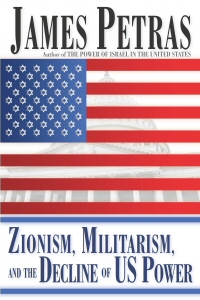
Zionism, the United States, and Hegemony in the Middle East

November 26, 2008

Zionism, Militarism, and the Decline OF US Power
By James Petras

Paperback: 192 pages
(Clarity Press, 2008)
ISBN-10: 0-932863-60-4
ISBN-13: 978-0-932863-60-7

Professor James Petras has written another book — Zionism, Militarism, and the Decline OF US Power — probing deeper into what he contends is a Zionist Power Configuration (ZPC) that has infiltrated and largely usurped US foreign policy even using the US military for its ends in the Middle East. Petras fills his book with lots of evidence backed by sound rationales.

Petras’s thesis is that Israel — and not Big Oil — was behind the push to invade and occupy Iraq. That has already happened. What concerns Petras now is the push by the ZPC to have the United States again breach international law and launch an attack against Iran.

Petras reasons that the ZPC’s purpose is to incorporate Palestine and consolidate its hegemony in the Middle East. Strategically, gaining and holding sway over the planet’s preeminent military power has been a major plank toward this goal.

The professor provides numerous examples of the sway the ZPC wields and how it wields it: through its propaganda and media arms (Petras cites how, pre-“war,” the Lobby produced about 8,800 pro-Iraq attack pieces which were circulated to major Anglo-American media versus zero pro-Iraq attack pieces published from Big Oil spokespeople); through its academic acolytes; through involving US soldiers to fight its wars (Petras charges that the Israel Firsters “ridicule the US military precisely to instigate them to prosecute wars and thereby avoid the loss of Israeli-Jewish lives”); through the relative silence of dissenting voices, including dissenting Jewish voices in mass media; through members of the US Congress beholden through acceptance of campaign contributions form the Lobby.

Campaign contributions turn out, actually, to be an investment. Through seeding the US Congress, Israel has become the prime beneficiary of US “aid,” even though Israel is a relatively well-to-do state, especially compared to many of its neighbors. Petras wavers on what the “US annual ‘tribute to Israel’” is. On page 68, he cites a figure of $6 billion a year; on page 68 he states $3 billion a year; on page 156, it is $2.4 billion a year; and on page 164 it is “well over $3 billion” a year. This irritation contributes to unevenness in Petras’s account.

Exacerbating this irritation is an uneven patchwork of endnotes. Sometimes key points are in the endnotes, and sometimes key points are not in the endnotes. For example, he writes that Big Oil is anxious and fearful about an Israeli-instigated warmongering destabilizing the Middle East citing a source for this claim (p. 32). On page 92 he claims electoral chicanery without citation. Whether the claims are true or not is beside the point, which is that the reader is hindered from checking the professor’s sources. And when there are endnotes, many convey scanty information (e.g., no author, no title, no page) that forces a reader to spend inordinate time tracking down a citation.

Petras, however, deserves kudos for taking on the Lobby which resorts to disreputable tactics to try and silence its critics. Petras does not shirk from identifying how he perceives the threat from the ZPC: “The lesson is clear: the rise of Judeo-fascism represents a clear and present danger to our democratic freedoms in the United States.”

The ZPC is ruthless says Petras, who observes that Israel reneges on obligations as an occupier in Palestine and engages in “meat-grinder genocidal policies in Gaza.” And yet, it has vulnerabilities, such as the “repeated failures and incredible stupidity of the Israeli intelligence agencies.”

The ZPC control apparatus is necessarily twined with the corporate media. “State provocations,” writes Petras, “require uniform mass media complicity in the lead-up to open warfare.”

With a massive media blitz and compliant government, Israel recruits US soldiers to fight its wars. The US, on the other hand, tries to get its victims to fight against their fellow countryfolk. This is a dubious strategy reasons Petras, as Iraqis fighters under occupation “recruited on basis of hunger and unemployment (caused by US war) are unreliable soldiers.”

This, according to Petras, is a losing tactic: “US colonization of Iraq is a blatant denial of the conditions necessary for reconciliation.”

Just how losing a strategy it is to run a militaristic economy is evidenced by the massive capitalistic expansion of non-belligerent China. In fact, the US is becoming less competitive and falling into an increasingly dire economic situation

Petras describes a schism among Jewry. He notes that “most Jewish Americans differ from the leaders of the major American Jewish organizations” … but that “they have not or do not challenge” this leadership. Antiwar sentiment among Jewish Americans, finds Petras, is quite vague.

He writes that “both the progressive majority of Jews and the reactionary minority … have a fundamental point of agreement and convergence: support for and identity with Israel and its anti-Arab prejudices, its expansion, and the dispossession of Palestine [sic].”

Given that the peace movement has gone AWOL, this bodes ill for the peoples of the Middle East. Here again, Petras holds the ZPC responsible since he charges that it has also infiltrated the antiwar movement and split it, rendering it anemic.

Petras notes that everywhere he visits around the globe people from all walks ask him why American citizens tolerate the killing done by the US government/military. This is a good question, but another question is unasked by Petras. Why do these citizens not demand the same answers from their complicit governments which, even when they do not contribute fighters to a so-called Coalition of the Willing, remain silent to the great criminal breaches of international law and the abandonment of morality?

That is why Petras’s thesis in Zionism, Militarism, and the Decline OF US Power is important: innocent people are dying for wicked reasons.

Kim Petersen is co-editor of Dissident Voice. He can be reached at: kim@dissidentvoice.org. Read other articles by Kim.

The present crisis of capitalist system

November 26, 2008

Here is Hillel Ticktin’s editorial for the forthcoming issue of Critique #46, due on December 1st, analysing the current crisis and its denouement:

http://www.critiquejournal.net

The most important ongoing event is the spectacular implosion of the financial system and the ongoing downturn. We will be having a number of articles on the subject in the next issue. These notes have conducted a running theoretical and empirical commentary but we will have more articles to supplement those in the April 2008 issue in the next issue-due to come out at the end of January.

The Implosion of Finance Capital-Depression and Deflation

It is almost impossible to open a newspaper without some reference to the historically important nature of our times. It is clear that we are living through a period comparable to that of the Great Depression in its political economic importance, even though it is unlikely to reproduce its length, depth and misery. These same establishment newspapers and journals find it necessary to defend and justify capitalism as a system, when there is no important movement challenging it. Marx is frequently quoted, both to support and criticise capitalism.1 Nor is it only the media who are enamoured of Marx and gripped with self-doubt. Bankers and other establishment figures have excused themselves for not taking Marx seriously. Banks’ advice now includes the caution that Marx may be right about capitalism collapsing under the weight of its own contradictions.2 Although, we may assume that the authors are not entirely serious, it is nonetheless a sign of the times.

Karl Marx appears then to have made a return from the grave to which he had been assigned in the nineties. Marxism has been declared wrong, irrelevant and worse for one and half centuries, only to return with renewed force. The suddenness of the conversion was unexpected. After all, far-left parties are marginal at best and detested at worst. The economics profession is, as ever, pro-market. Why then has there been this criticism of capitalism itself?

It was almost an orthodoxy that capitalism could always re-invent itself. That has been repeated by the historian Tristram Hunt 3 He points out that Engels had repeatedly expected a crisis to crack the system. He derives his material from Engels’ letters to Marx and concludes that capitalism gets through its crises. There is no doubt that capitalism is not at an end not least because there is no working class movement for socialism. However, Tristram Hunt has missed the point. We are now living in a period of instability, and the instability is that of the system itself. When someone argues that capitalism has survived, the question is always by what means. After all, the system has survived through repression, imperialism, and war as well as through the welfare state. We have never had a peaceful capitalism in the developed countries, without exploiting peoples beyond its borders. In the third world, the situation was and remains dire, with certain exceptions.

It is not accidental that Marx can be quoted and that the system itself be questioned by those at the heart of the system. This is in part because those personages know the weaknesses of the system in some detail but it is also in part because the Cold War is over and Marx is no longer tarnished with the taint of Stalinism. It is of particular note that these writers and commentators see capitalism as a system even if they argue that there is no replacement. Once capitalism is perceived as a system, its limitations can also be discussed and then it is a short step to perceiving capitalism itself as in evolution from its birth to its dotage.

Defence of Capitalism in the Downturn

The wave of questioning has led to three lines of defence. We are told that in the end we will be back where we were before the downturn or perhaps before the speculative rise in asset prices from 2004. Simon Jenkins, a liberal commentator, has argued that all the discussion of the limits of capitalism is just hot air.4 The failure lay in the regulators and the politicians who removed the regulation or who urged banks to extend their lending. Rationally considered, it can be argued that the financial crisis was an accident of history caused by the greed or incompetence of bankers or lack of regulation over a market which has to be regulated in order to function properly. In fact, there are three theses being put forward here.

Firstly, it is argued that capitalism is necessarily cyclical, but eternal, and hence the economy will recover and be better than ever, having learned its lesson. Secondly, it is maintained that the market requires regulation and regulation was systematically reduced over a period of more than twenty years, notably through the repeal of the Glass-Steagall Act in 1999 in the USA, allowing commercial banks to operate as investment entities as well as continue their everyday functions.5 Thirdly, it is held that things might not have gone awry had not a number of individuals been so greedy for ever higher rewards. A fourth thesis could also be put forward. The contradictions of capitalism are showing themselves but the system will continue as long as there is no political movement to replace it. The first view merges with the fourth. Much of the organised left effectively supports the last view, having given up on the idea of capitalism entering a systemic crisis. Tristram Hunt’s argument fits in here.

Clearly, none of these arguments says much for the capitalist system itself but then ‘the danger of meltdown’ has been a constant refrain in all the media. It would appear that both the capitalist class and those who manage their operations have been seriously frightened. Indeed, the two weeks that followed the nationalisation of the mortgage companies was described in graphic detail in the media, ‘Nightmare on Wall St’ being probably one of the best headline.

At the same time, although there is no organised left of any importance in the USA or Europe, the population is both worried and angry. It is one thing for a factory owner to receive a subsidy but another for bankers to be bailed out. Most people do not see bankers as anything but parasitic, receiving huge salaries for receiving other people’s money and lending that money out at exorbitant rates of interest. While financial capital is necessary for the capitalist system to function, the dominance of finance capital and the huge rewards it receives are a function of the present stage of capitalism itself and that view is widely held. Outside of the Anglo-Saxon countries, industrial capitalism plays a greater role and finance capital is often resented. As a result, Finance Capital and its functionaries see themselves as beleaguered, and in a fragile situation, both because of the threat to their ‘business’ and because of a possible systemic threat.

Continued >>

Karzai Demands ‘Timeline’ for End of Occupation

November 26, 2008

Karzai Grows Impatient as US General Warns War Has a “Long Way to Go”

Antiwar.com,  November 25, 2008

Seven years into the war in Afghanistan, Major General Robert Cone sought to tout the “great progress” made in readying Afghanistan’s own security forces, but rather wound up giving the impression that little has really been accomplished and the US mission has, in his words, “a long way to go.”

After five years of US training, only about a third of the Afghan Army is actually ready to operate on its own. The Afghan police are in even sorrier shape, with fully none of the 433 assessed units capable of performing its duties, and the vast, vast majority of them having the lowest possible rating of readiness.

The seemingly open-ended war is not sitting well with Afghan President Hamid Karzai, whose ambition for re-election in the fall is put in growing peril by the spiraling death toll and public perception of an inept government dependent on a foreign occupation for even the modicum of control they exert over the nation.

Rather than hoping the promised “surge” will set things right, President Karzai is petitioning the United Nations Security Council to put an end to the civilian casualties caused by the international forces, which operate under a UN mandate. Karzai also asked them to end house searching and unnecessary detentions.

But perhaps most tellingly, the president is asking the international community for a timeline on how much longer the war is going to take. Pakistani Senator Nisar Memon asked NATO the same thing yesterday, but was apparently rebuffed on the notion of an exit strategy for the ever-worsening war. Whether Karzai will get any answer remains uncertain.

Related Stories

compiled by Jason Ditz [email the author]

The Price of Hillary Clinton

November 26, 2008

by Srdja Trifkovic

Global Research, November 25, 2008

Chronicles – 2008-11-24

No secretary of state will come to that office with stronger pro-Israel credentials or closer ties to the Jewish community than Sen. Hillary Clinton, Douglas Bloomfield assures his readers in The Jerusalem Post. Good for them, and for Bosnia’s Muslims and Kosovo’s Albanians; but for the rest of us Mrs. Clinton’s appointment as the third woman U.S. Secretary of State is hugely problematic. It heralds “the end of the world as we know it” in some ways, although neither she nor her coterie necessarily know what they are doing.

At the technical level, Hillary Clinton is likely to deepen the chronic crisis of the once-venerable institution at Washington’s Foggy Bottom, to which her two female predecessors have contributed in two different ways.

Madeleine Albright was an activist who will be remembered for her hubris (“If we have to use force, it is because we are America. We are the indispensable nation. We stand tall. We see further into the future.”), coupled with studied callousness. Asked on “60 Minutes” about the death of a half-million Iraqi children due to sanctions, she promptly responded, “I think this is a very hard choice, but the price is worth it.” Her crowning glory was her premeditated 1999 war in the Balkans, prior to which she said that “the Serbs need a little bombing.” Her State Department contributed to the formulation, as well as execution, of Bill Clinton’s doctrine of “humanitarian intervention.”

Condoleezza Rice, less evil and more obtuse, will be remembered for nothing. She was an auxilliary tool of the Bush-Cheney team, with all key decisions made elsewhere.

Mrs. Clinton will try to rebuild the relative importance of the Department of State, which will become her personal fiefdom, but her labors will not be for the better. Her appointment, the most significant among several major figures from the Clinton era, belies Obama’s rhetoric of “change” when it comes to foreign affairs. There will be tectonic shifts, cultural and moral, at home. The established premises of an imperial presidency – which in world affairs inevitably translates into the quest for dominance and justification for global interventionism – will not be challenged, however.

Once it is accepted that Obama’s primary interest lies in an irreversible redistribution of power and money at home, it ceases to be surprising that he chose Hillary Clinton as his chief diplomat. Allowing her to indulge in some global grandstanding is acceptable to him, if that means the Clintons will not stand in the way of his domestic agenda. They are both revolutionaries, after all: that Mrs. Clinton is instinctively opposed to any traditional understanding of diplomacy became obvious during the primary campaign, when she accused Obama of “naivete” for saying he was willing to meet leaders of Iran, Syria and North Korea.

With Robert Gates staying at the Pentagon and Jim Jones as Obama’s national security adviser, there will be a lot of continuity in the U.S. foreign policy, not only with the 1990s but also with recent years. In Mrs. Clinton’s case there will be more lies, the hallmark of the family. During the primaries she listed a number of foreign policy accomplishments based on her husband’s legacy. She claimed that in 1999 she “negotiated open borders” in Macedonia to Albanian refugees from Kosovo, although the crossings were opened days before her arrival. She had repeatedly invoked her “dangerous” trip to Bosnia in 1996, including alleged snipers at Tuzla airport, whereas the Bosnian war had ended six months earlier and video footage shows smiling schoolchildren greeting her in Tuzla. (She later admitted “misspeaking” over sniper claims.)

In the same spirit Mrs. Clinton declared, in late 2002,

“Saddam Hussein has worked to rebuild his chemical and biological weapons stock, his missile-delivery capability and his nuclear program. He has also given aid, comfort and sanctuary to terrorists, including al-Qaida members. I want to insure that Saddam Hussein makes no mistake about our national unity and for our support for the president’s efforts to wage America’s war against terrorists and weapons of mass destruction.”

Hillary Clinton says that she has had second thoughts since that time, and a year ago she declared in Foreign Affairs magazine that “US troops should be brought home.” During the primary campaign, however, she was markedly less willing than Obama to commit to a withdrawal timetable. The woman who voted to authorize the Iraq war, and who parroted lies used to justify it, cannot be expected to clean up the mess created by that war. It is more likely that she will advocate a downsized, rebranded, and effectively open-ended U.S. occupation of Iraq for which the military has been preparing ever since the “Surge.”

In Afghanistan, far from disengaging, Mrs. Clinton will advocate greater troop deployments and an escalation of military activity. On Iran, during the primaries she sounded like John McCain: “I want the Iranians to know that if I’m the president, we will attack Iran” if it attacks Israel, she declared last April: “In the next 10 years, during which they might foolishly consider launching an attack on Israel, we would be able to totally obliterate them.” She will negotiate with the mullahs, however, if Tehran’s tacit support is considered necessary for the achievement of her major ambition: a breakthrough in the Middle East.

Bill Clinton came closer than any U.S. president to brokering Arab-Israeli peace in the final year of his presidency, and insiders say that Hillary will place this issue at the top of her agenda. She is a favourite of the pro-Israel lobby, however, and it is unclear what she can offer, or do, in 2009-2010 that was not offered or tried at Camp David a decade earlier.

Continued >>

Foreign Press in Israel Fight Gaza Entry Ban

November 26, 2008

JERUSALEM – International journalists based in Israel appealed to the country’s Supreme Court on Monday to overturn a government decision barring foreign correspondents from entering the Gaza Strip.

The Foreign Press Association filed the court petition against the military’s Gaza commander, Defense Minister Ehud Barak and Interior Minister Meir Sheetrit after the government failed to heed a letter signed by heads of the world’s largest news organizations calling for the ban to be lifted.

The court petition charged the media ban constitutes “a grave and mortal blow against freedom of the press and other basic rights and gives the unpleasant feeling that the state of Israel has something to hide.” It requested an urgent hearing.

The Tel Aviv-based Foreign Press Association represents foreign correspondents working in Israel and the Palestinian territories.

Israel has long restricted movement across its border with Gaza, but it closed the area to all but essential supplies on Nov. 5 after an upsurge in Palestinian rocket fire. For the first time, that included a blanket ban on foreign reporters entering the territory.

The government routinely prevents Israeli journalists from entering Gaza because of fears for their safety, but up to now foreign reporters had been permitted in, even during times of heavy fighting.

Since the ban, coverage in Gaza has been largely left to local Palestinian staff and a handful of foreign journalists who entered before the ban took effect, including two Associated Press reporters.

Israel’s Defense Ministry says foreign journalists will be allowed in only once Gaza militants stop shooting.

The letter protesting the ban, signed by The AP, Reuters, the New York Times, the BBC, CNN and other major news organizations, was sent last week to Prime Minister Ehud Olmert.

In responding to the letter, Defense Ministry spokesman Shlomo Dror said Israel was displeased with international media coverage, which he said inflated Palestinian suffering and did not make clear that Israel’s measures were in response to Palestinian violence.

Guantánamo Justice After Seven Years

November 26, 2008
Since the Bush administration began transporting men and boys to Guantánamo Bay in January 2002, it has tried to prevent them from presenting their cases before a neutral federal judge. Indeed, the naval base was turned into a prison camp precisely to keep the detainees away from impartial courts. The government argued that federal courts had no jurisdiction over men detained on Cuban soil. Twice, the Supreme Court rejected that argument, finding that the United States exercises complete jurisdiction and control over the Guantánamo Bay base.

Finally, on November 20, in a stunning development, U.S. District Court Judge Richard J. Leon ordered the government to release five Guantánamo Bay detainees “forthwith.” Finding that the government failed to prove the men were “enemy combatants,” the judge, in a rare comment, urged senior government leaders not to appeal his ruling. “Seven years of waiting for a legal system to give them an answer . . . in my judgment is more than enough,” he said.

The five detainees the judge ordered released are Lakhdar Boumediene, Mustafa Ait Idir, Hadj Boudella, Saber Lahmar and Mohammed Nechla. Judge Leon did, however, find that a sixth detainee, Belkacem Bensayah, was properly classified an enemy combatant.

It was the Supreme Court’s June 12, 2008 decision in Boumediene v. Bush (see Supreme Court Checks and Balances in Boumediene, JURIST Forum, June 16, 2008) that allowed Judge Leon to review the enemy combatant classifications. The high court upheld the Guantánamo detainees’ constitutional right to habeas corpus and made clear they were “entitled to a prompt habeas corpus hearing.” Judge Leon adopted the definition of “enemy combatant” used by the Combatant Status Review Tribunals, which is “an individual who was part of or supporting Taliban or al Qaeda forces, or associated forces that are engaged in hostilities against the United States or its coalition partners. This includes any person who has committed a belligerent act or has directly supported hostilities in aid of enemy armed forces.”

The six detainees in this case are native Algerians who were residing in Bosnia and Herzegovina, over a thousand miles from the battlefield in Afghanistan. All six held Bosnian citizenship or lawful permanent residence as well as native Algerian citizenship. Arrested by Bosnian authorities in October 2001 for alleged involvement in a plot to bomb the U.S. Embassy in Sarajevo, they were ordered released from prison on January 17, 2002 and then turned over to U.S. personnel who transported them to Guantánamo on January 20, 2002. They have been there ever since.

President Bush had withdrawn the alleged bomb plot as a basis for their detention. He argued instead that the men planned to travel to Afghanistan in late 2001 and take up arms against the United States and allied forces. Judge Leon found the government had failed to prove these allegations by a preponderance of evidence in the cases of all but Bensayah.

The judge said the Justice Department and intelligence agencies had relied solely on a classified document from an unnamed source. He wrote that “while the information in the classified intelligence report, relating to the credibility and reliability of the source, was undoubtedly sufficient for the intelligence purposes for which it was prepared, it is not sufficient for the purposes for which a habeas court must now evaluate it.” He added, “To allow enemy combatancy to rest on so thin a reed would be inconsistent with this Court’s obligation under the Supreme Court’s decision in Hamdi to protect petitioners from the risk of erroneous detention.”

The government did, however, present additional evidence which persuaded Judge Leon that Bensayah was “an al-Qaida facilitator” who planned to take up arms against the United States and facilitate the travel of unnamed others to do the same. That, wrote the judge, “constitutes direct support of al-Qaida in furtherance of its objectives” and “this amounts to ‘support’ within the meaning of the ‘enemy combatant’ definition governing this case.”

Bosnian authorities have indicated they are willing to take the five detainees once they are released.

In October, another federal district judge in Washington, Ricardo M. Urbina, ordered that 17 Uighur detainees be released from Guantanamo. The judge didn’t hold an evidentiary hearing because the government conceded the men were not enemy combatants. But the 17 men from western China languish in custody because the government has appealed Judge Urbina’s ruling.

President-elect Barack Obama has pledged to close the Guantánamo prison when he takes office. The National Lawyers Guild has urged Obama to ensure that the prisoners are released, repatriated, resettled, or brought to trial (if there is probable cause to believe they have committed a crime) in strict accordance with international human rights and humanitarian law, and the principles of fundamental justice pertaining to criminal proceedings. This includes but is not limited to, the Four Geneva Conventions of 1949, the Convention against Torture and other Cruel, Inhuman or Degrading Treatment or Punishment, and the International Covenant on Civil and Political Rights. The United States has ratified all of these treaties which makes their provisions binding U.S. law under the Supremacy Clause of the Constitution.

The Guild opposes the creation of national security courts to try the detainees. Although Obama said in August, “It’s time to better protect the American people and our values by bringing swift and sure justice to terrorists through our courts and our Uniform Code of Military Justice,” three Obama advisers told the Associated Press that the President-elect is expected to propose a new court system to deal with “sensitive national security cases.”

Concerns have been cited about disclosure of classified information in civilian courts and courts-martial. However, the Classified Information Procedures Act (CIPA) provides an adequate method of protecting classified information in existing U.S. courts. CIPA allows a judge to assess the importance of sensitive evidence before it is disclosed in open court and, if necessary, create a nonclassified substitute for use at trial. Former federal prosecutors Richard B. Zabel and James J. Benjamin, Jr. studied the 107 post-9/11 cases and prepared a 171-page white paper for Human Rights First called In Pursuit of Justice: Prosecuting Terrorism Cases in the Federal Courts. They wrote, “[w]e are not aware of a single terrorism case in which CIPA procedures have failed and a serious security breach has occurred.” National security courts, they write, “would give the government more power and make it easier for the government to secure convictions.”

President-elect Obama should send those prisoners he intends to try to U.S. civilian and military courts, which are well-suited to protect national security concerns. He should eschew the creation of a new system of courts with reduced due process, which will raise many of the same concerns as Bush’s dreaded military commissions.

Marjorie Cohn is a professor at Thomas Jefferson School of Law and the president of the National Lawyers Guild. She is the author of Cowboy Republic: Six Ways the Bush Gang Has Defied the Law and her new book, Rules of Disengagement: The Politics and Honor of Military Dissent (with Kathleen Gilberd) will be published in March by PoliPointPress. Her articles are archived at www.marjoriecohn.com.

Barack Obama mentor Abner Mikva warns over Hillary Clinton choice

November 26, 2008
From
November 26, 2008

Reports detail Congo atrocities

November 26, 2008

Government soldiers and rebels fighting in the eastern part of the Democratic Republic of the Congo have both committed serious human rights abuses, according to the United Nations secretary general.

A report presented by Ban Ki-moon to the UN security council documents atrocities perpetrated against the displaced civilian population of the vast region. Up to 250,000 people have been forced to flee their homes in the past few months.

The details of mass killings and rapes emerged as Human Rights Watch released a separate report estimating that as many as 500 political opponents of President Joseph Kabila’s government had been murdered since 2006 elsewhere in Congo. It described the human rights situation in the central African state as “a cause for grave concern” despite a current lull in fighting.

The UN report, which covers conditions between July and November, said elements of the Congolese army and national police were responsible for violations including arbitrary killings, rape and torture.

Rebels – including those loyal to Laurent Nkunda’s National Congress for the Defence of the People and Rwandan Hutu fighters – are accused in the report of “perpetrating serious human rights abuses with impunity”. Among the Hutu fighters are said to be some who participated in Rwanda’s 1994 genocide.