Pakistani floods affect millions, but level of international aid pitiful

August 11, 2010

By Vilani Peiris, wsws.org, Aug 11, 2010

With monsoonal rains continuing, the worst flooding in Pakistan in 80 years is still spreading. Pakistani relief organisations and government agencies are stretched to the limit. Yet despite urgent appeals from the UN and other aid organisations, the level of international aid is pitiful, even measured against the limited assistance donated in other recent disasters.

According to the UN, more than 14 million people, including 6 million children, have been affected by flooding which has ravaged parts of all four provinces in Pakistan. In appealing for further international aid, UN officials pointed out that the number of people affected exceeds the combined total for the 2004 Asian tsunami, the 2005 earthquake in Kashmir and this year’s earthquake in Haiti.

The death toll at nearly 1,700 is still comparatively low. However, many deaths are likely to be unrecorded. Large areas of the country have been cut off by landslides, washed away road and bridges and flooding. The Swat Valley in the worst affected province—Khyber-Pakhtunkhwa (formerly the North West Frontier Province)—is cut off, trapping an estimated 500,000 people. Most have received no relief supplies, except small quantities being transported into the areas by foot or donkey.

Continues >>

Nuclear Carriers on the Move

August 10, 2010

An Open Letter to President Barack Obama

By Arno J. Mayer, Counterpunch, August 9, 2010

Dear Mr. President:

As Commander-in-Chief you have ordered the nuclear-powered aircraft carrier U.S.S. George Washington to carry out major naval exercises off the coast of Japan and the Korean Peninsula before proceeding, most likely, to other exercises in the Yellow Sea, an inlet of the Pacific Ocean between mainland China and the Korean Peninsula to the east. One of the world’s largest warships, the George Washington is accompanied by some 20 armed vessels and submarines, scores of aircraft and helicopters along with thousands of naval, ground, and air personnel.

You have also ordered the deployment of the nuclear-powered U.S.S. Dwight Eisenhower and U.S.S. Harry Truman to cruise or patrol in an open-ended theater of naval operations in the Indian Ocean, the Red Sea, and the Persian Gulf. Both these carriers likewise are hubs of large strike forces consisting of numerous warships, military aircraft, units of the armed services, including special commandos and amphibious landing craft.

Given the scale and reach of this projection of raw military power—reminiscent of the comparatively paltry gunboat diplomacy of a not-so-distant past—I was wondering, Mr. President, whether it wouldn’t be wise for you to give the American people, the United Nations, and the rest of the world a reasoned statement of the need for such an oceanic display of America’s naval, air, soldierly, and electronic might at a time when the United States seems bent on continuing to act as a global policeman in the four corners of the world.

Should you clarify the objectives of American policy it might also be helpful if you could indicate how your policies are in harmony with the letter and spirit of the Nobel Peace Prize, awarded for your “extraordinary efforts to strengthen international diplomacy and cooperation between peoples,” which you humbly accepted. Such a reflection would stave off the question as to when and on which of America’s 12 nuclear-powered super-carriers you expect to declare “Mission Accomplished.”

Respectfully yours,
Arno J. Mayer

Arno J Mayer is emeritus professor of history at Princeton University. He is the author of The Furies: Violence and Terror in the French and Russian Revolutions.and Plowshares Into Swords: From Zionism to Israel (Verso).

The Resentment Against Indian Rule Persists in Kashmir

August 10, 2010
By Raoof Mir, Foreign Policy Journal, Aug 10, 2010

People of Kashmir carry the body of a man shot by Indian police in Srinagar on August 3, 2010 (Press TV)

Recently I was asked by one friend of mine who works as a reporter in a ‘reputed’ regional Telugu daily, the reasons for ‘gun culture’ and ‘stone pelting culture’ in the Indian administered Kashmir valley: “Why is it that people of Kashmir don’t peacefully complain about their problems to the government?”

I replied to him that it is the cynicism and the distrust of the people with the system. My friend didn’t ask me what that actually meant. I wanted to explain to him about the life of common people in Kashmir, the diabolical role of Indian army, and their impunity for human rights violations.I wanted to explain to him how a knock on the door late at night or sneaking away to smoke a cigarette at night sends spasms of anxiety through the people, afraid that this might be their last breath.

Continues >>

The Cycle of Violence in Afghanistan

August 10, 2010
by Rep. Ron Paul, Antiwar.com, August 10, 2010

Listen to Ron Paul deliver these remarks here.

Last week the National Bureau of Economic Research published a report on the effect of civilian casualties in Afghanistan and Iraq that confirmed what critics of our foreign policy have been saying for years:  the killing of civilians, although unintentional, angers other civilians and prompts them to seek revenge.  This should be self-evident.

The Central Intelligence Agency has long acknowledged and analyzed the concept of blowback in our foreign policy.  It still amazes me that so many think that attacks against our soldiers occupying hostile foreign lands are motivated by hatred toward our system of government at home or by the religion of the attackers.  In fact, most of the anger towards us is rooted in reactions towards seeing their mothers, fathers, sisters, brothers and other loved ones being killed by a foreign army.  No matter our intentions, the violence of our militarism in foreign lands causes those residents to seek revenge if innocents are killed.  One does not have to be Muslim to react this way, just human.

Continues >>

Unrivaled legacy of Avicenna

August 10, 2010
Middle East Online, Aug 9, 2010


Unforgettable name in the memory of the world


Avicenna’s works influenced number of Western scholars, researchers, still honoured today.

By Kourosh Ziabari – TEHRAN

Historically, Iran has been a land of prominent, influential figures in science, letters, arts and literature whose impact on the global civilization will remain in place forever.

Throughout its ancient history, Iran has introduced numerous people to the world who have been among the most impressive, notable and valuable figures in their own field of expertise.

Although the European nations usually boast of being the foremost pioneers and harbingers in various fields of science and arts, they know well that they owe to the Persians the achievement of many peaks and breakthroughs which they introduce as being theirs. Persians have been traditionally skilful and dexterous in different branches of astronomy, mathematics, physics, medicine, psychiatry, architecture, philosophy, theology and literature and the unparalleled names of Ferdowsi, Rumi, Rhazes, Rudaki, Biruni, Al-Farabi, Al-Khawrizmi and Avicenna attest to the fact that Iran has been perpetually a land of science, knowledge and conscience in which cleverness grows and talent develops.

Continues >>

“Liberating” the Women of Afghanistan

August 10, 2010

by Huda Jawad, Dissident Voice,  August 9th, 2010

Time magazine must be experiencing a severe case of amnesia, judging by the cover of this week’s issue which asks, “What Happens If We Leave Afghanistan .” At best, this effort by Time is irresponsible slick journalism; at worst, it is one of the most blatant pieces of pro-war propaganda seen in years. The world owes Afghanistan’s women an honest answer as to why we apathetically allow their condition to deteriorate from horrible to simply unspeakable. Instead, Time is willingly deceiving readers into thinking that the condition of Aisha – the woman pictured on the cover – is a product of the Taliban 10 years ago. It is not. Aisha’s scarred face is a heart-wrenching reflection of the state of Afghan women today in the year 2010, and under the absurd assertion of democracy and the presence of thousands of US and NATO troops in the country.

Continues >>


Pakistan: Death anniversary of radical activist Nazir Abbasi

August 10, 2010

Sohail Sangi , The Dawn/Pakistan, Aug 9, 2010

Sindhi youth and political activists have been observing Nazir Abbasi’s death anniversary each year in remembrance of the hardships he faced throughout his life and for the kind of inspiring leader he was. – File Photo

Nazir Abbasi was a courageous, intrepid student leader who was killed on August 9, 1989 during Zia-ul-Haq’s regime while under custody. According to Abbasi’s family, he was being held by secret agencies and it was a certain Colonel Imtiaz Ahmed who tortured him to death. Since then Sindhi youth and political activists have been observing his death anniversary each year in remembrance of the hardships Abbasi faced throughout his life and for the kind of inspiring leader he was.

Although Pakistan has witnessed democratic as well as military dictatorships, the investigations into Abbasi’s death have never taken off. Benzair Bhutto’s first government initiated the investigation into the death but till today, remains incomplete.

Abbasi was born in Tando Allahyar and joined politics of the Left during college. He used to work as a munshi (clerk) at the Tando Allahyar municipality at night while he studied and continued with political activism during the day.

Continues >>

See also Nazir Abbasi – A legendary hero of Sindh

Pakistan floods: disaster is the worst in the UN’s history

August 9, 2010
The United Nations has rated the floods in Pakistan as the greatest humanitarian crisis in recent history with more people affected than the South-East Asian tsunami and the recent earthquakes in Kashmir and Haiti combined.

By Neil Tweedie in Charsadda, Telegraph.co.uk, Aug 9, 2010

The United Nations has rated the floods in Pakistan as the greatest humanitarian crisis in recent history with more people affected than the South-East Asian tsunami and the recent earthquakes in Kashmir and Haiti combined.

Pakistani Army soldiers distribute food relief through helicopters in flooded areas near Muzaffargarh in southern Punjab Photo: REUTERS
A family takes refuge on top of a mosque while awaiting rescue from flood waters in Sanawa, a town located in the Muzaffar Ghar district of Pakistan's Punjab province

A family takes refuge on top of a mosque while awaiting rescue from flood waters in Sanawa, a town located in the Muzaffar Ghar district of Pakistan’s Punjab province Photo: REUTERS

Although the current 1,600 death toll in Pakistan represents a tiny fraction of the estimated 610,000 people killed in the three previous events, some two million more people – 13.8 million – have suffered losses requiring long or short-term help.

Maurizio Giuliano, a spokesman for the UN Office for the Coordination of Humanitarian Affairs (OCHA) said: “This disaster is worse than the tsunami, the 2005 Pakistan earthquake and the Haiti earthquake.”

Continues >>

US Congress allocates record amount for joint US-Israel military effort

August 9, 2010
author Saturday August 07, 2010 13:45author by Saed Bannoura – IMEMC News Report post

A committee of the US Congress designated $217.2 million of US tax money to a joint military venture between the US and Israel – this is in addition to the annual $3 billion in direct aid and $3 billion in indirect aid provided by the US to the Israeli government.

Israeli missile defense system (photo from Defence Talk)

The Defense Appropriations Subcommittee of the US House of Representatives approved the measure earlier this week, which provides support for a joint U.S.-Israeli missile defense system known as ‘The Arrow’ and David’s Sling’. The missile defense systems are allegedly meant to repel potential Iranian missile attacks on Israel, though their effectiveness as defense systems has been questioned by military experts, some of whom say the project is destined for failure.

The amount designated by the US Congress for the project is $95.7 million more than the amount requested by US President Barack Obama for the project, and indicates the extreme support for Israel within the US Congress, that even at a time of budget cuts for health, education and welfare, the Congress would see fit to donate a record amount to military support for Israel.

Congressman Steve Rothman of New Jersey, who helped push the funding through, told reporters, “This is only the latest example that when it comes to defense, military, and intelligence cooperation

Kashmir in Turmoil

August 9, 2010

By Akhila Raman, ZNet,  August 09, 2010

Change Text Size a- | A+

Akhila Raman’s ZSpace Page

“Go India, Go Back”
“We’ll take bullets on our heads but we’ll not give up.”
– Tens of thousands of Kashmiris chanting slogans at a rally August

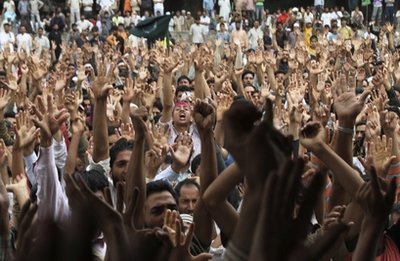
Kashmir Valley has been in turmoil over the past two months with tens of thousands taking to the streets in protest against killings of civilians by the Indian State which is seen as an occupying power by many of the people in Kashmir valley. Since the recent unrest started, at least 32 civilians have been killed and several hundreds injured, many of them due to Indian security forces firing into the unarmed crowd of civilian protestors. This review article examines the recent unrest and the historical roots of the present turmoil and argues that there is a genuine freedom struggle going on against the repressive Indian State by the Kashmiris who are alienated equally with India, Pakistan and the militants and whose grievances have their historical roots in the events of 1947.

Continues >>