Iraq: It All Boils Down to Oil

August 9, 2010

U.S. won’t leave Iraq’s energy reserves untended after its troops pull out

by Eric Margolis, The Toronto Sun, Aug 8, 2010

Last week, U.S. President Barack Obama restated his vow to pull all U.S. combat troops out of Iraq by the end of this month, and the remaining U.S. garrison by the end of 2011.

Has America’s long goodbye to Iraq really begun?

The 50,000 U.S. troops left until 2011 will supposedly “advise and assist” and perform “anti-terrorism” missions and training.

These troops will likely be six armor-heavy combat brigades, backed by warplanes from U.S. air bases in the Gulf.

A U.S. brigade withdrawn from Iraq will go to neighboring Kuwait. Most of the rest will transfer to Afghanistan.

No word about the 85,000 U.S.-paid mercenaries (a.k.a. “contractors”) in Iraq.

Continues >>

Pakistan flood victims desperate as crisis worsens

August 8, 2010

In a televised address to the nation on Friday night, Prime Minister Yusuf Raza Gilani sought international help in mitigating thea worsening crisis.

  • By Naveed Ahmad, Correspondent, Gulf News, Aug  8, 2010
Temporary shelter

  • A woman sits in her makeshift tent made of plastic sheets in Azakhel near Pabbi.
  • Image Credit: AP
Image 1 of 5
12345

Islamabad: As Pakistan awaits foreign assistance to deal with the mammoth flood relief challenge, Pakistanis desperate to get out of flooded villages threw themselves at helicopters on Saturday.

In the town of Muzaffargarh, near rivers bloated with rain and from as far away as Afghanistan and India merge with the Indus to flow south to the sea, army helicopters dropped packets of rice to people who had moved to higher ground to a cemetery.

Some latched on to helicopter skids as the aircraft took off.

An elderly man fought his way inside one. He looked down and wept.

“Things are getting worse. It’s raining again. That’s hampering our relief work,” said UN World Food Programme spokesman Amjad Jamal.

Dozens of villages have been flooded in Ghoki district on the left bank of the River Indus.

Over 5,000-year-old Mohenjo-Daro archeological treasures are at risk of being inundated by terrible flooding as protective embankments along the Indus continue to disintegrate.

Continues >>

Fidel Castro voices nuclear warning in Parliament speech

August 8, 2010

Times of Malta, August 7, 2010

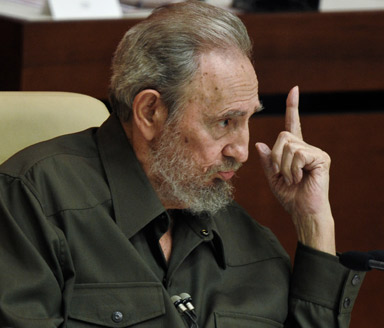
A lively and healthy looking Fidel Castro appealed to US President Barack Obama to prevent a global nuclear war in an emphatic speech today that marked his first official government appearance since emergency surgery four years ago.

The former Cuban leader’s speech before the country’s parliament, along with other numerous recent public appearances, raised questions about how much he will resume a leadership role.

Mr Castro, who turns 84 in a week, arrived on the arm of a helper, waving and smiling as the crowd applauded loudly in unison.

“Fidel, Fidel, Fidel!” the participants chanted. “Long live Fidel!”

Dressed in olive-green fatigues without military insignias, he immediately took the podium and delivered a fiery 11-minute speech on his fears of an impending global nuclear war. He implored President Obama and other wealthy nations to make sure such an event never happens.

Continues >>

Kashmir burns again as India responds to dissent with violence

August 8, 2010

The hospitals are filling up with gunshot victims but angry protesters say the world is blind to their plight. Andrew Buncombe reports from Srinagar

The Independent/UK, August 7, 2010

Srinagar residents burn an effigy of Omar Abdullah, the Chief Minister of Jammu and Kashmir
AP: Srinagar residents burn an effigy of Omar Abdullah, the Chief Minister of Jammu and Kashmir

From the end of the hospital corridor came frantic shouts, urgent voices that grew ever more desperate.
A dozen men appeared, gathered around a blood-smeared trolley, rushing its occupant towards the emergency surgery room. Abdul Rashid, said his friends, had been shot in the head by police who had opened fire on a peaceful gathering. “There was no stone-pelting, nothing,” yelled one of the 25-year-old’s friends, as medics pulled shut the doors to the surgery room. “There was no curfew … They fired indiscriminately.”

Once again, Kashmir is burning. Buildings and barricades have been set alight and its people are enflamed. The largest towns are packed with heavily-armed police and the hospital wards are full of young men with gunshot wounds. Around 50 people have been killed since June, more than 31 in the last week alone, and dozens more have been wounded. The dead include young men, teenagers and even a nine-year-old boy, reportedly beaten to death by the security forces after he tried to walk to the local shop.

Continues >>

Kashmir death toll rises as India faces fresh protests

August 8, 2010
Women attend the funeral of Mohammad Iqbal, a Kashmiri youth, in Srinagar this week. Kashmiri separatist leaders have appealed for calm in the biggest anti-India protests in two years, which have killed dozens of people. Photograph: Fayaz Kabli/Reuters

RAHUL BEDI in New Delhi, The Irish Times, August 7, 2010

THE DEATH toll from the recent round of recurring clashes between demonstrators and the security forces in Indian-administered Kashmir province is now close to 50.

Most of the dead were shot by the security forces for defying a curfew.

Since the middle of June, the Kashmir valley has been rocked by violent agitation. Protesters, angry over decades of repressive Indian rule over their disputed Muslim-majority Himalayan province, have hurled rocks and set government buildings and vehicles alight.

The demonstrators, mostly young men, have been joined by thousands of women, some carrying sticks and stones and chanting: “We want freedom” and “Blood for blood”.

Continues >>

Pilger: The lies of Hiroshima are the lies of today

August 8, 2010

John Pilger, johnpilger.com, August 6, 2010

In an article for the Guardian on the anniversary of the dropping of the atomic bomb on Hiroshima on August 6, 1945, John Pilger describes the ‘progression of lies’ from the dust of that detonated city, to the wars of today – and the threatened attack on Iran.

When I first went to Hiroshima in 1967, the shadow on the steps was still there. It was an almost perfect impression of a human being at ease: legs splayed, back bent, one hand by her side as she sat waiting for a bank to open. At a quarter past eight on the morning of August 6, 1945, she and her silhouette were burned into the granite. I stared at the shadow for an hour or more, then walked down to the river and met a man called Yukio, whose chest was still etched with the pattern of the shirt he was wearing when the atomic bomb was dropped.

Continues >>

Secretary of State Clinton: Now That the Wedding Is Over, Could You Respond to Requests From American Citizens on the Gaza Flotilla?

August 8, 2010

by Ann Wright, CommonDreams.org, August 5, 2010

Dear Secretary of State Clinton,

I am a retired US Army Reserve Colonel with 29 years in the US Army and Army Reserves and a former US diplomat who resigned after 16 years in the US State Department in opposition to the war on Iraq.

I was one of fourteen American citizens on the Gaza flotilla.

On June 14, 2010 I delivered to the Bureau of Consular Affairs, Office of American Citizen Services a letter to you requesting investigation of the Israeli attack on the Gaza flotilla in which one unarmed American citizen was killed by Israeli commandos and fourteen other American citizens were kidnapped from international waters and taken to Israel against their will, imprisoned and their personal possessions stolen by Israeli commandos.

Despite numerous inquiries to the State Department about the status of the response to my letter, after seven weeks I have not received a response to the letter nor to the 80 questions that I requested that the United States government pose to the Israeli government concerning their attack on the Gaza flotilla.

Continues >>

How Many Iraqis Did We ‘Liberate’ From Life on Earth?

August 8, 2010

Robert Naiman, The Huffington Post, August6, 2010

Is there a man or woman in America today who is willing to stand at noon in the public square and claim that demands to bomb, invade, and occupy other people’s countries have anything to do with human liberation?

If such people can be found, let them answer a few simple questions about the U.S. invasion and occupation of Iraq.

How many Iraqis did we “liberate” from the companionship of their loved ones?

How many Iraqis did we “liberate” from dwelling in the houses and towns and the country of their birth?

How many Iraqis did we “liberate” from life on Earth?

Continues >>

India: Protest against Kashmir killings in Hyderabad

August 7, 2010

GK NEWS NETWORK

Hyderabad, Aug 6: Hundreds of students from Students Federation of India (SFI) led by Kashmiri students and academics staged a protest against the ongoing killings in the Kashmir Valley here on Thursday evening.
Students carrying placards which read “stop the cycle of oppression in Kashmir, India doing Aushwitz in Kashmir, stop genocide of Kashmiris, revoke Armed Forces Special Powers Act,” took out a mass rally from the department of Social Sciences of Hyderabad Central University (HCU) to the main market.
Volunteers of SFI carried banners and flags which in Telgu language read: “Independence, democracy and justice.”
Later students from Osmania University, English and Foreign Languages University joined the rally.
The rally culminated at the main market and lit candles in memory of Kashmiris who have been killed during the recent unrest across the Valley. They expressed solidarity with the bereaved families by maintaining two minutes’ silence.
Speaking on the occasion a scholar from Manipur said, “There is one thing in common between North-East and Kashmir i.e. residents of both these places are facing torture.”

Kurtz II: Israel’s One and a Half State Solution

August 6, 2010

Donn M. Kurtz II,  Foreign Policy Journal, Aug 6, 2010

Jeremy Hammond, editor of this journal recently argued that the two state solution to the Israeli/Palestinian conflict is dead.  I contend that it was never alive. No Israeli government –regardless of the party or Prime Minister in power — has ever made a serious commitment to the essential reality of a Palestinian state.  At best Israel’s idea of a two state solution would lead to one and a half state outcome.

The conventional understanding of statehood involves four components.  A state is an entity consisting of a recognized population and territory with a government exercising sovereignty over those people and that territory.  In a variety of ways Israeli policy has always contradicted the substance of all four attributes of statehood.

Continues >>