Archive for the ‘warmongers’ Category

Israel’s Latest Violation

June 2, 2010

By Stephen Zunes, Foreign Policy In Focus, June 2, 2010

flotilla

Every time Israel’s right-wing government engages in yet another outrageous violation of international legal norms, it is easy to think, “No way are they going to get away with it this time!” And yet, thanks to the White House, Congress and leading American pundits, somehow, they do.

Israel’s attack on an unarmed flotilla of humanitarian aid vessels in the eastern Mediterranean — resulting in more than a dozen fatalities, the wounding of scores of passengers and crew, and the kidnapping of 750 others — has so far not proven any different.

Continues >>

Itching to Fight Another Muslim Enemy

May 19, 2010

By Robert Parry, Consortiumnews.com, May 18, 2010

If you read the major American newspapers or watch the propaganda on cable TV, it’s pretty clear that the U.S. foreign policy Establishment is again spoiling for a fight, this time in Iran.

Share this article
ShareThis
emailEmail
printPrinter friendly

Just as Iraq’s Saddam Hussein was the designated target of American hate in 2002 and 2003, Iranian President Mahmoud Ahmadinejad is playing that role now. Back then, any event in Iraq was cast in the harshest possible light; today, the same is done with Iran.

Anyone who dares suggest that the situation on the ground might not be as black and white as the Washington Post’s editors claim it is must be an “apologist” for the enemy regime. It’s also not very smart for one’s reputation to question the certainty of the reporting in the New York Times, whether about Iraq’s “aluminum tubes” for nuclear centrifuges in 2002 or regarding Iran’s “rigged” election in 2009.

It’s much better for one’s career to clamber onto the confrontation bandwagon. Nobody in the major U.S. media or in politics will ever be hurt by talking tough and flexing muscles regarding some Muslim “enemy.” And, if the posturing leads to war, it will fall mostly to working-class kids to do the fighting and dying while the bills can be passed along to future generations.

Even groups that should know better – like Votevets.org representing veterans of the Iraq and Afghan wars – have been piggybacking on the organized hate campaign against Ahmadinejad and Iran to advance other political agendas. In cable TV ads, Votevets.org uses Ahmadinejad’s face and Iran’s alleged manufacture of some IEDs to press the case for alternative energy.

Indeed, looking at this American propaganda campaign objectively, you would assume that the only acceptable outcome of U.S. differences with Iran is another Iraq-like ratcheting up of tensions, using Washington’s influence within the UN Security Council to impose escalating sanctions, leading ultimately to another war, as if the lessons of Iraq have already been forgotten.

Fearing Negotiations

This warmongering attitude was on display again Monday, when a possible breakthrough regarding Iran’s refining of nuclear material – its agreement to ship a substantial amount to Turkey in exchange for nuclear rods for medical research – was treated more as a negative than a positive.

The New York Times promptly framed the agreement reached by Iran, Turkey and Brazil as “complicating sanctions talk,” while the Washington Post rushed out an analysis with the headline, “Iran creates illusion of progress in nuclear negotiations.

The Post’s analysis followed a Saturday editorial denouncing Brazil’s President Luiz Ignacio Lula da Silva for even trying “yet another effort to ‘engage’ the extremist clique of Ayatollah Ali Khamenei and Mahmoud Ahmadinejad. “

The Post’s neocon editorial writers reprised the usual anti-Iran propaganda themes with all the arrogance that they once showed in declaring as flat fact that Saddam Hussein possessed stockpiles of WMD. After the U.S. invaded Iraq and found no WMD caches, the Post’s editorial page editor Fred Hiatt acknowledged to CJR that if there indeed were no WMD, “it would have been better not to say it.”

(To date, 4,401 American soldiers and hundreds of thousands of Iraqis have died, in part, because of Hiatt’s mistake.)

On Saturday, an unchastened Hiatt and his crew were back again spouting more fictions, this time about Iran, like the oft-repeated claim that the Iranian election last June was “fraudulent,” apparently because the Post’s preferred candidate, Mir Hossein Mousavi, lost.

An analysis by the University of Maryland’s Program on International Policy Attitudes earlier this year found that there was little evidence to support allegations of fraud or to conclude that most Iranians viewed Ahmadinejad’s reelection as illegitimate.

Not a single Iranian poll analyzed by PIPA – whether before or after the June 12 election, whether conducted inside or outside Iran – showed Ahmadinejad with less than majority support. None showed the much-touted Green Movement’s candidate Mousavi ahead or even close.

“These findings do not prove that there were no irregularities in the election process,” said Steven Kull, director of PIPA. “But they do not support the belief that a majority rejected Ahmadinejad.” [For details, see Consortiumnews.com’s “Ahmadinejad Won, Get Over It!”]

So, while many in the West may agree that Ahmadinejad is an unpleasant politician who foolishly questions the historical accuracy of the Holocaust and makes other bombastic statements, it is nevertheless a propaganda fiction to continue asserting that he was not the choice of most Iranian voters.

The point is not insignificant, because the claim about Iran’s “fraudulent” election has been cited repeatedly as fact by the Post, the Times and other major U.S. news outlets, feeding the rationale of Israel and U.S. neocons in demanding “regime change.”

If Ahmadinejad was actually elected – even if the process had flaws – then the goal of “regime change” would involve ousting a popularly chosen leader, much like the CIA helped do in 1953 when another anti-Western Iranian leader, Mohammed Mossadegh, was removed from office and replaced by Washington’s preferred choice, the Shah of Iran.

But the American hostility toward Ahmadinejad – and the U.S. media’s annoyance at any rapprochement between Washington and Tehran – present other dangers, particularly now that Iran has agreed to a previous Western demand that it transfer 1,200 kilograms (2,640 pounds) of low-enriched uranium out of the country, in this case to Turkey, where it would be stored.

The Iran-Turkey-Brazil agreement would then give Iran the right to receive about 265 pounds of more highly enriched uranium from Russia and France in a form that could not be used for a nuclear weapon, but could be put to use for peaceful purposes, such as medical research.

Even though this new deal parallels a plan that the Obama administration favored last October, U.S. officials have indicated that they might balk at the agreement now because the 2,640 pounds of low-enriched uranium represents a lower percentage of Iran’s total supply than it did last fall, possibly more like half than two-thirds.

“The situation has changed,” one diplomat told the New York Times.

White House press secretary Robert Gibbs also indicated that the new agreement would not stop the United States from seeking harsher sanctions against Iran.

“The United States will continue to work with our international partners, and through the United Nations Security Council, to make it clear to the Iranian government that it must demonstrate through deeds — and not simply words — its willingness to live up to international obligations or face consequences, including sanctions,” Gibbs said.

Victory/Defeat

The Washington Post’s analysis by Glenn Kessler portrayed the new agreement as “a victory” for Iran that has allowed it to create “the illusion of progress in nuclear negotiations with the West, without offering any real compromise to the United States and its allies.”

However, perhaps the bigger concern among American neocons is that the Iran-Turkey-Brazil accord might weaken the rationale for pressing ahead either with a military attack against Iran’s nuclear facilities or with a “regime change” strategy that would use sanctions and covert political operations to turn the Iranian people against their government.

By reducing the prospects of Iran building a nuclear weapon – something that Iran has vowed that it has no intention of doing and that U.S. intelligence agencies concluded in 2007 that it wasn’t doing – the new agreement could remove the scariest claim that Israel and its supporters have used in justifying a confrontation with Iran.

So, what might otherwise appear as good news – i.e. an agreement that at minimum delays the possibility of an Iranian bomb and could be a first step toward a fuller agreement – is presented as bad news.

“The Obama administration now faces the uncomfortable prospect of rejecting a proposal it offered in the first place — or seeing months of effort to enact new sanctions derailed,” Kessler explained.

As usual, too, the articles by the Washington Post and the New York Times left out the relevant fact that Israel, which has been aggressively pushing for greater transparency from Iran over its suspected interest in nukes, itself has one of the world’s most sophisticated – and undeclared – nuclear arsenals.

Even as President Barack Obama has demanded more nuclear transparency from all countries, he himself continues the longstanding charade of U.S. presidents, dating back to Richard Nixon, pretending that they don’t know that Israel has nuclear weapons.

In line with that history of double standards, Washington’s neocon opinion leaders now are framing what could be a positive step toward peace – the Iran-Turkey-Brazil accord – as another failure.

But the larger truth may be that the neocons are simply chafing under the possibility that their hunger for a new conflict in the Middle East might be delayed indefinitely and that – heaven forbid – cooler heads might prevail.

Robert Parry broke many of the Iran-Contra stories in the 1980s for the Associated Press and Newsweek. His latest book, Neck Deep: The Disastrous Presidency of George W. Bush, was written with two of his sons, Sam and Nat, and can be ordered at neckdeepbook.com. His two previous books, Secrecy & Privilege: The Rise of the Bush Dynasty from Watergate to Iraq and Lost History: Contras, Cocaine, the Press & ‘Project Truth’ are also available there. Or go to Amazon.com.
Tony Blair stands accused of crimes against humanity

April 22, 2010
Malaysia must not allow this mass murderer to be immune from justice.


By Prof SHAD SALEEM FARUDI,  Information Clearing House, April 22, 2010

Source: The Star


IT IS distressing to note that former British Prime Minister Tony Blair has been invited to Malaysia as an honoured guest of an NGO when he stands accused of war crimes and crimes against humanity by many learned and independent scholars of international law.

The case against him looks rock solid, especially after his confession to the BBC and the Chilcot Inquiry that he would have gone to war to topple Saddam Hussein regardless of the issue of Iraq’s alleged weapons of mass destruction.

Indictments around the world:

The international criminal court to which Britain is a signatory has received a record number of petitions against Blair.

The World Tribunal on Iraq held in Istanbul in 2005 heard evidence from 54 witnesses and published rigorous indictments against Blair, former US president George W Bush and others.

The Brussels War Crimes Tribunal, the Blair War Crimes Foundation and the American international law jurist Richard Falk have amassed impressive evidence of Blair’s complicity in international war crimes.

Spain’s celebrated judge Baltasar Garzon (who indicted former Chilean dictator and president Augusto Pinochet) has called for Bush, Blair and former Spanish Prime Minister Jose Maria Aznar to be prosecuted for the illegal invasion of Iraq, which Garzon has condemned as “one of the most sordid and unjustifiable episodes in recent human history”.

Many UK jurists have described the invasion as a devastating attack on the rule of law that left the United Nations in tatters.

Here at home, the Kuala Lumpur War Crimes Commission, after two years of meticulous investigation, received first-hand evidence from Iraqi victims of war that there have been grave violations of the international law of war in Iraq.

Last year, the Kuala Lumpur War Crimes Tribunal, consisting of several international jurists – including Richard Falk from the US, Alfred Webre from Canada, and Niloufer Bhagat from India – unanimously adjudicated that Bush and Blair do not enjoy any immunity in international humanitarian law.

The main charges against Blair relate to his collusion with Bush in an illegal war of aggression against Iraq in 2003.

Crimes against peace:

Blair repeatedly and deliberately deceived the UN, his allies and his own people that Saddam had weapons of mass destruction that could be rained on anyone within 45 minutes. In deceit and conspiracy, he incited passions for an illegal war.

The resulting amassing of an American, British and Australian invasion force outside Iraq and the invasion of March 20, 2003, were flagrant acts of lawlessness and an international crime.

The Charter of the UN contains a general prohibition against force as a means of resolving disputes. The unleashing of the horrors of war on innocent populations is permitted in only two circumstances by the Charter. First, legitimate self defence, under Article 51 in the event of an actual armed attack. Iraq had not attacked the US, the UK, Spain or Australia, and the argument about self-defence had no credibility.

Second, specific Security Council authorisation of force as a last resort to maintain peace and security under Articles 39 to 42 of the Charter. There never was such a resolution. The US and UK had tried to bulldoze one through but the Security Council was divided and the attempt failed, rendering the subsequent invasion a crime against peace.

Genocide and crimes against humanity: The Anglo-American alliance is also guilty of the heinous crimes of war, genocide and crimes against humanity.

The misadventure in Iraq has up to now caused 1.4 million deaths, four million refugees and countless maimings and traumas. Two to three million Iraqis are mentally and physically disabled. Iraq today is a land of five million orphans and one to two million widows.

There is near-total devastation of basic infrastructure, health, cultural and educational systems. Water systems have been contaminated. Iraq’s assets have been looted by the Allies.

In the prosecution of the illegal and racist war, indiscriminate rocket attacks were, and still are, being rained on civilian centres, killing thousands of innocent women and children.

In 2004, the entire population of Fallujah was expelled, save for young men of military age. Banned radioactive ammunition like depleted uranium, white phosphorous and cluster bombs have been used. Torturing of prisoners of war has been practised on a large scale.

These crimes of complicity by Blair are punishable under the United Nations Charter, the 1998 Rome Statute of the International Criminal Court, the Nuremberg Principles, Article 146 of the 1949 Geneva Convention and Article 3 of the 1907 Hague Convention.

What is also notable is that Blair has expressed no remorse whatsoever. Instead, he struts around the world as an apologist for the US in the Middle East and Israel. He recently received an Israeli “peace prize” worth US$1mil (RM3.2mil).

Malaysia must stand up and be counted among the community of civilised nations. It must not allow this perpetrator of epic crimes, who fakes faith in democracy and in “God’s work and God’s will”, to touch our soil ever again.

(Blair, who gave a talk at a local university in 2008, has been invited to head a line-up of speakers at the 2010 National Achiever Congress in Subang Jaya this weekend.)

If he does enter this country again we should arrest him. Regrettably, Malaysia has not yet ratified the Rome Charter, but we do have a Penal Code. Murder is a crime.

The Kuala Lumpur War Crimes Commission has countless reports from Iraqi survivors against Blair for complicity in mass slaughters, tortures, looting and other war crimes. The police must act on these reports and arrest this mass murderer.

In addition, citizens’ groups must file complaints against Blair with the United Nations General Assembly and with the Attorney-Generals of countries like Spain, Germany, Belgium, France and the UK which have “universal jurisdiction” statutes to pursue and prosecute war crimes and crimes against humanity.

A tribunal like the one that tried Nazis at Nuremberg and several Yugoslav and African warlords since then needs to be constituted.

The world needs to be reassured that international humanitarian law is not applied and enforced in a racist and selective way against Asian and African tyrants only. Imperial politicians from the West who destroy millions of lives should not, any more, be immune from justice.

Shad Saleem Faruqi is Emeritus Professor of Law at UiTM and Visiting Professor at USM.

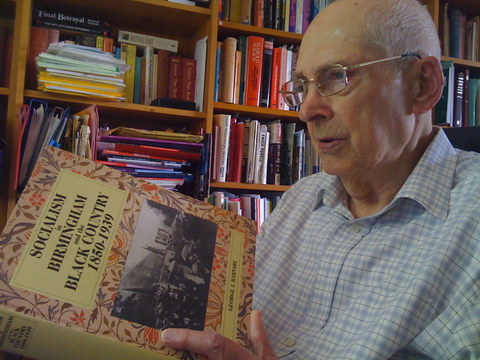
Radical Historian George Barnsby 1919–2010

April 13, 2010

By Nasir Khan

Dr George Barnsby

Dr George Barnsby, who died on April 11 at the age of 91 in Wolverhampton, was a leading radical activist and historian of the working class movement in the Black Country. Born in London in a working class family, his father died when he was only three years old. Now his mother had the sole responsibility to take care of her two infant sons in dire circumstances. The vicissitudes of his early life made George aware that the ‘station in life’ of many people was determined by their social and economic status. He certainly was not born with a silver spoon in his mouth.

He left school at 15 and did some ordinary jobs. He showed little interest in politics at that time. However, around the age of eighteen he became a reader of Daily Worker. It was the period when Nazism had emerged as the dominant voice of militarism and in many countries in Europe and the United States fascist parties emerged. Their model was the German Nazi party and their hero Adolf Hitler. When the Second World War started the young George was called up in 1939. At that time, he was 20 years old. When he went to fight for his ‘king and country’ his worldly possessions were two suits and a bicycle. He recalls in his ‘Subversive – One Third of the Autobiography of a Communist’ that for obvious reasons some people had more interest in ‘our country’ than he did!

He was sent to Burma. He experienced there inhumanity of the war and destruction caused by the Japanese. His contact with India and Indians subject to the imperial Raj gave him a broad political insight and awareness of the role of colonialism and imperialism. The Bengal Famine of 1943-44 occurred under the British rule. It is estimated that around 3 million Indians died from starvation and malnutrition. The Bengal government reacted to the disaster with little efficiency, and refused to stop the flow of rice from Bengal. George was an eye-witness to the apathy of the British rulers towards their subjects. There was no shortage of food in the British quarters either. There are still some hard questions about the role and knowledge of the British Prime Minster Winston Churchill into the affair. For instance, when the Secretary of State for India, Leo Amery, and Lord Wavell requested him an urgent release of food stocks for India, Churchill responded with a telegram to Wavell asking, if food was so scarce, ‘why Gandhi hadn’t died yet.’

The end of the Second World War saw the defeat of fascism and militarism in Germany and Japan. But no such harm came to the Spanish fascism under Franco. The Soviet Union and its Red Army in the Great Patriotic War had borne the brunt of the war on the Eastern Front. With the Allied victory, the army conscripts returned to their homes. In 1946, George was demobbed, receiving a gratuity of about £100. This sum he used to get further education. First, he matriculated from Regent Street Polytechnic before he went to the London School of Economics where he obtained a B.Sc. Honours degree there. From Birmingham University he gained an M.A. degree by writing ‘Social Conditions in the Black Country’ and then from the same university he earned a Ph.D. degree on his thesis ‘Working Class Movement in the Black Country 1750 to 1868′. His studies and committment to revolutionary Socialism that wanted to serve the interests of the working class had taken the central stage in his life. He was to struggle for these objectives for the rest of his life.

When he came to Wolverhampton in 1954, he became the secretary of the local Communist Party. This was the period when the Cold war was in full swing and in the United States anti-Communist crusade of McCarthyism had become the new credo of the Cold War allies in the West. In Britain, Communists were looked upon as traitors; they were spied upon and their telephones tapped. Obviously, George like other Communists was also regarded as subversive and he had to confront what came his way.

The range of his social, academic and political activities in the Black Country extends over vast areas. He wrote a number of histories and pamphlets on Socialism, Birmingham, Wolverhampton, Housing and the Radicals in the Black Country.

One major area of communal activity was around Bilston College of Further Education. Some teachers of the College and governors realised that many working-class people were excluded from formal institutional education who formed unqualified work force with little basic skills. Among the excluded were a disproportionate number of people from ethnic minority communities, mainly Afro-Caribbean and Asian. George was an active educator and a leading voice in the new approach to uplifting the working class people and providing them with education that met their needs. This progressive approach in a multicultural and multi-ethnic society was to counterbalance the legacy of Enoch Powell and his followers.

When American President George W. Bush and his close ally, Prime Minister Tony Blair, started their genocidal war of aggression against Iraq and the subsequent destruction of Iraq and Iraqis, George steadfastly opposed the imperial war. For him, the Anglo-American war in Iraq was a crime against humanity, a genocide, and its central figures the war criminals who need to be brought to justice. He focused on Bush and Blair and their allies, writing extensively on their policies on his website and informed the populace of the realities of the cover-up of their crimes and their incessant lies.

George Barnsby is survived by his wife Esme and two sons, William and Robert.

Behind Clinton’s tough talk on Iran

February 21, 2010

The goal of Hillary Clinton’s rhetoric seems to be to promote conflict and convince Americans Iran is a threat to their security

Mark Weisbrot, The Guardian/UK, Feb 18, 2020

In a visit to Qatar and Saudi Arabia this week, Hillary Clinton said that Iran “is moving toward a military dictatorship,” and continued the Administration’s campaign for tougher sanctions against that country.

What could America’s top diplomat hope to accomplish with this kind of inflammatory rhetoric? It seems unlikely that the goal was to support human rights in Iran. Because of the United States’ history in Iran and in the region, it tends to give legitimacy to repression. The more that any opposition can be linked to the United States’ actions, words, or support, the harder time they will have.

Second, it is tough for anyone – especially in the region – to believe that the United States is really concerned about human rights abuses. In addition to supporting Israel’s collective punishment of the Palestinians in Gaza, Washington has been remarkably quiet as the most important opposition leaders in Egypt were arrested as part of the government’s preparations for October elections. Amnesty International stated that the arrestees were “prisoners of conscience, detained solely for their peaceful political activities.”

So what is the purpose of a speech like this? The most obvious conclusion is that it is to promote conflict, and to convince Americans that Iran is an actual threat to their security. Americans generally have to be prepared and persuaded for years if they are to accept that they must go to war. The groundwork for the Iraq war was laid during the Clinton presidency. President Clinton imposed sanctions on the country that devastated the civilian population, carried out bombings, and publicly declared that Washington’s intention was to overthrow the government. Although, as we now know, Iraq never posed any significant security threat to the United States, President Clinton spent years trying to convince Americans that it did.

President Bush picked up where President Clinton left off; and President Clinton publicly supported his campaign for the war. So did Hillary, and she defended her decision in 2008 even as it looked like it might cost her the Presidency.

President Obama is unlikely to start a war with Iran – which would likely begin as an air war, not a ground war – not least because he already has two wars to deal with. But, as in the case of the Iraq war, his Secretary of State is preparing the ground for the next president that may have a stronger desire or better opportunity to do so. There is a strong faction of our foreign policy establishment that believes it has the right and obligation to bomb Iran in order to curtail its nuclear program, and they have a long-term strategy.

The public relations campaign is working. A new Gallup poll finds that 61 percent of Americans see Iran as “as a critical threat to U.S. vital interests,” with an additional 29 percent believing that it is “an important threat.” It is not clear why anyone would believe this; even if Iran did obtain a nuclear weapon, which is still a ways off, they would not have the capacity to deliver it as far as the United States. Nor is it likely that they would want to commit national suicide, any more than a number of other countries that currently have nuclear weapons.

The Obama team’s messaging is not nearly so successful with regard to the issues that the vast majority of the electorate will base their votes on in this years elections: the most recent ABC News/Washington Post Poll (Feb. 4-8) finds that 53 percent disapprove of his handling of the economy.

For the immediate future, foreign policy concerns will likely rank low, far behind the economy, for the electorate. But the Obama team’s foreign policy will hurt Democrats in the future. If I believed what Hillary Clinton and the Democratic leadership are telling me, I would have to consider voting Republican. If it’s really true that all these people just want to kill us for no reason; that it has nothing to do with our foreign policy or wars; that we can effectively reduce terrorism by bombing and occupying Muslim countries; and that terrorism is the country’s most urgent security threat – then why not vote for the party that looks tougher? This will inevitably come back to haunt the Democratic Party, as it did in the 2002 and 2004 elections.

Meanwhile, U.S. military spending  — by the Congressional Budget Office’s relatively narrow definition of the Department of Defense budget – reached 5.6 percent of GDP in 2009. Just before September 11, 2001, the Congressional Budget Office projected this spending for 2009 at 2.4 percent of GDP.

The difference, over 10 years, is more than four times the ten-year cost of proposed health care reform.

This column was published by The Guardian Unlimited on February 18, 2010.

Clare Short: Tony Blair lied and misled parliament in build-up to Iraq war

February 2, 2010
• Blair ‘lied’ over war preparations
• Attorney general ‘misled’ government
• Brown ‘marginalised and unhappy’
Clare Short at the Iraq war inquiry – as it happened
James Sturcke,The Guardian/UK, Feb 2, 2010,
Clare Short arriving to give evidence at the Iraq Inquiry

Clare Short arriving to give evidence at the Iraq inquiry. Photograph: Dan Kitwood/Getty Images

Clare Short, the former international development secretary, today accused Tony Blair of lying to her and misleading parliament in the build-up to the Iraq invasion.

Short, giving evidence to the Chilcot inquiry into the war, also said that the 2003 conflict had put the world in greater danger of international terrorism.

Declassified letters between Short and Blair released today show she believed that invading Iraq without a second UN resolution would be illegal and there was a significant risk of a humanitarian catastrophe.

She told the inquiry that she had a conversation with Blair in 2002. He told her that he was not planning for war against Iraq and that the evidence has since revealed that he was not telling the truth at that point, she said.

She also said she was “stunned” when she read the 337-word legal advice on the war written by the then-attorney general Lord Goldsmith during a cabinet meeting on 17 March 2003, three days before the war began. She was forbidden by Blair from discussing it during the meeting.

“I said, ‘That is extraordinary.’ I was jeered at to be quiet. If the prime minister says be quiet there is only so much you can do.

“I think for the attorney general to come and say there’s unequivocal legal authority to go to war was misleading.”

Short, who was applauded by some audience members in public seats at the end of her evidence, said the ministerial code was broken as cabinet colleagues were not aware of Goldsmith’s modifications to his legal advice over the previous weeks. The inquiry has already heard how Goldsmith changed his mind over the need for a second resolution after visiting the US the month before the war.

Short said cabinet colleagues were unaware of the legal advice given by the most senior Foreign Office lawyers, Sir Michael Wood and Elizabeth Wilmshurst, which called for a second UN resolution.

“The ministerial code said legal advice should be circulated and it wasn’t. We only had the answer to the parliamentary question [Goldsmith’s short ruling]. There was a lot of misleading of parliament too by the prime minister of the day.

“The ministerial code is unsafe because it is enforced by the prime minister and if he’s in on the tricks then that’s it. When I found out what went into it I think we were misled.”

She added that she had “various cups of coffee” with Gordon Brown, at that time the chancellor, who “was very unhappy and marginalised [in the run up to war]”.

He was disillusioned about a number of issues, not specifically Iraq, and felt Blair was “obsessed with his legacy”.

Later, Short added that after the war “Gordon was back in with Tony and not having cups of coffee with me any more”.

Asked about the cabinet meetings in the run-up to the war, Short told the inquiry that the cabinet did not operate in the manner it was required to constitutionally.

“It was not a decision-making body. I don’t think there was ever a substantive discussion about anything in cabinet. If you ever raised an issue with Tony Blair he would cut it off. He did that in July 2002 when I said I wanted to talk about Iraq. He said he did not want it leaking into the press.”

Short described cabinet meetings as “little chats” rather than decision-making opportunities.

“There was never a meeting … that said: ‘What is the problem? What are we trying to achieve? What are our options?'”

The declassified documents showed that Short believed the situation in Iraq to be “fragile” before hostilities began.

In one, written on 14 February 2003, she wrote: “Any disruption could lead to a humanitarian catastrophe. With some more time, sensible measures can be taken to reduce these risks and improve people’s prospect of stability after the conflict.”

Short told the panel that both the British and US armies failed to honour their Geneva convention responsibilities to keep order, describing the situation in the post-invasion aftermath as “mad”, with food for refugees only being ordered at the last minute.

Short said Blair persuaded her against resigning on the same day as Cook by assuring her that the UN would have the lead role in reconstructing Iraq and that George Bush would support the creation of an independent Palestinian state.

Asked why she didn’t resign earlier, she said: “If I knew then what I know now, I would have.” As for the pronouncements that the French would not back a second resolution, it was one of the “big deceits” of the British, Short said.

The French president, Jacques Chirac, could have supported military action but not while UN weapons inspectors wanted more time and it should have been given.

“There was no emergency. No one had attacked anyone. There wasn’t any new WMD. We could have taken the time and got it right. The forces weren’t ready to go in. They have said that themselves.”

Short ended her evidence by calling for a serious debate about the “special relationship” with the US, calling the current one “poodle-like”.

Short stood down from the cabinet on 12 May 2003, nearly eight weeks after the invasion.

Letter from Clare Short to Tony Blair on humanitarian planning and the role of the UN, 14 February 2003 (pdf).

Letter from Short to Blair on the UN and US roles in post-conflict Iraq, 5 March 2003 (pdf).

The Rogue State: Israeli violations of U.N. Security Council Resolutions

January 28, 2010
Foreign Policy Journal, January 27, 2010

By Jeremy R. Hammond

Following is a list of United Nations Security Council resolutions directly critical of Israel for violations of U.N. Security Council resolutions, the U.N. Charter, the Geneva Conventions, international terrorism, or other violations of international law.

Res. 57 (Sep. 18, 1948) – Expresses deep shock at the  assassination of the U.N. Mediator in Palestine, Count Folke Bernadotte, by Zionist terrorists.

Res. 89 (Nov. 17, 1950) – Requests that attention be given to the expulsion of “thousands of Palestine Arabs” and calls upon concerned governments to take no further action “involving the transfer of persons across international frontiers or armistice lines”, and notes that Israel announced that it would withdraw to the armistice lines.

Continues >>

British govt lawyer: Iraq war was unlawful

January 26, 2010

Middle East Online, Jan 26, 2010


Michael Wood says use of force against Iraq had no legal basis in international law.

LONDON – The 2003 Iraq war was illegal, the former chief legal advisor to Britain’s Foreign Office told a public inquiry into the war Tuesday, three days before ex prime minister Tony Blair appears.

“I considered that the use of force against Iraq in March 2003 was contrary to international law,” Michael Wood told the Chilcot inquiry in London.

“In my opinion, that use of force had not been authorised by the Security Council, and had no other legal basis in international law.”

Wood’s comments came as the probe’s focus shifted to the legality of the war.

Elizabeth Wilmshurst, his deputy who resigned in protest at the conflict, gives evidence later Tuesday, while the government’s senior legal advisor at the time, Peter Goldsmith, is due to appear Wednesday.

Goldsmith will likely face questions over whether he U-turned on the war’s legality. Two weeks before the invasion, he said it would be preferable to obtain a second UN Security Council resolution backing military action.

But this was not forthcoming and ten days later, Goldsmith said military action would be legal.

Blair himself is expected before the inquiry Friday, when anti-war protestors are set to stage demonstrations outside the probe venue.

An open letter to Sir John Chilcot

January 24, 2010

Various undersigned

Uruknet.infoJanuary 23, 2010

Sir

You stated the Iraq Inquiry would not apportion blame, but if it produces evidence that this country’s invasion and occupation of Iraq was illegal, then the public deserves that the matter not be allowed to rest there. As it is, the Inquiry’s Legal Advisor Sarah Goom has confirmed that if the Inquiry receives any ‘new evidence that criminal offences have been committed’, it would be obliged to refer that evidence to the appropriate investigating authority.

You also said the Inquiry is not ‘here to provide public sport or entertainment.’ Justified public outrage is neither, and must be fully and appropriately addressed. You added, ‘We ask fair questions and we expect full and truthful answers.’ Given Tony Blair’s past public assertions on Iraq, the public expects great depth and persistence when you examine him, with particular and detailed attention being addressed to all relevant issues of international law.

Continues >>

Pilger: For Israel, a reckoning

January 16, 2010

John Pilger,  New Statesman, January 14, 2010

A new global movement is challenging Israel’s violations of international law with the same strategies that were used against apartheid

The farce of the climate summit in Copenhagen affirmed a world war waged by the rich against most of humanity. It also illuminated a resistance growing perhaps as never before: an internationalism linking justice for the planet with universal human rights, and criminal justice for those who invade and dispossess with impunity. And the best news comes from Palestine.

The Palestinians’ resistance to the theft of their country reached a critical moment in 2001 when a UN conference on racism in Durban, South Africa, identified Israel as an apartheid state. To Nelson Mandela, justice for the Palestinians is “the greatest moral issue of the age”. The Palestinian civil society call for boycott, disinvestment and sanctions (BDS) was issued on 9 July 2005, in effect reconvening the great, non-violent movement that swept the world and brought the scaffolding of African apartheid crashing down.

Continues >>