|
by Prof. Francis A. Boyle
|
 |
|
|
Justice Robert H. Jackson Conference:
Planning for the Prosecution of High Level American War Criminals
Massachusetts Law School
September 13-14, 2008
Andover, Massachusetts
Since the impeachable installation of George W. Bush as President in January of 2001 by the U.S. Supreme Court’s Gang of Five, the peoples of the world have witnessed a government in the United States that has demonstrated little if any respect for fundamental considerations of international law, human rights, and the United States Constitution.
What the world has watched instead is a comprehensive and malicious assault upon the integrity of the international and domestic legal orders by a group of men and women who are thoroughly Machiavellian and Straussian in their perception of international relations and in their conduct of both foreign policy and domestic affairs. Even more seriously, in many instances specific components of the Bush administration’s foreign policies constitute ongoing criminal activity under well-recognized principles of both international law and U.S. domestic law, and in particular the Nuremberg Charter, the Nuremberg Judgment, and the Nuremberg Principles, as well as the Pentagon’s own U.S. Army Field Manual 27-10 on The Law of Land Warfare (1956), all of which apply to President Bush himself as Commander-in-Chief of United States Armed Forces under Article II, Section 2 of the United States Constitution.
Depending upon the substantive issues involved, those international crimes typically include but are not limited to the Nuremberg offenses of crimes against peace: For example, Afghanistan, Iraq, Somalia, and perhaps their longstanding threatened wars of aggression against Iran and now Pakistan. Their criminal responsibility also concerns Nuremberg crimes against humanity and war crimes as well as grave breaches of the Four Geneva Conventions of 1949 and of the 1907 Hague Regulations on land warfare: For example, torture at Guantanamo, Bhagram, Abu Ghraib, and elsewhere; enforced disappearances, assassinations, murders, kidnappings, extraordinary renditions, “shock and awe,” depleted uranium, white phosphorous, cluster bombs, Fallujah, and the Gitmo kangaroo courts.
Furthermore, various members of the Bush administration have committed numerous inchoate crimes incidental to these substantive offences that under the Nuremberg Charter, Judgment, and Principles as well as paragraph 500 of U.S. Army Field Manual 27-10 are international crimes in their own right: planning and preparation—which they are currently doing today against Iran and Pakistan—solicitation, incitement, conspiracy, complicity, attempt, aiding and abetting.
Finally, according to basic principles of international criminal law set forth in paragraph 501 of U.S. Army Field Manual 27-10, all high level civilian officials and military officers in the U.S. government who either knew or should have known that soldiers or civilians under their control (such as the C.I.A. or private contractors), committed or were about to commit international crimes and failed to take the measures necessary to stop them, or to punish them, or both, are likewise personally responsible for the commission of international crimes.
At the very top of America’s criminal chain-of-command are President Bush and Vice-President Cheney; former U.S. Secretary of Defense Rumsfeld; Rumsfeld’s Deputy Paul Wolfowitz; Secretary of State Rice; former Director of National Intelligence Negroponte; National Security Advisor Hadley; his Deputy Elliot Abrams; former U.S. Attorneys General Ashcroft and Gonzales, criminally responsible for the torture campaign launched by the Bush Jr. administration; and the Pentagon’s Joint Chiefs of Staffs along with the appropriate Regional Commanders-in-Chief, especially for U.S. Central Command (CENTCOM).
These U.S. government officials and their immediate subordinates are responsible for the commission of crimes against peace, crimes against humanity, and war crimes as specified by the Nuremberg Charter, Judgment, and Principles as well as by U.S. Army Field Manual 27-10. Today in international legal terms, the Bush Jr. administration itself should now be viewed as constituting an ongoing criminal conspiracy under international criminal law and U.S. domestic law because of its formulation and undertaking of serial wars of aggression, crimes against peace, crimes against humanity, and war crimes in violation of the Nuremberg Charter, Judgment, and Principles that are legally akin to those perpetrated by the former Nazi regime in Germany.
Of course the terrible irony of today’s situation is that six decades ago at Nuremberg the U.S. government participated in the prosecution, punishment and execution of Nazi government officials for committing some of the same types of heinous international crimes that the members of the Bush administration currently inflict upon people all over the world. To be sure, I personally oppose the imposition of capital punishment upon any human being for any reason no matter how monstrous their crimes, whether they be Bush Jr., Tony Blair, or Saddam Hussein.
As a consequence, American citizens possess the basic right under international law and United States domestic law, including the U.S. Constitution, to engage in acts of civil resistance designed to prevent, impede, thwart, or terminate ongoing criminal activities perpetrated by Bush administration officials in their conduct of foreign affairs policies and military operations purported to relate to defense and counter-terrorism. Today’s civil resisters are the sheriffs! The Bush administration officials are the outlaws!
We American citizens must reaffirm our commitment to the Nuremberg Charter, Judgment, and Principles by holding our government officials fully accountable under international law and U.S. domestic law for the commission of such grievous international and domestic crimes. We must not permit any aspect of our foreign affairs and defense policies to be conducted by acknowledged “war criminals” according to the U.S. government’s own official definitions of that term as set forth in the Nuremberg Charter, Judgment, and Principles, U.S. Army Field Manual 27-10, the U.S. War Crimes Act, the Four Geneva Conventions and the Hague Regulations. The American people must insist upon the impeachment, dismissal, resignation, indictment, conviction, and long-term incarceration of all U.S. government officials guilty of such heinous international and domestic crimes. If not so restrained, the Bush administration could very well precipitate a Third World War.
In this regard, during the course of an October 17, 2007 press conference, President Bush Jr. terrorized the entire world with the threat of World War III if he could not work his illegal will upon Iran. It is my opinion that the Bush administration is fully prepared to use tactical nuclear weapons against Muslim and Arab states and peoples in order to break the taboo of Hiroshima and Nagasaki. After the terrible tragedy of September 11, 2001 the United States of America has vilified and demonized Muslims and Arabs almost to the same extent that America inflicted upon the Japanese and Japanese Americans after Pearl Harbor. As the Nazis had previously demonstrated with respect to the Jews, a government must first dehumanize and scapegoat a race of people before its citizens will tolerate if not approve their elimination: witness Hiroshima and Nagasaki. In post -9/11 America we are directly confronted with the prospect of a nuclear war of extermination conducted by our White Racist Judeo-Christian Power Elite against Peoples of Color in the Muslim and Arab worlds in order to steal their oil and gas. The Crusades all over again. But this time nuclear Armageddon stares all of humankind right in the face!
We American lawyers must be inspired by the stunning example set by those heroic Pakistani lawyers who led the successful struggle against the brutal Bush-supported Musharraf military dictatorship in Pakistan. We American lawyers must now lead the fight against the Bush dictatorship and empire! This is our Nuremberg Moment!
Thank you.
Francis A. Boyle is a frequent contributor to Global Research. Global Research Articles by Francis A. Boyle


Disaster in Afghanistan
September 10, 2008John W. Warnock | Global Research, September 9, 2008
It is difficult to find out what is really going on in Afghanistan. The focus of the mass media is almost entirely on the military activities of the Canadian and NATO forces. There is absolutely no coverage of political developments. The news on the economy is limited to the state of the poppy industry. This is no accident. The North American media, including the CBC, has strongly supported the U.S./NATO strategy and the administration of President Hamid Karzai. Contrary to the mainstream message, things are not going well.
Rise in civilian casualties
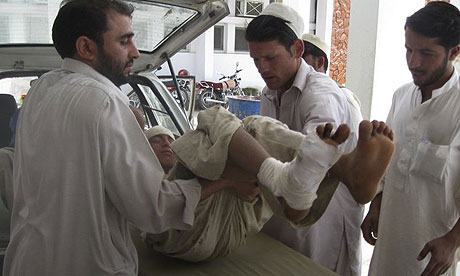
Over the past few weeks NATO forces have killed civilians in a number of incidents, and popular opposition to the western military effort is increasing. On August 22 the United States bombed the village of Azizabad in Herat province; the result was the death of 91 civilians, including over 60 children. Rockets and missiles were also used. Many homes were destroyed. Local citizens stoned the Afghan army when they tried to distribute supplies. NATO forces in Paktika province launched an artillery attack on a village on September 1 as part of a general sweep-and-destroy mission against Taliban forces. Three children were killed and seven injured. That same day U.S. and Afghan forces carried out an overnight raid in Hud Kheil, east of Kabul. A family of four, including two children, were killed when hand grenades were thrown into their house. In Kabul hundreds blocked the main road out of town protesting the military practices of the international forces.
Afghan government and NATO attacks In response to the steady increase of civilian deaths this year, the Afghan parliament passed a resolution in August calling on the Karzai administration to negotiate a new status-of-forces agreement with NATO and United States, making it consistent with Afghan and international law. President Karzai’s cabinet demanded “an end to air attacks in civilian areas, illegal detentions and unilateral house searches.” There is growing opposition to the presence of the occupying forces. The Senlis Council reported in June 2008 that in their most recent recent public opinion survey “more than six out of ten of those interviewed … said that foreign troops should leave.” This is the position taken by many of the democratic parties in Afghanistan. Malalai Joya, the outspoken critic of the Karzai government, has called for all foreign troops to leave the country. She argues that Afghans can settle this dispute better on their own.
The approaching famine
However, the most important current issue in Afghanistan is the drought, the crop failure, and the prospect of famine. This story has received no coverage in the North American media. Over the last winter Afghanistan received well-below normal rainfall and mountain snow pack. The spring runoff was light, and crop yields from irrigated agriculture have been significantly reduced. There are conditions of drought throughout the country. In many areas there are no crops and livestock has perished from lack of pasture. Wheat provides the staple food, and production is 60 percent below average. Recent rains have brought flooding, as the land has been hardened by the drought. Floods are more common because over the past few decades 60% of the woodland has been removed by the population seeking fuel for cooking and winter heating. The jump in fuel prices has raised the cost of the delivery of food from neighbouring countries. Food prices are rising. The price of a 50 kg bag of wheat flour is now $35. One half of the population in Afghanistan lives on less than $2 per day. The government of Afghanistan reports that 42% of the population lives in “extreme poverty”, defined as a per capita income of less than $120 per year. The United Nations Mission in Afghanistan reported in August that “at least four million most vulnerable people have already been pushed into the ‘high-risk food-insecurity ‘ category.” Children are the most vulnerable. One in five children die before the age of five, mainly due to malnutrition. In response, the United Nations and other food agencies have called for an emergency fund of $404 million in order to purchase food. To date less than 20% has been forthcoming from donor countries.
What is happening to women’s rights?
Supporters of the U.S. project in Afghanistan always point to how many girls are now going to school. But as Ann Jones points out, the number cited (5 million) is fewer than half the children of school age. In Kabul 85% are in school; in the Pashtun south, less than 20% and “near zero for girls.” Radio Free Afghanistan’s Jan Alekozai recently toured eastern Afghanistan. He noted that there were schools but no teachers, no chairs and tables, no electricity or water, no books, and no labs. “The participation of women is zero in the provinces,” he argued. While some are going to school “they cannot walk, for example, in a park – or with their families.” In February 2008 Womankind Worldwide (UK) released a survey of the status of women in Afghanistan. They found that 87% of Afghan women report domestic violence, 60% of all marriages are still forced, and 57% of all recent marriages involved girls under the age of sixteen, which is contrary to the law. Ann Jones, who spent a number of years in Afghanistan working for women’s rights, is not surprised. President Karzai’ wife is a qualified gynecologist but does not practice her skills. She remains locked up in the presidential fortress, the Arg, and is not seen by the general public. Since the onset of the 20th century, she is the first wife of a state leader who has not publicly championed women’s rights.
Change of regime in Afghanistan
Few Canadians would know that there is a presidential election scheduled for Afghanistan in 2009. Hamid Karzai has announced that he will run again. After his tour of eastern Afghanistan, Jan Alekozai reported strong opposition to the local warlords and the Karzai government. He judged that Karzai would have a hard time getting 20% of the votes in the 2009 election. The people blame the Americans and NATO for the increase in the power of the warlords. The main opposition to Karzai will come from the United National Front, which is largely a coalition of the warlords and Islamist leaders based in the parliament. They have demanded a change in the constitution to bring in a parliamentary system of government with political parties and elections by proportional representation. The Front is dominated by the Islamist forces from the Northern Alliance. The Front has called for a new international meeting to settle the ongoing civil war in Afghanistan. This would be hosted by the United Nations and include all neighbouring states as well as representation from Afghanistan’s political groups, including the armed opposition. In late August Fazel Sangcharaki, speaking for the Front, stated that many foreign envoys have supported this proposal. But the problem is the opposition of the U.S. government.
Canadian government stresses militarism
The policy of the Canadian government since 2001 has been to put the highest priority on its military role in Afghanistan. In support of the Afghan “war on terrorism”, the Canadian government has been spending around $1 billion per year on the military and only $100 million on humanitarian assistance and economic development. Much of the military budget has been spent on acquiring new military hardware, needed for counter-insurgency warfare.. Just before Stephen Harper forced a fall election, polls emerged which showed that Canadians remain skeptical of the role in Afghanistan. A poll by Ipsos Reid for the Department of National Defence revealed that the majority of Canadians still want Canada to emphasize peacekeeping. A CBC poll done by Environics reported that 56% of Canadians disapprove of Canada’s military role in Afghanistan. Since the March 2008 agreement by the Conservatives and Liberals to extend Canada’s mission to 2011, Afghanistan has largely disappeared from political discussion. The challenge for Canadians is to make this disastrous war in Afghanistan an issue in the current election.
John W. Warnock is a Regina political economist and author of Creating a Failed State: the US and Canada in Afghanistan. (Winnipeg: Fernwood Publishing, May 2008).
Share this:
Tags:Afghanistan, Azizabad killings, Canadian government, civilian casualties, domestic violence, extreme povery, forced marriages, Hamid Karzai, Kabul protesters, Malalai Joya demands, media, Paktia province, US and NATO strategy, war in Afghanistan, women's rights
Posted in Afghanistan, Commentary, US policy | Leave a Comment »