Archive for the ‘Iran’ Category

Police crack down on Iran protests

June 21, 2009
Al Jazeera, June 21, 2009

Protesters fought back with stones and set fires
in the streets of the capital, Tehran [AFP]

Riot police in Iran have used tear gas, water cannon and batons to disperse about 3,000 people attempting to protest over the disputed presidential election of Mahmoud Ahmadinejad, the president.

Witnesses said that dozens of people were hospitalised after being beaten by police and pro-government militia in the capital, Tehran, on Saturday.

“Lots of guards on motorbikes closed in on us and beat us brutally,” one protester said.

“As we were running away the Basiji [militia] were waiting in side alleys with batons, but people opened their doors to us trapped in alleys.”

Supporters of Mir Hossein Mousavi, a defeated reformist candidate, had planned to stage a rally in the city’s Revolutionary Square, but arrived to find their way blocked by police.

A witness told Al Jazeera that police were turning people away.

“The roads were pretty much blocked by the militia, they were out with retractable metal batons. It looked like they were very frantically trying to keep people from the area,” he said.

Protests ‘quelled’

Amateur video of Saturday’s protests, which could not be independently verified, showed dozens of Iranians running down a street after police fired tear gas.

Other footage showed protesters trying to give first aid to a badly injured woman in the street.

In depth

Video: Iran supreme leader in ‘power struggle’
Video: Iran’s ‘citizen journalists’
Video: Iran steps up net censorship
Video: Iranians go online to evade curbs
Video: The struggle for power
Video: Rival protests continue in Iran
Video: Iranians rally in Europe

Iran’s Ayatollah under threat?
Mousavi sees election hopes dashed
Iran writer on poll result
Mousavi’s letter to the people
Iran poll result ‘harms US hopes’
West concerned by Iran fraud claims
What next for Iran?
The Iranian political system
Riz Khan: Iran’s disputed election
Inside Story: Iran election recount
Inside Story: Iran’s political future

Your media: submit your clips of the protests to Al Jazeera

The protesters apparently threw stones at the police and set fires in the streets.

Al Jazeera’s Alireza Ronaghi, reporting from Tehran, said that the protests had largely been quelled by Saturday evening.

“The presence of security forces were very high, they definitely wanted to take back the streets of Tehran … right now I don’t expect that many protesters are concentrated anywhere in Tehran,” he said.

He said that state television had quoted the head of Iran’s police force as thanking the Iranian people for not taking to the streets and taking the police warnings seriously.

As the clashes took place, a suspected suicide bomber blew himself up outside the shrine of Ayatollah Ruhollah Khomeini, the leader of the Islamic revolution in 1979, injuring at least two people, local news agencies reported.

As night fell, the protesters kept up their show of defiance shouting “Allahu Akbar” (God is greatest) from the rooftops, a deliberate echo of a move made during the Islamic revolution in 1979.

Barack Obama, the US president, condemned the violence and urged Tehran to allow Mousavi’s supporters to stage peaceful protests.

“The Iranian government must understand that the world is watching,” he said.

“We mourn each and every innocent life that is lost. We call on the Iranian government to stop all violent and unjust actions against its own people.”

Nick Spicer, Al Jazeera’s correspondent in Washington DC, said: “It’s his [Obama] strongest language to date.

“He’s putting the blame for the violence squarely on the Iranian government saying that the world is watching what is going on in Iran, not just that the United States is watching

“Basically he is calling the whole world as a witness to what’s going on in Iran.

“He’s trying to make this not an Iran-America thing, but a global human rights argument that he’s putting to the leaders of Iran.”

‘Ready for martyrdom’

In a statement posted on the website of his Kalemeh newspaper, Mousavi repeated his demand for the elections results to be annulled and hit out at a speech by Ayatollah Ali Khamenei, Iran’s supreme leader.

“If this huge volume of cheating and changing the votes … which has hurt people’s trust, is presented as the very evidence of the lack of cheating, then it will butcher the republican aspect of the system and the idea that Islam is incompatible with a republic will be proven,” he said.

Anoushka Marashlian, an independent Middle East analyst, told Al Jazeera: “I think the momentum would be very difficult to maintain now because of the nature of the protests that have become more violent.

“They are not only defying the results of the elections but they are now perceived to be defying the directions of the supreme leader, and so, in essence, questioning the foundation of the Islamic Republic,” she said.

In a sermon on Friday, Khamenei ruled out any fraud in the June 12 vote and stressed there could be no doubting the re-election of Ahmadinejad.

An unnamed ally of Mousavi told the Reuters news agency that the former prime minister has said he would continue his fight and was “ready for martyrdom”.

Earlier on Saturday, Mousavi and Mehdi Karoubi, another defeated presidential candidate had declined to meet the Guardian Council, Iran’s highest legislative body, concerning 646 complaints of voting irregularities in the poll.

State television quoted a council spokesman as saying that the Guardian Council had expressed its readiness to “randomly” recount up to 10 per cent of the ballots.

The contested result gave President Mahmoud Ahmadinejad a tally of about 63 per cent, to Mousavi’s 34 per cent.

Iran’s dictator gives up pretence of democracy

June 21, 2009

The Sunday Times/UK, June 21, 2009

By Amir Taheri

Just before noon on Friday, June 19, the Islamic republic died in Iran. Its death was announced by its “supreme guide”, Ayatollah Ali Khamenei, who had come to praise the system but buried it instead. Khamenei was addressing supporters on the campus of Tehran University, transformed into a mosque for the occasion. Many had expected him to speak as a guide, an arbiter of disputes – a voice for national reconciliation. Instead, he spoke as a rabble rouser and a tinpot despot.

At issue was the June 12 presidential election that millions of Iranians, perhaps a majority, believe was rigged to ensure the re-election of President Mahmoud Ahmadinejad with a two-thirds majority. Since its inception in 1979, the Islamic republic has organised 31 elections at different levels. All have been carefully scripted, with candidates pre-approved by the regime and no independent mechanism for oversight.

Continued >>

Iran protesters to keep up pressure

June 17, 2009
Al Jazeera, June 17, 2009

Pro-Ahmadinejad supporters were out in force in Tehran on Tuesday [AFP]

Anti-government protesters appear set to keep up the pressure on the Iranian leadership, with a fifth day of rallies planned.

The plan by the demonstrators to hold more protests on Wednesday comes a day after the Guardian Council, Iran’s highest legislative body, said that it was prepared for a partial recount of last week’s vote.

Mahmoud Ahmadinejad, the incumbent president, was officially declared winner of Friday’s poll by a margin of two-to-one over his nearest rival Mir Hossein Mousavi.

Continued >>

Several killed at Iran rally

June 16, 2009
Al Jazeera, June 16, 2009

Several people were injured in the incident, but
the protest itself was largely peaceful [AFP]

An Iranian state radio channel has reported that seven people were killed after an attack on a military post close to a rally disputing the results of a presidential election.

The violence occurred on Monday in the capital, Tehran, amid protests against the re-election of Mahmoud Ahmadinejad, Radio Payam reported on Tuesday.

“Several thugs wanted to attack a military post and vandalise public property in the vicinity of Azadi Square,” the radio said, referring to the site of the rally.

In depth

Video: One dead at Iran rally
Video: Iranians rally in Europe
Video: Poll result triggers protests in Tehran
Iran curbs media after poll result
Mousavi sees election hopes dashed
Iran writer on poll result
Mousavi’s letter to the people
Iran poll result ‘harms US hopes’
West concerned by Iran fraud claims
The Iranian political system
Inside Story: Iran’s political future

“Unfortunately, seven people were killed and several others wounded.”

Also on Tuesday, the Iranian authorities arrested two prominent reformists, Saeed Hajjarian and Mohammad Ali Abtahi, their aides said.

The arrests came amid mounting unrest in the capital as Mousavi supporters pledged to continue their demonstrations.

Ahmadinejad supporters said they too planned a demonstration on Tuesday at the same location, raising the possibility of further clashes between the rival camps.

State television reported that Iran’s highest legislative body, the Guardian Council, was willing to recount the votes and that the recount may lead to changes in cadidates’ tallies.

Ahmadinejad in Russia

The news of the deaths came as Iran’s president arrived in Russia for a security conference, despite the popular protests at home against a vote in which the authorities declared him the winner.

Ahmadinejad landed in Yakaterinburg for the Shanghai Co-Operation Organisation (SCO), in which Iran has observer status.

“We welcome the fact that elections took place, we welcome the new president on Russian soil and see it as symbolic that he made his first visit to Russia,” Sergei Ryabkov, Russia’s deputy foreign minister, told reporters after Ahmadinejad’s arrival.

“This allows hope for progress in bilateral relations,” he said.

Ahmadinejad’s trip had been scheduled for Monday but he postponed it in the wake of the protests.

Violent clashes

Initial reports suggested that armed men loyal to Iran’s elite Revolutionary Guard opened fire during the protest rally in Azadi Square which was attended by tens of thousands of people.

Police mingled among the protesters in an attempt to control those attending [EPA]

An Associated Press photographer in the square said one person had been shot dead and several others appeared to be seriously wounded.The incident occurred in front of a local base of the Basij, Iran’s volunteer paramilitary force, which had been set ablaze.

Many at the rally were supporters of Mir Hossein Mousavi, the election candidate defeated in Friday’s poll.

Mousavi addressed the rally, his first public appearance since his defeat.

Clashes were reported hours after the demonstration, which was held in defiance of a ban imposed by the interior ministry, began.

Police fired tear gas as dozens of protesters set several motorbikes on fire.

“There has been sporadic shooting out there … I can see people running,” said a reporter of Iran’s English-language Press TV who was at the demonstration.

Peaceful protest

The demonstration had been largely peaceful until the shooting.

Robert Fisk, a writer and journalist who was observing the rally, told Al Jazeera that he had heard shots being fired and saw demonstrators break into a run, but that things had continued to be largely peaceful.

“It’s extraordinary to me that anyone would start shooting at such a huge crowd of people,” he said.

“Especially people who have been continuously non-violent all the way from the start of this march, which has of course been prohibited so I suppose that will be the excuse.”

Fisk said that not all the protesters were supporting Mousavi and that many were simply making a statement about the vote.

“I don’t think they [the demonstrators] are all supporting Mir Hossein Mousavi, they are objecting to the presence of Ahmadinejad as the president. They don’t believe he won those votes,” he said.

The official results of the election gave Ahmadinejad 63 per cent of the vote and Mousavi 34 per cent, figures Mousavi has dismissed as a “dangerous charade”.

Alireza Ronaghi, Al Jazeera’s correspondent in Tehran, said several different police units were at the rally.

“There were several kinds of police there; riot police were easily distinguishable from the rest of them with their gear and vests and helmet,” he said.

“There were normal police, with their green outfits. There were also plainclothes police who you could only recognise because they were carrying wireless communicators. And there were also others, who were just walking but looked like they didn’t belong to the rally.”

Poll backlash

Ayatollah Ali Khamenei, Iran’s supreme leader, on Monday ordered officials to look into the complaints against the veracity of the election.

The 12-man Guardian Council said it would rule within 10 days on the two official complaints it had received from Mousavi and Mohsen Rezaie, another losing candidate.

Further protests by rival camps have been planned for Tuesday [AFP]

The council, headed by Ayatollah Ahmad Jannati, who endorsed Ahmadinejad before the vote, vets election candidates and must formally approve the results for the outcome to stand.Earlier in the day, about 400 pro-reform students, many wearing green face masks to conceal their identity, gathered at a mosque in Tehran University and demanded Ahmadinejad’s resignation.

Iran has faced a growing international backlash over the validity of the polls.

Barack Obama, the US president, said on Monday that he was deeply troubled by the post-election violence.

Saying the world was inspired by Iranian demonstrators, he added that free speech and the democratic process must be respected.

France and Germany summoned the respective Iranian ambassadors to account for events.

Amnesty International cites “shocking” beating of Iran protesters

June 15, 2009

Middle East News, June 14, 2009

London/Washington – The human rights organization Amnesty International Sunday condemned reports of excessive violence by Iranian security forces against people protesting the results of Friday elections and called for an investigation.

‘The shocking scenes of violence meted out by the security forces need to be urgently investigated and those responsible for human rights violations must be brought to justice,’ said Hassiba Hadj, an AI official, in a statement e-mailed to dpa in Washington.

Hadj is deputy director of the Middle East and North Africa programme of the London-headquartered organization.

Amnesty International said that at least 170 people were arrested on Saturday as supporters of Iran’s opposition leader Mir-Hossein Moussavi protested the results that declared President Mahmoud Ahmadinejad re-elected by a 62 per cent majority.

Iranian police said 60 people had been arrested as some protestors threw rocks at store windows and carried out other acts of violence.

Amnesty International said it had reports that plain-clothes security forces used batons to beat and disperse many non-violent individuals, causing many injuries.

The report cited several incidents, saying University of Tehran students had reportedly been chased by 100 riot police. It said police on motorcycles had beat Moussavi supporters who were staging a peaceful sit-in in Tehran’s Vanak Square.

According to the rights organization, protests had spread to other cities including Rasht, Mashahd, Shiraz, Ahwaz, Zahedan and Oroumiye.

‘We deplore that the new presidential term is heralded with widespread abuses,’ the group said. ‘Amnesty International considers anyone arrested simply for demanding transparency and for questioning the results of the election is to be a prisoner of conscience who should be immediately and unconditionally released.’

Neocons Using Iran Election To Push For War

June 14, 2009
user-pic
By M.J. Rosenberg | TMP, June 13, 2009, 8:40PM

It helps that the neocons in both the United States and Israel made emphatically clear how much they wanted Ahmedinejad re-elected. If they had kept their mouths shut — and pretended that they preferred the moderate Moussavi — they would have a bit more credibility now as they shout that Ahmadinejad’s election justifies an end to diplomacy.

But they didn’t prefer Moussavi; they preferred the thug and said so. The internal contradiction in their argument can be seen in these words from Israel’s very neocon deputy foreign minister, Danny Ayalon today.

“We had no illusions about these elections in Israel,” said Deputy Foreign Minister Danny Ayalon, “because on the nuclear issue there was no fundamental difference between the candidates.” Nevertheless, he added, Ahmadinejad’s election removes “any glimmer of hope for change in Iran.”

Got that? Even though there was no difference between the candidates, Ahmadinejad’s “victory” removes “any glimmer of hope….”

Here is Elliot Abrams: “Both the apparent victory and the apparent fraud greatly complicate the Obama strategy. My advice is that they had better be thinking about more sanctions….Sanctions that bite might be a powerful tool and might push the regime into a serious negotiation. But it is more likely that the engagement strategy has been dealt a very heavy blow.

So what do these guys want?

They want confrontation with Iran, no matter who runs the government. Above all, they want President Obama to stop thinking about diplomacy and give Israel the green light to attack Iran that George W. Bush refused to give.

It’s not going to happen that way because the argument for diplomacy, and against war, is as strong after the stolen election as it was before.

America’s interests are the same regardless of the state of democracy in Iran. And those interests (the safety of American troops in Iraq, the survival of Israel and our other allies in the region, the supply of oil, eradicating Al Qaeda and the Taliban, and preventing Pakistan’s collapse, etc) all require us to prevent the neocons from leading us into another debacle — a twin pillar of failure to erect next to the Iraq war.

I’ll leave it to the experts to explain exactly why and how to pursue diplomacy. But for now, here’s my rule of thumb. The neocons are always wrong. They were wrong when they led the American cheering for Ahmadinejad and they are wrong when they lead the moaning over his “victory.” In fact, they have not been right any issue in the 30 years or so since Norman Podhoretz invented neoconservativism.

Neocons are a great and true weathervane. They always point in the wrong direction, the very opposite of a moral compass.

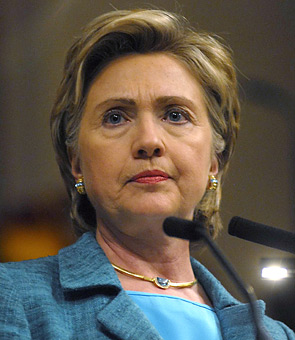
Hillary Clinton Threatens to Attack Iran ‘The Way That We Did’ Iraq

June 8, 2009
Secretary of State Says US or “Some Other Enemy” May Launch First Strike Against Iran

by Jason Ditz | Antiwar.com, June 8, 2009

Citing the disastrous 2003 US invasion of Iraq as an example, Secretary of State Hillary Clinton today warned that by continuing to refuse to abandon its civilian nuclear program, Iran was risking the possibility of an invasion by the US or “some other enemy that would do that to them.”

The comments came during an interview on ABC’s “This Week” program, and when asked by interviewer and former Clinton-era official George Stephanopoulus, Secretary Clinton reiterated “that’s right, as a first strike.”

The bulk of the interview emphasized US opposition to the Iranian program, along with unquestioned claims that the nation was pursuing nuclear weapons. Secretary Clinton also extended the American nuclear umbrella over Israel in the event that Iran attacked them.

Considering it was no more than 72 hours ago that President Obama made his historic call for a “new beginning” to US relations with the Muslim world, it seems incredible that his administration is already raising the prospect of an Iraq-style invasion of Iran.

Already six years in, the Iraq occupation has killed thousands of US soldiers, sucked trillions from the American economy, and is stretching the military to its limits. It is unfathomable that with this war still far from over, the Obama Administration is considering an Iraq redux in its larger neighbor to the east.

ANALYSIS / Netanyahu bringing Israel closer to war with Iran

May 26, 2009

Prime Minister Benjamin Netanyahu speaking during a faction meeting in the Knesset on Monday.
(AP)

By Aluf Benn, Haaretz Correspondent | Haaretz/Israel, May 26, 2009
Prime Minister Benjamin Netanyahu considers the lifting of the Iranian nuclear threat his life’s mission. Before coming to power, he had mentioned that such an operation might cost thousands of lives, but the price was justified in view of the threat’s severity. His comments yesterday at the meeting of Likud’s Knesset faction put to rest Ariel Sharon’s doctrine that Iran is not just Israel’s problem but the entire world’s problem, and Israel must not be at the forefront of the struggle. Israel is now at the forefront.

The leaders of Iran and Israel escalated the verbal confrontation yesterday. Mahmoud Ahmadinejad said discussions on the nuclear issue are over, which means Iran does not intend to give up enriching uranium. Netanyahu said that if Israel does not lead the defense against the Iranian threat and bring in the United States and other countries, no one else will.

In both cases, in Tehran and Jerusalem, it’s possible to justify the leaders’ comments by citing domestic political needs. But even if the immediate motive is domestic politics, the strategic implications cannot be ignored.


Netanyahu reiterated that he has come to an understanding with U.S. President Barack Obama on preventing Iran from acquiring a military nuclear capability. Unlike the dispute between Netanyahu and the United States on the Palestinian question, the Americans have not denied his statements on understandings reached on Iran.

A senior source close to the Obama administration has said that the dialogue Obama has offered Iran will come to nothing and that the U.S. will not strike Iran unless something unusual and unexpected happens. If this turns out to be the case, the Netanyahu government may have to decide whether to attack Iran’s nuclear installations.

Three arguments are normally made to reject the likelihood of an Israeli military option: the complexity of the mission, the U.S. veto and opposition in the government. It is usually assumed that Israel will seek to repeat the 1981 bombing of the nuclear reactor in Iraq. This is only one scenario and not a likely one.

There are other possibilities to consider: a war in the north that drags Iran in, or a strike against a valuable target for the Iranian regime, which leads Supreme Leader Ali Khamenei and Ahmadinejad to take action against “the Zionist regime.” If Iran attacks Israel first, the element of surprise will be lost, but then Israel’s strike against the nuclear installations will be considered self-defense.

The second argument, regarding American opposition to a strike, depends on the circumstances. It’s hard to imagine that Obama will order the interception of Israeli aircraft on the way to Natanz if all other ways of stopping the centrifuges have failed. Clearly the administration will have to chastise Israel, and let’s not forget the statements by CIA chief Leon Panetta, who warned against any operation not coordinated with the United States. But no one knows how Obama will behave in the moment of truth. He told Newsweek that he will not tell Israelis what their defense requirements are. Netanyahu liked this very much.

The third claim, about political opposition at home, is entirely mistaken. In talks on going to war, the ministers and officers compete over who is more patriotic, not who is wiser or more rational. At decision time, no one will dare go down in history as having reservations and risk being portrayed as a coward. If the Second Lebanon War is anything to go by, all the “heroes” who criticized the war in retrospect had voted to go to war. This will be the case if Netanyahu brings to the cabinet a plan to attack Iran, and the Israel Defense Forces will say that it can.

A war with Iran is not inevitable. But the prime minister took another step yesterday toward preparing the general public for the possibility that it might break out.

Obama Orders Update to Iran Attack Plan

May 23, 2009
Gates Says “All Options Are On the Table”

by Jason Ditz | Antiwar.com,  May 22, 2009

On NBC’s Today Show this morning, Secretary of Defense Robert Gates said that President Obama has ordered him to update the plans for a US attack on Iran, plans which were last updating during the Bush Administration. Gates says the plans are “refreshed” and insists that “all options are on the table” with respect to the potential attack.

It was only a month ago that Secretary Gates was warning vigorously against the potential attack, saying that it would create a “disastrous backlash” against the United States to hit Iran’s civilian nuclear facilities. The Obama Administration has insisted it is intending to pursue the matter diplomatically with Iran, but Secretary of State Hillary Clinton has repeatedly said the administration doesn’t expect diplomacy to work, and the effort seems to be primarily to rally international support for more measures against Iran.

The US has also been sending secret missions to Israel in recent days, reportedly to caution them against launching any surprise military attacks against Iran of their own. It was unclear how successful the warnings were: Prime Minister Netanyahu said he remained confident that the US would respect Israel’s right to attack Iran.

It is unclear whether Gates’ revelation portends a serious potential for an imminent US attack on Iran, or whether the move is more international posturing. Still, it seems unlikely the news will be greeted warmly in Iran, which is in the middle of an election campaign in which potential US talks are a major issue.

Related Stories

Western Media Propagandize Iran’s Missile Test

May 22, 2009

Iran announced on Wednesday that it had successfully tested its Sejil 2 surface-to-surface missile, and Western media sources took the opportunity to portray the Middle Eastern nation as a threat to world peace and, specifically, as a threat to Israel.

The Seijl 2 missile has a range of about 1,200 miles, and thus would be capable of hitting Israel, but Iran’s President Ahmadinejad announced in a speech following what he deemed a successful test that the missile’s purpose was to protect Iran from the threat of aggression.

Still, media accounts in the U.S. and other Western nations portrayed Iran’s test as a threatening provocation and linked it to an Iranian nuclear weapons program there is no evidence actually exists.

The London Times’ headline alarmingly read, “Ahmadinejad claims Iran’s new missile is capable of hitting Israel”.

But the paper failed to produce a quote of the Iranian president actually specifying Israel as being within range of the missile. Instead, the text of the article only states that Ahmadinejad merely announced that a missile with a range of 1,200 miles had been successfully tested.

Full article