Archive for the ‘India’ Category

Kashmiris’ revolt against Indian occupation and military terror

October 2, 2009

The Socialist Worker, October 2, 2009

Arundhati Roy is the renowned author of the novel The God of Small Things, for which she won the prestigious Booker Prize in 1997. But Roy is equally well known as a determined social movement activist and leading voice of the global justice movement.

Roy’s new collection of essays, titled Field Notes on Democracy: Listening to Grasshoppers, examines the dark side of democracy in her native India. It looks at how religious majoritarianism, cultural nationalism and neo-fascism simmer just beneath the surface in a country that projects itself as the world’s largest democracy.

Here, we republish an essay from the book that provides a brilliant account of the summer 2008 uprising against Indian occupation by the people of Kashmir–a disputed region partitioned between India and Pakistan, and subject to Indian military rule in the section it controls.

Field Notes on Democracy: Listening to Grasshoppers | Arundhati Roy

FOR THE past sixty days or so, since about the end of June, the people of Kashmir have been free. Free in the most profound sense. They have shrugged off the terror of living their lives in the gun-sights of half a million heavily armed soldiers, in the most densely militarized zone in the world.

Continues >>

Raina: Kashmir Ripe for Endgame?

October 1, 2009

By Badri Raina, ZNet, Oct 1, 2009

Badri Raina’s ZSpace Page

I

I have before me the full text of the report on Kashmir prepared by Beersman Paul, President, Human Rights Council, Geneva, submitted to the Council at its 12th session, 14th Sept.,-2nd October, 2009.

The report, which is titled “Belgian Association for Solidarity with Jammu & Kashmir: Solution Under the Indian Constitution,” encapsulates the interactions and findings of Mr. Beersman during his “study tour through Jammu & Kashmir State from June 30-July 27, 2009.

After a brief, factual introductory, Beersman lists the individuals and organizations he interviewed during what must clearly have been an exhausting job of fact-finding, covering all three provinces of the state of Jammu & Kashmir and most shades of opinion, although I do not find any entries either for Syed Ali Shah Geelani (the only separatist leader who holds fast to the objective of accession of the state with Pakistan, via, no doubt the formality of self-determination), for Yaseen Malik (JKLF, who steadfastly espouses “independence” from both India and Pakistan) or any interview with a Kashmiri Pandit spokesperson (remembering that the Pandits, at the other end of the spectrum, want the state’s accession to India to be unambiguously cemented.) The text can be accessed at http://basjak.org.

Hereunder is a bullet-point summation of the significant points made by some significant Valley leaders other than those whose allegiance to the accession with India remains firmly in place, often referred to as the “mainstream” parties and political groups. My catalogue is clearly not intended to reproduce the full text of what each individual/organization is recorded to have said in Beersman’s report, but to highlight what seem to me the chief concerns of each.

Continues >>

Kashmir dispute main cause of tension in South Asia

September 29, 2009

Kashmir Media Service,

New York, September 26 (KMS): The Chairman of All Parties Hurriyet Conference, Mirwaiz Umar Farooq, has said that Kashmir dispute is the main cause of tension in South Asia and needs to be resolved without any further delay. Addressing the OIC Foreign Ministers’ Conference in New York, the APHC Chairman said, because of its impact on relations between Pakistan and India, the conflict over Kashmir directly affects the peace and stability in the entire region, which is home to millions of people.

Mirwaiz maintained that the APHC was committed to bring about a peaceful and political solution to the dispute through meaningful dialogue among Pakistan, India and Kashmiris’ genuine leadership. He demanded demilitarization of Jammu and Kashmir, complete withdrawal of Indian troops from town and villages of occupied Kashmir and repeal of all draconian laws including Disturbed Areas Act, Public Safety Act and Armed Forces Special Powers Act.

The APHC Chairman said that human rights violations should be stopped and the international rights organisations should be allowed to have access to the occupied territory. He also called for the restoration of the rights of peaceful association, assembly and demonstrations, unconditional release of all political prisoners, freedom of all political leaders to travel abroad and allowing people to people contact on either side of the Line of Control.

Mirwaiz appealed to the leaders of the Islamic countries to use their moral and political influence to help resume the peace process for a just and honourable settlement of the Kashmir dispute and to grant the people of Kashmir their inalienable right of self-determination.

Complete text of the APHC Chairman’s speech is as follows

Mr. Chairman, Mr. Secretary General, Excellencies, distinguished guest, ladies and gentlemen,
Assalam-u-Alaikum Warahmatula-e-Wabarakatuhu,
I am enormously grateful for the opportunity to address this highly esteemed gathering of Foreign Ministers of the Organization of the Islamic Conference (OIC) on the subject of Kashmir.  I was also invited to participate in the OIC Council of Foreign Ministers in Damascus, Syria in May 2009. However, I could not attend that meeting because I was not given the travel document by the Government of India.

Excellencies, today, at this august body, I stand before you not just as a representative of the Kashmiri people struggling for their inalienable right of self-determination, but, more importantly as a ‘believer’. A believer who is urging the Ummah to reclaim its intellectual and spiritual glory.  A believer who is proud of the accomplishments of the Organization of Islamic Conference, yet, recognizes that there is much work still to do.

The Foreign Ministers in this annual coordination meeting aim to discuss various issues related to the United Nations’ agenda in order to enhance cooperation and coordination among the OIC Member States at the UN.  The importance of this initiative cannot be overstated. And, we need to be sure that our cooperation cannot be built on the hatred of anyone or anything, rather it should be undertaken with a love for ourselves and our traditions.

The present Charter of the Organization was adopted by the Eleventh Islamic Summit held in Dakar on 13-14 March 2008, which laid down the objectives and principles of the organization and fundamental purposes to strengthen the solidarity and cooperation among the Member States. The Organization has the singular honor to galvanize the Ummah into a unified body and have actively represented the Muslims by espousing all causes close to the hearts of over 1.5 billion Muslims of the world. The Organization has consultative and cooperative relations with the UN to protect the vital interests of the Muslims and to work for the settlement of conflicts and disputes involving Member States. One such conflict is that of the Jammu and Kashmir.

It bears no reiteration that the Kashmir conflict primarily involves the life and future of the people of the land. However, unresolved dispute is at the underlying cause of tension between two nuclear rival – India and Pakistan.  Because of its impact on relations between these two neighboring countries, it directly affects the peace and stability in an unstable region, which is home to more than 1.2 billion people, and the peace and security of many more nations beyond.

It has been a cause of two wars and numerous battles between the two neighbors, India and Pakistan.  The place has been aptly described by the former US President, Bill Clinton as the “most dangerous place” on earth. The situation has taken an ominous turn since the Mumbai attacks o November 26, 2008. With extremist threat growing in the region, the escalating turmoil in Kashmir promises to engulf the entire region extending from Afghanistan to Bangladesh.

Excellencies, the APHC is committed to a peaceful and political solution to the Kashmir dispute. We believe that for a meaningful dialogue between Pakistan, India and the Leadership of Jammu & Kashmir the following measures need to be taken.

1.  To demilitarize the arena of conflict – the State of Jammu and Kashmir – through a phased withdrawal of the troops;

2.  Complete withdrawal of India’s military presence from Kashmiri towns and villages;

3.  Immediate repeal of all draconian laws including Jammu and Kashmir Disturbed Areas Act and Public Safety Act and Armed Forces Special Powers Act;

4.   End to violations of human rights and allowing the international human rights organisations to have access to Kashmir;

5. The restoration of the rights of peaceful association, assembly and demonstrations;

6.    The unconditional release of all political prisoners;

7.     Freedom of all political leaders to travel abroad; and

8.   To allow people to people contact on either side of the Line of Control.

Excellencies, we trust you will bring your immense moral and political influence to bear on initiating a peace process which will lead to a speedy, just an honourable settlement of the dispute and to restore the inalienable right of self-determination of the people of Kashmir.

I thank you, Excellencies for your patient hearing.

See also, Resolving the Kashmir Conflict

UN says caste system is a human rights abuse

September 29, 2009

United Nations is to declare discrimination based on the Indian caste system is a human rights abuse.

By Dean Nelson in New Delhi, Telegraph.co.uk, Sep 29, 2009

The UN’s Human Rights Council, meeting in Geneva, is expected to ratify draft principles which recognises the scale of persecution suffered by 65 million ‘untouchables’ or ‘Dalits’ who carry out the most menial and degrading work

Many of them work as lavatory and sewer cleaners and in remote villages as “night-soil carriers”.

They are considered unclean by many higher-caste ‘Brahmins’ who regard their presence, and sometimes even their shadow as ‘polluting’.

Continues >>

Roy: What Have We Done to Democracy?

September 28, 2009

Of Nearsighted Progress, Feral Howls, Consensus, Chaos, and a New Cold War in Kashmir

Arundhati Roy, tomdispatch.com, Sep 27, 2009

While we’re still arguing about whether there’s life after death, can we add another question to the cart? Is there life after democracy? What sort of life will it be? By “democracy” I don’t mean democracy as an ideal or an aspiration. I mean the working model: Western liberal democracy, and its variants, such as they are.

So, is there life after democracy?

Attempts to answer this question often turn into a comparison of different systems of governance, and end with a somewhat prickly, combative defense of democracy. It’s flawed, we say. It isn’t perfect, but it’s better than everything else that’s on offer. Inevitably, someone in the room will say: “Afghanistan, Pakistan, Saudi Arabia, Somalia… is that what you would prefer?”

Continues >>

India’s Ugly Underbelly

September 19, 2009

By Badri Raina, ZNet, Sep 19, 2009

Badri Raina’s ZSpace Page

He that will not reason is a bigot; he that cannot reason is a fool; he that dare not reason is a slave.”

(H. Drummond)

I

India’s Tamilians have always considered themselves a distinct race. Distinct from the Aryans who, history tells us, displaced their Dravidian ancestors after the conquest of the Indus-Valley civilizations. The Tamil language and script are perhaps of greater antiquity than Sanskrit and have remained largely free of its influence. Not to speak of Tamil literature which may be the richest India has to offer, both in depth and scope.

Which is why Tamilians break into passionate protest when any Tamilian anywhere be perceived as being under siege. Sri Lanka offering a prime example, as well as the situation of Tamilians in Malysia.

So, would it be right to infer that Tamilian civilizational homogeneity brooks no breach?

Wrong.

In the Peraiyur taluk of Madurai district in Chennai is a place called Uthapuram. And there, for the last two decades a ten foot high wall segregates Tamilians from other Tamilians, namely, caste Tamils from those without caste (“untouchabes”).

This wall was built to deny access to casteless Tamils of Uthapuram to public places and facilities frequented by caste Tamils on the other side.

Continues >>

Something Rotten in the State of Gujarat

September 12, 2009

By Badri Raina, ZNet, Sep 12, 2009

Badri Raina’s ZSpace Page

I have supped full with horrors;

Direness, familiar to my slaughterous thoughts,

Cannot once start me.
(Macbeth Modi)

I

Indeed, great is the temptation to write this account wholly in Shakespearean quotation.

Four new skeletons now rattle for justice in the Modi cupboard. And well might he be saying to himself:

the time has been,

That, when the brains were out, the man would die,

And there an end; but now they rise again,

With twenty mortal murders on their crowns;

A judicial magistrate in Ahmedabad, one good man Tamang, has held that the killing of the nineteen year old college girl, Ishrat Jahan, and four others in June, 2004 was , after all, yet another “fake encounter” executed by high-ranked police Modi loyalists to curry favour with him and obtain preferment.

This on the heels of the earlier murder of one Sohrabuddin and his wife, Kausar Bi, acknowledged in court by the Modi government to have been “fake encounters.” And by the very same police personnel as well, two of whom are now in the slammer for that killing. At least for now.

Speculation is rife as to how many official murders may have been effected by the Gujarat state since 2002, when the Gujarat massacre took place.

Continues >>

MILITARIZATION WITH IMPUNITY: A Brief on Rape and Murder in Shopian, Kashmir

September 11, 2009

International People’s Tribunal on Human Rights and Justice in Kashmir (IPTK)
http://www.kashmirprocess.org

FOR IMMEDIATE RELEASE
JULY 19, 2009

MILITARIZATION WITH IMPUNITY:
A Brief on Rape and Murder in Shopian, Kashmir

http://www.kashmirprocess.org/shopian

From

Dr. Angana Chatterji, Convener IPTK and Professor, Anthropology, California Institute of Integral Studies
Advocate Parvez Imroz, Convener IPTK and Founder, Jammu and Kashmir Coalition of Civil Society
Gautam Navlakha, Convener IPTK and Editorial Consultant, Economic and Political Weekly
Zahir-Ud-Din, Convener IPTK and Vice-President, Jammu and Kashmir Coalition of Civil Society
Advocate Mihir Desai, Legal Counsel IPTK and Lawyer, Mumbai High Court and Supreme Court of India
Khurram Parvez, Liaison IPTK and Programme Coordinator, Jammu and Kashmir Coalition of Civil Society

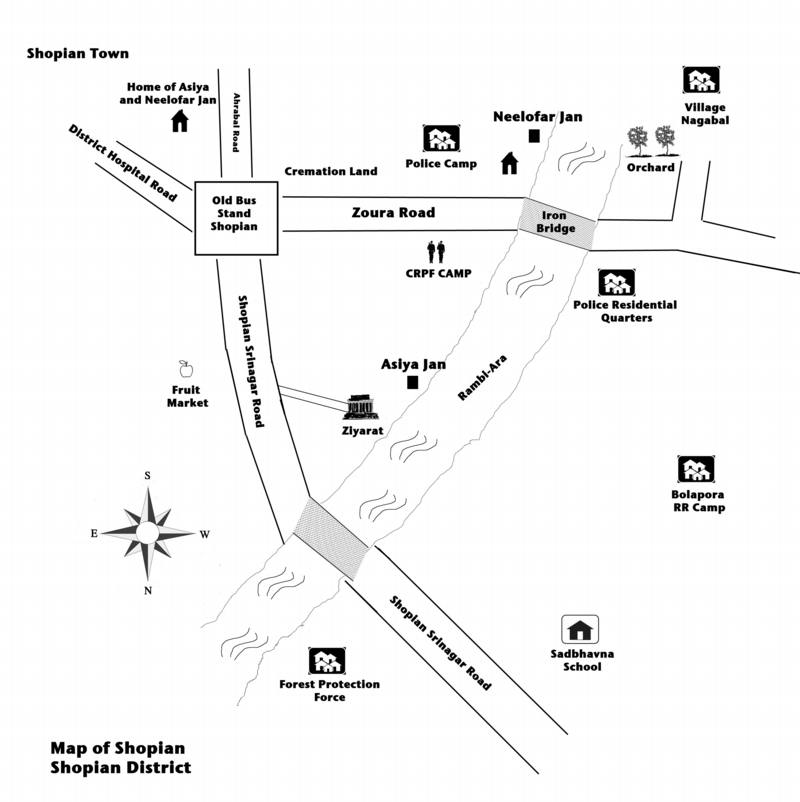
Enclosed, please find our brief on the events and investigative process in Shopian, Kashmir, connected to the brutalization and death of Asiya Jan and Neelofar Jan in end May 2009, in which the state security forces have been implicated.

While investigations have emphasized the procedural conduct of the police in their handling of the investigation, they failed to focus on the actual crimes that were committed, or the conduct of state institutions. The investigations in Shopian have not focused on the identification and prosecution of perpetrators or on addressing structural realities of militarization in Kashmir that foster and perpetuate gendered and sexualized violences, and undermine rule of law and justice. The investigations have instead concentrated on locating ‘collaborators’ and manufacturing scapegoats to subdue public outcry. ‘Control’ rather than ‘justice’ has organized the focus of the state apparatus, including all processes related to civic, criminal, and judicial matters.

What is the ‘truth’ of the matter, who are in the know, and what is being shielded?

We were compelled to write this brief to mark the inability of the state apparatus to deliver justice. We urge civil society institutions and international human rights groups and those working with issues of social justice to seek accountability.

In writing this, we have visited, and been in contact with, the family of Asiya Jan and Neelofar Jan, and civil society leaders and organizations in Shopian, and in Srinagar. We are grateful for the collegiality extended us, and especially to those that placed themselves at risk to offer us insight.

Full Report (PDF)

Coverletter
Photos and Video
Map
Shopian-related Civlian Injuries and Death (PDF)
Extended Bibliography

A Different Perspective on the U.S.-India Nuclear Deal

September 4, 2009

Peter Custers, Monthly Review, September  2009

The U.S.-India nuclear deal was initiated through a framework agreement signed by India’s Prime Minister Manmohan Singh and U.S. President Bush in July 2005. India, at the instigation of Washington, agreed to separate its civilian and military nuclear production facilities, and place all civilian production facilities under the inspection regime of the International Atomic Energy Agency (IAEA), in return for U.S. economic, technological, and military cooperation. The nuclear deal, which took three years to complete, is officially aimed at promoting India’s access to uranium and to civilian nuclear technology, through enlarged importation of both. Whereas nuclear energy contributed a reported 2.5 percent of India’s energy requirements in 2007, the deal is expected to boost the contribution of the nuclear sector to India’s electricity supply, without reducing India’s primary dependence on coal. From its very start, the U.S.-India nuclear deal has generated huge controversies, both in India and internationally. The intent here is to lay bare the implications of the deal for the creation of waste, while putting aside, for the moment, other important controversies associated with the nuclear agreement.

Continues >>

Yet He Could Not Equivocate to Heaven

September 2, 2009

By Badri Raina, ZNet, September 1, 2009

Badri Raina’s ZSpace Pag

That you may smile and smile and be a villain”

(Hamlet)

I

His great contribution to politics: pulling his party, the BJP, from two to some one hundred and eighty seats in parliament—all on the back of a hate-filled, anti-Muslim pogrom.

Hitler did as much.

His great contribution to “thought”: coining the phrase “pseudo-secularism,”—defined as any activity on behalf of the state to ameliorate the abysmal social and economic situation of India’s Muslims.

The Constitution be damned

This lean and hungry man, unctuous in speech, guilt-ridden finger-tips gingerly touching across his chest, watched over by foxy moustache, affecting gravitas with tentative stoop and bended head within which breed impulses of self-serving small-mindedness—this undeserving man who would be India’s prime minister has finally been found out.

And, like the priest who forged the gun-powder plot (and justified, during his interrogation, equivocation as sanctioned religious practice), he no longer can equivocate either to the nation or to god. Perhaps to himself as well. Although that must be in doubt.

Four members out of five that constituted the Cabinet Committee on Security during the Vajpayee regime in 1999 have made public averment that he was always present in the meetings that deliberated the hijack of the IC-814 by terrorists, and, contrary to his denials, was wholly in the know of and in agreement with the decision to let the then foreign minister accompany three high-value terrorists to Kandhar.

Thus, the Lauh Purush (iron man) has been found to be an abject equivocator merely, and a cowardly one at that.

Continues >>