Archive for the ‘imperialism’ Category

Fomenting Armageddon: Jerusalem’s Colonization and Western Apathy

April 29, 2010

By Dr. Ahmad Yousef, Uruknet.info, April 28, 2010

7jerusalem_jews_dancing_yousef.jpg

The Israelis are instigating a Jewish holy war staged in Jerusalem; and they are playing a superb game of propaganda painting the Palestinians as the “real” fundamentalists, despite the fact that the Knesset has more active right-wing political parties than any state in the civilized world. It’s a strategy that has caught the West by surprise as they continue to react with template disappointment.

Successive governments have supported colonization for decades; yet Benjamin “Bibi” Netanyahu’s recent moves have all but dispelled the façade of a secular rationale. Unfettered, expedited settlement construction in Jerusalem, with images of soldiers traipsing through Islam’s third holiest site in army fatigues, mark a new low for the Israelis; yet equally indicate a new level of brazen physical and psychological aggression that will result in a new intifada.

Continues >>

The Legality of Drone Warfare

April 29, 2010

By Joanne Mariner, Counterpunch, April 28, 2010

Congress is holding hearings this week on the legality of the US government’s drone warfare program. Conducted by the National Security and Foreign Affairs Subcommittee of the House Committee on Oversight and Government Reform, the hearings will examine the CIA’s use of unmanned aerial vehicles – commonly known as drones – to fire missiles at suspected militants in Pakistan and elsewhere.

While the Bush administration had an active drone warfare program, US reliance on drones increased greatly after President Obama took office. According to Peter Bergen and Katherine Tiedemann of the New America Foundation, who have carried out a study of the drone program, the Bush administration carried out a total of 45 drone strikes in eight years, whereas the Obama administration carried out 53 strikes in 2009 alone. The pace of such attacks quickened even further in 2010.

Continues >>

A Middle East Peace That Could Happen (But Won’t)

April 29, 2010

In Washington-Speak, “Palestinian State” Means “Fried Chicken”

By Noam Chomsky, TomDispatch.com, April 27, 2010

The fact that the Israel-Palestine conflict grinds on without resolution might appear to be rather strange.  For many of the world’s conflicts, it is difficult even to conjure up a feasible settlement.  In this case, it is not only possible, but there is near universal agreement on its basic contours: a two-state settlement along the internationally recognized (pre-June 1967) borders — with “minor and mutual modifications,” to adopt official U.S. terminology before Washington departed from the international community in the mid-1970s.

Continues >>

Engelhardt: Yes, We Could… Get Out!

April 26, 2010

Why We Won’t Leave Afghanistan or Iraq

By Tom Engelhardt, ZNet, April 26,  2010
Source: TomDispatch
Tom Engelhardt’s ZSpace Page

Yes, we could.  No kidding.  We really could withdraw our massive armies, now close to 200,000 troops combined, from Afghanistan and Iraq (and that’s not even counting our similarly large stealth army of private contractors, which helps keep the true size of our double occupations in the shadows).  We could undoubtedly withdraw them all reasonably quickly and reasonably painlessly.

Not that you would know it from listening to the debates in Washington or catching the mainstream news.  There, withdrawal, when discussed at all, seems like an undertaking beyond the waking imagination.  In Iraq alone, all those bases to dismantle and millions of pieces of equipment to send home in a draw-down operation worthy of years of intensive effort, the sort of thing that makes the desperate British evacuation from Dunkirk in World War II look like a Sunday stroll in the park.  And that’s only the technical side of the matter.

Continues >>

Kucinich: US drone attacks in Pakistan could ‘inspire radicalism’

April 25, 2010
By Sahil Kapur, The Raw Story, April 19, 2010

kucinichobama Kucinich: US drone attacks in Pakistan could inspire  radicalism

WASHINGTON – Rep. Dennis Kucinich (D-OH) forcefully criticized the United States’ drone strikes in Pakistan as inspiring the anti-American sentiments they seek to quell, touching upon a consequence of the policy rarely discussed in the media but well-recognized in the region.

“I do not support the drone attacks,” Kucinich told Raw Story, arguing that they are pushing the United States “into an area of unaccountability that would lead to blowback, where we actually lose friends, where we help inspire anti-American sentiments and fanaticism and radicalism.”

Continues >>

10,000 Palestinians homes razed by Israel in 10 years

April 22, 2010

Palestinian Information Center, April 21, 2010

OCCUPIED JERUSALEM, (PIC)– Al-Maqdesi foundation for society development said that Israel demolished more than 10,000 Palestinian homes in the neighborhoods of occupied Jerusalem during the past 10 years.

Director of the foundation Mu’aad Al-Zaatari stated that the Israeli occupation authority (IOA) issued 850 demolition orders against Palestinian homes at the pretext of unlicenced construction from the beginning of 2010.

Zaatari told Palestine newspaper that the IOA municipal council in Jerusalem, during 2009, demolished 110 housing units including 35 homes, which were knocked down by their Palestinian owners after they received court orders.

Continues >>

The US threat to Latin America

April 21, 2010

Morning Star Online, April 20, 2010

by Grace Livingstone

The military agreement between the United States and Colombia has caused outcry in Latin America. Many governments suspect that the US is trying to cement its military hegemony in the region and maintain its ability to intervene in the affairs of Latin American countries.

The State Department says that the deal is all about security within Colombia and does not affect other countries, but Pentagon documents show that the US has far wider and more ominous objectives.

An US air force budget justification Bill, sent to Congress last year, states that Palanquero airbase in Colombia “provides an opportunity for conducting full spectrum operations throughout south America.”

Full spectrum operations is Pentagon jargon for dominating the battle space on land, sea, air and space and can include the use of nuclear weapons.

Continues >>

“After Hiroshima And Nagasaki, There Was Fallujah.”

April 17, 2010

By William Blum, ZNet, April 17, 2010

William Blum’s ZSpace Page

When did it begin, all this “We take your [call/problem/question] very seriously”? With answering-machine hell? As you wait endlessly, the company or government agency assures you that they take seriously whatever reason you’re calling. What a kind and thoughtful world we live in.

The BBC reported last month that doctors in the Iraqi city of Fallujah are reporting a high level of birth defects, with some blaming weapons used by the United States during its fierce onslaughts of 2004 and subsequently, which left much of the city in ruins. “It was like an earthquake,” a local engineer who was running for a national assembly seat told the Washington Post in 2005. “After Hiroshima and Nagasaki, there was Fallujah.” Now, the level of heart defects among newborn babies is said to be 13 times higher than in Europe.

Contyinues >>

Radical Historian George Barnsby 1919–2010

April 13, 2010

By Nasir Khan

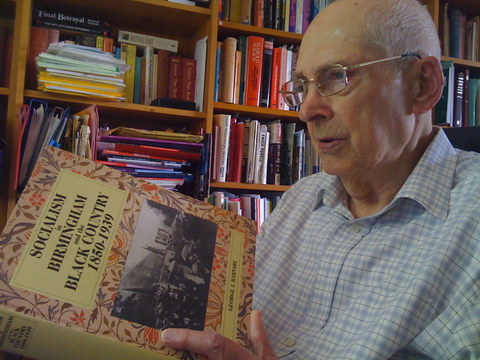
Dr George Barnsby

Dr George Barnsby, who died on April 11 at the age of 91 in Wolverhampton, was a leading radical activist and historian of the working class movement in the Black Country. Born in London in a working class family, his father died when he was only three years old. Now his mother had the sole responsibility to take care of her two infant sons in dire circumstances. The vicissitudes of his early life made George aware that the ‘station in life’ of many people was determined by their social and economic status. He certainly was not born with a silver spoon in his mouth.

He left school at 15 and did some ordinary jobs. He showed little interest in politics at that time. However, around the age of eighteen he became a reader of Daily Worker. It was the period when Nazism had emerged as the dominant voice of militarism and in many countries in Europe and the United States fascist parties emerged. Their model was the German Nazi party and their hero Adolf Hitler. When the Second World War started the young George was called up in 1939. At that time, he was 20 years old. When he went to fight for his ‘king and country’ his worldly possessions were two suits and a bicycle. He recalls in his ‘Subversive – One Third of the Autobiography of a Communist’ that for obvious reasons some people had more interest in ‘our country’ than he did!

He was sent to Burma. He experienced there inhumanity of the war and destruction caused by the Japanese. His contact with India and Indians subject to the imperial Raj gave him a broad political insight and awareness of the role of colonialism and imperialism. The Bengal Famine of 1943-44 occurred under the British rule. It is estimated that around 3 million Indians died from starvation and malnutrition. The Bengal government reacted to the disaster with little efficiency, and refused to stop the flow of rice from Bengal. George was an eye-witness to the apathy of the British rulers towards their subjects. There was no shortage of food in the British quarters either. There are still some hard questions about the role and knowledge of the British Prime Minster Winston Churchill into the affair. For instance, when the Secretary of State for India, Leo Amery, and Lord Wavell requested him an urgent release of food stocks for India, Churchill responded with a telegram to Wavell asking, if food was so scarce, ‘why Gandhi hadn’t died yet.’

The end of the Second World War saw the defeat of fascism and militarism in Germany and Japan. But no such harm came to the Spanish fascism under Franco. The Soviet Union and its Red Army in the Great Patriotic War had borne the brunt of the war on the Eastern Front. With the Allied victory, the army conscripts returned to their homes. In 1946, George was demobbed, receiving a gratuity of about £100. This sum he used to get further education. First, he matriculated from Regent Street Polytechnic before he went to the London School of Economics where he obtained a B.Sc. Honours degree there. From Birmingham University he gained an M.A. degree by writing ‘Social Conditions in the Black Country’ and then from the same university he earned a Ph.D. degree on his thesis ‘Working Class Movement in the Black Country 1750 to 1868′. His studies and committment to revolutionary Socialism that wanted to serve the interests of the working class had taken the central stage in his life. He was to struggle for these objectives for the rest of his life.

When he came to Wolverhampton in 1954, he became the secretary of the local Communist Party. This was the period when the Cold war was in full swing and in the United States anti-Communist crusade of McCarthyism had become the new credo of the Cold War allies in the West. In Britain, Communists were looked upon as traitors; they were spied upon and their telephones tapped. Obviously, George like other Communists was also regarded as subversive and he had to confront what came his way.

The range of his social, academic and political activities in the Black Country extends over vast areas. He wrote a number of histories and pamphlets on Socialism, Birmingham, Wolverhampton, Housing and the Radicals in the Black Country.

One major area of communal activity was around Bilston College of Further Education. Some teachers of the College and governors realised that many working-class people were excluded from formal institutional education who formed unqualified work force with little basic skills. Among the excluded were a disproportionate number of people from ethnic minority communities, mainly Afro-Caribbean and Asian. George was an active educator and a leading voice in the new approach to uplifting the working class people and providing them with education that met their needs. This progressive approach in a multicultural and multi-ethnic society was to counterbalance the legacy of Enoch Powell and his followers.

When American President George W. Bush and his close ally, Prime Minister Tony Blair, started their genocidal war of aggression against Iraq and the subsequent destruction of Iraq and Iraqis, George steadfastly opposed the imperial war. For him, the Anglo-American war in Iraq was a crime against humanity, a genocide, and its central figures the war criminals who need to be brought to justice. He focused on Bush and Blair and their allies, writing extensively on their policies on his website and informed the populace of the realities of the cover-up of their crimes and their incessant lies.

George Barnsby is survived by his wife Esme and two sons, William and Robert.

George W. Bush ‘knew Guantánamo prisoners were innocent’

April 9, 2010

The Times/UK, April 9, 2010
Tim Reid, Washigton

Two detainees are escorted to interrogation by U.S. military  guards at Camp X-Ray in the Guantanamo Bay U.S. Naval Base , Cuba

Andres Leighton/AP)

Two detainees are escorted to interrogation by US military guards at Guantánamo Bay

George W. Bush, Dick Cheney and Donald Rumsfeld covered up that hundreds of innocent men were sent to the Guantánamo Bay prison camp because they feared that releasing them would harm the push for war in Iraq and the broader War on Terror, according to a new document obtained by The Times.

The accusations were made by Lawrence Wilkerson, a top aide to Colin Powell, the former Republican Secretary of State, in a signed declaration to support a lawsuit filed by a Guantánamo detainee. It is the first time that such allegations have been made by a senior member of the Bush Administration.

Colonel Wilkerson, who was General Powell’s chief of staff when he ran the State Department, was most critical of Mr Cheney and Mr Rumsfeld. He claimed that the former Vice-President and Defence Secretary knew that the majority of the initial 742 detainees sent to Guantánamo in 2002 were innocent but believed that it was “politically impossible to release them”.

General Powell, who left the Bush Administration in 2005, angry about the misinformation that he unwittingly gave the world when he made the case for the invasion of Iraq at the UN, is understood to have backed Colonel Wilkerson’s declaration.

Colonel Wilkerson, a long-time critic of the Bush Administration’s approach to counter-terrorism and the war in Iraq, claimed that the majority of detainees — children as young as 12 and men as old as 93, he said — never saw a US soldier when they were captured. He said that many were turned over by Afghans and Pakistanis for up to $5,000. Little or no evidence was produced as to why they had been taken.

He also claimed that one reason Mr Cheney and Mr Rumsfeld did not want the innocent detainees released was because “the detention efforts would be revealed as the incredibly confused operation that they were”. This was “not acceptable to the Administration and would have been severely detrimental to the leadership at DoD [Mr Rumsfeld at the Defence Department]”.

Referring to Mr Cheney, Colonel Wilkerson, who served 31 years in the US Army, asserted: “He had absolutely no concern that the vast majority of Guantánamo detainees were innocent … If hundreds of innocent individuals had to suffer in order to detain a handful of hardcore terrorists, so be it.”

He alleged that for Mr Cheney and Mr Rumsfeld “innocent people languishing in Guantánamo for years was justified by the broader War on Terror and the small number of terrorists who were responsible for the September 11 attacks”.

He added: “I discussed the issue of the Guantánamo detainees with Secretary Powell. I learnt that it was his view that it was not just Vice-President Cheney and Secretary Rumsfeld, but also President Bush who was involved in all of the Guantánamo decision making.”

Mr Cheney and Mr Rumsfeld, Colonel Wilkerson said, deemed the incarceration of innocent men acceptable if some genuine militants were captured, leading to a better intelligence picture of Iraq at a time when the Bush Administration was desperate to find a link between Saddam Hussein and 9/11, “thus justifying the Administration’s plans for war with that country”.

He signed the declaration in support of Adel Hassan Hamad, a Sudanese man who was held at Guantánamo Bay from March 2003 until December 2007. Mr Hamad claims that he was tortured by US agents while in custody and yesterday filed a damages action against a list of American officials.

Defenders of Guantánamo said that detainees began to be released as early as September 2002, nine months after the first prisoners were sent to the jail at the US naval base in Cuba. By the time Mr Bush left office more than 530 detainees had been freed.

A spokesman for Mr Bush said of Colonel Wilkerson’s allegations: “We are not going to have any comment on that.” A former associate to Mr Rumsfeld said that Mr Wilkerson’s assertions were completely untrue.

The associate said the former Defence Secretary had worked harder than anyone to get detainees released and worked assiduously to keep the prison population as small as possible. Mr Cheney’s office did not respond.

There are currently about 180 detainees left in the facility.