- The Guardian,
- Monday September 8 2008
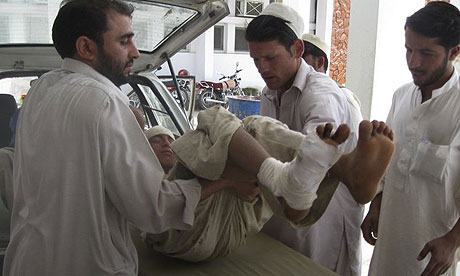
An injured Afghan boy is put on a stretcher at a hospital in Jalalabad city, Afghanistan. Photograph: Nesar Ahmad
Civilian deaths in Afghanistan from US and Nato air strikes have nearly tripled over the past year, with the onslaught continuing in 2008 and fuelling a public backlash, a leading human rights group says today.
The report by Human Rights Watch Human Rights Watch says that despite changes in the rules of engagement which had reduced the rate of civilian casualties since a spike in July last year, air strikes killed at least 321 civilians in 2007, compared with at least 116 in 2006. In the first seven months of this year at least 540 Afghan civilians were killed in fighting related to the armed conflict, with at least 119 killed by US or Nato air strikes, such as this July’s attack on a wedding party which killed 47, says Human Rights Watch.
“There has been a massive and unprecedented surge in the use of air power in Afghanistan in 2008,” the report says. It found that few civilians casualties were the result of planned air strikes on suspected Taliban targets. Instead, most were from air strikes during rapid response missions mostly carried out in support of “troops in contact” – ground troops under insurgent attack. Such strikes included situations where American special forces – normally small in number and lightly armed – came under insurgent attack.
“In response to increased insurgent activity, twice as many tons of bombs were dropped in 2007 than in 2006,” the report says. “In 2008, the pace has increased: in the months of June and July alone the US dropped approximately as much as it did in all of 2006. Without improvements in planning, intelligence, targeting, and identifying civilian populations, the massive use of air power in Afghanistan will continue to lead to unacceptably high civilian casualties.”
“Mistakes by the US and Nato have dramatically decreased public support for the Afghan government and the presence of international forces providing security to Afghans,” said Brad Adams, Asia director at Human Rights Watch. The report criticises the response given by US officials when civilian deaths occur. Before conducting investigations, US officials often immediately deny responsibility for civilian deaths or place all blame on the Taliban, the report says.
US investigations have been “unilateral, ponderous, and lacking in transparency, undercutting rather than improving relations with local populations and the Afghan government”.
Last night the US military announced it would reopen its investigation of an air strike last month in which the Afghan government says 90 civilians, mainly women and children, were killed. An initial US inquiry found that up to 35 suspected insurgents and seven civilians died in the attack on Azizabad in Herat province, but General David McKiernan, the senior US officer in Afghanistan, announced a review in the light of “new information”. Afghan and western officials say that videos of the bombing’s aftermath shows dozens of dead civilians.


 E-Mail Article
 Printer-Friendly
 3-Column Format
 Translate
 Share Article
 Listen to Article

 Text Size


Extraordinary Rendition, Extraordinary Mistake
August 31, 2008Sangitha McKenzie Millar | Foreign Policy In Focus, August 29, 2008
Mamdouh Habib, an Australian citizen, was living in Sydney with his wife and four children when he took a trip alone to Pakistan to find a home for his family. When Habib boarded a bus for the Islamabad airport to return home, Pakistani police seized him and took him to a police station, where he was subjected to various crude torture techniques, including electric shocks and beating. At one point, he was forced to hang by the arms above a drum-like mechanism that administered an electric shock when touched. Pakistani police asked him repeatedly if he was with al-Qaeda, and if he trained in Afghanistan. Habib responded “No” over and over until he passed out.
After 15 days in the Pakistani prison, Habib was transferred to U.S. agents who flew him to Cairo. When he arrived, Omar Solaimon, chief of Egyptian security, informed him that Egypt receives $10 million for every confessed terrorist they hand over to the United States. Habib stated that during his five months in Egypt, “there was no interrogation, only torture.” His skin was burned with cigarettes and he was threatened with dogs, beaten, and repeatedly shocked with a stun gun. During this time, he heard American voices in the prison, but Egyptians were in charge of the torture. In Michael Otterman’s book American Torture: From the Cold War to Abu Ghraib and Beyond (Pluto Press 2007), Habib said he was drugged and began to hallucinate: “I feel like a dead person. I was gone. I become crazy.” He remembers admitting things to interrogators, anything they asked: “I didn’t care … at this point I was ready to die.”
He was transferred back to the custody of U.S. agents in May 2002. They flew him first to Bagram Air Base in Afghanistan and then to Kandahar. After several weeks, American agents sent Habib to Guantánamo Bay. Three British detainees who have since been released from the prison described Habib as being in a “catastrophic state” when he arrived. Most of his fingernails were missing and he regularly bled from the nose, mouth, and ears while he slept.
Habib was held at Guantánamo Bay until late 2004, when he was charged with training 9/11 hijackers in martial arts, attending an al-Qaeda training camp in Afghanistan, and transporting chemical weapons. A Chicago human rights lawyer took his case and detailed all of Habib’s allegations of torture in court documents. After the case garnered national attention through a front page story in The Washington Post, Habib became a liability for the U.S. government. Rather than have his testimony on the torture he suffered in Egypt become a matter of public record, U.S. officials decided to send him back to Sydney in January 2005 – over three years after seizing him in Pakistan.
Unfortunately, Habib’s case isn’t unusual. There’s substantial evidence that the United States routinely and knowingly “outsources” the application of torture by transferring terrorism suspects to countries that frequently violate international human rights norms. As details of the extraordinary rendition program have emerged, politicians, journalists, academics, legal experts, and policymakers have raised serious objections to the policy. It has captured the attention of U.S. legislators, and both the House and Senate Committees on Foreign Relations as well as the House Committee on the Judiciary have held hearings to analyze the policy and examine related cases. Senator Joseph Biden (D-DE), chairman of the Senate Committee on Foreign Relations and the Democratic vice presidential nominee, expressed concern that “rendition, as currently practiced, is undermining our moral credibility and standing abroad and weakening the coalitions with foreign governments that we need to effectively combat international terrorism.” As the public continues to learn more about the program, calls to end extraordinary rendition have increased, and the next presidential administration will likely be forced to take a stand one way or another on the issue.
Continued . . .
Share this:
Tags:Afghanistan, CIA renditions, Daniel Byman, Dick Cheney, Egypt, Germany, Great Britain, Guantanamo Bay, human rights organizations, Human Rithts Watch, Kabul, Khaled el Masri, Mamdouh Habib, Pakistani police, prison, Rashul, Syria, United States, US agents, using torture
Posted in Afghanistan, Commentary, Human rights, Pakistan, US policy, USA, War Criminals | 1 Comment »