Michael Leonardi, Counterpunch, 20 Nov 2026
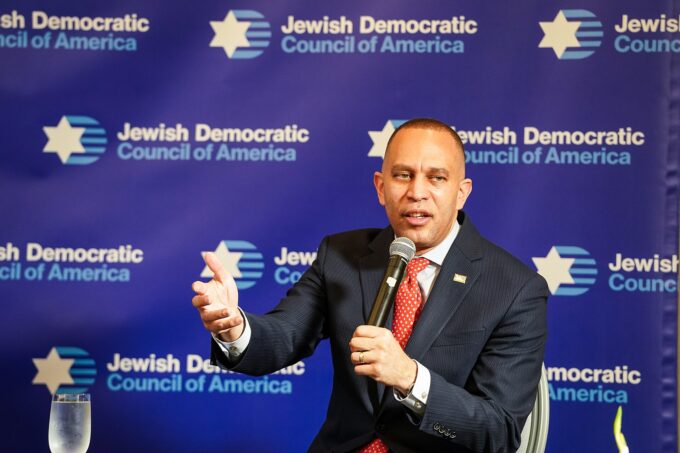
Photograph Source: Jewish Democratic Council of America – CC BY 2.0
The blue wave arrived, crested, and immediately flattened into a ripple.
On November 18, House Democrats nominated Hakeem Jeffries to be the next Speaker by a vote of 251 to 11. No one ran against him. The eleven who voted against him were the only ones brave enough to stand up to the mafia-like threats and pressure that enforce loyalty inside the caucus. The so-called progressive wing, including Alexandria Ocasio-Cortez, folded and caved with no binding commitments extracted.
The coronation was conducted in secret ballot. The outcome was preordained. The performance of democracy reduced itself to a closed-door ritual in which the only question was how many would bother to register a symbolic no.
This is what the so-called blue wave actually delivered: the same leadership, the same priorities, the same refusal to name the crime. The wave did not wash anything clean. It washed the same people back into the same rooms.
Jeffries is not a reluctant partner in the Gaza genocide. He is an active supporter.
At an AIPAC conference in 2020 he declared that in Brooklyn they consider Jerusalem the sixth borough of New York City, and that his repeated trips were simply visits to “catch up with my constituents.” The line has been repeated for years. It is not a slip.
It is the operating assumption of the Democratic leadership: the occupation is domestic politics and the West Bank is an extension of the borough. The people being displaced are not treated as constituents of any American politician.
Palestinian Americans in Dearborn and Detroit and across the country, who live the consequences remain a marginalized voice inside the party. Rashida Tlaib and Abdul El-Sayed have named the genocide and the occupation in plain language. They have not been given the room to set policy.
The sixth-borough claim extends Brooklyn into the West Bank while treating the communities that know the occupation firsthand as an inconvenience to be managed. There will now be some fiery speeches from Abdul to look forward to, but his well-spoken words will not translate into substantive change without a movement on the outside demanding it.
While Gaza is reduced to rubble and the ethnic cleansing of the West Bank accelerates under the same military that the United States funds and arms, Jeffries and the party he leads continue to treat the supply of weapons as non-negotiable. The midterm victories changed nothing about that commitment.
The public has noticed the disconnect. Jeffries’ approval ratings are abysmal.
Civiqs polling as of mid-November showed him at 22 percent favorable and 56 percent unfavorable. An Economist/YouGov survey before the midterms put his job approval at 26 percent against 47 percent disapproval—worse than the Republican Speaker he is poised to replace. Recent polls show the unfavorable lead running from the mid-teens to the low twenties.
Majorities of Democratic voters and large shares of the broader electorate say they want someone else leading the party. This is not what people voted for when they rejected the previous configuration. The base is not with the leadership. The leadership is not with the base.
The so-called progressives have made their bargain explicit. Alexandria Ocasio-Cortez and others have demonstrated that they will use the genocide of Palestinians as a bargaining chip for empty domestic platitudes. Healthcare, student debt, and climate language are offered as reasons to stay inside a party whose foreign policy remains fixed.
The Squad and the DSA-endorsed members who ultimately backed Jeffries have shown that the outer limit of their opposition is a press release and a withheld vote that carries no cost. They will not break the funding. They will not force a vote on the arms. They will not treat the ongoing killing as a reason to leave the room.
Pragmatism has become the doctrine of managed decline: stay inside, extract symbolic concessions, and leave the structure that enables the genocide intact.
The public is not fooled. Large numbers of Americans have already concluded that the role of Israel in U.S. politics has become intolerable. The phrase “United States of Israel” circulates because the material relationship is no longer deniable. The United States supplies the weapons, the diplomatic cover, and the vetoes. The Democratic leadership treats that arrangement as permanent.
Kamala Harris lost the 2024 election in part because of Palestine and the genocide. The author of the Democratic National Committee’s internal 2024 autopsy, Paul Rivera, concluded that the war in Gaza cost Harris votes, particularly in Michigan communities with large Arab American populations such as Dearborn. He found the losses accounted for a meaningful share of the shift toward Trump in the state.
Polls conducted after the election showed that nearly 30 percent of Biden 2020 voters who withheld support from Harris cited ending Israel’s violence in Gaza as a primary reason—outranking the economy, immigration, and healthcare for many of them. The official public autopsy omitted the finding. The private assessment did not.
The party’s loyalty runs deeper than public messaging. Five days before leaving the White House, on January 15, 2025—the day a ceasefire and hostage-release agreement was announced—Joe Biden told Benjamin Netanyahu, in a final phone call whose transcript was obtained by The Jerusalem Post:
“You’ve been through hell. I can’t tell you how much I appreciate you and what you’ve been through. I know we’ve disagreed on occasion but, you know… I still love you, pal. I don’t know how you’ve done it all… Next time I think I have a tough job, I’ll think of you… you’re a good man… I admire you. It took a lot of courage to do what you did.”
The private affection toward this wanted war criminal from Genocide Joe stands in contrast to any public criticism. It reveals the relationship that governs the party’s genocidal policy.
The Democratic Party functions as a party of oligarchy under Israeli and Zionist influence. Major donors such as Miriam Adelson—whose family fortune from Las Vegas Sands has long underwritten hardline support for Israel—illustrate the broader pattern of concentrated wealth shaping foreign policy priorities across the political spectrum. For Democrats the most visible instrument remains AIPAC.
Founded in 1954 as the American Zionist Committee for Public Affairs, it was renamed the American Israel Public Affairs Committee in 1959 to broaden its reach. In October 2026, facing mounting backlash, AIPAC announced it would stop endorsing candidates and making direct PAC contributions. It continues to operate its super PAC, the United Democracy Project, which has already moved tens of millions this cycle. The name on the door changes. The money does not.
There is no organized revolutionary left in the United States capable of challenging the root of the problem. The existing left remains trapped inside the party or adjacent to it, calculating the cost of rupture and concluding that the cost is too high. The result is a politics of permanent deferral.
The two-party system functions as a Western genocidal apparatus precisely because neither party is willing to interrupt the arms pipeline or the diplomatic shield. Democracy, in this configuration, is a failed experiment. It produces the periodic illusion of change while the material support for the killing continues. The coronation of Jeffries is the latest demonstration that the apparatus can absorb a midterm wave without altering its core commitments.
Europe supplies the parallel and the contrast. The European Union maintains partnership agreements and arms relationships with Israel while European governments issue statements of concern. Germany and Italy continue to ship weapons. Germany and Italy have repeatedly blocked efforts at the EU level to suspend the Association Agreement with Israel and end preferential economic partnership, even as Spain, Ireland, and others pushed for consequences.
In the same week as Jeffries’ nomination, Italy’s government gave final approval to legislation that writes the IHRA definition into law, supplying police and university administrations with a ready-made standard for treating political speech about the occupation as antisemitic. The measure sits in tension with Article 10 of the European Convention on Human Rights. Fascism and Zionism do not require a formal merger; they require only that each supplies the other with the tools and the silence it needs.
Yet across Europe the people have begun to refuse. Skyrocketing costs of living, energy prices, and inflation—driven by the war economy of Ukraine, the U.S. and Israeli campaigns against Gaza and the West Bank, and the United States of Israel’s illegal war on Iran—are pushing ordinary people into the streets. These material conditions have not yet produced equivalent mass action in the United States, but in Europe they already have.
On November 8 more than 200,000 people marched through Amsterdam under the slogan “No money for genocide.” Organizers including Amnesty International and Oxfam Novib reported the demand for an end to arms sales and trade benefits for Israel. In France, Spain, and Portugal the streets have filled repeatedly against the war economy and the genocide.
Dockworkers in Genoa, Livorno, Trieste, and Gioia Tauro have repeatedly blocked military and dual-use cargo. On October 30 more than twenty-five unions across 113 ports in 22 countries refused to load weapons. Italian grassroots unions and student networks have organized independently of the confederal unions, treating the war budget and the genocide as a single problem. Their power is measurable in the continuity of the blockades and the refusal to wait for a parliamentary majority that has shown it will not break with the policy of complicity.
A European-wide student strike is set for Friday, November 20. In Italy a general strike has been called, with another national mobilization scheduled for December 12. These actions link the daily experience of unaffordable energy, stagnant wages, and collapsing public services to the budgets that fund weapons for Israel and rearmament for NATO.
In the United States the “No Kings” protests drew large turnouts in cities and towns across the country, yet the movement that continues to organize has largely retreated into progressive bubbles such as New York City. The slogan remained broad and the demand stayed symbolic. In Italy the parallel call has been sharpened into “No Kings and Their Wars,” an explicit rejection of both monarchical pretensions and the wars those pretensions underwrite. The difference is substantive. One names the palace. The other names the palace and the cargo leaving the ports.
The Democratic Party is a pathetic joke because it has accepted the role of managing a genocidal apparatus while selling the public the language of change. The people who have begun to stop the cargo have already moved past that joke.
The question is no longer whether the blue wave was real. The question is how long the apparatus can continue to treat the killing as a domestic political detail while the people who load the ships, occupy the schools, and fill the squares decide that it is not.
The mechanics of the arrangement are not obscure. Every major arms package for Israel moves through the same committees, the same appropriations process, and the same bipartisan consensus that treats the relationship as permanent infrastructure rather than a policy choice.
When progressive members threaten to withhold a vote on a continuing resolution or a debt-ceiling deal, the leadership calculates the domestic cost and then routes the weapons through other vehicles. The result is that the killing continues on schedule while the domestic program is renegotiated at the margins.
This is not accidental. It is the structure that allows a party to campaign on healthcare and climate while the same party’s leadership treats the arms pipeline as non-negotiable. The blue wave did not disrupt that structure. It ratified it under new management.
The absence of an organized revolutionary left is not a temporary lag. It is the condition that makes the structure durable. Decades of institutional capture, donor dependence, and the calculated fear of rupture have produced a left that can name the problem in statements and then return to the same rooms to negotiate the next continuing resolution.
The calculation is always the same: the cost of leaving is higher than the cost of staying. The cost of staying is measured in the continued transfer of weapons, the continued vetoes, and the continued refusal to confront or indict the crime and the criminals.
The people who have already begun to interrupt the cargo at the docks have made a different calculation. They have concluded that the cost of remaining inside the existing political class is the continued material support for the killing. That conclusion has not yet been reached by any significant organized force inside the United States. Until it is, the blue wave will continue to function as a coronation rather than a breaking point that could lead to real transformative change.
Michael Leonardi lives in Italy and can be reached at michaeleleonardi@gmail.com


Leave a Reply