Jon Cink The Electronic Intifada 11 May 2026
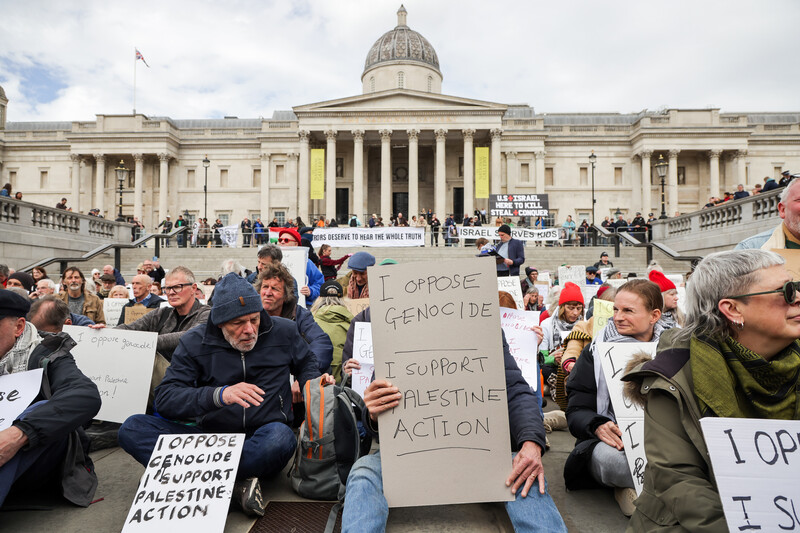
On 13 February, the UK’s High Court of Justice ruled that the proscription of Palestine Action was unlawful.
Palestine Action was added to the list of proscribed organizations in July 2025, a move initiated by the then Home Secretary Yvette Cooper and passed by Britain’s Parliament.
In February, a panel of three senior judges allowed the challenge brought by Huda Ammori, co-founder of Palestine Action, on two grounds.
First, the pathway to reach the decision to proscribe was not in line with the Home Office’s own policy. Second, a crucial ruling held that the ban under the Terrorism Act interfered with the fundamental rights of free expression and free assembly.
Yet the group remains banned, pending the outcome of the British government’s appeal.
The government’s challenge to the February ruling was heard by the Court of Appeal in late April. The verdict in the appeal case is expected within the coming weeks.
Paying no mind to the proscription, people from all walks of life have continued to show their opposition to the UK’s role in the ongoing genocide of Palestinians and in imperial violence throughout the Middle East. It’s clear beyond any doubt that Westminster failed at halting autonomous resistance or popular support for Palestine Action.
Direct action is a political strategy with little regard for established pathways to change when operating within a political environment that fails to prioritize human life over the interests of global finance and a decaying imperial order. Direct action is a weapon of the people.
As I write this, I am currently incarcerated in the UK, accused of being connected to an action at Brize Norton which saw two people enter a Royal Air Force base and spray paint on Voyager aircrafts which were being used to refuel British spy planes. The spy planes had regularly been seen above Gaza during Israel’s genocidal campaign, and have more recently been used to support US-Israeli attacks on Iran and Israeli attacks on Lebanon.
Yvette Cooper responded to the action at Brize Norton by announcing proscription. My co-defendants and I were arrested by counterterrorism police.
We were held completely incommunicado for the first 48 hours. Now, we all await trial in prison.
We have already spent approximately 10 months on remand (in pre-trial detention) and face additional time if not granted bail. Under most circumstances, the limit on detention in police custody is 24 hours and imprisonment without conviction should not exceed six months.
Moreover, being imprisoned under the Terrorism Act subjects us to further surveillance and security measures while in prison. A Muslim co-defendant of mine, held in the Wormwood Scrubs prison, has recently been visited by counterterrorism officers and instructed not to speak Arabic or practice Islam outside of his cell.
We are all subjected to legislation that is on paper the same. In reality, our treatment differs based in part on our proximity to contemporary stereotypes of terrorism.
These stereotypes, created through mainstream media and the entertainment industry, are directly linked to the state’s ability to disregard its subjects’ claims to rights, seemingly celebrated in liberal democracies.
Freedom to practice one’s religion is one of those rights.
Terror of occupation
Contemporary domestic counterterrorism powers deliberately lack many of the safeguards that, however imperfect, exist under most other encounters with the state. I am being subjected to this firsthand.
Globally, the so-called war on terror green-lighted torture and prolonged imprisonment of innocent people without any judicial oversight in places like Guantanamo or US-run black sites.
Terrorism, defined as the use of “terror” to advance a political or ideological cause, leaves out the reality that the colonizer or Western soldiers’ acts of terror are considered perfectly justified, no matter how brutal.
For the colonized, any attempts at survival are quickly designated as acts of terrorism, regardless of the actual means of resistance. From First Nations on the American continent through Algeria to Ireland and Palestine, labeling occupied people as terrorists is an attempt to strip them of their right to govern themselves and govern their land.
Palestinian children understand the meaning of terrorism far better than Shabana Mahmood, the current home secretary, or Yvette Cooper ever could. They live through the terror of occupation day in, day out.
The decision to proscribe cannot be viewed as an isolated instance of state repression. Countering so-called terrorism, with all its material consequences, has been deployed to stifle dissent throughout history.
The meaning of terrorism has always been deliberately vague and often manipulated to fit the given ruling class and its ideological interests. The designation of Palestine Action as a terrorist organization was not an error in an otherwise well-designed system.
It might have been an escalation, but nevertheless it was one that is in line with the historical utilization of a broad range of counterinsurgency tactics against effective political movements.
So while resistance to genocide and occupation never relied on permission from the courts, the ruling of Palestine Action’s proscription as unlawful is extremely significant nonetheless. It is the first successful legal challenge to a group’s proscription since the current counterterrorism powers came into force at the start of the century.
The court ruling from 13 February isn’t only a massive victory for the freedom of speech and right to protest in the UK. It challenges the state’s hegemony on deploying counterterrorism powers as a tool to manufacture a climate of fear, to distract, to justify invasion or genocide and in our case, attempt to make us into a deterrent.
The past 10 months have seen a sharp rise in public critiques of counterterrorism powers, especially in the context of political repression.
That has been made possible in no small way thanks to the campaign organized by Defend Our Juries and thanks to continuing resistance on the streets, on the top of weapons factories, and within prisons.
I reject the label of “terrorist.” I reject it only insofar as this rejection leads to the naming of terror experienced by millions in this country and globally – lack of social care, poverty, homelessness, brutal border policies and imperial wars.
State-sanctioned terrorism is policy-driven and deliberate terror, aimed at protecting the ideology of free market capitalism. I witness the effects of state-sanctioned terrorism daily through the stories and the fears of many women held behind the same walls as me.
I reject the label of “terrorist” as a way to reject the notion that all life isn’t equal.
I believe that we will ultimately see the unlawful proscription of Palestine Action completely lifted. However, we have a duty to keep up the struggle against the strategic deployment of counterterrorism powers at large beyond this moment.
Something that seems unavoidable at a time of increased imperial violence enacted by the US and the Zionist regime, whose leaders, yet again, rely on the excuse of fighting terrorism to justify their attacks on sovereign countries, all the while instilling terror themselves.
Jon Cink is in pre-trial detention after being arrested for allegedly breaking into Brize Norton, Britain’s largest airforce base, and helping to decommission two warplanes suspected of being used in the Gaza genocide.


Leave a comment