Archive for August, 2010

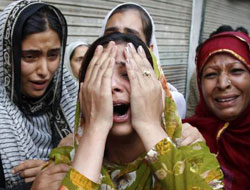
Kabul: US-led raid killed 39 civilians

August 6, 2010
Press TV, Thu, 05 Aug 2010
Font size :
The investigation shows the July US-led raid in Helmand killed 39 civilians.
The Afghan government has released the findings of an investigation into a deadly rocket attack by US-led forces in Helmand province last month.

President Hamid Karzai’s office said late on Wednesday the inquiry shows 39 civilians — all women and children — were killed in the attack.

“Subsequently, one rocket hit the house in which 39 women and children were killed and four wounded,” the presidential office said in a statement.

The bombardment took place in the city of Sangin in the southern province of Helmand on July 23, 2010.

Civilians crammed into a house to flee the exchange of fire between NATO troops and alleged militants when they were attacked.

Continues >>

Whose Hands? Whose Blood? Killing Civilians in Afghanistan and Iraq

August 6, 2010

By Tom Engelhardt, TomDispatch.com, August 5, 2010

Consider the following statement offered by Admiral Mike Mullen, chairman of the Joint Chiefs of Staff, at a news conference last week.  He was discussing Julian Assange, the founder of Wikileaks as well as the person who has taken responsibility for the vast, still ongoing Afghan War document dump at that site. “Mr. Assange,” Mullen commented, “can say whatever he likes about the greater good he thinks he and his source are doing, but the truth is they might already have on their hands the blood of some young soldier or that of an Afghan family.”

Now, if you were the proverbial fair-minded visitor from Mars (who in school civics texts of my childhood always seemed to land on Main Street, U.S.A., to survey the wonders of our American system), you might be a bit taken aback by Mullen’s statement.  After all, one of the revelations in the trove of leaked documents Assange put online had to do with how much blood from innocent Afghan civilians was already on American hands.

The British Guardian was one of three publications given early access to the leaked archive, and it began its main article this way: “A huge cache of secret U.S. military files today provides a devastating portrait of the failing war in Afghanistan, revealing how coalition forces have killed hundreds of civilians in unreported incidents. They range from the shootings of individual innocents to the often massive loss of life from air strikes…”  Or as the paper added in a piece headlined “Secret CIA paramilitaries’ role in civilian deaths”: “Behind the military jargon, the war logs are littered with accounts of civilian tragedies. The 144 entries in the logs recording some of these so-called ‘blue on white’ events, cover a wide spectrum of day-by-day assaults on Afghans, with hundreds of casualties.”  Or as it also reported, when exploring documents related to Task Force 373, an “undisclosed ‘black’ unit” of U.S. special operations forces focused on assassinating Taliban and al-Qaeda “senior officials”: “The logs reveal that TF 373 has also killed civilian men, women, and children and even Afghan police officers who have strayed into its path.”

Continues >>

Pilger: Blair must be prosecuted

August 6, 2010

John Pilger, New Statesman, August 4, 2010

Having helped destroy other nations far away, our former prime minister — “peace envoy” to the Middle East — is now free to profit from the useful contacts he made while working as a “servant of the people”.

Tony Blair must be prosecuted, not indulged like Peter Mandelson. Both have produced self-serving memoirs for which they have been paid fortunes; Blair’s, which have earned him a £4.6m advance, will appear next month.

Now consider the Proceeds of Crime Act. Blair conspired in and executed an unprovoked war of aggression against a defenceless country, of a kind the Nuremberg judges in 1946 described as the “paramount war crime”. This has caused, according to scholarly studies, the deaths of more than a million people, a figure that exceeds the Fordham University estimate of deaths in the Rwandan genocide.

In addition, four million Iraqis have been forced to flee their homes and a majority of children have descended into malnutrition and trauma. Cancer rates near the cities of Fallujah, Najaf and Basra (the latter “liberated” by the British) are now higher than those at Hiroshima. “UK forces used about 1.9 metric tonnes of depleted uranium ammunition in the Iraq war in 2003,” the Defence Secretary, Liam Fox, told parliament on 22 July. A range of toxic “anti-personnel” weapons, such as cluster bombs, was employed by British and US forces.

Such carnage was justified with lies that have been exposed repeatedly. On 29 January 2003, Blair told parliament: “We do know of links between al-Qaeda and Iraq . . .” Last month, the former head of MI5 Eliza Manningham-Buller told the Chilcot inquiry: “There is no credible intelligence to suggest that connection . . . [it was the invasion] that gave Osama Bin Laden his Iraqi jihad.” Asked to what extent the invasion exacerbated the threat to Britain from terrorism, she replied: “Substantially.”

The bombings in London on 7 July 2005 were a direct consequence of Blair’s actions.

Continues >>

Kashmiris condemn Indian war on Kashmiris, thousands march

August 5, 2010
Kashmiris accused New Delhi of adding to the heavy security presence in Kashmir while not reaching out for a political dialogue.

Tens of thousands of Kashmiri Muslims marched Wednesday to a town where seven people were killed over the weekend amid a rigid curfew in another day of massive protests against Indian rule in the Himalayan region.

Long lines of people carrying green and black protest flags thronged a big prayer ground in Khrew, a town south of Kashmir’s main city Srinagar.

At least 45 Kashmiri civilians have been killed over the past seven weeks.

Three of the seven people were gunned down by security forces who opened fire on thousands of protesters on the streets of Khrew on Sunday. The remaining four civilians were killed in a blast at a police station after it was set on fire by residents angry at the earlier shooting. A lot of explosive material used in quarry blasting was stored in the police station and it might have fueled the blast, police said.

On Wednesday, Kashmiris chanted slogans “Go India, go back” and “We’ll take bullets on our heads but we’ll not give up.”

Continues >>

The only package Kashmir needs is justice

August 5, 2010

Siddharth Varadarajan, The Hindu/India, August 5, 2010

T+ ·   T-
SEEKING JUSTICE: Protesters set ablaze police vechile after two young men were killed in firing in Pampore on August 1, 2010. Photo: Nissar Ahmad
If the Prime Minister [Dr Manmohan Singh] does not take bold steps to address the grievances of the Kashmiris, there’s no telling where the next eruption will take us.

Whatever his other failings, Chief Minister Omar Abdullah deserves praise for acknowledging that the protests which have rocked the Kashmir valley these past few weeks are ‘leaderless’ and not the product of manipulation by some hidden individual or group.

This admission has been difficult for the authorities to make because its implications are unpleasant, perhaps even frightening. In security terms, the absence of a central nervous system means the expanding body of protest cannot be controlled by arresting individual leaders. And in political terms, the spectre of leaderless revolt makes the offer of ‘dialogue’ or the naming of a ‘special envoy’ for Kashmir — proposals which might have made sense last year or even last month — seem completely and utterly pointless today.

Continues >>

Blum: USrael and Iran

August 5, 2010

William Blum, Foreign Policy Journal, August 5, 2010

If and when the United States and Israel bomb Iran (marking the sixth country so blessed by Barack Obama) and this sad old world has a new daily horror show to look at on their TV sets, and we then discover that Iran was not actually building nuclear weapons after all, the American mainstream media and the benighted American mind will ask: “Why didn’t they tell us that? Did they want us to bomb them?”

The same questions were asked about Iraq following the discovery that Saddam Hussein didn’t in fact have any weapons of mass destruction. However, in actuality, before the US invasion Iraqi officials had stated clearly on repeated occasions that they had no such weapons. I’m reminded of this by the recent news report about Hans Blix, former chief United Nations weapons inspector, who led a doomed hunt for WMD in Iraq. Last week he told the British inquiry into the March 2003 invasion that those who were “100 percent certain there were weapons of mass destruction” in Iraq turned out to have “less than zero percent knowledge” of where the purported hidden caches might be. He testified that he had warned British Prime Minister Tony Blair in a February 2003 meeting — as well as US Secretary of State Condoleezza Rice in separate talks — that Hussein might have no weapons of mass destruction.[1]

Continues >>

America isn’t leaving Iraq, it’s rebranding the occupation

August 5, 2010

Obama says withdrawal is on schedule, but renaming or outsourcing combat troops won’t give Iraqis back their country

Seumas Milne, The Guardian/UK, August 5, 2010

For most people in Britain and the US, Iraq is already history. Afghanistan has long since taken the lion’s share of media attention, as the death toll of Nato troops rises inexorably. Controversy about Iraq is now almost entirely focused on the original decision to invade: what’s happening there in 2010 barely registers.

That will have been reinforced by Barack Obama’s declaration this week that US combat troops are to be withdrawn from Iraq at the end of the month “as promised and on schedule”. For much of the British and American press, this was the real thing: headlines hailed the “end” of the war and reported “US troops to leave Iraq”.

Nothing could be further from the truth. The US isn’t withdrawing from Iraq at all – it’s rebranding the occupation. Just as George Bush’s war on terror was retitled “overseas contingency operations” when Obama became president, US “combat operations” will be rebadged from next month as “stability operations”.

But as Major General Stephen Lanza, the US military spokesman in Iraq, told the New York Times: “In practical terms, nothing will change”. After this month’s withdrawal, there will still be 50,000 US troops in 94 military bases, “advising” and training the Iraqi army, “providing security” and carrying out “counter-terrorism” missions. In US military speak, that covers pretty well everything they might want to do.

Continues >>

Indian brutality, killings in Kashmir continue

August 4, 2010

by Waseem Shehzad, Media Monitors Network, August  4, 2010


“Since 2002, India has purchased $5 billion worth of Israeli weapons. On the flip side of the coin, the Kashmiris have adopted the Palestinian youth’s tactics of confronting the heavily armed Indian troops with stones. Resistance tactics recognize no borders.”


Protests and the now-routine killing of Kashmiris by Indian occupation forces have resumed in Srinagar and other parts of the violence-plagued state of Kashmir. The latest round of protests erupted after the June 11 killing by Indian police of a 17-year-old youth, Tufail Ahmed Mattoo, who was hit by a tear gas shell on his head blowing his brains out. People were so enraged by this horrible act that they immediately held a protest rally. Other deaths followed. Since then, the cycle of violence has escalated. The June 11 rally was organized to protest the cold-blooded murder of three Kashmiri youth — Mohammed Shafi, Shahzad Ahmad Khan and Riyaz Ahmad — kidnapped by the India army in April. The gruesome murders were carried out on the direct orders of an Indian army colonel; a major was also involved.

Each killing brings out more protesters onto the streets. The situation has now deteriorated to the point where the Indian army has been called out to enforce curfew that the people appear determined to defy.

Continues >>

The global reach of neo-Nazis

August 4, 2010

From Israel to India, Taiwan and Chile … far-right groups are spreading

Jason Rodrigues, The Guardian/UK, August 2, 2010

Israeli neo-Nazi

A young Israeli neo-Nazi points at a religious Jewish man, as if to shoot him at a shopping mall. Israeli police later broke up a neo-Nazi group amd arrested members Photograph: Israeli police/EPA

Israel In 2008, four suspects were charged with neo-Nazi activities. They were members of a gang called Patrol 35 which targeted other minorities and desecrated synagogues. Some of the gang were Soviet immigrants who refused to accept their Jewish ancestry.

Chile Patria Nueva Sociedad (New Fatherland Society) is a well-organised neo-Nazi group in Chile. Its leaders claim to adhere to Nazi economic and labour principles but say the group is against xenophobia, racism and discrimination.

Russia Neo-Nazi gangs such as the White Wolves have resorted to lethal violence to get across their message of white supremacy. Gang members were jailed this year after several central Asian migrants were attacked and killed in Moscow’s back streets.

Taiwan In 2007 university students formed the National Socialism Association. The group claimed to have 800 members and a spokesperson said: “We want to study Hitler’s good points, not study his massacres.”

India A growing trend for Hitler memorabilia in India has caused shock. One publisher claims to have sold more than 100,000 copies of Mein Kampf (left) to Indians in the last 10 years. Some Indians have claimed to be inspired by Hitler’s “discipline and patriotism”.

David Cameron’s words are being used to justify Indian repression in Kashmir

August 4, 2010

Pakistan criticism has shifted focus away from deaths in Kashmir

Murtaza Shibli, The Guardian/UK, August 3, 2010

Protests continue in Srinagar, Kashmir, India - 28 Jul 2010
Indian police walk past  burning tyres used as a barricade by Kashmiri Muslims during an anti-India protest. Photograph: Keystone/Rex Features
Kashmiris may have become the unintended victims of David Cameron’s verbal attack on Pakistan, which has encouraged the hardline Indian establishment to continue to brutalise Kashmiris in the Kashmir Valley, an open-air prison camp much like Gaza.

As a salesman determined to shift as much deadly weaponry as he could, including Hawk fighter bombers, it was not surprising that Cameron chose to ignore the suffering in Kashmir. By blaming Pakistan, Cameron not only fed India’s national paranoia about Pakistan, but also shifted the focus away from Kashmir and the increasing death rate of its civilian population, which otherwise might have received some media attention.

Continues >>