| Al Jazeera, July 3, 2009 |
|||
An unmanned US drone aircraft has reportedly carried out a missile strike on Taliban targets near Pakistan’s border with Afghanistan. Missiles struck targets in parts of South Waziristan, in an area controlled by Pakistani Taliban leader and al-Qaeda ally Baitullah Mehsud, Pakistani intelligence officials have said. The missile strike hit a suspected training facility in the village of Montoi in South Waziristan. A suspected militant hide-out in Kokat Khel was also hit. There are believed to be casualties from the attack which took place early on Friday morning. Pakistani aircraft are also reported to have carried out an attack on two targets in North Waziristan in which up to 11 people are said to have been killed. Imran Khan, Al Jazeera’s correspondent in Islamabad, said the US military has not responded to the attacks. “The US never ever confirms whether they are behind these suspected drone strikes but popularly, it is believed that this is the kind of attack the US has made within this very troubled area of Pakistan before and they area likely to be behind these attacks,” he said.” “Drone strikes are causing much controversy in Pakistan – many people say they have killed a number of innocent civilians and act as more of a recruitment tool for Pakistan Taliban.” |
Posts Tagged ‘United States’
Deaths in suspected US drone strike
July 3, 2009
Troop Movement, Not Troop Withdrawal
July 2, 2009Congressman Dennis Kucinich (D-OH) made the following statement on June 30, 2009 regarding the announcement that U.S. troops have left the cities and towns of Iraq and turned over formal security to Iraqi security forces:
The withdrawal of some U.S. combat troops from Iraq’s cities is welcome and long overdue news. However, it is important to remember that this is not the same as a withdrawal of U.S. troops and contractors from Iraq.
U.S. troop combat missions throughout Iraq are not scheduled to end until more than a year from now in August of 2010. In addition, U.S. troops are not scheduled for a complete withdrawal for another two and a half years on December 31, 2011. Rather, U.S. troops are leaving Iraqi cities for military bases in Iraq. They are still in Iraq, and they can be summoned back at any time.
This is not a great victory for peace. On May 19, the Christian Science Monitor reported that Iraqi and U.S. military officials virtually redrew the city limits of Baghdad in order to consider the Army’s Forward Operating Base Falcon as outside the city, despite every map of Baghdad clearly showing it with in city limits. In fact, according to Section 24.3 of the “SOFA” U.S. troops can remain at any agreed upon facility. The reported reason for this decision is to ensure U.S. troops are able to ‘help maintain security in south Baghdad along what were the fault lines in the sectarian war.’
This troop movement should not be confused with a troop withdrawal from Iraq. In reality, this is a small step toward Iraqi sovereignty as Iraqi security forces begin assuming greater control over security operations, but it is a long way from independence and a withdrawal of the U.S. military presence.
Bagram Detainees Treated ‘Worse Than Animals’
June 27, 2009An investigation by the British Broadcasting Corporation (BBC) has revealed that former detainees at the U.S. Bagram airbase in Afghanistan were beaten, deprived of sleep and threatened with dogs.
The BBC’s conclusions are based on interviews with 27 former detainees who were held at Bagram between 2002 and 2006. None of these men were ever charged with a crime. Hundreds of detainees are still being held in U.S. custody at the Afghan prison without charge or trial.
Jonathan Hafetz, an attorney with the American Civil Liberties Union’s National Security Project, told IPS, “The BBC investigation provides further confirmation of the United States’ mistreatment of prisoners at Bagram.”
“These abuses are the direct consequence of decisions made at the highest levels of the U.S. government to avoid the Geneva Convention and forsake the rule of law. For too long, the unlawful detention and mistreatment of prisoners at Bagram has gone on outside the public eye,” he said. “Hopefully, this investigation will help change that.”
“When prisoners are in American custody and under American control, no matter the location, our values and commitment to the rule of law are at stake,” Hafetz said.
In April, the ACLU filed a Freedom of Information Act (FOIA) request for records pertaining to the detention and treatment of prisoners held at Bagram, including the number of people currently detained, their names, citizenship, place of capture and length of detention.
The ACLU is also seeking records pertaining to the process afforded those prisoners to challenge their detention and designation as “enemy combatants.”
“The U.S. government’s detention of hundreds of prisoners at Bagram has been shrouded in complete secrecy,” said Melissa Goodman, an ACLU staff attorney. “The American people have a right to know what’s happening at Bagram and whether prisoners have been tortured there.”
Amnesty International said it was “shocked” by the Bagram claims. It noted that a new detention center is currently under construction at the camp.
Another prominent human rights organization, the British-based Reprieve, called on the British government to take action concerning two Pakistanis who it says the U.K. helped render there from Iraq.
“The legal black hole in Bagram underlines the British government’s moral black hole when it comes to rendering two Pakistani prisoners there in 2004,” said Clive Stafford Smith, director of Reprieve. “These men were in British custody in Iraq, were turned over to the U.S., and have now been held for five years without any respect for their legal rights.”
In February 2009, British Defense Secretary John Hutton announced to the House of Commons that Britain had handed two anonymous Pakistani men over to the U.S., and they had subsequently been rendered to Afghanistan, where they were still being held.
“We have been assured that are held in a humane, safe and secure environment, meeting international standards consistent with cultural and religious norms,” Hutton said at the time.
“As we have said all along, beating people and holding them incommunicado is not humane, safe and secure,” Stafford Smith told IPS. “Britain has a moral duty to identify these men, so that we can reunite them with their legal rights, yet Mr. Hutton refuses to do this.”
No prisoner in Bagram has been allowed to see a lawyer, or challenge his detention. According to the BBC, the U.S. justice department argues that because Afghanistan is an active combat zone it is not possible to conduct rigorous inquiries into individual cases and that it would divert precious military resources at a crucial time.
“These men were never in Afghanistan until the UK and the U.S. took them there,” said Stafford Smith. “It is the height of hypocrisy to take someone to Bagram and then claim that it is too dangerous to let them see a lawyer. Even Guantánamo Bay is better than this.”
The Pentagon has denied the BBC’s charges of harsh treatment and insisted that all inmates in the facility are treated humanely.
The Bagram Airbase built by the Soviet military in the 1980s. The approximately 600 people held there are classified as “unlawful enemy combatants.” None was charged with any offence or put on trial — some even received apologies when they were released.
Many allegations of ill-treatment appear repeatedly in the BBC interviews: physical abuse, the use of stress positions, excessive heat or cold, unbearably loud noise, being forced to remove clothes in front of female soldiers.
In four cases detainees were threatened with death at gunpoint.
“They did things that you would not do against animals let alone to humans,” said one inmate.
“They poured cold water on you in winter and hot water in summer. They used dogs against us. They put a pistol or a gun to your head and threatened you with death,” he said.
“They put some kind of medicine in the juice or water to make you sleepless and then they would interrogate you.”
The BBC said its findings were shown to the Pentagon. Lt. Col. Mark Wright, a spokesman for the U.S. secretary of defense, insisted that conditions at Bagram “meet international standards for care and custody.” He said the U.S. Defense Department has a policy of treating detainees humanely.
But he acknowledged that, “There have been well-documented instances where that policy was not followed, and service members have been held accountable for their actions in those cases.”
Since coming to office, U.S. President Barack Obama has banned the use of torture and ordered a review of policy on detainees, which is expected to report next month. But unlike its detainees at the U.S. naval facility at Guantánamo Bay in Cuba, the prisoners at Bagram have no access to lawyers and they cannot challenge their detention.
(Inter Press Service)
U.N. Asked to Probe CIA Rendition
June 27, 2009By William Fisher | Inter Press Service
NEW YORK, Jun 26 (IPS) – Human rights groups are asking United Nations officials to investigate the case of an Italian citizen and victim of the “extraordinary rendition” programme of the U.S. Central Intelligence Agency who is currently being held in a Moroccan prison based on a confession coerced from him through torture.
The American Civil Liberties Union and the Geneva-based Alkarama for Human Rights have requested that two U.N. Special Rapporteurs investigate the circumstances of Abou Elkassim Britel’s forced disappearance, rendition, detention and torture, and raise his case with the governments of the United States, Morocco, Pakistan and Italy.
The requests were made to the U.N. Special Rapporteurs on Torture and the on the Promotion and Protection of Human Rights while Countering Terrorism.
Ex-detainees allege Bagram abuse
June 24, 2009BBC News, June 24, 2009
Former detainee: ‘They put medicine in our drink to prevent us sleeping’
|
By Ian Pannell
BBC News, Kabul |

Allegations of abuse and neglect at a US detention facility in Afghanistan have been uncovered by the BBC.
Former detainees have alleged they were beaten, deprived of sleep and threatened with dogs at the Bagram military base.
The BBC interviewed 27 former inmates of Bagram around the country over a period of two months.
The Pentagon has denied the charges and insisted that all inmates in the facility are treated humanely.
All the men were asked the same questions and they were all interviewed in isolation.
Ill-treatment
They were held at times between 2002 and 2008 and they were all accused of belonging to or helping al-Qaeda or the Taliban.
None were charged with any offence or put on trial; some even received apologies when they were released.
Just two of the detainees said they had been treated well.
 |
 They put a pistol or a gun to your head and threatened you with death. They put a pistol or a gun to your head and threatened you with death.  Former Bagram detainee
|
Many allegations of ill-treatment appear repeatedly in the interviews: physical abuse, the use of stress positions, excessive heat or cold, unbearably loud noise, being forced to remove clothes in front of female soldiers.
In four cases detainees were threatened with death at gunpoint.
“They did things that you would not do against animals let alone to humans,” said one inmate known as Dr Khandan.
“They poured cold water on you in winter and hot water in summer. They used dogs against us. They put a pistol or a gun to your head and threatened you with death,” he said.
“They put some kind of medicine in the juice or water to make you sleepless and then they would interrogate you.”
|
BAGRAM AIR BASE
Base built by the Soviet military in the 1980s
Around 600 people are held
Prisoners are classified as “unlawful enemy combatants’
 |
The findings were shown to the Pentagon.
Lt Col Mark Wright, a spokesman for the US Secretary of Defence, insisted that conditions at Bagram “meet international standards for care and custody”.
Col Wright said the US defence department has a policy of treating detainees humanely.
“There have been well-documented instances where that policy was not followed, and service members have been held accountable for their actions in those cases,” he said.
‘Legal black hole’
Bagram has held thousands of people over the last eight years and a new detention centre is currently under construction at the camp.
Some of the inmates are forcibly taken there from abroad, especially Pakistanis and at least two Britons.

Bagram detainees do not have the status of those at Guantanamo Bay
|
Since coming to office US President Barack Obama has banned the use of torture and ordered a review of policy on detainees, which is expected to report next month.
But unlike its detainees at the US naval facility at Guantanamo Bay in Cuba, the prisoners at Bagram have no access to lawyers and they cannot challenge their detention.
The inmates at Bagram are being kept in “a legal black-hole, without access to lawyers or courts”, according to Tina Foster, executive director of the International Justice Network, a legal support group representing four detainees.
She is pursuing legal action that, if successful. would grant detainees at Bagram the same rights as those still being held at Guantanamo Bay.
But the Obama administration is trying to block the move.
Last year, the US Supreme Court ruled that detainees at Guantanamo should be given legal rights.
Speaking on the presidential campaign trail, Barack Obama applauded the ruling: “The court’s decision is a rejection of the Bush administration’s attempt to create a legal black hole at Guantanamo.
“This is an important step toward re-establishing our credibility as a nation committed to the rule of law, and rejecting a false choice between fighting terrorism and respecting habeas corpus.”
Ms Foster accuses the new administration of abandoning that position and “using the same arguments as the Bush White House”.
In its legal submissions, the US justice department argues that because Afghanistan is an active combat zone it is not possible to conduct rigorous inquiries into individual cases and that it would divert precious military resources at a crucial time.
They also argue that granting legal rights to detainees could harm Mr Obama’s “ability to succeed in armed conflict and to protect United States’ forces” by limiting his powers to conduct military operations.
A US federal appeals court judge is expected to rule soon.
These revelations come at a time when Mr Obama is trying to re-set Washington’s relationship with the Muslim world and trying harder than ever to win the war in Afghanistan.
It is a controversy that threatens to damage the image of the new administration in both Afghanistan and Pakistan.
‘Dozens dead’ in US drone strike
June 23, 2009
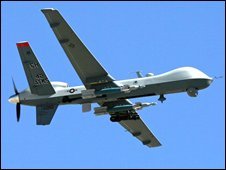
Pakistan officially objects to the strikes by pilotless US aircraft
|
At least 45 people have died in a missile strike by a US drone aircraft in Pakistan, officials there have said.
The people killed in South Waziristan region had been attending a funeral for others killed in a US drone strike earlier on Tuesday.
Intelligence officials said at least 45 people had been killed and dozens more injured in the later strike, when two missiles were fired.
But a local official told BBC News the death toll was more than 50.
The region is a stronghold of Pakistani Taliban leader Baitullah Mehsud.
Also on Tuesday, tribal leader Qari Zainuddin, who often criticised Mehsud, was shot dead by a gunman in north-western Pakistan.
Earlier this month, Zainuddin criticised Mehsud after an attack on a mosque, which killed 33 people.
The Pakistani army is preparing to launch an offensive against Taliban fighters under Mehsud’s command, who are blamed for a number of deadly attacks.
But Zainuddin’s killing is being seen as a setback for the government in its efforts to isolate Mehsud ahead of the security forces’ next phase of their anti-Taliban offensive in the tribal areas bordering Afghanistan, says the BBC’s Mike Wooldridge in Islamabad.


$2.775 billion in US aid supports Israeli nuclear weapons program
July 1, 2009Online Journal Guest Writer | Online Journal, June 29, 2009,
President Barak Obama’s fiscal year 2010 budget request for $2.775 billion in military aid to Israel is proceeding smoothly through the Congress.
On June 17, the House Appropriations Subcommittee on State, Foreign Operations, and Related Programs held a “mark-up” session on the budget. The subcommittee came under pressure from an antiwar group that sought to suspend or condition foreign aid over Israel’s use of US weapons which left 3000 Palestinians dead during the Bush administration. The subcommittee held its session in a tiny Capitol room denying activists and members of the press access. The budget quickly passed and is now before the full House Appropriations Committee.
Israel enjoys “unusually wide latitude in spending the [military assistance] funds,” according to the Wall Street Journal.
Unlike other recipients that must go through the Pentagon, Israel deals directly with US military contractors for almost all of its purchases. This gives the US based Israel lobby, particularly the American Israel Public Affairs Committee (AIPAC), an influence multiplier on Capitol Hill. Large contractors proactively segment military contracts across key congressional districts to make them harder to oppose. As contactors and local business interests fight for Israel’s favor, AIPAC can turn away from shepherding the massive aid package to dedicate considerable resources toward Iran sanctions.
Representative Mark Steven Kirk (R-Illinois) sponsored an amendment to the foreign operations bill that would prevent the Export-Import Bank of the United States from providing loan guarantees to companies selling refined petroleum to Iran. According to the Washington Report on Middle East Affairs, Kirk is the top 2008 recipient of Israel political action committee (PAC) contributions (PDF). Kirk received $91,200 in the 2008 election cycle and more than $221,000 over his career.
Kirk’s AIPAC sponsored sanctions legislation passed the House Appropriations Committee on June 23. While tactically positioned as a rebuke to the crackdown on Iranian election protesters, the measure is only the most recent of strategic long-term AIPAC sponsored sanctions against Iran’s nuclear program.
Israel contends Iran is secretly developing nuclear weapons under the auspices of a civilian program, though no hard evidence has emerged. However, an illicit nuclear arsenal in the region has been positively identified.
The US Army (PDF), former President Jimmy Carter, and Assistant Secretary of State Rose Gottemoeller have all recently confirmed that the only country in the Middle East that has deployed nuclear weapons is Israel. The Symington and Glenn amendments to foreign aid law specifically prohibit US aid to nuclear states outside the Nuclear Nonproliferation Treaty (NPT). Iran has signed. Israel hasn’t.
Congress can’t have it both ways on taxpayer funded sanctions and rewards. If gasoline imports indirectly support Iran’s nuclear ambitions, then $2.775 billion in cash for conventional US weapons and military technology clearly allows Israel to spend other resources on the development and deployment of its illicit nuclear arsenal.
Recently released CIA files long ago forecast that such an arsenal would not only make Israel more “assertive” but also reluctant to engage in bona fide peace initiatives. Cutting the massive and indirect US subsidization of nukes and forcing Israel to sign the NPT would go further in averting a nuclear arms race and conflicts in the region than targeting Iranian consumers at the gas pump. It would also demonstrate to the American public that the president and Congress, even under the pressure of AIPAC, won’t blatantly violate US foreign aid laws by publicly pretending Iran — rather than Israel — is the region’s nuclear hegemon.
Copyright © 2009 IRmep
Grant F. Smith is director of the Washington, DC-based Institute for Research: Middle Eastern Policy and author of the book “Foreign Agents: The American Israel Foreign Affairs Committee from the 1963 Fulbright Hearings to the 2005 Espionage Scandal.”
Copyright © 1998-2007 Online Journal
Share this:
Tags:Israel, military aid, nuclear weapons in Israel, President Barak Obama, United States, weapons
Posted in Commentary, President Barack Obama, Uncategorized, US policy, USA, Zionist Israel | Leave a Comment »