Posts Tagged ‘Taliban’

Quagmire, Phase 2: The Invasion of Pakistan

September 15, 2008
Truthdig.com, Posted on Sep 11, 2008

By William Pfaff

The United States has just invaded Cambodia. The name of Cambodia this time is Pakistan, but otherwise it’s the same story as in Indochina in 1970.

An American army, deeply frustrated by its inability to defeat an anti-American insurgent movement despite years of struggle, decides that the key to victory lies in a neighboring country. In 1970, the problem was the Ho Chi Minh Trail in Cambodia. Today it is Taliban and al-Qaida bases inside Pakistan, which the United States has been attacking from the air for some time, with controversial “collateral damage.”

George W. Bush has now authorized independent ground assaults on Taliban and al-Qaida targets in Pakistan’s Tribal Territories, without consultation with Pakistan authorities. These already have begun.

This follows a period of tension, with some armed clashes, between American and Pakistani military units, the latter defending “Pakistan’s national sovereignty.” Pakistan public opinion seems largely against “America’s war” being fought inside Pakistan.

Washington’s decision was made known just in time for the seventh anniversary of the 9/11 attacks that opened the first phase of the “war on terror,” after which “nothing could ever be the same.” We no doubt have now begun phase two.

The eventual outcome of the American intervention in Cambodia in 1970 was Communist overthrow of the American-sponsored military government in that country, followed by genocide. The future consequences in (nuclear-armed) Pakistan await.

There is every reason to think they may include civil protest and disorder in the country, political crisis, a major rise in the strength of Pakistan’s own Islamic fundamentalist movement and, conceivably, a small war between the United States and the Pakistan army, which is the central institution in the country, has a mind of its own and is not a negligible military force.

In Afghanistan, American and NATO forces have been complaining for many months that victory over the Taliban was impossible so long as there were secure Taliban bases in Pakistan’s largely inaccessible Tribal Territories.

Pakistan’s former president, Pervez Musharraf, was told by his American allies to clean the Taliban out of the Territories or the U.S. Army and NATO would do it for him. U.S. presidential candidate Barack Obama made the same threat. John McCain concurred. Musharraf had been looking for a negotiated arrangement with the tribesmen.

Pakistan’s military intelligence services created the Taliban while they were collaborating with the CIA to form the mujahadeen that drove the Soviet Union out of Afghanistan. Many in the service still support the Taliban as a useful instrument against India, and to keep Afghanistan out of the hands of more dangerous enemies.

Musharraf was forced out of office. The U.S. brought in exiled former Prime Minister Benazir Bhutto, expected to be cooperative. She was assassinated, presumably by Islamic extremists. Her widower has been elected to take her place and declares himself an enemy of terrorism. However, the United States has already taken the matter into its own hands.

In the Vietnamese case, the American military command held that it could win the war by invading Cambodia to cut the so-called Ho Chi Minh Trail, along which supplies and arms for the Viet Cong Communist insurrection were being transported. The argument made was that cutting this route would starve the Viet Cong of supplies.

Initially, the unhappy Prince Sihanouk of Cambodia, desperately trying to keep his country out of the Vietnam War, was persuaded to turn a blind eye to U.S. bombing of the trail. A military coup followed in 1970, installing an American puppet general. B-52 saturation bombing ensued, without the desired military effect, but killing many Cambodians.

The joint U.S. and South Vietnamese “incursion” to cut the trail came in April 1970; it simply pushed the supply operations deeper into Cambodia. Richard Nixon said he acted to prove that the United States was not “a second-rate power.” “If, when the chips are down, the world’s most powerful nation acts like a pitiful helpless giant, the forces of totalitarianism and anarchy will threaten free nations and free institutions throughout the world.”

The native Cambodian Khmer Rouge subsequently defeated the American-backed military regime in Phnom Penh. Genocide followed, the “killing fields,” on which the United States turned its back, condemning the triumphant Vietnamese Communist government when it later invaded Cambodia to stop the killing.

Visit William Pfaff’s Web site at www.williampfaff.com.

Bush Said to Give Orders Allowing Raids in Pakistan

September 11, 2008

By ERIC SCHMITT and MARK MAZZETTI | The New York Times, Sep 10, 2008

WASHINGTON — President Bush secretly approved orders in July that for the first time allow American Special Operations forces to carry out ground assaults inside Pakistan without the prior approval of the Pakistani government, according to senior American officials.

The classified orders signal a watershed for the Bush administration after nearly seven years of trying to work with Pakistan to combat the Taliban and Al Qaeda, and after months of high-level stalemate about how to challenge the militants’ increasingly secure base in Pakistan’s tribal areas.

American officials say that they will notify Pakistan when they conduct limited ground attacks like the Special Operations raid last Wednesday in a Pakistani village near the Afghanistan border, but that they will not ask for its permission.

“The situation in the tribal areas is not tolerable,” said a senior American official who, like others interviewed for this article, spoke on condition of anonymity because of the delicate nature of the missions. “We have to be more assertive. Orders have been issued.”

The new orders reflect concern about safe havens for Al Qaeda and the Taliban inside Pakistan, as well as an American view that Pakistan lacks the will and ability to combat militants. They also illustrate lingering distrust of the Pakistani military and intelligence agencies and a belief that some American operations had been compromised once Pakistanis were advised of the details.

The Central Intelligence Agency has for several years fired missiles at militants inside Pakistan from remotely piloted Predator aircraft. But the new orders for the military’s Special Operations forces relax firm restrictions on conducting raids on the soil of an important ally without its permission.

Pakistan’s top army officer said Wednesday that his forces would not tolerate American incursions like the one that took place last week and that the army would defend the country’s sovereignty “at all costs.”

It is unclear precisely what legal authorities the United States has invoked to conduct even limited ground raids in a friendly country. A second senior American official said that the Pakistani government had privately assented to the general concept of limited ground assaults by Special Operations forces against significant militant targets, but that it did not approve each mission.

Continued . . .

AFGHANISTAN: US-NATO Airstrikes Bring Higher Civilian Toll

September 9, 2008

Ali Gharib | Inter-Press Service, Sep 8, 2008


WASHINGTON, – Ramped-up U.S. and NATO airstrikes in Afghanistan are causing an increased civilian death toll, raising concerns about the fallout from civilian deaths on the war effort against the Taliban insurgency, according to a major new report by Human Rights Watch (HRW) released here Monday.

The 43-page report, “Troops in Contact: Airstrikes and Civilian Deaths in Afghanistan”, warned that the cost in civilian casualties caused by the increase in bombings goes well beyond the loss of human life and could put the nearly seven-year U.S.-NATO war effort at risk.

“The harm caused by airstrikes is not limited to the immediate civilian casualties,” said the report, which also cited the destruction of homes and property and the displacement of their civilian occupants caused by the bombing.

“Civilian deaths from airstrikes act as a recruiting tool for the Taliban and risk fatally undermining the international effort to provide basic security to the people of Afghanistan,” said Brad Adams, HRW’s Asia director of HRW.

Citing HRW statistics, an editorial in Saturday’s New York Times went further, asserting that civilian deaths caused by the stepped up bombing played into the hands of the Taliban and other insurgents: “America is fast losing the battle for hearts and minds, and unless the Pentagon comes up with a better strategy, the United States and its allies may well lose the war.”

Fuelling a growing controversy here, both the Times and the report said that the increase in air attacks — and the “collateral damage” they caused — was due in part to the relative lack of NATO and U.S. troops on the ground whose fire tends to be considerably more discriminating in their impact than aerial attacks.

Both the Pentagon and leading Democrats have been arguing for months for deploying at least 10,000 more U.S. troops to Afghanistan but have been unable to overcome resistance by military commanders in Iraq who, backed by President George W. Bush, are reluctant to draw down troop levels there below the current 144,000. U.S. ground forces are so stretched globally that deploying additional forces to Afghanistan must await further withdrawals from Iraq.

The increased level of bombing has come as a result of a stepped-up insurgency led by anti-government Taliban fighters and associated groups. Fighting in Afghanistan has intensified dramatically over the past year. At least 540 civilians have been killed in the conflict so far this year, a sharp increase over last year’s total. Casualties among the more than 60,000 U.S. and NATO troops in Afghanistan have also risen sharply this year.

U.S. and NATO forces, according to the report, dropped 362 tonnes of munitions in Afghanistan during the first seven months of this year, including a flurry of bombings in June and July that, by itself, nearly equaled the total amount of bombs, by weight, dropped by the coalition forces on suspected enemy positions in all of 2006.

“[…] While attacks by the Taliban and other insurgent groups continue to account for the majority of civilian casualties,” said the report, “civilian deaths from U.S. and NATO airstrikes nearly tripled from 2006 to 2007 (from 116 to 321).”

That increase prompted Afghan President Hamid Karzai to demand changes in targeting tactics, including using smaller munitions, delaying attacks where civilians might be harmed, and turning over house-to-house searches to the Afghan National Army.

Those changes were adopted by the NATO-led International Security Assistance Force (ISAF) with the result that, despite increased bombing during the first seven months of this year, fewer civilians (119) were killed compared to the same period in 2007.

But that figure does not include a controversial air strike Aug 22 on the village of Azizabad in western Afghanistan which, according to the Afghan government and a U.N. investigating team, killed 90 people, the vast majority of whom were women and children. The U.S. military, which carried out the attack, has insisted that 42 people were killed, 35 of them insurgents.

In some incidents, according to the report, U.S.-NATO air strikes may have violated the laws of war, particularly adherence to the principles of proportionality and the requirement that parties take all feasible precautions to prevent non-combatant casualties.

The report suggested that blame for civilian deaths can be focused fairly narrowly. While most foreign troops in Afghanistan operate under the banner of the NATO-led International Security Assistance Force (ISAF), a disproportionate number of civilian casualties resulted from air strikes called in by the nearly 20,000 U.S. troops who operate exclusively under U.S. command as part of Operation Enduring Freedom. Their rules of engagement, including when they can call for air support, are less strict than NATO’s.

The most problematic engagements have come when insurgents take U.S. Special Operations Forces (SOF) by surprise, and the SOF call in air support. The military term, “troops in contact” (TIC), gave the HRW report its name.

In TIC situations, U.S. forces have often engaged insurgents who then retreat to nearby villages, taking up positions in homes and preventing their civilian residents from leaving.

Faced with a standoff, U.S. troops have called in rapid-response air support to bomb the homes from which they were taking hostile fire. That appears to have been what took place in Azizabad.

While condemning of Taliban “shielding” — using civilian human shields or putting civilians at unnecessary risk so that when hurt, the story can be used as propaganda — the report noted that this does not excuse U.S. forces from the laws of war and considerations of civilian populations.

The report outlined several incidents where questionable rapid-response bombings caused civilian deaths. In one of them, two anti-government fighters were seen entering a compound that was then hit with an airstrike that caused nine casualties.

The U.S. claimed to have killed the two insurgents, but a local Afghan authority denied the claim, and journalists at the scene found no evidence supporting it. Moreover, U.S. troops and local villagers said that U.S. forces had visited the home the day before and should have known that civilians were present.

“The available information about the attack — in particular evidence suggesting that U.S. forces knew the house was inhabited by civilians and that only two lightly armed fighters may have been present — raises serious concerns that the airstrikes violated the international humanitarian law prohibition against disproportionate attacks,” said the report.

US air power triples deaths of Afghan civilians, says report

September 8, 2008
Afghan boy injured in US air strike

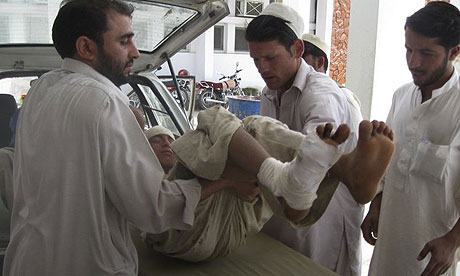
An injured Afghan boy is put on a stretcher at a hospital in Jalalabad city, Afghanistan. Photograph: Nesar Ahmad

Civilian deaths in Afghanistan from US and Nato air strikes have nearly tripled over the past year, with the onslaught continuing in 2008 and fuelling a public backlash, a leading human rights group says today.

The report by Human Rights Watch Human Rights Watch says that despite changes in the rules of engagement which had reduced the rate of civilian casualties since a spike in July last year, air strikes killed at least 321 civilians in 2007, compared with at least 116 in 2006. In the first seven months of this year at least 540 Afghan civilians were killed in fighting related to the armed conflict, with at least 119 killed by US or Nato air strikes, such as this July’s attack on a wedding party which killed 47, says Human Rights Watch.

“There has been a massive and unprecedented surge in the use of air power in Afghanistan in 2008,” the report says. It found that few civilians casualties were the result of planned air strikes on suspected Taliban targets. Instead, most were from air strikes during rapid response missions mostly carried out in support of “troops in contact” – ground troops under insurgent attack. Such strikes included situations where American special forces – normally small in number and lightly armed – came under insurgent attack.

“In response to increased insurgent activity, twice as many tons of bombs were dropped in 2007 than in 2006,” the report says. “In 2008, the pace has increased: in the months of June and July alone the US dropped approximately as much as it did in all of 2006. Without improvements in planning, intelligence, targeting, and identifying civilian populations, the massive use of air power in Afghanistan will continue to lead to unacceptably high civilian casualties.”

“Mistakes by the US and Nato have dramatically decreased public support for the Afghan government and the presence of international forces providing security to Afghans,” said Brad Adams, Asia director at Human Rights Watch. The report criticises the response given by US officials when civilian deaths occur. Before conducting investigations, US officials often immediately deny responsibility for civilian deaths or place all blame on the Taliban, the report says.

US investigations have been “unilateral, ponderous, and lacking in transparency, undercutting rather than improving relations with local populations and the Afghan government”.

Last night the US military announced it would reopen its investigation of an air strike last month in which the Afghan government says 90 civilians, mainly women and children, were killed. An initial US inquiry found that up to 35 suspected insurgents and seven civilians died in the attack on Azizabad in Herat province, but General David McKiernan, the senior US officer in Afghanistan, announced a review in the light of “new information”. Afghan and western officials say that videos of the bombing’s aftermath shows dozens of dead civilians.

US attack inside Pakistan threatens dangerous new war

September 6, 2008

Global Research, September 5, 2008

A ground assault by US Special Forces troops on a Pakistani village on Wednesday threatens to expand the escalating Afghanistan war into its neighbour. Pakistan is already confronting a virtual civil war in its tribal border regions as the country’s military, under pressure from Washington, seeks to crush Islamist militias supporting the anti-occupation insurgency inside Afghanistan.

The attack, which left up to 20 civilians dead, marks a definite escalation of US operations inside Pakistan. While US Predator drones and war planes have been used previously to bomb targets, Wednesday’s raid was the first clear case of an assault by American ground troops inside Pakistani territory. The White House and Pentagon have refused to comment on the incident but various unnamed US officials have acknowledged to the media that the raid took place and indicated that there could be more to come.

The attack was unprovoked. US troops landed by helicopter in the village of Jalal Khei in South Waziristan at around 3 a.m. and immediately targetted three houses. The engagement lasted for about 30 minutes and left between 15 and 20 people dead, including women and children.

A US official acknowledged to CNN that there may have been women and children in the immediate vicinity but when the mission began “everyone came out firing from the compound”. Even this flimsy justification for a naked act of aggression is probably a lie. “It was very terrible as all of the residents were killed while asleep,” a villager Din Mohammad told the Pakistan-based International News.

The newspaper provided details of the dead and injured: nine family members of Faujan Wazir, including four women, two children and three men; Faiz Mohammad Wazir, his wife and two other family members; and Nazar Jan and his mother. Two other members of Nazar Jan’s family were seriously wounded.

The US and international media have described the Angoor Adda area around the village as “a known stronghold of the Taliban and Al Qaeda” but offered no evidence to support the claim. A villager, Jabbar Wazir, told the International News: “All of those killed were poor farmers and had nothing to do with the Taliban.”

In comments to the International Herald Tribune, a senior Pakistani official branded the raid a “cowboy action” that had failed to capture or kill any senior Al Qaeda or Taliban leader. “If they had gotten anyone big, they would be bragging about it,” he commented.

The attack has provoked outrage in Pakistan. Pakistan’s Foreign Ministry issued a statement branding the attack as “a gross violation of Pakistan territory” and summoned US ambassador Anne Patterson to provide an explanation. North West Frontier Province (NWFP) governor Owais Ahmed Ghani declared that “the people expect that the armed forces of Pakistan would rise to defend the sovereignty of the country”. He put the number killed at 20.

Pakistani military spokesman Major General Athar Abbas said the raid was “completely counterproductive” and risked provoking an uprising even among those tribesmen who have previously supported the army’s operations in the border areas.

The International News reported: “Angry villagers later blocked the main road between Pakistan and Afghanistan in Angoor Adda by placing the bodies of their slain tribesmen on the road. They chanted slogans against the US and NATO military authorities for crossing the border without any provocation and killing innocent people.”

The US raid has compounded the political crisis inside Pakistan, where the selection of a new president is due to take place tomorrow. The ruling Pakistan Peoples Party (PPP) has been engaged in a delicate balancing act—continuing to support US demands for a crackdown by the Pakistani military along the border with Afghanistan, while trying to defuse widespread anger and fend off accusations that it is a US puppet.

Reaffirming his support for the Bush administration’s bogus “war on terror”, PPP presidential candidate Asif Ali Zardari declared in a column in yesterday’s Washington Post: “We stand with the United States, Britain, Spain and others who have been attacked.” Zardari went on to promise that he would ensure that Pakistani territory would not be used to launch raids on US and NATO forces inside Afghanistan.

However, as PPP spokesman Farhatullah Babar explained, the US attack was politically compromising. “We have been very clear that any action on this side of the border must be taken by Pakistani forces themselves,” he told the Associated Press. “It is very embarrassing for the government. The people will start blaming the government of Pakistan.”

An expanded war

The decision to launch Wednesday’s attack was undoubtedly taken at the top levels of the White House and Pentagon. As the New York Times reported in articles earlier this year, a high-level debate has been taking place in Washington over the use of US Special Forces inside Pakistan as well as the intensification of existing CIA operations, which include Predator missile strikes.

A meeting in early January involved Vice President Dick Cheney, Secretary of State Condoleezza Rice, Joint Chiefs of Staff chairman Admiral Mike Mullen and top national security and intelligence officials advisers. According to the New York Times on January 6, options discussed included “loosening restrictions on the CIA to strike selected targets in Pakistan” and operations involving US Special Operations forces, such as the Navy Seals.

The Times reported on January 27 that then Pakistani President Pervez Musharraf rejected proposals put by US Director of National Intelligence Mike McConnell and CIA Director Michael Hayden for an expanded American combat presence in Pakistan, either through covert CIA missions or joint operations with Pakistani security forces. While apparently accepting the refusal, the US intensified pressure on Pakistan to bring its border areas under control.

As the anti-occupation insurgency has expanded in Afghanistan, claiming a growing number of US and NATO casualties, Pakistan has become a convenient scapegoat. Washington has repeatedly accused the Pakistani military of failing to suppress Islamist militia and alleged that Pakistani military intelligence is actively supporting anti-US guerrillas inside Afghanistan.

Admiral Mullen has held five meetings since February with his Pakistani counterpart, army chief General Ashfaq Parvez Kayani, to press for tougher action. The most recent took place last weekend aboard the aircraft carrier USS Abraham Lincoln, stationed in the Arabian Sea. In comments to CNN, a US official “declined to say” whether there were any new agreements for US troops to operate inside Pakistani airspace or on the ground to attack Taliban and Al Qaeda.

Whether the Pakistani military quietly approved Wednesday’s attack or not, the Bush administration is making clear that it intends to extend the war into Pakistan. Citing top American officials, the New York Times reported on Wednesday that the raid “could be the opening salvo in a much broader campaign by Special Operations forces against the Taliban and Al Qaeda inside Pakistan, a secret plan that Defence Secretary Robert Gates has been advocating for months within President George W. Bush’s war council”.

This utterly reckless policy, which risks the eruption of a US war against Pakistan, is bipartisan in character. In fact, Democratic presidential candidate Barack Obama has repeatedly declared his support for broadening the “war on terror” through unilateral US attacks on insurgents based inside Pakistan. His candidacy has been strongly backed by sections of the US establishment that have been critical of the Bush administration’s invasion of Iraq for undermining US interests. Far from opposing aggressive US military action, Obama has become the political vehicle for shifting its focus to Afghanistan and Pakistan as the means of advancing US strategic interests in Central Asia and the Indian subcontinent.

The US attack on the village of Jalal Khei is another demonstration that the shift in policy, with all its potentially catastrophic consequences, is already underway.


Peter Symonds is a frequent contributor to Global Research.
Global Research Articles by Peter Symonds

US-led forces kill 15 Pakistani civilians

September 3, 2008

US-led forces alleged involved in Pakistan attack; at least 15 said killed

ISHTIAQ MAHSUD |AP News, Sep 02, 2008 23:47 EST

At least 15 people, including women and children, the border were killed in an attack involving U.S.-led forces in a remote Pakistani village near with Afghanistan, intelligence officials and a witness said Wednesday.

The U.S.-led coalition in Afghanistan said it had no report of such an incursion, said to have happened in the militant-infested South Waziristan tribal region. Pakistan’s army confirmed an attack but did not specify if it believed foreign troops were involved.

The U.S. and Pakistan, allies in the war on terror, have had tensions over cross-border attacks, including suspected American missile strikes in Pakistani territory. In one high-profile incident earlier this year, Pakistan said 11 of its soldiers died when U.S. aircraft bombed their border post.

Habib Khan Wazir, an area resident, said the latest incident happened before dawn, shortly after an American helicopter landed in the village of Musa Nikow in South Waziristan.

He said as the owner of a home nearby came outside with his wife, the “American and Afghan soldiers starting firing.”

Khan said later the troops entered the house and killed seven other people, including women and children. He said the troops also killed six other residents.

Two local intelligence officials confirmed the account on condition of anonymity because they were not authorized to speak to media. One official said 19 people died.

The U.S. embassy in Islamabad declined to comment.

Maj. Murad Khan, a spokesman for Pakistan’s army, said it could confirm an attack on a house near the Pakistan-Afghan border.

“We are collecting details,” Khan said, without specifying if Americans were involved.

American officials say Pakistan’s tribal regions along the Afghan border have turned into havens for al-Qaida and Taliban-linked militants involved in attacks on U.S. and NATO forces in Afghanistan. South Waziristan is the base for Pakistan’s top Taliban leader, Baitullah Mehsud.

The U.S. has pushed Pakistan to crack down on the militancy inside its territory, and there have been debates in Washington over how far the U.S. can go in carrying out its own strikes.

U.S. rules of engagement allow ground forces to go a few miles into Pakistan when in “hot pursuit” and when forces were targeted or fired on by the enemy. U.S. rules also allow aircraft to go several miles into Pakistan air space.

Source: AP News

Read also: News International, Sept 3, Coalition forces’ attack kills 20 in S Waziristan

Final straw for Afghan leader after child death toll in air strike hits 60

August 27, 2008

· Karzai orders new rules for all foreign military activity
· 90 civilians killed in worst incident since 2001

Sixty children were killed in air strikes by US-led coalition warplanes in western Afghanistan last week, a UN investigation has found. UN investigators said they discovered “convincing evidence” that a total of 90 Afghan civilians died in the incident.

The toll, potentially the worst since the fall of the Taliban in 2001, could wreck relations between the Afghan government and the Nato-led coalition forces, which were already under severe strain over civilian casualties and strategy in the counter-insurgency against the Taliban.

The government of President Hamid Karzai has ordered that any military operation by foreign forces on its territory will be subject to a new set of rules enforceable under international law.

Kai Eide, the UN special envoy to Afghanistan who ordered the investigation, said the incident could undermine the faith of the Afghan people in international efforts to stabilise the country.

Military sources said the air strikes last Thursday on the Shindand district of Herat province were carried out not by the Nato force attempting to bolster Karzai’s government, but as part of a parallel US mission targeting al-Qaida and Taliban militants, called Operation Enduring Freedom (OEF).

US officials initially said that the air strikes were aimed at a Taliban stronghold and had killed 30 jihadis. An OEF spokesman in Kabul said last night that an investigation into the incident had been launched last Saturday and was still under way.

In his report, Eide said investigators from the UN Assistance Mission in Afghanistan (Unama) found that up to eight houses in the village of Nawabad had been destroyed in the raids and many others damaged.

“Investigations by Unama found convincing evidence, based on the testimony of eyewitnesses, and others, that some 90 civilians were killed, including 60 children, 15 women and 15 men. Fifteen other villagers were wounded or otherwise injured,” Eide wrote.

“This is matter of grave concern to the United Nations, I have repeatedly made clear that the safety and welfare of civilians must be considered above all else during the planning and conduct of all military operations. The impact of such operations undermines the trust and confidence of the Afghan people in efforts to build a just, peaceful, and law-abiding state.”

Humayun Hamidzada, a spokesman for the Afghan president, said Karzai had ordered that all foreign military operations be governed by an internationally enforceable “status of forces agreement”.

“The patience of the Afghan people has run out. We no longer can afford to see the killing of our children,” Hamidzada said.

The incident comes at a fraught time for western forces in Afghanistan, after a week of high casualties and deep splits within Nato on sharing the burden of the Afghan conflict.

Eide was appointed to bring some coordination to the international community’s disparate efforts. But last night he warned that those efforts were in danger of being crippled by public mistrust.

In a harshly worded statement, he said: “I want to remind all parties engaged in the conflict that the protection of civilians must be their primary concern; they must respect their duties under international humanitarian and human rights law to protect the people we are here to serve.”

The antiwar movement and the “good war”

August 26, 2008

Eric Ruder argues that the antiwar movement needs to respond clearly to the growing focus of U.S. military might on Afghanistan.

U.S. paratrooper on patrol in Afghanistan's Paktika province (SoldiersMedia)U.S. paratrooper on patrol in Afghanistan’s Paktika province (SoldiersMedia)

ON ONE day in mid-August, Taliban forces in Afghanistan carried out their most serious attack in six years, mounting an all-night strike on a U.S. military base in the eastern province of Khost and a fierce assault on French forces east of the capital.

The Khost offensive targeted one of the largest foreign military bases in the country and was eventually repulsed, but the attack on French forces by 100 Taliban insurgents killed 10 French soldiers and wounded 21 more. Together, the attacks are the latest expression of the growing confidence and competence of the Taliban and the growing ferocity of the fighting in America’s “other war.”

Since the beginning of July, 70 coalition troops have been killed in Afghanistan, compared to just 31 U.S. troops killed in Iraq during the same period. Already this year, 192 NATO troops have been killed in Afghanistan, compared to 232 killed in all of last year, which itself was the deadliest for NATO troops since the war began in 2001.

At the same time, other developments in and around the region–the resignation of Pakistan’s ex-president Gen. Pervez Musharraf and the Russian thrashing of Georgia’s U.S.-backed military–have illustrated starkly that a new balance of power is taking shape, dealing a setback to U.S. ambitions.

This makes the stakes for the U.S. in Afghanistan higher than ever–and simultaneously places new demands on the U.S. antiwar movement.

– – – – – – – – – – – – – – – –

SINCE 2003, the antiwar movement has anchored itself in opposition to the U.S. war on Iraq, which was generally understood as a “war of choice” undertaken by the Bush administration. But the movement has been at best muted in its criticism–and at worst actually supportive–of the U.S. war on Afghanistan as a “legitimate” targeting of al-Qaeda’s Osama bin Laden following the September 11, 2001, attacks.

But in fact, the U.S. didn’t invade Afghanistan to “bring the perpetrators of 9/11 to justice” or to “liberate Afghan women from the Taliban.”

In truth, the U.S. had long sought an accommodation with the Taliban. As one U.S. diplomat put it in 1997, “The Taliban will probably develop like the Saudis. There will be Aramco [the oil consortium], pipelines, an emir, no parliament and lots of Sharia law. We can live with that.”

From the time that it took office, the Bush administration had been negotiating with the Taliban to enlist it as a regime friendly to U.S. interests and able to provide a bulwark against Russian and Chinese influence. At one point in negotiations, U.S. representatives tired of the slow pace and threatened Taliban officials, saying “either you accept our offer of a carpet of gold, or we bury you under a carpet of bombs,” according to a book by Jean-Charles Brisard and Guillaume Dasquie.

When the 9/11 attacks happened, it became the perfect rationale for imperial aggression that the U.S. had already contemplated.

The material and geopolitical interests that underpinned the U.S. invasion of Afghanistan are the subject of increasingly blunt discussions within the foreign policy establishment.

As Richard Holbrooke, U.S. Ambassador to the United Nations from 1999 to 2001, wrote in the most recent issue of Foreign Affairs:

As the war enters its eighth year, Americans should be told the truth: it will last a long time–longer than the United States’ longest war to date, the 14-year conflict (1961-75) in Vietnam. Success will require new policies with regard to four major problem areas: the tribal areas in Pakistan, the drug lords who dominate the Afghan system, the national police, and the incompetence and corruption of the Afghan government.

An August 21 New York Times editorial makes the case even more plainly:

More American ground troops will have to be sent to Afghanistan. The Pentagon’s over-reliance on air strikes– which have led to high levels of civilian casualties–has dangerously antagonized the Afghan population. This may require an accelerated timetable for shifting American forces from Iraq, where the security situation has grown somewhat less desperate.

NATO also needs to step up its military effort. With Russia threatening to redraw the post-Soviet map of Europe, this is not time for NATO to forfeit its military credibility by losing a war. Europe does not have a lot of available ground troops either. But it needs to send its best ones to Afghanistan and let them fight.

Afghanistan’s war is not a sideshow…Washington, NATO and the governments of Pakistan and Afghanistan must stop fighting it like a holding action and develop a strategy to win. Otherwise, we will all lose.

Presidential candidate Barack Obama is already promising to implement precisely this plan, calling himself a “strong supporter of the war in Afghanistan” and pledging to withdraw forces from Iraq in order to send at least two additional combat brigades to Afghanistan.

Continued . . .

Pouring Gas on the Afghanistan Bonfire

August 26, 2008

The wars in Iraq and Afghanistan grind forward with their terrible human toll, even as the press and many Americans play who gets thrown off the island with Barack Obama. Coalition forces carried out an airstrike that killed up to 95 Afghan civilians in western Afghanistan on Friday, 50 of them children, President Hamid Karzai said. And the mounting bombing raids and widespread detentions of Afghans are rapidly turning Afghanistan into the mirror image of Iraq. But these very real events, which will have devastating consequences over the next few months and years, are largely ignored by us. We prefer to waste our time on the trivia and gossip that swallow up air time and do nothing to advance our understanding of either the campaign or the wars fought in our name.

As the conflict in Afghanistan has intensified, so has the indiscriminate use of airstrikes, including Friday’s, which took place in the Azizabad area of Shindand district in Herat province. The airstrike was carried out after Afghan and coalition soldiers were ambushed by insurgents while on a patrol targeting a known Taliban commander in Herat, the U.S. military said. Hundreds of Afghans, shouting anti-U.S. slogans, staged angry street protests on Saturday in Azizabad to protest the killings, and President Hamid Karzai condemned the airstrike.

The United Nations estimates that 255 of the almost 700 civilian deaths in fighting in Afghanistan this year have been caused by Afghan and international troops. The number of civilians killed in fighting between insurgents and security forces in Afghanistan has soared by two-thirds in the first half of this year.

Ghulam Azrat, the director of the middle school in Azizabad, said he collected 60 bodies after the bombing.

“We put the bodies in the main mosque,” he told the Associated Press by phone, sometimes pausing to collect himself as he wept. “Most of these dead bodies were children and women. It took all morning to collect them.”

Azrat said villagers on Saturday threw stones at Afghan soldiers who arrived and tried to give out food and clothes. He said the soldiers fired into the crowd and wounded eight people, including one child.

“The people were very angry,” he said. “They told the soldiers, ‘We don’t need your food, we don’t need your clothes. We want our children. We want our relatives. Can you give [them] to us? You cannot, so go away.’ ”

We are in trouble in Afghanistan. Sending more soldiers and Marines to fight the Taliban is only dumping gasoline on the bonfire. The Taliban assaults, funded largely by the expanded opium trade, are increasingly sophisticated and well coordinated. And the Taliban is exacting a rising toll on coalition troops. Soldiers and Marines are now dying at a faster rate in Afghanistan than Iraq. In an Aug. 18 attack, only 30 miles from the capital, Kabul, the French army lost 10 and had 21 wounded. The next day, hundreds of militants, aided by six suicide bombers, attacked one of the largest U.S. bases in the country. A week before that, insurgents killed three foreign aid workers and their Afghan driver, prompting international aid missions to talk about withdrawing from a country where they already have very limited access.

Continued . . .

Afghanistan Anti-US demonstrations in Afghanistan

August 25, 2008

Euronews, 24/08 09:33 CET

  1. smaller_text
  2. larger_text
  3. print_article

Angry protests have broken out in Afghanistan following the deaths of scores of civilians in an air attack by US-led coalition forces on Friday. Afghan President Hamid Karzai has condemned the air strike.

The father of some victims said the coalition forces should come and see that all those killed were children and not Taliban.

The US military said only armed Taliban militants were killed in Friday’s attack in Shindand district of Herat province. Province police official, Ekramuddin Yawar put the number of dead following the coalition operation at 76.

Hundreds of angry villagers have reportedly attacked Afghan soldiers with stones who were bringing aid to the families of those killed in the attack.The United Nations says nearly 700 civilians were killed in the first six months of this year, the majority of them by Taliban militants.