 A group of made refugees in Sri Lanka’s civil war
THE SRI LANKAN military is intensifying its war on the country’s Tamil minority–but the international media is focused far more on the violence of the Tamil resistance.
Just as the Israelis did during their most recent invasion of Gaza, Sri Lankan authorities have prevented journalists from entering war zones. Consequently, the media has largely followed official Sri Lankan pronouncements and viewed this decades-old conflict through the relatively new lens of the “war on terror.”
Meanwhile, human rights organizations, various NGOs, and Tamil organizations worldwide have produced evidence of a brutal military campaign by the Sri Lankan state directed against the Tamil population at large.
A January 28 Amnesty International press release about the unfolding humanitarian catastrophe in Sri Lanka stated:
“Recent fighting has placed more than a quarter of a million civilians at great risk. People displaced by the conflict are experiencing acute shortages of humanitarian aid, especially food, shelter and medical care. There has been no food convoy in the area since 16 January,” said Yolanda Foster, Amnesty International’s Sri Lanka researcher.
The Government of Sri Lanka is carrying out military operations in areas with a civilian population. The aerial and artillery bombardment has reportedly led to civilian deaths, injuries, the destruction of property and mass displacement on this island nation off India’s southeastern coast.
Sri Lankan government forces have pushed the Tamil Tigers out of all major urban areas they had held for nearly a decade and into a small pocket of land. More than 300,000 civilians who have fled the oncoming government troops are also trapped in this small area. They have been displaced multiple times and are increasingly vulnerable as fighting moves closer.
Hundreds of people have been killed or injured and such medical care as has been available is threatened due to danger to the few health workers and damage to hospitals.
The government had declared “safe zones” to allow civilians to seek shelter, but information made available to Amnesty International indicates that several civilians in the so-called safe zone have been killed or sustained injuries as a result of artillery bombardment.
A doctor working in a hospital in a “safe zone” says that about 1,000 shells fell around the hospital.
Yet even though Amnesty International demonstrated that the overwhelming responsibility for the violence lay with government authorities, it titled its press release, “Government and Tamil Tigers violating laws of war.” According to Amnesty, “in at least one instance,” the rebel Tamil Tigers blocked the movement of a Red Cross convoy of injured and at-risk people out of the war zone. The statement ends by quoting Yolanda Foster again:
The immediate priority is medical attention for the seriously wounded. The Tamil Tigers must let injured civilians go. Preventing civilians from accessing medical care constitutes a war crime.
The Amnesty International statement thus offers a lengthy list of crimes committed by the Sri Lankan military, only to end by suggesting that the obstacle to meeting the most “immediate priority” is the “war crime” being committed by the rebel Liberation Tigers of Tamil Eelam (LTTE) group. Nowhere in the statement are the words “war crime” associated with the government’s actions, which are instead referred to as “a military campaign.”
In response, many Tamil activists and organizations have urged the international community to recognize the Sri Lankan government’s latest military assault on the Tamils as constituting, at a minimum, “acts of genocide” as defined by the Geneva Convention.
– – – – – – – – – – – – – – – –
ON THE streets of the capital Colombo, roving gangs of political thugs have waged a campaign of terror designed to intimidate any and all opposition to the Sri Lankan state. On January 28, human rights lawyer and activist Amitha Ariyaratne received death threats from police officers at a police station just north of Colombo. Three days later, his office was burned down by an unknown arsonist.
This came on the heels of the sensational assassination on January 8 of a leading journalist and critic of the government and editor of the Sunday Leader newspaper. Lasantha Wickramatunga was assassinated by unidentified assailants during his morning commute in rush-hour traffic. His car window was smashed in, and he was shot in the head, the chest and the stomach. He died on the way to the hospital.
Wickramatunga’s last article, “And then they came for me,” was a moving and passionate letter to his readers predicting his own death at the hands of his government. Not surprisingly, Reporters Without Borders ranks Sri Lanka 165th (out of 173 countries) in its index of press freedom around the world.
The Sri Lankan government has turned a deaf ear to international human rights organizations and Tamil NGOs who have complained about innumerable human rights violations and the ongoing humanitarian disaster in the northeast. Using “war on terror” rhetoric, Sri Lankan state propaganda has instead deflected international media attention towards war crimes allegedly committed by the LTTE.
However, the Sri Lankan government has absolved itself of its own obligation to respect human rights. In 2006 the Supreme Court declared that “[T]he Human Rights Committee at Geneva…is not reposed with judicial power under our constitution,” (see the text of the ruling here) providing a legal fig-leaf for the government’s draconian crackdown on the Tamils. The Asian Human Rights Commission has declared, “The Supreme Court of Sri Lanka is a part of the human rights violation mechanism.”
About 74 percent of the Sri Lankan population consists of Sinhala-speaking Buddhists, while the rest are Tamil-speaking Hindus and Muslims. Since the 1980s, a brutal civil war between the government forces and the Tamil Tigers has claimed over 70,000 lives, with hundreds of thousands more injured and displaced, the majority of them Tamils.
Most media reports date the origins of the conflict between the Tamils and the Sinhalese to the founding of the LTTE in the 1980s, but the Tamils have faced discrimination and repression at the hands of Colombo’s Sinhala-dominated government ever since Sri Lanka achieved its independence from Britain in 1948.
One of the first acts of the newly independent state in 1949 was to disenfranchise, at the stroke of a pen, some 1 million Tamils who had arrived in Sri Lanka in the twentieth century. They were declared non-citizens and told to return to India. Many of these “Indian Tamils” had been brought in by the British from India to not only labor in the tea plantations but to serve in the colonial administrative bureaucracy. British divide-and-rule policies resulted in special privileges for middle-class Tamils who had been educated in English in India. This bred resentment among sections of the Sinhala majority, and right-wing Sinhalese chauvinism began to gain ground during the waning years of British rule.
By disenfranchising the “Indian Tamils,” the newly-independent Sri Lankan state had resorted to a despicably ethnic-chauvinist policy, and encouraged the growth of the far right. In 1956, the Sri Lanka Freedom Party (SLFP) rode this wave of Sinhalese-Buddhist chauvinism to come to power and unleashed the first anti-Tamil pogrom, leaving some 100 Tamils dead and thousands displaced from their homes. The pogroms were led, and egged on, by militant and fascistic Buddhist monks.
Another wave of anti-Tamil hysteria in the 1960s resulted in the declaration of Sinhala as the only official language of the state. More pogroms followed in the early 1970s, with the monks and their allies periodically terrorizing and intimidating the Tamil population, while their political patrons reaped the rewards of a ready-made majority at the polls. In 1981, in an act that often referred to as “cultural genocide,” rioting policemen burned down the Jaffna Library, which housed much of the cultural memory of the Tamil population.
Continued >>



 Peace and Justice Post
SRI LANKA: Intl Condemnation Mounts, Along With Body Count
May 15, 2009By Lydia Zemke | Inter Press Service
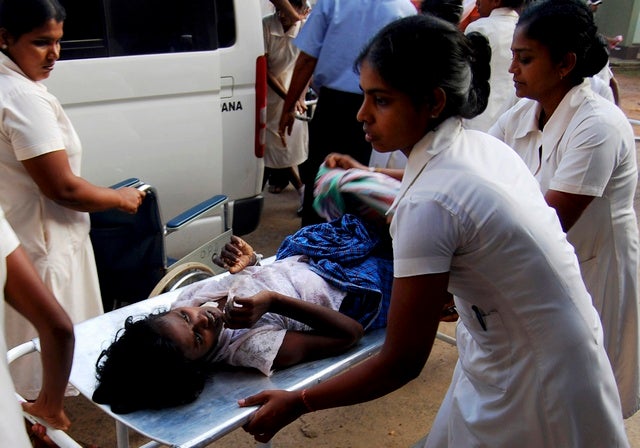
Civilians await medical treatment for wounds sustained in the fighting, May 10, 2009.
Credit:Church Mission Society
UNITED NATIONS, May 14 (IPS) – As the humanitarian crisis in Sri Lanka takes a turn for the worse, U.N. Secretary-General Ban Ki-moon is sending one of his most senior officials to take stock of the situation in the war zone, where hundreds of civilians are being killed both by government and rebel forces.
Under-Secretary-General Vijay Nambiar, the secretary-general’s chief of staff, is scheduled to make a second visit to Sri Lanka to convince the government of the need to rescue the estimated 50,000 civilians being used as human shields by the Liberation Tigers of Tamil Eelam, listed as a “terrorist organisation” by several countries, including the United States.
The outlawed rebel group has been fighting for a separate Tamil nation state in the politically-troubled northern and eastern provinces since the late 1970s, in one of the longest-running armed conflicts in Asia.
Meanwhile, on Wednesday, the 15 members of the Security Council met for the third time – the last two being informal briefings – to discuss the crisis, this time releasing the first “official and written [non-binding] statement” condemning the violence and killings in Sri Lanka.
The president of the Security Council, Ambassador Vitaly Churkin of Russia, denounced the violent actions of both the LTTE and the Sri Lankan government, demanding that “all parties respect their obligations under international humanitarian law”.
The press statement specifically urged that “the LTTE lay down its arms and allow the tens of thousands of civilians still in the conflict zone to leave,” and “call[ed] on the government of Sri Lanka to take the further necessary steps to facilitate the evacuation of the trapped civilians and the urgent delivery of humanitarian assistance to them.”
Hundreds of civilians were killed over the last weekend, including more than 100 children, according to Gordon Weiss, the United Nations spokesman in Sri Lanka, and at least another 50 killed on Wednesday alone in the shelling of a field hospital.
Some agencies claimed that heavy artillery was used in the northeast and in the No Fire Zone (also known as the “Safe Zone”), in which 50,000 civilians are reportedly still trapped. According to Amnesty International, an estimated 7,000 civilians have been killed and 13,000 injured since the beginning of the year.
Amnesty highlighted the difficulty of obtaining information on the current situation in Sri Lanka, describing it as “a war without witnesses”.
“The government has restricted journalists from accessing the conflict zone and has intimidated editors or critics of those who are reporting on the humanitarian crisis,” said Yolanda Foster, Amnesty International’s researcher on Sri Lanka.
On Monday, eight members of the U.N. Security Council met for the first unofficial briefing with U.N. officials and non-governmental organisations to discuss the escalation of violence over the weekend.
Austrian Foreign Minister Michael Spindelegger, French Foreign Minister Bernard Kouchner and British Foreign Minister David Miliband attended the meeting after having returned from their visit to Sri Lanka over the weekend with no significant achievement in calming the violence.
Following the meeting, Spindelegger stressed three main points: freeing the people currently trapped in the small area of the No Fire Zone, enhancing the situation in the IDP camps, and preparing for the future political negotiations that need to take place in order to end all military actions to lead towards viable peace.
All three ministers expressed their countries’ support towards helping the Sri Lankan government and its people to reach a peace agreement.
“We are clear that this is an issue that the U.N. Security Council should address. It involves major civilian loss of life and distress,” said Miliband.
“It does have ramifications for the region and it involves the word of a member of the United Nations not to use heavy weaponry in the pursuit of its goals to suppress a terrorist organisation. Those are fundamental issues that we, as European members of the Security Council, do believe belongs here,” stated Miliband.
Despite the foreign ministers’ emphasis on the importance of putting the issue on the Security Council agenda, some nations such as China and Russia have opposed strong action due to their own economic and military interests with the Sri Lankan government, preventing the U.N. from taking any significant action forward, other than humanitarian support.
At least two other countries – Libya and Vietnam – have also taken the position that the military conflict in Sri Lanka is a domestic issue that does not warrant Security Council intervention.
Amnesty International addressed a letter to both the Security Council and the Barack Obama administration in the U.S. urging them to take immediate action “to speak out against the indiscriminate killing of civilians in the current conflict between the Sri Lankan government and the Liberation Tigers of Tamil Eelam (LTTE).”
“The [Security] Council must convene without any further delay to discuss the latest disturbing developments and immediately require that attacks on civilians by the Sri Lankan army or the LTTE be stopped; that the LTTE allow all civilians to leave the conflict area; and that the Sri Lankan government provide immediate access to international monitors and humanitarian agencies.”
Addressing the issue for the first time at a press conference Wednesday, President Obama warned that, “without urgent action, this humanitarian crisis could turn into a catastrophe.”
Obama urged the Tamil Tigers to “lay down their arms and let civilians go”, but added that “the government should stop the indiscriminate shelling that has taken hundreds of innocent lives, including several hospitals, and the government should live up to its commitment to not use heavy weapons in the conflict zone.”
He also called on the government to permit access to U.N. humanitarian teams trying to reach the besieged civilians, and allow U.N. and Red Cross workers access to the nearly 190,000 displaced people within the country in need of supplies.
Share this:
Tags:civilians, no reports from war zone allowed, Sri Lanka, Sri Lankan government, Tamils killed, U.N. Secretary-General
Posted in Commentary, Sri Lanka, Uncategorized, war crimes | Leave a Comment »