The ICC has applied for an arrest warrant for Benjamin Netanyahu. But Israel’s assault on Gaza has been made possible by US support.
Past the 20-foot-high aluminum doors of the Justice Department’s Robert F. Kennedy Building, and down a long limestone hallway lined with art deco accents, Room B-206 has long served as the epicenter of the Biden administration’s prosecutorial war against former president Donald Trump. Behind the heavy wooden door is the office of special counsel Jack Smith, a highly secure redoubt where attorneys spent years building criminal cases against Trump for allegedly attempting to overturn the outcome of the 2020 election, as well as for his alleged improper handling of classified documents after leaving the White House.
But now, instead of heading to trial, the prosecutors are scrambling to empty file cabinets and stuff their contents into cardboard storage boxes. As a result of Trump’s election win, the prosecution is officially halted by the Justice Department’s policy prohibiting the filing of criminal cases against a sitting president. But while President-elect Trump will likely never face the consequences of his alleged criminal actions, President Biden may one day face trial for his, albeit in a far different courtroom in The Hague.
Three thousand eight hundred miles to the east from Washington sits the International Criminal Court (ICC), a complex of six modern towers in the Netherlands not far from Peace Palace and Europol in The Hague. In the largest building, Court Tower, are three courtrooms that carry out the institution’s mandate: to prosecute perpetrators of genocide, crimes against humanity, and war crimes, thereby providing justice to victims.
According to Article 1 of the Genocide Convention, the Contracting Parties, including the United States and Israel, must prevent and punish acts of genocide. Under Article III, those punishable acts include “Complicity in genocide,” such as by knowingly providing the deadly weapons used to carry it out. In 2007, the International Court of Justice (ICJ), in a case involving Bosnia and Serbia, established that the obligation to refrain from providing weapons or other assistance begins the moment a state becomes aware of the existence of a serious risk that genocide may be committed.
For the Biden administration, that moment came in January, when the ICJ found that there was a “plausible” risk of genocide being committed in Gaza against the Palestinian people by Israel. Shortly after, in February, the Dutch Appeals Court halted the transfer of F-35 munition parts to Israel on account of the serious risk of International Humanitarian Law violations. Further notice came in May with the applications for arrest warrants for Israeli Prime Minister Benjamin Netanyahu and others by the chief prosecutor of the ICC, Kharim Khan. Among the charges against Netanyahu related to Gaza were crimes against humanity, including extermination, murder, starvation of civilians as a method of warfare, intentional attacks against a civilian population, and “other inhumane acts.” It was the first potential ICC arrest warrant issued for the leader of a Western-style democracy. Nevertheless, European countries including France and Germany issued statements affirming their support for the legitimacy of the ICC.
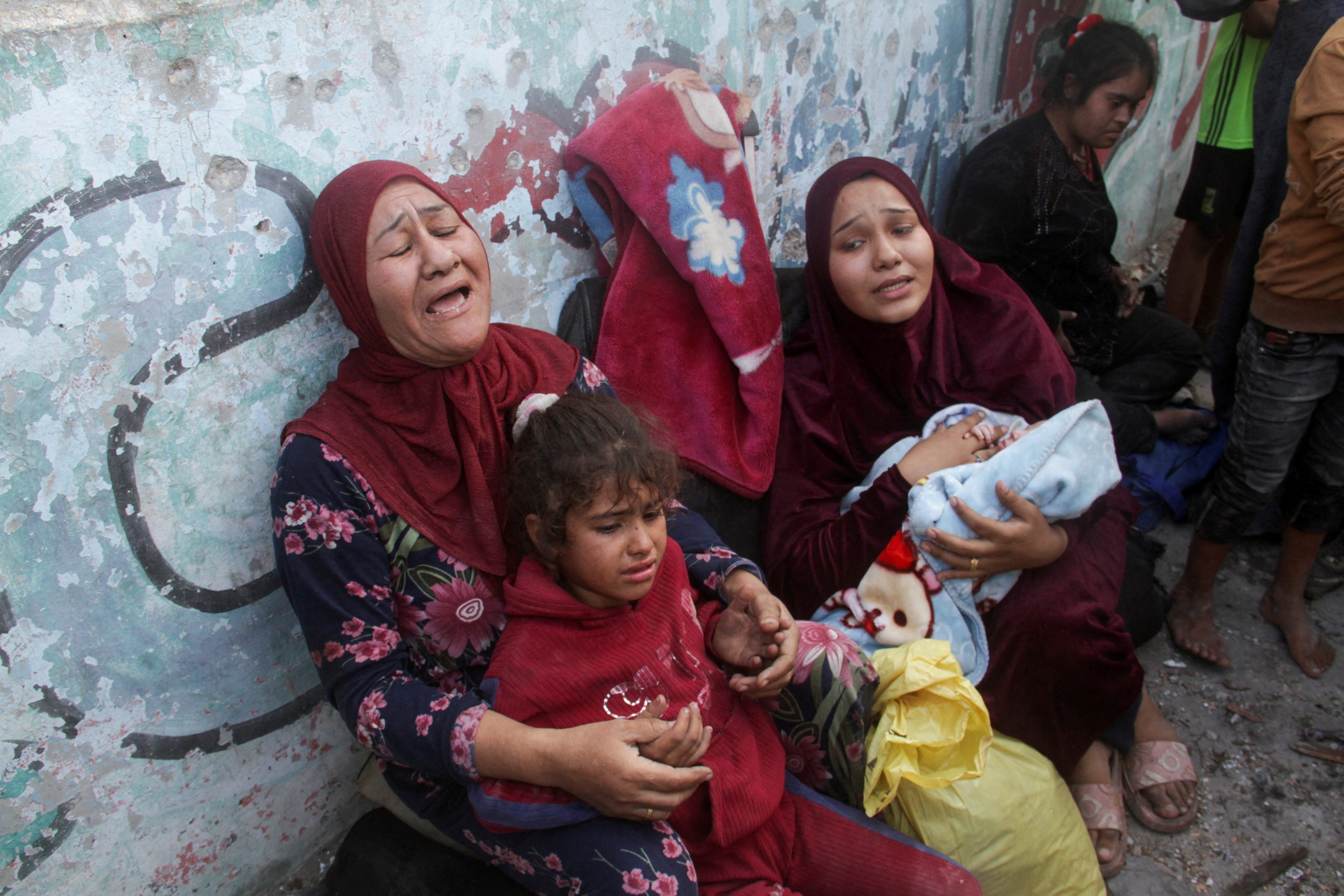
Despite the clear indication that American weapons were being used to carry out an alleged Israeli genocide, the bombs continued to flow and the wholesale massacres never stopped. According to a report last week by the UN Human Rights Office, close to 70 percent of the fatalities in Gaza have been children and women, “indicating a systematic violation of the fundamental principles of international humanitarian law,” said the report. Nizam Mamode, a retired surgeon with Britain’s National Health Service who recently returned from working at a hospital in Gaza, testified last week to members of Parliament that he treated children “day after day after day” who had been deliberately targeted by Israeli drones following bomb attacks.
Current Issue
In July, an analysis published by the medical journal The Lancet estimated that the actual number of Palestinian deaths in Gaza, including those decomposing beneath the rubble of bombed-out hospitals, schools, and densely packed refugee camps, is likely more than 186,000. And if the deaths continue at the same rate, said Devi Sridhar, chair of global public health at the University of Edinburgh, the estimated deaths by the end of the year would total 335,500.
In spite of those grim statistics, the Biden administration last month decided to play politics with the lives of the desperate and starving survivors in Gaza, most of whom had been forced to flee from multiple Israeli evacuation orders. To help the Harris campaign with pro-Palestinian voters, Biden pretended to turn tough and issued a highly publicized letter giving Netanyahu a 30-day deadline to increase the flow of food and other aid to Gaza or face a potential cutoff in military support. But it was simply a scam, since the deadline would fall after the election was over. When the time limit expired last week, there was no longer a need for Biden to pretend that the United States would take action. Instead, his administration continued to deceive the American public by falsely claiming that it found no evidence that Israel was obstructing shipments of food and other aid into Gaza.
The announcement was greeted with disbelief and anger by aid groups, including Save the Children, Oxfam, Refugees International, and Mercy Corps. “Israel’s actions failed to meet any of the specific criteria set out in the U.S. letter,” said a joint statement. “Israel not only failed to meet the U.S. criteria that would indicate support to the humanitarian response, but concurrently took actions that dramatically worsened the situation on the ground, particularly in Northern Gaza. That situation is in an even more dire state today than a month ago. The principals of the Inter-Agency Standing Committee now assess that ‘the entire Palestinian population in North Gaza is at imminent risk of dying from disease, famine and violence.’” According to an editorial in the Israeli newspaper Haaretz, “Israel is unleashing an apocalypse in Northern Gaza.”
Further evidence of the Biden administration’s deliberate cover-up of the ongoing genocide came days after the administration’s announcement when a UN special committee released a report that said, “The policies and practices of Israel during the reporting period [the past year] are consistent with the characteristics of genocide” and “Civilians have been indiscriminately and disproportionally killed en masse in Gaza.” The report went on to say that there were also serious concerns that Israel was “using starvation as a weapon of war”—a fact made clear by numerous reports of humanitarian aid convoys being looted right next to the Israeli troops, who stand by and do nothing to stop it. Israel’s decision to stop cooperating with UNRWA, the critical relief agency providing welfare services to Palestinians, is another clear war crime. “Since the beginning of the war,” the report concluded, “Israeli officials have publicly supported policies that strip Palestinians of the very necessities required to sustain life—food, water, and fuel.” The very definition of genocide.
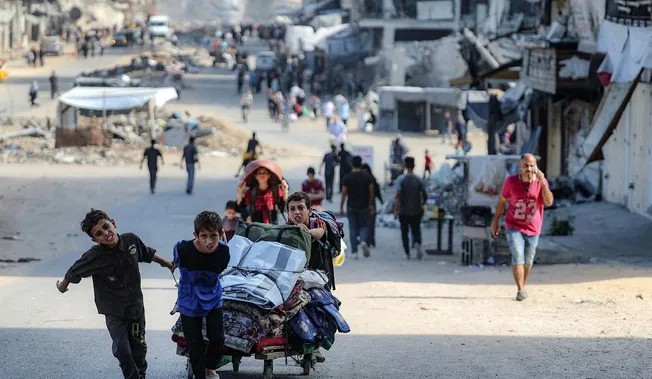
Also last week, Human Rights Watch issued a report charging that Israel is using its frequent evacuation orders to cause the “deliberate and massive forced displacement” of Palestinian civilians in Gaza, actions that appear to “meet the definition of ethnic cleansing” as well as crimes against humanity. The report, entitled “Hopeless, Starving, and Besieged: Israel’s Forced Displacement of Palestinians in Gaza,” went on to say that the group has collected clear evidence pointing to “the war crime of forcible transfer [of the civilian population].” They described these actions as “a grave breach of the Geneva conventions and a crime under the Rome statute of the international criminal court.”
That same evidence of genocide, starvation, ethnic cleansing, and forced displacement was clearly available to the Biden administration, yet it lied to the American public to hide its own criminal culpability in the war crimes, crimes against humanity, and genocide.
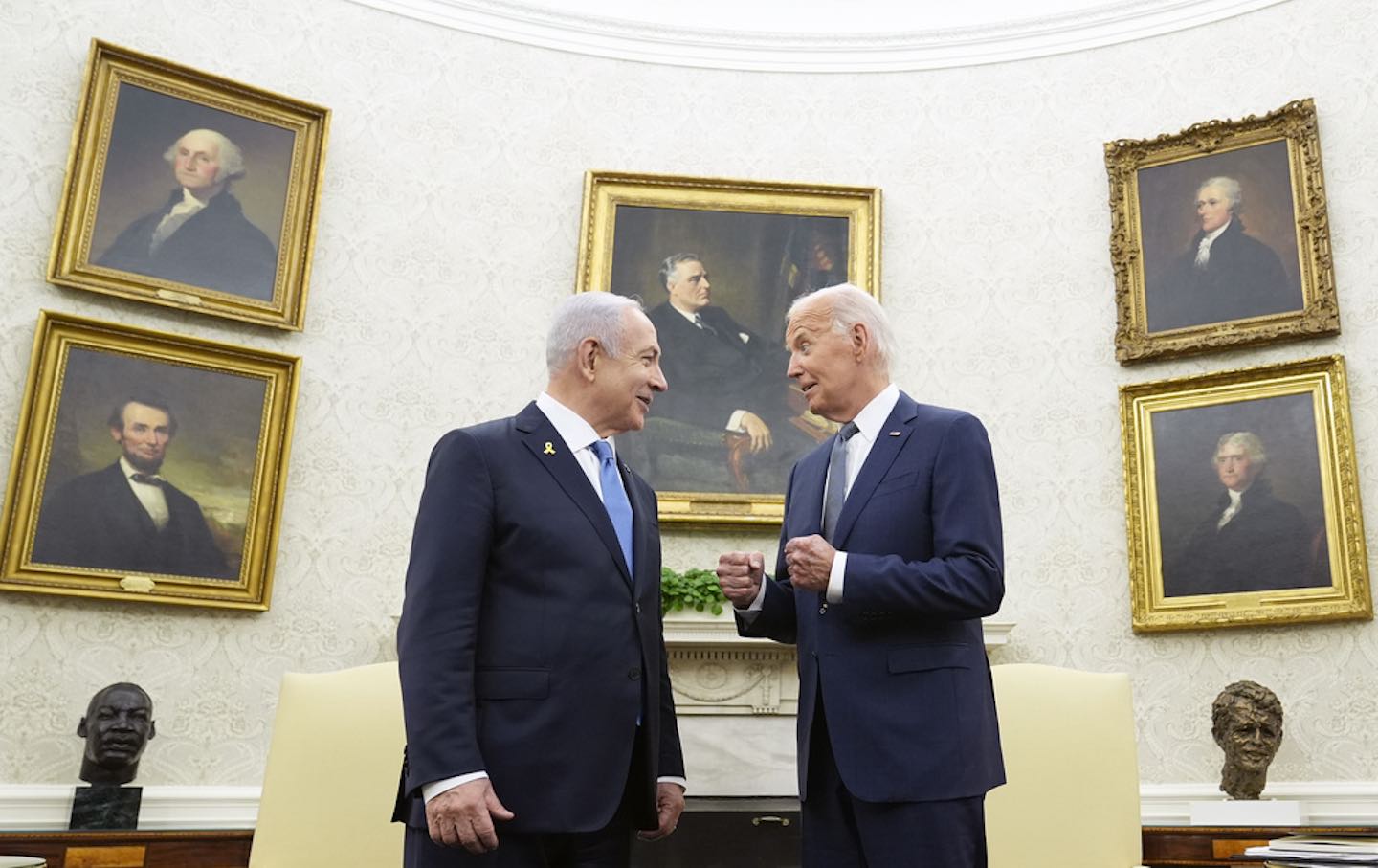
There is no statute of limitations when it comes to support for genocide, nor does it make a difference whether an individual is in or out of office. What matters is evidence of the crime, and there is more than enough for the ICC’s chief prosecutor to issue an application for an arrest warrant for Biden, just as it did for Netanyahu. After all, it’s the United States that builds the bombs, pays for them, ships them to Israel, provides intelligence on targets in Gaza, and supplies the planes that carry them. All Israel does is drop them, with US approval, on the tens of thousands of innocent civilians.
By June, the Biden administration had sent Israel at least 14,000 massively deadly 2,000-pound MK-84 bombs, made in Oklahoma and dropped on hospitals, apartment blocks, and crowded refugee camps. In addition, it sent 6,500 500-pound bombs, 3,000 Hellfire precision-guided air-to-ground missiles, 1,000 bunker-buster bombs, 2,600 air-dropped small-diameter bombs, and other munitions. Added to that is the approval of additional ground attack aircraft to Israel’s existing American-made F-15s, F-16s and F-35s and Apache helicopters. And in January, following a visit to Washington by Eyal Zamir, Israel’s Defense Ministry director-general, defense sources told the Times of Israel that Israel plans to procure a new squadron of 25 F35i stealth fighter jets, a squadron of 25 F-151A fighter jets, and a new squadron of 12 Apache helicopters.
Popular
“swipe left below to view more authors”Swipe →
- Donald Trump Has NOT Won a Majority of the Votes Cast for President Donald Trump Has NOT Won a Majority of the Votes Cast for President John Nichols
- Biden’s Mindless Escalation Is a Final Betrayal of Ukraine Biden’s Mindless Escalation Is a Final Betrayal of Ukraine Jeet Heer
- Why Americans Are Obsessed With Poor Posture Why Americans Are Obsessed With Poor Posture Books & the Arts / Zoe Adams
- Bosses Are Retaliating Against Workers for Showing Solidarity With Palestinians Bosses Are Retaliating Against Workers for Showing Solidarity With Palestinians Sarah Lazare
In the end, it’s the American taxpayers who are financing the genocide. According to Bruce Fein, an expert in international law, “The United States has clearly become a co-belligerent with Israel in its war against Hamas-Gaza Palestinians by systematically supplying the IDF with weapons and intelligence without conditions.”
If the ICC were to seek an arrest warrant for Biden before he leaves office or shortly thereafter, it would also serve as a warning to his successor, President-elect Donald Trump, who appears to have even less regard for the Palestinians. And his return to the White House will allow Netanyahu to not only speed up the genocide, but also to achieve his ultimate goal: the annexation of Gaza, the West Bank, and East Jerusalem, illegal actions under international law.
“Netanyahu has stalled until Trump’s election, and it paid off. Now there’s nothing standing in his way,” Palestinian political scientist Nour Odeh told Le Monde. He added: “He can wage his war as he sees fit, especially as he has just sacked his defense minister, Yoav Gallant, who had opposed him. As for Trump, he’s not interested in the Palestinian Authority, the state of which is getting worse all the time, nor in a dialogue with Mahmoud Abbas, because they’ve already fallen out. He’s going to do whatever Israel wants. And international law won’t hold him back any more than American law will.”
Among those overjoyed by Trump’s triumph is far-right Finance Minister Bezalel Smotrich. “Trump’s victory brings an important opportunity for the State of Israel,” he told supporters at a conference of his Religious Zionist Party. During Trump’s first term, he said, “we were on the verge of applying sovereignty over the settlements” in the West Bank. “Now,” he said, “the time has come to make it a reality.”
And on November 12, Trump sent the same signal back to Smotrich and Netanyahu by naming as his new ambassador to Israel Mike Huckabee, an evangelical Christian. Shortly afterward, Huckabee said in an Israeli radio interview that “of course” annexation of the West Bank is possible in the next administration, but the policy hasn’t been set. And in 2017, he claimed, “There is no such thing as a West Bank. It’s Judea and Samaria. There’s no such thing as a settlement. They’re communities, they’re neighborhoods, they’re cities. There’s no such thing as an occupation.” He went even further in a statement during his 2008 presidential campaign. “Basically, there really is no such thing as—I need to be careful about saying this, because people will really get upset—there’s really no such thing as a Palestinian,” he said. “There’s not.”
Although neither the United States nor Israel recognizes the jurisdiction of the ICC, most other countries of the world, including in Europe, do. So, should Biden join Netanyahu on the ICC’s wanted list, he would remain safe as long as he never leaves the country. But if he were to give a speech or attend a ceremony outside the country, an Interpol Red Notice would likely be waiting for him, followed by a quick trip to the ICC’s Court Tower in The Hague. According to The Architectural Review, those awaiting trial at the ICC are confined in a “dark gray holding cell complete with steel table and chair bolted to the floor, a slab for a bed, seatless stainless-steel prison toilet and sink.” And there is plenty of room for both Netanyahu and Biden.
We cannot back down
We now confront a second Trump presidency.
There’s not a moment to lose. We must harness our fears, our grief, and yes, our anger, to resist the dangerous policies Donald Trump will unleash on our country. We rededicate ourselves to our role as journalists and writers of principle and conscience.
Today, we also steel ourselves for the fight ahead. It will demand a fearless spirit, an informed mind, wise analysis, and humane resistance. We face the enactment of Project 2025, a far-right supreme court, political authoritarianism, increasing inequality and record homelessness, a looming climate crisis, and conflicts abroad. The Nation will expose and propose, nurture investigative reporting, and stand together as a community to keep hope and possibility alive. The Nation’s work will continue—as it has in good and not-so-good times—to develop alternative ideas and visions, to deepen our mission of truth-telling and deep reporting, and to further solidarity in a nation divided.
Armed with a remarkable 160 years of bold, independent journalism, our mandate today remains the same as when abolitionists first founded The Nation—to uphold the principles of democracy and freedom, serve as a beacon through the darkest days of resistance, and to envision and struggle for a brighter future.
The day is dark, the forces arrayed are tenacious, but as the late Nation editorial board member Toni Morrison wrote “No! This is precisely the time when artists go to work. There is no time for despair, no place for self-pity, no need for silence, no room for fear. We speak, we write, we do language. That is how civilizations heal.”
I urge you to stand with The Nation and donate today.
Onwards,
Katrina vanden Heuvel
Editorial Director and Publisher, The Nation
James Bamford
James Bamford is a best-selling author, Emmy-nominated filmmaker, and winner of the National Magazine Award for Reporting. His most recent book is Spyfail: Foreign Spies, Moles, Saboteurs, and the Collapse of America’s Counterintelligence, published by Twelve Books.











You must be logged in to post a comment.