By Talha Mujaddidi in Pakistan. Exclusive to Axis of Logic
Feb 7, 2009, 13:57 |
  |
A change in Pakistan’s relationship with the U.S. war on terror is required immediately.
Pakistan is amidst the worst political turmoil of its history. Things were not this bad at the turn of the millennium but after 9/11, its political future took a sharp, bleak downturn. When the U.S. started its “war on terror” in Afghanistan, it might have enjoyed support of many countries and their leaders but it did not enjoy support of the majority of the people of Pakistan. In addition, Pakistan’s Pukhtoon population and vast majority of Afghan population considered and still considers Afghanistan an occupied country. They had the same view when Soviet Russia was occupying Afghanistan, a land considered to be a graveyard for super powers.
The Valley of Swat and the TTP
 |
|
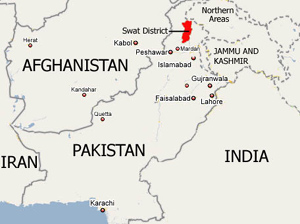
A map of Pakistan and the surrounding region highlighting Swat District
|
Pakistan’s current “catch 22” is in Swat, a valley in Northern part of Pakistan’s NWFP (North West Frontier Province). Swat was once Pakistan’ stop tourist destination, before its current and continuing chaos. The founder of the nation, Quaid-e-Azam Mohammad Ali Jinnah, called it “the Switzerland of Pakistan”. Winston Churchill was also fond of the valley in his early days in British India. In 2003 a new militant group emerged in Pakistan. This was Tehrik-e-Taliban (TTP). It was headed by Abdullah Mehsud, a former prisoner of the Guantanamo Bay Prison. Surprisingly he was cleared by U.S. authorities and sent back to Pakistan. He organized and started TTP which should not be confused with the Taliban in Afghanistan. This is a big common misconception in Pakistan and the rest of the world. It’s a pity that Pakistani and western journalists are confusing the Taliban with the Tehrik-e-Taliban (TTP) in their reporting and news articles.
The Taliban in Afghanistan have nothing against Pakistan and have never killed or threatened Pakistani people or Pakistani state. On the other hand, the TTP has done both. The TTP is a group based on Takfiri ideology (a Muslim who believes that all other Muslims even orthodox are not true Muslims and they are just collaborators of infidels and deserve to be attacked and killed). All Muslim scholars are unanimous in declaring Takfiris ‘heretics of Islam’.
The Hashshashin Sect
History provides us an example that sheds light on the Takfiris. When the Crusaders began to attack the Muslim world in the 11th century, a group of heretic Muslims emerged that started creating havoc amongst the Muslims by declaring war on their fellow Muslims. The group was the Hashshashin sect (the word assassin came from Hashshashin). Hashshashins were Muslims who had become heretics believing that other Muslims are Kafir (infidels) and had to be killed by any means necessary. Their doctrine was known as Fedayeen (a person ready to sacrifice his life for a mission). They should not be confused with today’s Mujaideen (Muslims committed to an armed struggle). While the Muslim armies were fighting the Crusaders, these Hashshashins also declared war on Muslims! Such internecine fighting is not unusual in other ethnic groups and religions. Similar fundamentalist sects who fought against their own can also be found in the histories of Christianity and Judiasm. Because of the Hashashin sect, Muslims had to fight with two brutal armies simultaneously during the time of the Crusades.
Often the Hashshashins fought alongside the Christian Crusaders against the Muslim armies. They assassinated Muslim scholars, political leaders, and civilians ruthlessly. This is the ideology that TTP is following in Pakistan. In 2004, under pressure from U.S.., former President Musharraf started a military operation in Pakistan’s tribal areas to remove TTP from those areas. At that time things were more stable in Swat. But they were about to get worse.
Need for a strong, central government in Pakistan
Swat, like the rest of Pakistan has always suffered from lack of a strong central government and a rule of law. According to Amnesty International Pakistan’s civil, district and Supreme courts suffer from massive corruption. According to Asian Journal of Political Science August 2007, report,
“Pakistan is generally included in most discussions of ‘failing states’ that pose the maximum danger to global security, with the rise of Islamic militancy being the most commonly cited reason for the ‘failure’. However, Islamic militancy is a result of impending state failure, not a cause of it.
“The state’s inability, caused by decades of systemic corruption, to provide any appreciable level of public goods or services, broadly defined, is responsible for the de-legitimization of the state and its inability to maintain law and order in the cities or suppress Islamist insurgents in the rest of the country.”
There has been a succession of corrupt Pakistani governments in the past. With nothing to offer to the Pakistani population these corrupt governments looked up to U.S., Britain, Saudi Arabia, and other countries in order to consolidate their position in power. They plundered the national wealth and placed Pakistan in debt by taking new loans from World Bank, IMF and other imperial financial institutions. Corrupt governments and weak parliaments were responsible for breakdown of institutions in Pakistan resulting in corruption, nepotism and rising lawlessness.
Emergence of Sufi Mohammad
The failure of civil law and order and the failure of enforcement have been the direct cause of the rise of local militants who controlled and operated their parallel Islamic courts in Swat. Sufi Mohammad was one such militant who started a movement to impose Islamic laws in Swat and other areas. His movement is not new. It first became known in 1989. In 1995 he started mass protests against the government. The government of Benazir Bhutto at that time negotiated with him and the matter was swept under the carpet.
Sufi Mohammad emerged again when U.S. attacked Afghanistan on October 7, 2001. He and his followers went to Afghanistan to fight U.S. invasion, most of his followers were killed there. Sufi Mohammad was captured and then sent back to Pakistan where he was imprisoned. He remained in Pakistani prison until April 2008, when he agreed to denounce “terrorist acts”, militancy, give up arms and come into agreement with Pakistan government.
Maulvi Fazalullah (also known as Radio Maulvi) is the current leader in charge of militants in Swat. He is son-in-law of Sufi Mohammad. Maulvi Fazalullah, unlike Sufi Mohammad, has not at all renounced violence or the armed struggle. Also note that followers of Fazalullah and TTP (Takfiri) are two separate groups. With the failure of law and order in Swat, many who lived outside the laws of Central Government, took refuge in Swat since civil law and enforcement has been virtually absent from the area.
When the Pakistan army started military operations against TTP in Tribal areas of Pakistan, Fazalullah and his militants began to attack police stations and to challenge the central government. Many civilians were killed. Members of the local population are often threatened, schools (especially girls’ schools) are closed down, teachers are killed, local politicians are attacked along with NGO workers and other acts of violence are taking place.
The judicial system in Swat
Swat was a princely state during British Rule in India. After the creation of Pakistan people of Swat used to follow the Islamic Shariah Laws to manage their day to day affairs. This means that all cases from criminal to civil to child custody were all managed by laws under Islamic Shariah Laws. After 1970 the Government of Pakistan took Swat under the District administration system just like the other parts of Pakistan. This meant that from that point on all Shariah courts would be replaced by civil courts, district courts. Pakistan is still following British laws that were incorporated under British India Act of 1935. The Pakistan government is still following a lot of obsolete rules and regulations of Act of 1935. The people of Swat agreed to accept the change but the problem with civil courts is that they take a longtime to come to any conclusion. They are susceptible to bribery and corruption because of the presence of unnecessary red tape and the handling of cases takes longtime. Plus the fact that there is a shortage of lawyers who are unwilling to work for lowly paid government jobs instead of more lucrative work in private practice.
Swat rejects Fazalullah
This system continued until Sufi Mohammad started his movement of re-introduction of Shariah courts. The local public wanted Shariah courts. As long as Sufi Mohammad was leading the movement it was non-violent. The people of Swat supported Sufi Mohammad. However, Fazalullah is now acting like a local war-lord. The people of Swat do not support violence at all and they are not supporting Fazalullah. The problem is that he has around 4000 men who are well trained and well armed and they have terrorized the local population. The local police, already understaffed and under budgeted, have been faced with massive desertions. The police does not have sophisticated weapons and gear comparable to that of Maulvi Fazalullah’s militants. The local police are no match for Fazalullah’s professional combatants.
Swat is different from Tribal Areas of Pakistan. Tribal areas are purely Pukhtoon and their daily lives are managed under tribal codes and laws. Mainstream schooling is very limited, whereas in Swat mainstream schooling was widespread. Swat, the most popular tourist destination in Pakistan once thrived with economic activity, local shops, small hotels and vintage shops. This resulted in better economic level compared to Tribal areas. Another thing to remember is that Tribal Areas have their traditional customs where all men consider carrying weapons a part of traditional manhood. In Swat this was not the case.
In the past, Swat progressed just like any other city in Pakistan and weapons were not to be found in every household. If Maulvi Fazalullah had appeared in Tribal Areas he would not have been able to terrorize the local population because there, the people are armed. Even though there is a great deal of anger throughout Pakistan over U.S. drone attacks, that anger will not cause the people of Swat to support Fazalullah. They see him as someone who is taking advantage of the U.S.. invasion and as one who is responsible for ruthless killings and the destruction of their local economy.
The government tried to bring Fazallullah under control through dialogue but to no avail. Fazalullah started his FM radio transmission that earned him the name of Radio Mullah. Notice the similarities between actions of Fazalullah and Hashshashins. There is no doubt that the restoration of law and order in Swat is a must through military intervention by the central government of Pakistan. There is no point with having a dialogue with Fazalullah, who has repeatedly backtracked from “peace talks” initiated by the central government. But this is an internal matter and is not the responsibility of foreign governments like the United States.
Who is providing arms to Fazalullah?
The situation in Swat has worsened in the last two years. With rising tensions between Pakistan and India, Pakistan moved some of its troops from Swat and tribal areas to eastern border with India; this provided a window of opportunity for Fazalullah to foment more anarchy in Swat. One important question is, “Who is the source of the weapons and supplies that are used by Fazalluah and TTP? In my view, the weapons are coming from Afghanistan where India operates 19 consulates. These are nothing more or less than operation centers of RAW (Research and Analysis Wing). RAW is India’s equivalent of CIA.
NDS is Afghanistan’s intelligence agency created by U.S. military after they setup Karzai government. The head of NDS is Amrullah Saleh, the thirty-six-year-old director of Karzai’s spy agency. Saleh became the world’s youngest intelligence chief in 2004, at age 32. Since 2005, NDS has emerged as a major source of strategic instability in the region. Saleh, explaining his action in Pakistan, says that “Insurgency is like grass, you cut the upper part but after sometime it will grow back, you poison the soil [Pakistan] where that grass is and it will die forever.”
Another problem for Pakistan is that the current government of Afghanistan is composed of Northern Alliance Warlords (NAW) who are supported by the U.S.. government. The NAW are extremely hostile towards Pakistan and very close to India. Historically, they have been mostly based in minority ethnic groups of Afghanistan like Tajik, Uzbek, Hazara (Shia by faith), and other groups. Pakistan has always supported majority ethnic group Pukhtoon, since Pakistan has huge Pukhtoon population. Taliban of Afghanistan was also Pukhtoon. During Taliban’s rule, India, Iran or Russia had no access into Afghanistan.
The India Factor
India’s intelligence bureau (IB) has always been responsible for internal intelligence gathering. The IB formed the “Research and Analysis Wing” known as RAW in 1968 for conducting external intelligence, comparable to the CIA. Recently, under RAW, India, in cooperation with the CIA, has begun to move some ground troops into Afghanistan.
According to Asian Tribune report of September 2008, India has 14 consulates in Afghanistan from which RAW is operating. In Wakhan, Badakshan province, RAW is operating a madarssah, where clerics from India are brainwashing local Afghans, Uzbeks and Tajiks. Their students are then infiltrated into Pakistan where they readily carry out suicide missions and other operations. The report further states:
“Mullah Omar (leader of the real Taliban) had never shown interest in establishing any links with Pakistani Taliban (TTP) and had warned Nek Muhammad (a militant who agreed to make peace deal with Pakistan government before he was killed in a U.S. drone attack) not to operate under the brand name of Taliban. It is being questioned as to why Baitullah, Fazlullah and their spokesmen desperately wanted by Pakistan security forces have escaped the hawkeye of U.S., particularly after they have been seen giving detailed interviews to media and using their cell phones? ISI [Pakistan’s intelligence service] had once given six figure coordinates of Baitullah and yet no Hellfire missile was fired on his hideout by CIA.”
It is very surprising that the CIA has not been able to kill Baitullah Mehsud, head of TTP or Fazalullah, when they have no problem hitting civilians with its drone-fired hellfire missiles.
Cambodia-Vietnam Analogy
When U.S. was fighting against the Vietcong in Vietnam, the U.S. military falsely claimed that support for the Vietcong was coming from Cambodia and President Lyndon Johnson, a Democrat, started air strikes in Cambodia. At the time, the military government of Cambodia was just a U.S. puppet regime. That U.S. bombing killed one million people Cambodian people. What was the result? Cambodia was torn into civil war and brutal suffering took place under Pol Pot. The same thing could happen in Pakistan. They are triangulating the U.S.. war in Afghanistan with India and Pakistan. One of their convoluted methods is to use India’s RAW in Afghanistan which leads to the indirect attacks in Pakistan by RAW’s madarssah students in Afghanistan. The Pakistani government’s stance on the “War on terror” is as never before at a tangent with the public opinion.
The government of Pakistan must act now to avert catastrophe
The Pakistan government must take the following steps immediately if complete destabilization and catastrophe is to be averted. If the Pakistan government does not take these steps, it must be removed and an interim government must be set up to carry out these steps.
- Pakistan must pass a bill in the parliament that authorizes the Pakistan Air Force to retaliate against deadly U.S. drone attacks. Pakistan has asked the U.S. government and military leadership repeatedly to stop drone attacks into Pakistan but to no avail.
- Pakistan must ask the U.S. to pack up its military bases and get them out off Pakistani soil, since there was no open agreement for these air bases between Pakistan government and U.S.. in the first place.
- After 9/11 military ruler Pervez Musharraf became dictator of Pakistan. All agreements were made between him and the U.S.. government. These agreements with the U.S. must be made public and cancelled. New agreements must be made with the U.S.. which ensures Pakistan’s territorial sovereignty.
- Pakistan must ask NATO and the U.S. military to make sure that Afghanistan’s soil is not used by India to create proxy war against Pakistan. Pakistan must declare neutrality in War in Afghanistan, Pakistan can’t continue to be supporting Afghan Government that is working against the interests of Pakistan.
- Pakistan must stop giving NATO and the U.S.. access to move arms and supplies through Pakistan. If the U.S. continues to send drones to kill civilians in Pakistan under the Obama regime, it will only fuel more militancy in Pakistan. Pakistan must stop the NATO/U.S. supply route.
Of course all this is easier said than done. The U.S.. knows it need not worry about any of this or similar course of action being taken by the current Pakistani government. The U.S.. is completely involved with Pakistani leadership, especially with the President and the Army Chief. What is not reported in the U.S.. media is that U.S.. Ambassador to Pakistan, Ann Patterson, meets with Pakistani leaders and even opposition leaders as often as she can. In one week in January 2009 she met with Pakistani President thrice. But will she say a word to stop the pointless, deadly U.S. drone attacks inside Pakistan by the U.S.. military?
Obama’s “War on Terror”
On December 26, 2008, immediately after he was inaugurated, President Obama ordered his first drone missile attack in sovereign Pakistan, killing 16 civilians. Obama should realize that the escalating “War on Terror” inside Pakistan is totally counterproductive. U.S. must realize that there is no option but to bring the Taliban into the political process in Afghanistan. Hamid Karzai, NATO commanders, and British government have all expressed similar views. Pakistan, on the other hand, must distance itself from the U.S. “war on terror” as it is creating havoc inside Pakistan and has no basis in fact, worldwide. It is also important to note that the Pakistan army is also not in best of moods since they are not particularly in tune with the government and have no desire to fight their own countrymen.
If the government does not address the situation, mounting public pressure can result in wide spread social unrest, protests, strikes, and even violent agitation? The situation in Pakistan’s tribal areas and Swat is moving from bad to worse. Even if the situation in Swat or Tribal Areas were to improve, trouble is likely to start in some other part of NWFP or Baluchistan province of Pakistan. The point is that Pakistan is facing tough challenges from TTP, Maulvi Fazalullah and other militants, and current U.S. policy of carrots and sticks for Pakistan is only making it worse. The U.S. must deal with people of Pakistan in a civil manner and respect their territorial integrity and national sovereignty rather than making back-room deals with the corrupt President and Prime Minister. Their refusal to do so raises questions about whether they really want to see Pakistan united in peace or a destabilized Pakistan that serves their imperial agenda. The spokesman for the Pakistan Army spokesman has said that crushing militancy will take a longtime as it’s very difficult to distinguish militants from local residents. Moreover, the continuing illegal U.S.. attacks are fostering support by local populations for disparate militant groups who already live their lives within those populations.
Democracy does not work the same way in Pakistan as it is reported to be working in the U.S. or Europe. With 35% literacy rate, it cannot be the same kind of democracy as in EU or North America. The U.S. belligerent support to corrupt democratic leaders of Pakistan will only undermine what is already a weak democracy in Pakistan. Weak democratic institutions give rise to militancy, extremism, and parallel institutions. Continuous U.S. and British support to corrupt Pakistani rulers will only result in more hatred for Pakistani state, Pakistani rulers, and in turn, the United States.
Conclusion
Finally, the news coverage of the Swat region is very limited, and no one exactly knows how many people have been killed. According to a rough estimate by Center for Research and Security Studies, since 9/11 Pakistan has lost at least 12,000 people as a result of the U.S. war on terror. Some were blown up in suicide bombings, some were killed by U.S. drone attacks, some of the dead were Pakistani army soldiers, some police officers, and a lot of them were women and children. This is nothing compared to the death count of Afghanistan, Palestine and Iraq but it is enough to push Pakistan on the brink of disaster. A policy shift by the Pakistan government toward foreign intervention is the need of the hour.
The current carnage in Swat has resulted in killing of many civilians, security personal and militants. The exact number of people killed is not known. The local economy has collapsed and people are making mass exodus from the valley. How long the military operation will continue is unknown. Pakistan must make drastic changes in its foreign policy in Afghanistan and its policy on the U.S. “war on terror”. Otherwise, we the people of Pakistan will suffer more.
Talha Mujaddidi is a writer/analyst and Axis of Logic correspondent, living in Pakistan. He can be contacted at: talhamujaddidi@gmail.com



 Peace and Justice Post
Now or Never!! Pakistan must change its position on the “war on terror”.
February 7, 2009Feb 7, 2009, 13:57
A change in Pakistan’s relationship with the U.S. war on terror is required immediately.
Pakistan is amidst the worst political turmoil of its history. Things were not this bad at the turn of the millennium but after 9/11, its political future took a sharp, bleak downturn. When the U.S. started its “war on terror” in Afghanistan, it might have enjoyed support of many countries and their leaders but it did not enjoy support of the majority of the people of Pakistan. In addition, Pakistan’s Pukhtoon population and vast majority of Afghan population considered and still considers Afghanistan an occupied country. They had the same view when Soviet Russia was occupying Afghanistan, a land considered to be a graveyard for super powers.
The Valley of Swat and the TTP
A map of Pakistan and the surrounding region highlighting Swat District
Pakistan’s current “catch 22” is in Swat, a valley in Northern part of Pakistan’s NWFP (North West Frontier Province). Swat was once Pakistan’ stop tourist destination, before its current and continuing chaos. The founder of the nation, Quaid-e-Azam Mohammad Ali Jinnah, called it “the Switzerland of Pakistan”. Winston Churchill was also fond of the valley in his early days in British India. In 2003 a new militant group emerged in Pakistan. This was Tehrik-e-Taliban (TTP). It was headed by Abdullah Mehsud, a former prisoner of the Guantanamo Bay Prison. Surprisingly he was cleared by U.S. authorities and sent back to Pakistan. He organized and started TTP which should not be confused with the Taliban in Afghanistan. This is a big common misconception in Pakistan and the rest of the world. It’s a pity that Pakistani and western journalists are confusing the Taliban with the Tehrik-e-Taliban (TTP) in their reporting and news articles.
The Taliban in Afghanistan have nothing against Pakistan and have never killed or threatened Pakistani people or Pakistani state. On the other hand, the TTP has done both. The TTP is a group based on Takfiri ideology (a Muslim who believes that all other Muslims even orthodox are not true Muslims and they are just collaborators of infidels and deserve to be attacked and killed). All Muslim scholars are unanimous in declaring Takfiris ‘heretics of Islam’.
The Hashshashin Sect
History provides us an example that sheds light on the Takfiris. When the Crusaders began to attack the Muslim world in the 11th century, a group of heretic Muslims emerged that started creating havoc amongst the Muslims by declaring war on their fellow Muslims. The group was the Hashshashin sect (the word assassin came from Hashshashin). Hashshashins were Muslims who had become heretics believing that other Muslims are Kafir (infidels) and had to be killed by any means necessary. Their doctrine was known as Fedayeen (a person ready to sacrifice his life for a mission). They should not be confused with today’s Mujaideen (Muslims committed to an armed struggle). While the Muslim armies were fighting the Crusaders, these Hashshashins also declared war on Muslims! Such internecine fighting is not unusual in other ethnic groups and religions. Similar fundamentalist sects who fought against their own can also be found in the histories of Christianity and Judiasm. Because of the Hashashin sect, Muslims had to fight with two brutal armies simultaneously during the time of the Crusades.
Often the Hashshashins fought alongside the Christian Crusaders against the Muslim armies. They assassinated Muslim scholars, political leaders, and civilians ruthlessly. This is the ideology that TTP is following in Pakistan. In 2004, under pressure from U.S.., former President Musharraf started a military operation in Pakistan’s tribal areas to remove TTP from those areas. At that time things were more stable in Swat. But they were about to get worse.
Need for a strong, central government in Pakistan
Swat, like the rest of Pakistan has always suffered from lack of a strong central government and a rule of law. According to Amnesty International Pakistan’s civil, district and Supreme courts suffer from massive corruption. According to Asian Journal of Political Science August 2007, report,
There has been a succession of corrupt Pakistani governments in the past. With nothing to offer to the Pakistani population these corrupt governments looked up to U.S., Britain, Saudi Arabia, and other countries in order to consolidate their position in power. They plundered the national wealth and placed Pakistan in debt by taking new loans from World Bank, IMF and other imperial financial institutions. Corrupt governments and weak parliaments were responsible for breakdown of institutions in Pakistan resulting in corruption, nepotism and rising lawlessness.
Emergence of Sufi Mohammad
The failure of civil law and order and the failure of enforcement have been the direct cause of the rise of local militants who controlled and operated their parallel Islamic courts in Swat. Sufi Mohammad was one such militant who started a movement to impose Islamic laws in Swat and other areas. His movement is not new. It first became known in 1989. In 1995 he started mass protests against the government. The government of Benazir Bhutto at that time negotiated with him and the matter was swept under the carpet.
Sufi Mohammad emerged again when U.S. attacked Afghanistan on October 7, 2001. He and his followers went to Afghanistan to fight U.S. invasion, most of his followers were killed there. Sufi Mohammad was captured and then sent back to Pakistan where he was imprisoned. He remained in Pakistani prison until April 2008, when he agreed to denounce “terrorist acts”, militancy, give up arms and come into agreement with Pakistan government.
Maulvi Fazalullah (also known as Radio Maulvi) is the current leader in charge of militants in Swat. He is son-in-law of Sufi Mohammad. Maulvi Fazalullah, unlike Sufi Mohammad, has not at all renounced violence or the armed struggle. Also note that followers of Fazalullah and TTP (Takfiri) are two separate groups. With the failure of law and order in Swat, many who lived outside the laws of Central Government, took refuge in Swat since civil law and enforcement has been virtually absent from the area.
When the Pakistan army started military operations against TTP in Tribal areas of Pakistan, Fazalullah and his militants began to attack police stations and to challenge the central government. Many civilians were killed. Members of the local population are often threatened, schools (especially girls’ schools) are closed down, teachers are killed, local politicians are attacked along with NGO workers and other acts of violence are taking place.
The judicial system in Swat
Swat was a princely state during British Rule in India. After the creation of Pakistan people of Swat used to follow the Islamic Shariah Laws to manage their day to day affairs. This means that all cases from criminal to civil to child custody were all managed by laws under Islamic Shariah Laws. After 1970 the Government of Pakistan took Swat under the District administration system just like the other parts of Pakistan. This meant that from that point on all Shariah courts would be replaced by civil courts, district courts. Pakistan is still following British laws that were incorporated under British India Act of 1935. The Pakistan government is still following a lot of obsolete rules and regulations of Act of 1935. The people of Swat agreed to accept the change but the problem with civil courts is that they take a longtime to come to any conclusion. They are susceptible to bribery and corruption because of the presence of unnecessary red tape and the handling of cases takes longtime. Plus the fact that there is a shortage of lawyers who are unwilling to work for lowly paid government jobs instead of more lucrative work in private practice.
Swat rejects Fazalullah
This system continued until Sufi Mohammad started his movement of re-introduction of Shariah courts. The local public wanted Shariah courts. As long as Sufi Mohammad was leading the movement it was non-violent. The people of Swat supported Sufi Mohammad. However, Fazalullah is now acting like a local war-lord. The people of Swat do not support violence at all and they are not supporting Fazalullah. The problem is that he has around 4000 men who are well trained and well armed and they have terrorized the local population. The local police, already understaffed and under budgeted, have been faced with massive desertions. The police does not have sophisticated weapons and gear comparable to that of Maulvi Fazalullah’s militants. The local police are no match for Fazalullah’s professional combatants.
Swat is different from Tribal Areas of Pakistan. Tribal areas are purely Pukhtoon and their daily lives are managed under tribal codes and laws. Mainstream schooling is very limited, whereas in Swat mainstream schooling was widespread. Swat, the most popular tourist destination in Pakistan once thrived with economic activity, local shops, small hotels and vintage shops. This resulted in better economic level compared to Tribal areas. Another thing to remember is that Tribal Areas have their traditional customs where all men consider carrying weapons a part of traditional manhood. In Swat this was not the case.
In the past, Swat progressed just like any other city in Pakistan and weapons were not to be found in every household. If Maulvi Fazalullah had appeared in Tribal Areas he would not have been able to terrorize the local population because there, the people are armed. Even though there is a great deal of anger throughout Pakistan over U.S. drone attacks, that anger will not cause the people of Swat to support Fazalullah. They see him as someone who is taking advantage of the U.S.. invasion and as one who is responsible for ruthless killings and the destruction of their local economy.
The government tried to bring Fazallullah under control through dialogue but to no avail. Fazalullah started his FM radio transmission that earned him the name of Radio Mullah. Notice the similarities between actions of Fazalullah and Hashshashins. There is no doubt that the restoration of law and order in Swat is a must through military intervention by the central government of Pakistan. There is no point with having a dialogue with Fazalullah, who has repeatedly backtracked from “peace talks” initiated by the central government. But this is an internal matter and is not the responsibility of foreign governments like the United States.
Who is providing arms to Fazalullah?
The situation in Swat has worsened in the last two years. With rising tensions between Pakistan and India, Pakistan moved some of its troops from Swat and tribal areas to eastern border with India; this provided a window of opportunity for Fazalullah to foment more anarchy in Swat. One important question is, “Who is the source of the weapons and supplies that are used by Fazalluah and TTP? In my view, the weapons are coming from Afghanistan where India operates 19 consulates. These are nothing more or less than operation centers of RAW (Research and Analysis Wing). RAW is India’s equivalent of CIA.
NDS is Afghanistan’s intelligence agency created by U.S. military after they setup Karzai government. The head of NDS is Amrullah Saleh, the thirty-six-year-old director of Karzai’s spy agency. Saleh became the world’s youngest intelligence chief in 2004, at age 32. Since 2005, NDS has emerged as a major source of strategic instability in the region. Saleh, explaining his action in Pakistan, says that “Insurgency is like grass, you cut the upper part but after sometime it will grow back, you poison the soil [Pakistan] where that grass is and it will die forever.”
Another problem for Pakistan is that the current government of Afghanistan is composed of Northern Alliance Warlords (NAW) who are supported by the U.S.. government. The NAW are extremely hostile towards Pakistan and very close to India. Historically, they have been mostly based in minority ethnic groups of Afghanistan like Tajik, Uzbek, Hazara (Shia by faith), and other groups. Pakistan has always supported majority ethnic group Pukhtoon, since Pakistan has huge Pukhtoon population. Taliban of Afghanistan was also Pukhtoon. During Taliban’s rule, India, Iran or Russia had no access into Afghanistan.
The India Factor
India’s intelligence bureau (IB) has always been responsible for internal intelligence gathering. The IB formed the “Research and Analysis Wing” known as RAW in 1968 for conducting external intelligence, comparable to the CIA. Recently, under RAW, India, in cooperation with the CIA, has begun to move some ground troops into Afghanistan.
According to Asian Tribune report of September 2008, India has 14 consulates in Afghanistan from which RAW is operating. In Wakhan, Badakshan province, RAW is operating a madarssah, where clerics from India are brainwashing local Afghans, Uzbeks and Tajiks. Their students are then infiltrated into Pakistan where they readily carry out suicide missions and other operations. The report further states:
It is very surprising that the CIA has not been able to kill Baitullah Mehsud, head of TTP or Fazalullah, when they have no problem hitting civilians with its drone-fired hellfire missiles.
Cambodia-Vietnam Analogy
When U.S. was fighting against the Vietcong in Vietnam, the U.S. military falsely claimed that support for the Vietcong was coming from Cambodia and President Lyndon Johnson, a Democrat, started air strikes in Cambodia. At the time, the military government of Cambodia was just a U.S. puppet regime. That U.S. bombing killed one million people Cambodian people. What was the result? Cambodia was torn into civil war and brutal suffering took place under Pol Pot. The same thing could happen in Pakistan. They are triangulating the U.S.. war in Afghanistan with India and Pakistan. One of their convoluted methods is to use India’s RAW in Afghanistan which leads to the indirect attacks in Pakistan by RAW’s madarssah students in Afghanistan. The Pakistani government’s stance on the “War on terror” is as never before at a tangent with the public opinion.
The government of Pakistan must act now to avert catastrophe
The Pakistan government must take the following steps immediately if complete destabilization and catastrophe is to be averted. If the Pakistan government does not take these steps, it must be removed and an interim government must be set up to carry out these steps.
Of course all this is easier said than done. The U.S.. knows it need not worry about any of this or similar course of action being taken by the current Pakistani government. The U.S.. is completely involved with Pakistani leadership, especially with the President and the Army Chief. What is not reported in the U.S.. media is that U.S.. Ambassador to Pakistan, Ann Patterson, meets with Pakistani leaders and even opposition leaders as often as she can. In one week in January 2009 she met with Pakistani President thrice. But will she say a word to stop the pointless, deadly U.S. drone attacks inside Pakistan by the U.S.. military?
Obama’s “War on Terror”
On December 26, 2008, immediately after he was inaugurated, President Obama ordered his first drone missile attack in sovereign Pakistan, killing 16 civilians. Obama should realize that the escalating “War on Terror” inside Pakistan is totally counterproductive. U.S. must realize that there is no option but to bring the Taliban into the political process in Afghanistan. Hamid Karzai, NATO commanders, and British government have all expressed similar views. Pakistan, on the other hand, must distance itself from the U.S. “war on terror” as it is creating havoc inside Pakistan and has no basis in fact, worldwide. It is also important to note that the Pakistan army is also not in best of moods since they are not particularly in tune with the government and have no desire to fight their own countrymen.
If the government does not address the situation, mounting public pressure can result in wide spread social unrest, protests, strikes, and even violent agitation? The situation in Pakistan’s tribal areas and Swat is moving from bad to worse. Even if the situation in Swat or Tribal Areas were to improve, trouble is likely to start in some other part of NWFP or Baluchistan province of Pakistan. The point is that Pakistan is facing tough challenges from TTP, Maulvi Fazalullah and other militants, and current U.S. policy of carrots and sticks for Pakistan is only making it worse. The U.S. must deal with people of Pakistan in a civil manner and respect their territorial integrity and national sovereignty rather than making back-room deals with the corrupt President and Prime Minister. Their refusal to do so raises questions about whether they really want to see Pakistan united in peace or a destabilized Pakistan that serves their imperial agenda. The spokesman for the Pakistan Army spokesman has said that crushing militancy will take a longtime as it’s very difficult to distinguish militants from local residents. Moreover, the continuing illegal U.S.. attacks are fostering support by local populations for disparate militant groups who already live their lives within those populations.
Democracy does not work the same way in Pakistan as it is reported to be working in the U.S. or Europe. With 35% literacy rate, it cannot be the same kind of democracy as in EU or North America. The U.S. belligerent support to corrupt democratic leaders of Pakistan will only undermine what is already a weak democracy in Pakistan. Weak democratic institutions give rise to militancy, extremism, and parallel institutions. Continuous U.S. and British support to corrupt Pakistani rulers will only result in more hatred for Pakistani state, Pakistani rulers, and in turn, the United States.
Conclusion
Finally, the news coverage of the Swat region is very limited, and no one exactly knows how many people have been killed. According to a rough estimate by Center for Research and Security Studies, since 9/11 Pakistan has lost at least 12,000 people as a result of the U.S. war on terror. Some were blown up in suicide bombings, some were killed by U.S. drone attacks, some of the dead were Pakistani army soldiers, some police officers, and a lot of them were women and children. This is nothing compared to the death count of Afghanistan, Palestine and Iraq but it is enough to push Pakistan on the brink of disaster. A policy shift by the Pakistan government toward foreign intervention is the need of the hour.
The current carnage in Swat has resulted in killing of many civilians, security personal and militants. The exact number of people killed is not known. The local economy has collapsed and people are making mass exodus from the valley. How long the military operation will continue is unknown. Pakistan must make drastic changes in its foreign policy in Afghanistan and its policy on the U.S. “war on terror”. Otherwise, we the people of Pakistan will suffer more.
Talha Mujaddidi is a writer/analyst and Axis of Logic correspondent, living in Pakistan. He can be contacted at: talhamujaddidi@gmail.com
Share this:
Tags:Afghanistan, Baitullah Mehsud, CIA, Fazalullah, Northern Alliance Warlords, Pakistan, Pakistan government, Shariah courts, Sufi Mohammad, Swat, Taliban in Afghanistan, US war on terror
Posted in Commentary, Pakistan | Leave a Comment »