Posts Tagged ‘Human Rights Watch’

Nepal: End Torture of Children in Police Custodypali government

November 19, 2008

Nepali Children’s Day Marred by Ongoing Reports of Abuse

The Nepali police have a duty to protect children and to prevent crime. Instead, by torturing children in custody they are committing crimes against those they are supposed to be protecting.

Bede Sheppard, Asia researcher for the Children’s Rights Division
Downloadable Resources:

(New York, November 18, 2008) – The Nepali government should urgently address the widespread torture and ill-treatment of children in police custody, Human Rights Watch said today in a statement marking Nepali Children’s Day on November 20. So far in 2008, Human Rights Watch has received credible claims of more than 200 cases of torture or abuse committed by members of the Nepali police against boys and girls, some as young as 13.

“The Nepali police have a duty to protect children and to prevent crime,” said Bede Sheppard, Asia researcher for Human Rights Watch’s Children’s Rights Division. “Instead, by torturing children in custody they are committing crimes against those they are supposed to be protecting.”

According to a large number of consistent and reliable reports, including first-person testimony from children, the most common methods of torture police use on children include: kicking; fist blows to the body; inserting metal nails under children’s toenails; and hitting the soles of feet, thighs, upper arms, backs of hands, and the back with bamboo sticks and plastic pipes.

Most children abused by the police are suspected of committing petty crimes, or are children living or working on the streets.

“Sometimes, the torture is inflicted to extract confessions from the children,” Sheppard said. “While at other times it appears to be carried out purely for the entertainment of the official.”

Torture is prohibited under Nepal’s Constitution, but is not defined as a crime under the country’s civil code (Nepal’s criminal law is part of its civil code). The torture of children is, however, illegal under article 7 of the Children’s Act, though the maximum penalty is just one year’s imprisonment and a fine.

Human Rights Watch said that despite the widespread nature of abuses against children in police custody, no government official has ever been prosecuted for the torture of children under the Children’s Act.

“It’s unusual to find a country where torture has not at least been recognized as a crime in its basic criminal law,” Sheppard said. “Given the widespread and credible nature of the allegations of torture in police custody, and the fact that the Children’s Act allows the government to prosecute torturers of children, it is also surprising that not a single police officer has been prosecuted for this offense.”

Human Rights Watch also expressed concern about the conditions children face while in custody. Children are generally not separated from adults while in detention as required under international law, and thus face a greater risk of being assaulted by other prisoners. Children also lack access to adequate medical facilities and legal assistance, and some face long periods – sometimes many days – of arbitrary detention.

One first-person testimony obtained by Human Rights Watch came from a 15-year-old boy who was routinely abused over a period of four days by police officers from three different police stations in Sunsari District in January 2008. The boy, who was arrested on suspicion of being involved in a robbery, explained:

“As I denied their accusations, [two unidentified police personnel] started beating me with a green plastic pipe and a bamboo stick on my hands, legs, and all over my body. Then, they forced me to lie on the floor with my legs on the table and started beating me on my feet. While beating, they asked some questions such as ‘Who was involved in robbery?’ and ‘What are their names?’…. They tortured and interrogated me for about one hour.”

The next day, the same boy was transferred to a different police station, where he said he was again abused:

“Some five or six unidentified police personnel asked me the same questions as [I had been asked the] previous day. As soon as I stated that I was not involved in the robbery, they started beating me with a plastic pipe, a silver pipe, and a bamboo stick all over my body. They even punched and kicked me with their boots. After a while, they placed a pistol on my temple and threatened to shoot me dead in an encounter. Then, they forced me to admit my involvement in the robbery…. They forced me to lie on the floor and one police man put his legs with boots on my chest and another sat on my head and the next police officer started beating me on my feet, legs, and all over my body with sticks. Then, they forced me to jump up and down on the floor for seven to ten minutes and again started beating me. I was beaten and interrogated simultaneously [over a two-hour period].”

Forcing victims to jump up and down is a tactic often used in Nepal to get blood circulating with the intention of lessening the physical evidence of torture.

Human Rights Watch urged the Nepali government to mark Children’s Day by making a clear statement that police torture is absolutely prohibited, and that any police officer involved should be prosecuted to the full extent of the law.

“If the government takes children’s rights seriously, then it should use Children’s Day to condemn police torture of children and bring the perpetrators to justice,” Sheppard said. “Nepal’s government should commit that by next year’s Children’s Day, torture will be a criminal offence, punishable with a proportionate penalty.”

Activists Celebrate Iran’s Ban on Juvenile Executions

October 17, 2008

By Zainab Mineeia and Jim Lobe | Inter-Press Service

WASHINGTON, Oct 16 – International human rights groups have welcomed the reports out of Tehran Thursday that Iranian courts may no longer order the death penalty against juvenile offenders.

Of the five countries that still permit the execution of juveniles, Iran has been responsible for the most executions in recent years.

“I’m delighted,” Jo Becker, director of the Children’s Rights Project of New York-based Human Rights Watch (HRW) told IPS. “If this directive is implemented, it will be a huge step forward and will move the world very close to a real ban on the execution of juvenile offenders.”

“[We] welcome the announcement and hope that it will pave the way to a complete abolition of the death penalty in Iran,” said a statement issued late Thursday by Amnesty International in London.

The group also called on Iran’s parliament, the Majlis, to ensure that the ban, which was reportedly issued by the office of Iran’s prosecutor general, is made into law and that the Islamic Republic’s Council of Guardians endorses it.

Both Amnesty and HRW, as well as a number of other international and Iranian rights groups, have made the abolition of the execution of juvenile offenders a major priority in their international lobbying efforts.

Earlier this week, they published a statement signed by more than 300 non-governmental organisations (NGOs) from 82 countries around the world calling on the U.N. General Assembly to put pressure on the five hold-out countries, which include Saudi Arabia, Sudan, Pakistan, and Yemen, as well as Iran, to ban the practice.

Together, the five countries had executed 32 individuals who were juveniles at the time they allegedly committed the capital offence of which they were accused between January 2005 and last month. Of the total, however, Iran executed by far the most — 26.

“We, as local , national, regional and international non-governmental organisations from every part of the world, call on each U.N. member state to fully implement the absolute ban on the juvenile death penalty, as required by customary law, the Convention on the Rights of the child, the International Covenant on Civil and Political Rights, and as highlighted by the (U.N.) Secretary-General’s recent study on violence against children,” said the petition, which was organised by the Children’s Rights International Network (CRIN).

Until 2005, when its Supreme Court declared the execution of juvenile offenders unconstitutional, the United States also executed juvenile offenders. From 1976 until the Court’s ruling, 22 individuals who were younger than 18 at the time they committed their crimes were executed in U.S. states, 13 of them in Texas.

According to an interview with the Islamic Republic News Agency (IRNA) Wednesday, the judicial deputy of the Prosecutor General said courts have been ordered to commute death sentences of juvenile offenders to prison terms.

“According to this directive, punishments for offenders under the age of 18 [in capital offence cases], will be reduced to life in prison in the first stage and in the second stage [of parole] will be reduced to 15 years,” the deputy, Hussein Zebhi, stated, according to a translation provided by the International Campaign for Human Rights in Iran.

“In addition, in cases of good behaviour and signs of rehabilitation, juvenile offenders may qualify for conditional release under Islamic compassions guidelines,” he told IRNA, the state news agency.

The Campaign’s coordinator, Hadi Ghaemi, explained that Iranian officials had previously made a distinction between execution for capital offences and executions for under the law of “qisas” (“an eye for an eye”), claiming qisas sentences cannot be reduced by judges.

But while Zebhi did not explicitly address that issue, he told IRNA that “offenders under the age of 18, no matter what their offence is, will not be subject to executions but will receive other punishments according to the law.” Ghaemi called on the Iranian Judiciary to publicly release the entire text of the directive and clearly state that there will be no exceptions for cases of qisas.

“This decision is long overdue given that Iran leads the world in executing juvenile offenders, and it is a significant step towards honouring international law,” Ghaemi said, noting that Iran has ratified the relevant treaties, including the Convention on the Rights of the child and the International Covenant on Civil and Political Rights, which bans the death penalty for offenders under the age of 18.

“We are extremely for the families of nearly 130 juveniles on death row and hope that this directive will put an immediate end to any more executions of juvenile offenders,” he said.

Like Amnesty, however, Ghaemi stressed that the directive still fell short of a legally binding commitment and called for it to be approved into law by the parliament. “The next and urgently needed step is for the parliament to act on this issue and abolish the death penalty for children through legislation,” he said.

One of those apparently spared by the new directive may be Mohammed Feda’i, who allegedly killed another boy in a fight when he was 17. Earlier this summer, he was given a stay of execution to allow his family more time to reach an agreement over financial compensation with the victim’s family, according to Amnesty, which noted that Iran’s Supreme Court had upheld the sentence despite evidence that he had received inadequate representation at his trial.

The directive comes too late for Seeyed Reza Hejazi who was executed Aug. 19 for his role in a murder committed in 2003, when he was 15. Hejazi, who admitted that he stabbed an assailant while trying to break up a fight involving several others, insisted repeatedly that he did not intend to kill him.

Iran executed eight juvenile offenders last year and another six so far in 2008. According to a HRW report released last month, judges in Iran have had the power to impose the death penalty in capital cases if the defendant has attained “majority”, which is defined in Iranian law “as nine years for girls and 15 years for boys”.

Saudi Arabia: Free Political Prisoners

October 16, 2008

Many Criminals Granted Amnesty, but Activists Remain in Prison

Source: Human Rights Watch

New York, October 3, 2008) – The Saudi government should free unlawfully detained political activists, including Professor Matrook al-Faleh, one of Saudi Arabia’s leading advocates of reform, Human Rights Watch said today. Although Saudi prison officials said that they had amnestied 1,000 convicted criminals during Ramadan in September, dozens of political activists remain behind bars or are subject to arbitrary travel bans.

" Peaceful dissidents continue to be locked up for speaking out, while convicted criminals get amnesty. Apparently the government considers reform advocates a greater danger to their authority. "
Sarah Leah Whitson, Middle East director at Human Rights Watch
Contribute

Also Available in

arabic

“Peaceful dissidents continue to be locked up for speaking out, while convicted criminals get amnesty,” said Sarah Leah Whitson, Middle East director at Human Rights Watch. “Apparently the government considers reform advocates a greater danger to their authority.”

Saudi secret police arrested al-Faleh, a professor of political science at King Saud University in Riyadh, on May 19, 2008 at the university. The arrest came two days after he publicly criticized conditions in Buraida prison following a visit to two fellow human rights activists being held there.

For six days, the secret police denied holding him, and even after they acknowledged that he was in detention, officials allowed his family just one visit during the first 60 days.

Saudi officials have not charged al-Faleh with a crime, though the criminal procedure code adopted in 2002 requires the authorities to charge detained suspects and take their statement within 48 hours. Officials have not interrogated him during his five months in prison, and al-Faleh has not been allowed to see the evidence, if any exists, on which the Investigation and Public Prosecutions Bureau is holding him. He is being held in solitary confinement next to suspected militants at the secret police’s al-Ha’ir prison.

Al-Faleh, denied the right to see his lawyers, started a hunger strike. During that time, prison guards taunted him with food and also shined a bright light in his cell around the clock. He has since broken off his hunger strike. His lawyers, Ibrahim Mubaraki and Khalid al-Mutairi, still have not been allowed to visit him.

Officials said they released at least 1,000 prisoners during the holy month of Ramadan, Saudi newspapers Al-Riyadh, Okaz, and Al-Sharq al-Awsat reported between September 14 and 29. In November 2007, 1,500 suspected militants held in separate prisons run by the secret police were released after undergoing a reeducation program in prison. These detainees had never faced charge or trial.

In February 2007, Saudi secret police arrested nine dissidents in Jeddah, who remain in prison without charge or trial. In December 2007, the secret police detained for almost five months without charge or trial Fu’ad Farhan, a blogger who had written in support of the release of the Jeddah group. Mansur al-‘Awdha, a reform activist from Jawf, has been in al-Ha’ir prison without charge since December 2007.

The Universal Declaration of Human Rights spells out the rights to free expression and freedom from arbitrary arrest. Closely mirroring the International Convention on Civil and Political Rights (ICCPR), articles 14 and 32 of the Arab Charter of Human Rights, which the Saudi Shura Council (an appointed parliament) ratified in March 2008, guarantee freedom from arbitrary arrest and freedom of expression. Saudi Arabia has not signed the ICCPR.

The kingdom has no penal code, and there are only a few statutory offenses, such as drug smuggling and embezzlement. Saudi Arabia implemented a Criminal Procedure Code safeguarding due process rights in 2002; articles 34 and 116 oblige the authorities to charge detained suspects within 48 hours.

Uzbekistan: Journalist Sentenced to 10 Years

October 11, 2008

With Repression Continuing, EU Should Not Drop Sanctions

Human Rights Watch

(Moscow, October 11, 2008) – Uzbek authorities should immediately and unconditionally release an independent journalist sentenced on October 10 on politically motivated charges, Human Rights Watch said today. Solijon Abdurakhmanov, a journalist known for his critical reporting, was sentenced to 10 years in prison for selling drugs, an offense he did not commit.

" Abdurakhmanov’s conviction is an affront to human rights and free speech in Uzbekistan. He often criticized local authorities, including law enforcement. It is clear that he is being punished for his work. Once again, the Uzbek government is showing that it will not tolerate dissent. "
Igor Vorontsov, Uzbekistan researcher for Human Rights Watch
Contribute

Related Material

Uzbekistan: On Media Freedom, Talk Is Cheap
Written Statement, October 6, 2008

Uzbekistan: Free Human Rights Activist
Press Release, September 16, 2008

Uzbekistan: Release Independent Journalist
Press Release, September 12, 2008

More of Human Rights Watch’s work on Uzbekistn
Press Release

“Abdurakhmanov’s conviction is an affront to human rights and free speech in Uzbekistan,” said Igor Vorontsov, Uzbekistan researcher for Human Rights Watch. “He often criticized local authorities, including law enforcement. It is clear that he is being punished for his work. Once again, the Uzbek government is showing that it will not tolerate dissent.”

On October 13 and 14, the European Union is slated to review Uzbekistan’s human rights record to determine whether to continue the sanctions regime adopted in the aftermath of the 2005 Andijan massacre, when government forces shot hundreds of protesters, most of them unarmed (http://hrw.org/reports/2008/uzbekistan0508/ ). Among the assessment criteria established by the European Union for reviewing the sanctions are for the Uzbek government to stop the harassment of civil society and to release imprisoned rights defenders and dissidents.

Police in Nukus, 1,100 kilometers west of Tashkent, arrested Abdurakhmanov on June 7 after claiming that they had found 114.18 g of marijuana and 5.89 g of opium on the underside of his car. Abdurakhmanov denies knowing about or having anything to do with the drugs and his brother, Bakhrom, a lawyer who represented him at this trial, believes that the police planted the drugs. A few days before his arrest, Abdurakhmanov left his car in a local repair shop. He told his brother that the police monitored him closely after he picked up his car and until his arrest. The investigators failed to carry out basic investigative steps, such as checking the drugs for fingerprints despite repeated requests by Abdurakhmanov and his lawyer.

Abdurakhmanov is an outspoken journalist who has written on issues that are sensitive in Uzbekistan, such as social and economic justice, human rights, corruption, and the legal status of Karakalpakstan, an autonomous republic of which Nukus is the capital. He worked closely with UzNews, an independent online news agency, and also did freelance work for Radio Free Europe/Radio Liberty, Voice of America, and the Institute for War and Peace Reporting.

Abdurakhmanov’s sentence comes just one week after a forum on the “Liberalization of the Mass Media,” co-sponsored by the EU and the Uzbek government, concluded in Tashkent. A group of independent organizations from EU member states that participated in the forum had warned that it should not be considered evidence of any improvement in Uzbekistan’s policy of suppressing free speech.

“Abdurakhmanov’s sentence is yet another blatant failure to meet the EU sanctions criteria,” said Vorontsov. “Any easing of the sanctions in the face if this travesty would be wholly unconscionable. It would send a signal that the EU stands by while Uzbekistan locks up its critics.”

Human Rights Watch urged EU governments and the United States to raise the case of Abdurakhmanov urgently with the Uzbek government and to demand his immediate release.

In the latest episode of a longstanding effort to obstruct Human Rights Watch’s work in Uzbekistan, the Uzbek government first denied work accreditation to Human Rights Watch’s researcher in Tashkent, then proceeded to outright ban him from entering the country. As a result, Human Rights Watch has been unable to maintain its presence in Uzbekistan since mid-July 2008.

In a September 29, 2008 letter to EU foreign ministers, Human Rights Watch urged the EU to uphold the sanctions against Uzbekistan and make clear they will not be lifted until all the assessment criteria have been met.

China: Release Jailed Rights Activist Hu Jia

October 2, 2008

Exonerate or Grant Medical Parole to Olympics Dissident

Human Rights Watch

(New York, October 2, 2008) – The Chinese government should immediately exonerate or grant medical parole to imprisoned human rights activist Hu Jia, Human Rights Watch said just ahead of the sixth-month anniversary of his flawed conviction. Human Rights Watch also called on the government to cease the harassment and surveillance of Hu’s wife Zeng Jinyan and infant daughter Qianci.

"Hu Jia was incarcerated for doing nothing more than exercising rights expressly guaranteed by China’s constitution. If the government won’t exonerate Hu, it should at least release him to get proper medical care. "

Sophie Richardson, Asia advocacy director at Human Rights Watch.

A leading HIV/AIDS advocate, Hu Jia became an outspoken critic of human rights abuses related to the preparations for the 2008 Beijing Olympics. He was sentenced to a three-and-a-half-year prison term on April 3, 2008, for “inciting subversion against the state.” Authorities have limited his access to his lawyer, thus violating Hu’s fundamental rights and resulting in proceedings that did not meet international fair trial standards. He suffers from liver cirrhosis linked to chronic hepatitis B infection.

“Hu Jia was incarcerated for doing nothing more than exercising rights expressly guaranteed by China’s constitution,” said Sophie Richardson, Asia advocacy director at Human Rights Watch. “If the government won’t exonerate Hu, it should at least release him to get proper medical care.”

Hu, a long-time activist who originally focused on violations of the rights of Chinese citizens infected with HIV/AIDS, was formally arrested on January 30, 2008. He was charged with “incitement to subvert state power,” which criminalizes criticism of the government and the Communist Party of China. Hu’s criticisms included a September 2007 letter written with Teng Biao, a fellow human rights activist and leading civil rights lawyer, entitled “The Real China and the Olympics.” The letter detailed specific and wide-ranging violations of human rights by the government, and called on the international community to hold Beijing to the promises it made when bidding to host the Olympic Games, including improving human rights.

Human Rights Watch said that Hu’s arrest and conviction was part of a systematic crackdown on Chinese citizens critical of human rights abuses linked to the preparations for the 2008 Beijing Games. Other activists targeted by the Chinese government include Yang Chunlin, a property rights activist detained in July 2007 for his involvement in a petition, “We Want Human Rights, Not the Olympics,” signed by farmers protesting land seizures; Ye Guozhou, serving a four-year prison sentence for organizing protests against Olympics-related forced evictions; and Wang Ling, sentenced to 15 months of “re-education” in November 2007 for opposing demolition of her property for an Olympics-related project.

Hu’s wife, Zeng Jinyan, has documented the decline in Hu’s health since his arrest in December on her blog. But, despite a 2006 diagnosis by Beijing’s Ditan Hospital of “acute liver cirrhosis,” the Chinese government in June 2008 rejected Zeng’s April 2008 application for Hu’s medical parole. Authorities told Zeng that Hu is not “critically ill,” and that any such applications can only be filed after he has served one-third of his sentence. On July 25, 2008, Zeng wrote that “[Hu’s] eyesight had declined greatly in his time at the detention centre. … [He] also said that because his right hand was handcuffed so tightly, it was digging into his flesh, and leaving marks.” On September 16, 2008, a national security officer told Zeng that medical parole for Hu was impossible because he had been “disobedient” and refused to be “quiet,” thus violating prison rules.

On September 8, 2008, Zeng also noted in a blog entry that prison authorities were confiscating letters that Hu had written and that they were refusing to allow Zeng and other relatives to visit Hu in line with prison regulations. Zeng said that police had told her they were linking an improvement in Hu’s prison conditions with an end to his activism for better conditions inside the prison. “He had put forward suggestions about how to improve the prison, and he wouldn’t drop the issue of human rights, thus making things difficult for the prison’s staff and management,” Zeng wrote in her blog.

Zeng has been under house arrest in Beijing since May 18, 2007, and continues to be the target of police surveillance along with her 10-month-old daughter Qianci. House arrest without charge is an extrajudicial punishment that has no legal basis in either Chinese or international law. Beijing police, who closely monitor Zeng’s activities and restrict her movement outside her apartment, escorted her and her daughter from their home on August 7, 2008, the day before the start of the Beijing Olympics, and kept her incommunicado in the coastal city of Dalian until August 23, the day before the end of the Beijing Games. “For 16 days, I knew nothing of what was going on in the world,” Zeng wrote in her blog. “Home remains the same – there are still plainclothes police officers in the courtyard and at all the exits.”

“The authorities’ relentless harassment of Zeng Jinyan and her young daughter not only violates their basic rights, but is essentially collective punishment for Hu Jia’s activities,” said Richardson. “Is this Beijing’s definition of the ‘rule of law?’”

Saudi Arabia: Shia Minority Treated as Second-Class Citizens

September 28, 2008

Wahhabi Authorities Discriminate Against Ismaili Citizens

Source: Human Rights Watch

(London, September 22, 2008) – The Saudi government should end its systematic discrimination against its Ismaili religious minority, Human Rights Watch said in a report released today. Human Rights Watch called upon the government to set up a national institution empowered to recommend remedies for discriminatory policies and responding to individual claims.

" The Saudi government preaches religious tolerance abroad, but it has consistently penalized its Ismaili citizens for their religious beliefs. The government should stop treating Ismailis as second-class in employment, the justice system, and education. "
Joe Stork, deputy Middle East director at Human Rights Watch
Contribute

Also Available in

arabic

The 90-page report, “The Ismailis of Najran: Second-Class Saudi Citizens,” based on more than 150 interviews and reviews of official documents, documents a pattern of discrimination against the Ismailis in the areas of government employment, education, religious freedom, and the justice system.

“The Saudi government preaches religious tolerance abroad, but it has consistently penalized its Ismaili citizens for their religious beliefs,” said Joe Stork, deputy Middle East director at Human Rights Watch. “The government should stop treating Ismailis as second-class in employment, the justice system, and education.”

At least several hundred thousand, and perhaps as many as 1 million, Ismailis live in Saudi Arabia, part of the Shia minority in the Sunni-dominated country of 28 million. Most Ismailis live in Najran province, on Saudi Arabia’s southwestern border with Yemen, where tensions have been growing in recent years.

Saudi Arabia conquered Najran following a brief war with Yemen in 1934, incorporating into the kingdom the local Sulaimani Ismailis, one strand of Ismaili belief. Najran has been home to the highest Sulaimani Ismaili cleric, the Absolute Guide, since the 17th century.

Despite more than 70 years of shared history, Saudi authorities at the highest levels continue to propagate hate speech against this religious minority. In April 2007, the Council of Senior Religious Scholars, the body tasked with officially interpreting Islamic faith, ritual, and law, termed Ismailis “corrupt infidels, debauched atheists.” In August 2006, Saudi Arabia’s highest judge, Shaikh Salih al-Luhaidan, declared to an audience of hundreds that Ismailis “outwardly appear Islamic, but inwardly, they are infidels.” Other Saudi officials did not rebut or disown those statements.

Growing tension since the mid-1990s between Ismailis and Najran’s governor, Prince Mish’al bin Sa’ud bin Abd al-‘Aziz, led to clashes in April 2000, after the authorities arrested an Ismaili cleric they accused of “sorcery.” Security forces arrested hundreds of Ismailis, and tortured and secretly tried dozens of others. The authorities then purged some 400 Ismailis from the local bureaucracy.

Since then, local officials who have been sent to Najran from other parts of the country and reflecting the country’s dominant conservative Wahhabi Muslim ideology, have continued to discriminate against Ismailis in employment, education and the justice system, and interfered with their ability to practice their religion.

Only one of the 35 department heads of the Najran provincial government is an Ismaili. Almost no Ismailis work as senior security personnel or as religion teachers. Saudi textbooks teach that the Ismaili faith is a sin of “major polytheism,” tantamount to excommunication. Wahhabi teachers in Najran insult Ismaili pupils’ faith and try to convert them to Sunni Islam, even using threats of class failure and flogging.

Ismailis are not free to pass their religious teachings on to new generations. The authorities have at times exiled the Absolute Guide from Najran or placed him under house arrest. Saudi authorities also ban the import or production of Ismaili religious literature. Ismailis face obstacles in obtaining permits to build new mosques or expand existing ones, whereas the state funds and builds Sunni mosques in Najran, even in areas without a Sunni population.

The country’s Sharia judges, following Wahhabi beliefs, routinely discriminate against Ismailis on the basis of their faith. In March 2006, a judge annulled the marriage of an Ismaili man to a Sunni woman, saying that the man lacked religious qualification. In May 2006, another judge barred an Ismaili lawyer from representing his Sunni client.

“State-sponsored and officially tolerated discrimination against the Ismailis of Najran seriously threatens their identity and denies them basic rights,” Stork said. “The authorities are shutting them out from education, government employment, and professions.”

In July 2008, King Abdullah opened a well-publicized interfaith conference in Spain initiated by Saudi Arabia and attended by Muslim, Jewish, Christian, Hindu, and Buddhist religious leaders.

“The measure of Saudi religious tolerance will be its practice at home, not only what it preaches abroad,” Stork said.

MIDEAST: Everyone Loses in the War of Silencing

September 24, 2008

By Mohammed Omer | Inter-Press Service


GAZA CITY, Sep 23, – So much is missing as you walk down the street along the shops of Gaza. Food and medicines kept out by the blockade enforced by Israel; but also newspapers once a part of the street landscape.

Al-Hayat-Al-Jadeeda and Al-Ayyam, two newspapers loyal to Fatah, are not around any more. And for once, you couldn’t blame the Israelis for censorship.

Of the two big Palestinian territories, Gaza is ruled by Hamas, and the West Bank by Fatah. Fighting between the two groups has led to a silencing of voices on both sides.

Hamas affiliated police forces banned three newspapers in Gaza Jul. 28 this year; of them Al-Quds has now been allowed in. Earlier in June the West Bank authorities banned Falsteen and Al-Risalah, two newspapers affiliated with Hamas.

“We have given them some guidelines to report more professionally, but they have refused to deal with us,” Hamas spokesman Taher Al-Nounno told IPS, speaking of the Fatah publications. “The newspapers have been publishing lies and instigating unrest.”

In the West Bank, Nimir Hamad, political advisor to Palestinian Authority President Mahmoud Abbas, said “Al-Rasalah and Falasteen are both propagandist papers calling for strife, they are publishing extremist and fundamentalist thinking.”

Journalists and camera crews working for a Hamas-owned television station in the West Bank were arrested. So were journalists working for Fatah-supporting media in Gaza. Both sides have closed radio stations, and both have confiscated media equipment.

The international watchdog Reporters Sans Frontieres (RSF, Reporters Without Borders) has said that at least nine media outlets have ceased operating in Gaza since July 2007, when Hamas took control of Gaza after a landslide win in elections in January 2006. Of these outlets, three were state-owned, and six privately owned.

The Basic Law of the Palestine Authority (PA) declares that every person has the right to freedom of thought and expression. But in 1995 the PA passed a law against criticism of the Palestinian Authority or its president. That law is now being implemented in the attacks on newspaper offices and journalists.

The law does not apply to foreign media. But Human Rights Watch has noted that an increasing number of independent journalists are opting out of the region because the risks are too many.

And far too often now, nobody is around to report the many abuses that take place. “Over the past 12 months, Palestinians in both places (the West Bank and Gaza) have suffered serious abuses at the hands of their own security forces, in addition to persistent abuses by the occupying power, Israel,” HRW has stated.

The HRW report says that since taking control of Gaza last year, Hamas has tortured detainees, carried out arbitrary arrests of political opponents, and clamped down on freedom of expression and assembly. And that Fatah has done exactly the same.

Israel brought censorship to this Promised Land long back. In 1971 then Israeli prime minister Golda Meir wiped the name of Palestine off all maps produced in Israel. Israeli occupation forces declared all Palestinian symbols like flags and posters illegal.

During the first Intifadah (1987-1992), the name given to the Palestinian uprising, and again in the second (since September 2000), Israeli authorities have closely censored Palestinian publications, ordering removal of ‘security’ related information.

Israeli authorities have arrested media personnel, beaten them up and denied them press cards. RSF says Israeli soldiers have shot at least nine Palestinian journalists.

But beyond Israel and the Palestinian factions, the blame for censorship lies with those champions of freedom, the European Union and the United States, HRW says. That arises from the funding and the political protection they have given to security forces, it says. (END/2008)

The war they all agree on

September 19, 2008

America’s two ruling parties came together in August to plan the escalation of the U.S. war on Afghanistan.

IN EARLY September, the Pentagon closed its investigation into allegations that U.S. bombs killed 92 Afghan civilians, including as many as 60 children, as they slept peacefully in the village of Nawabad on the night of August 21.

Columnist: Sharon Smith

Sharon Smith Sharon Smith is the author of Subterranean Fire: A History of Working-Class Radicalism in the United States, a historical account of the American working-class movement, and Women and Socialism, a collection of essays on women’s oppression and the struggle against it. She is also on the board of Haymarket Books.

Despite protests from the UN, human rights organizations and the villagers themselves, Pentagon officials insisted for weeks that only seven civilians had been killed, along with 35 Taliban fighters, during a legitimate military operation aimed at capturing Taliban commander Mullah Sadiq.

Indeed, they claimed that the attack, which included bombardment with a C130 Specter gunship, was a necessary response to heavy fire emanating from a meeting of Taliban leaders in the village.

In its defense, the Pentagon cited evidence from an embedded Fox News correspondent who had substantiated its claims. Unfortunately, that correspondent turned out to be former Marine Lt. Oliver North, who has been known to bend the truth in the past.

North’s military career was cut short after his role was revealed in the Iran-contra scandal in the 1980s. At the time, North admitted to having illegally channeled guns to Iran while funneling the profits to the CIA-backed contra mercenary force fighting to overthrow Nicaragua’s democratically elected Sandinista government–and then lying to Congress about it. In recent years, North has nevertheless cultivated a lucrative broadcasting career at Fox.

U.S. soldiers take up positions in the town of Gangikhel in southeastern Afghanistan  (Sgt. Sean Terry | U.S. Army)U.S. soldiers take up positions in the town of Gangikhel in southeastern Afghanistan (Sgt. Sean Terry | U.S. Army)

Although North assured Fox viewers, “Coalition forces…have not been able to find any evidence that non-combatants were killed in this engagement,” video footage taken on the scene by a local doctor showed scores of dead bodies and destroyed homes, documenting a civilian death toll at Nawabad that is the largest since the U.S. began bombing Afghanistan nearly seven years ago.

Thus, the U.S. military was forced to reopen its own investigation on September 8, only days after it had exonerated itself. A red-faced official told reporters that “emerging evidence” had convinced the Pentagon to investigate the matter further.

On that same day, Human Rights Watch issued a report that U.S. and NATO forces dropped 362 tons of bombs over Afghanistan during the first seven months of this year; bombings during June and July alone equaled the total during all of 2006.

The rising civilian death toll in Afghanistan rattled even the normally placid New York Times, which argued, “America is fast losing the battle for hearts and minds, and unless the Pentagon comes up with a better strategy, the United States and its allies may well lose the war.”

– – – – – – – – – – – – – – – –

AS NEWS of the Nawabad massacre unfolded, another atrocity was also gaining media attention, further exposing the gangster state installed and maintained by U.S. forces to run Afghanistan since 2001.

President Hamid Karzai, the U.S.’s handpicked puppet, reportedly pardoned two men convicted of brutally raping a woman in the northern province of Samangan in September 2005.

At the time, Mawlawi Islam, the commander of a local militia, was running for a seat in Afghanistan’s first parliamentary elections. “The commander and three of his fighters came and took my wife out of our home and took her to their house about 200 meters away and, in front of these witnesses, raped her,” the woman’s husband told the Independent.

The couple has a doctor’s report that the rapists cut her private parts with a bayonet during the rape, and then forced her to stagger home without clothes from the waist down.

Mawlawi won a seat in parliament in September 2005, as the U.S. media celebrated the elections as proof that democracy was flourishing in Afghanistan thanks to U.S. occupation. But Mawlawi was assassinated, mafia-style in January of this year.

His past had caught up with him. Mawlawi had first fought as a mujahideen commander in the 1980s, but switched sides to become a Taliban governor in the 1990s. He switched sides yet again when the U.S. invaded Afghanistan in 2001 and re-joined the former mujahideen, which had morphed into the Northern Alliance–the group of warlords installed by the U.S. to run Afghanistan as a collection of private gangster fiefdoms.

Karzai issued a press statement expressing his “deep regret” in response to Mawlawi’s death in January. Bypassing the rape charge, he expressed nothing but praise: “Mawlawi Islam Muhammadi was a prominent jihadi figure who has made great sacrifices during the years of jihad against the Soviet invasion.”

Mawlawi’s three subordinates were finally convicted for the rape this year, and one died in prison. But although they were sentenced to 11 years, Karzai reportedly issued a pardon for the other two in May, claiming the men “had been forced to confess their crimes.”

The drug-running warlords who have controlled Afghanistan since 2001 have no interest in either democracy or women’s rights. Indeed, it is not uncommon for poor poppy farmers who cannot repay loans to local warlords to offer up their daughters for marriage instead.

Gang rapes and violence against women are on the rise, according to human rights organizations. As a member of parliament, Mir Ahmad Joyenda, told the Independent, “The commanders, the war criminals, still have armed groups. They’re in the government. Karzai, the Americans, the British sit down with them. They have impunity. They’ve become very courageous and can do whatever crimes they like.” In this situation, Afghan warlords again produce 90 percent of the world’s opium, without legal repercussion.

Women’s prisons, in contrast, are teeming once again. As Sonali Kolhatkar, the author of Bleeding Afghanistan: Washington, Warlords and the Propaganda of Silence, argued on Democracy Now! “Women are being imprisoned in greater numbers than ever before, for the crime of escaping from home or having, quote-unquote, ‘sexual relations’–‘illegal sexual relations.’ Most of these women are simply victims of rape.”

Continued . . .

Uzbekistan: Free human rights activist Akzam Turgunov

September 16, 2008

Government Critic Held on Fabricated Charges, Ill-Treated in Custody

Human Rights Watch, Sep 16, 2008

(Moscow, September 16, 2008) – Uzbek authorities should drop all charges against a human rights defender and opposition activist who faces politically motivated prosecution and immediately release him, Human Rights Watch said today. The trial against Akzam Turgunov resumes on September 16, 2008 in the remote town of Manget. Human Rights Watch also called on the authorities to ensure that Turgunov gets medical care for burns he suffered from ill-treatment in custody.

" The case against Turgunov sends a chilling message to other activists that working for justice is a dangerous business in Uzbekistan. Despite the recent release of several other activists, new cases like this one show that any government critic will be dealt with harshly. "
Igor Vorontsov, Uzbekistan researcher at Human Rights Watch
Contribute

Also Available in

russian

“The case against Turgunov sends a chilling message to other activists that working for justice is a dangerous business in Uzbekistan,” said Igor Vorontsov, Uzbekistan researcher at Human Rights Watch. “Despite the recent release of several other activists, new cases like this one show that any government critic will be dealt with harshly.”

Police in Manget arrested Turgunov, 56, on July 11 on suspicion of extortion under circumstances that seemed to have been staged to frame him. He had originally traveled to Manget, in Karakalpakstan, an autonomous republic 1,100 kilometers west of Tashkent, in response to a request from a woman to help her with a court case to seek child support payments from her former husband. The woman’s former husband agreed to an out-of-court settlement and arranged to meet Turgunov and the woman’s brother to hand over the money. When a plastic bag supposedly containing the money was handed over to Turgunov, the police appeared and arrested him and the woman’s brother, charging that they had extorted money from the former husband. If convicted of extortion, Turgunov faces up to 15 years of imprisonment.

Turgunov is the chairman of Mazlum (“the oppressed”), a Tashkent-based human rights organization. He has served as a public defender in trials throughout Uzbekistan, including many in Karakalpakstan, in cases involving violations of human rights and civic freedoms.

Turgunov’s trial is not the only politically motivated prosecution ongoing in Uzbekistan. Last week, the trial of Salijon Abdurakhmanov, an independent journalist, began in Nukus, on politically motivated drug charges. These cases are the latest in a long line of prosecutions against government critics. At least 18 human rights defenders, dissidents and journalists remain in prison. Numerous others, fearing for their safety, have fled Uzbekistan to seek asylum abroad. In response to international criticism, the government has released several imprisoned human rights defenders, but harassment and arrests of others continue.

Continued . . .

US air power triples deaths of Afghan civilians, says report

September 8, 2008
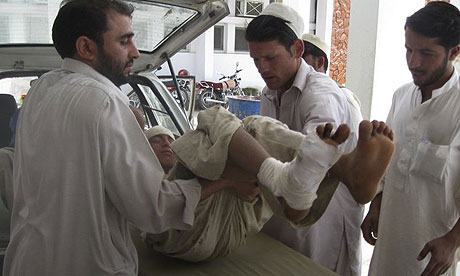
Afghan boy injured in US air strike

An injured Afghan boy is put on a stretcher at a hospital in Jalalabad city, Afghanistan. Photograph: Nesar Ahmad

Civilian deaths in Afghanistan from US and Nato air strikes have nearly tripled over the past year, with the onslaught continuing in 2008 and fuelling a public backlash, a leading human rights group says today.

The report by Human Rights Watch Human Rights Watch says that despite changes in the rules of engagement which had reduced the rate of civilian casualties since a spike in July last year, air strikes killed at least 321 civilians in 2007, compared with at least 116 in 2006. In the first seven months of this year at least 540 Afghan civilians were killed in fighting related to the armed conflict, with at least 119 killed by US or Nato air strikes, such as this July’s attack on a wedding party which killed 47, says Human Rights Watch.

“There has been a massive and unprecedented surge in the use of air power in Afghanistan in 2008,” the report says. It found that few civilians casualties were the result of planned air strikes on suspected Taliban targets. Instead, most were from air strikes during rapid response missions mostly carried out in support of “troops in contact” – ground troops under insurgent attack. Such strikes included situations where American special forces – normally small in number and lightly armed – came under insurgent attack.

“In response to increased insurgent activity, twice as many tons of bombs were dropped in 2007 than in 2006,” the report says. “In 2008, the pace has increased: in the months of June and July alone the US dropped approximately as much as it did in all of 2006. Without improvements in planning, intelligence, targeting, and identifying civilian populations, the massive use of air power in Afghanistan will continue to lead to unacceptably high civilian casualties.”

“Mistakes by the US and Nato have dramatically decreased public support for the Afghan government and the presence of international forces providing security to Afghans,” said Brad Adams, Asia director at Human Rights Watch. The report criticises the response given by US officials when civilian deaths occur. Before conducting investigations, US officials often immediately deny responsibility for civilian deaths or place all blame on the Taliban, the report says.

US investigations have been “unilateral, ponderous, and lacking in transparency, undercutting rather than improving relations with local populations and the Afghan government”.

Last night the US military announced it would reopen its investigation of an air strike last month in which the Afghan government says 90 civilians, mainly women and children, were killed. An initial US inquiry found that up to 35 suspected insurgents and seven civilians died in the attack on Azizabad in Herat province, but General David McKiernan, the senior US officer in Afghanistan, announced a review in the light of “new information”. Afghan and western officials say that videos of the bombing’s aftermath shows dozens of dead civilians.