Posts Tagged ‘Afghanistan’

Afghanistan, the Next US Quagmire?

February 20, 2009
by Thalif Deen | Antiwar.com, Feb 20, 2009

The United States is planning to send an additional 17,000 troops to one of the world’s most battle-scarred nations – Afghanistan – long described as “a graveyard of empires.”

First, it was the British Empire, and then the Soviet Union. So, will the United States be far behind?

“With his new order on Afghanistan, President (Barack) Obama has given substantial ground to what Martin Luther King Jr., in 1967 called ‘the madness of militarism,'” Norman Solomon, executive director of the Washington-based Institute for Public Accuracy, told IPS.

“That madness should be opposed in 2009,” said Solomon, author of War Made Easy: How Presidents and Pundits Keep Spinning Us to Death.

The proposed surge in U.S. troops will bring the total to 60,000, while the combined forces from the North Atlantic Treaty Organization (NATO), including troops from Germany, Canada, Britain and the Netherlands, amount to over 32,000.

When in full strength, U.S.-NATO forces in Afghanistan could reach close to 100,000 by the end of this year.

Still, in a TV interview Tuesday, Obama said he was “absolutely convinced that you cannot solve the problem of Afghanistan, the Taliban (insurgency), the spread extremism in that region solely through military means.”

“If there is no military solution, why is the administration’s first set of decisions to continue drone attacks and increase ground troops?” Marilyn B. Young, a professor of history at New York University, told IPS.

She said the uncertainty around Afghan policy seems to be spreading even while the Obama administration announces an increase in troops.

“This is one of the ways events seem to echo U.S. escalation in the Vietnam War,” said Young, author of several publications, including “Iraq and the Lessons of Vietnam: Or, How Not to Learn From the Past.”

On Tuesday, the U.N. Assistance Mission in Afghanistan (UNAMA) released a report revealing that in 2008, there were 2,118 civilian casualties in Afghanistan, an increase of almost 40 percent over 2007.

Of these casualties, 55 percent of the overall death toll was attributed to anti-government forces, including the Taliban, and 39 percent to Afghan security and international military forces.

“This is of great concern to the United Nations,” the report said, pointing out that “this disquieting pattern demands that the parties to the conflict take all necessary measures to avoid the killing of innocent civilians.”

During his presidential campaign last year, Obama said the war in Iraq was a misguided war.

The United States, he said, needs to pull out of Iraq, and at the same time, bolster its troops in Afghanistan, primarily to prevent the militant Islamic fundamentalist Taliban from regaining power and also to eliminate safe havens for terrorists.

But most political analysts point out that Afghanistan may turn out to be a bigger military quagmire for U.S. forces than Iraq.

Solomon of the Institute for Public Accuracy said Obama’s moves on Afghanistan have “the quality of a moth toward a flame.”

In the short run, Obama is likely to be unharmed in domestic political terms. But the policy trajectory appears to be unsustainable in the medium-run, he added.

“Before the end of his first term, Obama is very likely to find himself in a vise, caught between a war in Afghanistan that cannot be won and a political quandary at home that significantly erodes the enthusiasm of his electoral base while fueling Republican momentum,” Solomon argued.

Dr. Christine Fair, a senior political scientist with the RAND Corporation and a former political officer with UNAMA in Kabul, told IPS she is doubtful that more troops will secure Afghanistan.

“Perhaps several years ago more troops would have been welcomed. My fear is that more troops means more civilian losses and further erosion of good will and support for the international presence,” Fair said.

“I would personally prefer a move from kinetics and towards using this increased capacity to help build Afghan capacity,” she noted.

“I also think greater support from the international community for reconciliation is needed. Afghans need to own this process,” said Fair, a former senior research associate with the Center for Conflict Analysis and Prevention at the U.N. Institute of Peace (USIP) in Washington.

However, she said, the international community has legitimate interests in remaining in some capacity to ensure that Afghanistan does not again emerge as a safe haven for al-Qaeda and other international terrorist groups.

Fair also co-authored (along with Seth Jones) a USIP report released early this week, titled “Securing Afghanistan,” which spelled out the reasons why international stabilization efforts have not been successful in Afghanistan over the last seven years.

“Security issues in Afghanistan are extraordinarily complex, with multiple actors influencing the threat environment – among them, insurgent groups, criminal groups, local tribes, warlords, government officials and security forces,” the report said.

Afghanistan also presents a multi-front conflict that includes distinct security challenges in the northern, central and southern parts of the country, the study declared.

In Afghanistan, Solomon argued, the U.S. president is proceeding down a path that can only be too steep and not steep enough.

The basic contradiction of his current position – asserting that the situation cannot be solved by military means yet taking action to try to solve the problem by military means – signifies that Obama is bargaining for short-term wiggle room at the expense of longer-term rationality, he added.

“In a very real sense, Obama is kicking a bloody can down the road, unable to think of any other way to confront circumstances that will grow worse with time in large measure because of his actions now,” he said.

Even while disputing some thematic aspects of the “war on terrorism” at times, Obama is reinvesting his political capital – and re-dedicating the Pentagon’s mission – on behalf of a U.S. war effort that is probably doomed to fail on its own terms, Solomon said.

“Reliance on violence is a chronic temptation for a commander-in-chief with the mighty U.S. military under its command. We’ve seen the results in Iraq – or, more precisely, the people of Iraq and many American soldiers have seen and suffered the results,” he added.

(Inter Press Service)

Afghan Official Claims 15 Civilians Killed in US Strike in Herat

February 19, 2009

Eyewitness say six women, five men, and four children in the village of Karez Sultan were killed in the strike. Several hundred animals are also said to have been killed there.

By Shapoor Saber in Herat | RAWA News, Feb 18, 2009

Afghans carry body parts of the victims
Afghans carry body parts of the victims, who the villagers said were killed in an air strike in Gozara district of Herat province west of Kabul, Afghanistan on Tuesday, Feb. 17, 2009. (AP photo)

Photo Gallery of US victims in Afghanistan
The Afghan Victim Memorial Project by Prof. Marc

United States forces in Afghanistan claim to have killed up to 15 militants associated with an infamous warlord in Herat province in an airstrike on February 16, but district officials and eyewitnesses say that the dead were a family of Kuchis, or nomads, who were camped out nearby.

“A Coalition forces precision strike targeted Ghulam Yahya Akbari, a key insurgent commander, near Gozara district, Herat province, Monday. Killed in the attack were up to 15 militants suspected of associating with Yahya,” read a press release issued by Lieutenant Commander Walter Matthews of the US Forces Public Affairs Office.

Yahya himself, it seems, was not hurt in the attack, despite an earlier Coalition press release reporting his death.

“They tried to hit me but struck a family of Kuchis instead,” said Yahya, speaking by telephone to IWPR, Tuesday, February 17.

Ghulam Mahboob Afzalzada, district governor of Gozara, insisted the strike had claimed the lives of Kuchis, a nomadic people who shepherd their animals throughout the country.

“Foreign forces, without coordinating the attack with the local government, killed innocent people,” said Afzalzada, speaking from the scene of the attack Tuesday afternoon. “All those killed were civilians.” All are Kuchi nomads.”

Eyewitness say six women, five men, and four children in the village of Karez Sultan were killed in the strike. Several hundred animals are also said to have been killed there.

“There was a [Kuchi] man and his family, including women and children,” said local resident Gul Ahmad, who was standing near the site of the strike Tuesday afternoon.

Speaking by telephone Tuesday morning, Captain Elizabeth Mathias said that US military had no information on civilian casualties. The press release, issued later in the day, said that the Coalition forces were arranging for a combined Coalition and Afghan assessment team.

Afghans dig graves for the victims

Afghans dig graves after an air strike in Gozara district of Herat province February 17, 2009. In an air strike in western Afghanistan that Afghan police say killed 12 civilians and U.S. forces said killed 16 militants. (Reuters Photo)

Afghans look at animals killed after the air strike

Afghans look at animals killed after the air strike at a tented nomad encampment, in Gozara district of Herat province February 17, 2009. (Reuters Photo)

“There are no official reports of civilian casualties at this time,” said Lieutenant Colonel Rick Helmer, spokesperson for US Forces Afghanistan. “However, when we receive confirmed reports of civilian deaths we take those reports very seriously and investigate them along with out Afghan counterparts. Coalition forces make every effort to prevent the injury or loss of innocent lives.”

Civilian casualties are an extremely sensitive issue in Afghanistan, causing anger among the population and tension with the Afghan government. President Hamed Karzai has become increasingly outspoken in his criticism of foreign troops, who, he says, carry out their operation without sufficient coordination with the Afghan government.

There was a 40 per cent rise in civilian casualties last year, according to a United Nations report on Protection of Civilians in Armed Conflict, released on Tuesday. In all, 2118 civilians were killed, 828 of them by Afghan government or foreign forces. However, said the report, the figures could be much higher.

“UNAMA (United Nations Assistance Mission in Afghanistan) does not claim that the statistics represented in this report are complete; it may be that, given the limitations of the operating environment, UNAMA is underreporting civilian casualties,” read the report.

The UN report also questioned the ability of the military to investigate thoroughly in cases where locals allege that civilians have been killed.

“International forces showed themselves more willing than before to institute more regular and transparent inquiries into specific incidents, although the independence of these inquiries is still questionable,” it said.

Several high-profile incidents last year undermined the credibility of the international forces in reporting civilian casualties. First came an attack in July in Nangahar province that killed 47 members of a wedding party, including the bride.

In August, a bombing in Herat province left more than 90 civilians dead, according to the UN and the Afghan government. In both instances, the international forces claimed to have targeted and killed only militants. Only after many weeks and mounting pressure did they acknowledge that some intelligence mistakes may have been resulting in civilian deaths.

Yahya, who is also known as “Siyawooshan” after his home village in Gozara district, is a controversial figure with a long and colourful history in Herat. He began his fighting career as a jihadi commander associated with Mohamamd Ismail Khan, former “Emir” of Herat and currently minister of power and water management.

At the time of the mujaheddin civil war, in the mid-nineties, Yahya was mayor of Herat, where he earned a reputation for honesty and brutality in almost equal measure. During the Taleban regime, he fled to Iran, returning to battle the Islamists in the Herat area. He became head of the department of public works after the fall of the Taleban, and worked once again with Ismail Khan, until the latter’s appointment to Kabul.

Yahya did not get along with Ismail Khan’s successor in Herat, Sayed Hussein Anwari, whom he accused of unfairly distributing land and positions to the Shia minority.

Sacked by Anwari, Yahya retreated to his native Gozara district and took up arms against the government. For the past two years, he is said to have carried out missile strikes against the UNAMA compound in Herat, the nearby foreign military base and airport.

He is also reported to have supported himself and his men by kidnapping for ransom, including one Indian citizen who reportedly died while in Yahya’s custody.

He has been linked to the Taleban, al-Qaeda, and Gulbuddin Hekmatyar’s Hezb-e-Islami faction, but insists he is operating on his own.

While the US forces insist that Yahya is “known to move throughout the mountains in this area, hiding amongst the civilian population to avoid detection”, he is easily accessible to reporters, who call him on his mobile phone to arrange interviews.

Yahya is feared by many and revered by some, according to those who live under his iron rule in Gozara district.

Most ordinary Heratis just want to live in peace.

“None of these [militant] groups are respecting us,” said Abdul Zahir, 30, a resident of Herat city, speaking for many locals. “The opposition factions kidnap people, and the foreigners kill innocent civilians.”

Shapoor Saber is an IWPR trainee in Herat.

Shoot First, Ask Questions Later? Say It Ain’t So, Mr. President

February 19, 2009

by Tom Andrews | The Huffington Post,  Feb 18, 2009

Yesterday’s announcement by the White House that the president was ordering 17,000 more US troops into Afghanistan was particularly troubling to many of us who – unlike Mr. Limbaugh and his followers on Capitol Hill – actually want President Obama to succeed.

As a candidate, President Obama offered – and American’s overwhelming chose – “new thinking” on foreign policy and national security. We had all seen the devastating results of a “Bring ’em on” foreign policy where the hole dug by “shock and awe” militarism got progressively deeper and the incessant demand from Pentagon officials for yet more troops to deal with the consequences became increasingly greater. President Bush was always ready to meet these demands. The result was a weakened America, a broken military and more than a trillion dollars – and counting – added to the national debt.

We were relieved when the new president announced during his first week in office that he was ordering a comprehensive review of an obviously failed US policy in Afghanistan. Things had steadily gone from bad to worse there. What was desperately needed was a fundamental course correction guided by a healthy dose of “new thinking”.

New thinking was not in evidence yesterday when the White House announced that it was ordering 17,000 more US troops into harms way in Afghanistan even though it’s comprehensive review would not be completed for several more weeks.

Military commanders apparently warned that it would be too risky not to deploy troops now out of fear that they would not be in place by the anticipated spike in fighting this spring. Nothing surprising here – when you are a hammer, everything looks like a nail. Military commanders have a point of view born out of their training and orientation.

But, new thinking requires a broader view than what can be seen from a military lens. It begins with considering the risk that a military escalation will actually make things worse, not better.

First off, where does military escalation end? According to the Army and Marine Corps field manual, counterinsurgency operations require, at a minimum, twenty counterinsurgents per 1,000 residents. In Afghanistan, this would mean combined forces of 640,000 troops. No, I did not incorrectly add an extra zero – that is 640,000 troops. In short, even if we wanted to go down this road, we can’t.

Several independent analysts have publicly warned that the presence of foreign soldiers fighting a war in Afghanistan is probably the single most important driving force in the resurgence of the Taliban. New thinking would at least consider the option of reducing, not increasing our military imprint as a means of dividing and weakening the armed opposition. At the very least, it would withhold final judgment and action until all of all options are subject to a truly comprehensive review.

The risks are too high to do anything else. As Katrina vanden Heuvel writes in The Nation:

Escalating the occupation of Afghanistan will bleed us of the resources needed for economic recovery, further destabilize Pakistan, open a rift with our European allies, and negate the positive consequences of withdrawing from Iraq on our image in the Muslim world.

We hope that this early display of shoot first, ask questions later will be an anomaly for the new administration. What the nation needs is a truly comprehensive plan for Afghanistan and the region that is fundamentally different from the approach that led us to where we now find ourselves. What we don’t need is another military quagmire and an albatross around the neck of a nation and an administration that we all need to succeed.

Tom Andrews, a former Member of Congress from the first Congressional District of Maine, is the National Director of Win Without War, a coalition of forty-two national membership organizations including the National Council of Churches, the NAACP, the National Organization of Women, the Sierra Club, and MoveOn.

US gears up for massive Afghan ‘surge’

February 19, 2009
(Wednesday 18 February 2009)
DANGEROUS PLANS: President Obama has vowed to intensify the "fight against terrorism" in Afghanistan.

DANGEROUS PLANS: President Obama has vowed to intensify the “fight against terrorism” in Afghanistan.

THE US military was gearing up on Wednesday for a massive new “surge” in Afghanistan after President Barack Obama announced plans to increase troop numbers by over 50 per cent.

Mr Obama has vowed to intensify the “fight against terrorism” by pouring 17,000 more soldiers into the country over coming months.

Most of the new soldiers are expected to deploy in southern Afghanistan, where occupation forces are struggling to hold territory against increasingly bold resistance forces.

A marine expeditionary brigade will arrive in Afghanistan later this spring and an army stryker brigade will deploy in summer.

The expeditionary brigade includes about 8,000 troops and the army brigade is 4,000-strong.

An additional 5,000 “support troops” are also set to be deployed before the Afghan elections on August 20.

The extra 17,000 troops will bolster the 33,000 US soldiers and 55,100 NATO troops who are already in the impoverished country.

The Afghan army and occupation troops have faced a record number of roadside bombs and suicide explosions since early 2008.

US military commanders have repeatedly complained of having too few troops, especially in central and eastern Afghanistan.

Afghan President Hamid Karzai’s office said that Mr Obama had called Mr Karzai on Tuesday to reassure him that Washington “will continue the fight against terrorism.”

Senator John McCain, the Arizona Republican who was defeated by Mr Obama in last November’s presidential election, described the situation in Afghanistan as “dire.”

Mr McCain called on Mr Obama to spell out a clear strategy.

“There still exists no integrated civil-military plan for this war, more than seven years after we began military operations,” he said, adding: “A major change in course is long overdue.”

Both Democrats and Republicans have welcomed Mr Obama’s decision to pour more troops into Afghanistan.

A US general travelled to western Afghanistan on Wednesday to investigate claims that six women and two children were killed in a US air strike.

The Pentagon said in a statement that a strike in the Gozara district of Herat province on Monday had killed 15 militants.

But Afghan police official Ekremuddin Yawar said that six women and two children were among the dead, along with five men.

Mr Yawar said that they belonged to a nomadic tribe that lives in tents in remote areas.

Chomsky: No change coming with Obama

February 18, 2009
By Shahram Vahdany | Press TV

The following is a Press TV interview with respected American author, political analyst and world-renowned linguist, Professor Noam Chomsky.

Press TV: Professor Chomsky, we better start with Pakistan. The White House not commenting on the killings of people [in cross-border drone attacks from Afghanistan into Pakistan]. Richard Holbrooke, someone whom you’ve written about in the context of Yugoslavia, is the man [President Barack] Obama has chosen to solve the situation.

Chomsky: Well, it was pretty clear that Obama would accept the Bush doctrine that the United States can bomb Pakistan freely, and there have been many case which are quite serious.

There has been for example a great deal of chaos and fighting in Bajaur province, which is a adjacent to Afghanistan and tribal leaders- others there- have traced it to the bombing of a madrassa school which killed 80 to 95 people, which I don’t think was even reported in the United states, it was reported in the Pakistani press of course.

The author of the article reporting it, a well-known nuclear physicist, Pervez Hoodbhoy pointed out at the time that this kind of massacre will of course engender terror and reactions, which will even threaten the state of Pakistan. And that has been what is happening. We are now seeing more of it.

The first message of the Pakistani government to General [David] Petraeus, the American General when he took command of the region was that they did not want any more bombings in Pakistan.

Actually, the first message to the new Obama administration by President [Hamid] Karzai of Afghanistan was the same, that he wanted no more bombings. He also said that he wants a timetable for the withdrawal of the foreign troops, US and other troops, from Afghanistan. That was of course just ignored.

Press TV: And these three foreign envoys, well the third one has not been announced yet perhaps, but some people are expressing optimism about George Mitchell’s position as Middle East envoy.

Richard Holbrooke, which have looked at. We have talked to the former Bosnian foreign minister here, who seemed to imply that he may even have had a role in the say so for the Srebrenica massacre, and of course, Dennis Ross is being talked about as an envoy for Iran.

Chomsky: well Holbrooke has a pretty awful record, not so much Yugoslavia, but earlier. For example, In the Indonesian atrocities in eastern Timor, where he was the official in charge, and evaded to stop the US support for them, and all together it’s a very spotty record.

George Mitchell is, of the various appointments that have been made, he is the most decent let’s say. He has a pretty decent record. He achieved something in Northern Ireland, but of course, in that case there was an objective.

The objective was that the British would put an end to the resort to violence in response to IRA terror and would attend to the legitimate grievances that were the source of the terror. He did manage that, Britain did pay attention to the grievances, and the terror stopped- so that was successful.

But there is no such outcome sketched in the Middle East, specially the Israel-Palestine problem. I mean, there is a solution, a straightforward solution very similar to the British one. Israel could stop its US-backed crimes in the occupied territories and then presumably the reaction to them would stop. But that’s not on the agenda.

In fact, President Obama just had a press conference, which was quite interesting in that respect. He praised the parabolic peace initiative, the Saudi initiative endorsed by the Arab League, and said it had constructive elements. It called for the normalization of relation with Israel, and he called on the Arab states to proceed with those “constructive elements,” namely the normalization of relations.

But that is a gross falsification of the Arab League initiative. The Arab League initiative called for accepting a two-state settlement on the international border, which has been a long-standing international consensus and said if that can be achieved then Arab states can normalize relations with Israel.

Well, Obama skipped the first part, the crucial part, the core of the resolution, because that imposes an obligation on the United States. The United States has stood alone for over thirty years in blocking this international consensus, by now it has totally isolated the US and Israel.

Europe and now a lot of other countries have accepted it. Hamas has accepted it for years, the Palestinian Authority of course, the Arab League now for many years [have accepted it]. The US and Israel block it, not just in words, but they are blocking it in actions constantly, (this is) happening every day in the occupied territories and also in the siege of Gaza and other atrocities.

So when he skips that it is purposeful. That entails that the US is not going to join the world in seeking to implement a diplomatic settlement, and if that is the case, Mitchell’s mission is vacuous.

Press TV: Is there a contradiction in that George Mitchell of course did speak to members of the Sinn Féin, their military wing of course of the IRA.

At the same time, well on this channel [Press TV] we have been covering the Gaza conflict, its headquarters were bombed, and now we are being told that Israeli soldiers will not give their names, and the names of people are not being released for fear of prosecution.

And yet, some were saying that Obama did say that the border should be opened. Should we see any change in policy there?

Chomsky: He did say that, but he did not mention the fact that it was in the context of a lot other demands. And Israel will also say, sure the borders should be opened but he still refuses to speak to the elected government (i.e. Hamas), quite different from Mitchell in Northern Ireland.

It means Palestinians will have to be punished for voting in a free election, the way the US did not want them to, and he endorsed the Condoleezza Rice-Tzipi Livni agreement to close the Egyptian-Gaza order, which is quite an act of imperial arrogance.

It is not their border, and in fact, Egypt strongly objected to that. But Obama continued. He says we have to make sure that no arms are smuggled through the tunnels into the Gaza Strip. But he said nothing about the vast dispatch of far more lethal arms to Israel.

In fact, right in the middle of the Gaza attack, December 31, the Pentagon announced that it was commissioning a German ship to send 3,000 tons of war material to Israel. That did not work out, because the government of Greece prevented it but it was supposed to go through Greece but it could all go through somewhere else. This is right in the middle of the attack on Gaza.

Actually there were very little reporting, very few inquiries. The Pentagon responded in an interesting way. They said, well this material won’t be used for the attack on Gaza, in fact they knew that Israel had plans to stop the attack right before the inauguration, so that Obama would not have to say anything about it.

But the Pentagon said that this material is being used for pre-positioning for US forces. In other words, this has been going for a long time, but this is extending and reinforcing the role of Israel as a US military base on the edge of the major oil producing regions of the world. If they are ever asked why they are doing it, they will say for defense or stability, but it is just a base for further aggressive action.

Press TV: Robert Gates and Admiral [Mike] Mullen have been talking about the 16-month timeline for withdrawal from Iraq is just one of the options, a slight difference from what Obama has been saying in the campaign. And, Hillary Clinton famously said she was prepared to obliterate all of Iran and kill 70 million citizens. On Iraq and Iran what do you see as changes?

Chomsky: What happened in Iraq is extremely interesting and important. The few correspondents with real experience any whom know something have understood it. Patrick Cockburn, Jonathan Steele and one or two others.

What has happened is that there was a remarkable campaign of non-violent resistance in Iraq, which compelled the United States, step-by-step, to back away from its programs and its goals. They compelled the US occupying forces to allow an election, which the US did not want and tried to evade in all sorts of ways.

Then they went on from there to force the United States to accept at least formally a status of forces agreement, which if the Obama administration lives up to it, will abandon most of the US war aims. It will eliminate the huge permanent military bases that the US has built in Iraq. It will mean the US will not control decisions over how the oil resources will be accessed and used. And in fact just every war aim is gone.

Of course there is a question of whether the US will live up to it and what you are reporting is among the serious indications that they are trying to evade living up to it. But what happened there is really significant, and a real credit to the people of Iraq, who have suffered miserably. I mean, the country has been absolutely destroyed, but they did manage to get the US to back away formally from its major war aims.

In the case of Iran, Obama’s statements have not been as inflammatory as Clinton’s, but they amount to pretty much the same thing. He said all options are open. Well, what does all options mean? Presumably that includes nuclear war, you know, that is an option.

There is no indication that he is willing to take the steps, say, that the American population wants. An overwhelming majority of the American population for years has been in favor, has agreed with the Non-Aligned Movement, that Iran should have the rights granted to the signers of the non-proliferation treaty, in fact to develop nuclear energy.

It should not have the right to develop nuclear weapons, and more interestingly about the same percentages, about 75 to 80%, call for the establishment of a nuclear weapons free zone in the region, which would include Iran, Israel, and any US forces deployment there, within all kinds of verifications and so on.

That could eliminate probably one of the major sources of the conflict. There is no indication that the Obama administration has any thought of doing anything about this.

Press TV: Just finally Professor Chomsky, the US economy, of course where you are -that is dominating the news and the lives all Americans and arguably the people around the world- and this 825 billion dollar package. How do you think the Obama people are going to handle this?

Chomsky: Nobody really knows. I mean, what is happening with the economy is not well understood. It is based on extremely opaque financial manipulations, which are quite hard to decode. I mean, the general process is understood, but whether the $800 billion, or probably larger government stimulus, will overcome this crisis, is not known.

The first $350 billion have already been spent- that is the so-called part bailout but that went into the pockets of banks. They were supposed to start lending freely, but they just decided not to do it. They would rather enrich themselves, restore their own capital, and take over other banks- mergers and acquisition and so on.

Whether the next stimulus will have an effect depends very much on how it is handled, whether it is monitored, so that it is used for constructive purposes. [It relies] also on factors that are just not known, like how deep this crisis is going to be.

It is a worldwide crisis and it is very serious. It is suddenly striking that the ways that Western countries are approaching the crisis is exactly the same as the model that they enforce on the Third World when there is a crisis.

So when Indonesia has a crisis, Argentina and everyone else, they are supposed to raise interest rates very high and privatize the economy, and cut down on public spending, measures like that. In the West, it is the exact opposite: lower interest rates to zero, move towards nationalization if necessary, pour money into the economy, have huge debts.

That is exactly the opposite of how the Third World is supposed to pay off its debts, and that this seems to pass without comment is remarkable. These measures for the West are ones that might get the economy moving again, while it has been a disaster for others.

Why Obama Should Reconsider His Afghanistan Pledge

February 16, 2009

Col. Daniel Smith | Foreign Policy In Focus, February 16, 2009

Last week Secretary of Defense Robert Gates briefed President Barack Obama on Afghanistan and the Pentagon’s proposal to send 15,000 more troops there by late spring. Obama is expected to accept the plan as a “down payment” on his pledge during the campaign to put more troops into the fight against al-Qaeda and the Taliban insurgents. These troops are only about half the number requested by the field commanders, and Gates will return with a new request soon.

This decision — and the original campaign pledge — gave many pause about supporting Obama. It doesn’t serve the interests of either the United States or Afghanistan. After all, no U.S. “vital national interest” is involved. President George W. Bush chose to use military force as a form of retribution for September 11, 2001. And as long as foreign military forces are in Afghanistan, the Afghan people and government can’t exercise full sovereignty in accord with their traditions.

Nor is this decision a positive development for the U.S. soldiers and Marines expected to pick up the pace of operations in Afghanistan. With the “insurgents” adopting tactics from their Iraqi counterparts, the terrible toll of Iraq will be repeated, indeed compounded, in Afghanistan.

The units to be sent as “down payment” will be two Army Brigade Combat Teams and one of Marines. Originally slated for Iraq, they’re going to Afghanistan because security in Iraq has “improved” to the point that fewer U.S. troops are needed there. One unit that had undergone training for deployment to Iraq is already in the process of establishing its base camp in southern Afghanistan.

The Wrong War

Afghanistan isn’t the “good war.” It’s wrong not only for Afghanistan but for U.S. soldiers. Before he agreed to Gates’ request, Obama should have paid close attention to three recent developments.

The first was the Army’s announcement that once again in 2008, a record number of service members — 128 — committed suicide. No Pentagon official was prepared to go on record to discuss the causes of this annual record-setting death toll. Even off-record murmurings were generally confined to the usual financial, personal, legal, and work-related factors. But if one examines the records, what jumps out is the correlation between multiple combat tours (until recently 15 months’ duration), the number of cases of Post-Traumatic Stress Disorder (PTSD), and suicides. Over the last four years, 30% of suicides occurred during deployment and 35% after completing a deployment. As for PTSD among soldiers with multiple tours, the rates of occurrence continue to be substantially higher than among soldiers on their first deployment.

There has also been an increase in instances of domestic violence and an accelerating divorce rate for returning troops. For some months, the Pentagon has known that one-third of women serving in the military claimed they were victims of sexual harassment. Last week, CBS News, in a two-part report, said that nationwide police statistics reveal that in 50% of domestic violence cases, at least one person involved was in the military. Over the last 10 years, almost 90 women have been killed.

High-Altitude Assignment

The third development involves the particular geography of Afghanistan. The United States plans to base its reinforcements in an extremely rugged and high-altitude part of Afghanistan. Despite these conditions, the weight of equipment and protective personal armor the individual soldier is expected to carry has gone from a maximum of 65-80 pounds — even as an infantry platoon leader I never came close to carrying such a load on a “forced march” during training — to 130-150 pounds for a typical three-day mission. That’s as much as three times the recommended weight load of 50 pounds per Marine in a 2007 Department of the Navy study. The combination of high altitudes with thinner oxygen, rugged terrain that limits vehicle usage, and the weight of equipment deemed essential is causing a new kind of stress that is putting more troops out of commission. The Army lists 257,000 acute orthopedic injuries (muscular or skeletal stress or fractures) for 2007, up by 10,000 from 2006.

The increased number of troops Obama plans to send to Afghanistan — together with the growing number of temporary and, more seriously, “permanent non-deployables” from physical and psychological stress — could leave the Army once again resorting to enlist anyone who can walk and carry a weapon. That will include many who suffer from PTSD but who, being part of the “warrior culture,” are reluctant to seek help.

Obama was elected in part because the American public was tired of more and more veterans returning home mentally and physically damaged by experiences they didn’t need to endure. Obama may find that, if he continues down this path, “the war Bush forgot” will all too soon turn into “Obama’s war.” And he’ll have to shoulder the responsibility for all the damage done to Afghan civilians and U.S. soldiers alike.

Daniel Smith is a contributor to Foreign Policy In Focus, a retired U.S. Army colonel, and a senior fellow on military affairs at the Friends Committee on National Legislation. You can contact Dan at dan (at) fcnl (dot) org or reach him at his blog The Quakers’ Colonel.

Now or Never!! Pakistan must change its position on the “war on terror”.

February 7, 2009
By Talha Mujaddidi in Pakistan. Exclusive to Axis of Logic
Feb 7, 2009, 13:57
Email this article Printer friendly page

A change in Pakistan’s relationship with the U.S. war on terror is required immediately.

Pakistan is amidst the worst political turmoil of its history. Things were not this bad at the turn of the millennium but after 9/11, its political future took a sharp, bleak downturn. When the U.S. started its “war on terror” in Afghanistan, it might have enjoyed support of many countries and their leaders but it did not enjoy support of the majority of the people of Pakistan. In addition, Pakistan’s Pukhtoon population and vast majority of Afghan population considered and still considers Afghanistan an occupied country. They had the same view when Soviet Russia was occupying Afghanistan, a land considered to be a graveyard for super powers.

The Valley of Swat and the TTP

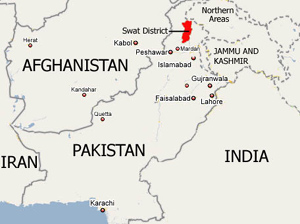
A map of Pakistan and the surrounding region highlighting Swat District

Pakistan’s current “catch 22” is in Swat, a valley in Northern part of Pakistan’s NWFP (North West Frontier Province). Swat was once Pakistan’ stop tourist destination, before its current and continuing chaos. The founder of the nation, Quaid-e-Azam Mohammad Ali Jinnah, called it “the Switzerland of Pakistan”. Winston Churchill was also fond of the valley in his early days in British India. In 2003 a new militant group emerged in Pakistan. This was Tehrik-e-Taliban (TTP). It was headed by Abdullah Mehsud, a former prisoner of the Guantanamo Bay Prison. Surprisingly he was cleared by U.S. authorities and sent back to Pakistan. He organized and started TTP which should not be confused with the Taliban in Afghanistan. This is a big common misconception in Pakistan and the rest of the world. It’s a pity that Pakistani and western journalists are confusing the Taliban with the Tehrik-e-Taliban (TTP) in their reporting and news articles.

The Taliban in Afghanistan have nothing against Pakistan and have never killed or threatened Pakistani people or Pakistani state. On the other hand, the TTP has done both. The TTP is a group based on Takfiri ideology (a Muslim who believes that all other Muslims even orthodox are not true Muslims and they are just collaborators of infidels and deserve to be attacked and killed). All Muslim scholars are unanimous in declaring Takfiris ‘heretics of Islam’.

The Hashshashin Sect

History provides us an example that sheds light on the Takfiris. When the Crusaders began to attack the Muslim world in the 11th century, a group of heretic Muslims emerged that started creating havoc amongst the Muslims by declaring war on their fellow Muslims. The group was the Hashshashin sect (the word assassin came from Hashshashin). Hashshashins were Muslims who had become heretics believing that other Muslims are Kafir (infidels) and had to be killed by any means necessary. Their doctrine was known as Fedayeen (a person ready to sacrifice his life for a mission). They should not be confused with today’s Mujaideen (Muslims committed to an armed struggle). While the Muslim armies were fighting the Crusaders, these Hashshashins also declared war on Muslims! Such internecine fighting is not unusual in other ethnic groups and religions. Similar fundamentalist sects who fought against their own can also be found in the histories of Christianity and Judiasm. Because of the Hashashin sect, Muslims had to fight with two brutal armies simultaneously during the time of the Crusades.

Often the Hashshashins fought alongside the Christian Crusaders against the Muslim armies. They assassinated Muslim scholars, political leaders, and civilians ruthlessly. This is the ideology that TTP is following in Pakistan. In 2004, under pressure from U.S.., former President Musharraf started a military operation in Pakistan’s tribal areas to remove TTP from those areas. At that time things were more stable in Swat. But they were about to get worse.

Need for a strong, central government in Pakistan

Swat, like the rest of Pakistan has always suffered from lack of a strong central government and a rule of law. According to Amnesty International Pakistan’s civil, district and Supreme courts suffer from massive corruption. According to Asian Journal of Political Science August 2007, report,

“Pakistan is generally included in most discussions of ‘failing states’ that pose the maximum danger to global security, with the rise of Islamic militancy being the most commonly cited reason for the ‘failure’. However, Islamic militancy is a result of impending state failure, not a cause of it.

“The state’s inability, caused by decades of systemic corruption, to provide any appreciable level of public goods or services, broadly defined, is responsible for the de-legitimization of the state and its inability to maintain law and order in the cities or suppress Islamist insurgents in the rest of the country.”

There has been a succession of corrupt Pakistani governments in the past. With nothing to offer to the Pakistani population these corrupt governments looked up to U.S., Britain, Saudi Arabia, and other countries in order to consolidate their position in power. They plundered the national wealth and placed Pakistan in debt by taking new loans from World Bank, IMF and other imperial financial institutions. Corrupt governments and weak parliaments were responsible for breakdown of institutions in Pakistan resulting in corruption, nepotism and rising lawlessness.

Emergence of Sufi Mohammad

The failure of civil law and order and the failure of enforcement have been the direct cause of the rise of local militants who controlled and operated their parallel Islamic courts in Swat. Sufi Mohammad was one such militant who started a movement to impose Islamic laws in Swat and other areas. His movement is not new. It first became known in 1989. In 1995 he started mass protests against the government. The government of Benazir Bhutto at that time negotiated with him and the matter was swept under the carpet.

Sufi Mohammad emerged again when U.S. attacked Afghanistan on October 7, 2001. He and his followers went to Afghanistan to fight U.S. invasion, most of his followers were killed there. Sufi Mohammad was captured and then sent back to Pakistan where he was imprisoned. He remained in Pakistani prison until April 2008, when he agreed to denounce “terrorist acts”, militancy, give up arms and come into agreement with Pakistan government.

Maulvi Fazalullah (also known as Radio Maulvi) is the current leader in charge of militants in Swat. He is son-in-law of Sufi Mohammad. Maulvi Fazalullah, unlike Sufi Mohammad, has not at all renounced violence or the armed struggle. Also note that followers of Fazalullah and TTP (Takfiri) are two separate groups. With the failure of law and order in Swat, many who lived outside the laws of Central Government, took refuge in Swat since civil law and enforcement has been virtually absent from the area.

When the Pakistan army started military operations against TTP in Tribal areas of Pakistan, Fazalullah and his militants began to attack police stations and to challenge the central government. Many civilians were killed. Members of the local population are often threatened, schools (especially girls’ schools) are closed down, teachers are killed, local politicians are attacked along with NGO workers and other acts of violence are taking place.

The judicial system in Swat

Swat was a princely state during British Rule in India. After the creation of Pakistan people of Swat used to follow the Islamic Shariah Laws to manage their day to day affairs. This means that all cases from criminal to civil to child custody were all managed by laws under Islamic Shariah Laws. After 1970 the Government of Pakistan took Swat under the District administration system just like the other parts of Pakistan. This meant that from that point on all Shariah courts would be replaced by civil courts, district courts. Pakistan is still following British laws that were incorporated under British India Act of 1935. The Pakistan government is still following a lot of obsolete rules and regulations of Act of 1935. The people of Swat agreed to accept the change but the problem with civil courts is that they take a longtime to come to any conclusion. They are susceptible to bribery and corruption because of the presence of unnecessary red tape and the handling of cases takes longtime. Plus the fact that there is a shortage of lawyers who are unwilling to work for lowly paid government jobs instead of more lucrative work in private practice.

Swat rejects Fazalullah

This system continued until Sufi Mohammad started his movement of re-introduction of Shariah courts. The local public wanted Shariah courts. As long as Sufi Mohammad was leading the movement it was non-violent. The people of Swat supported Sufi Mohammad. However, Fazalullah is now acting like a local war-lord. The people of Swat do not support violence at all and they are not supporting Fazalullah. The problem is that he has around 4000 men who are well trained and well armed and they have terrorized the local population. The local police, already understaffed and under budgeted, have been faced with massive desertions. The police does not have sophisticated weapons and gear comparable to that of Maulvi Fazalullah’s militants. The local police are no match for Fazalullah’s professional combatants.

Swat is different from Tribal Areas of Pakistan. Tribal areas are purely Pukhtoon and their daily lives are managed under tribal codes and laws. Mainstream schooling is very limited, whereas in Swat mainstream schooling was widespread. Swat, the most popular tourist destination in Pakistan once thrived with economic activity, local shops, small hotels and vintage shops. This resulted in better economic level compared to Tribal areas. Another thing to remember is that Tribal Areas have their traditional customs where all men consider carrying weapons a part of traditional manhood. In Swat this was not the case.

In the past, Swat progressed just like any other city in Pakistan and weapons were not to be found in every household. If Maulvi Fazalullah had appeared in Tribal Areas he would not have been able to terrorize the local population because there, the people are armed. Even though there is a great deal of anger throughout Pakistan over U.S. drone attacks, that anger will not cause the people of Swat to support Fazalullah. They see him as someone who is taking advantage of the U.S.. invasion and as one who is responsible for ruthless killings and the destruction of their local economy.

The government tried to bring Fazallullah under control through dialogue but to no avail. Fazalullah started his FM radio transmission that earned him the name of Radio Mullah. Notice the similarities between actions of Fazalullah and Hashshashins. There is no doubt that the restoration of law and order in Swat is a must through military intervention by the central government of Pakistan. There is no point with having a dialogue with Fazalullah, who has repeatedly backtracked from “peace talks” initiated by the central government. But this is an internal matter and is not the responsibility of foreign governments like the United States.

Who is providing arms to Fazalullah?

The situation in Swat has worsened in the last two years. With rising tensions between Pakistan and India, Pakistan moved some of its troops from Swat and tribal areas to eastern border with India; this provided a window of opportunity for Fazalullah to foment more anarchy in Swat. One important question is, “Who is the source of the weapons and supplies that are used by Fazalluah and TTP? In my view, the weapons are coming from Afghanistan where India operates 19 consulates. These are nothing more or less than operation centers of RAW (Research and Analysis Wing). RAW is India’s equivalent of CIA.

NDS is Afghanistan’s intelligence agency created by U.S. military after they setup Karzai government. The head of NDS is Amrullah Saleh, the thirty-six-year-old director of Karzai’s spy agency. Saleh became the world’s youngest intelligence chief in 2004, at age 32. Since 2005, NDS has emerged as a major source of strategic instability in the region. Saleh, explaining his action in Pakistan, says that “Insurgency is like grass, you cut the upper part but after sometime it will grow back, you poison the soil [Pakistan] where that grass is and it will die forever.”

Another problem for Pakistan is that the current government of Afghanistan is composed of Northern Alliance Warlords (NAW) who are supported by the U.S.. government. The NAW are extremely hostile towards Pakistan and very close to India. Historically, they have been mostly based in minority ethnic groups of Afghanistan like Tajik, Uzbek, Hazara (Shia by faith), and other groups. Pakistan has always supported majority ethnic group Pukhtoon, since Pakistan has huge Pukhtoon population. Taliban of Afghanistan was also Pukhtoon. During Taliban’s rule, India, Iran or Russia had no access into Afghanistan.

The India Factor

India’s intelligence bureau (IB) has always been responsible for internal intelligence gathering. The IB formed the “Research and Analysis Wing” known as RAW in 1968 for conducting external intelligence, comparable to the CIA. Recently, under RAW, India, in cooperation with the CIA, has begun to move some ground troops into Afghanistan.

According to Asian Tribune report of September 2008, India has 14 consulates in Afghanistan from which RAW is operating. In Wakhan, Badakshan province, RAW is operating a madarssah, where clerics from India are brainwashing local Afghans, Uzbeks and Tajiks. Their students are then infiltrated into Pakistan where they readily carry out suicide missions and other operations. The report further states:

“Mullah Omar (leader of the real Taliban) had never shown interest in establishing any links with Pakistani Taliban (TTP) and had warned Nek Muhammad (a militant who agreed to make peace deal with Pakistan government before he was killed in a U.S. drone attack) not to operate under the brand name of Taliban. It is being questioned as to why Baitullah, Fazlullah and their spokesmen desperately wanted by Pakistan security forces have escaped the hawkeye of U.S., particularly after they have been seen giving detailed interviews to media and using their cell phones? ISI [Pakistan’s intelligence service] had once given six figure coordinates of Baitullah and yet no Hellfire missile was fired on his hideout by CIA.”

It is very surprising that the CIA has not been able to kill Baitullah Mehsud, head of TTP or Fazalullah, when they have no problem hitting civilians with its drone-fired hellfire missiles.

Cambodia-Vietnam Analogy

When U.S. was fighting against the Vietcong in Vietnam, the U.S. military falsely claimed that support for the Vietcong was coming from Cambodia and President Lyndon Johnson, a Democrat, started air strikes in Cambodia. At the time, the military government of Cambodia was just a U.S. puppet regime. That U.S. bombing killed one million people Cambodian people. What was the result? Cambodia was torn into civil war and brutal suffering took place under Pol Pot. The same thing could happen in Pakistan. They are triangulating the U.S.. war in Afghanistan with India and Pakistan. One of their convoluted methods is to use India’s RAW in Afghanistan which leads to the indirect attacks in Pakistan by RAW’s madarssah students in Afghanistan. The Pakistani government’s stance on the “War on terror” is as never before at a tangent with the public opinion.

The government of Pakistan must act now to avert catastrophe

The Pakistan government must take the following steps immediately if complete destabilization and catastrophe is to be averted. If the Pakistan government does not take these steps, it must be removed and an interim government must be set up to carry out these steps.

  • Pakistan must pass a bill in the parliament that authorizes the Pakistan Air Force to retaliate against deadly U.S. drone attacks. Pakistan has asked the U.S. government and military leadership repeatedly to stop drone attacks into Pakistan but to no avail.

  • Pakistan must ask the U.S. to pack up its military bases and get them out off Pakistani soil, since there was no open agreement for these air bases between Pakistan government and U.S.. in the first place.

  • After 9/11 military ruler Pervez Musharraf became dictator of Pakistan. All agreements were made between him and the U.S.. government. These agreements with the U.S. must be made public and cancelled. New agreements must be made with the U.S.. which ensures Pakistan’s territorial sovereignty.

  • Pakistan must ask NATO and the U.S. military to make sure that Afghanistan’s soil is not used by India to create proxy war against Pakistan. Pakistan must declare neutrality in War in Afghanistan, Pakistan can’t continue to be supporting Afghan Government that is working against the interests of Pakistan.

  • Pakistan must stop giving NATO and the U.S.. access to move arms and supplies through Pakistan. If the U.S. continues to send drones to kill civilians in Pakistan under the Obama regime, it will only fuel more militancy in Pakistan. Pakistan must stop the NATO/U.S. supply route.

Of course all this is easier said than done. The U.S.. knows it need not worry about any of this or similar course of action being taken by the current Pakistani government. The U.S.. is completely involved with Pakistani leadership, especially with the President and the Army Chief. What is not reported in the U.S.. media is that U.S.. Ambassador to Pakistan, Ann Patterson, meets with Pakistani leaders and even opposition leaders as often as she can. In one week in January 2009 she met with Pakistani President thrice. But will she say a word to stop the pointless, deadly U.S. drone attacks inside Pakistan by the U.S.. military?

Obama’s “War on Terror”

On December 26, 2008, immediately after he was inaugurated, President Obama ordered his first drone missile attack in sovereign Pakistan, killing 16 civilians. Obama should realize that the escalating “War on Terror” inside Pakistan is totally counterproductive. U.S. must realize that there is no option but to bring the Taliban into the political process in Afghanistan. Hamid Karzai, NATO commanders, and British government have all expressed similar views. Pakistan, on the other hand, must distance itself from the U.S. “war on terror” as it is creating havoc inside Pakistan and has no basis in fact, worldwide. It is also important to note that the Pakistan army is also not in best of moods since they are not particularly in tune with the government and have no desire to fight their own countrymen.

If the government does not address the situation, mounting public pressure can result in wide spread social unrest, protests, strikes, and even violent agitation? The situation in Pakistan’s tribal areas and Swat is moving from bad to worse. Even if the situation in Swat or Tribal Areas were to improve, trouble is likely to start in some other part of NWFP or Baluchistan province of Pakistan. The point is that Pakistan is facing tough challenges from TTP, Maulvi Fazalullah and other militants, and current U.S. policy of carrots and sticks for Pakistan is only making it worse. The U.S. must deal with people of Pakistan in a civil manner and respect their territorial integrity and national sovereignty rather than making back-room deals with the corrupt President and Prime Minister. Their refusal to do so raises questions about whether they really want to see Pakistan united in peace or a destabilized Pakistan that serves their imperial agenda. The spokesman for the Pakistan Army spokesman has said that crushing militancy will take a longtime as it’s very difficult to distinguish militants from local residents. Moreover, the continuing illegal U.S.. attacks are fostering support by local populations for disparate militant groups who already live their lives within those populations.

Democracy does not work the same way in Pakistan as it is reported to be working in the U.S. or Europe. With 35% literacy rate, it cannot be the same kind of democracy as in EU or North America. The U.S. belligerent support to corrupt democratic leaders of Pakistan will only undermine what is already a weak democracy in Pakistan. Weak democratic institutions give rise to militancy, extremism, and parallel institutions. Continuous U.S. and British support to corrupt Pakistani rulers will only result in more hatred for Pakistani state, Pakistani rulers, and in turn, the United States.

Conclusion

Finally, the news coverage of the Swat region is very limited, and no one exactly knows how many people have been killed. According to a rough estimate by Center for Research and Security Studies, since 9/11 Pakistan has lost at least 12,000 people as a result of the U.S. war on terror. Some were blown up in suicide bombings, some were killed by U.S. drone attacks, some of the dead were Pakistani army soldiers, some police officers, and a lot of them were women and children. This is nothing compared to the death count of Afghanistan, Palestine and Iraq but it is enough to push Pakistan on the brink of disaster. A policy shift by the Pakistan government toward foreign intervention is the need of the hour.

The current carnage in Swat has resulted in killing of many civilians, security personal and militants. The exact number of people killed is not known. The local economy has collapsed and people are making mass exodus from the valley. How long the military operation will continue is unknown. Pakistan must make drastic changes in its foreign policy in Afghanistan and its policy on the U.S. “war on terror”. Otherwise, we the people of Pakistan will suffer more.


Talha Mujaddidi is a writer/analyst and Axis of Logic correspondent, living in Pakistan. He can be contacted at: talhamujaddidi@gmail.com

Obama airstrikes kill 22 in Pakistan

January 25, 2009

January 25, 2009

Islamabad is the first to get a taste of the president’s ‘tough love’ policy

PAKISTAN received an early warning of what the era of “smart power” under President Barack Obama will look like after two remote-controlled US airstrikes killed 22 people at suspected terrorist hideouts in the border area of Waziristan.

There will be no let-up in the military pressure on terrorist groups, US officials warned, as Obama prepares to launch a surge of 30,000 troops in neighbouring Afghanistan. It is part of a “tough love” policy combining a military crack-down with diplomatic initiatives.

The Pakistani government, which received a visit from General David Petraeus, the chief of US Central Command, on the day of Obama’s inauguration, has been warned that it must step up its efforts against militants if it is to continue to receive substantial military aid from America.

The airstrikes were authorised under a covert programme approved by Obama, according to a senior US official. It was a dramatic signal in the president’s first week of office that there will be no respite in the hunt for Al-Qaeda and Taliban leaders.

However, Obama aims to win hearts and minds in the region by tripling the nonmilitary aid budget to Pakistan and encouraging reconciliation and reconstruction efforts in Afghanistan as a component of the surge.

Hillary Clinton, the secretary of state, said during her Senate confirmation hearing: “We will use all the elements in our power – diplomacy, development and defence – to work with those . . . who want to root out Al-Qaeda, the Taliban and other violent extremists.”

Clinton pledged that a mix of active diplomacy and strong defence, which she described as “smart power”, would help to restore US leadership in foreign policy.

The airstrikes are deeply resented in Pakistan, where enthusiasm for Obama is said to be lower than in any other Muslim country.

Shuja Nawaz, a Pakistani who runs the South Asia centre of the Atlantic Council, a Washington think tank, said Obama had to do more than lob missiles at Pakistan.

“He can’t just focus on military achievements; he has to win over the people.” Nawaz added that it was important to set conditions in return for aid because “people are more cognisant of the need for accountability – for ‘tough love’ ”.

Increased military cooperation from Pakistan is a vital part of the surge, according to diplomatic sources who fear the efforts in Afghanistan will be wasted if terrorists can operate with relative ease from bases across the border.

Obama is also ramping up the pressure on Hamid Karzai, the Afghan president, who is increasingly viewed as an obstacle to progress and faces reelection this year.

“We’re going to need more effective government and a more effective drive against corruption coming from the leadership in Kabul if the Nato effort is to be sustainable,” said a senior British official.

Richard Holbrooke, 67, a veteran diplomat known as “the bulldozer”, was appointed as a special envoy to Afghanistan and Pakistan last week.

“Nobody can say the war in Afghanistan has gone well,” Holbrooke said when his appointment was announced.

Obama last week delivered the warning that Afghanistan and Pakistan were the “central front” in the war on terror.

“There is no answer in Afghanistan that does not confront the Al-Qaeda and Taliban bases along the border,” he said, “and there will be no lasting peace unless we expand spheres of opportunity for the people of Afghanistan and Pakistan.”

The Pentagon has acknowledged that it needs to define its strategy in the region.

Robert Gates, who has retained his job as defence secretary, said last week: “One of the points where I suspect both administrations come to the same conclusion is that the goals we did have for Afghanistan are too broad and too far into the future.”

Gates said America needed to set more “concrete goals” for Afghanistan that could “be achieved realistically within three to five years”.

He described these goals as reestablishing Afghan government control in the south and east of the country, and delivering better services to its people.

In a sign that there may be turf wars to come between the State Department and the Pentagon, Clinton said she wanted diplomats rather than military officers to hand out aid, set up schools and encourage political reconciliation – a break from the counter-insurgency strategy pursued in Iraq under Petraeus.

Calling a Time Out

January 24, 2009

As you settle into the Oval Office, Mr. President, may I offer a suggestion? Please do not try to put Afghanistan aright with the U.S. military. To send our troops out of Iraq and into Afghanistan would be a near-perfect example of going from the frying pan into the fire. There is reason to believe some of our top military commanders privately share this view. And so does a broad and growing swath of your party and your supporters.

True, the United States is the world’s greatest power — but so was the British Empire a century ago when it tried to pacify the warlords and tribes of Afghanistan, only to be forced out after excruciating losses. For that matter, the Soviet Union was also a superpower when it poured some 100,000 troops into Afghanistan in 1979. They limped home, broken and defeated, a decade later, having helped pave the way for the collapse of the Soviet Union.

It is logical to conclude that our massive military dominance and supposedly good motives should let us work our will in Afghanistan. But logic does not always prevail in South Asia. With belligerent Afghan warlords sitting atop each mountain glowering at one another, the one factor that could unite them is the invasion of their country by a foreign power, whether British, Russian or American.

I have believed for some time that military power is no solution to terrorism. The hatred of U.S. policies in the Middle East — our occupation of Iraq, our backing for repressive regimes such as Egypt and Saudi Arabia, our support of Israel — that drives the terrorist impulse against us would better be resolved by ending our military presence throughout the arc of conflict. This means a prudent, carefully directed withdrawal of our troops from Iraq, Afghanistan, Saudi Arabia, Qatar and elsewhere. We also need to close down the imposing U.S. military bases in this section of the globe, which do so little to expand our security and so much to stoke local resentment.

We cannot evade this reckoning. The British thought they could extend their control over Iraq even while pulling out their ground forces by creating a string of bases in remote parts of the country, away from the observation of most Iraqis. It didn’t work. No people that desires independence and self-determination wishes to have another nation’s military bases in its country. In 1776, remember, 13 little colonies drove the mighty British Empire from American soil.

In 2003, the Bush administration ordered an invasion of Iraq, supposedly to reduce terrorism. But six years later, there is more terrorism and civil strife in Iraq, not less. The same outcome may occur in Afghanistan if we make it the next American military conflict.

Mr. President, the bright promise of your brilliant campaign for the White House and the high hopes of the millions who thronged the Mall on Tuesday to watch you be sworn in could easily be lost in the mountains and wastelands of Afghanistan.

The Nobel Prize-winning economist Joseph E. Stiglitz has estimated that the war in Iraq will have a total cost of more than $3 trillion. That war has clearly weakened our economy and our armed forces even as it has made the national debt soar. The Bush administration committed itself to Iraq before the recession. Today, with our economy teetering, does the Obama administration believe that it is time for yet another costly war in yet another Muslim country?

I’m aware that some of my fellow Americans regard me as too idealistic. But sometimes idealism is the best realism. And at a minimum, realism and idealism need not be contradictory. The invasion and occupation of Iraq has not only angered Iraqis who have lost family members, neighbors or homes; it has also increased the level of anger throughout the Muslim world and thrown up obstacles to our political leadership in that deeply important part of the planet.

Like you, Mr. President, I don’t oppose all wars. I risked my life in World War II to protect our country against genuine danger. But it is the vivid memory of my fellow airmen being shot out of the sky on all sides of me in a war that I believe we had to fight that makes me cautious about sending our youth into needless conflicts that weaken us at home and abroad, and may even weaken us in the eyes of God.

As you have noted, Mr. President, we take pride in our soldiers who conduct themselves bravely. But as you have also said, some of these soldiers have served two, three and even four tours in dangerous combat. Many of them have come home with enduring brain and nerve damage and without arms and legs. These troops need rest, rehabilitation and reunions with their families.

So let me suggest a truly audacious hope for your administration: How about a five-year time-out on war — unless, of course, there is a genuine threat to the nation?

During that interval, we could work with the U.N. World Food Program, plus the overseas arms of the churches, synagogues, mosques and other volunteer agencies to provide a nutritious lunch every day for every school-age child in Afghanistan and other poor countries. Such a program is now underway in several countries approved by Congress and the United Nations, under the auspices of the George McGovern-Robert Dole International Food for Education and Child Nutrition Act. (Forgive the self-serving title.) Although the measure remains painfully underfunded, with the help of other countries, we are reaching millions of children. We could supplement these efforts with nutritional packages for low-income pregnant and nursing mothers and their infants from birth through the age of 5, as is done here at home by WIC, the Special Supplemental Nutrition Program for Women, Infants and Children.

Is this proposal pie-in-the-sky? I don’t think so. It’s food in the stomachs of hungry kids. It would draw them to school and enable them to learn and grow into better citizens. It would cost a small fraction of warfare’s cost, but it might well be a stronger antidote to terrorism. There will always be time for another war. But hunger can’t wait.

George McGovern, a former senator from South Dakota, was the Democratic nominee for president in 1972.

Killing of 17 Afghan Civilians in US-led operation

January 10, 2009

At least 1,500 civilians were among the 4,000 people killed in the first eight months of 2008

RAWA News, January 8, 2009

A dead civilian
One civilian was killed during a US-led coalition forces operation in Masmo village of Ali-shing district of eastern Laghman province. (Photos: PAN/Najibulrahman Enqalabi)

Afghan President Hamid Karzai on Thursday condemned the reported killing of 17 civilians, including women and children, in a US-led coalition operation in eastern Afghanistan, the presidential palace said in a statement. The US military said on Wednesday that their forces killed 32 Taliban insurgents, including an armed female militant, in an operation that targeted a roadside bomb-making network in Alishing district of Laghman province in eastern Afghanistan.

The military statement said that the combined forces fought the 75 militants barricaded in a compound with small-arms-fire, avoiding air support and artillery fire in order to minimize the potential for civilian deaths.

But a statement issued by Karzai’s office said that besides terrorists, “17 civilians including women and children were also martyred in the operation.”

President Karzai condemned the incident and said, “The Afghan government has repeatedly made it clear that we want a quick end to these kinds of incidents.”

Colonel Greg Julian, US military spokesman in Afghanistan, denied there were any civilian deaths.

“We were very clear on that. There is clear evidence that there was no civilian casualty,” he told Deutsche Presse-Agentur dpa.

Afghan government authorities and coalition military officials often differ on numbers of civilians killed in international military operations.

Afghan officials including Karzai repeated their assertion that 90 civilians – mostly children – were killed in a US-led airstrike in Azizabad village in western Herat province in August 2008. The US military finally accepted that around 30 civilians were killed after insisting for weeks that the air raid only left around five civilians dead.

Villagers digging graves for the dead
Dozens of residents of Masmo village are busy digging and arranging graveyard for burial of the victims of US offensive.

Civilian casualties at the hands of international forces have angered the Afghan public and has become a sensitive issue for the government of Western-backed President Karzai.

Karzai has repeatedly warned that increasing civilian deaths would erode public support for his government and would provoke anti-foreigner sentiments in Afghanistan.

Several demonstration have been staged in Afghan cities and rural areas to condemn the killing of civilians by foreign forces.

Unable to seek revenge independently, many Afghan men in southern and eastern Afghanistan have joined the Taliban ranks after losing members of their families in international military operations, according to Afghan officials.

At least 1,500 civilians were among the 4,000 people killed in the first eight months of 2008, according to United Nations officials in Afghanistan.